Volume 3 Issue 7 ǁ October 2018.
www.ijahss.com
The Usability Of King Khalid University Website: Assessing
Effectiveness, Efficiency, And Satisfaction
NaifJabli, HamedAlghamdi, Fatih Demir
King Khalid University, Northern Illinois University, Northern Illinois University
ABSTRACT :As technology continues to advance, usability issues become more and more central to the process of designing new technological tools such as apps, websites, etc. With the increasing progress of technology integration into our lives, usability evaluation is needed in order to humanize technologies and make them user-friendly to the end users. Therefore, the concept of usability evaluation helps to investigate issues related to technologies’ interface design. Usability testing is an essential element prior to the release of a product and overseeing the existing products. The college websites, particularly the library web services, serving to academic communities, are the main assets for teaching and learning and they must be designed in a meaningful way with ease-of-use. The goal of this research is the usability evaluation of King Khalid University (KKU) website to determine users’ needs, expectations, and satisfaction as well as the current issues with the KKU online services. The research results show that KKU’s website has some major, moderate and minor usability problems impeding effectiveness, efficiency and thus decrease users’ satisfaction.
KEYWORDS:King Khalid University, KKU, Needs Analysis, Usability, User Experience, Technology Evaluation.
I. INTRODUCTION
In the 21st century, technology continues to advance the daily life of the people and technology design issues become more and more central to the process of designing new products including mobile applications, game, websites, e-dictionaries, online shopping etc. However, the design issues play a significant role in technology acceptance by the users [1];[2]. Innovations in social media, information technology, led to some complexity in user interface designs and triggered a need for usability evaluation. The end goal for these evaluations is to create more user friendly and beneficial to the end users.
User Experience (UX) research has unique methods and procedures that inspect User Interfaces (UI) of websites to identify the usability problems, pros, and cons of the design, and level of user satisfaction [3]. Usability is defined as "the extent to which a product can be used by specified users to achieve specified goals with effectiveness, efficiency, and satisfaction in a specified context of use" [4, p. 79]. Usability testing has been the focus of many studies due to its significance in technology evaluation and its approach to measure and make an understanding of users’ preferences [4]; [5];[6];[2]. Usability testing refers to the tool that is used “to ensure that defects affecting usability are detected before the release of a new product” [5, p. 172]. Moreover, UX is beyond the usability testing that also considers users’ feelings, engagement and enjoyment with the product [7].
The concept of usability is to make objects user-friendly for human interaction. Usability theory focuses on the study between humans and technologies’ front-ended interactions[8].. Its principles are designed to investigate factors that hinder or latent within the interface design of any technology that allows human interaction. According to Nielsen (1993), usability theory has eight principles that could be used to determine the usability of a system, which consists of effectiveness, efficiency, satisfaction, learnability, memorability, errors, know the user, and know the task [9].
1.1. Background
authors, despite the number of models that have been proposed by researchers, the optimal sample size is still unknown. According to Jeng (2008), empirical data shows that only 5-user is enough to underestimate to achieve reasonable levels of problem discovery [10]. UX research studies show that 5 participants are enough to discover 85% of the usability problems and keep the testing effectively and non-costly whereas more participants help to determine for more [11].
Accessibility is another important issue in webdesign that allows all users, even those with disabilities, to interact fully with the product. In order to design better digital tools and communication innovations for accessibility, it is the designers’ responsibility to fully consider the users and user-centered design principles [12]; [13]; [1]. Following the design criteria and guidelines may create a central issue for researchers to reach levels that are inclusive of the users’ expectations while improving the world of virtual interaction. The designers of technology are required to take a more holistic approach in which the tools functionalities are in the range of users’ potentials and opportunity.
Luna-García, et al., (2015) studied 36 of the design patterns that might enhance accessibility and use of social applications for older adults in North America[1]. The study aimed at establishing a reliable starting point for designers and developers to easily incorporate usability in User Interfaces (UIs). They investigated the issues of technology promoting, technology acceptance, usability, and adoption of technology among older adults. The aimed at solving the challenges encountered by older adults who, are forced to interact with IT interface and, struggle with “multiple obstacles derived from bad designs and aggravated by natural age-changes” (p. 87). The authors concluded that issues such esign consistency, content clarity, font sizes, effective navigability, and high levels of control are to be considered if designers are interested in solving usability problems for older adult users [1].
Issues of cultural diversity, cross-cultural web design guidelines, and cross-cultural web usability models were among the topics that research studies have been discussing for more than two decades [14]; [6]. Conducting a large-scale study, Alexander, at al., (2017) investigated the issue of translation in practices of website design regarding cross-cultural web design, and they compared users’ design preferences of Australian, Chinese, and Saudi Arabian users [14].
Similarly, Hall, De Jong, and Steehouder (2004) investigated the effect of cultural differences on designing websites and web communication [6]. They cited previous research on issues such as the relationship between cultural aspects and Internet adoption, how users’ cultural backgrounds impact use and appreciation of websites, and how cultural issues are regarded by local and international organizations on their websites. The authors indicated that cultural differences need to be evaluated and considered by website designers. They recommended conducting cross-cultural research to further understand the relationship between the designers’ principles and the users’ cultural backgrounds. The study showed that cultural differences between participants are among the factors that affect the choice of evaluation methods and their results.
1.2. Usability Evaluation Of King Khalid University
A sizeable portion of these services and resources are accessible via the KKU website. However, despite the role and the size of this university, no usability research has been done to investigate the website and its utilization. The initial analysis which the researchers conducted prior to the project indicated that some faculty, staff, and students (users) were not motivated or critically engaged with KKU website. This concern supports the significance of this project and encourages researchers to evaluate the usability of KKU’s website to determine whether the proper usability requirements have been sufficiently met.
With an influence of the usability theory, the appropriate elements or principles that apply to the purpose of this study are effectiveness, efficiency, and users’ satisfaction. Effectiveness refers to task success rates whether the user achieved successfully or not. Efficiency refers to the required time to complete a certain task. Finally, satisfaction indicates subjective satisfaction of the users when interacting with the product. This study aimed at observing users interaction with the KKU website and the results were evaluated based on three principles.
The purpose of this research was to evaluate the usability of King Khalid University (KKU) website to determine the users’ effectiveness, efficiency, and satisfaction as well as their needs and expectations, in order to come up with further design recommendations and better improvement in KKU’s online services. This usability evaluation’s steps included testing whether participants could navigate successfully throughout the KKU website to achieve pre-defined tasks and whether the participants could retrieve learning materials from the website. The research questions of this study are as follows:
1. What is the effectiveness rate with the pre-defined tasks? 2. What is the efficiency rate with the pre-defined tasks?
3. What is the satisfaction level when interacting with the KKU website?
II. METHOD
A mixed method was used through an in-person moderated usability test. The researchers observed the participants interacting the website with a set of pre-defined tasks. A total of 12 tasks were prepared to conduct the research. The task test was followed by a satisfaction survey and a semi-structured interview.
A total of 10 users participated in this project including University staff, faculty and students as well as participants not from the education community. All of the participants were native Arabic speakers who reside in the United States.
This research adopted a mixed method approach using both qualitative and quantitative methodologies. Quantitative methods were used to collect data for measuring effectiveness, efficiency, and satisfaction where qualitative methods were deployed to collect further data by means of interview, think a loud session, and observation in order to get an in-depth analysis.
1.3. Pre-Defined Tasks
Task 1:You are a user and want to access educational resources, Use KKU website to check whether they provide the Blackboard system or not?
Task 2:King Khalid University have an event entitled “The Fourth Scientific Forum of King Khalid's History”.
Use the KKU website and tell us when the event will be held?
Task 3:You want to see KKU pictures albums. Use KKU website and tell us how may picture included in the
album.
Task 4:King Khalid University support Research Scientific database. Use the KKU website and tell us how many Scientific Journals KKU offer?
Task 6:You are interested to know the deadline for dropping the 1st semester study or courses. Use the KKU website and tell us when the deadline for that is.
Task 7:You want to listen to KKU Radio at your home. Use the KKU website and tell us how many episodes
are available?
Task 8:Use the KKU website to tell us how much does Verified Certificate in Design Thinking Course cost?
Task 9:King Khalid University has KKU Affag news, use the KKU website and tell us what the last volume number is.
Task 10:You want to download Visio Professional 2016 software, use the following login credentials: username:
njabli password: ***345 and tell us how much it costs.
Task 11:You are a lecture at King Khalid University and want to login to Enjaz services, use the following login information: username: njabli password: ***456
Task 12:Finally, send a message to the King Khalid University IT support team to let them know what do you
think about the website?
III. Results
A total of eight participants (80%) were male and two (20%) were female users. The ages of the participants ranged from 18 to 55 years-old. 50% of the users had prior experience with the KKU website. The highest percentage of the participants were graduate students which reached 70%, followed by undergraduate students who scored 20%, and the remaining 10% had a college level education.
1.1. Effectiveness
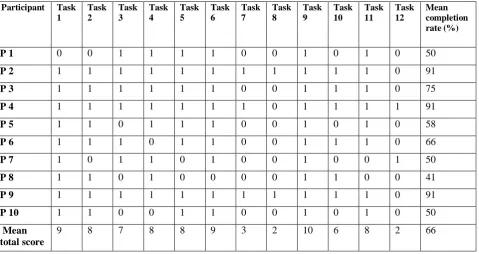
All tasks were kept the same for all participants. As shown in Table 1, the effectiveness scores indicated that none of the participants successfully completed all of the tasks, failing to complete one or more tasks. The average effectiveness rate corresponds to a 66% success rate.
Table 1.System Effectiveness (Task Completion)
Participant Task
1
Task 2
Task 3
Task 4
Task 5
Task 6
Task 7
Task 8
Task 9
Task 10
Task 11
Task 12
Mean completion rate (%)
P 1 0 0 1 1 1 1 0 0 1 0 1 0 50
P 2 1 1 1 1 1 1 1 1 1 1 1 0 91
P 3 1 1 1 1 1 1 0 0 1 1 1 0 75
P 4 1 1 1 1 1 1 1 0 1 1 1 1 91
P 5 1 1 0 1 1 1 0 0 1 0 1 0 58
P 6 1 1 1 0 1 1 0 0 1 1 1 0 66
P 7 1 0 1 1 0 1 0 0 1 0 0 1 50
P 8 1 1 0 1 0 0 0 0 1 1 0 0 41
P 9 1 1 1 1 1 1 1 1 1 1 1 0 91
P 10 1 1 0 0 1 1 0 0 1 0 1 0 50
Mean total score
9 8 7 8 8 9 3 2 10 6 8 2 66
1.2. Efficiency
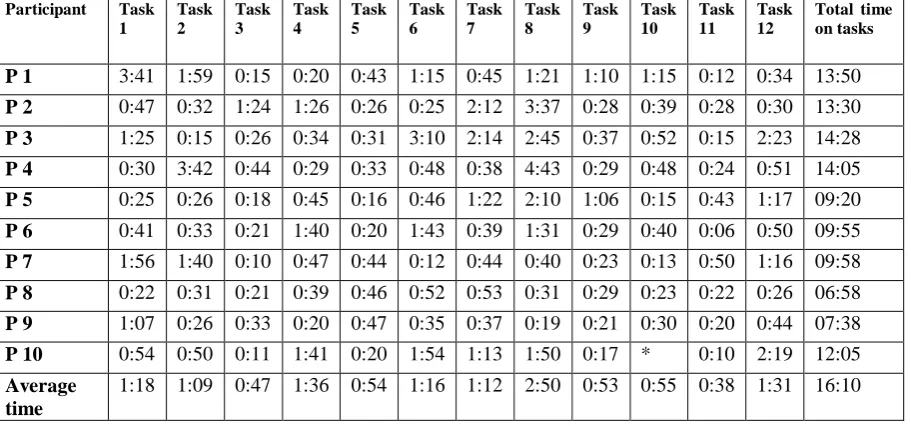
Efficiency measures the required time to complete the task. It also indicates the time that the participant tries to accomplish but fail and quit, when also examining Table 1. Completion time for each task was measured to examine the efficiency of KKU website (see Table 2).
Table 2.System Efficiency (Time on Task)
Participant Task 1
Task 2
Task 3
Task 4
Task 5
Task 6
Task 7
Task 8
Task 9
Task 10
Task 11
Task 12
Total time on tasks
P 1 3:41 1:59 0:15 0:20 0:43 1:15 0:45 1:21 1:10 1:15 0:12 0:34 13:50
P 2 0:47 0:32 1:24 1:26 0:26 0:25 2:12 3:37 0:28 0:39 0:28 0:30 13:30
P 3 1:25 0:15 0:26 0:34 0:31 3:10 2:14 2:45 0:37 0:52 0:15 2:23 14:28
P 4 0:30 3:42 0:44 0:29 0:33 0:48 0:38 4:43 0:29 0:48 0:24 0:51 14:05
P 5 0:25 0:26 0:18 0:45 0:16 0:46 1:22 2:10 1:06 0:15 0:43 1:17 09:20
P 6 0:41 0:33 0:21 1:40 0:20 1:43 0:39 1:31 0:29 0:40 0:06 0:50 09:55
P 7 1:56 1:40 0:10 0:47 0:44 0:12 0:44 0:40 0:23 0:13 0:50 1:16 09:58
P 8 0:22 0:31 0:21 0:39 0:46 0:52 0:53 0:31 0:29 0:23 0:22 0:26 06:58
P 9 1:07 0:26 0:33 0:20 0:47 0:35 0:37 0:19 0:21 0:30 0:20 0:44 07:38
P 10 0:54 0:50 0:11 1:41 0:20 1:54 1:13 1:50 0:17 * 0:10 2:19 12:05
Average time
1:18 1:09 0:47 1:36 0:54 1:16 1:12 2:50 0:53 0:55 0:38 1:31 16:10
* indicates missing data due to technical difficulties
Based on Table 2, efficiency results reflect that the users are completed all of the 12 tasks in an average of 16:10 minutes time. The range of task completion was around 38 seconds to almost 3 minutes per task. Participants spent in an average of 1:18 minutes to become familiar with the website.
1.3. User satisfaction survey results
The System Usability Scale (SUS) survey was given to the participants directly after they completed the session of the 12 tasks. The 10-item Likert scale type SUS survey was designed to measure users’ subjective satisfaction level [15]. The SUS survey was applied to measure the user’s subjective satisfaction level with King Khalid University (KKU). Although the satisfaction scores can range from 0 to 100, it doesn’t represent the percentage of satisfied users. SUS score suggests an average of the maximum possible score and refers to the industry-accepted average satisfaction score of a product which is 65 [7].
The SUS survey with the KKU website had a score of 53.5 which meant that the KKU website remains under the average acceptable score which is 65. The SUS score itself indicates that users were not satisfied with the website.
IV. Discussion
The index page of KKU website received the most negative users’ feedback. This consisted of the lack of repetitive icons which made it unclear to find specific information. Several participants considered the lack of icon description as a major error and a crucial element that caused the participants to give up without completing the task. Furthermore, the participants said that they found the search box too small, in addition to difficulties with the English language. They recommended some changes such as moving the search box to the top of the main page in order to help users quickly find the needed services on the website. There was a strong opinion that the website should be serving more as an educational tool rather than a platform for posting news and announcements for users in the field. Most of the participants (9 out of 10) mainly struggled to contact IT support directly to troubleshoot failures or to provide a feedback or corrections. To this point, participant number five commented saying, “They should consider adding space to contact IT directly for help or more information”. All participants agreed that developing the mapping of the website is important for achieving the goal of the tasks and increasing the users’ ability to reach website services. They said, “Clicking the KKU logo was not always functioning as a navigator to move the user from all the pages to the index page.”
Some of the tasks were left uncompleted due to difficulty in the form submission or got lost in navigation through the system. The eighth participant, who did not complete parts of their tasks, said that they failed to complete the tasks because of a difficulty in using online services and lack of guidelines on how to progress the tasks. Incomplete tasks meant that participants gave up trying and they were unable to finish the task because the website did not support the task, which indicates severe usability problems.
In details, a total of eight participants failed on task 8 and 12, which stated that they were two kinds of problems that faced users when trying to complete those two tasks; the website navigation is not clear and the search icon was not easy to find. All participants achieved the task 9 which was about finding the latest volumes of issues by Affag News at the specified location.
The KKU website dashboard was designed to facilitate accomplishment of all required tasks by users. Measuring the duration to complete each task was important for online services, especially when the main purpose of the services is about educational or operational knowledge for the audience.
Although the SUS satisfaction survey doesn’t indicate why users satisfied or not satisfied the product (Demir, 2012) it was obvious that the participants’ satisfaction with the KKU website was far below the industry average. The satisfaction scores showed that there is a lot of room for KKU web developers to improve the website and further design iterations need to be thought of to create a more satisfied service.
V. Conclusion
King Khalid University (KKU) is one of the largest universities in Saudi Arabia that attracts national and international students. As the main asset of the university, KKU’s website and online services is the main hub for the current and prospective students. Therefore, a usability research is a must to determine the current level of usability of the web services.
This research study involved in task test with a think aloud protocol, system usability scale satisfaction survey, semi structured interview as well as the observation by the researchers. Information was collected through an in-person moderated usability test with a total of 10 users. The effectiveness results indicate that users’ are having major problems accessing the desired information such as online journal article database, radio services and contacting the IT department asking for help when necessary.
The efficiency scores show that the average time to complete all of the tasks is about 16 minutes for a total of ten pre-defined tasks. Although the average score doesn’t indicate any point of efficiency, the problematic design lead users to spend nearly 2 minutes 30 seconds with a failure in success. The lack of information, inappropriate labeling, and ineffective search box were the main factors that keep users to navigate through the site and end up with failure to complete the tasks successfully.
On the other hand, subjective satisfaction score of 53.5 is way below the industry average of 65 and indicates that there is a big room for developers to re-design the web services with the support of results.
REFERENCES
[1] Luna-García, H. (2015). Design patterns to enhance accessibility and use of social applications for older adults, Communicator, 23(45), 172-185.
[2] Prigmore, M. & Gledhill, D. (2015). Usability evaluation of tablet computers to facilitate instant written feedback, Innovation in Teaching and Learning in Information and Computer Science, 1-17.
[3] Demir, F., Ahmad, S., Calyam, P., Jiang, D., Huang R. &Jahnke, J. (2017). A next-generation augmented reality platform for mass casualty incidents (MCI). Journal of Usability Studies, 12(4), 193-214.International conference (HCII 2009), San Diego CA, USA.
[4] Ball, L.H., &Bothma, T.J.D. (2017). A usability evaluation of the prototype Afrikaanseidiome-woordeboek, Lexikos, 27(1), 78-106.
[5] Cazañas, A., San-Miguel, A., & Parra, E. (2017). Estimating sample size, Enfoque UTE,1(8), 172-185. [6] Hall, M., De Jong, M., &Steehouder, M. (2004). Cultural differences and usability evaluation:
Individualistic and collectivistic participants compared, Technical Communication, 51(4), 489-503. [7] Demir, F., Karakaya, M., &Tosun, H. (2012). Research methods in usability and interaction design:
Evaluations and case studies (2nd ed.). Germany: Lambert Academic Publishing.
[8] Demir, F. (2011). Technology use in community policing: Usability evaluation by eye tracking method,
Germany: Lambert Academic Publishing.
[9] Nielson, J. (1993). Noncommand user interfaces, Communications of the ACM, 36(4), 83-99.
[10] Jeng, J. (2008). Usability assessment of academic digital libraries: Effectiveness, efficiency, satisfaction, and learnability, International Journal of Libraries and Information Studies, 55(2-3), 96-121.
[11] Janet, M., &Macefield, R. (2016). How to determine the right number of participants for usability studies, Retreived September 14, 2018, from https://www.uxmatters.com/mt/archives/2016/01/how-to-determine-the-right-number-of-participants-for-usability-studies.php
[12] Clarkson, P. J., & Coleman, R. (2015). History of inclusive design in the UK, Applied Ergonomics, 46(1), 235-247.
[13] Coleman, R., Clarkson, J., Dong, H., &Cassim, J. (2016). Design for inclusivity: A practical guide to
accessible, innovative, and user-centered design, New York: Routledge.
[14] Alexander, R., Thompson, N., & Murray, D. (2017). Towards cultural translation of websites: a large-scale study of Australian, Chinese, and Saudi Arabian design preferences, Journal of Bahaviour and
Information Technology, 36(4), 351-363.
[15] Lewis, J. R., &Sauro, J. (2009). The factor structure of the system usability scale,In: Kurosu M. (eds) Human Centered Design. HCD 2009. Lecture Notes in Computer Science, vol 5619. Springer, Berlin, Heidelberg