Original Research Article
Diabetes related distress in adults with type 2 diabetes mellitus:
a community based study
Allbright K. Simon
1, Saritha Susan Vargese
2*, Elsheba Mathew
2,
Akshay K. R.
1, Jacob Abraham
2INTRODUCTION
The International Diabetes Federation (IDF) has reported in 2017 that 425 million adults are living with diabetes around the globe, projected to increase to 629 million by 2045. As per IDF data for the year 2017, there are 73 million people with diabetes in India, the country with second highest number of individuals affected by type 2 DM.1
Diabetes distress, a relatively new concept, is getting increasing attention in this context. It refers to a far broader affective experience than major depressive disorder. A chronic disease comes with worries, concerns and fears, specifically emotional distress among individuals living with it.2
Living with diabetes can be difficult, since it is can affect the patient physically as well as psychologically.3
ABSTRACT
Background: Living with diabetes can be difficult, since it can affect the patient physically as well as psychologically. Patients with diabetes face psychological issues which may be part of the spectrum of disease experience, distinct from depression, which hinder glycaemic control. The objective of the study was to determine the prevalence of diabetes related distress, and its association with socio-demographic characteristics, in adults with type 2 diabetes.
Methods: A community based cross sectional study was conducted among 250 individuals of 30-60 years, with type 2 diabetes.
Results: The prevalence of diabetes related distress in the study population was 13.3%; among the sub scales highest reported was regimen related distress 21.6%, followed by physician related 17.2%, emotional burden 16.4%, and inter personal distress 14.8%. Diabetes related distress was found to have significant statistical association with occupational class. In occupational class, distress was higher among unemployed while least in unskilled workers. It was higher among older (above 50 years) participants, males, members of joint family, unmarried and those with more years of education though there was no significant difference.
Conclusions: The prevalence of diabetes related distress (13.2%) especially regimen and physician related, underscores need for better clinician involvement paying appropriate attention to systematic diabetes self-care and management education, and timely diagnosis of distress for positive clinical outcome.
Keywords: Diabetes related distress, Adults, Type II diabetes mellitus, Community
1Pushpagiri Institute of Medical Sciences and Research Centre, Tiruvalla, Kerala, India 2
Department of Community Medicine, Pushpagiri Institute of Medical Sciences and Research Centre
,
Tiruvalla, Kerala, India
Received: 05 December 2018
Revised: 20 December 2018
Accepted: 21 December 2018
*Correspondence:
Dr. Saritha Susan Vargese, E-mail: [email protected]
Copyright: © the author(s), publisher and licensee Medip Academy. This is an open-access article distributed under the terms of the Creative Commons Attribution Non-Commercial License, which permits unrestricted non-commercial use, distribution, and reproduction in any medium, provided the original work is properly cited.
Although medical management of diabetes is crucial for glucose control, beyond that the majority of management is self-care at home by the individual.4 Complex, demanding, and confusing self-care principles make the subject frustrated, angry, overwhelmed or discouraged. This may lead to diabetes related conflict with loved ones and, strange relationship with health care individuals, making life more difficult.3 This requires mental preparedness for change, as well as support from family, friends and health care personnel. These emotional burdens and worries about diabetes, its management, threats of complications, and unmet needs of moral support from family, friends and health care providers have been recognized as diabetes distress.4
The rapid economic development and the subsequent changes in the way of life may lead to non-adherence to healthy life style guidelines giving significant association with psychological disorders. This also favours the risk of serious complications and may reduce the quality of life and lead to early death.5 Due to emotional burden achievement adequate blood sugar level becomes difficult
due to decreased self-management and limited
management of self-care activities. Here the distress has more prevalence than depression in a diabetes individual, and other than HbA1c, factors like age, gender treatment adherence and social support also has an influence on the distress.6 Advanced age, being unmarried, having more complications and co morbidities, having less family support, and being depressed are associated with higher levels of distress.7 In order to maintain better glycaemic control, good diabetes self-care behaviours like patient’s knowledge and physical skills, and social and emotional factors should be favourable. This can reduce the distress related with disease management, and also avoid complications.8 Poor diet, lack of necessary management, diabetes related complications, work impairment, unemployment, treatment cost, poor metabolic control, all these subsequent stressors can lead to moderate to high level distress.9 Patients who feel the distress due to overwhelming and burn out problems of living with diabetes can cause decreased motivation, poor self-care, higher blood glucose level, increased risk of complications and poorer quality of life.10
Many community-based studies have shown higher prevalence of diabetes distress than other mode depressive disorders even though they have a component from distress. Significant relationship was present between HbA1c and diabetes distress but not with depressive disorders.11,12 Research shows that many patients with diabetes, diagnosed to have depression are actually facing distress.13
Being content-related, specific interventions can easily be linked to the source of diabetes distress, opening up an opportunity to prevent or delay further morbidities.2 Therefore, this study aims at examining the diabetes related distress, and associated socio-demographic factors among adults living with type 2 diabetes mellitus.
METHODS
A cross sectional analytical design was used to satisfy the objectives of the study in the field practice areas of the urban health training centre (UHTC), Department of Community Medicine of a teaching hospital in South Kerala, India. The study population included adults (30-60yrs) with a diagnosis of type 2 diabetes and those living in the area adopted under the UHTC formed the study sample. The study was conducted during January 2018 to October 2018.
Inclusion criteria were patients of either gender having a diagnosis of diabetes for at least one year, residing in the study area, and understanding Malayalam or English were included in the study. The exclusion criteria included all patients who were severely ill, with psychological or psychiatric illness, pregnant and lactating women, and those with cognitive impairments. The minimum calculated sample size was 236, considering the prevalence of diabetes related distress to be 18%, and an allowable error of 5% and using the formula, N=(Z1-α)2PQ/d.14 With UHTC as centre, one
lane was selected by simple random sampling, data collection was initiated from the first house till the end of the lane and continued with the next lane on the right till the desired sample size was attained. A structured questionnaire was used to collect the sociodemographic data, medical history for comorbidities, medications, weight and height. The diabetes related distress was measured using diabetes distress scoring (DDS-17) questionnaire.
The DDS-17 consists of 17 items with four subscales: emotional burden (5 items), physician related distress (4 items), regimen related distress (5 items) and interpersonal distress (3 items). Response to each item is based on a 6-point Likert scale, rated from 1 (not a problem) to 6 (a very serious problem) concerning diabetes for the past 1 month. The total mean item score is calculated by summing up the responses to all items and dividing by 17. The mean score of each subscale is calculated by summing up the responses to all the items in that subscale, and dividing by the number of items. A score of <2.0 was considered as “little or no distress”, 2.0–2.9 was considered as “moderate distress”, and ≥3.0
was considered “high distress”.15 The above
were cross checked by the senior faculty to ensure the quality.
The data was analysed using Epi info software. Descriptive statistics, including frequencies and percentages for categorical variables were done. Chi- square test was done to find the association between categorical variables. Level of significance was set at p<0.05. Approval was obtained from the Institutional Research and Ethics Committees. After explaining the purpose of study, a written informed consent was obtained from the study participants. Anonymity and strict confidentiality were ensured.
RESULTS
The study was conducted among 250 individuals, 30-60 years living with type 2 diabetes mellitus.
Table 1 reports that among the 250 study participants, more than half were males (53.2%) and mean and standard deviation of age of the sample was 54.08 (6.3). Majority (98%) were married and belonged to nuclear family (87.2%).
Table 1: Socio-demographic characteristics of the study sample.
Variable Groups Frequency %
Gender Male 133 53.2
Female 117 46.8
Marital status Married 244 97.6
Unmarried 6 2.4
Type of family
Joint 32 12.8
Nuclear 218 87.2
Age in years <50 69 27.6
>50 181 72.4
Years of education
≤10 177 70.8
>10 73 29.2
Occupation
Unemployed 44 17.6
Unskilled/
semiskilled 102 40.8
Skilled 57 22.8
Professional/ semi-professional
47 18.8
The prevalence of diabetes related distress in the study sample was 9.2% (moderate level), 4.0% (high level) making a total of 13.2%.
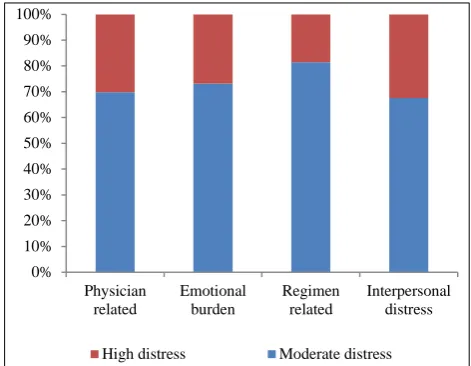
Figure 1 shows that the frequency of diabetes related distress (moderate and high) in the four sub scales were 17.2% (physician related distress), 16.4% (emotional burden dimension), 21.6% (regimen related distress) and 14.8% (interpersonal distress).
Figure 1: Prevalence of subscale level diabetes related distress in the study sample.
Table 2 shows that proportion of individuals with moderate to high DRD was 13.0% among people below 50 years and 13.3% above 50 years and there is no significant difference between them (p=0.964). DRD was higher among males (13.7%) when compared to females (12.8%); joint family (15.6%) to nuclear family (12.8%), unmarried than married (16.7%, 13.1%) but there was no significant difference between the two groups. In the occupational classes, the DRD was highest among unemployed (25%), followed by 21.3% in professional and semi-professionals, 10.5% in semi-skilled workers, skilled workers, clerical and shop owners, and lowest among unskilled workers (5.9%), and there was significant difference among the occupational classes (p=0.004).
Table 2: Association between diabetes related distress and socio-demographic factors in the study sample.
Sociodemographic factors Normal With distress Total P value*
No.(%) No.(%) No.(%)
Age (years) <50 60 (87) 9 (13) 69 (100) 0.964
>50 157 (86.7) 24 (13.3) 181 (100)
Gender Female 116 (87.2) 17 (12.8) 133 (100) 0.8
Male 101 (86.3) 16 (13.7) 117 (100)
Type of family Joint family 27 (84.4) 5 (15.6) 32 (100) 0.664
Nuclear family 190 (87.2) 28 (12.8) 218 (100)
Marital status Married 212 (86.9) 32 (13.1) 244 (100) 0.8
Unmarried 5 (83.3) 1 (16.7) 6 (100)
0% 10% 20% 30% 40% 50% 60% 70% 80% 90% 100%
Physician related
Emotional burden
Regimen related
Interpersonal distress
Sociodemographicfactors Normal With distress Total P value*
Years of
education (years)
≤10 154 (87) 23 (13) 177 (100)
0.881
>10 63 (13.7) 10 (13.7) 73 (100)
Occupation
Unemployed 33 (75) 11 (25) 44 (100)
Unskilled worker 96 (94.1) 6 (5.9) 102 (100)
0.004 Semiskilled, skilled
worker 51 (89.5) 6 (10.5) 57 (100)
Professional and semi
professional 37 (78.8) 10 (21.3) 47 (100)
*Chi-square test.
DISCUSSION
The study was a cross sectional community-based study of 250 adults with type 2 diabetes mellitus, residing in the urban field practice areas of a teaching hospital in Pathanamthitta, South Kerala. The prevalence of (moderate to high level) diabetes related distress (DRD) among them was found to be 13.2% with regimen related being the highest among the subscales. Prevalence of distress in other Asian countries was reported to be higher, ranging from 19-23%.6,7 A study conducted in South Africa revealed that 44% of subjects suffered from moderate to high level of distress and also higher scores of emotional burden dimension and regimen distress, in congruence with the study results.10 In a North Indian study by Gahlan, et al the prevalence was 18% with the highest subscale being emotional burden dimension.14 A South Indian hospital-based study reported a very low distress of 2.4% and majority who experienced diabetes distress were found to have poor glycaemic control.8,16 The varied prevalence could be due to different age groups involved in the study and the availability of diabetes management programmes.
Age and gender were not found to be associated with diabetes related distress in the study, whereas mixed results were reported in different regions. Younger age and female gender were significant factors in several studies.10,11 Though not statistically significant, distress was found to be higher in unmarried participants which was similar to the findings in another South Indian study.16 Also, separated and divorced had significantly higher distress in other researches.4,5
The present study showed a significant association between occupational classes and diabetes related distress (p<0.004). Distress was significantly higher among unemployed (25%) as well as semi-professionals and professionals (21.5%) may be through different mechanisms. There is sufficient scientific evidence from international and national researches demonstrating the association between unemployment and distress.10,16 Distress was almost similar in those having less than or more than 10 years of education (13%, 13.7%). Contradictory to these results, studies by Qui et al, Gahlan et al documented lower education levels contributing to higher distress.5,13
CONCLUSION
Diabetes related distress is a not much explored area in India and this community-based research throws light on the current situation in the field practice areas of a medical college. The higher prevalence of regimen and physician related distress warrants the need for a person-centred diabetes management programme. Physicians are to be alerted on the early identification of distress to prevent people going in to depression and to have a good glycaemic control. Further research is required to understand the risk factors of diabetes related distress in order to plan appropriate interventions.
ACKNOWLEDGEMENTS
We greatly acknowledge the support from short term studentship, Indian Council of Medical Research to the first author. We are thankful to all the participants of the research project.
Funding: No funding sources Conflict of interest: None declared
Ethical approval: The study was approved by the Institutional Ethics Committee
REFERENCES
1. International Diabetes Federation, 8th ed.
International Diabetes Federation. IDF Diabetes Atlas. 2017. Available from: http://www.idf.org/ diabetesatlas. Accessed on 13 September 2018.
2. Fisher L, Gonzalez JS, Polonsky WH. The
confusing tale of depression and distress in patients with diabetes: a call for greater clarity and precision. Diabetic medicine : a journal of the British Diabetic Association. 2014;31(7):764-72.
3. Polonsky WH, Fisher L, Earles J, Dudl RJ, Lees J, Mullan J, Jackson RA. Assessing psychosocial distress in diabetes: development of the diabetes distress scale. Diabetes Care. 2005;28(3):626–31. 4. Chasens ER, Korytkowski M, Sereika SM, Burke
LE. Effect of Poor Sleep Quality and Excessive Daytime Sleepiness on Factors Associated with Diabetes Self-Management. The Diabetes educator. 2013;39(1):74-82.
among diabetes mellitus adults in the Jilin province in China: a cross-sectional study. 2017;5:e2869. 6. Zhou H, Zhu J, Liu L, Li F, Fish AF, Chen T, et al.
Diabetes-related distress and its associated factors among patients with type 2 diabetes mellitus in China. Psychiatry Res. 2017;252:45–50.
7. Tan ML, Tan CS, Griva K, Lee YS, Lee J, Tai ES, et al. Factors associated with diabetes-related distress over time among patients with T2DM in a tertiary hospital in Singapore. BMC Endocrine Disorders. 2017;17:36.
8. Sekhar STVD, Kodali M, Burra KC, Muppalla BS,
Gutta P, Bethanbhatla MK. Self Care Activities, Diabetes Distress and other Factors Affecting Glycemic Control in a Tertiary Care Teaching Hospital in South India. J Clin Diagnos Res. 2013;7(5):857-60.
9. Rehan S, Naz H. Diabetes Self Care and Diabetic Distress in Patients with Type 2 diabetes. Pakistan J Professional Psychol. 2015;6(1):61-73.
10. Ramkissona S, Pillaya BJ, Sartorius B. Diabetes distress and related factors in South African adults with type 2 diabetes. J Endocrinol Metabol Diabetes South Africa. 2016;21(2):35–9.
11. Fisher L, Mullan JT, Skaff MM, Glasgow RE, Arean P, and Hessler D. Treatment Predicting diabetes distress in patients with Type 2 diabetes: a longitudinal study. Diabet Med. 2009;26:622–7. 12. Karlsen B, Oftedal B, Bru E. The relationship
between clinical indicators, coping styles, perceived support and diabetes-related distress among adults
with type 2 diabetes. J Adv Nursing.
2012;68(2):391–40.
13. Baradaran HR, Mirghorbani SM, Javanbakht A, Yadollahi Z, Khamseh ME. Diabetes Distress and its Association with Depression in Patients with Type 2 Diabetes in Iran. Int J Prevent Med. 2013;4(5):580-4.
14. Gahlan D, Rajput R, Gehlawat P, Gupta R. Prevalence and determinants of diabetes distress in patients of diabetes mellitus in a tertiary care centre. Diabetes Metab Syndr. 2018;12(3):333-6.
15. Chin YW, Lai PSM, Chia YC. The validity and reliability of the English version of the diabetes distress scale for type 2 diabetes patients in Malaysia. BMC Family Practice. 2017;18:25. 16. Dogra P, Rajendra Prasad S, Subhashchandra BJ.
Assessment of depression and diabetes distress in type 2 diabetes mellitus patients in a tertiary care hospital of South India. International J Res Med Sci. 2017;5(9):3880-6.
17. Karlsen B, Bru E. The relationship between diabetes-related distress and clinical variables and perceived support among adults with type 2 diabetes: A prospective study. Int J Nursing Studies. 2014;51:438–47.