Sharma V et al. Int J Community Med Public Health. 2018 Aug;5(8):3440-3444
http://www.ijcmph.com pISSN 2394-6032 | eISSN 2394-6040
Original Research Article
Study on socio-demographic determinants of knowledge and practice
regarding road safety among medical students of CIMS, Bilaspur (C.G.)
Vivek Sharma, Shailesh K. Kawale*, Hemlata Thakur
INTRODUCTION
An accident has been defined as an unexpected, unplanned occurrence which involves injury.1 A WHO advisory group in 1956 defined accident as “an unpremeditated event resulting in recognizable damage.”2 Road traffic injuries are the eighth leading cause of death globally, and the current trends suggest that by2030 road traffic deaths will become the fifth leading cause of death unless urgent action istaken.3 Every year the lives of more
than 1.25 million people were cut short as a result of a road traffic crash. Between 20 and 50 million more people suffer non-fatal injuries, with many incurring a disability as a result of their injury. 90% of the world's fatalities on the roads occur in low- and middle-income countries, even though these countries have approximately 54% of the world's vehicles. Road traffic crashes cost most countries 3% of their gross domestic product. Nearly half of those dying on the world’s roads are “vulnerable road users”: pedestrians, cyclists, and motorcyclists. People aged between 15 and 44 years’ account for 48% of global road traffic deaths.4
ABSTRACT
Background: An accident has been defined as an unpremeditated event resulting in recognizable damage. Youths
constitute the most vulnerable group to get into the road traffic accidents so they need significant level of awareness and realization of their knowledge gap regarding road safety measures. The aims and objectives of the study were to find out the level of knowledge about road traffic signs; to assess the practice of medical students towards road traffic rules
Methods: A cross sectional study was conducted among willing undergraduate M.B.B.S. students enrolled in CIMS,
Bilaspur. We recorded verbal response of participants by interview with the use of pre designed & pre tested questionnaire.
Results: Total 289 students were participated in our study. 139 were female and 150 were male, 75 students were below 20 year of age, 89 were living with their parents. In our study we found that student’s age >20 years have more knowledge (36%) of road traffic signs than students aged ≤20 years (28%). Boys have more knowledge (36.66%) of road traffic signs than girls (30.93%). Students living without parents have more knowledge of road traffic signs over students living with their parents. More sensible practice was seen in students >20 years of age, more careful practice seen in male over female and more responsible practice was seen in students living with their parents.
Conclusions: The level of knowledge regarding road signs and symbol among study participants was not satisfactory.
But regarding practice most of the participants were using the safety measures occasionally.
Keywords: Road safety, Traffic signals, Traffic rules, Medical students
Department ofCommunity Medicine, Chhattisgarh Institute of Medical Sciences, Bilaspur, Chhattisgarh, India
Received: 04 May 2018
Revised: 05 June 2018
Accepted: 08 June 2018
*Correspondence: Dr. Shailesh K. Kawale,
E-mail: [email protected]
Copyright: © the author(s), publisher and licensee Medip Academy. This is an open-access article distributed under
the terms of the Creative Commons Attribution Non-Commercial License, which permits unrestricted non-commercial use, distribution, and reproduction in any medium, provided the original work is properly cited.
In September 2015 the United Nations launched the 2030 agenda for Sustainable Development for Road safety. Sustainable Development Goal 3 (SDG) relates to halve the number of global deaths and injuries from road traffic crashes by2020. SDG11 relates to providing access to sustainable transport systems for all, improving road safety and expanding public transport.5
In WHO’s South East Asia Region road traffic injuries kill approximately 316000people each year. These deaths account for 25% of the global total of road traffic deaths. The South-East Asia region has a road traffic death rate of 17 per 100000 population compared to the global rate of 17.4. Rates of road traffic deaths are higher in middle-income countries in comparison to low-middle-income countries.6
India faces the double burden of already existed communicable disease and increasing burden of non-communicable diseases including RTAs. Accidents are definitely on an increase in India. Overcrowding, lack of awareness and poor implementation of essential safety precautions result in an increase in number of accidents. A total of 4,64,674 road accident cases were reported during 2015. Road accident cases in the country have increased by 3.1% (4,64,674 in 2015 from 4,50,898 in 2014) during 2015 compared to 2014. 4,64,674 road accidents caused 1,48,707 deaths and injuries to 4,82,389 persons during 2015.Cause wise analysis of road accidents revealed that most of road accidents were due to over-speeding accounting for 43.7% of total accidents (2,02,882 out of 4,64,474 cases) which caused 60,969 deaths and injuries to 2,12,815 persons. Dangerous/ careless driving or overtaking caused 1,46,059 accidents which resulted in 48,093 deaths and injuries to 1,51,231 persons during 2015. 3.7% (17,235 out of 4,64,674 cases)
of such accidents were due to poor weather condition. Driving under influence of drug/alcohol contributed 1.5% of total such accidents which resulted in injuries to 6,295personsand 2,988 deaths in the country.7
METHODS
The present cross-sectional study was conducted among undergraduate medical students of CIMS Bilaspur (C.G.), during the period of March 2017 to May 2017. After obtaining clearance from the institutional Ethics Committee, data collection was done. With the help of universal sampling technique among the all undergraduate medical students from first to final year, only those who knew driving (2 wheeler and/or 4-wheelervehicle) and consented to take part in the study were included. Sick and not available students during data collection were excluded from the study after making necessary exclusion total 289 students were included in study. After obtaining written informed consent, a pre-tested semi-structured questionnaire was administered to the students. The questionnaire included the general information related to the participants, knowledge and behavioural patterns/practice on road safety measures. The information collected was analysed using Microsoft Excel, and software epi- info 7.
RESULTS
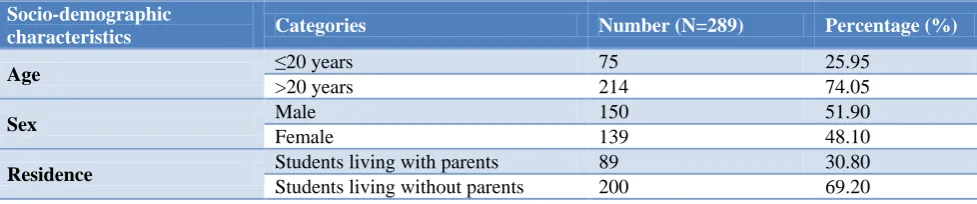
Total 289 students were participated in the study. Out of 289 students 74.05% were from age >20 year of students and remaining 25.95% students belong to ≤20 years, 51.9% students were male and 48.1% were female, 30.8% students resides with their parents while 69.2% students living without parents (hostellers and living in ranted room) (Table 1).
Table 1: Socio-demographic profile of study participants.
Socio-demographic
characteristics Categories Number (N=289) Percentage (%)
Age ≤20 years 75 25.95
>20 years 214 74.05
Sex Male 150 51.90
Female 139 48.10
Residence Students living with parents 89 30.80
Students living without parents 200 69.20
When we assess students’ knowledge regarding road symbol for road safety, we found that student age >20 years were having higher knowledge (36%) then younger students (28%) while males were having better knowledge (36.6%) then female(30.93%) but significant difference was seen between students who resides without parents (42%) than those students who resides with parents(16.85%) (Table 2).
In contrast to their level of knowledge younger students were taking safety measures more frequently (46.67%) than older students (43.4%), while road safety measure taken by male students (54%) were found significantly higher than female students (33.8%). Also safety measures were significantly taken more by those students who resides with parents (57.3%) than those who resides without parents (Table 3).
Table 2: Association among knowledge of traffic rules and sign with socio-demographic factors of study participants.
Socio-demographic
characteristics Categories
Adequate
knowledge N (%)
Inadequate knowledge N (%)
Chi square p value
Age ≤20 years 21 (28) 54 (72) 1.2425
>0.05 >20 years 77 (36) 137 (64)
Sex Male 55 (36.66) 95 (63.34) 0.8172
>0.05 Female 43 (30.93) 96 (69.07)
Residence With parents 15 (16.85) 74 (83.15) 16.1944
<0.001* Without parents 84 (42) 116 (58)
*significant association.
Table 3: Association between safety measures taken by study participants with their socio-demographic factors.
Socio-demographic
characteristics Categories
Safety measures taken N (%)
Safety measures not taken N (%)
Chi square p value
Age ≤20 years 35 (46.67) 40 (53.33) 0.1199
>0.05 >20 years 93 (43.4) 121 (56.6)
Sex Male 81 (54) 69 (46) 11.11
< 0.001* Female 47 (33.8) 92 (66.2)
Residence With parents 51 (57.3) 38 (42.7) 8.082
< 0.001* Without parents 77(38.5) 123 (61.5)
*significant association.
Figure 1: Sex wise distribution of different safety measures taken by study participants.
Figure 2: Residence wise distribution of different safety measures taken by study participants.
0.00% 10.00% 20.00% 30.00% 40.00% 50.00% 60.00%
Use of helmet Showing indicator Following traffic signals
Overtaking from right
Use of seatbelt 41.33%
52%
38.67%
34%
23.34% 38.84%
22.30% 23.02% 22.30%
15.83%
Male Female
0.00% 20.00% 40.00% 60.00% 80.00% 100.00%
Use of helmet Showing indicators Following trafic signals
Overtaking from right
Use of seatbelt 91.01%
76.40%
69.07%
56.80%
50.56%
17.50% 20.50%
14% 19%
Out of all safety measure most common is use of helmet followed by showing indicators before turning the vehicle. All these safety measures were more commonly taken by male students as compared to female students (Figure 1).
From the data, we found that all safety measures were more commonly followed by students who reside with parents as compared to students who were not residing with parents. Use of helmet was the most common safety measure followed by showing indicator during turning the vehicle, while use of seat belt was least followed safety measure during driving the vehicle (Figure 2).
DISCUSSION
Present study was conducted in CIMS Bilaspur to find out the knowledge and practice regarding road safety measures and their socio-demographic determinants among medical students. In this study we assess knowledge regarding sing and symbol in which we found that males are having batter knowledge (36.66%) than females (30.93%) while students age more than 20 years are having better knowledge (36%) than younger students (28%), similar findings were found in study conducted by Manjula et al in SN Medical College, Bagalkot, Karnataka.8
Younger students are taking safety measures more frequently (46.67%) than older students (43.4%) while road safety measure taken by male students are significantly higher than female students. In our study we found that most common safety measure taken by participant was use of hamlet followed by showing indicators before turning. Zaidi et al is also having similar finding in his study in Mayo Institute of Medical Sciences, Barabanki, Uttar Pradesh, India.9 All safety measures were more frequently taken by male (54%) than female (33.8%) and this difference was significant. Safety measures were significantly more commonly used by those students who reside with parents (57.3%) than those students who don’t reside with parents (38.5%). This show that parent’s guidance and supervision is very important for road safety measures taken by students. Younger students are taking safety measures more frequently than older students however this difference is not significant.
CONCLUSION
The level of knowledge regarding road signs and symbol among study participants was not satisfactory. But regarding practice most of the participants were using the safety measures occasionally it may be due to lack of enforcement of road safety rules by authorities. Parent’s supervision also play role in fallowing road safety measures while driving vehicle as students residing with parents practice more safety measures than the students who were not with the parents.
Limitations
The study was conducted among specific group i.e. young medical college students hence the results obtained can’t be generalized for entire population. Medical students were supposed to well-educated and more aware & careful in regards to road safety measures due to their professional exposure to RTA in hospitals.
Recommendations
Students should be encouraged to practice optimum road safety measures & adopt a more careful attitude.
Repeated reinforcement in the form of lectures and health education should be undertaken in order to maintain the knowledge and practice of road safety measures
Exercise of optimally careful practices while driving & especially while trespassing traffic.
Strict enforcement of checking for protective gears, license, etc at signals & public parking premises.
ACKNOWLEDGEMENTS
We acknowledge to all the participants of this study for their participation and full cooperation.
Funding: No funding sources Conflict of interest: None declared
Ethical approval: The study was approved by the Institutional Ethics Committee
REFERENCES
1. Park K. Accidents and Injuries. In: Text Book of Preventive and Social Medicine, 18th edn. Jabalpur: Banarsidas Bhanot Publishers; 2005: 327.
2. World Health Organisation. Accidents in Childhood. Facts as a basis for prevention. Report of a an advisory group. Technical Report Series no 118. Geneva: WHO. 1957.
3. World Health Organization. Global status report on road safety. 2013. Available at: http://www.who.int/ violence_injury_prevention/road_safety_status/2013 /en. Accessed on 13 February 2018.
4. WHO (2018) fact sheet, Road traffic injuries. Available at: http://www.who.int/en/news-room/ fact-sheets/detail/road-traffic-injuries. Accessed on 30 February 2018.
5. United Nations Organisation. Sustainable Development Goals report. 2016 Available at: http://unstats.un.org/sdgs/report/2016/The%20Sustai nable%20Development%20Goals%20Report%2020 16.pdf. Accessed on 30 February 2018.
7. National crime record bureau, Ministry of home affair Accidental Deaths & Suicides in India – 2015, Chapter–1A Traffic accidents. Available at: http://ncrb.gov.in. Accessed on 30 April 2018. 8. Manjula R, Vijaylaxmi BH, Dorle AS. A study on
knowledge and practice of road safety among medical students of S.N. Medical College, Karnataka, Int J Community Med Public Health. 2017;4(6):1993-5.
9. Zaidi SHN, Paul PC, Mishra P, Srivastav A. Risk perception and practice towards road traffic safety
among medical students. Int J Community Med Public Health. 2017;4:9-14.
Cite this article as: Sharma V, Kawale SK, Thakur