http://www.ijcmph.com pISSN 2394-6032 | eISSN 2394-6040
Original Research Article
Knowledge, attitude, practice and perception about menstruation
and menstrual hygiene among adolescent school girls in rural
areas of Raigad district
Jyoti Parle*, Zoya Khatoon
INTRODUCTION
In India, adolescence accounts for 20% of countries population.1 According to Census 2011,there are around 1.2 million female in which 0.8 million lives in rural areas of Raigad district. Adolescent belong to vital age group, not only because they are entrant population to parenthood but also because they are threshold between childhood and adulthood. Menarche is the most important event take place in adolescent girl; generally it starts age
between 10-15 years. Menstruation is the onset of puberty, it is a physiological process among females who experience shedding of blood for 1-7 days from uterus, in every month from the age of maturity until menopause.1 Bleeding generally lasts between 2-7 days, some with lighter flow and some with heavier.
Menstruation is still regarded as something unclean, dirty and matter of embarrassment in Indian society, Various aspects such as physiology, pathology and psychology of
ABSTRACT
Background: Menstrual hygiene is essential to decrease susceptibility of urinary and reproductive tract infection and promotes better health of women. Cultural and religious beliefs concerning menstruation such as food taboos and untouchability have harmful impact on dignity and wellbeing of adolescent girls. As a consequence many girls lack appropriate and satisfactory information regarding menstruation and menstrual hygiene. Thereby it is crucial to assess knowledge, attitude, practice and perception about menstruation and menstrual hygiene.
Methods: It was a cross-sectional study, conducted among 600 adolescent school girls in rural areas of Raigad district to assess knowledge, attitude, practice and perception about menstruation and menstrual hygiene via self made questionnaire. The data collected was analyzed using SPSS version 24. Chi square test was applied to find association between variables.
Results: Overall more than half 53.3% and 52.8% of the respondent had poor knowledge and poor practice on menstruation and menstrual hygiene respectively. Despite of poor knowledge majority of respondent 55.2% heard about menstruation before attaining menarche. Factors that were significantly associated with knowledge of menstruation and menstrual hygiene were adolescent age (Χ2=267.294, p=0.00), mother’s education (Χ2=77.331, p=0.00) and practice on menstruation (Χ2
=111.745, p=0.00).
Conclusions: Health education strategies and awareness programme on menstruation and menstrual hygiene should be framed to promote better health of adolescent girl.
Keywords: Menstruation, Menstrual hygiene, Knowledge, Practice, Rural areas
Department ofPhysiotherapy, MGM College of Physiotherapy, Kamothe, Navi Mumbai, Maharashtra, India
Received: 14 March 2019
Revised: 10 May 2019
Accepted: 13 May 2019
*Correspondence:
Dr. Jyoti Parle,
E-mail: [email protected]
Copyright: © the author(s), publisher and licensee Medip Academy. This is an open-access article distributed under the terms of the Creative Commons Attribution Non-Commercial License, which permits unrestricted non-commercial use, distribution, and reproduction in any medium, provided the original work is properly cited.
menstruation culture, religion and socio-demographic status have been found to be associated with health and wellbeing of adolescent girls, consequently it is an imperative issue in relation to morbidity and mortality of female population.1
Personal hygiene is hygienic and safe practice during menstruation. Menstrual hygiene is an issue for adolescent girls in developing countries, predominantly when attending school. Good menstrual hygiene means sufficiently cleaning external genitalia daily, use of sanitary pad and regularly changed pad every 3-5 hours per day to prevent odour and infection.2 Practice related to menstrual hygiene is essential to ensure prevention of disease and better health of adolescent girls. Unhygienic menstrual practices can affect the health of the girls and there is an increased vulnerability to reproductive tract infections, urinary tract infections, pelvic inflammatory diseases and other complications. To reduce burden of all reproductive phase complications, it is important to educate adolescence girl. Women having better knowledge about menstrual hygiene and out of harm's way practices are most likely to practice adequate sanitation during their menstruation are less vulnerable to urinary and reproductive tract infection.1
In India, women’s perceptions of menstruation differ with regards to their tradition, culture and religion.3 Adolescent girls generally hesitate and embarrassed to talk about menstruation and menstrual problem with their parent, friend and teacher which can affects their health. Many studies has shown that majority of adolescent girls had inadequate and inappropriate knowledge on menstruation, physiology of menstruation and follow inaccurate menstrual practice to maintain hygiene. Studies have shown that young girls, who lack knowledge about menstruation, are prone to suffer from gynaecological problems. Hence it is indispensable to assess knowledge, attitude, practice and perception about menstruation and menstrual hygiene among adolescent school girl, which will help to plan and execute necessary educational programs or interventions in school curriculum to create awareness.
METHODS
This is cross-sectional study conducted among 600 students in rural areas of Raigad district (Kalamboli, Navade) for 6 month from September 2018 to February 2019. Convenient sampling technique was used for sample collection. We had taken 6 schools from rural areas of Raigad district. The adolescent girls of age between 10-18 years and student who had menarche and regularly menstruate were included in study. The study was conducted after obtaining approval from ethical committee, permission also obtained from school principle. Informed and written consent of subject was taken before starting procedure. Method and purpose of this study was explained to the subject. Participation was entirely voluntary and confidentiality was ensured.
Respondent’s who had not given consent and who had not completed questionnaire was excluded from the study. Data were collected using self made questionnaire which was validated by ethical committee. The questionnaire was translated into Marathi and Hindi for student who may find easier to complete in local language. Questions were asked about respondents’ socio demographic characteristics, knowledge, attitude, practice and perception on menstruation and menstrual hygiene. The collected data was analyzed using SPSS version 24. Chi square test was applied to find association between different variables of menstruation and menstrual hygiene. P value less than 0.05 was considered to be significant.
RESULTS
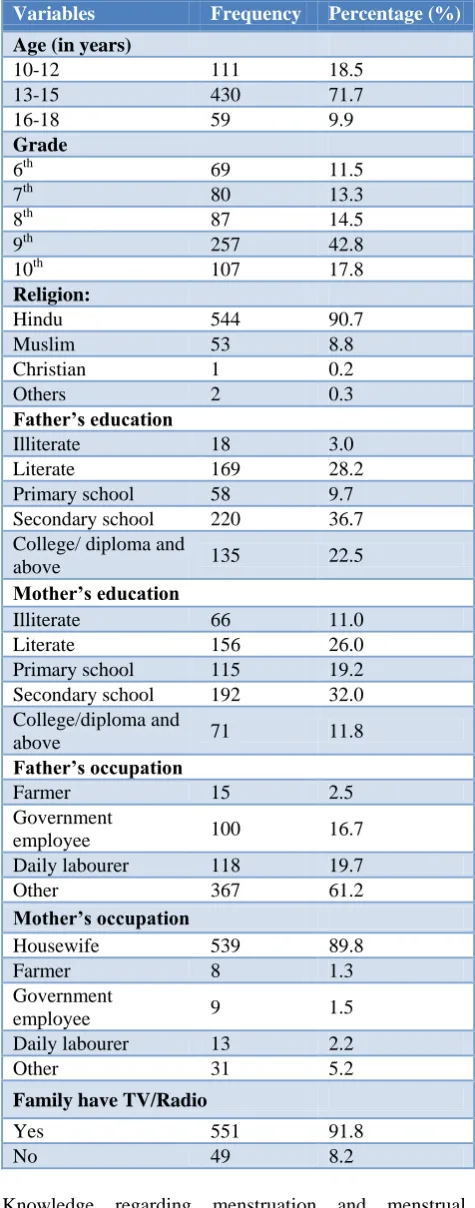
The study was conducted among 600 adolescent girls from rural areas of Raigad district. The majority of respondents 430 (71.7%) are in age group 13-15 years. The mean age of participant was 13.7 years (SD±1.39 years), around 257 (42.8%) participant are in 9th grade. The majority of respondent parent’s had secondary School education (Table 1).
The most of respondent 332 (55.2%) had heard about menarche before menstruation and main source of information was the respondents mother 246(74.09%), about 409 (68.1%) said menstruation is normal process, around 168(28%) respondent said vagina is the organ from which menstrual blood came then abdomen 95 (15.8%) and bladder 94 (15.6%). Most of respondent 555 (92.4%) doesn’t know about menstrual hygiene. Overall more than half 320 (53.3%) of the respondent had poor knowledge while 280 (46.7%) had good knowledge on menstruation and menstrual hygiene (Table 2).
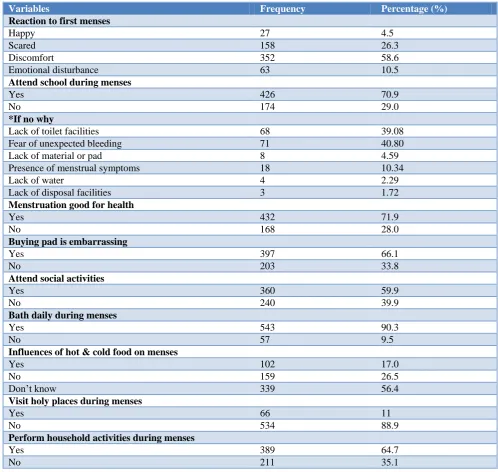
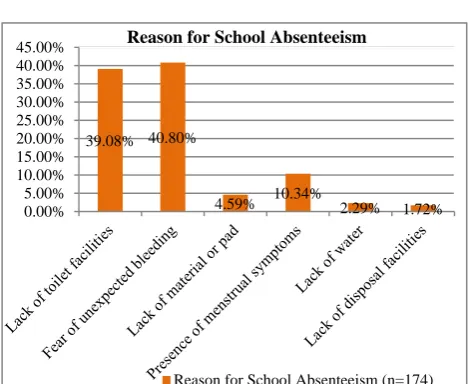
About 352 (58.6%) of respondents describe their reaction to first menses was discomfort and scary 158(26.3%), around 174 (29.0%) of the participant remain absent from school during menstruation (Figure 1). The reason for absenteeism from school was mainly lack of toilet facilities 68 (39.08%) and fear of unexpected bleeding 71 (40.80%) (Figure 2), 397 (66.1%) respondent think buying pad from store is embarrassing, 360 (59.9%) participant attend social activity and 543 (90.3%) bath daily during menstruation. About 534 (88.9%) of respondent were not allowed to visit holy places during menstruation (Table 3).
Table 1: Socio-demographic variables (n=600).
Variables Frequency Percentage (%)
Age (in years)
10-12 111 18.5
13-15 430 71.7
16-18 59 9.9
Grade
6th 69 11.5
7th 80 13.3
8th 87 14.5
9th 257 42.8
10th 107 17.8
Religion:
Hindu 544 90.7
Muslim 53 8.8
Christian 1 0.2
Others 2 0.3
Father’s education
Illiterate 18 3.0
Literate 169 28.2
Primary school 58 9.7
Secondary school 220 36.7
College/ diploma and
above 135 22.5
Mother’s education
Illiterate 66 11.0
Literate 156 26.0
Primary school 115 19.2
Secondary school 192 32.0
College/diploma and
above 71 11.8
Father’s occupation
Farmer 15 2.5
Government
employee 100 16.7
Daily labourer 118 19.7
Other 367 61.2
Mother’s occupation
Housewife 539 89.8
Farmer 8 1.3
Government
employee 9 1.5
Daily labourer 13 2.2
Other 31 5.2
Family have TV/Radio
Yes 551 91.8
No 49 8.2
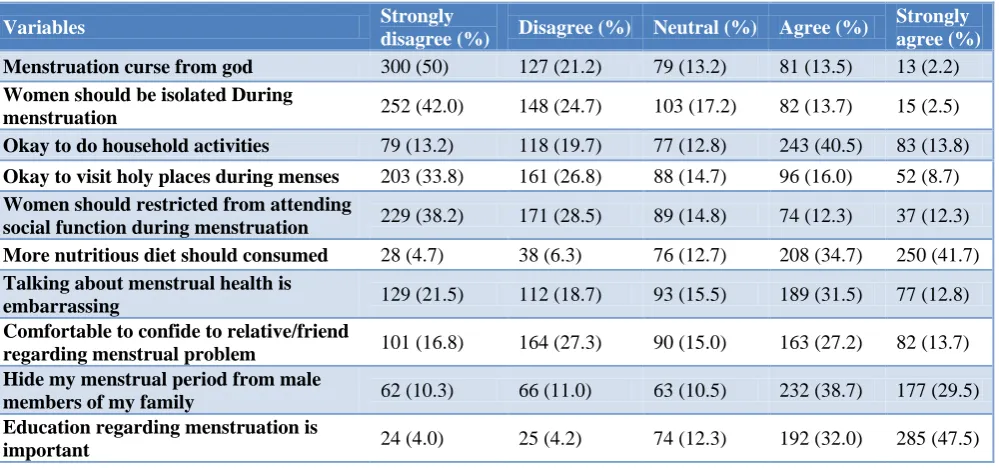
Knowledge regarding menstruation and menstrual hygiene was poor still participant shows positive perception towards importance of education regarding menstruation and feels that more nutritious diet should be consumed during menstruation (Table 5).
Table 2: Knowledge on menstruation and menstrual hygiene (n=600).
Variables Frequency Percentage (%)
Menstruation
Normal process 409 68.1
Disease 7 1.2
Curse of god 23 3.8
Don’t know 161 26.8
Cause of menstruation
Hormones 317 52.7
Curse of god 18 3.0
Caused by disease 6 1.0
Don’t know 259 43.1
Organ does menstrual blood comes
Uterus 89 14.8
Vagina 168 28.0
Bladder 94 15.6
Abdomen 95 15.8
Don’t know 154 25.6
Heard about menstruation before attaining menarche
Yes 332 55.2
No 268 44.6
*Source of informant
Mother 246 74.09
Teacher 22 6.62
Friend 54 16.26
Book 5 1.50
Media(TV/Radio) 4 1.20
Know about menstrual hygiene
Yes 45 7.5
No 555 92.4
Menstrual blood is unhygienic
Yes 184 30.6
No 227 37.8
Don’t know 189 31.4
Common to experience pain/discomfort
Yes 433 72.1
No 81 13.5
Don’t know 86 14.3
Symptoms prior to menstruation
Yes 310 51.6
No 103 17.1
Don’t know 187 31.1
Menstruation continue throughout life
Yes 153 25.5
No 302 50.2
Don’t know 145 24.1
Knowledge score
Good 280 46.7
Poor 320 53.3
There is a statistically significant association between the knowledge (4.09±2.20.7) and practice (5.27±1.266) of menstruation and menstrual hygiene (Χ2
p=0.00). There is a statistically significant association between the knowledge (4.09±2.20.7) and selected variables such as age (13.7±1.399) of participant
(Χ2=267.294, p=0.00) and Mother’s education (3.08±1.221) respectively on menstruation and menstrual hygiene (Χ2
=77.331, p=0.00) (Table 6).
Table 3: Attitude on menstruation and menstrual hygiene (n=600).
Variables Frequency Percentage (%)
Reaction to first menses
Happy 27 4.5
Scared 158 26.3
Discomfort 352 58.6
Emotional disturbance 63 10.5
Attend school during menses
Yes 426 70.9
No 174 29.0
*If no why
Lack of toilet facilities 68 39.08
Fear of unexpected bleeding 71 40.80
Lack of material or pad 8 4.59
Presence of menstrual symptoms 18 10.34
Lack of water 4 2.29
Lack of disposal facilities 3 1.72
Menstruation good for health
Yes 432 71.9
No 168 28.0
Buying pad is embarrassing
Yes 397 66.1
No 203 33.8
Attend social activities
Yes 360 59.9
No 240 39.9
Bath daily during menses
Yes 543 90.3
No 57 9.5
Influences of hot & cold food on menses
Yes 102 17.0
No 159 26.5
Don’t know 339 56.4
Visit holy places during menses
Yes 66 11
No 534 88.9
Perform household activities during menses
Yes 389 64.7
No 211 35.1
Table 4: Practices of menstruation (n=600).
Variables Frequency Percentage (%)
Use absorbent material
Yes 515 85.8
No 85 14.2
Type of material use during menstruation
Sanitary pad 511 85.2
Napkin 2 0.3
Toilet roll 0
Cloth 87 14.5
Other 0
Variables Frequency Percentage (%)
Using cloth how do you clean it
Soap and water 79 90.80
Only water 5 5.74
Other 2 2.29
How do you dry the cloth
Sunlight 22 25.28
Inside house 62 71.26
Number times pad/cloth change per day
Three and more 254 42.3
Twice 295 49.2
Once 50 8.3
Dispose pads
Dustbin 462 77.0
Drain 4 0.7
Toilet 47 7.8
Open field 0
Other 3 0.5
Types of wrap used for disposing pad
Papers 257 42.8
Plastic bag 239 39.8
Not wrap 19 3.2
Other 1 0.2
Change panty daily during menses
Yes 489 81.5
No 111 18.5
Clean your genitalia during menses
Yes 573 93.5
No 27 4.5
Practice score
Good 283 47.1
Poor 317 52.8
Table 5: Perception on menstruation and menstrual hygiene.
Variables Strongly
disagree (%) Disagree (%) Neutral (%) Agree (%)
Strongly agree (%)
Menstruation curse from god 300 (50) 127 (21.2) 79 (13.2) 81 (13.5) 13 (2.2)
Women should be isolated During
menstruation 252 (42.0) 148 (24.7) 103 (17.2) 82 (13.7) 15 (2.5) Okay to do household activities 79 (13.2) 118 (19.7) 77 (12.8) 243 (40.5) 83 (13.8)
Okay to visit holy places during menses 203 (33.8) 161 (26.8) 88 (14.7) 96 (16.0) 52 (8.7)
Women should restricted from attending
social function during menstruation 229 (38.2) 171 (28.5) 89 (14.8) 74 (12.3) 37 (12.3) More nutritious diet should consumed 28 (4.7) 38 (6.3) 76 (12.7) 208 (34.7) 250 (41.7)
Talking about menstrual health is
embarrassing 129 (21.5) 112 (18.7) 93 (15.5) 189 (31.5) 77 (12.8) Comfortable to confide to relative/friend
regarding menstrual problem 101 (16.8) 164 (27.3) 90 (15.0) 163 (27.2) 82 (13.7) Hide my menstrual period from male
members of my family 62 (10.3) 66 (11.0) 63 (10.5) 232 (38.7) 177 (29.5) Education regarding menstruation is
Table 6: Association between knowledge and practice and selected variables.
Variables Mean& SD Statistical indices
Knowledge 4.09±2.20.7 Χ2
=111.745 df= 63 p=0.00
Practice 5.27±1.266
Knowledge 4.09±2.20.7 Χ2=267.294 df= 63 p=0.00
Age 13.7±1.399
Knowledge 4.09±2.20.7 Χ2
=77.331 df= 36 p=0.00
Mother’s education 3.08±1.221
Figure 1: School absenteeism.
Figure 2: Reason for school absenteeism.
DISCUSSION
Knowledge on menstruation and menstrual hygiene
Knowledge on menstruation and menstrual hygiene is essential in life of every adolescence girl. It is known fact that poor menstrual hygiene can lead to reproductive and urinary tract infection. So it’s today’s need to assess knowledge, attitude, practice and perception on menstruation and menstrual hygiene in adolescent girls, which will help to implicate necessary awareness among them. In this study, knowledge on menstruation and menstrual hygiene was poor (53.3%) which was contradicting the study done in Nigeria.4 That shows
health education programme needs to be strengthened in rural areas.
This study revealed considerably high level of awareness of menarche (55.2%) and main source of information were the mother (74.09%).This was similar to finding of study done in Nigeria.4 This can be due the fact that in Indian culture children are usually closer to their mother. Also the respondent were not aware of menstrual hygiene (92.4%), this might be due to limited knowledge on menstruation and menstrual hygiene of mother itself. Generally mother and other women hesitate from discussing the menstrual issues with adolescent girls, because of which young girls grow up with limited knowledge on menstruation despite the fact that they know about menstruation before attaining menarche.
Attitude toward menstruation and menstrual hygiene
A variety of factors are known to influence menstrual behaviours and attitude, prominent ones residential status (urban and rural), culture and religion belief. The manner in which girls learn about menstruation and its associated changes may have an impact on her response to the event of menarche. In this study participant reaction to first menses was discomfort or scared. This was similar finding of study carried out in Pakistan by Ali et al and Nigeria (in tribal area).4,13 Girls are not given adequate information and not properly, mentally prepared for the first menstruation, that is why it’s a normal tendency when girl first see blood they get scared. There are lots of myths, belief related to menstruation, also behaviour of family member changes because of which they feel discomfort. Study shows 29% of respondent remain absent during menstruation. Reason for absenteeism was girls having fear of unexpected bleeding and lack of toilet facilities in schools. More than half respondent (66.1%) think buying pad from the store is embarrassing. This is social stigma attached to menstruation because of which women generally hide their menstruation from other people, which causes many girl and women to carry out dangerous hygiene practice.
Practices on menstruation
Overall hygiene practice during menstruation was poor 52.8%. Though menstruation is natural process, it is linked with several misconceptions and poor menstrual practices that can result into adverse health outcomes. 70.90%
29.00%
Attend school during menstruation
Yes No
39.08% 40.80%
4.59% 10.34% 2.29% 1.72%
0.00% 5.00% 10.00% 15.00% 20.00% 25.00% 30.00% 35.00% 40.00%
45.00% Reason for School Absenteeism
Hygiene related practices of women during menstruation are of considerable important, as it has a health impact in terms of increased vulnerability to reproductive tract infection. Today millions of women suffers of reproductive tract infection and its complication and often transmitted to the offspring during pregnancy. Therefore increase knowledge of menstruation from childhood may escalate safe practice and may help in mitigating the suffering of millions women. Despite the study conducted in rural area we have found majority 85% of adolescent girls use sanitary pad during menstruation, but frequency of changing pad was twice a day which is not good menstrual hygiene practice. To have good practice women should change their pad 3-5 hourly per day.2 study shows frequently practiced method of disposal of the used absorbent were, wrapping it in paper (42.8%) or plastic (39.8%) and disposing it in dustbin (77.0%). Regarding personal hygiene around 4.5% of respondent don’t clean their genitalia during menses and others use only water to clean, which will increase growth of bacteria in genital area and prone to infection, which increase risk of gynaecological health problems among adolescent girls.
Perception about menstruation and menstrual hygiene
India is multicultural country, due to different culture and religion various restrictions were practice by adolescent girls. There are ignorance, unawareness, social stigma and false perception about menstruation, which hamper intellectual and mental development of young girls and women. Majority of respondent shows negative perception towards visiting holy place. They feels shy to discuss about menstruation, discomfort to confide to relative and friend about menstrual problem possibly because same were practiced by their mother, elderly sister in family and friend.
CONCLUSION
The study conclude that there was poor knowledge on menstruation and menstrual hygiene and majority of adolescent do not observed good hygienic practice. Effort has to be deposit into ensuring, adolescent girls are well knowledgeable on meaning of menstruation significance of good menstrual hygienic practice. Since mother was key source of information about menstruation, family member particularly mother have to aware of the menstruation and menstrual hygiene. The effort must be taken to bring about change in myths, misconception, restriction and traditional taboos concerning menstruation, so as to further develop and promote the menstrual hygiene and practice. Health education strategies and awareness have to be framed up for better health of adolescent girls.
ACKNOWLEDGEMENTS
We would like to thank all those who helped and guided us in conducting the study. We would like to thank all our
participants for giving us the opportunity to conduct this study and for completely co-operating throughout the study. Very special thanks to my parents, brother and colleagues for their co-operation and for creating friendly working atmosphere for successful completion of research.
Funding: No funding sources Conflict of interest: None declared
Ethical approval: The study was approved by the Institutional Ethics Committee
REFERENCES
1. Bacloo T, Kumar R, Goyal A, Singh P, Yadav SS, Bhardwaj A, et al. A study on perception and practice of menstruation among school going adolescent girls in district Ambala Haryana, India. International J Community Med Public Health. 2016;3(4):931-7.
2. Sultan S, Sahu DS. Knowledge, attitude and practices about menstruation and related problems in adolescent girls. Int J Reprod Contracept Obstet Gynecol. 2017;6(12):5235-40.
3. Koitan SM, Choudhary VK, Mutya VS, Sekhon AS, Sriraman S, Prasad P. Assessment of knowledge, practice, and perception of menstruation among adult women in the reproductive age group, in Mangalore, India. International J of Reprod Contracept Obstet Gynecol. 2017;6(10):4595-601. 4. Funmito FO, Akintunde OF, Ayodele OA, Idowu A,
Olumuyiwa AO, Idowu PO. Assessment of knowledge, attitude, practice about menstruation and menstrual hygiene among secondary high school girls in Ogbomoso, Oyo state, Nigeria. Int J Reprod Contracept Obstet Gynecol. 2017;6(5):1726-32.
5. Yadav RN, Joshi S, Poudel R, Pandeya P. Knowledge, Attitude, and Practice on Menstrual Hygiene Management among School Adolescents. J Nepal Health Res Counc. 2017;15(37):212-6. 6. Upashe SP, Tekelab T, Mekonnen J. Assessment of
knowledge and practice of menstrual hygiene among high school girls in western Ethiopia. BMC Womens Health. 2015;15:84.
7. Sapkota D, Sharma D, Budhathoki SS, Khanal VK, Pokharel HP. Knowledge and practices regarding menstruation among school going adolescents of rural Nepal. J Kathmandu Med Coll. 2013;2(3). 8. Hakim A, Shaheen R, Manisha, Tak H. A cross
sectional study on the knowledge, attitudes and practices towards menstrual cycle and its problems: a comparative study of government and non-government adolescent school girls. Int J Community Med Public Health. 2017;4(4):973-81. 9. Mathiyalagen P, Peramasamy B, Vasudevan K,
union territory, India. J Family Med Prim Care. 2017;6(2):360–5.
10. UNICEF. The State Of World’s Children. 2011. www.unicef.org. Accessed 12 February 2019. 11. Mohite RV, Mohite VR, Kumbhar SM,
Ganganahalli P. Common Menstrual Problems among Slum Adolescent Girls of Western Maharashtra, India. JKIMSU. 2013;2(1):89-97. 12. Dasgupta A, Sarkar M. Menstrual Hygiene. Indian J
Community Med. 2008;33(2):77-80.
13. Rizvi N, Ali TS. Misconceptions and Mismanagement of Menstruation among Adolescents Girls who do not attend School in Pakistan. Journal of Asian Midwives. 2016;3(1):46-62.
14. Tharkre S, Reddy M, Rathi N, Pathak K, Ughade S. Menstrual hygiene: knowledge and practice among adolescent school girls of Saoner, Nagpur District. J Clinic Diagnos Res. 2011;5:1027-33.
15. Sreedhar M, Syed A. Practices of Menstrual hygiene among urban adolescent girls of Hyderabad. Indian J Basic Appl Med Res. 2014;4(1):478-86.
16. Prajapati J, Patel R. Menstrual hygiene among adolescent girls: A cross sectional study in urban community of Gandhinagar. JMR. 2015;1(4):122-5. 17. Madhusudan M, Mahadeva TS. Menstrual hygiene:
knowledge and practice among secondary school girls of Hosakote, rural Bangalore. Int J Basic Appl Medic Sci. 2014;4(2):313-20.
18. Sommer M, Sahin M. Overcoming the taboo: advancing the global agenda for menstrual hygiene management for schoolgirls. Am J Public Health. 2013;103:1556-9.
19. Jothy K, Kalaiselv IS. Is menstrual hygiene and management an issue for the rural adolescent school girls? Elixir Int J. 2012;44:7223-8.
20. Teklemariam G. Practice of menstrual hygiene and associated factors among female Mehalmeda high school students in Amhara Regional State, Ethiopia. Sci J Public Health. 2014;2(3):189-95.
21. Shanbhag D, Shilpa R, D’Souza N. Perceptions regarding menstruation and Practices during menstrual cycles among high school going adolescent girls in resource limited settings around Bangalore city, Karnataka, India. Int J Collab Res on Int Med Pub Health. 2012;4(7):1353-62.
22. Muhit IB, Chowdhury ST. Menstrual Hygiene Condition of Adolescentn Schoolgirls at Chittagong Division In Bangladesh. Int J Sci Tech Res. 2013;2(6):58-62.
23. Ray S, Mishra SK, Roy AG, Das BM. The menstrual characteristics:A study of adolescents of rural and urban West Bengal, India. Ann Human Boil. 2010;37(5):668-81.
24. Patil MS, Angadi MM. Menstrual pattern among adolescent girls in rural area of Bijapur; Al Ameen J Med Sci. 2013;6(1):17-20.
25. Kusuma ML, Ahmed M. Awareness, perception and practices of government pre-university adolescent girls regarding menstruation in Mysore city, India. International J Comm Med Pub Health. 2016;3(6):1593-9.