REVIEW ARTICLE
A Framework for Effective Big data Analytics for
Decision Support Systems
Osama Islam
1, Ahmed Alfakeeh
2, Farrukh Nadeem
31, 2, 3
Department of Information Systems, Faculty of Computing and Information Technology, King Abdulaziz
University, Jeddah, Saudi Arabia.
1
[email protected],
2[email protected],
3[email protected]
Published online: 02 November 2017
Abstract – Supporting decision makers requires a good understanding of the various elements that affect the outcomes of a decision. Decision Support Systems have provided decision makers with such insights throughout its history of usage with varying degrees of success. The availability of data sources was a main limitation to what decision support systems can do. Therefore, with the advent of improved analytical methods for Big data sources new opportunities have emerged that can possibly enhance how decision makers analyze their problem and arrive at decisions using information systems. This paper analyzed current related works on both Big data and decision support systems to identify clear elements and factors relevant to the subject and identifying possible ways to enhance their joint usage. Finally, the paper proposes a framework that integrates the key components needed to ensure the quality and relevance of data being analyzed by decision support systems while providing the benefits of insights generated over time from past decisions and positive recommendations.
Index Terms – Big data, Big data Analytics, Decision Support Systems, Information Systems.
1. INTRODUCTION
The recent raise of large online data sources, commonly referred to as Big data, has presented new opportunities to improve decision making processes using advanced Decision Support Systems (DSS). However, to be able to properly examine the potential that Big data has on DSS a proper understanding of both DSS and the analysis of Big data is important, which is detailed in sections 3 and 4 respectively.
In general, DSS started as a research topic in the latter half of the past century. Then over the years DSS toke a more prominent role within organizations in supporting decisions and analyzing data [1]. At the same time, DSS as an information system had a wide range of types and variations [2] that depended on its use case and expected benefits. Data-driven DSS [3] with its focus on analyzing data has taken more attention in recent years due to the increasing interest in processing very large datasets.
These complex datasets, which are very large in size and not ease to process for further analysis using traditional data storage and manipulation techniques are commonly referred to
as Big data [4]. Big data is defined by variety, volume, and velocity or as the 3 Vs, while some have added more Vs such as Veracity, Variability and Value for example.
Big data alone has no value, which is why Big data analytics as a sub-field has taken the attention of the academic and commercial sectors, who all strive to obtain value from Big data [5]. The main aim of this analytics approach is to deal with processing very large sets of data input, the limited timeframe for processing streams of data, and the various data types and formats that must be analyzed.
The use of Big data with DSS also faces some key issues, such as the limited availability of expert personnel in this new field, the high costs of the underlying technologies as they are still in the emerging stage, and the difficulty in customizing these new systems according to unique requires without major software development projects. However, some research areas are also exploring potential solutions for the challenges of Big data [6], while others propose future research into Big data and DSS [7].
This paper is structured as follows. Section 2 gives a general review of other work related to the research topic, while section 3 discusses what DSS is and how Big data environments have presented opportunities for better decisions using data-driven DSS. Section 4 then analyses Big data analytics and its potential uses by decision makers. After that Section 5 presents relevant best practices and trends in Big data analytics for use with DSS. Section 6 then details the proposed framework highlighting key components. Finally, we conclude and describe the future directions in section 7.
2. RELATED WORK
REVIEW ARTICLE
for combining both descriptive (historical data) and predictive (Big data streams) approaches when analyzing data for decision making purposes. However, they highlighted the importance of ensuring a decision maker’s knowledge and judgment is used in combination with the proposed information technology.
Their main contribution was in the promotion of an integrated view that combines DSSs, business intelligence and Big data to assist managers in their decision-making activities. They described key elements of the integrated model, namely, content collection, intelligence, alternatives generation, decision support system, and decision implementation. In addition, they also proposed organization learning as an additional element, which focuses on capturing and storing knowledge in an organizational memory that further helps decision makers in future problem-solving situations.
The authors also indicated that for information systems to benefit from Big data sources they should strive to increase the engagement and participation of decision makers during their decision-making process, which is the key element to successfully benefit from their tacit knowledge and experience. This would also help decision makers to better visualize decision-making opportunities.
Before exploring how Big data analytics can assist DSS, it is important to clearly define what Big data is, especially as it has been overused by both the academic and commercial sectors, as highlighted in the paper by [9], who addressed the lack of comprehensive academic definitions of what Big data is and its underlying fundamental concepts and questions, such as how big should data be to be considered Big data. The authors provided a wider definition of Big data by exploring all its main characteristics from both the academic and practitioner perspectives. In addition, they focused on the methods of analyzing Big data, especially unstructured data, which is estimated to make-up 95%.
Most academic authors and industry practitioners commonly use the 3 Vs, namely Velocity, Variety and Volume, to identify very large datasets. In addition, in recent years, corporations such IBM introduced Veracity as the fourth V, while Variability was introduced by SAS, and then Value was introduced by Oracle. However, relativity is a main challenge for all dimensions of very large datasets as there is no universal benchmark for the Vs, as they usually depend on the size, sector and location of the organization using Big data and is also prone to change over time.
The authors have also highlighted that the true value of Big data can be achieved only when it can support decision making, which is why they discussed the importance of efficient processes that transform Big data sources into meaningful knowledge and insights. These processes usually cover data management and analytics, and Big data analytics as a
sub-process. At the same time, the authors discussed predictive analytics as a supportive technique to Big data, but at the same time cautioned its used without addressing Big data issues such as spurious correlations, noise accumulation, incidental endogeneity, and heterogeneity.
The authors also highlighted that novel analytical techniques for Big data are still in development, and real-time analytics is taking the center stage with the growing number of location aware devices and applications. Therefore, an analysis of possible techniques and algorithms can assist in identifying improved Big data analytics in decision making scenarios.
A range of opportunities to improve decision making has risen with the increasing use of Big data environments, by utilizing data-driven DSS with Big data analytics to enable better decisions that are supported with insights from a larger and real-time dataset. However, Big data cannot be used directly with DSS without proper filtering and analysis, which was what [10], presented in their paper through a case study that
investigates possible management challenges that
organizations may face when trying to utilize Big data sources in their decision-making process, specifically within Customer Relationship Management (CRM) systems. In addition, they presented the results of an experiment that utilized sentiment analysis of customer social media used for improved decision making.
Therefore, Big data can provide enhanced decision making within CRM processes, as highlighted by the authors. However, this cannot be taken without properly addressing related factors and dimensions of CRM. They presented a model proposed by [11] as a basis for their analysis of CRM systems that utilize Big data for decision making. The identified dimensions cover the degree of alignment in people, process and organization that are necessary for successful use of information systems, in addition to the system outputs. These dimensions highlight the required critical factors for an effective Big data strategy for CRM.
The successful adaptation of Big data with DSS within organizations cannot be realized with just technology implementation, but rather what is required is a comprehensive
DSS framework that addresses both technological,
organizational and strategic aspects of an organization. In addition, as indicated by the authors having the right skillsets are essential for a successful Big data project, particularly as data scientists are very expensive to hire full-time. Such concepts will be important to integrate into a proposed framework for effective Big data analytics for DSS.
REVIEW ARTICLE
variables. Their model utilizes a feature selection approach based on the Random Forests and Least Absolute Shrinkage Selection Operation, which were both compared to linear regression and time series analysis models.
The main objective of the paper was to investigate potential algorithms helpful for Big data analytics. The presented case study looked at weather data from past days collected from distributed weather stations. This data would be helpful in forecasting pricing due to its expected reactions to weather changes as more electricity is fed into the power system from regenerative sources, such as windmills or photovoltaic installations. However, a selection process will be required to identify only those stations that are relevant based on the areas of the country that don’t have renewable power.
The benefit of utilizing predictive analytics with Big data is that it provides critical and valuable information to decision makers who are faced with risky or unpredictable alternatives in certain situations. The authors main findings supported their hypothesis that the current prices of electricity are reliant on weather data and that the use of exogenous predicators can benefit the models of forecasting. In addition, this also indicates the potential that Big data sources, if properly utilized, can have in improving critical decision-making processing.
In today’s competitive marketplace organizations success is based on how effective they are in extracting knowledge from data. However, this can only be done with the use of comprehensive algorithms and a proper understanding of the data being analyzed. Therefore, with the appropriate algorithm in place Big data source can be effectively analyzed to extract relevant knowledge useful to organization’s strategic objectives.
Another important dimension that was explored by researchers was the potential risks that Big data can introduce to decision makers, which was highlighted in a paper by [14], who examined potential threats that Big data may introduce. These threats can become serious risks if not addressed properly by key stakeholders. The author adapted a scenario analysis approach to investigate the various quality factors that affect the analysis of very large datasets, in addition to discussing the ethical, moral, and legal responsibilities associated with Big data.
The author analyzed the factors of Big data quality by categorizing them into two quality perspectives, for both data and information. Data quality factors are reviewed when data is collected, while quality factors of information can only be assessed after the data is used. Therefore, with such factors proper analysis can be conducted.
At the same time, identifying a recommended set of factors relevant to a decision area is important as it helps balance data quality factors with collection costs, which may be high
considering very large datasets. The author has also identified data compression during collection as another source for challenges because of sampling and filtering techniques. This, may reduce accuracy and completeness of data.
The author has also indicated that Big data analytics can be used as a decision system, where decisions as semi-automated with notifications of exceptions that must be dealt with by decision makers. This if not properly controlled may lead to over confidence on software inferences and less use of judgment and experience in decisions. However, the author also presented that the analysis of Big data is more effective and applicable for DSS when they are linked with decision makers who evaluate the recommendations before they are implemented.
Utilizing Big data analytics for strategic planning must also be taken with care as such practices have historically been based on structured data with clear trends, for example, a paper by [15], explored the potential effects that Big data can have on organizational strategies. They examined how the various attributes of Big data that produce useful information can introduce challenges in strategy development, which has been traditionally based on structured information with lasting value for specific organizational objectives. The main purpose of the paper was to investigate how Big data erodes models of decision making related to prescriptive strategy, which is traditionally based on top management’s decisions as opposed to descriptive strategic management that involves lower level managers in the strategic decision process.
One of the main issues that the authors presented in their study is that Big data by itself does not provide useful information, as these datasets were not original intended for analytical or decision-making purpose, as a result they usually require further analysis to deduce relevance and potential value to strategic objectives. This issue, would also require changes to the models and tools used for strategy development specifically in data collection and analysis. An example given by the authors was how customers can be served through social media while at the same time their responses and actions tracked to produce more tailor-made services to them, so in since these customers are both consumers and producers of data.
REVIEW ARTICLE
inferences. Especially when comparing standard strategy context with Big data digital ecosystem.
3. DATA DRIVEN DECISION SUPPORT SYSTEMS
Information systems that support decision making can be described from many perspectives, for example as highlighted by [1] from a historical perspective Decision Support Systems (DSS) started as a research topic in the latter half of the past century. This conceptual research into the topic of DSS, in the 1970s, resulted in many systems that support decision makers within organizations, including group-based DSS. However, it was in 1990s that DSS toke a more prominent role in most organizations with the introduction of the client/ server architecture, the Internet and Online Analytical Process (OLAP) tools that top management/ stakeholders viewed the full potential that DSS systems can provide.
On the other hand, from an information system perspective DSS can be described, as highlighted by [2], as an information system that assists senior management in making decisions that are not easily defined in advance or can change frequently. In addition, DSS is usually supported and interacts with other information systems, for example DSS usually depend on transactional processing systems and management information systems to obtain the needed information to make semi-structured or unsemi-structured decisions, while at the same time DSS can be a source for higher-level executive support systems. However, with the large number of DSS that have been developed over the years' common characteristics and types of DSS have been established, for example [3] identified
five types of DSS: data-driven, document-driven,
communication-driven, model-driven, and knowledge-driven.
The rise of environments utilizing very large datasets has also introduced a range of opportunities for improving decision making, by utilizing DSS that are supported with insights from real-time datasets. Data-driven DSS, usually focuses on gaining access to various data sources, both internal and external, and adapting different techniques to analyze the data to present trends and inferences relevant to issues faced by decision makers.
Data-driven DSS as described by [2], are information systems that analyze large sets of data that allow decision makers to extract relevant information. Traditionally these systems gathered historical data into data warehouses that were later analyzed using data mining tools. However, with the introduction of Big data newer sources of data stream have also been targeted for analysis but using newer data stream mining techniques. In addition, [16, 15] discussed the main benefits of data-driven DSS, which in general focuses on providing decision makers with the ability to perform ad-hoc inquires in an interactive manner while obtaining fast results compared to traditional system.
At the same time, understanding the major components of a DSS is also important to identify the areas that may needed to be improved to factor in challenges presented by Big data. In general, DSS include the following main components [2]:
Data Source(s), this component represents the collection
of data from its various sources, either as standalone databases or from other systems.
Software System, this component represents the set of tools needed for the analysis of data and providing the output to the decision makers.
User Interface, this component represents the actual set of screens and views that the user interacts with to arrive at a decision. Most are graphical based and highly interactive to allow for dynamic manipulation of represented data.
While there is not one type of DSS that can solve all problems, the goal that most designers of DSS try to achieve is to balance the degree of support that this system provides decision makers, ranging from providing basic facts all the way to making the decision in place of the decision maker in an automated manner. Therefore, DSS must be designed to suit the needs of the decision maker first and foremost and should not be a system that tries to solve all problems.
The type or level of decisions is also an important factor to consider when designing DSS, particularly if the decisions are operational or strategic. For example, [17] explored many decision support systems over forty years looking for common themes in how they are used. Their main findings showcased that most DSS support operational level decisions. In addition, the authors also found a growing number of use cases for other areas such as strategic planning and intercompany decisions.
In addition, DSS should be an enabler to the decision maker process, as highlighted by Herbert Simon, a well-known author on decision making, by covering some or most of the key steps that includes intelligence, design, choice and review.
4. BIG DATA ANALYTICS
As described by [4] Big data usually refers to complex data that is very large in size and not ease to process for further analysis using traditional data storage and manipulation techniques. In particular, very large datasets are defined by variety, volume, and velocity or as the 3 Vs, while some have added more Vs such as Veracity, Variability and Value for example.
REVIEW ARTICLE
the limited timeframe for processing streams of data, and the various data types and formats that must be analyzed. Examples of enabling technologies for Big data analytics include in-database analytics, in-memory analytics, grid computing & MPP, and appliances.
Some of the issues facing Big data’s use with DSS is the limited availability of expert personnel in this new field, the high costs of the underlying technologies as they are still in the emerging stage, the difficulty in customizing these new systems according to unique requires without major software development projects. For example, [18] highlight how BGI one of the largest producers of genomic data in the world, are faced with extreme pressure as they generate 6 terabytes of data every day. The main challenges in this case were not the availability of software or hardware capacity but rather the interoperability of these various subsystems that work together, which usually require in its absence a specialized engineer to handle the technical aspects of such systems.
Therefore, most solution to Big data challenges must address the issues associated with the management of data, how analysts work this data and finally the management of the underlying technology platforms. [6] also explored potential solutions for the challenges of Big data, for example, they highlighted five research areas that Big data needs to focus on in the coming years, which included Big data analytics, analytics of text/ network/ Web/ Mobile. On the other hand, [7] proposed future research into further automating the backbone data, coming from Big data source, to assist decision support systems in better dealing with such data sources in the future.
[19] Also presented two main paradigms for Big data analytics, which are:
Stream processing, the focus is on obtaining valuable information from streams of real-time data and possibly react to exceptions using alerts to avoid problems. This approach usually requires streaming analytics that performs continues calculations to data coming in with limited timeframe for storing data for later use.
Batch processing, the focus is on storing data in an efficient manner for later analysis. One of the most widely use approach is the MapReduce mode, where data is broken down into smaller parts that are then processed in parallel and in a distributed approach.
In addition, one important advantage of utilizing analytics with very large datasets is in its ability to improve the efficiency of dealing with Big data sources that cannot be managed using traditional approaches to data management. [20] Provides some example of how Big data can benefit organizations:
Increasing data availability, by being more transparent and providing Big data to stakeholders, value can be
created between the organizations and its main stakeholders.
Improved segmentation of operational data, allowing for
more detailed performance tracking and measurement.
Increased opportunities for decision making automation,
by examining decision making processes certain algorithm can be utilized to support stakeholders at veracious stages of their decision-making process.
Newer business models, with Big data organizations can
create new business models for their various divisions or setting up a new company that was not possible in the past without Big data to provide the needed competitive advantage.
In the past DSS has been instrumental in supporting decision makers in dealing with semi-structured and unstructured problems, however this situation is becoming more difficult with the growing amount of data being generated by various systems related to an organization. As a result, decision makers cannot ignore potential benefits of using Big data analytics such as better targeted marketing, clearer business insights, better segmentation of clients, quicker identification of market opportunities.
5. FRAMEWORK FOR EFFECTIVE BIG DATA
ANALYTICS FOR DECISION SUPPORT SYSTEMS
The analysis of very large datasets can potentially generate a wide range of findings that can mislead or negatively affect decision making. While decision makers can deal with such situations using their intuition and experience to filter irrelevant findings it would still be an ineffective approach if implemented on a wider scale within organizations.
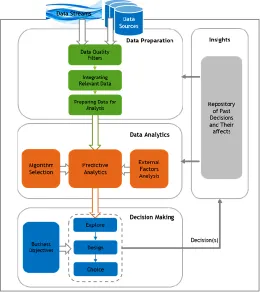
Therefore, the proposed framework, as highlighted in Figure 1, aims to integrate the key components needed to ensure the quality and relevance of data being analyzed within a decision support system. This cycle of data preparation/analysis and decision making also gains the benefits of insights generated over time from past decisions and positive recommendations and stored into a repository that organizations can tap into to gain further knowledge if required.
The framework covers four main components, which includes data preparation, data analytics, decision making and an insights repository. These components interact together to transition data from its raw form to meaningful and relevant information used in further analysis and decision support activities. In addition to being used for future cycles of analytics.
REVIEW ARTICLE
stream mining subsystem and the traditional data warehousing subsystem. In addition, to linking with the insights repository.
5.1. Data Preparation Component
The data preparation component receives data input from traditional data sources, such as databases or transactional systems, or receives data from data streams, such as data from social media or mobile devices. This would require the decision support system to have an interface with such systems, either directly if within the organization or using web services/ interfaces if they are outside the organization.
The first part of this component is the data quality filters, which ensures that both traditional and Big data sources are filtered using quality factors, such as meta-data, relevance, accuracy & completeness and timeliness. The main purpose of such an activity would be to raise the underlying data quality used for analysis. This is an essential point to consider when dealing with Big data, which was not initially intended for data analysis and can generate a lot of irrelevant and incorrect inferences.
The second part of this component is integrating relevant data, which decides if there are other data sources that can be integrated with the filtered data to improve its analysis or pass them along to the analytics comportment. The final part is preparing data for analysis, which performs any needed transformations or cleansing required to prepare data for analysis.
The key benefit of this component is ensuring the quality and relevance of the underlying data being analyzed, in addition joining relevant data together to add context to initial findings.
5.2. Data Analytics Component
The data analytics component receives the filtered and prepared data from the previous component to perform the required predictive analytic approach. This would require that an appropriate algorithm is selected based on many external factors relevant to the problem domain. Therefore, this component will require many predetermined algorithms to be classified based on the target business domain in addition to identifying the priorities of the relevant external factors. This would ensure that the appropriate analytical algorithm is selected that best fits the problem domain.
With the appropriate algorithm in place the predictive analytics model can generate potential outcomes that are presented to the decision maker as a form of recommendation and views. However, the models for predictive analytics will require a degree of monitoring to ensure that its predictive accuracy is within acceptable limits in the problem domain. Furthermore, the model should also be continuously improved using traditional models to compare its results. This would require the decision support system to have a subsystem for predictive
analytics that automates the algorithm selection and the ability to set the external factors based on specific problem domains.
The key benefit of this component is to generate a set of recommendations to the decision maker based on a predictive model, which bases its outcome on a selected algorithm relevant to the problem at hand and relevant external factors.
Figure 1 Framework for Effective Big data Analytics for Decision Support Systems
5.3. Decision Making Component
REVIEW ARTICLE
The key benefit of this component is to ensure that the decision maker can explore potential alternatives presented to him through filtered data streams and traditional data sources, in addition to predictive recommendation. The decision maker is then able to design and choose his decision that is aligned with the business objectives of his organization.
5.4. Insights Component
The insights component ensure that decisions are stored into repositories to provide the needed feedback into future cycles of data preparation, data analytics and decision making. This would require that the decision support system be linked with a knowledge base repository that can sort, filter and organize insights accordingly for later use in the data preparation and data analytics components, such a link would need to be automated to a certain degree to ensure that cycles of decisions improve over time and that decision makers are alerted in cases of identified inefficiencies based on past decisions or recommendations.
The key benefit of this component is to assist in redefining the quality factors as needs and priorities change. While data analytics can utilize such insights to determine the success rates of past predications and use that to improve future predications.
6. BEST PRACTICES & TRENDS IN BIG DATA
ANALYTICS FOR DSS
The increasing use of Big data analytics within organizations has led many of them to continue their search for best practices in the analysis of such large data sources. The following are some of the key best practices of Big data analytics programs presented by [21]:
Determining the data to be analyzed, organizations can be easily swayed to include everything they find, however successful organizations identify what strategic data is needed to arrive at valuable insights. For example, identifying the combination of data that can assist in determining factors for client retention decisions.
Balancing complexity with the need to meet business rules, involving business focused data stakeholders are essential to identifying if the right business rules are in place so the right level of complexity is developed to generate the expected findings.
In-Memory processing, organization can drastically
increase the speed of processing analytics with the use of the in-memory approach versus traditional physical-disk approach. This approach has the potential to support a shift by decision makers to increasingly depend on real-time analysis of complex data.
Moreover, what can be expected from Big data analytics is a shifting trend in how decision makers deal with problems and making decision [22]. This process does not happen
immediately but rather requires a comprehensive
transformation of decision makers to accept the use of Big data sources.
From an industry perspective, a recent report by [23] presented many key trends within analytics that are impacting the Big data field and decision making, the following are some of these trends:
Automation of a wide range of Processes,
machines/systems are taking over past human-based processes in increasing degree using advanced processing techniques that utilize Big data. This can be also seen from the increasing investments in cognitive research and technologies by organizations. However, this does not mean that people are not required but rather they will move to more strategic and value adding activities.
Insight-Driven Organizations, an increasing number of organizations are utilizing Big data analytics across their enterprise for improved decision-making and not limiting them to a single function or process. This means that organizations are moving to benefit from Big data on a much wider coverage within the organization and at different levels.
Predicting cyber security threats to avoid and monitor them. However, such trends are led by government and financial institutions that have a lot to lose to avoid potentially crippling damage from hackers or security breaks. This may conflict with certain privacy policies and legal rights of the individuals being monitored and should not be abused.
The increasing potential of the Internet of Things (IoT) has led to newer models of operations and creating opportunities for society and businesses. IoT has increased the flow of data streams into organizations and is expected to increase in the coming years as a result effective Big data analytics that taps into these streams will be very important. A study by [24] highlighted the potential of utilizing machine learning algorithms with wireless sensor network as means to improve the adaptability of such devices in dynamic environments. While another study by [25] looked at using the ZigBee standard in the design of wireless sensor network topologies. Such approaches can assist in having smart devices that can provide more valuable information to their key users.
REVIEW ARTICLE
Volume Growth of Analytics Big data, a third of
organizations have passed the 10TB mark. And the number seems to increase with time.
Managing Analytic Big data, enterprise data warehouses
are still the preferred method for analytics even though it may not provide the needed features for advanced Big data analytics.
Data Types for Big data, structured data is still the major source of analytics in organizations, however other sources such as web data and real-time data are growing fast in their adaptation in analytics within organization.
Refresh Rates for Analytic Data, real-time processing of
Big data streams is essential to identifying meaningful information and properly reacting to it.
Replacing Analytics Platforms, nearly half of the
surveyed organizations are not planning to replace their analytics platform, which indicates a challenge to introducing advanced Big data analytics without the needed investments.
[26] Also presented trends for Big data analytics use by organizations based on their growth and commitment levels in terms of options, the following are the trends expected for committed organizations with high growth:
Advanced analytics, the goal here is to increase the value garneted from analytical processes using advanced methodologies and tools with Big data.
Visualization, the goal here is to present the analysis results in an interactive and meaningful manner for decision makers, especially when dealing with a range of data types to be presented.
Real Time, the goal here is to utilize operational business intelligence that continuously monitors the businesses daily operations using Big data sources.
On the other hand, some organizations have also utilized Big data within their core processes such as supply chain management and smart city management. For example:
Supply Chain Management, in these use cases data
streams from the length of the supply chain is continuously analyzed to identify customer trends or potential opportunities for decision makers. This would assist organizations in identifying and developing unique competitive advantages to their operations, which would not be easy to identify if Big data analytics was not used. For example, [27] presented how organizations are impacted by the Big data when improving their decision-making processes within supply chain management.
Smart Cities, in this use case governments potentially improve services to its constituents by utilizing Big data analytics. One example, as highlighted by [28] was how future smart cities are using cloud based Big data analytics to ensure improved governance of local and regional communities.
7. CONCLUSION
This paper presented the analysis of related works in the fields of DSSs and Big data to investigate the underlying elements and factors essential to improved decision making. An in-depth analysis of data-driven DSSs and Big data analytics were both presented as important topics in this research. To enable the effective utilization of Big data analytics for DSSs, a framework was proposed to assist decision makers in implementing and utilizing decision support systems aligned with effective Big data sources. Some of the main best practices and trends in Big data analytics used with decision support systems, were also highlighted as key examples relevant to this research.
Future work for this research study includes the evaluation of the proposed framework within an organization in a case study approach with focus on the quality elements of data analysis and their effect on Big data analytics. Other future work includes, exploring practical applications for the use of Big data analytics within clinical DSS as the healthcare sector is one of the main generators of Big data streams.
REFERENCES
[1] Bhargava, H. and Power, D. (2001) ‘Decision Support Systems and Web Technologies: A Status Report’, Americas Conference on Information Systems 2001 Proceedings, Paper 46.
[2] Laudon, K. and Laudon, J. (2006) Management Information Systems: Managing the Digital Firm, 9th Edition, Upper Saddle River New Jersey, Pearson – Prentice Hall.
[3] Power, D. J. (2004). Specifying an Expanded Framework for Classifying and Describing Decision Support Systems. The Communications of the Association for Information Systems, 13(1), 52.
[4] Sagiroglu, S., & Sinanc, D. (2013). Big data: A review. In Collaboration Technologies and Systems (CTS), 2013 International Conference on (pp. 42-47). IEEE.
[5] Tsai, C. W., Lai, C. F., Chao, H. C., & Vasilakos, A. V. (2015). Big data analytics: a survey. Journal of Big data, 2(1), 1-32.
[6] Chen, H., Chiang, R. H., & Storey, V. C. (2012). Business Intelligence and Analytics: From Big data to Big Impact. MIS quarterly, 36(4), 1165-1188.
[7] Renu, R. S., Mocko, G., & Koneru, A. (2013). Use of Big data and knowledge discovery to create data backbones for decision support systems. Procedia Computer Science, 20, 446-453.
[8] Poleto, T., de Carvalho, V. D. H., & Costa, A. P. C. S. (2015). The Roles of Big data in the Decision-Support Process: An Empirical Investigation. In Decision Support Systems V–Big data Analytics for Decision Making (pp. 10-21). Springer International Publishing.
[9] Gandomi, A., & Haider, M. (2015). Beyond the hype: Big data concepts, methods, and analytics. International Journal of Information Management,35(2), 137-144.
REVIEW ARTICLE
[11] Öztayşi¸ B., Kaya, T., & Kahraman, C. (2011). Performance comparison based on customer relationship management using analytic network process. Expert Systems with Applications, 38, 9788–9798.
[12] Ludwig, N., Feuerriegel, S., & Neumann, D. (2015). Putting Big data analytics to work: Feature selection for forecasting electricity prices using the LASSO and random forests. Journal of Decision Systems, 24(1), 19-36.
[13] Amin Y. Noaman, Farrukh Nadeem, Abdul Hamid M. Ragab, et al., “Improving Prediction Accuracy of “Central Line-Associated Blood Stream Infections” Using Data Mining Models,” BioMed Research International, vol. 2017, Article ID 3292849, 12 pages, 2017. doi:10.1155/2017/3292849.
[14] Clarke, R. (2016). Big data, big risks. Information Systems Journal, 26(1), 77-90.
[15] Manal Abumelha, Awatef Hashbal, Farrukh Nadeem, Naif Aljohani, Development of Infection Control Surveillance System for Intensive Care Unit: Data Requirements and Guidelines, International Journal of Intelligent Systems and Applications 8(6): 19-26, May 2016.
[16] Constantiou, I. D., & Kallinikos, J. (2015). New games, new rules: Big data and the changing context of strategy. Journal of Information Technology,30(1), 44-57.
[17] Pick, R. A., & Weatherholt, N. (2013). A Review On Evaluation and Benefits of Decision Support Systems. The Review of Business Information Systems (Online), 17(1), 7.
[18] Eom, S. and Kim, E. (2006). A Survey of Decision Support System Applications (1995-2001). The Journal of the Operational Research Society, 57(11), 1264–1278.
[19] Marx, V. (2013). The Big Challenges of Big data. Nature, 498(7453), 255-60.
[20] Lokhande, S., and Khare, N. (2015). An outlook on Big data and Big data analytics. International Journal of Computer Applications, 124(11). [21] Manyika, J., Chui, M., Brown, B., Bughin, J., Dobbs, R., Roxburgh, C.,
& Byers, A. H. (2011). Big data: The next frontier for innovation, competition, and productivity.
[22] Ohlhorst, F, (2012) “Best Practices for Big Data Analytics,” in Big Data Analytics, John Wiley & Sons, Inc., pp. 93–109.
[23] Power, D. J. (2014). Using ‘Big data’for analytics and decision support. Journal of Decision Systems, 23(2), 222-228.
[24] Deloitte (2016). Analytics Trends 2016: The Next Evolution [Online]. Available from: http://www2.deloitte.com/us/en/pages/deloitte-analytics/articles/analytics-trends.html (Accessed: 28/4/2016). [25] Khan, Z.A. and Samad, A., 2017. A Study of Machine Learning in
Wireless Sensor Network. International Journal of Computer Networks and Applications (IJCNA), 4(4).
[26] Vançin, S. and Erdem, E., 2015. Design and simulation of wireless sensor network topologies using the ZigBee standard. International Journal of Computer Networks and Applications (IJCNA), 2(3), pp.135-143. [27] Russom, P. (2011). Big data analytics. TDWI Best Practices Report,
Fourth Quarter, 1-35.
[28] Ittmann, H. W. (2015). The impact of Big data and business analytics on supply chain management. Journal of Transport and Supply Chain Management, 9(1), 9-pages.
Authors
Osama S. Islam graduated from King Saud University in Riyadh, Saudi Arabia in 1998 with a B.Sc. in computer & information sciences – information systems. He has worked over 19 years as an information technology and management consultant with a range of experience in information systems, organizational development, business technology solutions, and strategic management consulting. His experience in consulting companies covers a wide range of industries; such as contracting, manufacturing, retail, tourism, banking, healthcare and public sector organizations. He is currently holding the position of General Manager in an information technology company in Saudi Arabia. He is also currently pursuing a Master’s degree in computer information systems at the King Abdulaziz University in Jeddah, Saudi Arabia.
Ahmed S. Alfakeeh is an assistant professor at Information System Department, Faculty of Computing and Information Technology, King Abdulaziz University, Jeddah, Saudi Arabia. Currently, he is a Vice-Dean of Research and Consultation Institute for Development. He gets his PhD in 2015 from Software Technology Research Laboratory, a research institute established within De Montfort University, Leicester, UK. His research projects involve feature interactions detection and resolution in context-aware systems, Smart Homes Systems, Software Engineering, IoT. Ahmed graduated in computer science and education in 2005 from King Abdulaziz University, and then in 2010 he received MSc in IT from De Montfort University.