Abstract—Strategic management provides an overall direction to the enterprise and plays an important role in the resource utilization by specifying the organization's mission, vision and objectives. IT projects always create for the achievement of the organization strategy. The linkage between the organization strategy and software project is needed to conform the alignment between them. This research proposed mapping rules for UML use case and activity diagram construction used for software requirements modelling using the result of the B-SCP analysis framework as an input. A prototype of a supporting is also developed to serve the proposed mapping rules application. The case study for Loan Origination System of Bank for Agriculture and Agricultural Cooperatives is presented to show how to apply the proposed mapping rule.
Index Terms—Requirements elicitation, requirements analysis, UML, use case diagram, activity diagram.
I. INTRODUCTION
Strategic management provides an overall direction to the enterprise and play an important role in the resource utilization by specifying the organization's mission, vision and objectives. Organization usually develops policies and plans often in terms of projects. To help achieve the organization success, several of projects have been proposed and authorized to develop according to the organization evaluation criteria. Currently, the information technology project is significantly accepted that it has a major influence on the organization capability enhancement and achievement. So, it is necessary to ensure that the IT project must be aligned with the organization strategy. The B-SCP framework proposed the system model construction by integrating the three themes of strategy, context, and process using requirements engineering notation. This framework addresses an organization’s business strategy and the alignment of IT requirements with that strategy. UML has been widely used among software engineers to construct the system model using various aspects of UML diagram. This research presents a set of rules for mapping mechanism between the B-SCP system model notation to UML use case and activity diagram. Also, a supporting software tool is developed to facilitate and present the mapping result automatically. A case study, Loan Origination System of
Manuscript received January 16, 2012; revised March 18, 2012. The authors are with Software Engineering Laboratory, Department of Computer Engineering, Faculty of Engineering, Chulalongkorn University, Bangkok, Thailand (Tel.: +66 2 2186956 ; fax: +66 2 2186955; e-mail: [email protected], [email protected]).
Bank for Agriculture and Agricultural Cooperatives, is presented for the proposed research work application.
II. RELATED WORKS
Our studies on the related works which focus on the alignment between organization and IT strategy can be classified to three aspects.
The first research aspect mainly concerns the linkage between organizational strategy and software requirements analysis and definition. From the research [1] presents B-SCP requirements framework analysis for validating an alignment between software requirements and organization strategy based on strategy, context and process. Another research [2] presents a framework for domain requirements analysis and architecture modelling in software product lines. Another researches [3] and [4] presents a requirements analysis method are Role Activity Diagrams (RADs) to represent the business process and Jackson context diagrams to represent requirements analysis in an interest domain. Both researches are present Role Activity Diagrams and Jackson Context Diagram in detail. That proposed requirements analysis method which cover business strategy and software requirements are used to validate and verify an alignment organizational IT to support the business strategy. The researches apply the method with case study Seven-Eleven Japan. Another research [5] presents a requirements analysis method called PALM (Pedigreed Attribute eLicitation Method). PALM is the methods that analyze requirements from business strategy in various points of view. Next interpret business strategy to Non-Functional Requirements (NFR) that important to software architecture. This research proposes the quality requirements analysis method from goal. Another research [6] presents a requirements analysis method from business strategy. First, Use goal oriented and i* Model to requirements analysis. Then use problem frame to observation and capture interest domain in process. Applying method with case study appointment system that show architecture and relation of make appointment. This research proposes requirements analysis in various technique that be able to apply together. Another research [7] presents a requirements analysis method from business strategy and scenarios based and then interpret to functional requirements which represent by use case diagrams. Applying method and tools with Home Integration System (HIS) used to identify and meaning to software requirements in product line based on the business goal, product marketing plan. This research proposes requirements analysis step from goal and key
Implementing Software Requirements and Modeling
Using Mapping Rules Based on B-SCP Framework
Analysis
related factors. Research [8] presents requirements analysis method using design structure with Blackboard Architecture Pattern that help software engineer to analyze domain with problem frame and SysML. This method is bridging gap between requirements and design. This research proposes requirements analysis consists of the design.
The second research aspect mainly focuses on software requirements and contribution link with design. The research [9] presents linking method of software requirements and design at the initial phase of architecture design efficiency. Using Goal-Oriented and Scenario-based methods show system architecture to system analysis (SA). First, consider the goal to functional requirements and non-functional requirements. This research proposes linking step between requirements analysis and design. Another research [10] presents linking method between software requirements and architecture via problem frame to requirements analysis and the problem is divided into sub-problems and related. This research proposes step of relating software requirements and architecture.
The third research aspect mainly focuses on software developer to understanding the software requirements in the same direction therefore the reference model must be analyzed and designed with standard language to represent the software requirements. Another research [11] presents a method and tool for auto generates a set of requirements to UML class diagram and to create class diagram using the IBM Rational Software Architect (IBM RSA). The researcher presents a method to create UML class diagram and some part of relation that show responsibility of classes.
All of the researches as discussed above are show the requirements analysis technique from the business strategy and the relational. There are many various requirements analysis technique that can be able to apply to this research. The research “B-SCP: A requirements analysis framework for validating strategic alignment of organizational IT based on strategy, context, and process” [1] is selected to the main reference paper. B-SCP analysis framework is the requirements analysis technique to help the stage of requirements elicitation base on strategy context and process to ensure that the organizational IT is in alignment and support business strategy, critical affect to the success of business. In addition, the study and analyst that illustrate the step of requirements elicitation from goal and relation in various aspect. This research apply the method to case study. The demonstration of how to use each technique as shows in section 2.1-2.4.
III. UNDERLINING CONCEPTS
The main concept used in this research are i* Goal Modelling, Jackson Context Diagrams, and Role Activity Diagrams.
A. i* Goal Modelling
i* Goal Modelling [1] is a reference model to demonstrate the relationship business goals and tasks.
B. Jackson Context Diagrams
Jackson context diagrams [1] or Problem Frames are used
to capture, structure and classify software development problem with problem diagram [14,15].
C. Role Activity Diagrams
Role Activity Diagram (RAD) [16] is used to describe business process.
Fig. 1: A simple of example goal model structure. [1]
Fig. 2. An anatomy of problem diagram. [1]
The notations for all concepts are presented in figure 1, 2, and 3. Applying these concepts with our work will be presented in section 4.
D. B-SCP requirements analysis framework to alignment organizational IT base on strategy, context and process
B-SCP analysis framework [1] proposed framework that integrates the works [1][14,15][16] in strategy, context and process. The application description of i* goal modeling, Jackson context diagrams and role activity diagrams is presented in table. A wholesale business example of the integration of i* goal modeling and Jackson context diagrams is shown in figure 4.
Fig. 3. An elements example of a role activity diagrams. [1]
TABLE 1:B-SCP CONTEXT AND THE APPLIED TECHNIQUES.[1]
CONTEXT DESCRIPTION TECHNIQUES
Strategy
Organizational goal that needs to be performed by the organization’s department to reach the achievement
i* Goal Modeling
Context
The business or environmental environment which an organization to
perform
Jackson context diagrams
Process
Activities or business processes and resources used to serve the organization
strategy
Fig. 4. Business strategy and context as problem diagram: wholesale business example. [1]
IV. RESEARCH METHODOLOGY
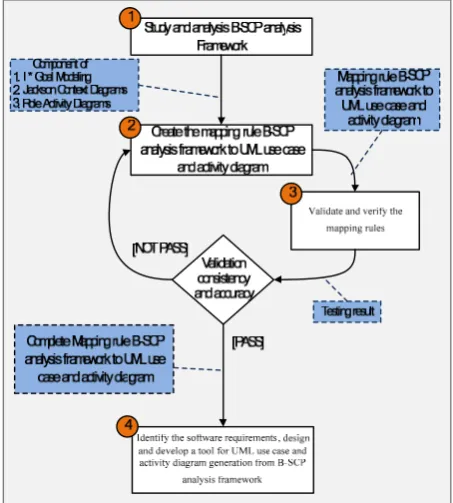
This section presents our research methodology to create UML use case and activity diagram that align to business strategy and to develop a software supporting tool step by step as shown in Fig 5.
A. Study and Analyze B-SCP Framework
The objective of the study and analysis of B-SCP framework is to understand the syntax and semantic of the element of each notations of techniques that have been applied in this framework.
B. Create the Mapping rule B-SCP Analysis Framework to UML Use Case and Activity Diagram
The results of the previous step will help map the basic elements of notations in B-SCP framework and UML use case and activity diagram elements. The mapping rule construction is sequentially divided into two steps. The first one is the mapping rule construction from i* Goal Modelling and Jackson context diagrams to UML use case diagrams. The second one is the mapping rule construction from role activity diagrams to UML activity diagram.
a) Construct a mapping rule for i* Goal Modelling and Jackson context diagrams to UML use case diagram
After analysing the elements of each component in the i* Goal Modelling and Jackson context diagrams, we map each element of it to each element of UML use case diagram in the context of semantic representation. The low-level of B-SCP framework based on i*Goal Modelling and Jackson context diagrams which is the system context is the input of the mapping. The mapping rule is shown in Table 2.
Fig. 5. Research methodology.
TABLE2:MAPPING RULE FOR I*GOAL MODELLING AND JACKSON CONTEXT DIAGRAMS TO UML USE CASE DIAGRAM.
Mapping rule Result: Mapping to use case diagrams
1.Notation “Context” of Jackson context diagrams maps to notation “Actor” in use case diagram.
Example of mapping notation “Context” of Jackson context diagram to notation “Actor” in use case diagram
2. Notation “Task” of i* Goal Modelling maps to
notation “Use-Case” in use case diagram. Example of mapping notation “Task” of i* Goal Modelling
to notation “Use-Case” in use case diagram
3. Notation “Oval” (requirement) of Jackson context diagrams maps to “System boundary” in
use case diagram. Example of mapping notation “Oval” (requirement) of
Jackson context diagrams to “System boundary” in use case diagram
4. Notation “Relation line” between i* Goal Modeling and Jackson context diagrams maps to “Relationship” in use case diagram.
b) Construct a mapping rule from Role Activity Diagrams to UML Activity diagram
Using the same concept as previous step, the mapping rule
from role activity diagrams applied in a system context level to UML activity diagram is constructed as shown in Table 3.
TABLE3:MAPPING RULE ROLE ACTIVITY DIAGRAMS TO ACTIVITY DIAGRAM.
Mapping rule Result: Mapping to activity diagrams
1.Notation “Black rectangle” of role Activity Diagrams maps to “Activity” in activity
diagrams. Example of mapping notation from “Black rectangle” of
Role Activity Diagrams to “Activity” in activity diagram.
2.Notation “Decision” of role Activity Diagrams maps to “Decision node” in activity diagrams.
Example of mapping notation from “Decision” of role Activity Diagrams to “Decision node” in activity diagram.
3.Notation “Interaction between role” of Role Activity Diagrams maps to “Control flow” in
activity diagrams. Example of mapping notation from “Interaction between role” of
Role Activity Diagrams to “Control flow” ” in activity diagram.
C. Validate and verify the mapping rules
Validate the mapping rule construction in terms of completeness and correctness evaluation criteria. If they do not conform to the evaluation criteria, the modification is performed. A case study in the real business case for a Loan Origination is also used to verify that the proposed mapping rules can be used in the target real environment.
D. Identify the software requirements, design and develop a tool for UML use case and activity diagram generation from B-SCP analysis framework.
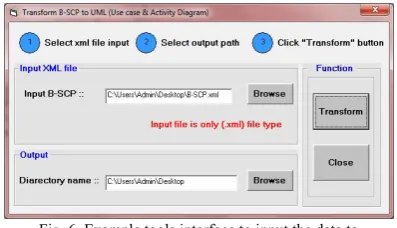
This section will identify the software requirements, design and develop a tool to generate UML use case and activity diagram the source notations used from B-SCP framework analysis. The example of user interface screen design for inputting i* Goal and Jackson context diagrams in order to product UML use case diagram is shown in fig. 6.
Fig. 6. Example tools interface to input the data to generate to UML use case and activity diagram.
V. THE APPLICATION OF THE PROPOSED WORK
This section describes the step by step of the application of
our proposed work to the case study, the Loan Origination for Bank for Agriculture and Agricultural Co-operatives (BAAC). The results of the application will illustrate that the business strategy is implemented in a software project as a software requirements and model using UML use case diagram and UML activity diagram. In the same meaning, we can assure that the IT implementation is aligned to the business strategy. The application of our work is as follows. A. Study and analysis of Loan Origination system case study
The aim of this step is to understand the business context; the problem domain especially the business process, roles and responsibilities associated the each activity in the process. The result of the study and analysis is described as follows.
The Loan Origination system of Bank for Agriculture and Agricultural Co-operatives (BAAC) aims to serve financial service for customer as farmers, agricultural cooperatives and individuals. Currently, this bank has 691 branch offices (based on 9 August 2011) to provide the banking service. B. Applying B-SCP analysis framework with Loan Origination strategy
According to B-SCP analysis framework, the organization vision, mission and goal must be defined in both organization and departmental level. Before we can generate the UML use case and activity diagram, we must create the diagrams based on B-SCP analysis framework will be used as an input of our proposed mapping construction. The results of applying B-SCP analysis framework is presented in 4.2.1-4.2.3.
a) Apply i* Goal Modelling
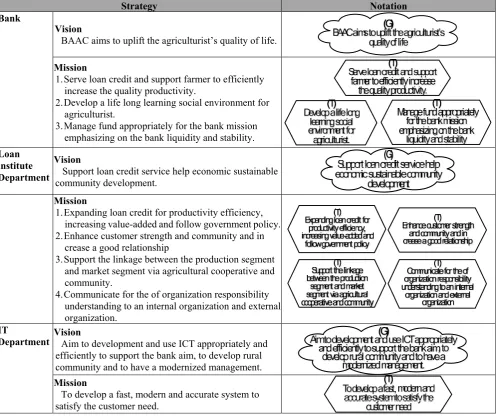
TABLE4:EXAMPLE OF APPLYING DEFINE BUSINESS STRATEGY OF CASE STUDY LOAN ORIGINATION SYSTEM WITH I*GOAL MODELING.
Strategy Notation
Bank
Vision
BAAC aims to uplift the agriculturist’s quality of life. Mission
1.Serve loan credit and support farmer to efficiently increase the quality productivity.
2.Develop a life long learning social environment for agriculturist.
3.Manage fund appropriately for the bank mission emphasizing on the bank liquidity and stability. Loan
institute Department
Vision
Support loan credit service help economic sustainable community development.
Mission
1.Expanding loan credit for productivity efficiency, increasing value-added and follow government policy. 2.Enhance customer strength and community and in
crease a good relationship
3.Support the linkage between the production segment and market segment via agricultural cooperative and community.
4.Communicate for the of organization responsibility understanding to an internal organization and external organization.
IT
Department VisionAim to development and use ICT appropriately and efficiently to support the bank aim, to develop rural community and to have a modernized management. Mission
To develop a fast, modern and accurate system to satisfy the customer need.
The results from table 4 is then used to construct i*Goal Modelling diagram as shown in Fig. 7.
Fig. 7. Applying i* Goal Modeling for organization’s goal, vision and mission development.
b) Apply Jackson Context Diagrams
The interest domain context is constructed based on the Jackson context diagrams. In our case study, there are two parts: the first one is a requirements list and the second one is the domain context composed of customer agent, bank agent
c) Apply role activity diagrams
For the loan credit analysis focusing on credit scoring process done by a loan officer, the business activities modelling using Role Activity diagrams is shown in Fig. 10.
Fig. 8. Example applying problem frame with case study Loan Origination system
Fig. 9. Credit scoring process of Loan Origination system : part of customer type is agricultural.
Fig. 10. Credit scoring process to role activity diagrams
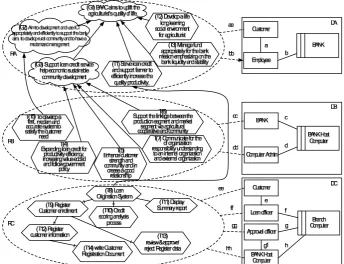
d) Integrated between i* Goal Modelling and Jackson context diagrams
This part shows the integral result of the case study for the application of i* Goal Modeling and Jackson context diagrams.
1) Domain DA and set of requirements RA
DA-RA describes the necessary tasks (T1-T3) to serve to business goal achievement (G1-G3). Domain DA defines the relation between employee and bank (b) to serve customer service on loan credit approval (a) as shown in the top part of fig. 11
2) Domain DB and set of requirements RB
DA-RA describes the main goal to achieve business strategy. The refinement step is needed to detail in the lower
level mission of the organization structure which is at the departmental level as shown in DB-RB in the middle part of fig. 11.
3) Domain DC and set of requirements RC
DC-RC is defined the necessary subtasks as software requirements list declared in DA-RA Serve loan credit and support farmer to efficiently increase the quality productivity. as shown in the bottom part of fig. 11. From this fig. 11 we can see the tasks and subtasks defined in an IT area to serve the organization business strategy. This explicitly shows the harmonization of the organization structure responsibilities in the aspect of IT alignment to the organization goal. C. Verify the consistency between business strategy and software requirements
This step aims to verify the consistency between the business strategy and software requirements base on B-SCP framework [1] via contribution link according to the completeness and correctness of the agent role and responsibilities in the problem domain context to serve the business strategy.
D. Apply the proposed mapping rule to construct UML use case and activity diagram
This section shows the result of the application of the proposed mapping rule to the case study.
a) Applying mapping rule i* Goal Modelling and Jackson context diagrams to use case diagrams.
The use case diagram is created from i* Goal Modelling and Jackson context diagrams to specify the software function as shown in Fig. 12.
b) Applying mapping rule Role activity diagrams to activity diagrams.
The activity diagram is created from Role activity diagrams to model the business process of credit scoring analysis process as shown in Fig. 13.
VI. CONCLUSION
This research proposed a mapping rule for UML use case and activity diagram construction based on B-SCP analysis framework with the objective to show the software requirements and modelling in an IT area that aligns to the organization strategy. The application of our proposed mapping rule is illustrated using the loan origination system of Bank for Agriculture and Agricultural Cooperatives. The prototype of a supporting tool is also developed to facilitate the application of the mapping rules in an automatic fashion. Our future work will be focused on improvement of the tool capability by inputting feedback from target users such as the system analysts who work in the bank case study.
VII. LIMITATION
supporting tools does not support the syntax checking.
Fig. 11. Loan Origination system progression of problems: combined goal model and context diagrams.
Fig. 12. Example mapping i* Goal Modelling and Jackson context diagrams to use case diagram : Loan Origination case study.
Fig. 13. Example mapping Role activity diagrams to activity diagram : credit scoring analysis process Loan Origination case study.
REFERENCES
[1] S. J. Bleistein, K. Cox, and K. T. Phalp, “B-SCP: A Requirements Analysis Framework for Validating Strategic Alignment of Organizational IT Based on Strategy, Context, and Process,” Special Issue Section: Distributed Software Development, Elsevier, 2006, vol. 48, pp. 846-868.
[2] J. Kim, S. Park, and V. Sugumaran, “DRAMA: A framework for domain requirements analysis and modeling architectures in software product line.” Journal of Systems and Software, Elsevier, 2008, pp. 37-55.
[3] K. Cox, K. T. Phalp, S. J. Bleistein, and J. M. Verner, “Deriving requirements from process models via the problem frames approach,”
Journal of Information and Software Technology, Elsevier, vol. 47, issue 5, 2005.
[4] S. J. Bleistein, K. Cox, and J. M. Verner, “Validating strategic alignment of organizational IT requirements using goal modeling and problem diagrams,” Journal of Systems and Software, Elsevier, vol. 79, issue 3, 2006.
[5] P. Clements and L. Bass, “Using Business Goals to Inform a Software Architecture,” Requirement Engineering Conference (RE) 2010 18th IEEE International, IEEE, 2010, pp. 69-78.
[6] L. Lin and J. Zhi, “Requirements Analyses Integrating Goals and Problem Analysis Techniques,” Tsinghua Science & Technology, 2007, vol. 12. Issue 6, pp. 729-740.
[7] J. Kim, M. Kim, and S. Park, “Goal and Scenario Based Domain Requirements Analysis Environment,” 11th Asia Pacific Software Engineering Conference (APSEC2004), 2006, vol. 79, issue 7, pp. 926-938.
[8] C. Pietro, K. Ferhat, and L. Luigi, “Bridging the gap between requirements and design: An approach based on Problem Frames and SysML,” The Journal of Systems and Software, Elsevier, 2011. [9] L. Liu and E. Yu, “From Requirements to Architectural Design –Using
Goals and Scenarios,” The First International Workshop From Software Requirements to Architectures (STRAW01) at ICSE 2001, Toronto.Canada, 2001.
[10] J. G. Hall, M. Jackson, R. C. Laney, B. Nuseibeh, and L. Rapanotti, “Relating Software Requirements and Architectures using Problem Frames,” in Proceedings of the 10th Anniversary IEEE Joint International Conference on Requirements Engineering (RE ‘02), USA, IEEE, 2002.
Requirements,” Software Engineering Conference APSEC ’09 Asia-Pacific, IEEE, 2009, pp. 35-42.
[12] E. Yu, “Modeling organizations for information systems requirements engineering,” IEEE International Symposium on Requirements Engineering, IEEE, 1993
[13] S. J. Bleistein, K. Cox, and J. M. Verner, “Strategic alignment in requirements analysis for organizational it: an integrated approach,”
20th ACM Symposium on Applying Computing (SAC’05), Santa Fe, NM,
USA, 2005.
[14] M. Jackson, Problem Frames: Analyzing and Structuring Software Development Problem first ed., Addison-Wesley, Reading, MA, 2001. [15] M. Jackson, Software Requirements& Specifications: A Lexicon of
Practice, Principles, and Prejudices, ACM Press/Addison-Wesley, New York/Wokingham, 1995.
![Fig. 3. An elements example of a role activity diagrams. [1]](https://thumb-us.123doks.com/thumbv2/123dok_us/1318586.1639752/2.595.330.531.502.603/fig-elements-example-role-activity-diagrams.webp)