Abstract—In this paper, we study the challenging problem of optimizing gateway placement for throughput in Wireless Mesh Networks and propose a novel algorithm based on Ant Colony Optimization (ACO) for it. The ACO algorithm is originated from ant behavior in the food searching based on pheromone. We generate the locations of gateway randomly and independently then calculate the probability and pheromone values of ants will choose to go from current gateway i to next client j. After each iteration, the pheromone values are updated by all the number of ants that have reached to the destination successfully and found a optimal solution. Numerical results show that the proposed algorithm has achieved much better than previous studies.
Index Terms—Wireless mesh networks, gateway placement, ant colony optimization.
I. INTRODUCTION
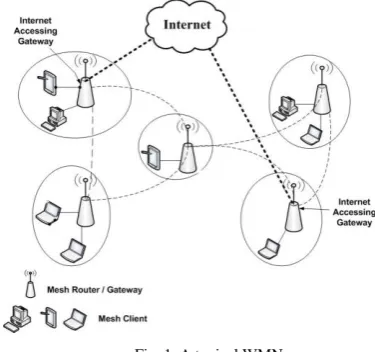
A wireless mesh network (WMN) is a communication network made up of radio nodes organized in a mesh topology, which often consists of mesh clients, mesh routers and gateways [1]. The mesh clients are often laptops, cell phones and other wireless devices, which are connected to the Internet through the mesh routers. The mesh routers forward traffic to and from the gateways which connected to the Internet. The coverage area of the radio nodes working as a single network is sometimes called a mesh cloud. Access to this mesh cloud is dependent on the radio nodes working in harmony with each other to create a radio network. A mesh network is reliable and offers redundancy. When one node can no longer operate, the rest of the nodes can still communicate with each other, directly or through one or more intermediate nodes. Wireless mesh networks can be implemented with various wireless technology including 802.11, 802.16, cellular technologies or combinations of more than one type.
A wireless mesh network has some features which are similar to wireless ad-hoc network. It is often assumed that all nodes in a wireless mesh network are immobile but this is not necessary. The mesh routers may be highly mobile and
Manuscript received August 12, 2012; revised September 27, 2012. Dac-Nhuong Le is with the Faculty of Information Technology, Haiphong University, Vietnam (e-mail: Nhuongld@ hus.edu.vn).
Nhu Gia Nguyen is with the Duy Tan University, Danang, Vietnam (e-mail: [email protected]).
Nghia Huu Dinh is with the School of Graduate Studies, Vietnam National University, Vietnam (e-mail: [email protected]).
Nguyen Dang Le is with Haiphong University, Vietnam (e-mail: Nguyenld@ hus.edu.vn).
Vinh Trong Le is with the Faculty of Mathematics, Mechanics and Informatics, Hanoi University of Science, Vietnam National University (e-mail: [email protected]).
are not limited to power, memory, calculating ability and operate as intelligent switching devices. Fig. 1 presents an example of a WMN.
In recent years, the optimizing WMN problem is interested in many researches. However it still remains open [1]. In there, gateway placement is the most interested problem in optimizing WMN. There are some analogous research results in wired or cellular networks. However, all the above investigation has been focused on network connectivity of WMNs by deploying the minimum number of backbone nodes [2].
Throughput is one of the most important parameters that affect the quality of service of WMN. So in this paper, we will improve a gateway placement algorithm to optimize throughput for WMNs. A similar problem was studied by Ping Zhou, Xudong Wang, B. S. Manoj and Ramesh Rao in [2], however, their scheme was not updated step by step, and the locations of gateways were determined sequentially, so the location of previously-placed gateways affects the location of those placed later. In the latest paper have published in [3]-[4], we was studied the challenging problem of optimizing gateway placement for throughput in Wireless Mesh Networks and propose a novel algorithm based Particle Swarm Optimization (PSO) algorithm. They are generated randomly and independently, updated step by step with the best method, so quickly find the optimal scheme and achieve better result than previous studies.
Fig. 1. A typical WMN
Constructing computation model to calculate the throughput of WMNs is very necessary, but it is not simple to build. There are many computation models built in [5]-[10], but all of them, except [10], are not suitable for calculating throughput of WMNs. In this paper, we use the computation model in [2], in which TDMA scheduling is assumed to coordinate packet transmissions in mesh clients, mesh routers, and gateways.
Optimizing Gateway Placement in Wireless Mesh
Networks Based on ACO Algorithm
The rest of this paper is organized as follows. Section II presents the computation model and briefly introduces the main idea of MTW-based gateway placement proposed in [2]. Section III presents our new algorithm for gateway placement in optimizing WMN based on ACO. Section IV presents our simulation and analysis results, and finally, Section V concludes this paper.
II. MTW-BASED GATEWAY PLACEMENT
In this section, we first present the computation model and briefly introduce the main idea of MTW-based gateway placement proposed in [2]
A. Computation Model 1) Network topology
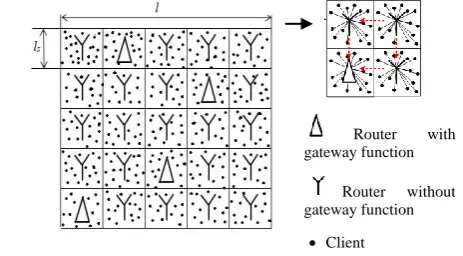
The computation model presented in [2] brings out a typical WMN topology for Internet accessing as follows and is illustrated in Fig. 2. This topology has Nc mesh clients
which are assumed to be distributed on a square R, Nrrouters,
and Ng gateways with the constraint of 1 ≤ Ng ≤ Nr≤ Nc.
According to [11] R is partitioned evenly into Nr cells Rj, and
a mesh router is placed in the center of each cell. In each cell, mesh clients are connected to the mesh router like a star topology and are not communicated with each other directly. Data transmission is carried out among mesh clients, which are equivalent such that they always have the same amount of packets to send or receive during a certain time, while the mesh routers find the best route and forward data to its destination. All traffic is assumed to go through gateways. Each mesh router determines its nearest gateway to relay packets to or from that. If there is more than one nearest gateways, the router will load its traffic to all its nearest gateways by a round robin. A mesh client is said to be associated with a gateway if its connected router is associated with the gateway. Thus, traffic load of a mesh client will also be shared by all its potentially associated gateways.
I.
Router with gateway function
Router without gateway function
Client
Fig. 2. Network topology of an WMN infrastructure with gateways.
There are some definitions of communications which will be frequently used:
Local communications: it is referred as the communications between a mesh router and a mesh client;
Backbone communications: it is referred as the communications between two mesh routers, which includes the communications between a gateway and a mesh router;
Downlink communications: it is referred as the communications from a gateway to a mesh client, in
which a data packet is first relayed among mesh routers in backbone communications and is then sent by a mesh router to one of its connected mesh clients;
Uplink communications: it is referred as the communications from a mesh client to a gateway, in which a data packet is sent in the exact reverse direction as described in the downlink communications.
2) Transmission model
Each mesh router is often equipped with two virtual radio interfaces over one physical radio interface, in which one transmitting at W1 bits/s for backbone communications and
the other transmitting at W2 bits/s for local communications.
Each mesh client transmits W2bits/s in local communications.
It is assumed that W1 and W2 are orthogonal so that local
communications and backbone communications do not influence each other.
Moreover, mesh routers or mesh clients can receive packets from only one sender at a time. Transmission and reception can occur in either time-division duplex (TDD) or frequency division duplex (FDD), depending on how the physical and MAC layers are implemented.
3) Throughput
The computation model proposed in [2] introduces two criterions to evaluate the performance of gateway placement algorithms: the total of throughput and the minimal throughput of each client. In this paper, we also use these criterions to evaluate the performance of our algorithm.
Problem 1: Optimal gateway placement for maximizing aggregate throughput of WMNs, i.e., in the above WMN model, given Nc, Nr, Ng, W1, W2 and specific clients’
distribution, routers’ distribution, transmission, scheduling and routing protocols, Ng gateways are chosen among Nr
mesh routers such that,
1
( , ) c
N
g i
TH i N
(1)is maximized, where TH(i,Ng) denotes the per client
throughput of the ith mesh client when Ng gateways are deployed.
Problem 2: Optimal gateway placement for maximizing the worst case of per client throughput in the WMN, i.e., in the above WMN model, given Nc, Nr, Ng, W1, W2 and specific
clients’ distribution, routers’ distribution, transmission, scheduling and routing protocols, Ng gateways are chosen among Nr mesh routers such that, is maximized.
) , ( min
1 g
N
i TH i N
c
(2)
4) Sharing efficiency of gateways
IntD is defined as Interfering Distance of Gateways. If distance of two gateways less than IntD, they interfere with each other. Interfering gateways have to share the same wireless channel in the backbone communications. The algorithm to calculate the sharing efficiency of gateways is presented as follows.
1) Constructing the table of non-overlapping interfering groups arranged in descending order of the number of elements in the group.
top to the last row in the above table.
In the first step, any two elements of each group that interfere with each other, and a group appearing later must have at least one gateway which does not belong to the previous groups.
The procedure that calculates percentage value for the gateways is described as follows:
Assign value of 100% for all the gateways.
For the top row to the last row of the table in the first step k=1/the number of gateways in current group.
For the first gateway to the last gateway in current group If percentage value > k then push into subgroup1 Else push into subgroup2.
End for.
P=
1-sum of all the percentage value in subgroup2 the number of the gateways in subgroup1
Assign value of P for all gateways in subgroup1. End for.
The final computing value is stored in Geff (k), k=1..Ng.
5) Throughput computation
Throughput of the ith mesh client when Ng gateways are
deployed, denoted as TH(i,Ng), is calculated as follow:
TH(i, Ng)= min{ THW1(i, Ng), THW2(i)},
i=1…Nc. (3)
Here, THW1(i, Ng) is defined as the throughput of the ith
mesh client in backbone communications and THW2(i) is
defined as the throughput of ith mesh client in local communications. Because W1 and W2 are orthogonal, so we
can compute THW1(i, Ng) and THW2(i) separately. Note that
THW2(i) is independent of Ng in WMN model and if a mesh
client is connected directly to a gateway, its throughput is decided only by the per-client throughput in local communications.
THW1(i, Ng) is computed as follows:
) ( ) ( ' ) , (
1 N j
k TH N i TH g R router mesh the with gateways associated the all k g g W j
(4)
Here, Ng(j) is the number of gateways associated with the
mesh router Rj. A gateway is associated with a router if the distance between them is less than or equal the radius of that gateway. The computation of the radius of gateway is proposed in sub-section II.2 . TH’g(k) is the throughput per
client that the kth gateway can guarantee for all its associated mesh clients in backbone communications.
gateway k the with routers associated all l g hop c eff g th l N l N l N W c k G k TH )) ( ) ( ' ) ( ( ) ( ) (' 1 1 (5)
Here c1W1 is the throughput that the kth gateway can
guarantee in backbone communications, Nc(l) is the number
of clients associated with the mesh lth router. Nhop’(l) is the
actual time slot that the Rl-connected mesh client uses to transmit data to the gateway.
Nhop’(j)=Nhop(j), if Nhop(j) < SRD; (6)
Nhop’(j)=SRD, if Nhop(j) ≥ SRD;
Here, Nhop(j) is the number of hops from the mesh client to
the gateway. SRD is defined as Slot Reuse Distance. Next, THW2(i) is computed simply as follows:
c c
W i N
j N CRF W c i
TH , 1..
) ( )
( 2 2
2
(7)
Here, c2W2 is the throughput that Rj can guarantee for all
associated mesh clients. CRF is defined as Cell Reuse Factor. B. The Original MTW-Based Gateway Placement
In this algorithm, a traffic-flow weight, denoted as MTW(j), is calculated iteratively on the mesh router Rj, j=1..Nr. Each
time, the router with the highest weight will be chosen to place a gateway. The weight computation is adaptive to the following factors:
1) The number of mesh routers and the number of gateways.
2) Traffic demands from mesh clients.
3) The location of existing gateways in the network. 4) The interference from existing gateways.
First of all, this algorithm proposes a formula to compute the gateway radius.
) 2 ( g r g N N round
R (8)
Assuming all mesh clients are similar in WMN model, then local traffic demand on each mesh router, denoted as D(j), j=1..Nr, represented by the number of mesh clients
connected to Rj.
MTW(j) is calculated with D(j) and Rg as follows:
MTW(j)=( Rg+1)× D(j)
+ Rg×(traffic demand on all 1-hop neighbors of Rj) + (Rg-1)×(traffic demand on all 2-hop neighbors of Rj) + (Rg-2)×(traffic demand on all 3-hop neighbors of Rj) +…
Place the first gateway on the router with highest MTW(j). If more than one gateways are requested, re-adjust D(j), j=1..Nr with Rg as follows: set the value 0 for all routers
within (Rg-1) hops away from Rj(including Rj) and reduce to
half for gateways which are Rg hops away from Rj.
Re-calculate MTW(j) with the new D(j), and perform the following procedure.
1) Choose the router with the highest weight as potential location for gateway placement, namely Rj.
2) Re-construct the table of non-overlapping interfere groups with Rj and previous gateways.
3) Compute the sharing efficiency for Rj. 4) MTW’(j) = MTW(j) × Geff(j)MTW’(j).
If MTW’(j) is still larger than the second highest weight, then place the gateway in the location. Otherwise, repeat the above steps from 1 to 5 until obtaining the location
III. APPLY ACOALGORITHM TO GATEWAY PLACEMENT
PROBLEM
pheromone concentration the other ants choose appropriate path. The paths with the greatest pheromone concentration are the shortest ways to the food. The optimization algorithm can be developed from such ant behavior. The first ACO algorithm was the Ant System [12], and after then, other implementations of the algorithm have been developed [13]-[14].
A. Expressing an Element
In our case the pheromone matrix is generated with matrix elements that represent a location for ant movement, and in the same time it is possible receiver location. Assume that the WMN model, presented in Section II-1, is divided into N cells and numbered from left to right and from top to bottom. In this paper, we use integer encoding to express an element of matrix Am*n (m is the number of gateways, n is number of
client). aij will then receive a random integer generated
correlatively .
The pseudo code of the procedure for each element 1) Determine the location of gateways.
2) Compute the throughput achieved. B. Population Initialization
The ant population is randomly generated (50 ants) and each ant is associated to one matrix location (node). Location of ants is an integer, randomly generated, corresponding to the interval of [0, N-1].
C. Cost function
The next node (location) is selected according to the probability with which ant k will choose to go from current gateway i to next client j is calculated by the following formula:
k i
ij ij
k ij
ij ij
l N
p
(9)In which,
ijis the pheromone content of the path fromgateway i to client j, Nik is the neighborhood includes only locations that have not been visited by ant k when it is at gateway i, ηij is the desirability of client j, and it depends of optimization goal so it can be our cost function. The influence of the pheromone concentration to the probability value is presented by the constant α, while constant β do the same for the desirability. These constants are determined empirically and our values are α=1, β=10. The ants deposit pheromone on the locations they visited according to the relation.
new current k
j j j
(10) where
kj is the amount of pheromone that ant k exudes to the client j when it is going from gateway i to client j. This additional amount of pheromone is defined by1
k j
j
f
(11)
where fj is the cost function of the client j is computed by the
formula (3). The pheromone evaporates during time and diminishes if there are no new additions. The pheromone
evaporation is applied to all locations as follows
1
0 1
new
j j
(12) The value of ρ is selected empirically, what is in our case ρ= 0.1.IV. NUMERICAL RESULTS AND DISCUSSION
According to numeric results in [2], the MTW-based Gateway Placement Algorithm is better than three gateway placement algorithms: Random Placement (RDP), Busiest Router Placement (BRP), and Regular Placement (RGP). Therefore in this paper we only compare our algorithm with MTW-based gateway placement algorithm.
We study two experiments. In the first experiment we assume Nc=200, Nr=36, l=1000m, i.e. there are 200 mesh
clients distributed in a square region of 1000m x 1000m; the square is split evenly into 36 small square cells and a mesh router is placed in the center of each cell. Concurrently, we assume CRF = 4, SRD =3, IntD=2, the backbone bandwidth is 20Mbps and the local bandwidth is 10Mbps. The second experiment is similar to the first one, but in which Nc=400,
Nr=64. The local traffic demand of each mesh router in all
experiments is generated randomly.
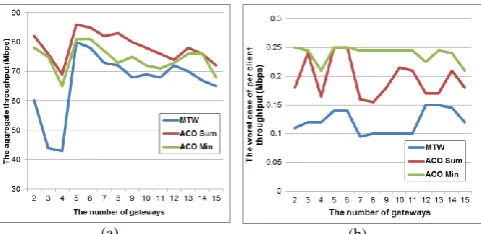
In each experiment, we optimize the gateway placement problem by maximum one of two parameters: the total throughput of all mesh clients, denoted as ACO_Sum, and the minimal throughput of each mesh client, denoted as ACO_Min. Then we compare our results with the results achieved by MTW-based gateway placement algorithm.
Firstly, we compare the aggregate throughput and the worst case throughput achieved by each algorithm, as shown in Fig. 3 and Fig. 4. We find that the results achieved by our algorithm are better than the results achieved by MTWP algorithm in all experiments.
Next, we easily realize the fact that when the number of gateways increase, the throughput might not be better. So when designing the WMN, it is necessary to choice the number of gateways suitably to maximum the throughput of WMN and reduces the cost.
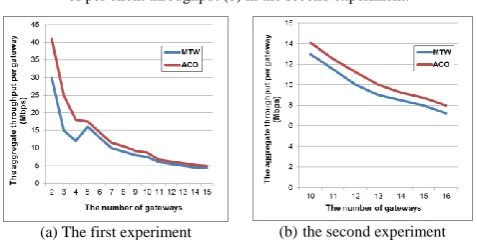
Final, we compare throughput per gateway of two gateway placement algorithm, as shown in Fig. 5a and Fig. 5b. The results show us once again the superiority of the algorithm proposed in this paper.
(a) (b)
(a) (b)
Fig. 4. The comparison of the aggregate throughput (a) and the worst case of per client throughput (b) in the second experiment.
(a) The first experiment (b)the second experiment
Fig. 5. The comparison of the aggregate throughput per gateway.
V. CONCLUSION AND FUTURE WORK
The problem of gateway placement in WMNs for enhancing throughput was investigated continuously in this paper. A gateway placement algorithm was proposed based on ant colony optimization. A non-asymptotic analytical model was also derived to determine the achieved throughput by a gateway placement algorithm. Based on such a model, the performance of the proposed gateway placement algorithm was evaluated. Numerical results show that the proposed algorithm has achieved much better performance than other schemes. It is also proved to be a cost-effective solution. The ACO algorithm doesn't converges so fast and its result is little worse than PSO [4, 15]. Optimizing gateway placement together with throughput maximization is our next research goal.
REFERENCES
[1] F. Akyildiz, X. Wang, and W. Wang, “Wireless mesh networks: a survey,” Computer Networks and ISDN Systems, vol. 47 no.4, pp. 445-487, 15 March 2005.
[2] P. Zhou, X. Wang, B. S. Manoj, and R. Rao, “On optimizing gateway placement for throughput in wireless mesh networks,” Journal on Wireless Communications and Networking vol. 2010, pp. 12, 2010. [3] V. T. Le, N. H. Dinh, and N. G. Nguyen, “The minimum numbers of
gateway for maximizing throughput in wireless mesh networks,” in
Proc. 2nd International Symposium on Information and
Communication Technology (SoICT 2011), Ha Noi, Viet Nam, 2011. [4] V. T. Le, N. G. Nguyen, and D. H. Nghia, “A novel PSO-based
algorithm for gateway placement in wireless mesh networks,”in Proc, 3rd IEEE International Conference on Communication Software and
Networks (ICCSN), China, 2011, pp. 41-46.
[5] P. Gupta and P. R. Kumar, “Internets in the sky: The capacity of three dimensional wireless networks,” Commun. Inform and Syst., vol. 1, no. 1, pp. 33-49, Jan 2001.
[6] M. Grossglauser and D. Tse, “Mobility increases the capacity of ad-hoc wireless networks,” in Proc IEEE Infocom vol.1, 2001. [7] B. Liu, Z. Liu and D. Towsley, “On the capacity of hybrid wireless
networks,” in Proc IEEE Infocom vol. 3, 2003.
[8] U. C. Kozat and L. Tassiulas, “Throughput capacity of random ad hoc networks with infrastructure support,” in Proc ACM Mobicom vol. 3, 2003.
[9] A. Zemlianov and G. de Veciana, “Capacity of ad hoc wireless networks with infrastructure support,” IEEE J. Sel. Areas Commun., vol. 23, no. 3, pp. 657-667, Mar. 2005.
[10] P. Zhou, X. Wang, and .R. Rao, “Asymptotic capacity of infrastructure wireless mesh networks,” IEEE Transaction on Mobile Computing, vol. 7, no. 8, pp. 1011-1024, Aug. 2008.
[11] J. Robinson and E. Knightly, “A performance study on deployment factors in wireless mesh networks,” in Proc. IEEE Infocom 2007, pp. 2054-2062, May 2007.
[12] M. Dorigo, V. Maniezzo, and A. Colorni, “Ant system: Optimization by a colony of cooperating agents,” IEEE Trans. on System, MAN, and Cybernetics-Part B, vol. 26, pp. 29-41, February 1996
[13] E. R. Iglesias and O. Q. Teruel, “Linear array synthesis using an ant colony optimization based algorithm,” IEEE Trans. on Antennas and Propagation, 2005.
[14] M. Dorigo, M. Birattari, and T. Stitzle, “Ant colony optimization: Arificial ants as a computational intelligence technique,” IEEE Computational Intelligence Magazine, November, 2006.
[15] J. Kennedy and R. Eberhart, “Particle swarm optimization,” in
Proceedings of IEEE International Conference on Neural Networks, pp. 1942–1948, 1995.
Dac-Nhuong Le received the BSc degree in computer science and the MSc degree in information technology from College of Technology, Vietnam National University, Vietnam, in 2005 and 2009, respectively. He is currently a lecture at the Faculty of information technology in Haiphong University, Vietnam. His research interests include algorithm theory, computer network and networks security.
Nhu Gia Nguyen received the BSc degree in computer science and the MSc degree in information technology from Dannang University, Vietnam, in 1998 and 2006, respectively. He currently works in Duy Tan University, Danang, Vietnam. His research interests include algorithm theory, network and wireless security.
Nghia Huu Dinh received the BSc degree in computer science and the MSc degree in information technology from Vietnam National University in Hanoi, Vietnam, in 2006 and 2011, respectively. He currently works in School of Graduate Studies, Vietnam National University. His research interests include algorithm theory, network and wireless security.
Nguyen Dang Le received the BSc degree in computer science and the MSc degree in information technology from College of technology, Vietnam National University in Hanoi, Vietnam, in 1996 and 2005, respectively. He currently works in Haiphong University, Vietnam. His research interests include algorithm theory, network and wireless security.