Original Research Article
Awareness, acceptance and practice of plastic ban legislation among
residents of an urban area in Kanchipuram district, Tamil Nadu:
a cross sectional study
Sujitha P.*, Swetha N. B., Gopalakrishnan S.
INTRODUCTION
Earth provides its valuable resources to satisfy every man’s necessity. But human beings are misusing earth’s resources for their greed. There has been a gradual change in the global environment, which has led to a challenging phase to living creatures due to the fact that each nation is focusing on its development without taking environment into consideration. Rampant use of plastics is considered one of the key factors contributing to the
earth’s pollution. Plastics are being used on day to day basis in every part the world.
The word plastic is derived from a Greek word “Plastikos”, which means “fit for moulding” and are materials of synthetic or semi-synthetic nature that are malleable.1 Plastics being long chain polymers contain inorganic materials such as styrene which contributes to their non-biodegradable property.1 Plastics take up to 500 to 1000 years to degrade. Plastic bags are an
ABSTRACT
Background: Convenience of plastic use pays a high price by negatively affecting health and environment. As nationwide ban on use of plastic carry bags failed, statewide ban was imposed in Tamil Nadu from 1st January 2019. This study was planned with the objective of determining the awareness, acceptance and practice of plastic ban legislation among residents in urban population in Kancheepuram district, Tamil Nadu.
Methods: This community based cross sectional study was carried out with a sample size of 250 using systematic random sampling method. Data was collected using structured questionnaire and further analysis was done with SPSS Version 25 Software.
Results: About 94% respondents were aware of legislation and 76% had a positive attitude towards the ban. About 52% participants continued using plastic bags despite the ban. Common source of knowledge about the ban was mass media (42%). About 80% were aware of the negative effects of plastic use and 70% were aware that plastics are non-bio-degradable. Statistically significant association was found between various socio demographic factors with the use of plastic bags. Alternate eco-friendly bags usage was found among 48% of respondents.
Conclusions: Good awareness level about the ill effects of plastic use and its ban was observed but the level of implementation in their daily life was poor. Even after the preparatory period of six months given to get accustomed to eco-friendly alternatives, the use of plastic bags still remains rampant. IEC activities need to be intensified to bring about changes in the attitude and practice of plastic use.
Keywords: Carry bags, Attitude, Eco-friendly, Alternatives
Department ofCommunity Medicine, Sree Balaji Medical College and Hospital, Chennai, Tamil Nadu, India
Received: 07 November 2019
Revised: 11 December 2019
Accepted: 12 December 2019
*Correspondence:
Dr. Sujitha P.,
E-mail: [email protected]
Copyright: © the author(s), publisher and licensee Medip Academy. This is an open-access article distributed under the terms of the Creative Commons Attribution Non-Commercial License, which permits unrestricted non-commercial use, distribution, and reproduction in any medium, provided the original work is properly cited.
environmental disaster. Convenience of plastic use pays a
high price by negatively affecting health and
environment. Using plastics on daily basis leads to polluted environment.2 Though the discovery of plastic has paved way to various inventions, it has also ended up being hazardous to health and environment.
About 22-43% of the plastics that are disposed are accumulated in landfills and nearly 10-20 million tons find their way to the oceans. This huge volume of plastics has become hazardous because of the insufficiency to recycle them.3 Direct disposal (littering or dumping) in the landfills, dumping in rivers, clogging and incineration (burning) of these wastes have direct ill effects towards health and environment. When the polluted water reaches household, they serve as a medium of transport for many diseases.4 The waste materials are often burnt on the roadside which liberates toxic gases polluting the area and posing health hazards.5 These gases might have carcinogenic effects on health. Though there are many programs to solve the waste problems, negative consequences still remain marked. Western Countries do the recycling by exporting the plastic wastes to Asian countries where recycling is done by using cheap laborers who are paid very less. The increased push for uncontrolled trade and neo-liberal policy has hiked in intensifying these activities.2
Recent research works points out that burning plastic wastes in the backyards are more hazardous than it was thought. Burning polystyrene polymers like cups, egg trays, plates etc., releases styrene which is highly toxic, which gets readily absorbed through skin and lungs thereby affecting various systems of the body. This increases the risk of cardiovascular diseases, aggravates respiratory illnesses and has negative effects over renal, hepatic, nervous systems etc.6
In India nearly 4.5 million tons of plastic wastes are generated.7 On an average, production of plastic globally crosses 150 million tonnes per year.8 It is estimated that approximately 70% of plastic packaging products are converted into plastic waste in a short span.8 According to the reports for year 2017-18, Central Pollution Control Board (CPCB) has estimated that India generates approximately 9.4 Million tonnes per annum plastic waste, (which amounts to 26,000 tonnes of waste per day), and out of this approximately 5.6 Million tonnes per annum plastic waste is recycled (i.e. 15,600 tonnes of waste per day) and 3.8 million tonnes per annum plastic waste is left uncollected or littered (9,400 tonnes of waste per day).9 While these statistics are 38% higher than the global average of 20%, there are no comprehensive methods in place for plastic waste management. Additionally, there is a constant increase in plastics waste generation. One of the major reasons for this is that 50% of plastic is discarded as waste after single use. This also adds to increase in the carbon footprint since single use of plastic products increase the demand for virgin plastic products.
Considering all these factors, the Government of India notified plastic waste management rules 2016 amending the existing rules, imposing a nationwide ban on plastic carry bags less than 50-micron thickness, among other things. However this ban didn’t bring about any noticeable reduction in the pollution caused by plastic carry bags, the most notorious among the “Use and throwaway” plastics that makes half of the plastic pollution. Feeling an urgent need to address the issue, the Government of Tamil Nadu has come up with a stringent approach by imposing a statewide ban on certain “use and throwaway” plastics on June 5th 2018, which was
effective from 01 January 2019.10
Based on the above background, this study was carried out with the objective to determine the awareness, acceptance and practice of plastic ban legislation among residents of an urban area in Kancheepuram district, Tamil Nadu, India, in order to ascertain the gaps existing in the study area and to plan possible corrective measures.
METHODS
Study design
This is a community based cross sectional descriptive study.
Study area and population
The study was conducted in Anakaputhur, the urban field practice area attached to a medical college in Kancheepuram district, Tamil Nadu. The total population in the study area is about 48050 (males24158, females -23892) and the total number of households are 1851. The study population included individuals residing in the study area and aged above 18 years. The study was done for a period of six months, from February 2019 to July 2019.
Sample size and sampling technique
The sample size was calculated based on the prevalence of awareness of plastic ban legislation from a study done by Joseph et al, in the year 2013 in Mangalore which showed that 85% of the population were aware of the plastic ban legislation.11 Using the formula 4pq/d2, with the allowable error of 5%, the sample size was calculated to be 204. Adding 10% non-response rate, the sample size was calculated to be 224, which were rounded off to 250.
was selected. From that house, the next 7th household was selected. This procedure was followed till the desired sample size was reached. One individual in the age group of 18 and above residing in the selected household was selected using the KISH method.
Inclusion and exclusion criteria
Resident individuals aged 18 years and above and willing to participate were included in the study. Residents whose house was locked on the day of data collection, those who were mentally unstable, sick and bed ridden were excluded from the study.
Data collection
Data was collected from eligible and willing participants using a pre-tested, structured interviewer administered questionnaire. Socio-demographic information including age, gender, occupation, education, marital status and socio economic status were collected. The awareness of the participants about the plastic bag ban legislation, knowledge on effects of plastic on health and environment, acceptance of the ban legislation and practices related to plastic usage after the ban were also collected.
Statistical analysis
Data collected were entered in Microsoft Excel and analysis was done in SPSS software version 25.0. Data
was analysed using Descriptive and Analytical
statistics.Chi-square test was used to compare the differences in proportions with the significance level set at p≤0.05. Binary logistic regression model, which included variables with statistical significance on the Chi-square test, were used to examine factors associated with awareness, acceptance and practice of plastic ban legislation among the participants. Odds ratio (OR) with 95% confidence intervals was used to report the association between the exposure variables and outcome variables.
Ethical approval and informed consent
Ethical approval was obtained from Institutional Ethics Committee of Sree Balaji Medical College and Hospital. Written Informed consent was obtained from the study participants before data collection, after explaining about the objectives of the study.
RESULTS
The results of study conducted among 250 participants in the field practice area of Kancheepuram district on the awareness, acceptance and practice of plastic ban legislation are presented using tables and figures.
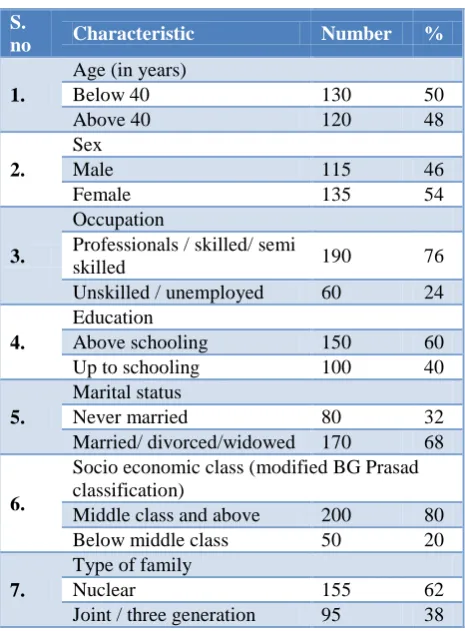
The socio demographic characteristics of the study participants are summarized in Table 1. Study
participants belonged to age group 19 to 64 years. The mean age of the study participants was calculated to be 41±13.4 years. About 52% of the respondents belonged to age group 19-39 years and nearly 20% belonged to age group 40-49 years. Female participants (54%) were comparatively higher than male (46%) participants. Regarding occupational status of the study participants nearly 60% were technicians / skilled workers, 18% unskilled workers, 12% were semi skilled workers, 6% unemployed and remaining 4% were professionals. With regards to education, 56% of the study participants were
graduates. According to modified BG Prasad
socioeconomic classification (2017), 40% belonged to middle class and 38% to upper middle class. Majority of the respondents were married (56%) and belonged to nuclear (62%) type of family.
Table 1: Socio demographic profile of the respondents (n=250).
S.
no Characteristic Number %
1.
Age (in years)
Below 40 130 50
Above 40 120 48
2.
Sex
Male 115 46
Female 135 54
3.
Occupation
Professionals / skilled/ semi
skilled 190 76
Unskilled / unemployed 60 24
4.
Education
Above schooling 150 60
Up to schooling 100 40
5.
Marital status
Never married 80 32
Married/ divorced/widowed 170 68
6.
Socio economic class (modified BG Prasad classification)
Middle class and above 200 80
Below middle class 50 20
7.
Type of family
Nuclear 155 62
Joint / three generation 95 38
Awareness on plastic ban legislation
Figure 1: Awareness on legal ban of plastic bags in percentage (n=250).
Knowledge on effects of plastic on health and environment
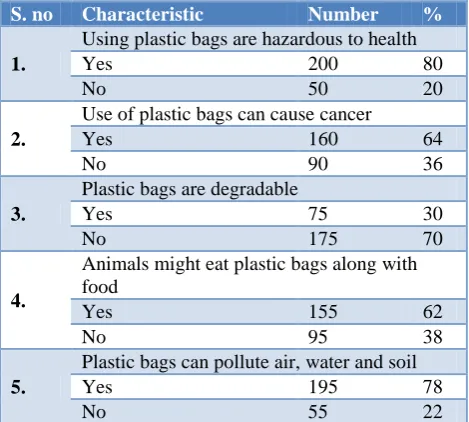
Knowledge of the study participants on the effects of plastic on health and environment is summarised in Table 2. About 80% of the respondents were aware that usage of plastic bags was injurious to health and 64% knew that plastics are cancerous. Majority of the study participants were aware that plastics are non-degradable (70%).The knowledge on ill effects of plastic usage affecting the environment by means of soil, water and air pollution was observed in 78% of the study participants.
Table 2: Knowledge on the effects of plastic use on health and environment among study participants
(n=250).
S. no Characteristic Number %
1.
Using plastic bags are hazardous to health
Yes 200 80
No 50 20
2.
Use of plastic bags can cause cancer
Yes 160 64
No 90 36
3.
Plastic bags are degradable
Yes 75 30
No 175 70
4.
Animals might eat plastic bags along with food
Yes 155 62
No 95 38
5.
Plastic bags can pollute air, water and soil
Yes 195 78
No 55 22
Attitude of the participants towards the plastic ban legislation
Participants’ attitude towards the plastic ban legislation was assessed using 3 point Likert scale that is briefed in Table 3. About 78% (195) of the study participants were open to the idea of using reusable bags. Approximately similar percentage of participants responded that they would advise others to stop using plastic bags. About
58%agreed to go only to shops that abolished plastic bags, 65% used only less than 5 plastic bags per week.
Table 3 Attitude of the participants towards the plastic ban legislation (n=250).
S.
no Acceptance
Agree Neutral Disagree
N % N % N %
1.
Open to the idea of using reusable bags
195 78 30 12 25 10
2.
Will advise others to stop using plastic bags
190 76 35 14 25 10
3.
Prefer shops that do not use plastic bags
146 58 21 9 83 33
Table 4: Practice on the usage of plastic bags after the ban legislation (n=250).
S.
no Characteristic Number %
1.
Using plastic bags after the plastic ban legislation
Yes 130 52
No 120 48
2.
Reasons for continued s use plastic bags? (n=130)
Easily carried 58 45
Light weight 15 12
Affordable 5 3
Easy to store 52 40
3.
Number of plastic bags used per week after the plastic ban legislation (n=130)
Less than 5 85 65
6 to 10 35 27
More than 10 10 8
4.
Situation / purpose of using plastic bags (n=130)
Garbage storage & disposal 67 52
Local market 24 18
Petti shops / department stores 11 8
Hotels / tea stall 28 22
5.
Type of alternative bags currently used (n=120)
Cloth bags 64 53
Jute bags 23 19
Paper bags 14 12
Basket 19 16
Practice of plastic bag usage after the ban
The participants’ practices towards the plastic ban legislation are depicted in Table 4. Of the 250 participants, 130 (52%) participants still continued using plastic bags even after the plastic ban legislation. On the other hand nearly 120 (48%) participants said that they stopped using plastics bags and shifted to eco-friendly alternatives. Most common reasons for continued use of
94% 6%
plastic bags were that they could be easily carried (45%), easy to store (40%), light weight (12%) and affordable (3%). Though 52% of participants continued using plastic bags, 65% of the participants used less than 5 plastic bags in a week and a very less proportion of 8%used more than 10 plastic bags in a week. Nearly 52% of the respondents used plastic bags for garbage storage and disposal, 22%
used plastic bags from hotels and tea stalls, 18% for local market purposes to carry fruits and vegetables and 8% from flower vendors and departmental stores. Remaining 48% who did not use plastic bags were using eco-friendly alternatives like cloth bags (53%), jute bags (19%), paper bags (12%) and baskets (16%).
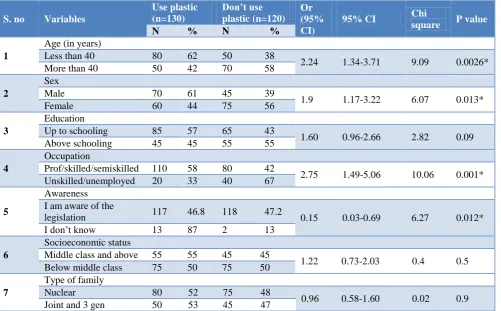
Table 5: Factors, which are associated towards the use of plastic bags.
S. no Variables
Use plastic (n=130)
Don’t use plastic (n=120)
Or (95% CI)
95% CI Chi
square P value
N % N %
1
Age (in years)
Less than 40 80 62 50 38
2.24 1.34-3.71 9.09 0.0026*
More than 40 50 42 70 58
2
Sex
Male 70 61 45 39
1.9 1.17-3.22 6.07 0.013*
Female 60 44 75 56
3
Education
Up to schooling 85 57 65 43
1.60 0.96-2.66 2.82 0.09
Above schooling 45 45 55 55
4
Occupation
Prof/skilled/semiskilled 110 58 80 42
2.75 1.49-5.06 10.06 0.001*
Unskilled/unemployed 20 33 40 67
5
Awareness I am aware of the
legislation 117 46.8 118 47.2 0.15 0.03-0.69 6.27 0.012*
I don’t know 13 87 2 13
6
Socioeconomic status
Middle class and above 55 55 45 45
1.22 0.73-2.03 0.4 0.5
Below middle class 75 50 75 50
7
Type of family
Nuclear 80 52 75 48
0.96 0.58-1.60 0.02 0.9
Joint and 3 gen 50 53 45 47
OR: Odds ratio; CI: confidence interval; ref: reference. *P<0.05 statistically significant at 95% CI.
Factors associated towards the use of plastic bags
On univariate analysis, factors such as age ≤40 years, male gender, those engaged in professional, skilled and semiskilled jobs, those who are aware of plastic ban legislation were found to have a statistically significant association with the use of plastic bags. People who are aged less than 40 years are 2.24 times more likely to use plastic bags compared to those who are aged more than 40(OR: 2.24, 95% CI 1.34-3.71, p=0.0026). Among the study participants, male respondents are 1.9 times more likely to use plastic bags compared to females (OR:1.9,CI: 1.17-3.22, p=0.013). Study subjects who are engaged in professional, skilled and semiskilled jobs are 2.75 times more likely to use plastic bags than the unskilled and unemployed workers (OR:2.75, CI 1.49-5.06, p=0.001). The chances of using plastic bags are 85% less among participants who are aware of the legislation compared to those who are not.(OR: 0.15, CI: 0.03-0.69, p=0.012) (Table 5).
DISCUSSION
Burden of plastic poses a great threat to health and environment. This study which was conducted among 250 participants in an urban area of Kancheepuram district, Tamil Nadu, depicts the current status of awareness, acceptance and practice on plastic usage after the plastic ban legislation among the study participants with varied outcomes that are discussed below.
Awareness of plastic ban legislation among study participants
participants were unaware of the plastic ban legislation, which is much lesser when compared to a study conducted by Joseph et al, in Mangalore, where nearly 15% of the respondents were ignorant about the law that was passed towards banning use of plastics.11
A study conducted in Mangalore states that the shop keepers continued supplying plastic bags to customers without questioning for an alternative bag.11 Similar observations were made in a study conducted in Delhi where certain shops continued to provide plastic bags despite the legislation passed towards the banning of plastics.13 This highlights about the effective coverage of law enforcement in our study area.
Knowledge about health and environmental hazards due to plastic use
Majority (80%) of the subjects were familiar about at least one health hazard generated due to use of plastic which was similar when compared to a study done in Mangalore where 86% of the respondents knew about health threats as a result of using plastics.11 These results are better when compared to different studies conducted in other parts of the world where only 50% to 70% of the respondents knew about the harmful health hazards on using plastic.15-18 In this study nearly 78% were familiar of the ill effects of plastic over the environment which was less when compared to a study done in California were 93% of the respondents had adequate knowledge on the harmful effects of plastic use over environment.15 This might probably be due to lack of knowledge about the negative effects of plastic use over environment which can be strengthened by conducting awareness campaigns. Availability of posters and banners with ill effects of plastic use printed on them can be used to intensify their knowledge.
Associated factors of plastic use
In this study, participants aged above 40 years favored towards the ban by using less plastics when compared to those aged below 40, which is similar to the observations from a study done by Joseph et al, in Mangalore.11 These findings are controversial to the findings of the Delhi based study which suggested that the youngsters were more conscious over the negative effects of plastic bags.13From a study done by Adane et al, in Ethiopia it was observed that maximum participants who continued using plastic bags were females.18 which is controversial in this study where females (56%) were found to use plastics less likely when compared to males. A study done in China by Xing et al, observed that there was a drastic reduction on plastic use after the ban.14 In this study it was observed that nearly 52% of the participants continued using plastic bags, which is lesser when compared to a study conducted in Ethiopia where almost 77% of them continued using plastic bags even after the ban was being imposed.18 In the present study it is observed that 65% of the participants use less than 5 plastics in a week which is lesser when compared to a
study conducted in Madurai which reported that each person uses at least two plastic bags per day.19 This highlights the difference in implementation of the ban in different districts.
Reasons for continued usage of plastic bags
The reasons for preferring plastic bags in this study were that they are easily carried (45%) and easy to store (40%), lightweight (12%) and affordable (3%). This was similar to findings from another study done in Mangalore were the reasons quoted were easy availability.11 This was same as the findings from study conducted in Delhi where convenience for shopping was the commonest reason stated by most respondents.12 Another study conducted in Ethiopia reported that low price, easy availability and light weight were the main reasons for popularity of plastic bags amongst the respondents.18 A study conducted in Ethiopia stated that the main reason to use plastic bags was that they were of low price (70%) which when compared to this current study shows that only 3% of the study participants opted plastic bags on affordability basis.18 In the current study nearly 52% of the participants used plastic bags for garbage storage and disposal, which in turn lead them to dispose plastic bags in open areas. Similarly, an Ethiopian study reported 59.6% and a study done in Rajasthan reported that 40% used to litter plastic bags in open.18,20 The disposal rate might be influenced by the awareness on the life cycle of plastics.
Practice of alternative bags usage
It was observed that 48% of them shifted to using eco-friendly alternatives. This is much better when compared with a study conducted in Mangalore, where only 5% of the participants adopted eco-friendly alternatives.11 The eco-friendly alternatives for plastic bags like cloth bags (53%), jutes bags (19%), paper bags (12%), baskets (16%) were opted as they were durable and reusable. In another study conducted in Delhi, 57.6% users used cloth bags, while 40% preferred paper bags.17
Tamil Nadu has achieved 75% success in enforcing the ban on plastic products and would soon achieve 100%. Nearly 170 plastic product making companies are closed in Tamil Nadu after the plastic ban legislation. With all these developments, there still remains a gap at implementation level, which was observed in this study. This highlights the ineffectiveness of awareness campaigns in disseminating information on penalties imposed under this legislation and the lack of proper community participation in this campaign.
Limitations of the study
CONCLUSION
The study shows good awareness (94%) about the plastic ban legislation. Satisfactory awareness level about the ill effects of plastic use and its ban was observed but the level of implementation in their daily life was poor (52%). Even after the preparatory period of six months given to get accustomed to eco-friendly alternatives, the use of plastic bags still remains rampant. These findings highlight the need to improve the attitude and practice towards the use of eco-friendly alternatives. Information, education and communication (IEC) activities need to be intensified to bring about changes in the attitude and practice. Most of the participants in the settings had the awareness of health hazards of the usage of plastic bags and supported its ban. However, practices with respect to usage of alternative bags or reuse of already used bags were found poor among majority of the participants.
The concept of the 5 R’s, i.e., reduce, reuse, recycle, rethink, restrain, may serve as a guiding tool for adaptive measures addressing environmental and human health issues posed by plastics.
Recommendations
Public awareness campaigns have to be intensified. Awareness programmes should be targeted towards students and homemakers. On creating a strong knowledge on the negative effects of plastic use through academic approach, children may in return play an effective role in strengthening the community. By this approach financial burden for training staffs can be minimised. Display of eco-friendly alternatives can be put up as posters near the billing area in supermarkets. Low cost information strategies can be used, by providing pamphlets about the ill effects of using plastic bags. Mass media and social media can also help in dissemination of information. Discount on products can be offered for customers who bring their own environment friendly bags. Measures for scientific disposal of plastic products can be initiated. Steps can be made towards generating electricity from plastic wastes.
ACKNOWLEDGEMENTS
We would like to thank the College Management and the Faculty of Department of Community Medicine for their logistic support and guidance throughout the study. We sincerely thank all the participants, for their valuable time in completing this study and to the postgraduates for helping in completing this study. We also thank the field staff of UHTC, Anakaputhur for helping to carry out this study by organizing the house visits.
Funding: No funding sources Conflict of interest: None declared
Ethical approval: The study was approved by the Institutional Ethics Committee, Sree Balaji Medical College and Hospital
REFERENCES
1. National Environment Agency. Waste Statistics and
Recycling Rate for 2010. Available at:
http://www.cpcb.nic.in. Accessed on 14 August 2019.
2. Ecology center. The problems with Plastics.
Available at: https://ecologycenter.org/plastics/ Accessed on 19 August 2019.
3. Kari Embree. Global plastics packaging market to
hit $375 billion by 2020. Available at:
https://www.plasticstoday.com/packaging/global-
plastics-packaging-market-hit-375-billion-2020/23800481624973. Accessed on 14 August 2019.
4. Gourmelon G. Global plastic production rises
recycling lags; New worldwide institute analysis explore trends in plastics consumption and recycling
for immediate release. Available AT:
https://www.projectaware.org/update/global-plastic-production-rises-recycling-lags Accessed on 02 June 2019.
5. Ministry of Environment, Forest and Climate
Change. Beat Plastic Pollution. Available at: http://moef.gov.in/beat-plastic-pollution-good-news-from-india-2/. Accessed on 20 August 2019.
6. Women in Europe for a Common Future. Dangerous
Health Effects of Home Burning of Plastics and
Waste. Available from: http://www.wecf.eu/
cms/download/2004-2005/homeburning_plastics. pdf. Accessed on 02 June 2019.
7. A wide angle view of India. The global war against
plastic. Available at: https://nitawriter.wordpress. com/2007/10/24/the-global-war-against-plastic/ Accessed on 26 July 2019.
8. Ministry of Housing and Urban Affairs,
Government of India. Plastic Waste Management Issues, solutions & case studies. Available at: http://164.100.228.143:8080/sbm/content/writereadd ata/SBM%20Plastic%20Waste%20Book.pdf. Accessed on 08 June 2019.
9. Ministry of Environment. Plastic Waste
Management (Amendment) Rules, 2018. Available
at: http://www.indiaenvironmentportal.org.in/
content/454052/plastic-waste-management-amendment-rules-2018/. Accessed on 26 July 2019.
10. Tamil Nadu Pollution control Board. Ban on use of
one time use and throwaway plastics. Available at https://www.tnpcb.gov.in/pdf_2018/G.O_84_BanPla stic3718. Accessed on 01 August 2019.
11. Joseph N, Kumar A, Majgi SM, Kumar GS,
Prahalad RB. Usage of plastic bags and health hazards: A study to assess awareness level and perception about legislation among a small population of Mangalore city. J Clin Diagn Res. 2016;10(4):LM01-4.
12. Foundation for Organisational Research &
Education. Use of plastic bags: factors affecting ecologically oriented behavior in consumers.
https://www.thefreelibrary.com/Use+of+plastic+bag s%3a+factors+affecting+ecologically+oriented+beh avior...-a0192438179. Accessed on 02 September 2019.
13. Gupta K. Consumer responses to incentives to
reduce plastic bag use: Evidence from a field experiment in urban India. SAMDEE; 2011.
14. Xing X. Study on the ban on free plastic bags in China. J Sustainable Develop. 2009;2(1):156-8. 15. Brittany Turner, Jessica Sutton. Plastic bags:
Hazards and mitigation. Available at
http://digitalcommons.calpoly.edu/cgi/viewcontent.c gi?article=1082&context=socssp Accessed on 19 July 2019.
16. Sung GB. Ban on Plastic Bags Usage-Is It a Right Move? An Empirical Study on Consumer Perception and Practice. Research Report in partial fulfillment of the requirements for the degree of Master of Business Administration. Malaysia: UniversitiSains Malaysia; 2010.
17. Sanghi S. Use of plastic bags: factors affecting ecologically oriented behavior in consumers. Abhigyan. 2008;26(3):34-46.
18. Adane L, Muleta D. Survey on the usage of plastic bags, their disposal and adverse impacts on environment: A case study in Jimma City, Southwestern Ethiopia. J Toxicol Environ Health Sci. 2011;3:234-48.
19. Rajkumar P. A study on the plastic waste and environmental degradation. Journal of Advanced Research. 2015;4(1):9-15.
20. Singh MK, Devi SR. Hazards of Plastic Bags in Dholpur-A Small District town of Rajasthan, India. Int Res J Environ Sci. 2013;2:6-10.
Cite this article as: Sujitha P, Swetha NB,
Gopalakrishnan S.Awareness, acceptance and