Original Research Article
Awareness and practices on road safety among adolescents school
children in Imphal, Manipur: a cross-sectional study
Joymati Oinam, Bishwalata Rajkumari
*
, Haobam Danny Singh, Joenna Ningombam
INTRODUCTION
Road traffic accident is the 8th leading cause of death among all age groups globally and top leading cause of death for children and young adults aged 5 to 29 years, signaling a need for a shift in the current child health agenda, which has largely neglected the road safety.1,2 As progress is made in the prevention and control of infectious diseases, the relative contribution of deaths from non-communicable diseases and injuries increases.2
More than 90% of road traffic deaths occur in low and middle-income countries.The South-East Asia region of the WHO, contributes the second highest of the global
road traffic deaths rate with 20.7 deaths per 100,000 population. It will continue to increase significantly due to rapid motorization, urbanization and population explosion.2
The UN General Assembly declared 2011-2020 as the "Decade of Action for Road Safety” with the goal to stabilize and reduce the increasing trend in road traffic fatalities. According to the Youth and Road Safety, Geneva, WHO (2007), Road safety is defined as a measure to reduce the harm resulting from crashes of road vehicles, to convey information to road users, to enhance their knowledge about road safety issues, influence their behavior on the road and prepare them for
new safety measures. A combination of physical and
ABSTRACT
Background: The UN General Assembly declared 2011-2020 as the "Decade of Action for Road Safety” with the goal to stabilize and reduce the increasing trend in road traffic fatalities. The objective of the study was to assess awareness and practices on road safety among adolescent school children and to determine any factors associated with awareness and practices on road safety with selected socio-demographic variable.
Methods: A cross-sectional study was conducted among 2306 adolescent school students studying in classes VIII-XII in various schools selected by random sampling technique in two districts of Manipur during June 2018. Data were collected using a self-administered questionnaire. Based on the percentile, awareness level of the students was grouped into good, average and poor. Descriptive statistics like mean, SD and analytical statistics such as Chi-squared test were used. A p-value <0.05 was considered as statistically significant.
Results: The mean (SD) age of the 2306 students was 15.29±1.4 year. Majority of the students belongs to late adolescents. Only 10% of the students have good awareness level on road safety. Majority of the students’ drives two wheelers (96.7%), does not possess driving license (89.1%) and around two-fifths used mobile phone while driving. Around 30% of the students were ever exposed to road traffic accident. Statistically significant association was found between late adolescents, boys, higher class, increase in parent’s educational level with good awareness level.
Conclusions: Few students have good awareness level on road safety measures. Therefore, awareness campaigns regarding road traffic safety should be included in the compulsory training program of schools.
Keywords: Awareness, Road safety, Adolescents, Road traffic accident
Department ofCommunity Medicine, Jawaharlal Nehru Institute of Medical Sciences, Imphal, Manipur, India
Received: 28 August 2019
Accepted: 05 October 2019
*Correspondence:
Dr. Bishwalata Rajkumari, E-mail: [email protected]
Copyright: © the author(s), publisher and licensee Medip Academy. This is an open-access article distributed under the terms of the Creative Commons Attribution Non-Commercial License, which permits unrestricted non-commercial use, distribution, and reproduction in any medium, provided the original work is properly cited.
developmental immaturity among children, and inexperience and youth-related lifestyles further increase the risk of young road users, particularly males to road traffic collisions.Improving the knowledge and practice gap among the people in the community can lead to a drastic reduction in road traffic accidents.3,4
There is lack of effective implementation of Road safety policies and Programmes in Manipur and adolescents being at more risk should be educated on road safety practices. The chances of road traffic accidents can be reduce to a large extent, if school children who are going to be adults of tomorrow are made aware of road safety measures. No previous studies are available regarding the awareness and practice towards the road safety in Manipur. Therefore, this study was conducted to assess awareness and practices on road safety among adolescent school children and to determine any factors associated with awareness and practices on road safety with selected socio-demographic variable.
METHODS
This cross-sectional study was conducted among adolescent school students studying in classes VIII-XII in high schools and higher secondary schools located in Imphal East and Imphal West districts of Manipur during June 2018. Those students who were absent on the day of data collection and those who did not give assent were excluded.
Sample size and sampling
Sample size was calculated based on a prevalence of knowledge of road traffic accident (RTA) of 33.1%, taking an absolute allowable error of 2% and at 5% significance level using the formula for single proportion ZαPQ/e2 the calculated sample size comes to 2215
students rounded off to 2230.5 Schools were selected by using lottery method and all eligible students in selected schools were included in the study. Both government and private schools were included in the study. Based on school enrollment rate total of 12 schools were sampled to reach the calculated sample size.
Study tool and data collection
A pre-designed, semi-structured, self-administered
questionnaire containing four sections was used as section I consisted of socio-demographic profile, section II consisted of knowledge questions, section III consisted of practice questions for those who knew how to drive and section IV consisted of practice questions for all. Questionnaires were distributed and explanation was given how to fill up and emphasis was given to the students to give their honest answer. The surveyors were all present during the time and any query from the students were clarified. After the questionnaires were collected, a brief interactive health talk on road safety measures was given to each class by the surveyors.
Operational definition
Adolescents
They are the young people in the process of developing into an adult between the ages of 10-19 years of age. (WHO)
It is divided into young {10-14 years} and late adolescents {15-19 years} (UNICEF).
For awareness on road safety
Questions related to knowledge were given scores and summated. The maximum obtainable score was 18 and minimum was 0. Based on the percentile, awareness level of the students was grouped into:
Good awareness level which scored >75th percentile.
Average awareness level which scored between
25th-75th percentile.
Poor awareness level which scored <25th percentile.
Statistical analysis
Collected data were entered in Microsoft Excel software and data cleansing were performed. Data were analyzed using SPSS IBM Statistics version 21 (Chicago, IL, USA). Descriptive statistics like Mean, SD, percentages and proportion were employed. Analytical statistics such as Chi-squared (χ²) test was performed to test the association between the awareness level and the socio-demographic profile of the students such as age, gender class etc. A probability value <0.05 was considered as statistically significant.
Ethical issues
Approval was taken from the institutional ethics committee, JNIMS before the start of research. Permission was obtained prior from the school authority and assent from all the school students before the start of data collection. All identifiers were removed from the collected data and strict confidentiality was maintained.
RESULTS
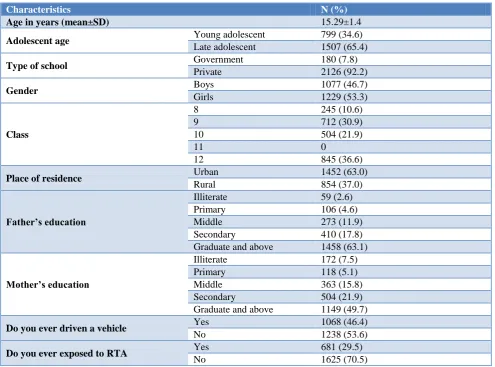
A total of 2306 students from 12 schools participated in the survey and the mean (SD) age of the student was 15.29±1.4 years. Majority of the students (65.4%) belongs to late adolescents and more than half were girls (53.3%). Majority of the students were from private schools. Around two-fifth (62.7%) students were from urban area. Majority of the father and mother educational level is graduate and above (Table 1).
indication of different traffic light signals. Majority were aware that both the driver and pillion rider should wear helmet in two wheelers. Around half of the students were aware that speed is the most common cause of RTA in world. Around four-fifth of the students were aware that vehicles should stop behind zebra crossing in the traffic point when signal red light. Majority of the students (85.7%) were aware that used of mobile phone while
driving is legally not allowed. Majority of the students were aware that possession of driving license is compulsory. Regarding the priority vehicle on road, almost all the students said vehicles of VIP as the priority, which was an incorrect response. Among the correct responses, majority gave ambulance (75.4%) followed by fire brigade (48.7%). Only few gave army convoy (9.9%).
Table 1: Socio-demographic profile of the students (n=2306).
Characteristics N (%)
Age in years (mean±SD) 15.29±1.4
Adolescent age Young adolescent 799 (34.6)
Late adolescent 1507 (65.4)
Type of school Government 180 (7.8)
Private 2126 (92.2)
Gender Boys 1077 (46.7)
Girls 1229 (53.3)
Class
8 245 (10.6)
9 712 (30.9)
10 504 (21.9)
11 0
12 845 (36.6)
Place of residence Urban 1452 (63.0)
Rural 854 (37.0)
Father’s education
Illiterate 59 (2.6)
Primary 106 (4.6)
Middle 273 (11.9)
Secondary 410 (17.8)
Graduate and above 1458 (63.1)
Mother’s education
Illiterate 172 (7.5)
Primary 118 (5.1)
Middle 363 (15.8)
Secondary 504 (21.9)
Graduate and above 1149 (49.7)
Do you ever driven a vehicle Yes 1068 (46.4)
No 1238 (53.6)
Do you ever exposed to RTA Yes 681 (29.5)
No 1625 (70.5)
Table 2: Responses to knowledge questions on road safety (n=2306).
Questions
Responses N (%)
Correct Incorrect
Legal age for starting driving in India 1976 (85.7) 330 (14.3)
Traffic light signal indication
Red 2274 (98.6) 32 (1.4)
Yellow 2170 (94.1) 136 (5.9)
Green 2259 (98.0) 47 (2.0)
Correct side of overtaking on road 1457 (63.2) 849 (36.8)
Who should wear helmet in a two wheeler? 2025 (87.8) 281 (12.2)
Most common cause of RTA in world 1140 (49.4) 1166 (50.6)
Shape of mandatory traffic signs 1047 (45.4) 1259 (54.6)
Children’s seat in a four-wheeler vehicles 1727 (74.9) 579 (25.1)
Where pedestrians should cross the road 2077 (90.1) 229 (9.9)
Questions Responses N (%)
Correct Incorrect
Use of mobile phone while driving legal or not 1976 (85.7) 330 (14.3)
Reason for prohibition of drunk-driving 760 (33.0) 1546 (67.0)
Who should wear seatbelts in four wheeler 1899 (82.4) 406 (17.6)
Compulsory possession of driving license 2235 (96.9) 71 (3.1)
Vehicle priority on road
Ambulance 1739 (75.4) 567 (24.6)
Fire brigade 1124 (48.7) 1182 (51.3)
Army convoy 228 (9.9) 2078 (90.1)
Vehicles of VIP (e.g., ministers) 10 (0.4) 2296 (99.6)
Majority of the students have average awareness level on road safety (66.9%). Only 10.2% of them have good awareness level on road safety (Figure 1).
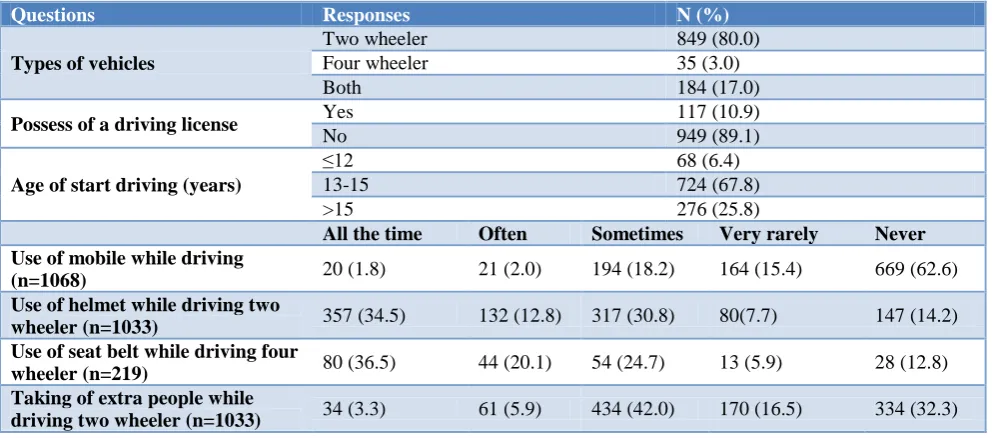
Around half of the students have ever driven a vehicle (47.91%). Majority of the students’ drives two wheelers (80%). Majority of the students (89.1%) does not possess driving license. More than three-fourth of the students (67.14%) started driving by the age of 13 to 15 years. Around two-fifths of the students used mobile phone in one way or the other while driving a vehicle. Around two-fifths of the students who drives a two-wheelers always uses helmet while driving. Those who drive four wheelers, 37.73% always used seat belt. More than three-fifths of the students take extra person while driving two-wheelers (Table 3).
Figure 1: Awareness level on road safety.
Table 3: Practice questions among those who ever drive a vehicle (n=1068).
Questions Responses N (%)
Types of vehicles
Two wheeler 849 (80.0)
Four wheeler 35 (3.0)
Both 184 (17.0)
Possess of a driving license Yes 117 (10.9)
No 949 (89.1)
Age of start driving (years)
≤12 68 (6.4)
13-15 724 (67.8)
>15 276 (25.8)
All the time Often Sometimes Very rarely Never Use of mobile while driving
(n=1068) 20 (1.8) 21 (2.0) 194 (18.2) 164 (15.4) 669 (62.6)
Use of helmet while driving two
wheeler (n=1033) 357 (34.5) 132 (12.8) 317 (30.8) 80(7.7) 147 (14.2) Use of seat belt while driving four
wheeler (n=219) 80 (36.5) 44 (20.1) 54 (24.7) 13 (5.9) 28 (12.8)
Taking of extra people while
driving two wheeler (n=1033) 34 (3.3) 61 (5.9) 434 (42.0) 170 (16.5) 334 (32.3)
Table 4 shows that around two-fifths of the students (37.8%) sometimes use mobile phones while walking on the road. Around two-fifths (37.5%) never use helmets while sitting at the back of a two wheeler. Majority of the students, 60.7% use footpath all the time while walking on the road.
Table 5 shows that more than one-fourth of the students (29.5%) were ever exposed to RTA.
Two-wheeler was the most common vehicle involved in RTA (72.2%). More than one-fourth (29.4%) had RTA in evening followed by afternoon (25.6%) and morning (20.8%). Around one-fourth of the students ever exposed to RTA were driving the vehicle by themselves at the time road traffic accidents occurred.
236(10.2 %)
1543(66. 9%) 527(22.9
%) Good
Average
Table 5: Questions related to RTA (n=681).
Questions Responses N (%)
Type of vehicle (n=681)
2 wheeler 494 (72.2)
Car 99 (14.7)
Truck 28 (4.2)
Autorickshaw 39 (5.8)
Others* 21 (3.1)
Time (n=681)
Morning 140 (20.8)
Noon 71 (10.5)
Afternoon 172 (25.6)
Evening 206 (29.4)
Night-time 92 (13.7)
Were you driving the vehicle when the RTA happened (n=681)
Yes 180 (26.7)
No 501 (73.3)
*Bus, van, rickshaw.
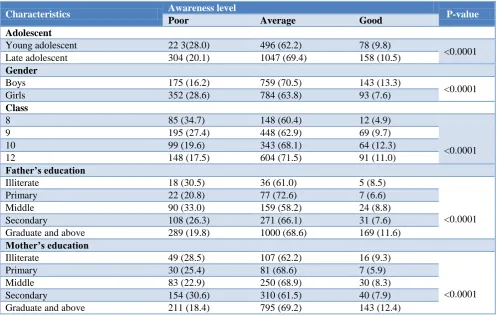
Table 6: Association between background characteristics and awareness level.
Characteristics Awareness level P-value
Poor Average Good
Adolescent
Young adolescent 22 3(28.0) 496 (62.2) 78 (9.8)
<0.0001
Late adolescent 304 (20.1) 1047 (69.4) 158 (10.5)
Gender
Boys 175 (16.2) 759 (70.5) 143 (13.3)
<0.0001
Girls 352 (28.6) 784 (63.8) 93 (7.6)
Class
8 85 (34.7) 148 (60.4) 12 (4.9)
<0.0001
9 195 (27.4) 448 (62.9) 69 (9.7)
10 99 (19.6) 343 (68.1) 64 (12.3)
12 148 (17.5) 604 (71.5) 91 (11.0)
Father’s education
Illiterate 18 (30.5) 36 (61.0) 5 (8.5)
<0.0001
Primary 22 (20.8) 77 (72.6) 7 (6.6)
Middle 90 (33.0) 159 (58.2) 24 (8.8)
Secondary 108 (26.3) 271 (66.1) 31 (7.6)
Graduate and above 289 (19.8) 1000 (68.6) 169 (11.6)
Mother’s education
Illiterate 49 (28.5) 107 (62.2) 16 (9.3)
<0.0001
Primary 30 (25.4) 81 (68.6) 7 (5.9)
Middle 83 (22.9) 250 (68.9) 30 (8.3)
Secondary 154 (30.6) 310 (61.5) 40 (7.9)
Graduate and above 211 (18.4) 795 (69.2) 143 (12.4)
Table 6 shows that statistically significant association was found between late adolescents, boys, higher class, increase in parent’s educational status with good awareness level
DISCUSSION
In the present study, majority of the students (66.9%) have average awareness and only 236 (10.2%) of them have good awareness level on road safety measures.
Majority of the students (85.7%) in the present study were aware that mobile phone should not be used while driving. Our finding is higher as compared to a study conducted by Mahawar et al in Indore, 2013 where they reported only 72.3%.6 This difference can be because of time-gap between these two studies, as mobile phone is recently becoming an accessory among the adolescents.
Similarly, 85.7% gave the correct response regarding legal age for start driving which is lower as compared to other studies conducted by Evangeline et al (97.5%), Chennai and Prakash et al (99.1%), Raichur city.5,7 This may be probably due to the difference in study population as they conduct only class 11 and 12 students, whereas in our study it was from class 8 to 12 and students from lower classes may not be aware of it.
Regarding correct side of overtaking, our students (63.2%) were more aware as compared to other studies conducted in other parts of India viz., Chennai (28.3%) and Raichur (32.8%). This could be because in Manipur, children were usually exposed to under age driving for tuition or some other reasons and moreover the traffic rules and regulations were not so strict. So, because of this early exposure maybe the students were aware of it.
Almost all the students were aware of the red and green traffic signal (98.6% and 98.0%) which was almost comparable to a study.8 However, in their study, 86.9% students were aware of yellow signal which was lower than our study, where 94.1% students were aware of it.
In this study, around half of the students ever drive a vehicle, among those majority (96.7%) drive two wheelers. Similar findings were noted by Evangeline et al and Salve et al in their studies.5,8 Our study shows that 89.1% of students drives vehicle without license. However, our finding is much higher as compared to study reported by Salve et al where 68% drives without license.8 This may be due to below legal age or casual attitude of traffic police that makes difficult to keep watch on defaulters.
Use of mobile phones while driving is 35.4% in our study. But 46% used mobile phones while driving as reported by Prakash et al.7 The reason might be listening to music or talking over phone while driving. In our study, 34.5% and 36.5% reported that they always wear helmet and seatbelt while driving two wheelers and four wheelers vehicle respectively. However, in the study carried out by Prakash et al only 15% wear seatbelt and 20% wear helmet as recorded by Salve et al.7,8
In the present study, more than one-fourth of the students (29.5%) were exposed to road traffic accidents. Similar findings were noted in a study conducted in Raichur in 2017, where they reported 23.7% students exposed to
RTA.7 However, our finding is much lower as compared
to other studies conducted in Chennai (39.2%) and Maharashtra (58.8%).5,8
Limitations
Limitations of the present study was that the findings and their interpretations are restricted to school going adolescents only and no students from class 11 were included in the study as class 11 session was not yet started at the time of data collection. Further studies are needed to cover the adolescents that are out of school and in college, as the prevalence of health-risky behaviors is likely to be higher among such adolescents.
CONCLUSION
The study reveals that only few students have good awareness level on road safety measures. Almost half of the students drive a vehicle but very few of them possessed a driving license. Majority of them do not wear helmets nor wear a seatbelts. Around one-thirds of the students used mobile phones while driving and 3 out of 10 students are involved in road traffic accidents. Students of higher age, higher class, male students, more educated parents significantly have good awareness level of road safety measures
Recommendations
Law enforcement agencies should strengthened measures imposed on violators of traffic rules; checks on driving vehicles without license; focus on using mobile phone/drinking while driving, use of seat belts and helmets should be promoted. Awareness campaigns regarding road traffic safety measures should be included in the compulsory training program of schools.
Funding: No funding sources Conflict of interest: None declared
Ethical approval: The study was approved by the Institutional Ethics Committee
REFERENCES
1. World Health Organization. Disease, injury and
causes of death country estimates, 2000–2015.
2017. Available at: http://www.who.
int/healthinfo/global_burden_disease/estimates_cou ntry_2000_2015/en/1. Accessed on 20 December 2018.
2. World Health Organization. Global Health
Estimates, 2018. Available at: http://www.who.int /healthinfo/global_burden_disease/en. Accessed on 20 December 2018.
3. World Health Organization. Global Status Report on
Road Safety, 2018. Management of
non-communicable Diseases, Disability, Violence and
Injury Prevention (NVI). Available at:
http://www.who.int/violence_injury_prevention/roa d_traffic/en . Accessed on 20 January 2019.
4. World Health Organization. Dept of injuries and
Available at: hppt://www.who.int/iris/handle/10665 /43607. Assessed on 20 June 2018.
5. Evangeline A, Chitra A, Arunmozhi T. A
cross-sectional study to assess the knowledge attitude and practice toward road safety rules and regulation among higher secondary school student in Chennai. Ind J of Basic Appl Med Res. 2016;5(4):779-89.
6. Mahawar P, Dixit S, Khatri AK, Rahul R, Bhurre R,
Kirar S, et al. An Education intervention to improve awareness on road safety among school going
teenagers in India. Nat J Comm Med.
2013;4(3):529-32.
7. Prakash R, Fahim A, Rahul C. A cross-sectional
study to assess the knowledge, attitude and practice
toward road traffic safety among adolescent student of a selected pre-university college in Raichur city. Int J Comm Med Public Health. 2018;5(6):2446-53.
8. Salve SB, Dase RK, Jadhav VS, Mahajan SM,
Adchitre SA. A study on awareness and behaviour of adolescents towards traffic accidents. Int J Curr Med Appl Sci. 2014;4(1):33-40.
Cite this article as: Oinam J, Rajkumari B, Singh
HD, Ningombam J.Awareness and practices on road