Original Research Article
Assessing and testing the reliability of mini self-care practices
questionnaire among type 2 diabetic patients attending rural health
training centre, Kanchipuram, Tamil Nadu
Preethi Selvaraj, Ramkumar Boopathirajan*
INTRODUCTION
India is the diabetic capital of the world with nearly 31.7 million people suffering from the disease in 2000 which is projected to become 79.4 million in the year 2030.1 Type II diabetes mellitus (DM) is a metabolic condition where in the body fails to produce sufficient insulin and hence it is characterized by abnormal glucose homeostasis. The incidence of diabetes in India is around 8.8%.2 Diabetes is a chronic disease, requiring a
multi-prolonged approach for its management, where in the patient has an important role to play.
DM by its definition is a chronic metabolic disorder presented with hyperglycaemia either due to absolute (type 1 DM) or relative (type 2 DM) deficiency of insulin hormone. Diabetes is usually coupled with complications such as cardiovascular diseases, nephropathy, retinopathy and neuropathy, which can lead to chronic morbidities and mortality.3 The needs of diabetic patients are not only limited to adequate glycaemic control but also correspond
ABSTRACT
Background: India is the diabetic capital of the world with nearly 31.7 million people suffering from the disease in 2000 which is projected to become 79.4 million in the year 2030. The incidence of diabetes in India is around 8.8%. This study aims at developing a mini questionnaire to quickly assess the self-care practices among the diabetic patients attending rural health training centre and also to educate the diabetic patients about self-care practices and dietary pattern they need to follow.
Methods: The study design is a community based cross-sectional study. All diabetic patients who visited rural health training centre attached to a private medical college aged 40 years and above in the period of June to July 2019 were included in our study. Institutional ethical clearance was taken before commencing the study. Construction of mini self-care practices questionnaire (MSCPQ) comprised of two phases. Trained medical students collected the data by interview method using semi-structured, pre-tested questionnaire.
Results: The reliability of the MSCPQ using Cronbach’s alpha came to be 0.82 and the intra class correlation coefficient was 0.81; 95% CI (0.763-0.853) (p=<0.001). Around sixty six percent are having their health check-up regularly. Most (43%) of the study participants check their blood sugars monthly.
Conclusions: Even though there are various factors contributing in facilitating self-care activities in patients living with diabetes, the role of health care physicians in educating about self-care practices are indispensable.
Keywords: Self-care, Diabetes, Questionnaire, Reliability
Department ofCommunity Medicine, SRM Medical College Hospital and Research Centre, Kattankulathur, Chennai, Tamil Nadu, India
Received: 01 November 2019 Revised: 19 November 2019 Accepted: 20 November 2019
*Correspondence:
Dr. Ramkumar Boopathirajan, E-mail: [email protected]
Copyright: © the author(s), publisher and licensee Medip Academy. This is an open-access article distributed under the terms of the Creative Commons Attribution Non-Commercial License, which permits unrestricted non-commercial use, distribution, and reproduction in any medium, provided the original work is properly cited.
with preventing complications; disability limitation and rehabilitation.
Self-care management in diabetes is defined as a process of developing adequate knowledge or awareness by learning to survive with the complex nature of the diabetes.3 The patients are also required to follow certain self-care practices in order to achieve an optimal glycaemic control and prevent complications such as neuropathy, nephropathy, and retinopathy. There are about seven essential self-care behaviours in people living with diabetes which can predict good outcomes namely healthy eating, being physically active, monitoring of blood sugar, compliant with medications, good problem-solving skills, healthy coping skills and risk-reduction behaviours.3
The most prevalent is the type 2 diabetes which constitutes 95% of the diabetic population in the country. In this, most of patients are non-insulin dependent and they can control the glucose in their blood and can prevent, prolong the occurrence of diabetic complications by eating measured diet and by following self-care practices (regular blood glucose check-up, eye check-up, feet inspection, regular exercise and oral medication). Lack of awareness, education, depression, economic constraints and multiple complications are associated with malnutrition that leads to the morbidity and mortality. Even though there are many questionnaires developed before, it makes health care physician difficult to assess the patient with the existing time-consuming questionnaire. This study aims at developing a mini questionnaire to quickly assess the self-care practices among the diabetic patients attending rural health training centre and also to educate the diabetic patients about self-care practices and dietary pattern they need to follow.
METHODS
This study design was a community based cross sectional study conducted among the patients who visited the rural health training centre attached to SRM Medical College Hospital and Research Centre at Kanchipuram district. The study theme is about the people who have knowledge about self-care in diabetes. The study took place for about two months from June to July 2019. All diabetic patients who visited rural health training centre aged 40 years and above were included in our study. Institutional ethical clearance was taken before commencing the study. Informed written consent was obtained before collecting the data from study participants. Construction of mini self-care practices questionnaire (MSCPQ) comprises of two phases. In the initial phase based on the different studies undertaken and review of literature we came with six item questionnaires in the construction of the MSCPQ. In the second phase we tested the reliability and validity of the MSCPQ by using semi-structured, pre-designed, pre-tested questionnaire consisting of information regarding socio-demographic details and self-care practices among diabetic patients. The participants
were contacted in formal set up of hospital with the help of hospital staff. Communication was done in local language Tamil. Trained medical students collected the data by interview method using semi-structured, pre-tested questionnaire. Data were entered into the Microsoft Excel sheet and analysed using SPSS 22.0 version. Descriptive statistics like frequency and percentage were used.
RESULTS
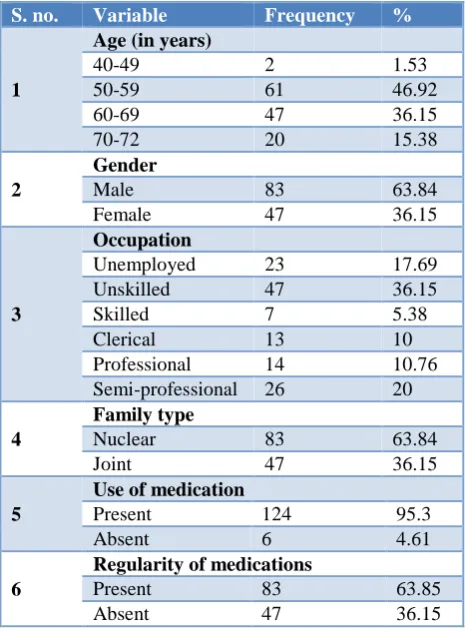
In our study majority of the patients were in the age group of 50-59 years (46%) followed by 60-69 years (36%), 70-72 years (15.38%) and only two of the participants were in the age group of 40-49 years. Overall aged participants in our study were more compared to middle age people with diabetes in that geographical location. Most of the participants were males of about 63% of the study participants and remaining 36% were females. Major type of occupation was unskilled type of work (36%) followed by 5% indulged in skilled type of work. Around 17% of the study participants were unemployed. In our study 20% of the patients were semi-professionals, 10% professionals and remaining 10% in clerical type of work. Nuclear type of families was more prevalent in our study with 63% of study participants belonging to them. Around 95% of the study participants use medications for diabetes but 4.61% still not using any medications for their illness.
Table 1: Distribution of study participants according to their demographic characteristics (n=130).
S. no. Variable Frequency %
1
Age (in years)
40-49 2 1.53
50-59 61 46.92
60-69 47 36.15
70-72 20 15.38
2
Gender
Male 83 63.84
Female 47 36.15
3
Occupation
Unemployed 23 17.69
Unskilled 47 36.15
Skilled 7 5.38
Clerical 13 10
Professional 14 10.76
Semi-professional 26 20
4
Family type
Nuclear 83 63.84
Joint 47 36.15
5
Use of medication
Present 124 95.3
Absent 6 4.61
6
Regularity of medications
Present 83 63.85
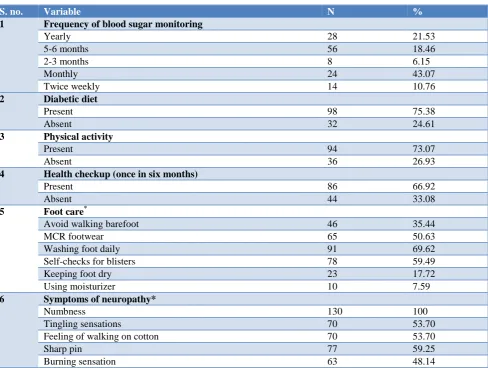
Table 2: Distribution of MSCPQ among the study participants (n=130).
S. no. Variable N %
1 Frequency of blood sugar monitoring
Yearly 28 21.53
5-6 months 56 18.46
2-3 months 8 6.15
Monthly 24 43.07
Twice weekly 14 10.76
2 Diabetic diet
Present 98 75.38
Absent 32 24.61
3 Physical activity
Present 94 73.07
Absent 36 26.93
4 Health checkup (once in six months)
Present 86 66.92
Absent 44 33.08
5 Foot care*
Avoid walking barefoot 46 35.44
MCR footwear 65 50.63
Washing foot daily 91 69.62
Self-checks for blisters 78 59.49
Keeping foot dry 23 17.72
Using moisturizer 10 7.59
6 Symptoms of neuropathy*
Numbness 130 100
Tingling sensations 70 53.70
Feeling of walking on cotton 70 53.70
Sharp pin 77 59.25
Burning sensation 63 48.14
*: Multiple responses.
Table 3: Cronbach’s alpha and intra-class correlation coefficient of MSCPQ.
Domain Cronbach’s alpha ICC* 95% CI† for ICC*
MSCPQ 0.82 0.810 0.763-0.853
*ICC: Intra-class correlation †:Confidence interval (CI).
Among those who were using medications we can see only 63% compliant and remaining 37% being non-compliant (Table 1).
In Table 2, different parameters specific to self-care in diabetes were assessed. Most of the study participants were checking their blood sugar level monthly (43%) followed by 21% of them checking yearly. Eighteen percent of them check their blood sugar levels every 5 to 6 months and 10% of them check twice weekly. Majority of the study participants are following diabetic diet (75%) and only twenty five percent not following it. Those twenty five percent were indulged in alcohol, smoking and high cholesterol diet. Similarly, seventy three percent of diabetic patients are engaged in some form of physical activity daily. Around sixty six percent are having their health check-up regularly. We assessed their foot care practices. Around 70% used to wash their foot daily, 60%
of them self-check for blisters, 50% of them regularly use microcellular rubber (MCR) footwear, 17% keep their foot dry and 7% use moisturizer. Symptoms of neuropathy were assessed among the participants. Numbness was present among all the participants surveyed, 60% had sharp pin like sensation, 53% of them felt like walking on cotton, another 53% of them had tingling sensation and forty eight percent had burning sensation like symptoms.
DISCUSSION
The present study aimed at framing a quick mini diabetic self-care practice questionnaire and assessing the same. Around 75% of the study participants are following diabetic diet on all days of the week. Padma et al in her study also showed the same findings.4 Rajashekaran et al in his study reported only 45.9% had a healthy eating plan on a daily basis.5 The significance of ensuing a proper diabetic diet in terms of quantity and quality ensures the fact that blood sugar levels are adequately monitored and weight is under control. World Health Organization recommends daily intake of fruits and vegetables. Around 400 g of fruits and vegetables need to be consumed daily for a better management of blood sugar levels keeping the complications minimal.6 Adequate education need to be made mandatory for the patients attending the rural health training centre to be enforced through various posters and health talks. Diabetic patients need to be educated about the consumption of oil and to completely avoid trans-fats and saturated fats in their diet because the risk of cardiovascular disease is more common among people with diabetes. In our study only 43% of the study participants regularly monitor their blood sugar levels. Eighteen percent of them check their blood sugar levels every 5 to 6 months and 10% of them check twice weekly. Rajashekaran et al in his study reported regular blood sugar monitoring was done by 76.6%.5 Monitoring of blood sugar levels regularly is indispensable in managing complications of diabetes. Self-monitoring of blood sugar at home is very much less and thus needed to educate the patients about the monitoring of blood glucose levels at home. Seventy three percent of diabetic patients are engaged in some form of physical activity daily in our study. Those 73% of the diabetic patients were engaged in 30 min exercise in the form of walking, swimming, jogging, yoga and some kind of cardio work out every day. Similar findings were seen in few studies reported in India.6-8 Regular workout is suggested for diabetic patients which in order are beneficial to them in way by adequate control of blood sugar levels, reduction in insulin resistance and even control of hypertension. Uma et al9 in her study reported more than three-fourth of our study participants (75.6%) checked blood sugar levels at least once in 3 months.
In our study most of the participants (70%) wash their foot daily, 60% of them self-check for blisters, 50% of them regularly use MCR footwear, 17% keep their foot dry and 7% use moisturizer. Similar findings were seen in a study done by Uma et al where the practice of washing of feet every day reported to be 74.1%.9 Around 81% of them examined their foot regularly. A study done in Pakistan reported only twenty percent of the participants practiced washing feet daily basis and seventeen percent examined their feet daily.10 In our study around 70% used to wash their foot daily, 60% of them self-check for blisters, 50% of them regularly use MCR foot wear, 17% keep their foot dry and 7% use moisturizer. A study done at Tanzania by Chiwanga et al reported among those who
received foot care advise from health care physicians were more likely to practice foot care than others.11 The foot care hygiene is essential for prevention of complication due to diabetes such as foot ulcers and gangrenous lesions which in turn can lead to limb amputations resulting in disability and handicap. Around sixty six percent are having their health check-up regularly once in six months in our study. This is a good practice to overcome microvascular complications due to diabetes.
Our study reported Cronbach’s alpha of MSCPQ to be 0.82 and intra class correlation coefficient was 0.81. Schmitt et al developed a diabetes self-management questionnaire (DSMQ). Sixteen item questionnaires with four subscales including glucose management, dietary control, physical activity, and health-care use, as well as a sum scale as a global measure were designed.12 The overall internal consistency of DSMQ (Cronbach’s alpha) was good (0.84). The correlation of both MSCPQ and DSMQ are almost same (r=0.89, indicating a good convergence suggesting better validity.
Limitation
In our study we have used hospital based cross-sectional study and the participants were those attending the outpatient clinic of rural health training centre. There are a number of diabetic patients in the community who might not have been for a follow-up visit. Our sampling method was convenient sampling. We have not assessed HbA1c, individual components of diabetic diet and type of pharmacology therapy.
CONCLUSION
This study aims at quick assessment of self-care practices in diabetic individuals to prevent micro and macro vascular complications at an early stage in outpatient clinic. It’s the need of the hour to monitor physical activity, foot care practices, at home monitoring of blood sugar levels, adherence to diabetic diet, regular follow up to a tertiary care hospital and assessment of neuropathy symptoms at the earliest. Even though there are various factors contributing in facilitating self-care activities in patients living with diabetes, the role of health care physicians is indispensable.
Recommendations
We can recommend using this mini self-care practice questionnaire by all the health care physicians at the out-patient clinic for early diagnosis of complications and treating people living with diabetes at the earliest.
ACKNOWLEDGEMENTS
Funding: No funding sources Conflict of interest: None declared
Ethical approval: The study was approved by the Institutional Ethics Committee
REFERENCES
1. IDF Diabetes Atlas. 6th ed. Available at: http://www.diapedia.org/introduction-to-diabetes-mellitus/the-burden-of-diabetes-in-india. Accessed on 13 November 2019.
2. Global report on diabetes. World Health Organization. Geneva: World Health Organization; 2016. Available at: apps.who.int/iris/bitstream/ 10665/204871/1/9789241565257_eng.pdf. Accessed on 2 February 2017.
3. Shrivastava SR, Shrivastava PS, Ramasamy J. Role of self-care in management of diabetes mellitus. J Diabetes Metabol Disorder. 2013;12(1):14.
4. Padma K, Bele DS, Bodhare TN, Valsangkar S. Evaluation of knowledge and self-care practices in diabetic patients and their role in disease management. Natl J Community Med. 2012;3:3–6. 5. Rajasekharan D, Kulkarni V, Unnikrishnan B,
Kumar N, Holla R, Thapar R. Self-care activities among patients with diabetes attending a tertiary care hospital in Mangalore Karnataka, India. Ann Med Health Sci Res. 2015;5(1):59-64.
6. Lock K, Pomerleau J, Causer L, Altmann DR, McKee M. The global burden of disease attributable to low consumption of fruit and vegetables: Implications for the global strategy on diet. Bull World Health Organ. 2005;83:100–8.
7. Gopichandran SV, Lyndon MK, Angel PB, Manayalil BP, Blessy KR, Alex RG, et al. Diabetes
self-care activities: a community-based survey in urban southern India. Natl Med J India. 2012;25(1):1-14.
8. Guo XH, Yuan L, Lou QQ, Shen L, Sun ZL, Zhao F, et al. A nationwide survey of diabetes education, self-management and glycemic control in patients with type 2 diabetes in China. Chin Med J (Engl). 2012;125:4175–80.
9. Maheshwari RU, Sowmiya KR, Kavin S. Self-care practices among type II diabetics attending primary health centre, Thiruvallur district, Tamil Nadu. Int J Community Med Public Health. 2017;4:2745-9. 10. Saeed N, Zafar J, Atta A. Frequency of patients with
diabetes taking proper foot care according to international guidelines and its impact on their foot health. J Pak Med Assoc. 2010;60:732–5.
11. Chiwanga FS, Njelekela MA. Diabetic foot: prevalence, knowledge, and foot self-care practices among diabetic patients in Dar es Salaam, Tanzania– a cross-sectional study. J Foot Ankle Res. 2015;8:20.
12. Schmitt A, Gahr A, Hermanns N, Kulzer B, Huber J, Haak T. The Diabetes Self-Management Questionnaire (DSMQ): development and evaluation of an instrument to assess diabetes self-care activities associated with glycaemic control. Health Quality Life Outcomes. 2013;11(1):138.