* To whom all correspondence should be addressed. Tel.: +91- 40 27090661(Off); Fax: 91-40 27090661; Mob.:+91-9391011277;
E-mail: [email protected]
Screening and Parameters Optimization of Pentose
Fermenting Yeasts for Ethanol Production
using Simulated Media
Sirous Kalhorinia, Jyosthna Khanna Goli and L. Venkateswar Rao*
Department of Microbiology, Osmania University, Hyderabad – 500 007, India. doi: http://dx.doi.org/10.13005/bbra/1317
(Received: 15 February 2014; accepted: 31 March 2014)
Saccharomyces cerevisiae has been widely used for fermentation of refined starch and sugar. S.cerevisiae is unable to utilize pentose sugars such as xylose and arabinose etc. Hence pentose utilizing three standard cultures Candida tropicalis Y-27405, Candida intermedia MTCC-1404 and Candida tropicalis Y-1552 were screened for best ethanol and C. intermedia MTCC -1404 was found to be best ethanol producer. Further the effect of different process parameters like initial pH, temperature, agitation, concentration of xylose, initial glucose concentration, inoculum size and fermentation time on ethanol yield by selected organism C. intermedia MTCC-1404 for ethanol production. The yield of ethanol obtained under optimal conditions was 0.4±0.012 g/g.
Key words: Pentose fermenting yeats, Ethanol production, Simulated media.
Bioethanol production is an interesting alternative to fossil fuels. In 2010, 86.8 billion liters of ethanol was produced worldwide, mostly in the USA and Brazil1. Nowadays most of the bioethanol production is from starch and soluble sugar-based biomass like sugar cane juice and corn starch2.
The fermentation of sugar mixtures that result from biomass hydrolysis is a significant bottleneck in the overall process. Few fermentative organisms can ferment both hexose and pentose sugars to liquid fuels such as ethanol have been identified3-6. Xylose is only second to glucose in natural abundance, and xylose can be fermented by microorganisms like Pichia stipitis, Candida shehatae etc., Thus, there has been a great emphasis in the last two decades on developing an efficient
organism for pentose fermentation through metabolic engineering7,8.
S. cerevisiae is robust budding yeast that has been widely used for fermentation of refined starch and sugar into9 significant titers of fuel ethanol when grown aerobically in batch culture10 However; S. cerevisiae is unable to utilize pentose sugars such as xylose and arabinose that result from the hydrolysis of hemicellulose. The engineering of pentose metabolism into the S. cerevisiae genome has been achieved, but problems with co-factor imbalances and gene expression have hindered the efficiency of these mutants11.
H o w e v e r, t h e l a c k o f s u i t a b l e microorganisms ferment pentose and hexose sugars into ethanol has been one of the major problems preventing commercialization of second generation ethanol production12. Therefore the researchers are trying to isolate different microorganisms and modify genetically to overcome the low ethanol productivity by traditional organisms .
In the present study, 3 standard cultures
MTCC-1404 and Candida tropicalis Y-1552 which have ability to ferment D-xylose were screened for best ethanol yield and the effect of different process parameters (pH, temperature, xylose concentration, agitation and aeration) on ethanol yield by selected organism have been studied
MATERIALS AND METHODS
Microorganism and its Maintenance
C. tropicalis Y-27405 and C. tropicalis
Y-1552 were procured from, The Agricultural Research Service ARS Culture Collection center (NRRL) USA. The stock culture was maintained on (YPX) agar slants containing yeast extract 10 (g/l), peptone (20g/l), xylose (30 g/l), agar (25g/l) and pH to 5 stored at 40 C.
C.intermedia MTCC-1404 was obtained from IMTECH, Chandigarh. The stock culture was maintained on (YPX) agar slants.
Inoculum media
The seed culture of three yeasts were prepared by inoculating loopful of each yeast
from YPX slants into 25ml sterile media in 100 ml Erlenmeyer flask, consisting of 20 g/lof xylose, 20 g/l ofPeptone and10 g/l of Yeast extract. Inoculum was grown aerobically at 30 °C on a rotary shaker at 150 rpm for 24 h.
Screening of pentose fermenting yeast
For ethanol production, three different pentose utilizing yeasts C. tropicalis Y-27405,
C.intermedia MTCC-1404 and C. tropicalis
Y-1552) were examined to select the best one based on their ethanol production and their ability to utilize maximum sugar. Each 50 ml of modified MGYP inoculum media containing malt extract 0.5%, glucose + xylose 1.0%, yeast extract 0.5%, peptone 0.5% and pH 5.5 21 is inoculated with C.
tropicalis Y-27405, C. intermedia MTCC-1404 and C. tropicalis Y-1552 separately and incubated at 30°C and 150 rpm for 24 h. This 24 h old inoculum is transferred to fermentation medium. Fermentation medium (20 ml) was taken in 3sets of conical flasks each containing 3% concentration of xylose , inoculated separately with C. tropicalis
Y-27405, C. intermedia MTCC-1404 and C. tropicalis Y-1552 , at 30 °C, 150 rpm for 96 h. Samples were collected after every 12 h interval starting from 12h to 96h of fermentation to estimate concentration of ethanol , biomass production and
left over sugar present in fermented broth . Parametric optimization studies of ethanol production by C.intermedia MTCC-1404
Effects of various physical factors have been studied to know the best suitable conditions for maximum ethanol production. These parameters include; initial pH (3.5-7.5), temperature (20-40 °C), agitation (static -250 rpm), concentration of xylose (3-7%), initial glucose concentration (0.2-0.5%), inoculum size (5-15%) and fermentation time (24h-96h) which were studied separately in synthetic media. Optimizations of parameters were carried out in a stepwise procedure where specified parameter was varied by keeping all the other parameters constant.
Analytical methods Total reducing sugars
The total reducing sugars released after acid hydrolysis were estimated by DNS method13.
Ethanol estimation
The fermented media was centrifuged at 5000g at 40C for 5 min and the supernatant was filtered using 0.22μm cellulose acetate filters and then ethanol produced was analyzed by gas chromatography (GC) (Shimadzu (GC-2011), Japan) using ZB-Wax column (30 mm×0.25 mm) with a flame ionization detector (FID). The analysis was performed according to NREL (National Renewable Energy Laboratory) procedure LAP #001 (David, 1994). The column temperature was 150°C (isothermal), program run time: 5.5 min, ethanol retention time: about 2.3 min and the carrier gas was nitrogen (16 kPa), injector temperature: 175 °C, detector temperature: 250 °C, flow rate: 40 ml/min, spilt ratio: 1/50, velocity of H2 flow: 60 ml/min, sample quantity: 1 μl.
Statistical analysis of data
All the experiments were performed in triplicates and the results were presented as mean ± standard deviation and were also analyzed by ANOVA using statistical software Graphpad-Prism 6 Demo.
RESULTS AND DISCUSSION
Screening of pentose fermentation yeast Ethanol fermentation of xylose (3%) was performed with C. tropicalis (Y-27405)
(Y-1552).
C. intermedia (MTCC-1404) was selected for pentose fermentation than C. tropicalis (Y-27405)
The ethanol produced by C. intermedia
(MTCC-1404) was 9 g L-1 with a yield of 0.3± 0.01 g/g at D-xylose concentration of 3% (Figure 1).
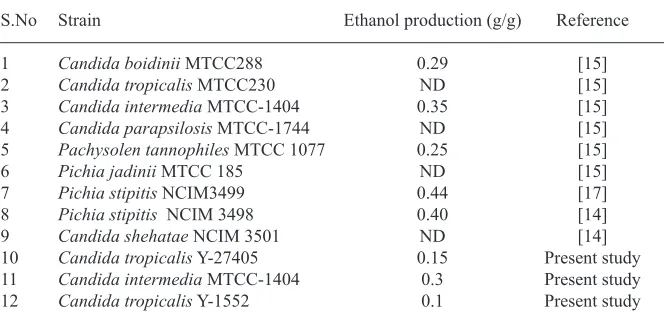
Jyothi15 studied 6 different MTCC strains for ethanol production from synthetic media 30 xylose and reported that C.intermedia MTCC-1404 produced 0.35 (g/g) ethanol yield. Table 1 compares the result of present study with previous reports on ethanol production from pentoses sugar.
Rao et al.,16 isolated 35 yeasts from the gut of beetles collected from Hyderabad city, India. They reported 12 strains can convert xylose to xylitol that reduced ethanol production. Jyothi15 reported that C. intermedia MTCC-1404 has produced more amount of ethanol and little amount of xylitol and their results support the present study.
In present study, C. intermedia MTCC-1404 has been selected for optimization process parameter ethanol production.
Table 1. Comparison of ethanol production with previous reports of pentose fermenting yeast
S.No Strain Ethanol production (g/g) Reference
1 Candida boidinii MTCC288 0.29 [15] 2 Candida tropicalis MTCC230 ND [15] 3 Candida intermedia MTCC-1404 0.35 [15] 4 Candida parapsilosis MTCC-1744 ND [15] 5 Pachysolen tannophiles MTCC 1077 0.25 [15] 6 Pichia jadinii MTCC 185 ND [15] 7 Pichia stipitis NCIM3499 0.44 [17] 8 Pichia stipitis NCIM 3498 0.40 [14] 9 Candida shehatae NCIM 3501 ND [14] 10 Candida tropicalis Y-27405 0.15 Present study 11 Candida intermedia MTCC-1404 0.3 Present study 12 Candida tropicalis Y-1552 0.1 Present study
Fig. 1. Ethanol yield using Candida tropicalis (Y-27405)
Candida intermedia (MTCC-1404) and Candida tropicalis (Y-1552)
Parametric optimization studies for ethanol production by C. intermedia MTCC-1404
To produce maximum ethanol by yeast in synthetic xylose media, optimization of various
Effect of pH on ethanol production by C. intermedia MTCC-1404
The effect of initial pH for ethanol production using xylose by C. intermedia MTCC-1404 was investigated within the range of 3.5 -7.5. The pH was adjusted either with 1N NaOH or 1N
HCl. C.intermedia MTCC-1404 was grown at temperature 30 °C, agitation and 150 rpm. Figure 3 shows that maximum ethanol yield of 0.3±0.013 (g/g) was obtained with initial pH- 5.5 using xylose as carbon source.
Table 2. Parametric optimization studies for ethanol production by Candida intermedia MTCC-1404
S. No Parameters Optimum level Ethanol yield g/g
1 pH 5.5 0.3±0.013
2 Temperature 30 0.3±0.012
3 Concentration of xylose 5% 0.36±0.016
4 Agitation 150rpm 0.36±0.015
5 Initial glucose concentration 0.2% 0.38±0.0162
6 Inoculum size 15% 0.4±0.014
Fig. 3: Effect of pH on ethanol production by C. intermedia MTCC-1404
Effect of temperature on ethanol production by Candida intermedia MTCC-1404
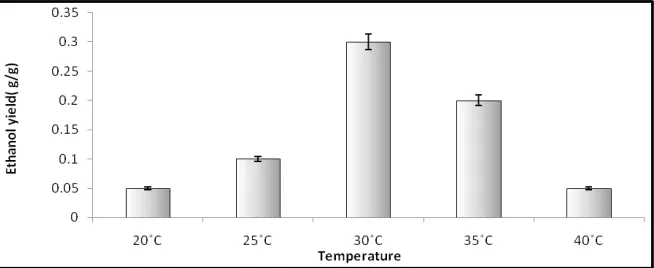
The effect of temperature on the ethanol production was carried out at the level of 20-40 0C. The results are shown in Figure 4. The
optimum temperature for maximum ethanol yield (0.3±0.012g/g) was found at to be 30 0C and an increase in the temperature, the ethanol yield was increased upto 30°C and further increase in temperature decreased the ethanol yield.
Effect of different concentration of xylose on ethanol production by C. intermedia MTCC-1404
The effect of xylose concentration ranging from 3-7 % was studied for maximum ethanol
production. The results were shown in Figure 5. The ethanol yield of 0.36±0.016 g/g was maximum consistent up to 5% xylose concentration thereafter it declined constantly.
Fig. 5. Effect of different concentration of xylose on ethanol production by C. intermedia MTCC-1404 Effect of agitation on ethanol production by
Candida intermedia MTCC-1404
Ethanol production was carried out in static and shaking condition. Optimization of agitation was performed by varying the agitation
speed in the range between 100 to 250 rpm. Agitation at 150 rpm resulted in higher yield of ethanol i.e. 0.36±0.015 g/g when compared with static mode (Figure 6) .
Fig. 6. Effect of agitation speed on ethanol production by C. intermedia MTCC-140
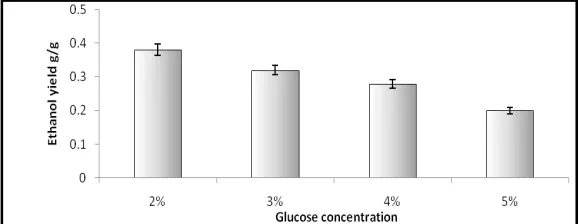
Fig. 7. Effect of different concentration of glucose on ethanol production by Candida intermedia MTCC-1404 Effect initial glucose concentration on ethanol
production by C. intermedia MTCC-1404 The effect of initial glucose concentration ranging from 0.2-0.5% was studied for maximal
concentration of glucose.
Effect of different inoculum size on ethanol production by C. intermedia MTCC-1404
The effect of different inoculum size on ethanol production was studied to select the best
inoculum size for maximum ethanol production. There was a regular increase in ethanol production with the increase in size from 5-15 and thereafter it declined. The maximum ethanol yield 0.4±0.014 g/g was recorded at 15% of inoculum size. (Figure
Fig. 8. Effect of different inoculum size on ethanol production by C. intermedia MTCC-1404
8)
Effect of fermentation time on ethanol production by Candida intermedia MTCC-1404
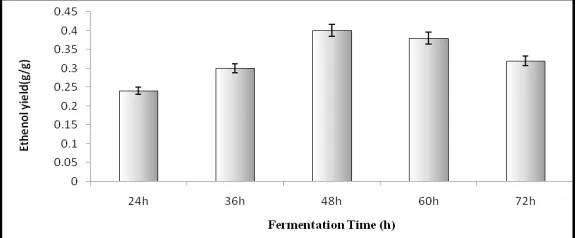
The effect of fermentation time on ethanol production was studied to know the optimum time
for maximum ethanol production. There was a regular increase in ethanol production up to 48h; further increase in the fermentation time decreased the ethanol production. Maximum ethanol of 0.4±0.012 g/g was produced at 48h (Fig. 9).
Fig. 9. Effect of fermentation time on ethanol production by Candida intermedia MTCC-1404
In the present work, optimum pH and temperature were found to be 5.5 and 30°C. With more than these levels ethanol productivity decreased. Membre et al.,18 reported that generally low pH and high sugar concentration is adverse for the bacterial growth hence bacterial contamination could be reduced. Maximum ethanol yield of 0.3±0.013 g/g was obtained with initial pH- 5.5. Abbi et al., 19 mentioned that at low temperature, the decline in ethanol production was probably due to inactivation of cellular activities and at higher
Statistical evaluation of parametric optimization data
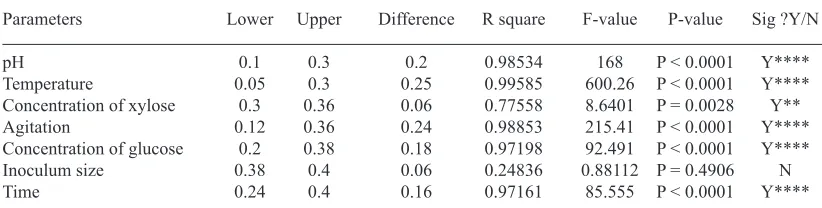
To assess whether fermentation parameters have any significant effect on ethanol production, ANOVA analysis was carried out using Graphpad software. The results infer that all the parameters
have significant effect on ethanol production (Table 3), all the F-values yielded were positive (p<0.05), among all parameters temperature with F-value of 576.98 and R square of 0.99569 showed more significant effect and initial glucose with F-value of 10.279 and R square of 0.80436 showed least significant effect.
Table 3. Statistical evaluation of parametric optimization data -ANOVA
Parameters Lower Upper Difference R square F-value P-value Sig ?Y/N
pH 0.1 0.3 0.2 0.98534 168 P < 0.0001 Y****
Temperature 0.05 0.3 0.25 0.99585 600.26 P < 0.0001 Y**** Concentration of xylose 0.3 0.36 0.06 0.77558 8.6401 P = 0.0028 Y**
Agitation 0.12 0.36 0.24 0.98853 215.41 P < 0.0001 Y****
Concentration of glucose 0.2 0.38 0.18 0.97198 92.491 P < 0.0001 Y****
Inoculum size 0.38 0.4 0.06 0.24836 0.88112 P = 0.4906 N
Time 0.24 0.4 0.16 0.97161 85.555 P < 0.0001 Y****
CONCLUSION
Three different pentose utilizing yeasts
C. tropicalis Y-27405, C.intermedia MTCC-1404 and C. tropicalis Y-1552) were examined to select the best one based on their ethanol production and their ability to utilize maximum sugar C. intermedia MTCC-1404 was found to be best organism for ethanol production. Parametric optimization studies were carried out to know the most influential range of parameters like pH, temperature, agitation, concentration of xylose, initial glucose concentration, inoculum size, fermentation time and ethanol production by for
C. intermedia MTCC-1404. The yield of ethanol obtained under optimal condition at pH 5.5, 30°C, 150 rpm, 5 percent xylose, 0.2 percent initial glucose, 15percent inoculum size and 48h was 0.4±0.012 g/g.
REFERENCES
1. Renewable Fuels Association., Choose Ethanol. Accessed 26.04.2012 at: http://chooseethanol. com/what-is-ethanol/entry/ethanol-at-a-glance, 2011.
2. Bai FW, Anderson WA and Moo-Young M., Ethanol fermentation technologies from sugar and starch feedstocks. Biotechnology Advances, 2008; 26: 89-105.
3. G o w e n C M a n d F o n g S S , E x p l o r i n g Biodiversity for Cellulosic Biofuel Production.
Chemistry&Biodiversity, 2010; 7: 1086-1097. 4. Girio FM, Fonseca C, Carvalheiro F, Duarte
LC, Marques S and Bogel-Aukasik R., Hemicelluloses for fuel ethanol: A review. Bioresource Technology, 2010; 101: 4775–4800. 5. Pickens LB, Tang Y and Chooi Y., Metabolic
Engineering for the Production of Natural Products. Annual Review of Chemical and Biomolecular Engineering, 2011; 2: 211-236.
6. Almeida JR, Runquist D, Sànchez i Nogue V, Liden G and Gorwa-Grauslund MF., Stress-related challenges in pentose fermentation to ethanol by the yeast Saccharomyces cerevisiae. Biotechnology journal, 2011; 6: 286-299. 7. Brenner K, You L and Arnold FH., Engineering
microbial consortia: a new frontier in synthetic biology. Trends in Biotechnology, 2008; 26: 483-489.
8. Wei H, Xu Q, Taylor Ii LE, Baker JO, Tucker MP and Ding SY., Natural paradigms of plant cell wall degradation. Chemical and Biosciences Center, 2009; 20: 330-338.
9. Chemier JA, Fowler ZL and Koffas MAG., Trends in microbial synthesis of natural products and biofuels. Advances in enzymology and related areas of molecular biology, 2009; 76: 151-217.
10. Sonnleitner B and Kappeli O., Growth of
Bioengineering, 1986; 28: 927-937.
11. Matsushika A, Inoue H, Kodaki T and Sawayama S., Ethanol production from xylose in engineered
Saccharomyces cerevisiae strains: current state and perspectives. Applied Microbiology and Biotechnology ,2009; 84: 37–53.
12. Taylor MP, Eley KL, Martin S, Tuffin MI, Burton SG and Cowan DA., Thermophilic ethanologenesis future prospects for second-generation bioethanol production. Trends in Biotechnology, 2009; 27: 398-405.
13. Miller GL., Use of Dinitrosalicylic acid reagent for determination of reducing sugar. Analytical
Chemistry, 1959; 31:426–428.
14. Yadav KS, Naseeruddin S,Prashanthi SG and Sateesh L and Rao LV., Bioethanol fermentation of concentrated rice straw hydrolysate using co-cultureof Saccharomyces cerevisiae and Pichia stipitis. Bioresource Technology 2011; 102: 6473-6478.
15. Jyothi PCH., Biotechnological production of xylitol & ethanol from D-xylose using Candida sp. And effect of xylitol and antimicrobial agents on clinical isolates. PhD thesis, Osmania University. Hyderabad, India, 2009.
16. Rao SS, Bhadra B and Shivaji S., Isolation and
characterization of ethanol– producing yeasts from fruits and tree barks. Letters in applied Microbiology, 2008; 47:19-24.
17. Kumar A., Bioconversion of Saccharum Spontaneum into ethanol by thermotolerant yeast. PhD thesis, Jawaharlal Nehru Technological University.
18. Membre JM, Kubaczka M, and Chene C., Combined effects of pH and sugar on growth rate of Zygosaccharomyces rouxii, bakery product spoilage yeast. Applied and Environmental Microbiology, 1999; 65:4921-4925.
19. Abbi M, Bioconversion of rice straw into ethanol by Candida shehatae NCL-3501. MSC .Thesis. Delhi University. Delhi, India, 1996.
20. Nigam JN., Bioconversion of water-hyacinth (Eichhornia crassipes) hemicellulose acid hydrolysate to motor fuel ethanol by xylose-fermenting yeast. Journal of Biotechnology
,2002; 97: 107-116.