M E T H O D
Open Access
Rule-based induction method for haplotype
comparison and identification of candidate
disease loci
Sirkku Karinen
1†, Silva Saarinen
2†, Rainer Lehtonen
2,3, Pasi Rastas
3,4, Pia Vahteristo
2, Lauri A Aaltonen
2and
Sampsa Hautaniemi
1*Abstract
There is a need for methods that are able to identify rare variants that cause low or moderate penetrance disease susceptibility. To answer this need, we introduce a rule-based haplotype comparison method, Haplous, which identifies haplotypes within multiple samples from phased genotype data and compares them within and between sample groups. We demonstrate that Haplous is able to accurately identify haplotypes that are identical by descent, exclude common haplotypes in the studied population and select rare haplotypes from the data. Our analysis of three families with multiple individuals affected by lymphoma identified several interesting haplotypes shared by distantly related patients.
Background
One of the most important goals in biomedical research is to identify genes that predispose humans to diseases, such as cancer. To facilitate the identification of these genes, a number of genome-wide approaches have been suggested, such as genetic linkage and genome-wide association (GWA) methods [1]. The linkage methods have revealed several high penetrance disease suscept-ibility loci [1], whereas GWA studies have been useful in the ‘common disease - common allele’ model [2]. However, neither approach is well suited to tackle mod-erate penetrance susceptibility because such a condition rarely results in large pedigrees, with few or no pheno-copies, convenient for linkage analysis. As the GWA approaches cannot detect these presumably rare alleles, there is clearly a need for methods that are able to iden-tify loci where such variants could be located. Evolutio-narily recent, and thus rare, mutations are usually conveyed in a pedigree by a shared haplotype. There-fore, detection of such haplotypes can lead to the
identification of rare or moderate penetrance variants behind disease susceptibility.
We introduce here Haplous, a novel computational approach that uses phased genotype data, such as gen-ome-wide SNPs, to identify and prioritize genomic regions likely to be inherited from a common ancestor. The central idea of our approach is to use haplotypes, instead of single alleles, and rank them based on expert-defined rules that determine the haplotypes shared in heterozygous and homozygous forms. As the identifica-tion of haplotypes has been recognized as useful for revealing disease predisposing genes, several haplotype association methods have been developed [3-10]. These methods include detection of haplotype diversity and sta-tistical association tests. Haplotypes can be detected with fixed or variable length sliding window [7,11,12], haplo-type blocks [13], haplohaplo-type clustering [9], a cladistic approach [10] or considering non-contiguous haplotypes [5,8]. Some haplotype analysis methods are feasible in genome-wide settings [9,11,13], although several are intended only for smaller datasets [6,12]. Many haplo-type-based approaches essentially aim to identify identi-cal by descent (IBD) regions between samples [14-16].
To our knowledge, Haplous is the first method that uses a rule-based approach to identify rare haplotypes shared by multiple individuals from genome-wide data.
* Correspondence: [email protected] †Contributed equally
1Research Programs Unit, Genome-Scale Biology, and Institute of
Biomedicine, Biochemistry and Developmental Biology, University of Helsinki, Haartmaninkatu 8, Helsinki, FIN-00014, Finland
Full list of author information is available at the end of the article
To identify a rare disease-associated haplotype with a statistical test would require thousands of samples, which in general is not feasible. The rule-based induc-tion takes advantage of prior knowledge and research hypothesis to rank the identified regions, which allows analysis of small cohorts. The main objective of Haplous is to allow analysis and comparison of phased haplo-types; it thus goes further than simply identifying IBD regions from pairs of individuals. Haplous is freely avail-able with a user guide [17].
We used here three synthetic case studies to demon-strate the ability of Haplous to identify rare shared hap-lotypes. First, we used the HapMap database [18] to assess the true positive (TP) and false positive (FP) rates when haplotype estimation has introduced uncertainty to the haplotype data. We chose individuals from the HapMap database whose haplotype phases were deter-ministically estimated using pedigree (phase-known) data, and compared those data to a setting in which their haplotype phases were estimated using a popula-tion based method (phase-predicted). Second, we simu-lated datasets from an extended pedigree with a mutation inherited from a common ancestor and a data-set for a healthy non- related population, and identified the mutation locus from the data. We also compared Haplous with an existing method [14]. Third, we studied the robustness of Haplous in settings where the para-meters or sample grouping are incorrect.
In order to show that Haplous is applicable to an experimental setting where the aim is to identify predis-position loci for a complex disease using familial infor-mation, we analyzed three Finnish lymphoma families with putative genetic lymphoma predisposition, as several individuals in these families have been affected by Hodg-kin lymphomas (HLs) and non-HodgHodg-kin lymphomas (NHLs). The incidence of HL is about 3 in 100,000 per year, and most cases are sporadic. However, many famil-ial clusters of HL have been reported, and large epide-miological studies have confirmed the increased familial risk associated with HL [19]. Recently,KLHDC8Band NPAT have emerged as candidate HL predisposition genes [20,21], but these preliminary results have not yet been confirmed. Thus, familial HL is an example of a dis-ease in which a hereditary component is apparent but lit-tle is known about its molecular background. In our analysis, Haplous suggested several loci that may contain lymphoma-associated genes, and the genes located in the best-scoring regions were further prioritized with the SNPs3D text mining method [22].
Materials and methods
Haplous
Haplous is designed to detect haplotypes inherited by individuals who have the same familial disease
predisposition and a distantly related common ancestor. It can also be used to compare haplotypes shared by a particular group of affected individuals to haplotypes of unaffected non-related controls. The same haplotype is found from several samples due to a common ancestor or a random event. That is, the haplotype is IBD (com-mon ancestor) or identical by state (IBS; random event). The IBD haplotypes can be identified by filtering against the IBS haplotypes in matched controls and focusing on long haplotypes.
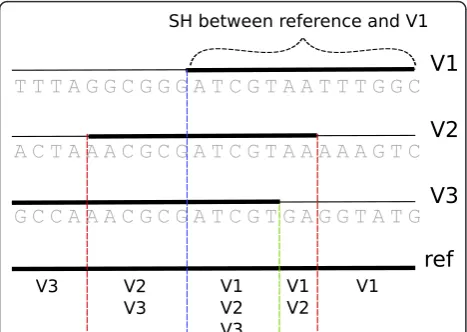
Haplous searches for a shared haplotype (SH) between individuals by using a sliding window and compares the SHs among sample sets, such as cases and controls. The comparison is based on rules, which formulate homozy-gous and heterozyhomozy-gous haplotype composition within and between sample groups. Each SH is assigned a score that allows ranking and prioritization. The score is based on the length of the SH and its abundance in cases and controls. The input to Haplous is phased gen-otypes and outcome is ranked lists of SHs and corre-sponding chromosomal regions.
Haplous is implemented in Java, and it is freely avail-able as an independent Java library. In addition, it is included as a pipeline in the Anduril bioinformatics workflow engine [23]. Anduril compliance allows straightforward integration of Haplous analysis and results to other studies. The Haplous Java library, Anduril components and the user guide are freely avail-able [17].
Haplous parameters
Haplous uses phased haplotypes and predicts the SHs by comparing consecutive SNP alleles with each other using a fixed-sized sliding window with user-adjustable parameters for window size (w), mismatches (m), and length of identical regions (l). Each sample has the phased SNPs for maternal and paternal chromosomes, which are effectively two allele vectors for each sample. Each allele vector in turn is used as a reference to which all other allele vectors are compared. The window ofwmarkers is slid over the reference vector and com-pared to an allele vector, and windows having at most m differences are identified as SHs. Shorter identical regions oflmarkers are identified as SHs as well.
Thus, having multiple pair-wise SHs in a region does not mean that all the allele vectors are the same. Miss-ing markers are treated as matches. The maternal and paternal vectors in each sample are also compared with each other, which reveals the location of homozygous regions.
The running time and the memory requirements of Haplous grow quadratically with the number of samples and linearly with the number of markers. Therefore, Hap-lous is applicable in genome-wide studies in rare diseases, where the number of samples is less than 500. For larger sample sizes, Haplous allows the user to define those sam-ples that are used as a reference in the comparison, and the rest of the samples are skipped. This is a useful option in the case-control settings, since Haplous can be used to compare cases to controls but skip the control-case and the control-control comparisons. Additionally, each sam-ple can be analyzed independently from each other, which enables parallelization of each run. Haplous is also imple-mented on an Anduril [23] bioinformatics workflow engine that automatically parallelizes the execution. Thus far, Haplous has been used to analyze datasets of 930 cases and 960 controls (data not shown).
Haplous gives an estimate for informativeness of each SH. This informativeness describes how rare a given SH is. Informativeness is defined as a joint probability of the alleles in SH estimated from the allele frequencies by multiplying allele frequenciesaifrom the first marker
of SH (i) to the last marker (n), that is, ni P(ai). The user may set a threshold (t) for informativeness. In this case, only those SHs that have informativeness belowt
are included in the results. The value of informativeness is between zero and one. Zero denotes that the alleles of SH could never be seen in the population, while one means that alleles of SH are always observed in that region and thus the region is completely uninformative.
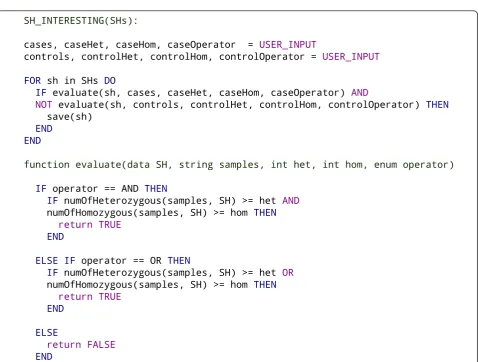
Simply scanning all SHs that meet the criteria would pro-duce a huge list of SHs that are abundant in the population but not particularly interesting regarding the phenotype in question. To find the interesting SHs, we make use of the expert knowledge of the user: the user defines the rules that determine which SHs are interesting. The rules were used to define the features that an interesting SH needs to have, and these features are defined for cases and controls sepa-rately. If a SH has these features, it is considered interesting. The rules are set as thresholds for the number of cases or controls that share the SH.
These rules can be better understood through an ana-logy with basic parametric linkage analysis. The main differences are that in Haplous the‘parameters’are pre-sented as counts instead of percentages, and IBD shar-ing expectations between families can be controlled at the same time. We need to find the IBD haplotype car-rying a predisposing mutation that segregates with the disease trait. These rules include the inheritance model (dominant and recessive model - that is, heterozygotes and homozygotes), assumed penetrance (proportion of mutation-carrying individuals who have the disease in question - that is, the number of cases and controls sharing the same haplotype), phenocopies (the number of cases that do not share the same haplotype) and mutation frequency (the total number of cases and con-trols that share the same haplotype). Using the rules, the user can tune the parameters to correspond to the hypothesis of the current analysis.
The pseudo-code of this inference is given in Figure 2. Briefly, the inference algorithm takes the thresholds and list of cases and controls as an input, calculates the number of cases and controls sharing each SH, and evaluates whether a SH has the features of an interesting SH taking into account both the cases and controls. These evaluations for cases and controls are produced with the same function but the return value is negated for the control rule. The rules follow a natural deduc-tion, an example of which could be: ‘the SH is interest-ing if it is shared by one or more homozygous case samples and not shared by any control samples’.
After filtering the most interesting SHs, the result set may still include many regions that are almost equally promising for further studies. Haplous gives scores for SHs, which are stored in a file with information about the range, score and samples sharing the particular hap-lotype. This allows straightforward identification and post-processing of the most interesting homozygous and heterozygous chromosomal regions.
The score calculated by Haplous emphasizes the num-ber of cases and controls that share the haplotype as well as the length of the SH. The score is calculated according to the formula M(Ca- Co), where M is the
number of markers in the chromosomal region of a SH, Cais the number of times cases share the SH andCois
the number of times controls share the SH. Note that in the case of homozygous loci, each homozygous sample shares the SH twice, which increases either Caor Co.
Instead of a specific haplotype, we assign a score for the chromosomal region carrying the different haplotypes. This score is assigned similarly Mr(Car-Cor), whereCar
is the number of cases and Cor the number of controls
having any SH in a given marker.Mr is the number of
markers in the chromosomal region that receives the same score from (Car- Cor). The upper or lower limits
of the scores depend on the parameter values.
HapMap data
We used the HapMap phase 3 European population (CEU) chromosome 12 [18] phase-known dataset that has been created for each family trio in the database. Computational methods are needed to estimate haplo-type phases from high-throughput SNP data. In many cases, genotypes of the family members are not available but instead population data are used as a reference [24]. However, estimates based on family genotypes are more accurate since inheritance of most of the SNPs can be estimated based on the pedigree. The HapMap database provides unphased genotypes and corresponding haplo-types inferred from the families [18]. In HapMap, the phases of 94% of SNPs are known through the family information in the parents-child trios [25]. On average, 28% of the SNPs are heterozygous, and the trios reveal the phase for 80% of the heterozygous SNPs. We treat
!
"#$!
"#
" !
!
%# "#& ' #
$!
#%()'#*$!
#%()'#*
#
!
+
#%()'#*
#%()'#*
#
!
+
#$+
!
the more accurate family-based haplotypes as phase-known haplotypes, and use Haplous to compare them with the estimated phase-predicted haplotypes of the same HapMap samples, using Haplous.
Here we used only data from parents, as children con-vey redundant information. To create a population of unrelated individuals for the haplotype phase estimation, we randomly picked one individual from each family and used their unphased genotypes. Next, we selected SNPs that were present in the phase- known and unphased datasets. These formed a dataset of 60,704 SNPs for a population of 41 unrelated individuals. The phase-predicted haplotypes were estimated with the HaploRec software [24] based on the 41 population samples. The 29 samples present in the phase-known and the phase-predicted datasets were selected to test Haplous performance, and from these samples we cre-ated two datasets, one having phase-known and the other phase-predicted haplotypes.
Data simulation
We used the simulation software GENOME [26] to gen-erate 6,000 SNP haplotypes from a single chromosome spanning 78 cM. The population had an effective popu-lation size of 100,000 with a mutation rate of 10-8per generation. From this population, we chose 4,068 SNPs that matched best to the Illumina SNP map of human chromosome 22 and had a minimum allele frequency of 0.05 or more. Randomly chosen 1,500 haplotypes were used as the founder haplotypes for the affected pedigree, and 500 other randomly chosen haplotypes were paired as 250 healthy controls.
We created the pedigree by selecting random mem-bers A andB from both lymphoma families 2 and 3. BothAandBhad at most one direct ancestor, and their alleles could be inherited by at least 20% of the youngest generations. The new family members in this pedigree were added so thatAandBhad a common ancestor 10 to 27 generations away from the youngest members.
The mutated allele was inserted into the common ancestor and the rest of the founders were non-carriers. For both families, we chose ten random paths from the youngest individuals to the common ancestor and forced the mutation to be passed through generations in these paths. Then we used our own simulator to simu-late the inheritance of non-founder alleles from the old-est generation to the youngold-est based on the genetic map of chromosome 22.
The individuals from the youngest generation who had the mutation were inserted into the case dataset. The mutation allele was set to the same allele in all the final samples. This simulation was repeated 100 times, each time varying the position of the mutation.
Lymphoma data
Blood-derived DNA was collected from nine lymphoma patients, of whom six had nodular lymphocyte predomi-nant Hodgkin lymphoma (NLPHL) and three had either T-cell/histiocyte rich B-cell lymphoma (TCRBCL), NHL or classical Hodgin lymphoma (cHL). When possible, samples were also collected from the children or parents of these patients for phase determination (Figure 3). Samples were also collected from the children and sib-lings of four deceased lymphoma patients, one of whom
Family 1
Family 3
Family 2
Nodular lymphocyte predominant Hodgkin lymphoma T-cell/histiocyte rich B-cell lymphoma
Other non-Hodgkin lymphoma Classical Hodgkin lymphoma Multiple myeloma
Genome-wide SNP data was available
had had NLPHL, one TCRBCL and two NHL (Figure 3). Altogether, 29 samples were available, of which 20 were from unaffected family members. The slightly modified pedigrees and sample information are shown in Figure 3. The samples and patient information were obtained with approval from the Ethics committees of the Hel-sinki University Central Hospital and Hospital District of Helsinki and Uusimaa (Dnro 408/13/03/03/2009). All blood samples were derived after a signed informed con-sent in accordance with the Declaration of Helsinki. Genotypes from 250 unaffected Finnish control indivi-duals were also available from the Nordic Center of Excellence in Disease Genetics control database [27].
Lymphoma data processing
Genome-wide SNP data were available from four lym-phoma patients in family 1, two in family 2, and three in family 3, as well as from 20 unaffected family mem-bers (Figure 3). In the cases of four lymphoma patients whose DNA was not available, SNP data from their chil-dren and siblings were used to define their haplotypes. This created uninformative gaps in the haplotype data of the deceased individuals. In this study, however, we decided to consider all the uninformative regions as SHs in the haplotype screening in order not to lose any information.
Genomic DNA extracted from 29 blood samples was used for SNP genotyping with the Illumina’s HumanCNV370 -Duo DNA Analysis BeadChip using Infinium Assay (Illumina Inc., San Diego, CA, USA). Genotyping was performed according to the manufac-turer’s standard protocol in the Institute for Molecular Medicine Finland (FIMM) Genome and Technology Centre (Finland). Genotype calling was carried out with BeadStudio software (Illumina Inc.) using the default GenCall score cutoff of 0.15. All samples passed the quality filtering. SNP genotypes were exported from BeadStudio to the Progeny database (Progeny Software LLC, South Bend, IN, USA), in which pedigree, pheno-type, sample and SNP data were integrated. Mendelian error checking was performed on the genotype data using tools integrated in Progeny. The markers with Mendelian errors were removed from further analysis. Pedigree-based haplotypes were constructed using Mer-lin [28] with the‘–best’mode, which estimates the most likely haplotype vector. For the haplotype estimation, the large pedigree of family 3 was first split into smaller overlapping sub-pedigrees. Unlikely genotypes that cause double recombinants were predicted with the Merlin error detection tool and subsequently excluded from the final analysis. The haplotypes for controls were estimated using HaploRec [24] with default parameters and the chromosome split into regions 500 markers long that overlapped by 10 markers and had an extra 20
markers at the tails of each split. In the phase- known family-based haplotypes the uninformative loci were transformed into missing markers.
Analysis of simulated data
From each 100 simulated datasets, we selected the first 11 cases for the analysis and used all controls from each simu-lated dataset. The Haplous SH scan was executed using parameters‘m= 0,w= {20,30,50,100,150,180,200}’. The rules for controls were (USER INPUT = {controlHet =
4, controlHom = 1, controlOperator = OR}) and
for cases it was varied from (USER INPUT = {caseHet =
{1,2,3, caseHom = {1,2,3}, caseOperator = AND}) to (USER INPUT = {caseHet = {1,2,3,
4,5,6,7,8,9,10,11}, caseHom = {1,2,3,4,5,
6,7,8,9,10,11}, caseOperator = AND}). The
rules (USER INPUT = {caseHet = {1,2,3,4,5,6},
caseHom = {1,2,3,4,5,6}, caseOperator = AND}) are comparable with the lymphoma analysis, and they were used for the analysis of Haplous robustness (Tables 1 and 2). BEAGLE was executed using the para-meter‘fastibd = true’.
Lymphoma analysis by Haplous
A schematic of the six-staged lymphoma data analysis is presented in Figure 4. In stage 1, genotypes were imported to the analysis. In stage 2, the haplotypes were estimated from the genotypes. In stage 3, haplotypes of the cases and controls were combined and all SHs were extracted from the data using the following parameters: window size 100, no more than one mismatch within a window and identi-cal haplotype length 80 (w= 100,m= 1 andl= 80). Infor-mativeness was not considered (t= 1). In stage 4, SHs present in the controls were excluded by filtering, allowing the maximum of three SHs as heterozygous or none in homozygous form (USER INPUT = {controlHet = 4,
controlHom = 1, controlOperator = OR}). At this
stage we did not set any threshold for lymphoma cases. In stage 5, we applied in parallel six different rules to identify
Table 1 Summary of the results from the simulated dataset using different numbers of controls
Number of controls
10 60 110 160 210
Percentage of results that included the mutation (%)
100 100 100 100 100
Percentage of mutation loci in the top hit (%) 46 43 37 38 37 Mean length of haplotypes (number of SNPs) 629 546 441 410 383
five SHs in cases in all conformations. As the identified families do not provide a clear clue to the mode of inheri-tance, we varied the number of required heterozygous SHs (hetSHs) and homozygous SHs (homSHs) in cases (USER
INPUT = {caseHet = {0,1,2,3,4,5}, caseHom =
{0,1,2,3,4,5}, caseOperator = AND}). In stage 6,
we selected the ten highest scoring SHs that are more than 30 markers long.
The filtering breaks the SHs into shorter segments based on samples that share the SHs. Therefore, SHs encompassing at least 30 SNPs were considered to be sufficiently long to be genetically interesting, that is, to represent potential IBD haplotypes. The SHs were fil-tered six times, and the ten highest scoring hits from each run were examined in more detail. Region bound-aries were retrieved using SNP identifiers and a list of genes located in these regions was collected from the Ensembl database (release 59) [29]. A downstream ana-lysis of these genes was performed. Genes that had a UniProt identifier were considered as protein coding. In order to find candidate genes that could be interesting considering what is known about their function in the literature, we performed a SNPs3D [22] search for lym-phoma-related features. The search terms were‘nodular lymphocyte predominant Hodgkin lymphoma’, ‘T-cell rich B-cell lymphoma’,‘histiocyte rich B-cell lymphoma’, ‘non-Hodgkin lymphoma’,‘Hodgkin lymphoma’ and‘ B-cell’. We also used three known NHL or NLPHL related
genes (BCL6 [30,31], A20 [32] and SOCS1 [33]) as search words as well as‘NFkB’, a pathway that appears to be activated in both NLPHL and non-Hodgkin lym-phomas [31,33,34].
Results
True positive and false positive rates of Haplous using HapMap data
The haplotype phase is not seen directly from the SNP data, and haplotype estimation procedures may produce switch errors, which are loci where consecutive hetero-zygous SNPs are phased incorrectly. These errors may have a dramatic effect on downstream analyses. In order to characterize the sensitiveness of Haplous to such switch errors, we compared haplotypes from individuals in the HapMap database [18] whose haplotype phase was deterministically estimated by using pedigree (phase-known) data to a setting in which the haplotype phase was estimated using a population based method (phase-predicted). The phase-predicted dataset has switch errors from population-based phase estimation, whereas the phase-known dataset can be considered as a dataset without phasing errors.
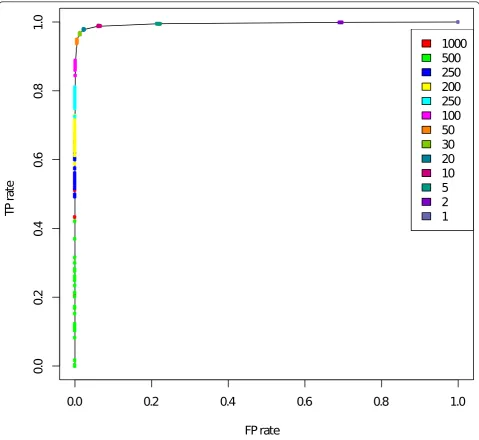
We compared SHs between non-related individuals in phase-known and phase-predicted datasets. This com-parison gives an estimate of the trade-off between find-ing correct SHs and includfind-ing false markers in the SHs. Figure 5 shows the ratio of estimated TP and FP rates.
Table 2 Summary of the results from the simulated dataset mixing cases and controls
Number of cases/number of controls in case dataset
1/10 2/9 3/8 4/7 5/6 6/5 7/4 8/3 9/2 10/1
Percentage of datasets that had haplotypes (%) 0 0 0 0 12 97 99 99 99 100
Percentage of results that included the mutation (%) 0 0 0 0 8 99 98 98 100 99
Percentage of mutation loci in the top hit (%) 0 0 0 0 100 67 53 43 35 32
Mean length of haplotypes (number of SNPs) 0 0 0 0 163 443 428 397 377 355
The controls and cases were mixed into the same case-dataset at different ratios, and then analyzed using a 100 marker window and requiring six cases and three controls to share the shared haplotype (SH). When the number of controls was seven or more, no haplotypes were found. If the dataset had more cases, mutated haplotypes were identified with high frequency. For the borderline case of five cases and six controls, Haplous discovered SHs from 12% of datasets, and one of these had the mutation, which was, however, the top hit in that dataset. The percentages of datasets that included any haplotypes or the mutated haplotypes and the percentage of mutated haplotypes as the top hit were calculated from the 100 simulated datasets. The mean length of haplotypes in number of SNPs was also calculated from the 100 simulated datasets.
! "!
! #
$ " %
!
% " $ #
& ' %' "' $' #' ('
The TP rate was quantified by comparing the number of markers where the SHs were captured similarly in the phase-known and phase-predicted datasets. The FP rate is the number of SNPs falsely included in SHs compared to all SNPs that differ between two samples. The same SHs in both datasets were interpreted as TPs, and the SHs only in the phase-known dataset were considered as false negatives (FNs).
We executed Haplous by varying the window size w from 2,000 to 1 and allowing one mismatch in the win-dow. Window sizew= 2,000 did not find any SHs and with w = 1 Haplous included all the markers in SHs.
Figure 5 shows the ratio of TP and FP rates. When the window size was between 100 and 30, the TP rate was high and the FP rate low. When a very large window size (w> 200) was used, SHs seemed to correspond to the real SHs quite poorly, which is shown as a rapid decline in the TP rate. Also, when the window size was smaller (w< 30), which means higher tolerance for mis-matches, Haplous considers almost all markers as SHs.
Mutated haplotype in the simulated data
We applied Haplous to 100 simulated datasets each hav-ing 11 cases from an extended pedigree and 250 healthy
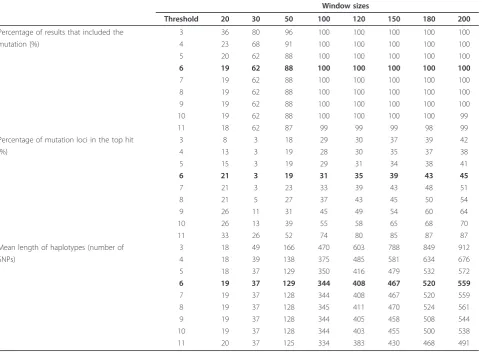
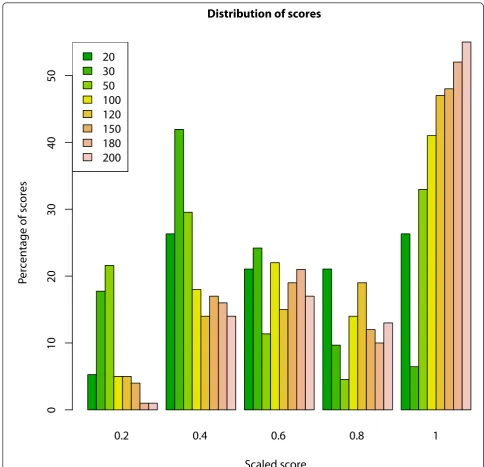
non-related controls. We extracted different sizes of identical SHs from each of the simulated datasets. The SHs that were left in the dataset after filtering were con-sidered interesting. These interesting SHs were found from each of the simulations, and the mutation was included in most of these results (rows in bold in Table 3). The largest window sizes performed the best; they identified the mutation in every run and the mutated haplotype was the top hit in the SHs of highest frequency. The performance declined with smaller win-dow sizes. The length of interesting SHs increased with the window size. Figure 6 shows the distribution of the scaled scores found with different window sizes. The longest windows created the highest scoring SHs, and the mutation SHs found with a window size of 20 received evenly low and high scores. The longest win-dows probably find the most specific haplotypes, which also can be seen in the scores.
For comparison, we used BEAGLE [14] to identify IBD regions from the data set. The mean length of all signifi-cant BEAGLE IBD regions (score < 10-13) was 282 mar-kers, and the mutation was included in 9% of the significant IBD regions. Next we took the 50 highest scoring IBD regions from each of the result sets to examine the most interesting IBD regions, resulting in 5,000 best IBD regions. The mean length of these IBD pairs was 1,303 markers. The mutation was found in 46% of the best IBD regions. The mean length of these regions was 1,618 markers. This shows that BEAGLE detected many very long IBD regions between the sam-ples. Long regions, however, are not well suited for loca-lizing the mutations.
Robustness of Haplous
In order to demonstrate the performance of Haplous in situations where the assumptions in terms of parameter
Table 3 Summary of the results from the simulated dataset using different thresholds
Window sizes
Threshold 20 30 50 100 120 150 180 200
Percentage of results that included the 3 36 80 96 100 100 100 100 100
mutation (%) 4 23 68 91 100 100 100 100 100
5 20 62 88 100 100 100 100 100
6 19 62 88 100 100 100 100 100
7 19 62 88 100 100 100 100 100
8 19 62 88 100 100 100 100 100
9 19 62 88 100 100 100 100 100
10 19 62 88 100 100 100 100 99
11 18 62 87 99 99 99 98 99
Percentage of mutation loci in the top hit 3 8 3 18 29 30 37 39 42
(%) 4 13 3 19 28 30 35 37 38
5 15 3 19 29 31 34 38 41
6 21 3 19 31 35 39 43 45
7 21 3 23 33 39 43 48 51
8 21 5 27 37 43 45 50 54
9 26 11 31 45 49 54 60 64
10 26 13 39 55 58 65 68 70
11 33 26 52 74 80 85 87 87
Mean length of haplotypes (number of 3 18 49 166 470 603 788 849 912
SNPs) 4 18 39 138 375 485 581 634 676
5 18 37 129 350 416 479 532 572
6 19 37 129 344 408 467 520 559
7 19 37 128 344 408 467 520 559
8 19 37 128 345 411 470 524 561
9 19 37 128 344 405 458 508 544
10 19 37 128 344 403 455 500 538
11 20 37 125 334 383 430 468 491
choices or sample groupings are incorrect, we designed three cases that show: 1) the effect of loose and strin-gent assumptions; 2) the effect of insufficient numbers of controls; and 3) the effect of mixing controls to cases, which corresponds to unrelated phenocopies that are falsely assumed to be distantly related cases.
We studied the effect of loose and stringent parameter values by running the simulation with varying thresholds for cases from 3 to 11. Sensitivity is reduced with
increased stringency and the FN rate, as expected (Table 3). With the increased FN rate, we see also increased specificity, since up to 87% of the top hits carried the mutation. Also, the mean length of the haplotypes decreased, which localizes the mutation with higher precision.
In order to evaluate the effect of insufficient numbers of controls, we used 11 cases and reduced the number of controls from 210 to 10 with an interval of 50
0.2
0.4
0.6
0.8
1
Distribution of scores
Scaled score
P
ercentage of scores
0
1
02
03
04
05
0
20
30
50
100
120
150
180
200
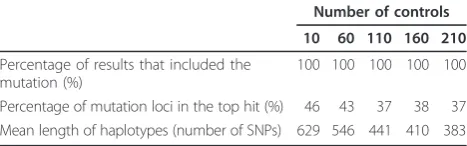
controls at a time. We performed the analysis using a 100 marker window and required 6 cases and 3 controls to share the SH. Table 1 shows that the mutated haplo-type was identified from all the simulations, and it received the highest ranking more often with low num-bers of controls. However, the number of controls had a large effect on precision, which improved with a higher number of controls. This can be seen by the increased length of SHs with the smaller number of controls.
In order to study how often we would get similar results by random, we mixed controls and cases. We used 11 case datasets, each having 11 samples, of which 1 to 10 samples were controls. Corresponding controls were removed from the control data set. We did the analysis using a 100 marker window and required 6 cases and 3 controls to share the SH. Table 2 shows that Haplous does not find FP haplotypes if the data are far from the assumptions in the research setting. In this case the user can clearly see that the assumptions were false since Haplous, instead of FP results, did not return anything. When there were six controls and five cases, Haplous discovered SHs only from 12% of the datasets. Only one of these datasets (8%) included the mutation, which was, however, the top hit in that simulation.
Lymphoma case study
We applied Haplous analysis to three Finnish families with a possible lymphoma predisposing gene. HL is a B-cell-derived hematopoietic neoplasm that is classified into cHL and NLPHL. Approximately, cHL accounts for 95% and NLPHL for 5% of new cases [35]. Based on recent gene expression studies on tumor cells in both HL subtypes, it seems that cHL and NLPHL are sepa-rate, but closely related, disease entities [34]. In addition, the expression pattern of the neoplastic cells in NLPHL is close to that of the cancer cells in TCRBCL [34], which is a subtype of NHL.
We have previously reported a family where four cou-sins (family 1 in Figure 3) have had the rare subtype of HL, NLPHL, in their early twenties [36]. In the current study, we identified a new NLPHL family with three affected siblings from northern Finland (family 2 in Figure 3) by using a systematic search for related NLPHL patients from the Finnish Cancer Registry and genealogy studies. Interestingly, we were able to connect this family to another family with seven individuals with lymphomas, including two with TCRBCL (family 3 in Figure 3). Both families originated from the same geo-graphical region. The common ancestor of these families was born in the 1670s. Since NLPHL is very rare, and NLPHL and TCRBCL are closely related lymphoma sub-types, it is possible that common genetic factors contri-bute to lymphoma susceptibility in these three families.
Conventional linkage analysis was not applicable (data not shown) in the combined pedigree of the two families (families 2 and 3 in Figure 3) due to the complex and looped structure and large size of the pedigree together with low DNA sample rate on the affected individuals. Therefore, to detect the putative IBD haplotypes in lym-phoma patients from these families we used Haplous. We compared long SHs in lymphoma patients to SHs in unaffected controls to separate the IBD haplotypes from IBS haplotypes and to exclude haploblocks with high linkage disequilibrium (LD) in order to identify interest-ing regions for further studies.
Shared chromosomal regions in lymphoma families
We assumed the genetic defect behind lymphoma pre-disposition is the same in at least two of the families. Thus, considering the number of available samples, we decided to look for overlapping SHs that are present in at least five lymphoma patients, but are not frequently found in unaffected controls. These criteria enabled us to exclude haplotypes that are shared by patients of either family 1 or family 2 only, but allowed the possibi-lity that some patients are phenocopies and do not necessarily share a haplotype with others. To avoid IBS haplotypes, we allowed SHs to exist only in three con-trols as heterozygous, and did not allow any SHs as homozygous in controls. The pedigrees do not clearly represent a certain mode of inheritance; therefore, six independent analyses were performed where the mini-mum number of required hetSHs and homSHs in cases was varied to cover all possible combinations of hetSHs and homSHs. A SH with a length of 30 or more SNPs was found in 1,288 different regions. Each SH was given a score based on the number of markers in the SH and on the number of times the cases share a SH. The high-est scoring regions found in each analysis using different parameters are shown in Additional file 1.
The highest scoring regions in Additional file 1 con-tain 684 genes, from which we focused on protein-cod-ing genes. Out of the set of 684 genes, 273 had a UniProt code and were considered as protein coding. We analyzed these genes using the SNPs3D [22] text mining method to search for lymphoma-related features. This analysis highlighted seven potentially interesting genes as shown in Additional file 1. BCL10(B-cell CLL/ lymphoma 10) is involved in a translocation found in B-cell lymphomas of mucosa-associated lymphoid tissue (MALT lymphomas) [37]. BCL10has also been reported to activate NF-kB[37]. MBP (myelin basic protein) is expressed in all hematopoietic cells, including B cells [38].SIAH1(seven in absentia homolog 1) is known to be down-regulated in diffuse large B-cell lymphoma as the result of Epstein-Barr virus infection [39]. ST8SIA1 (ST8 alpha-N-acetyl-neuramide alpha-2,8- sialyltransfer-ase 1) contributes to the formation of GD3 ganglioside [40], which is a cell surface molecule involved in various functions of the cell, such as apoptosis, cell growth and adhesion. It is expressed in various tissues, including activated germinal center B cells [41]. SNRPN (small nucleolar polypeptide) is an imprinted gene that is methylated in leukemias [42].CACNA1H(calcium chan-nel, voltage-dependent, T type, alpha 1H subunit) encodes a voltage-dependent calcium channel and is located in a region that appears to be hypomethylated in T-cell leukemias [43]. SPSB3(splA/ryanodine receptor domain and SOCS box containing 3) encodes a protein that belongs to a family of socs proteins that contain a SPRY domain, but its gene function is so far unknown.
Shared haplotypes in the lymphoma dataset
Using results from previous research where significance of SHs has been studied [44], the probability of all cases sharing at least one IBD haplotype, regardless of the dis-ease status, is:
1−e−(dλ+k)2a−d≤(dλ+k)2a−d (1)
wheredis the number of meioses between cases and their common ancestor, ais the number of common ancestors (1 or 2), k is the number of chromosomes, and lis the expected number of recombinations over these chromosomes. For human data,k= 22 andl≈35 [45]. Below we also assume thata= 2.
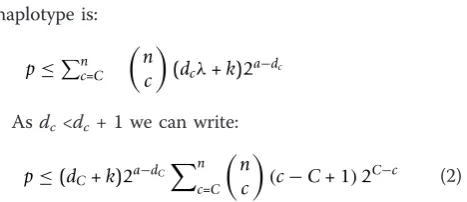
Next we generalize Equation 1 to access significance of the high scoring regions of the lymphoma data. The probability that ccases out ofn shared an IBD haplo-type, regardless of the disease status, is
≤
n c
(dcλ+k)2a−dc, where at least dc meioses
sepa-rates any subset ofccases from their common ancestor. The significance that at leastC cases shares some IBD
haplotype is:
p≤nc=C
n c
(dcλ+k)2a−dc
Asdc<dc+ 1 we can write:
p≤(dC+k)2a−dC
n
c=C
n c
(c−C+ 1)2C−c (2)
The interesting haplotypes were shared by five to eight samples (Additional file 1). Using the right-hand side of Equation 2, we discovered that finding five IBD SHs is significant at the 5% level ifd5 ≥27.
Similarly, finding eight SHs is significant ifd8≥24.
If the common ancestor is, on average, at leastx gen-erations away from all subsets of Ccases, thendCmust
be at least 2x + C- 2. This is because there must be two cases that are connected by at least 2xmeioses, and the remaining cases must each contribute at least 1 to dC . This simple reasoning shows that whend5≥27 for
five significantly shared haplotypes, the common ances-tor is, on average, at least 12 generations away from the samples. For eight SHs the common ancestor must then be, on average, at least 9 generations away. In the lym-phoma data, both of these significant (within 95% confi-dence interval) distances from the common ancestor seem probable by inspecting the partial pedigree of the lymphoma families (Figure 3).
Following the original analysis [44], the length of an IBD region (in Morgans) right and left from the disease loci is exponentially distributed with parameter d, if the cases (or their subset) are connected by dmeioses. So the total length of the IBD region is the sum of these two exponentially distributed random variables. Thus,
the expected length of such a region is 2
d. When d
increases, the IBD region becomes narrower, but at the same time becomes more significant as well. All of the analysis above has concerned IBD. However, IBS values can only be obtained from the lymphoma data. The separate control data allow filtering out of some IBS regions that are not IBD. Moreover, if the IBS region found is long enough, then it is likely to also be IBD. In light of the analysis above, this depends on the number of meioses d connecting the cases. When d is suffi-ciently large, but not too large, the above analysis works also with IBS values.
only in controls (red). Since we had 250 controls and only 13 cases, SHs in controls are shared in much higher numbers than SHs in cases. Nevertheless, the length of SHs declines more rapidly in controls than in cases. This was expected, since controls should not have close ances-try and their SHs are from shorter IBS haplotypes.
Despite long SHs in cases, we did not pick the most interesting SHs based solely on the length, but per-formed six analyses on cases to cover all combinations of homozygous and heterozygous haplotypes, and dis-covered five affected individuals with the same SH. Figure 8 shows the distribution of SH length and num-ber from these analyses, giving the count in normal and logarithmic scales. The distributions of all of the ana-lyses have tails of rarely occurring long SHs, but the tails are in different positions in the x-axis. This is because homozygous samples actually share the
haplotype twice and the length of SHs decreases when the number of SHs in the dataset increases. For exam-ple, the logarithmic scale shows that SHs shared by five heterozygous samples have the longest SHs, but are also shared the lowest number of times. Furthermore, SHs shared by five homozygous samples (black) are found only in short regions.
Discussion
We have developed Haplous for haplotype-based analy-sis and comparison. Haplous enables the search of IBD haplotypes in a group of affected individuals determined by the user in a rule-based manner. The rules and para-meters can be adjusted flexibly. Our approach is applic-able to studies aiming to identify rare or moderate penetrance genetic determinants that cannot be found by traditional linkage and GWA analyses.
2 4 6 8 10 12 14
The TP and FP ratio of the SHs identified from the HapMap data indicates that even though accuracy of haplotype estimation has raised some concerns [13], Haplous is able to compensate for possible incorrect switches from the haplotype phasing (Figure 5). In the HapMap test, Haplous achieved a high TP rate in a very limited number of samples. The TP rate declines espe-cially with long window sizes, the most likely cause of which is that HaploRec, similar to many other haplotype phase estimation software, tends to favor common hap-lotypes in the dataset, which cannot be adapted for. Therefore, haplotype phase should be estimated for cases and controls separately to ensure that haplotypes in the controls do not hide the typical haplotypes in the cases. Haplous uses the number of markers to define the SH length, which is an adaptation to the LD struc-ture in the population, since SNPs in many genotyping arrays are designed accordingly. If the marker density does not take into account the LD structure in the
study population, we suggest cleaning the data from markers in LD blocks before running Haplous. If matched population controls are included in the analy-sis, they usually represent the same LD structure, and the possible bias can be corrected with proper filtering.
Haplous identified the mutated region from the simu-lated data with high frequency. The simulation followed the setting in the lymphoma study, which shows that our approach is applicable to real-life genome-wide genetic data. The longest windows created the highest scoring SHs, probably because long SHs are more speci-fic for the cases. On the other hand, a small window of 20 markers performed the worst, probably because it finds frequent SHs in both cases and controls. In gen-eral, a SH of 20 markers cannot be considered to harbor an IBD region most of the time.
Haplous identified the mutation more efficiently than BEAGLE when we applied the same assumptions that were used in the lymphoma study. BEAGLE’s sensitivity
0 1000 2000 3000 4000 5000
2 3 4 5 6 7 8
in all IBD regions was much lower than the regions returned by Haplous (Table 3); the 50 highest scoring IBD regions of BEAGLE were comparable with the per-formance of Haplous when using 20 to 30 marker win-dows. In addition, Haplous had better precision in terms of haplotype length (Table 3). Furthermore, BEAGLE is designed for discovering pair-wise IBD regions, and in the extended pedigree they are usually very long. There-fore, the BEAGLE analysis would require the tedious work of combining multiple IBD regions.
We have shown how the results are affected if the initial assumptions used for setting the parameters are wrong. Table 3 shows how sensitivity and specificity are affected by the parameter stringency. Too stringent values will not capture the whole signal and too loose will include FP regions in the results. The FP results should not be considered as a problem as the findings can be verified using other means, such as next genera-tion sequencing, but a decrease in sensitivity is definitely a problem. Table 1 shows that the matched controls will improve the identification of the mutation. Haplous will find the mutation if the assumptions are close to the ‘true values’, as they were in this test, but its perfor-mance suffers if the number of controls is insufficient. Table 2 shows that Haplous does not find FP haplotypes if the data do not correspond to the research setting. Accordingly, the user can see from the results that the assumptions were false since Haplous, instead of giving FP results, did not return anything. In the borderline case where the data are almost as assumed (five affected cases and six non-related controls in Table 2), it may be difficult to distinguish whether analysis is successful. In general, Haplous performs well even in suboptimal situations. However, it is best to vary the parameters in multiple runs to explore the limitations in the data.
The aggregation of HL in some families has been long acknowledged, but the causes of this clustering are lar-gely unknown. NLPHL is a rare subtype of HL and the presence of several affected family members strongly suggests a genetic factor contributing to disease predis-position. Such families, as we have reported here, pro-vide an excellent opportunity for genetic studies. However, sporadic lymphomas are common and pheno-copies further complicate gene identification studies. Therefore, for the reported families, we used Haplous to search for haplotypes that are shared by most patients, but are rare or absent in the control population.
Six different Haplous analyses were run because the pedigrees do not clearly represent a certain mode of inheritance. These analyses covered all combinations of homozygous and heterozygous haplotypes that could lead to five affected individuals having the same SH. This way the smaller families, families 1 and 2, could not produce a hit alone without support from the other
families. As the pedigree of family 3 is complex and contains several lymphoma patients, such regions that are shared by five patients from family 3 would also be of interest. As the genome-wide search produced over 1,000 regions with a SH, we decided to focus on the 10 highest scoring regions from each analysis. These regions still included 273 known protein coding genes. In order to further prioritize the gene set, we performed a SNPs3D search to find the genes with lymphoma-related features.
Even though the number of generations from last common ancestor is unknown in the lymphoma dataset, we have estimated that SHs shared by five cases are true IBD haplotypes with 95% confidence. Figures 7 and 8 show that, as expected, we found longer SHs in lym-phoma cases than in the general population. Also, the number of SHs declines rapidly with the SH length. As we showed with the simulated data, the mutated haplo-types in the related samples are longer than those in the population in general. Therefore, we can conclude that long rare SHs in lymphoma cases are not seen in the population and may well carry the disease predisposition mutation.
With literature mining, we found seven genes that are frequently associated with hematopoietic cells and malignancies, lymphomagenesis or lymphoma-related pathways. The most interesting of these seven genes is BCL10, which is known to be disrupted in other kinds of lymphomas [37]. A link between SIAH1 and NHLs was also found in the literature, when Epstein-Barr virus infection had been detected in the tumor [39]. Similar direct links to lymphomas could not be found for the rest of these genes. One reason for this is that the prin-cipal phenotypes we study here are NLPHL and TCRBCL, which are rare lymphoma subtypes and not much is known about their molecular background. No gene hits were found when‘nodular lymphocyte predo-minant Hodgkin lymphoma’, ‘T-cell rich B-cell lym-phoma’or ‘histiocyte rich B-cell lymphoma’were used as keywords. This could suggest that the genetics of these lymphoma types are still largely unknown. Clearly, the putative gene harboring a predisposing variant can also be a gene that has not yet been implicated in the literature to be related to hematological malignancies or B-cell development, and the SNPs3D search must be considered only as a supporting method to prioritize candidate genes for more detailed analyses.
embedded within a haplotype that is relatively common in the population. Due to the uninformativeness caused by the missing DNA of some samples, some of the interesting regions can be false positive hits. In general, Haplous allows more stringent criteria for handling con-trols and uninformativeness than what we have used in our analysis. In the lymphoma study, however, the hap-lotypes of some of the key individuals have been pre-dicted using SNP data from their relatives, resulting in a considerably large number of genetic regions where the phase-known haplotype cannot be estimated. Thus, we decided to tolerate FP SHs rather than lose information, especially as the effect of the FPs can be narrowed down in the future by combining the results with other plat-forms, such as gene expression studies and large scale sequencing efforts. Results from Haplous enable targeted next generation sequencing of putative disease-asso-ciated regions, and help focus the analysis of whole gen-ome or exgen-ome sequencing data to particular loci; a key feature considering the abundance of variants detected by these methods.
Taken together, Haplous can be used to scrutinize next generation sequencing results that contain plenty of irrelevant information and errors, especially when other SNP array-based methods are not applicable. This is an important feature in settings where the sample sizes are small. Even though the number of FPs increases with small sample numbers, this cannot be seen as a major obstacle as novel high-throughput sequencing technologies are able to cover multiple large regions with relatively low cost. The outcome of Hap-lous is a ranked set of candidate regions that fulfill the criteria determined by the user. The results are easy to interpret, which increases the reproducibility that has been a challenge in previous haplotype-based tests [4]. The user can also choose whether to emphasize the haplotype length or the number of cases sharing a hap-lotype when the score for each region is created. Hap-lous is flexible and allows various testing of various inheritance models and datasets such as a recessive family-based inheritance model, IBD analyses in multiple pedigrees of any size, homogenous population samples, or any combination of these.
Conclusions
We have developed a novel computational method, Haplous, which is a rule-based haplotype comparison method for flexible analysis of haplotypes with high accuracy in groups of individuals, enabling these haplo-types to be further used to locate disease-causing muta-tions. We used Haplous to identify haplotypes that are common to patients in three lymphoma families to which linkage analysis could not be applied. Several
interesting loci were identified, and these results can be integrated with the patient data produced by other high-throughput approaches, such as gene expression and sequence information.
Additional material
Additional file 1: The results of all six different Haplous analyses
performed on lymphoma families. If the analysis produced more than
10 hits longer than 30 SNPs, only the 10 highest scoring shared haplotypes (SHs) are shown. The number of heterozygous SHs (hetSHs) and homozygous SHs (homSHs), the region boundaries, and the individuals who share the haplotype are also shown. Ensembl release 59 was used as the reference build. The codes for individuals in families 1 to 3 are the same as in Figure 3. Separately depicted SHs can partially overlap as affected individuals can share different parts of the haplotype within a region.
Abbreviations
cHL: classical Hodgkin lymphoma; FN: false negative; FP: false positive; GWA: genome-wide association; hetSH: heterozygous SH; HL: Hodgkin lymphoma; homSH: homozygous SH; IBD: identical by descent; IBS: identical by state; LD: linkage disequilibrium; NHL: non-Hodgkin lymphoma; NLPHL: nodular lymphocyte predominant Hodgkin lymphoma; SH: shared haplotype; SNP: single nucleotide polymorphism; TCRBCL: T-cell/histiocyte rich B-cell lymphoma; TP: true positive.
Acknowledgements
We thank the Nordic Center of Excellence in Disease Genetics for providing the control genotype database and Tiia Pelkonen for proof-reading. The Illumina SNP BeadArrays were processed in the Institute for Molecular Medicine Finland (FIMM) core facility. This work was supported by Academy of Finland (125826, Center of Excellence in Cancer Genetics Research), Sigrid Jusélius Foundation, Finnish Cancer Organisations, Biocentrum Helsinki, Finnish Medical Foundation (SS), K Albin Johansson Foundation (SS) and Finnish Graduate School in Computational Sciences (SK).
Author details 1
Research Programs Unit, Genome-Scale Biology, and Institute of
Biomedicine, Biochemistry and Developmental Biology, University of Helsinki, Haartmaninkatu 8, Helsinki, FIN-00014, Finland.2Research Programs Unit, Genome-Scale Biology, and Haartman Institute, Department of Medical Genetics, University of Helsinki, Haartmaninkatu 8, Helsinki, FIN-00014, Finland.3Department of Biological Sciences, University of Helsinki, Viikinkaari 1, FIN-00014, Finland.4Department of Computer Science, University of Helsinki, Gustaf Hällströmin katu 2b, FIN-00014, Finland.
Authors’contributions
SK developed Haplous, and was responsible of the bioinformatics of the study and wrote the corresponding sections of this article. SS was responsible for the lymphoma study and wrote the corresponding sections of this article. RL was responsible for co-supervising the algorithm development and the data analysis and reviewed and modified the manuscript. PR was responsible for data simulation, evaluating the significance of the lymphoma results and wrote the corresponding sections. PV produced the lymphoma SNP data and family-based haplotypes and reviewed the manuscript. LAA contributed to the lymphoma case study and to the writing of the manuscript. SH initiated and supervised the project, and contributed to the writing of the manuscript. All authors have read and approved the manuscript for publication.
Competing interests
The authors declare that they have no competing interests.
References
1. Houlston RS:Detecting low penetrance genes in cancer: the way ahead.
J Med Genet2000,37:161-167.
2. Broderick P, Carvajal-Carmona L, Pittman AM, Webb E, Howarth K, Rowan A, Lubbe S, Spain S, Sullivan K, Fielding S, Jaeger E, Vijayakrishnan J, Kemp Z, Gorman M, Chandler I, Papaemmanuil E, Penegar S, Wood W, Sellick G, Qureshi M, Teixeira A, Domingo E, Barclay E, Martin L, Sieber O, Kerr D, Gray R, Peto J, Cazier J-B, Tomlinson I, Houlston RS:A genome-wide association study shows that common alleles of SMAD7 influence colorectal cancer risk.Nat Genet2007,39:1315-1317.
3. Guo W, Lin S:Generalized linear modeling with regularization for detecting common disease rare haplotype association.Genet Epidemiol
2009,33:308-316.
4. Hauser E, Cremer N, Hein R, Deshmukh H:Haplotype-based analysis: a summary of GAW16 Group 4 analysis.Genet Epidemiol2009,33:S24-S28. 5. Abo R, Knight S, Wong J, Cox A, Camp NJ:hapConstructor: automatic
construction and testing of haplotypes in a Monte Carlo framework.
Bioinformatics2008,24:2105.
6. Purcell S, Daly MJ, Sham PC:WHAP: haplotype-based association analysis.
Bioinformatics2007,23:255.
7. Li Y, Sung W, Liu J:Association mapping via regularized regression analysis of single- nucleotide-polymorphism haplotypes in variable-sized sliding windows.Am J Hum Genet2007,80:705-715.
8. Laramie JM, Wilk JB, DeStefano AL, Myers RH:HaploBuild: an algorithm to construct non-contiguous associated haplotypes in family based genetic studies.Bioinformatics2007,23:2190.
9. Browning BL, Browning SR:Efficient multilocus association testing for whole genome association studies using localized haplotype clustering.
Genet Epidemiol2007,31:365-375.
10. Durrant C, Zondervan KT, Cardon LR, Hunt S, Deloukas P, Morris AP: Linkage disequilibrium mapping via cladistic analysis of single-nucleotide polymorphism haplotypes.Am J Hum Genet2004,75:35-43. 11. Allen A, Satten G:Genome-wide association analysis of rheumatoid
arthritis data via haplotype sharing.BMC Proc2009,3:S30.
12. Guo W, Liang C, Lin S:Haplotype association analysis of North American Rheumatoid Arthritis Consortium data using a generalized linear model with regularization.BMC Proc2009,3:S32.
13. Shim H, Chun H, Engelman C, Payseur B:Genome-wide association studies using single- nucleotide polymorphisms versus haplotypes: an empirical comparison with data from the North American Rheumatoid Arthritis Consortium.BMC Proc2009,3:S35.
14. Browning BL, Browning SR:A fast, powerful method for detecting identity by descent.Am J Hum Genet2011,88:173-182.
15. Gusev A, Lowe JK, Stoffel M, Daly MJ, Altshuler D, Breslow JL, Friedman JM, Pe’er I:Whole population, genome-wide mapping of hidden relatedness.
Genome Res2008,19:318-326.
16. Purcell S, Neale B, Todd-Brown K, Thomas L, Ferreira MAR, Bender D, Maller J, Sklar P, de Bakker PIW, Daly MJ, Sham PC:PLINK: a tool set for whole-genome association and population-based linkage analyses.Am J Hum Genet2007,81:559-575.
17. Haplous.[http://csbl.fimm.fi/haplous/].
18. International HapMap Consortium, Frazer KA, Ballinger DG, Cox DR, Hinds DA, Stuve LL, Gibbs RA, Belmont JW, Boudreau A, Hardenbol P, Leal SM, Pasternak S, Wheeler DA, Willis TD, Yu F, Yang H, Zeng C, Gao Y, Hu H, Hu W, Li C, Lin W, Liu S, Pan H, Tang X, Wang J, Wang W, Yu J, Zhang B, Zhang Q,et al:A second generation human haplotype map of over 3.1 million SNPs.Nature2007,449:851-861.
19. Goldin LR, Bjorkholm M, Kristinsson SY, Turesson I, Landgren O:Highly increased familial risks for specific lymphoma subtypes.Br J Haematol
2009,146:91-94.
20. Salipante SJ, Mealiffe ME, Wechsler J, Krem MM, Liu Y, Namkoong S, Bhagat G, Kirchhoff T, Offit K, Lynch H, Wiernik PH, Roshal M, McMaster ML, Tucker M, Fromm JR, Goldin LR, Horwitz MS:Mutations in a gene encoding a midbody kelch protein in familial and sporadic classical Hodgkin lymphoma lead to binucleated cells.Proc Natl Acad Sci USA
2009,106:14920-14925.
21. Saarinen S, Aavikko M, Aittomäki K, Launonen V, Lehtonen R, Franssila K, Lehtonen H, Kaasinen E, Broderick P, Tarkkanen J, Bain B, Bauduer F, Unal A, Swerdlow A, Cooke R, Mäkinen H, Houlston R, Vahteristo P, Aaltonen L: Exome sequencing reveals germline NPAT mutation as a candidate risk factor for Hodgkin lymphoma.Blood2011,118:493-498.
22. Yue P, Melamud E, Moult J:SNPs 3 D: Candidate gene and SNP selection for association studies.BMC Bioinformatics2006,7:166.
23. Ovaska K, Laakso M, Haapa-Paananen S, Louhimo R, Chen P, Aittomäki V, Valo E, Núñez-Fontarnau J, Rantanen V, Karinen S, Nousiainen K, Lahesmaa-Korpinen AM, Miettinen M, Saarinen L, Kohonen P, Wu J, Westermarck J, Hautaniemi S:Large-scale data integration framework provides a comprehensive view on glioblastoma multiforme.Genome Med2010, 2:65.
24. Eronen L, Geerts F, Toivonen H:HaploRec: efficient and accurate large-scale reconstruction of haplotypes.BMC Bioinformatics2006,7:542. 25. Index of/downloads/phasing/2009-02_phaseIII/HapMap3_r2.[http://
hapmap.ncbi.nlm.nih.gov/downloads/phasing/2009-02_phaseIII/ HapMap3_r2/].
26. Liang L, Zöllner S, Abecasis GR:GENOME: a rapid coalescent-based whole genome simulator.Bioinformatics2007,23:1565.
27. Nordic Centre of Excellence in Disease Genetics.[http://www.ncoedg.org/ ].
28. Abecasis GR, Cherny SS, Cookson WO, Cardon LR:Merlin - rapid analysis of dense genetic maps using sparse gene flow trees.Nat Genet2001, 30:97-101.
29. Flicek P, Aken BL, Ballester B, Beal K, Bragin E, Brent S, Chen Y, Clapham P, Coates G, Fairley S, Fitzgerald S, Fernandez-Banet J, Gordon L, Gräf S, Haider S, Hammond M, Howe K, Jenkinson A, Johnson N, Kähäri A, Keefe D, Keenan S, Kinsella R, Kokocinski F, Koscielny G, Kulesha E, Lawson D, Longden I, Massingham T, McLaren W,et al:Ensembl’s 10th year.Nucleic Acids Res2010,38:D557-D562.
30. Ye BH, Lista F, Coco FL, Knowles DM, Offit K, Chaganti RS, Dalla-Favera R: Alterations of a zinc finger-encoding gene, BCL-6, in diffuse large-cell lymphoma.Science1993,262:747-750.
31. Compagno M, Lim WK, Grunn A, Nandula SV, Brahmachary M, Shen Q, Bertoni F, Ponzoni M, Scandurra M, Califano A, Bhagat G, Chadburn A, Dalla-Favera R, Pasqualucci L:Mutations of multiple genes cause deregulation of NF-kappaB in diffuse large B-cell lymphoma.Nature
2009,459:717-721.
32. Kato M, Sanada M, Kato I, Sato Y, Takita J, Takeuchi K, Niwa A, Chen Y, Nakazaki K, Nomoto J, Asakura Y, Muto S, Tamura A, Iio M, Akatsuka Y, Hayashi Y, Mori H, Igarashi T, Kurokawa M, Chiba S, Mori S, Ishikawa Y, Okamoto K, Tobinai K, Nakagama H, Nakahata T, Yoshino T, Kobayashi Y, Ogawa S:Frequent inactivation of A20 in B-cell lymphomas.Nature2009, 459:712-716.
33. Davis RE, Brown KD, Siebenlist U, Staudt LM:Constitutive nuclear factor kappaB activity is required for survival of activated B cell-like diffuse large B cell lymphoma cells.J Exp Med2001,194:1861-1874. 34. Brune V, Tiacci E, Pfeil I, Doring C, Eckerle S, van Noesel CJ, Klapper W,
Falini B, von Heydebreck A, Metzler D, Brauninger A, Hansmann ML, Kuppers R:Origin and pathogenesis of nodular lymphocyte-predominant Hodgkin lymphoma as revealed by global gene expression analysis.J Exp Med2008,205:2251-2268.
35. Yung L, Linch D:Hodgkin’s lymphoma.Lancet2003,361:943-951. 36. Saarinen S, Vahteristo P, Launonen V, Franssila K, Kivirikko S, Lehtonen R,
Bain B, Bauduer F, Unal A, Aaltonen L, Aittomäki K:Analysis of KLHDC8B in familial nodular lymphocyte predominant Hodgkin lymphoma in a Finnish family.Br J Haematol2011,154:413-415.
37. Willis TG, Jadayel DM, Du MQ, Peng H, Perry AR, Abdul-Rauf M, Price H, Karran L, Majekodunmi O, Wlodarska I, Pan L, Crook T, Hamoudi R, Isaacson PG, Dyer MJ:Bcl10 is involved in t(1;14)(p22;q32) of MALT B cell lymphoma and mutated in multiple tumor types.Cell1999,96:35-45. 38. Marty MC, Alliot F, Rutin J, Fritz R, Trisler D, Pessac B:The myelin basic protein gene is expressed in differentiated blood cell lineages and in hemopoietic progenitors.Proc Natl Acad Sci USA2002,99:8856-8861. 39. Imig J, Motsch N, Zhu JY, Barth S, Okoniewski M, Reineke T, Tinguely M,
Faggioni A, Trivedi P, Meister G, Renner C, Grasser FA:microRNA profiling in Epstein-Barr virus-associated B-cell lymphoma.Nucleic Acids Res2011,39:1880. 40. Matsuda Y, Nara K, Watanabe Y, Saito T, Sanai Y:Chromosome mapping of
the GD3 synthase gene (SIAT8) in human and mouse.Genomics1996, 32:137-139.
42. Benetatos L, Hatzimichael E, Dasoula A, Dranitsaris G, Tsiara S, Syrrou M, Georgiou I, Bourantas KL:CpG methylation analysis of the MEG3 and SNRPN imprinted genes in acute myeloid leukemia and myelodysplastic syndromes.Leuk Res2010,34:148-153.
43. Yoshida M, Nosaka K, Yasunaga J, Nishikata I, Morishita K, Matsuoka M: Aberrant expression of the MEL1S gene identified in association with hypomethylation in adult T-cell leukemia cells.Blood2004, 103:2753-2760.
44. Thomas A, Camp NJ, Farnham JM, Allen-Brady K, Cannon-Albright LA: Shared genomic segment analysis. Mapping disease predisposition genes in extended pedigrees using snp genotype assays.Ann Hum Genet
2007,72:279-287.
45. Broman KW, Murray JC, Sheffield VC, White RL, Weber JL:Comprehensive human genetic maps: individual and sex-specific variation in recombination.Am J Hum Genet1998,63:861-869.
doi:10.1186/gm320
Cite this article as:Karinenet al.:Rule-based induction method for haplotype comparison and identification of candidate disease loci. Genome Medicine20124:21.
Submit your next manuscript to BioMed Central and take full advantage of:
• Convenient online submission
• Thorough peer review
• No space constraints or color figure charges
• Immediate publication on acceptance
• Inclusion in PubMed, CAS, Scopus and Google Scholar
• Research which is freely available for redistribution