R E S E A R C H A R T I C L E
Open Access
Tenofovir decrease hepatocellular
carcinoma recurrence in chronic hepatitis B
patients after liver resection
Min Zhang
1, Dexin Wang
2, Haidong Liu
1and Hui Li
3*Abstract
Background:Tenofovir disoproxil fumarate (TDF) and entecavir (ETV) are recommended as the first-line choices regarding the treatment of chronic hepatits B. The impact of the two antiviral agents on prognosis of Chronic hepatitis B (CHB) related hepatocellular carcinoma (HCC) remains to be explored. We aim to investigate whether CHB-related HCC patients receiving TDF and ETV have a different prognosis.
Methods:233 CHB-related compensated cirrhosis patients were divided into groups according to the nucleut(s)ide
patients received. The results of TDF and ETV groups were reviewed and compared. The disease-free survival (DFS) and overall survival (OS) of both groups were analyzed and compared.
Results:233 CHB-related compensated cirrhosis patients from 2013 October to 2014 November were included
in our study. 107 and 126 patients received TDF and ETV monotherapy, respectively. Child-Pugh score, alanine aminotransferase (ALT), aspartate aminotransferase (AST), total bilirubin level, status of hepatitis B e antigen (HBeAg) and serum HBV DNA level were compared between groups. DFS in TDF-treatment group were significantly longer than it in ETV-treatment group (p< 0.05). multi-variant analysis indicated that TDF duration was significantly
associated with lower probability of HCC development, (hazard ratio, 0.35; 95% confidence interval range, 0.33–0.84, p< 0.05).
Conclusion:Anti-virus regimen containing TDF benefits for the prognosis of CHB-related liver cirrhosis patients.
Keywords:Tenofovir, Entecavir, Chronic hepatits B, Hepatocellular carcinoma, Nucleus(t)ide analogues
Background
Hepatocellular carcinoma (HCC) is among the most com-mon causes of cancer-related deaths with a high preva-lance worldwidely, [1] of which Chinese patients acounts for over 50%. [2,3] For the high incidence of recurrence, the prognosis and disease-free survival of patients after curative resection remain to be improved, although sur-veilance of patients with chronic hepatic diseases has been enhanced. [4–6] Advances of HCC recurrence have re-vealed a number of risk factors, including the serum α-fetoprotein (AFP), tumor stage, cirrhosis, chronic hepa-tits B and heptitis C. [5]
More than 50% incidence of HCC is associated with chronic hepatits B virus (HBV) infection. [7, 8] In China, about 100 million people are infected with HBV and 20% of them will progress to chronic infection. [9,10] 10~ 20% of patients will develop cirrhosis within 5 years. [11] High HBV viral load has been determined to be associated with tumor relapse in HBV-related HCC. [12, 13] As one of HCC risk factors, HBV viral load can be controllable with effective antiviral agents such as tenofovir disoproxil fumarate (TDF) and entecavir (ETV), [14, 15] which are recommended as the first-line therapy by international anti-HBV guidelines. [16–18] Long term duration of nucleus(t)ide analogues (NAs) to continuous suppress relication of HBV has been proved to be associated with regression of cirrhosis and decompensated hepatic dis-eases. [19, 20] Evidences also indicated NAs reduce the risk of CHB-related HCC development. [21–24]
* Correspondence:[email protected]
3Invasive Technology Department, Jining NO.1 People’s Hospital, Jining,
Shandong 272100, People’s Republic of China
Full list of author information is available at the end of the article
TDF and ETV were determined to have high barrier to clinical resisitance and better viral response rate. [14, 15] But whether there are discrepancies of the two first-line antiviral agents regarding the prognosis of CHB-related HCC patients after surgeries remains to be explored. Recent advance indicated that nucleutide analogues, rather than nucleuside analogues can induce the expression of IFN-λ, which might be another target for the antiviral therapy. [25] We suppose the induction of IFN-λexpression may also exert impact on the prog-nosis of CHB-related HCC patients. We conduct a retrospective study to review and compare the survival of CHB-related HCC patients after curative liver resection.
Methods Study population
All the patients received liver resections between 2013 October to 2014 November at Jining NO.1 People’s Hospital (Shandong, China). The anti-viral treatment were conducted at Qingdao NO.6 People’s Hospital (Shandong, China). All the clinical data were retrieved from hospital electronic database. Patients accepted anti-viral treatment at least for 6 months before they underwent surgery. We excluded patients with concurrent viral infections, such as hepatits C, hepatitis D and human immunodeficiency virus, Child-Turcotte-Pugh (CTP) scoring ≤9,alcoholic hepatic diseases, invalid clinical characteristics and la-boratory outcomes and patients received TDF/ETV combination therapy or antiviral regimen switch from TDF to ETV during follow-up, and vice versa. Overall, the initial cohort consisted of 321 patients, 85 patients were excluded for co-infected with HCV (n= 21) and HDV (n= 3), regimen switch (n= 37) and invalid clin-ical data (n= 27). The final patients included were 233.
This study was conducted under compliance with the Declaration of Helsinki and obtained by the Human Ethics Committee of Jining NO.1 People’s Hospital and the Human Ethics Committee of Qingdao NO.6 People’s Hospital.
Antiviral treatment and follow-up
HBV infection were diagnosed with positive serum viral marker and elevated serum HBV-DNA level (> 1000 cop-ies/mL during two consecutive detection). Serum HBV DNA level was quantified by real-time quantitative PCR assay with Roche LightCycler (Roche Diagnostics, Basel, Switzerland) and suitable reagents (PG Biotech, Shenzhen, China), the lower limit of quantification is 1000 copies/mL and the linear range was between 1120 and 6.69 log copies/ mL. HCC and cirrhosis were histologically confirmed through specimen from sugeries. Contrast-enhanced CT, ultrasonography or liver biopsy were conducted to screen HCC recurrence during follow-up. Child-Pugh scoring was
applied for consideration of prognosis as previously re-ported. 107 patients received TDF monotherapy, of which 65 patients were switch from lamivudine monotherapy or lamivudine in combination with adefovir. 126 patients re-ceived ETV monotherapy, of which 81 patients were switch from lamivudine monotherapy or lamivudine in combin-ation with adefovir. Total follow-up period of all patients ranged from 6 months to 41 months and the median period of follow-up is 28 months. Patients underwent follow-up examination at least every 6 months, including serum AFP level, contrast-enhanced and serum viral load.
Statistics
Continuous variables were expressed as mean ± SD with normal distribution and median (range) without normal distribution. The comparison of continuous variables with or without normal distribution was analyzed with Student t test and Wilcoxon rank test, respectively. Chi-square and Fisher’s test were applicated for analysis of categorical variables. P< 0.05 was regarded as statisti-cally significant. The univariate analysis of factors associ-ated with overall survival of patients were conducted through Kaplan-Meier statistics and Log-rank test. Multi-variate analysis was assessed with Cox regression test. Variables with p< 0.05 were employed into the Cox re-gression model. P< 0.05 was considered as statistically significant. Statistics analysis was conducted with SPSS (version 16.0, SPSS Inc., Chicago, IL, USA) software pack-age. Figures were made with GraphPad Prism 5 software.
Results
Baseline characteristics
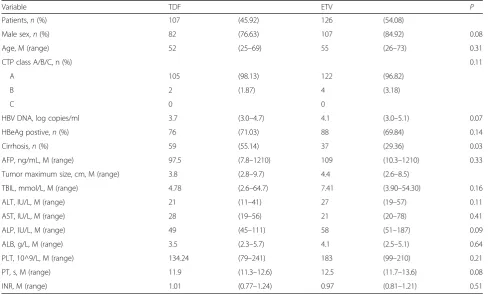
The baseline characteristics were presented in Table 1. The mean age of patients is 54 years old. Ranging from 25 to 73. Most patients were male (n= 182, 78.11%). The CTP scoring of patients were predominantly A (n= 227, 97.42%) and no patients were classified as CTP C scor-ing. The average level of serum viral load was 3.9 log copies/mL, ranging from less than 3 to 5.1 log copies/ mL and 70.39% patients were positive for HBV e anti-gen. 96 patients were histologically confirmed with cir-rhosis. Median size of tumor was 4.1 cm, ranging from 2.1 to 9.7. The average total bilirubin level is 5.87 mmol/ L, 15 patients had jaundice caused by tumor invasion of hepatic bile ducts and recovered to normal soon after surgery.
group and 28% patients in ETV group were positvie for serum HBV DNA (> 1000 copies/mL). The other clin-ical parameters were comparable between two groups, including CTP scoring, serum viral load, albumin, alkaline phosphatase (ALP), alanine aminotransferase (ALT), aspartate aminotransferase (AST) and platelet count (Table2).
Virological response and serum biomarker dynamics of 233 patients, 132 patients were NAs experienced (NAs duration > 12 months) and 101 patients were NAs naïve. No patients received interferon for anti-HBV treatment. The median duration of TDF and ETV were 24 and 26 months, respectively. All patients were serum viral load negative after 12 months NAs treatment and no patients relapsed during follow-up period.
In TDF group, 21 patients were NAs naïve and 86 were NAs experienced; In ETV group, the number was consists of 80 NAs naïve patients and 46 NAs experi-enced patients. 21 patients in TDF group and 31 patients in ETV group experienced viral breakthroughs (> 1000 copies/mL during two consecutive detection) for at least once, all of which were related to poor adherence. We checked the adherence of patients by judging whether their pills matched the days between two administrations of NAs.
Table 1Baseline characteristics
Variable Value Patients,n 233
Male sex,n(%) 182 (78.11) Age, M (range) 54 (25–73) CTP class A/B/C,n(%) 227/6/0 (97.42/2.58/0) Tumor maximum size, cm, M (range) 4.1 (2.1–9.7) HBV DNA, log copies/ml 3.9 (3.0–5.1) HBeAg postive,n(%) 164 (70.39) Cirrhosis,n(%) 96 (41.20) AFP, ng/mL, M (range) 103.7 (7.8–1210) TBIL, mmol/L, M (range) 5.87 (2.60–64.70) ALT, IU/L, M (range) 26 (11–57) AST, IU/L, M (range) 27 (19–78) ALP, IU/L, M (range) 51 (45–187) ALB, g/L, M (range) 3.9 (2.3–5.7) PLT, 10^9/L, M (range) 163.5 (79–241) PT, s, M (range) 12.1 (11.3–13.6) INR, M (range) 0.99 (0.77–1.24)
AFP =α-fetoprotein, ALB = albumin, ALP = alkaline phosphatase, ALT = alanine aminotransferase, AST = aspartate aminotransferase, CTP=Child–Trucott–Pugh score, HBV = hepatitis B virus, INR = international normalized ratio, PLT = platelet, PT = prothrombin time, TBIL = total bilirubin
Table 2Comparison of baseline variables in patients receiving TDF and ETV
Variable TDF ETV P
Patients,n(%) 107 (45.92) 126 (54.08)
Male sex,n(%) 82 (76.63) 107 (84.92) 0.08 Age, M (range) 52 (25–69) 55 (26–73) 0.31
CTP class A/B/C, n (%) 0.11
A 105 (98.13) 122 (96.82)
B 2 (1.87) 4 (3.18)
C 0 0
HBV DNA, log copies/ml 3.7 (3.0–4.7) 4.1 (3.0–5.1) 0.07 HBeAg postive,n(%) 76 (71.03) 88 (69.84) 0.14 Cirrhosis,n(%) 59 (55.14) 37 (29.36) 0.03 AFP, ng/mL, M (range) 97.5 (7.8–1210) 109 (10.3–1210) 0.33 Tumor maximum size, cm, M (range) 3.8 (2.8–9.7) 4.4 (2.6–8.5)
TBIL, mmol/L, M (range) 4.78 (2.6–64.7) 7.41 (3.90–54.30) 0.16 ALT, IU/L, M (range) 21 (11–41) 27 (19–57) 0.11 AST, IU/L, M (range) 28 (19–56) 21 (20–78) 0.41 ALP, IU/L, M (range) 49 (45–111) 58 (51–187) 0.09 ALB, g/L, M (range) 3.5 (2.3–5.7) 4.1 (2.5–5.1) 0.64 PLT, 10^9/L, M (range) 134.24 (79–241) 183 (99–210) 0.21 PT, s, M (range) 11.9 (11.3–12.6) 12.5 (11.7–13.6) 0.08 INR, M (range) 1.01 (0.77–1.24) 0.97 (0.81–1.21) 0.51
During the follow-up period, 68 of 164 HBeAg postive patients (41.46%) had HBeAg disappeared and 31 pa-tients (18.90%) had HBeAg seroconversion. No HBsAg disappearance or seroconversion was observed.
Survival analysis
During the follow-up period, 174 (74.68%) patients expe-rienced HCC recurrence and 47 patients died. In order to compare the difference between TDF and ETV group, we conducted survival analysis with Kaplan Meier curve. The median DFS of TDF and ETV group were 33 and 24 months, respectively. The results showed that disease-free survival (DFS) of TDF group was signifi-cantly longer than ETV group (p< 0.05). (Fig.1).
Predictors for disease-free survival
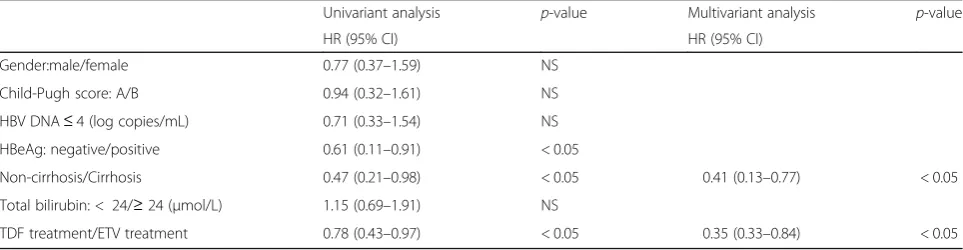
In order to verify the potential effect of TDF treatment duration on disease-free survival of CHB-related HCC pa-tients. We conduct both univariant and multi-variant ana-lysis to potential factors that might associated with DFS. The results of univariant analysis showed that status of HBeAg (hazard ratio, 0.61; 95% confidence interval, 0.11– 0.91; p< 0.05), non-cirrhosis (0.47, 0.21–0.98, p< 0.05)
and TDF duration (0.78, 0.43–0.97,p< 0.05) were associ-ated with disease-free survival. Further multi-variant analysis using Cox regression model indicated that TDF treatment duration (0.35, 0.33–0.84, p< 0.05) and non-cirrhosis (0.41, 0.13–0.77,p< 0.05) were independently associated with better disease-free survival.(Table3).
Discussion
Active HBV replication is significantly associated with the recurrence of hepatocellular carcinoma after surgery. [6] Although continuous supression of HBV has been proved to be effective in reducing the incidence and re-currence of HCC with solid evidence. [26,27] Both ETV and TDF were recommended as first line agents for anti-HBV therapy and regarded with high efficiency and high barrier to genetic resistance. [14,15] Recent clinical evidence showed that up to 10% of patients with HBV can develop HCC even with effective anti-virus agents. [28] Our study showed that CHB-related HCC patients received TDF after surgery have better DFS, compared to patients received ETV. The underlying mechanism might be complicated. However, recent advance showed that nucleutide analogues, rather than nucleuside ana-logues can induce the expression of IFN-λ [25]. since interferon-λ3 has been demonstrated to be involved in modulation of imunity during virus infection or autoi-mune diseases [29]. Inflammation is determined to have a strong association with carcinogenesis and recurrence of HCC [30]. Thus, we supposed that ADV might regu-late the immunity through induction of interferon-λ3 to improve the survival of CHB-related HCC patients in our study. However, it requires further studies to prove our hypothesis.
Sustained suppression of HBV replication is critical for lowering recurrence incidence of CHB-related HCC pa-tients after surgery. [27, 28] Since most patients receiv-ing their anti-HBV treatment out-of-hospital, it’s difficult for us to conduct close monitoring on their adherence. 52 patients (22.32%) experienced transient serum viral load fluctuation due to poor adherence. Regarding the actual obstacle of monitoring, we develop an easy and Fig. 1The disease-free survival of CHB-related HCC patients after
surgery. The comparison of cumulative HCC development probability between TDF group (red) and ETV group (blue). X-axis represented time (month), Y-axis represented disease-free survival
Table 3Univariate and multivariate analysis of disease-free survival
Univariant analysis p-value Multivariant analysis p-value HR (95% CI) HR (95% CI)
Gender:male/female 0.77 (0.37–1.59) NS Child-Pugh score: A/B 0.94 (0.32–1.61) NS HBV DNA≤4 (log copies/mL) 0.71 (0.33–1.54) NS HBeAg: negative/positive 0.61 (0.11–0.91) < 0.05
Non-cirrhosis/Cirrhosis 0.47 (0.21–0.98) < 0.05 0.41 (0.13–0.77) < 0.05 Total bilirubin: < 24/≥24 (μmol/L) 1.15 (0.69–1.91) NS
TDF treatment/ETV treatment 0.78 (0.43–0.97) < 0.05 0.35 (0.33–0.84) < 0.05
practical method by matching the days between two consecutive administration date and number of pills remained to help patients self-monitor drug adherence. The serum viral load of patients experienced viral break-thoughs returned to negative after continuous adminis-traion. We compared the DFS between patients with viral breakthrough and patient without, the results showed there was no significant difference between two groups.
We include patients both naïve and experienced to NAs and we also compared the potential difference. However, only the number of patients experienced viral break-through in NAs experienced group was higher than that of patients naïve to NAs (41 vs. 11). Due to our retro-spective design and population included, further study with prospective attempt and de novo comparison may provide a better understanding regarding patients receiv-ing different NAs both in sreceiv-ingle and in combination. And due to the financial situation of patients included, con-secutive monitoring on the quantification of serum viral markers, such as HBsAg, was limited, which might pro-vide a clue to explore the potential mechanism.
Conclusions
In conclusion, our study suggested the different impact of TDF and ETV on prognosis of CHB-related HCC patients. Patients receiving longterm TDF treatment had a longer DFS than patients receiving ETV. We shall con-firm these results with prospecitve study and lager sam-ple size.
Abbreviations
ALT:Alanine aminotransferase; CHB: Chronic hepatits B; ETV: Entecavir; HBeAg: Hepatitis B e antigen; HBsAg: Hepatits B surface antigen; HBV: Hepatitis B virus; HCC: Hepatocellular carcinoma; LAM: Lamivudine; LdT: Telbivudine; NAs: Nucleus(t)ide analogues; SD: Standard deviation; TDF: Tenofovir disoproxil fumarate
Availability of data and data and materials
Please contact author for data requests.
Grant support
There is no grant support in our study.
Authors’contributions
MZ contributes to patients follow-up, data collection and manuscript prepar-ation. DW and HL are responsible for patients follow-up. HL is responsible for study design, statistical analysis and patients follow-up. All authors read and approved the final manuscript.
Ethics approval and consent to participate
This study was conducted under compliance with the Declaration of Helsinki and were approved bythe Human Ethics Committee of Jining NO.1 People’s Hospital and the Human Ethics Committee of Qingdao NO.6 People’s Hospital.
Competing interests
All the authors declared that there is no conflicts of interests.
Publisher’s Note
Springer Nature remains neutral with regard to jurisdictional claims in published maps and institutional affiliations.
Author details
1Department of Gastroenterology, Qingdao NO.6 People’s Hospital, Qingdao,
Shandong 266033, People’s Republic of China.210th Department of
Hepatology, Qingdao NO.6 People’s Hospital, Qingdao, Shandong 266033, People’s Republic of China.3Invasive Technology Department, Jining NO.1
People’s Hospital, Jining, Shandong 272100, People’s Republic of China.
Received: 24 February 2018 Accepted: 31 May 2018
References
1. Torre LA, Bray F, Siegel RL, Ferlay J, Lortet-Tieulent J, Jemal A. Global cancer statistics, 2012. CA Cancer J Clin. 2015;65(2):87–108.
2. Chen W, Zheng R, Baade PD, Zhang S, Zeng H, Bray F, Jemal A, Yu XQ, He J. Cancer statistics in China, 2015. CA Cancer J Clin. 2016;66(2):115–32.
3. Chen W, Zheng R, Zeng H, Zhang S. The updated incidences and
mortalities of major cancers in China. 2011 Chin J Cancer. 2015;34(11):502–7. 4. Poon RT, Fan ST, Lo CM, Liu CL, Ng IO, Wong J. Long-term prognosis after
resection of hepatocellular carcinoma associated with hepatitis B-related cirrhosis. J Clin Oncol. 2000;18(5):1094–101.
5. Toyama T, Hiramatsu N, Yakushijin T, Oze T, Nakanishi F, Yasumaru M, Mochizuki K, Kanto T, Takehara T, Kasahara A, et al. A new prognostic system for hepatocellular carcinoma including recurrent cases: a study of 861 patients in a single institution. J Clin Gastroenterol. 2008;42(3):317–22. 6. Kim BK, Park JY, Kim DY, Kim JK, Kim KS, Choi JS, Moon BS, Han KH, Chon
CY, Moon YM, et al. Persistent hepatitis B viral replication affects recurrence of hepatocellular carcinoma after curative resection. Liver Int. 2008;28(3): 393–401.
7. El-Serag HB. Hepatocellular carcinoma. N Engl J Med. 2011;365(12):1118–27. 8. Petruzziello A. Epidemiology of hepatitis B virus (HBV) and hepatitis C virus
(HCV) related hepatocellular carcinoma. Open Virol J. 2018;12:26–32.
9. Tanaka M, Katayama F, Kato H, Tanaka H, Wang J, Qiao YL, Inoue M.
Hepatitis B and C virus infection and hepatocellular carcinoma in China: a review of epidemiology and control measures. J Epidemiol. 2011; 21(6):401–16.
10. Ott JJ, Stevens GA, Groeger J, Wiersma ST. Global epidemiology of hepatitis B virus infection: new estimates of age-specific HBsAg seroprevalence and endemicity. Vaccine. 2012;30(12):2212–9.
11. Iloeje UH, Yang HI, Su J, Jen CL, You SL, Chen CJ. Predicting cirrhosis risk based on the level of circulating hepatitis B viral load. Gastroenterology. 2006;130(3):678–86.
12. Chen CJ, Yang HI, Su J, Jen CL, You SL, Lu SN, Huang GT, Iloeje UH. Risk of hepatocellular carcinoma across a biological gradient of serum hepatitis B virus DNA level. Jama. 2006;295(1):65–73.
13. Iloeje UH, Yang HI, Jen CL, Su J, Wang LY, You SL, Chen CJ. Risk and predictors of mortality associated with chronic hepatitis B infection. Clin Gastroenterol Hepatol. 2007;5(8):921–31.
14. Marcellin P, Gane E, Buti M, Afdhal N, Sievert W, Jacobson IM, Washington MK, Germanidis G, Flaherty JF, Aguilar Schall R, et al. Regression of cirrhosis during treatment with tenofovir disoproxil fumarate for chronic hepatitis B: a 5-year open-label follow-up study. Lancet (London, England). 2013; 381(9865):468–75.
15. Hosaka T, Suzuki F, Kobayashi M, Seko Y, Kawamura Y, Sezaki H, Akuta N, Suzuki Y, Saitoh S, Arase Y, et al. Long-term entecavir treatment reduces hepatocellular carcinoma incidence in patients with hepatitis B virus infection. Hepatology (Baltimore MD). 2013;58(1):98–107.
16. EASL 2017 Clinical Practice Guidelines on the management of hepatitis B virus infection. J Hepatol 2017, 67(2):370–398.
17. Sarin SK, Kumar M, Lau GK, Abbas Z, Chan HL, Chen CJ, Chen DS, Chen HL, Chen PJ, Chien RN, et al. Asian-Pacific clinical practice guidelines on the management of hepatitis B: a 2015 update. Hepatol Int. 2016;10(1):1–98.
18. Terrault NA, Bzowej NH, Chang KM, Hwang JP, Jonas MM, Murad MH.
AASLD guidelines for treatment of chronic hepatitis B. Hepatology (Baltimore MD). 2016;63(1):261–83.
19. Kumada T, Toyoda H, Tada T, Kiriyama S, Tanikawa M, Hisanaga Y, Kanamori A, Niinomi T, Yasuda S, Andou Y, et al. Effect of nucleos(t)ide analogue therapy on hepatocarcinogenesis in chronic hepatitis B patients: a propensity score analysis. J Hepatol. 2013;58(3):427–33.
20. Matsumoto A, Tanaka E, Rokuhara A, Kiyosawa K, Kumada H, Omata M,
preventing hepatocellular carcinoma in chronic hepatitis B: a multicenter retrospective study of 2795 patients. Hepatol Res. 2005;32(3):173–84. 21. Wang JP, Kao FY, Wu CY, Hung YP, Chao Y, Chou YJ, Li CP. Nucleos(t)ide
analogues associated with a reduced risk of hepatocellular carcinoma in hepatitis B patients: a population-based cohort study. Cancer. 2015;121(9): 1446–55.
22. Xu L, Gao H, Huang J, Wang H, Zhou Z, Zhang Y, Li S, Chen M. Antiviral therapy in the improvement of survival of patients with hepatitis B virus-related hepatocellular carcinoma treated with sorafenib. J Gastroenterol Hepatol. 2015;30(6):1032–9.
23. Zuo C, Xia M, Wu Q, Zhu H, Liu J, Liu C. Role of antiviral therapy in reducing recurrence and improving survival in hepatitis B virus-associated
hepatocellular carcinoma following curative resection (review). Oncol Lett. 2015;9(2):527–34.
24. Yang X, Gao JY, Wang J, Cheng J. The impact of anti-HBV treatment on the occurrence and recurrence of hepatocellular carcinoma: focus on Asian studies. Discov Med. 2015;19(103):89–99.
25. Murata K, Asano M, Matsumoto A, Sugiyama M, Nishida N, Tanaka E, Inoue
T, Sakamoto M, Enomoto N, Shirasaki T, et al. Induction of IFN-lambda3 as an additional effect of nucleotide, not nucleoside, analogues: a new potential target for HBV infection. Gut. 2016;
26. Chen LP, Zhao J, Du Y, Han YF, Su T, Zhang HW, Cao GW. Antiviral treatment to prevent chronic hepatitis B or C-related hepatocellular carcinoma. World J Virol. 2012;1(6):174–83.
27. Yin J, Li N, Han Y, Xue J, Deng Y, Shi J, Guo W, Zhang H, Wang H, Cheng S, et al. Effect of antiviral treatment with nucleotide/nucleoside analogs on postoperative prognosis of hepatitis B virus-related hepatocellular carcinoma: a two-stage longitudinal clinical study. J Clin Oncol. 2013;31(29): 3647–55.
28. Lim YS, Han S, Heo NY, Shim JH, Lee HC, Suh DJ. Mortality, liver
transplantation, and hepatocellular carcinoma among patients with chronic hepatitis B treated with entecavir vs lamivudine. Gastroenterology. 2014; 147(1):152–61.
29. Syedbasha M, Egli A. Interferon lambda: modulating immunity in infectious diseases. Front Immunol. 2017;8:119.