O R I G I N A L P A P E R
Omega-3 fatty acids regulate gene expression levels differently
in subjects carrying the
PPAR
a
L162V polymorphism
Iwona RudkowskaÆChristophe GarencÆ Patrick CoutureÆ Marie-Claude Vohl
Received: 13 February 2009 / Accepted: 16 June 2009 / Published online: 8 July 2009
ÓSpringer-Verlag 2009
Abstract Omega-3 fatty acids (FAs) are natural ligands of the peroxisome proliferator-activated receptor-a (PPARa), a nuclear receptor that modulates expression levels of genes involved in lipid metabolism. The L162V polymorphism of the PPARa gene is associated with a deteriorated metabolic profile. We postulate that subjects carrying thePPARa-V162 allele exhibit differences in the expression ofPPARa and its target genes after incubation with omega-3 FAs compared with L162 homozygotes. Peripheral blood monocytes from six men carrying the
PPARa-V162 allele paired for age and for body mass index with six L162 homozygotes were differentiated into mac-rophages and activated with eicosapentaenoic acid (EPA), docosahexaenoic acid (DHA), or mixtures of EPA:DHA. Data demonstrates that gene expression levels ofPPARa and apolipoprotein AI (APOA1) were significantly lower for carriers of thePPARa-V162 allele compared to L162 homozygotes after the addition of DHA and a mixture of EPA:DHA. Additionally, lipoprotein lipase (LPL) gene expression displayed a tendency to be lower in thePPARa L162V polymorphism subgroup after the addition of a mixture of EPA:DHA. Consequently, individuals carrying the PPARa-V162 allele may demonstrate inferior improvements in their lipid profile due to alterations in gene expression rates in response to omega-3 FA supplementation.
Keywords Eicosapentaenoic acid
Docosahexaenoic acidPPARa Lipoprotein lipase Apolipoprotein AI Triglycerides
Introduction
Omega-3 fatty acids (FAs), especially eicosapentaenoic acid (EPA) and docosahexaenoic acid (DHA), are associ-ated with cardiovascular benefits [2, 11]. The effects of omega-3 FAs on lipid metabolism are likely mediated by changes in gene expression. More specifically, FAs and their derivatives are natural ligands of the nuclear receptor peroxisome proliferator-activated receptor a (PPARa), which heterodimerize with the retinoid 9receptor (R9R) before triggering the expression of target genes [13]. Par-ticular target genes include lipoprotein lipase (LPL) [15], a central enzyme in triglyceride metabolism, and apolipo-protein AI(APOAI) [34], a key structural element in high-density lipoproteins (HDL). Overall, omega-3 FAs bind to
PPARa and consequently have the potential to lower plasma triglyceride (TG) levels and increase HDL-choles-terol (HDL-C) levels.
In addition, numerous studies revealed associations between thePPARaL162V polymorphism and changes in the serum concentrations of lipids/lipoproteins [8,21,29– 32]. Indeed, thePPARaL162V polymorphism alone or in interaction with dietary fat intake was shown to be asso-ciated with components of the metabolic syndrome [21, 29]. An intervention study recognized differences in lipid parameters in carriers of the PPARa-V162 allele versus L162 homozygotes after modification of dietary poly-unsaturated to saturated fat ratio [16]. Furthermore, the
PPARaL162V polymorphism has been also shown to have an effect on transactivation efficiency in vitro after
I. RudkowskaC. GarencP. CoutureM.-C. Vohl Lipid Research Center, CHUL Research Center,
The Nutraceuticals and Functional Foods Institute (INAF), Quebec, Canada
M.-C. Vohl (&)
Lipid Research Center, CHUQ-CHUL,
2705 Laurier Blvd, TR-93, Quebec, QC G1V 4G2, Canada e-mail: [email protected]
activation by a synthetic ligand, such as fibrates [8, 25]. Additionally, a recent study demonstrated differential effects of thePPARa L162V polymorphism on transcrip-tional rate with physiological concentrations of natural ligands- omega-3 FAs [24].
Yet, it is uncertain whether subjects who carry the
PPARa-V162 allele compared to L162 homozygotes have altered expression of PPARa, APOA1 and LPL after omega-3 FA supplementation. Since PPARa has been identified in macrophages to control lipid metabolism [20], we hypothesize that monocytes-derived macrophages from subjects who carry thePPARa-V162 allele exhibit differ-ences in the expression of key genes involved in lipid metabolism when incubated with omega-3 FAs compared with macrophages from L162 homozygotes.
Methods
Subjects
Twelve Caucasian male subjects, including six carriers of thePPARa-V162 allele matched according to age and body mass index (BMI) to six L162 homozygotes, participated in the study. Subjects were excluded from the study if they had taken omega-3 FA supplements for at least 6 months prior to the study, used oral hypolipidemic therapy, or had been diagnosed with diabetes, hypertension, hypothyroid-ism, or other known metabolic disorders. They gave writ-ten consent to participate in this study, which was approved by the ethics committee of Laval University Hospital Research Center.
Anthropometric and blood pressure measurements Body weight, height and waist circumference were mea-sured according to the procedures recommended by the Airlie Conference [5] and were taken at screening. BMI was calculated as weight per meter squared (kg/m2). Resting blood pressure measurements were performed after a 5 min rest in a sitting position, Phases I and V of Ko-rotkoff sounds being respectively used for systolic (SBP) and diastolic (DBP) blood pressures.
Dietary intake determination
A validated food-frequency questionnaire (FFQ) was administered to the participants by a registered dietician [10]. This FFQ is based on typical food items available in Quebec and contains 91 items: 27 items had between 1 and 3 sub-questions. The subjects were asked how often they consumed each item per day, per week, per month, or none at all during the last month. Several examples of portion
size and food models were provided for a better estimation of real serving consumed by the subject. Nutrient intakes from the FFQ were compiled with Nutrition Data System for Research (NDS-R) software version 4.03 (Nutrition Co-ordination Center, University of Minnesota, Minneapolis, USA).
Plasma lipids determination
Blood samples (65 ml) were collected from an antecubital vein into vacutainer tubes containing EDTA after a 12 h overnight fast and 48 h alcohol abstinence. Blood sample was taken to determine the PPARa-L162V genotype of each participant and to measure blood lipid levels. Plasma was separated by centrifugation (2,5009g for 10 min at 4°C). Plasma total cholesterol (TC) and TG concentrations were measured using enzymatic assays [4,14]. The HDL-C fraction was obtained after precipitation of low-density lipoprotein (LDL) particles in the infranatant with heparin manganese chloride [1]. The LDL-cholesterol (LDL-C) was calculated with the Friedewald formula [9].
Genotype determination
Genetic analyses were performed on genomic DNA iso-lated from human leukocytes. The PPARa L162V poly-morphism was determined by the polymerase chain reaction- restriction fragment length polymorphism (PCR-RFLP) method, as previously described [33].
Cell culture
interference of FAs found in bovine serum [3]. Cells were treated with either the serum free medium/MSFM alone (control), the vehicle (DMSO, 0.01% final concentration) alone or the treatments of EPA or/and DHA (Sigma-Aldrich). Briefly, pure EPA or DHA was dissolved by serial dilution to 10lM in DMSO. For mixtures of 5:5lM, 15:5lM and 5:15lM EPA:DHA, the dissolved individual omega-3 FAs at appropriate concentrations were mixed together.
RNA isolation
On day 12 of culture, macrophage total RNA was extracted using the RNeasy Mini Kit (QIAGEN) according to the manufacturer’s instructions and stored at -80°C. After spectrophotometric quantification and verification of the total RNA quality via the Agilent 2100 Bioanalyser (Agilent Technologies, Palo Alto, CA, USA), cDNA was generated using the High Capacity cDNA Archive Kit (Applied Biosystems) as described in the protocol. Real-time RT-PCR
cDNA was mixed with TaqMan Universal PCR Master Mix (Applied Biosystems) and a gene-specific primer and probe mixture (predeveloped TaqMan Gene Expression Assays; Applied Biosystems) in a final vol-ume of 20ll. The assays used were as follows: Hs00173425_m1 (LPL), Hs00231882_m1 (PPARa), Hs00163641_m1 (APOA1), and b-actin as the house keeping gene Hs99999903_m1 (ACTB). All assays used the same fluorescent reporter probe (FAMTM dye-labeled) and thus each combination treatment and gene was analyzed in individual wells on a 96-well plate. All samples were run in duplicate on an Applied Biosystem 7500 Real Time PCR System (Applied Biosystems) using the following thermal cycling profile: 50°C (2 min), 95°C (10 min), followed by 40 steps of 95°C for 15 s and 60°C for 60 s. The RT-PCR results were imported into Microsoft Excel and the average value of duplicate Ct values calculated. Data were adjusted for
the endogenous control (ACTB) and then expressed as percentage of differences relative to control (serum free medium/MSFM) set to 100%.
Statistical analyses
Data are shown as mean±SD. All data were tested for normal distribution with the Shapiro-Wilk test for nor-mality. Statistical analyses were conducted using Student’s
ttest. Paired ttests were used to test within-group differ-ences using SAS 9.1. A two-tailed value ofPB0.05 was considered as significant.
Results
Subjects characteristics
The subjects’ characteristics at screening are presented in Table1 according to L162V genotype. There were a total of six subjects carrying the PPARa-V162 allele matched for age and BMI to 6 L162 homozygotes. The mean dif-ference between genotype groups was 1.7±3.1 years and 1.8±3.9 kg/m2. There were no significant differences between genotype groups for anthropometrical indices, blood pressures and plasma lipid concentrations.
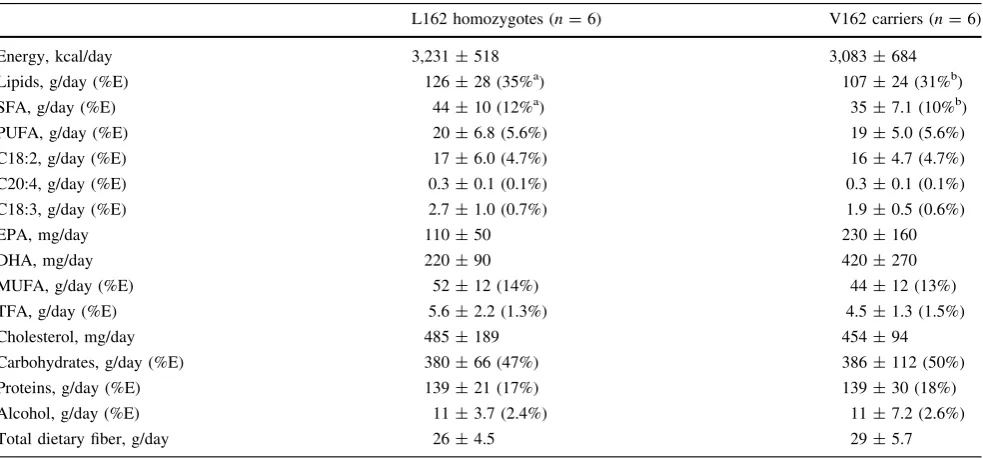
Energy, macro and micro-nutrient intakes were similar between genotype groups. As shown in Table2, L162 homozygotes had a significantly higher percentage of fat and saturated fat in the diet compared to carriers of the
PPARa-V162 allele. All other macronutrients were con-sumed to a similar percentage in both groups.
Gene expression
Rates of gene expression levels of PPARa, APOA1 and
LPLbetween alleles were not different after the addition of DMSO (data not shown). Yet, after the addition of omega-3 FAs, significant differences between subgroups were observed. First, expression of PPARa gene in human macrophages of L162 homozygotes homozygotes tends to increase following incubation with 10lM EPA and 10lM DHA (Fig.1). However, the expression of PPARa in macrophages from carriers of thePPARa-V162 allele was consistently lowered by 1–4% in comparison to L162 homozygotes. Furthermore, there was a significant differ-ence in the expression of PPARa between the carriers of the PPARa-V162 allele and the L162 homozygotes sub-group following incubation with 10 lM DHA (P =0.04) and 10:5lM EPA:DHA (P=0.04).
Secondly, similar trends were seen for the expression of
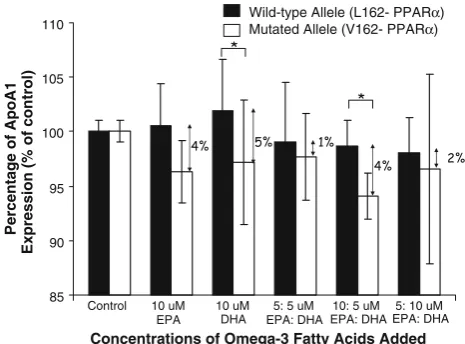
APOA1 in macrophages (Fig.2). More specifically, the addition of EPA or DHA increased the expression of
APOA1 in L162 homozygotes. Again, the expression of
APOA1of L162 homozygotes compared to carriers of the
PPARa-V162 allele was 4, 5, 1, 4 and 2% greater with 10lM EPA, 10 lM DHA, 5:5lM EPA:DHA, 10:5 lM EPA:DHA and 5:10lM EPA:DHA, respectively. In addition, there was a significant difference between sub-groups after the incubation with 10lM DHA (P =0.02) and 10:5lM EPA:DHA (P=0.01).
Thirdly,LPLexpression increased in L162 homozygotes after the addition of EPA, DHA or mixture 5:5 EPA:DHA compared to controls (Fig.3). Once more, the expression of
LPLhad a tendency to be consistently lower in carriers of the
EPA:DHA, and 10:5lM EPA:DHA. The expression ofLPL
tended to be different between the two subgroups after the addition of 10:5lM EPA:DHA (P=0.10). Overall, the expression ofPPARaand target genes is consistently lower in carriers of thePPARa-V162 allele than in L162 homozygotes.
Discussion
Results from the current study indicate that there are dis-parities in gene expression levels in macrophages from
carriers of thePPARa-V162 allele and L162 homozygotes incubated with omega-3 FAs, which suggest functional differences between genotypes. Data shows differences in
PPARa and APOA1 gene expression levels following incubation with DHA and mixtures of EPA:DHA, between carriers of thePPARa-V162 allele and L162 homozygotes. A similar trend is seen for LPL expression following addition of a mixture of EPA:DHA. In sum, the study clearly support the hypothesis that a gene-nutrient inter-action between the PPARa L162V polymorphism and omega-3 FAs exists.
Table 1 Baseline characteristics of study participants according to the PPARaL162V polymorphism matched for age and BMI
Data are shown as mean±SD. Statistical analysis was performed using a Student’s ttest. No significant differences between both groups were identified
L162 homozygotes (n=6) V162 carriers (n=6)
Age (years) 35.5±11.2 37.2±11.7
Weight (kg) 77.3±11.5 83.4±9.8
Body mass index (kg/m2) 23.8±3.4 25.6±3.8
Waist circumference (cm) 87.5±8.4 92.3±8.4
Systolic blood pressure (mmHg) 122.0±12.1 118.8±9.1
Diastolic blood pressure (mmHg) 70.0±9.1 73.3±6.9
Cholesterol
Total (mmol/L) 4.3±1.1 4.6±0.8
LDL (mmol/L) 2.5±1.1 2.5±0.9
HDL (mmol/L) 1.3±0.3 1.3±0.4
Ratio total cholesterol/HDL 3.5±1.2 3.4±0.9
Triglycerides (mmol/L) 1.1±0.3 0.9±0.3
ApoB 100 (g/l) 0.8±0.3 0.9±0.2
Table 2 Daily energy and nutrient intake from food frequency questionnaire of study participants according to the PPARaL162V polymor-phism matched for age and BMI
L162 homozygotes (n=6) V162 carriers (n=6)
Energy, kcal/day 3,231±518 3,083±684
Lipids, g/day (%E) 126±28 (35%a) 107±24 (31%b)
SFA, g/day (%E) 44±10 (12%a) 35±7.1 (10%b)
PUFA, g/day (%E) 20±6.8 (5.6%) 19±5.0 (5.6%)
C18:2, g/day (%E) 17±6.0 (4.7%) 16±4.7 (4.7%)
C20:4, g/day (%E) 0.3±0.1 (0.1%) 0.3±0.1 (0.1%)
C18:3, g/day (%E) 2.7±1.0 (0.7%) 1.9±0.5 (0.6%)
EPA, mg/day 110±50 230±160
DHA, mg/day 220±90 420±270
MUFA, g/day (%E) 52±12 (14%) 44±12 (13%)
TFA, g/day (%E) 5.6±2.2 (1.3%) 4.5±1.3 (1.5%)
Cholesterol, mg/day 485±189 454±94
Carbohydrates, g/day (%E) 380±66 (47%) 386±112 (50%)
Proteins, g/day (%E) 139±21 (17%) 139±30 (18%)
Alcohol, g/day (%E) 11±3.7 (2.4%) 11±7.2 (2.6%)
Total dietary fiber, g/day 26±4.5 29±5.7
Data are shown as mean±SD;SFAsaturated fatty acids,PUFApolyunsaturated fatty acids,C18:2linoleic acid,C20:4arachidonic acid,C18:3 a-linolenic acid,EPAeicosapentaenoic acid,DHAdocosahexaenoic acid,MUFAmonounsaturated fatty acids,TFAtrans fatty acids. Statistical analysis was performed using a Student’sttest
First, numerous in vivo and in vitro studies have shown thatPPARais activated by FAs [19,26].PPARa responds to changes in both exogenous dietary fat and newly
synthesized fat by triggering the expression of multiple enzymes involved in fatty acyl CoA formation and hydrolysis, FA elongation and desaturation, and FA oxi-dation [17]. However, certain FAs are more effective activators ofPPARathan others. For example, adding FAs that are normally abundant in cells, such as oleic acid, has little effect on intracellular nonesterified FAs quantity and does not induce PPARa activity [17,18]. In contrast, the addition of a FA that is typically a minor component of the cell, such as DHA, alters the nonesterified FAs fraction and significantly activates PPARa and triggers the expression of target genes [17,18]. In this study, both EPA and DHA at physiological doses were able to modestly increase
PPARa gene expression in L162 homozygotes, but not in carriers of the PPARa-V162 allele. Results also demon-strate differences between the alleles in the expressions of
PPARa after the addition of DHA or EPA:DHA. A previ-ous in vitro study demonstrated that at low synthetic ligand levels, the activity of PPAR-V162 isoform was lower than the wild-type isoform; however, at high synthetic ligand levels, the activity of the polymorphic receptor was higher than the wild-type [25]. Therefore, a physiological dose of omega-3 FAs was added to macrophages to represent the average values of plasma or red blood cell enrichment with omega-3 FAs that may be found after an omega-3 FAs supplementation in individuals instead of a supra-physio-logical dose. Further, if the mutation would be located in the ligand binding domain, it would have been suggested
85 90 95 100 105 110
Concentrations of Omega-3 Fatty Acids Added
Percentage of PPARa
Expression (% of control)
Control 10 uM EPA
10 uM
DHA EPA: DHA5: 5 uM EPA: DHA10: 5 uM EPA: DHA5: 10 uM
Wild-type Allele (L162- PPAR α ) Mutated Allele (V162- PPAR α )
Fig. 1 Expression ofPPARa in macrophage of subjects who carry
PPARa-V162 (n=6) allele compared to L162 homozygotes (n=6)
supplemented EPA, DHA, and mixtures of EPA: DHA. Duplicates of real-time RT-PCR were performed for each sample. Values were normalized with a housekeeping gene, b-actin, as described in ‘‘Methods’’. Then, treated samples were expressed as percentage of gene expression of control sample and compared between alleles. Statistical analysis was performed using a Student’sttest. Data was not normally distributed; therefore, was transformed in LOG values for statistical analysis.Asteriskdescribes a statistically significantly different between wild-type and mutated allele (PB0.05)
85 90 95 100 105 110
Concentrations of Omega-3 Fatty Acids Added
Percentage of ApoA1
Expression (% of control)
Control 10 uM EPA
10 uM DHA
5: 5 uM EPA: DHA
10: 5 uM EPA: DHA
5: 10 uM EPA: DHA
Wild-type Allele (L162- PPARα)
Mutated Allele (V162- PPARα)
Fig. 2 Expression ofApoA1in macrophage of subjects who carry
PPARa-V162 (n=6) allele compared to L162 homozygotes (n=6)
supplemented EPA, DHA, and mixtures of EPA: DHA. Duplicates of real-time RT-PCR were performed for each sample. Values were normalized with a housekeeping gene, b-actin, as described in ‘‘Methods’’. Then, treated samples were expressed as percentage of gene expression of control sample and compared between alleles. Statistical analysis was performed using a Student’sttest. Data was not normally distributed; therefore, was transformed in LOG values for statistical analysis.Asteriskdescribes a statistically significantly different between wild-type and mutated allele (PB0.05)
85 90 95 100 105 110
Concentration of Omega-3 Fatty Acids Added
Percentage of LPL Expression
(% of control)
5: 10 uM EPA: DHA 10: 5 uM
EPA: DHA 5: 5 uM
EPA: DHA 10 uM
DHA 10 uM
EPA Control
Wild-type Allele (L162- PPARα) Mutated Allele (V162- PPARα)
Fig. 3 Expression of LPL in macrophage of subjects who carry
PPARa-V162 (n=6) allele compared to L162 homozygotes (n=6)
that the polymorphism interferes with the ligand recogni-tion; however, the L162V polymorphism is located in the DNA binding domain, thus, the mutation is thought to have an impact on the receptor’s ability to bind DNA [25]. Generally, carriers of the PPARa-V162 allele maybe more at risk of chronic metabolic diseases, in particular if they consume low intake of omega-3 FAs, due to insufficient control ofPPARa.
Second,PPARastimulates the expression of a large set of genes involved in lipid metabolism, thus there is an interest in examining these particular genes. PPARa has been shown to regulate lipid metabolism through the con-trol of the expression of genes encoding for apolipopro-teins. Studies in transgenic mice and rabbits have demonstrated that overexpression of the human APOAI
gene results in increased plasma HDL and apoAI concen-trations, which provide protection against atherogenesis [7,22,28]. Further, synthetic ligands such as fibrates, have shown to upregulate the expression ofAPOAI in humans studies [34]. Additionally, human studies have also shown that fibrates lower the risk of cardiovascular diseases by raising HDL-C and lowering TG [23]. The current study shows that EPA and DHA were able to increase APOA1
gene expression beyond control samples in the L162 homozygous subgroup. ThePPARa-V162 allele subgroup, did not reach the same level ofAPOA1expression partic-ularly after DHA or EPA:DHA treatment. This data may provide an explanation in regards to previous epidemio-logical and clinical studies where carriers of thePPARa
-V162 allele demonstrated lower HDL-C and apoA1 levels [8,16,30,32]. Overall, the low plasma levels of HDL-C and apoA1 described in previous studies may be due to a diminished expression of APOA1 gene in carriers of the
PPARa-V162 allele seen after controlling for omega-3 FA intake.
Thirdly, previous studies have demonstrated that PPARa ligands such as FAs can upregulate theLPLexpression [15]. In the current study, omega-3 FAs were capable to increase
LPLgene expression levels. Macrophages of non-carriers of thePPARaL162V polymorphism demonstrated a tendency towards higher LPL expression after the addition of EPA:DHA mixture compared to carriers of thePPARa-V162 allele. Yet, the difference inLPLgene expression level did not reach statistical difference between the subgroups possibly due to the low number of subjects upon which the present study was based. Since, previous observational studies have shown that carriers of the PPARa L162V polymorphism have demonstrated differences in plasma TG [21,27,32] and apoCIII levels [27], further investigation warranted to give a plausible rational for the involvement of the PPARa L162V polymorphism in the interindividual variability observed in plasma TG levels.
In conclusion, even if sample size of the study was small, all genes under study displayed a tendency to be expressed at a lower level in macrophages of individuals carrying the PPARa-V162 allele versus L162 homozy-gotes, which may explain the interindividual variability of lipid response in the efficacy of omega-3 FA supplemen-tation. The current study is in accordance with results of our previous in vitro study [24], where in vitro transfection of the mutated allele demonstrated lower transcriptional rate compared to wild-type allele. The current study con-firms that these differences between PPARa-V162 allele carriers and L162 homozygotes translate to physiological differences in gene expression rates of human macro-phages, and thus provides further mechanistic evidence for functional differences between genotypes. Even small but consistent differences in gene expression may have sub-stantial changes in energy and lipid metabolism over time. In addition, multiple genes may exhibit small differences within the pathway, suggesting more systematic effects. Therefore, the impact of omega-3 FAs on set of genes versus individual genes may provide further understanding of the impact of PPARa L162V polymorphism on the metabolic response to omega-3 FAs.
Acknowledgments We express our gratitude to the subjects for their excellent collaboration. We thank Nicole Roy for nursing assistance and Alain Houde for contributing to the laboratory work. This study was supported by a grant no# 200609MOP from the Canadian Institutes of Health Research (CIHR). Iwona Rudkowska is support by a CIHR Fellowship (200810MFE).
References
1. Albers JJ, Warnick GR, Wiebe D, King P, Steiner P, Smith L, Breckenridge C, Chow A, Kuba K, Weidman S, Arnett H, Wood P, Shlagenhaft A (1978) Multi-laboratory comparison of three heparin-Mn2?precipitation procedures for estimating cholesterol
in high-density lipoprotein. Clin Chem 24:853–856
2. Balk EM, Lichtenstein AH, Chung M, Kupelnick B, Chew P, Lau J (2006) Effects of omega-3 fatty acids on serum markers of cardiovascular disease risk: a systematic review. Atherosclerosis 189:19–30
3. Barbier O, Torra IP, Duguay Y, Blanquart C, Fruchart JC, Glineur C, Staels B (2002) Pleiotropic actions of peroxisome proliferator-activated receptors in lipid metabolism and athero-sclerosis. Arterioscler Thromb Vasc Biol 22:717–726
4. Burstein M, Samaille J (1960) On a rapid determination of the cholesterol bound to the serum alpha- and beta-lipoproteins. Clin Chim Acta 5:609
5. Callaway CW (1988) CWBC Standardization of anthropometric measurements. The Airlie (VA) Consensus Conference. Human Kinetics Publishers, Champaign
7. Duverger N, Kruth H, Emmanuel F, Caillaud JM, Viglietta C, Castro G, Tailleux A, Fievet C, Fruchart JC, Houdebine LM, Denefle P (1996) Inhibition of atherosclerosis development in cholesterol-fed human apolipoprotein A-I-transgenic rabbits. Circulation 94:713–717
8. Flavell DM, Pineda TI, Jamshidi Y, Evans D, Diamond JR, Elkeles RS, Bujac SR, Miller G, Talmud PJ, Staels B, Humphries SE (2000) Variation in the PPARalpha gene is associated with altered function in vitro and plasma lipid concentrations in Type II diabetic subjects. Diabetologia 43:673–680
9. Friedewald WT, Levy RI, Fredrickson DS (1972) Estimation of the concentration of low-density lipoprotein cholesterol in plasma, without use of the preparative ultracentrifuge. Clin Chem 18:499–502
10. Goulet J, Nadeau G, Lapointe A, Lamarche B, Lemieux S (2004) Validity and reproducibility of an interviewer-administered food frequency questionnaire for healthy French-Canadian men and women. Nutr J 3:13
11. Harris WS (1997) n-3 fatty acids and serum lipoproteins: human studies. Am J Clin Nutr 65:1645S–1654S
12. Jungling E, Kammermeier H (1988) A one-vial method for rou-tine extraction and quantification of free fatty acids in blood and tissue by HPLC. Anal Biochem 171:150–157
13. Kersten S (2008) Peroxisome proliferator activated receptors and lipoprotein metabolism. PPAR Res 2008:132960
14. McNamara JR, Schaefer EJ (1987) Automated enzymatic stan-dardized lipid analyses for plasma and lipoprotein fractions. Clin Chim Acta 166:1–8
15. Michaud SE, Renier G (2001) Direct regulatory effect of fatty acids on macrophage lipoprotein lipase: potential role of PPARs. Diabetes 50:660–666
16. Paradis AM, Fontaine-Bisson B, Bosse Y, Robitaille J, Lemieux S, Jacques H, Lamarche B, Tchernof A, Couture P, Vohl MC (2005) The peroxisome proliferator-activated receptor alpha Leu162Val polymorphism influences the metabolic response to a dietary intervention altering fatty acid proportions in healthy men. Am J Clin Nutr 81:523–530
17. Pawar A, Botolin D, Mangelsdorf DJ, Jump DB (2003) The role of liver X receptor-alpha in the fatty acid regulation of hepatic gene expression. J Biol Chem 278:40736–40743
18. Pawar A, Jump DB (2003) Unsaturated fatty acid regulation of peroxisome proliferator-activated receptor alpha activity in rat primary hepatocytes. J Biol Chem 278:35931–35939
19. Reddy JK, Mannaerts GP (1994) Peroxisomal lipid metabolism. Annu Rev Nutr 14:343–370
20. Rigamonti E, Chinetti-Gbaguidi G, Staels B (2008) Regulation of macrophage functions by PPAR-alpha, PPAR-gamma, and LXRs in mice and men. Arterioscler Thromb Vasc Biol 28:1050–1059 21. Robitaille J, Brouillette C, Houde A, Lemieux S, Perusse L, Tchernof A, Gaudet D, Vohl MC (2004) Association between the PPARalpha-L162V polymorphism and components of the meta-bolic syndrome. J Hum Genet 49:482–489
22. Rubin EM, Krauss RM, Spangler EA, Verstuyft JG, Clift SM (1991) Inhibition of early atherogenesis in transgenic mice by human apolipoprotein AI. Nature 353:265–267
23. Rubins HB, Robins SJ, Collins D, Fye CL, Anderson JW, Elam MB, Faas FH, Linares E, Schaefer EJ, Schectman G, Wilt TJ, Wittes J (1999) Gemfibrozil for the secondary prevention of coronary heart disease in men with low levels of high-density
lipoprotein cholesterol. Veterans Affairs High-Density Lipopro-tein Cholesterol Intervention Trial Study Group. N Engl J Med 341:410–418
24. Rudkowska I, Verreault M, Barbier O, Vohl MC (2009) Differ-ences in transcriptional activation by the two allelic (L162V polymorphic) variants of PPARalpha after omega-3 fatty acids treatment. PPAR Res 2009:369602
25. Sapone A, Peters JM, Sakai S, Tomita S, Papiha SS, Dai R, Friedman FK, Gonzalez FJ (2000) The human peroxisome proliferator-activated receptor alpha gene: identification and functional characterization of two natural allelic variants. Phar-macogenetics 10:321–333
26. Schoonjans K, Staels B, Auwerx J (1996) The peroxisome pro-liferator activated receptors (PPARS) and their effects on lipid metabolism and adipocyte differentiation. Biochim Biophys Acta 1302:93–109
27. Shin MJ, Kanaya AM, Krauss RM (2008) Polymorphisms in the peroxisome proliferator activated receptor alpha gene are asso-ciated with levels of apolipoprotein CIII and triglyceride in African-Americans but not Caucasians. Atherosclerosis 198:313– 319
28. Singaraja RR, Bocher V, James ER, Clee SM, Zhang LH, Leavitt BR, Tan B, Brooks-Wilson A, Kwok A, Bissada N, Yang YZ, Liu G, Tafuri SR, Fievet C, Wellington CL, Staels B, Hayden MR (2001) Human ABCA1 BAC transgenic mice show increased high density lipoprotein cholesterol and ApoAI-dependent efflux stimulated by an internal promoter containing liver X receptor response elements in intron 1. J Biol Chem 276:33969–33979 29. Tai ES, Corella D, Demissie S, Cupples LA, Coltell O, Schaefer
EJ, Tucker KL, Ordovas JM (2005) Polyunsaturated fatty acids interact with the PPARA-L162 V polymorphism to affect plasma triglyceride and apolipoprotein C-III concentrations in the Framingham Heart Study. J Nutr 135:397–403
30. Tai ES, Demissie S, Cupples LA, Corella D, Wilson PW, Schaefer EJ, Ordovas JM (2002) Association between the PPARA L162 V polymorphism and plasma lipid levels: the Framingham Offspring Study. Arterioscler Thromb Vasc Biol 22:805–810
31. Tanaka T, Ordovas JM, Delgado-Lista J, Perez-Jimenez F, Marin C, Perez-Martinez P, Gomez P, Lopez-Miranda J (2007) Perox-isome proliferator-activated receptor alpha polymorphisms and postprandial lipemia in healthy men. J Lipid Res 48:1402–1408 32. Uthurralt J, Gordish-Dressman H, Bradbury M, Tesi-Rocha C, Devaney J, Harmon B, Reeves EK, Brandoli C, Hansen BC, Seip RL, Thompson PD, Price TB, Angelopoulos TJ, Clarkson PM, Moyna NM, Pescatello LS, Visich PS, Zoeller RF, Gordon PM, Hoffman EP (2007) PPARalpha L162V underlies variation in serum triglycerides and subcutaneous fat volume in young males. BMC Med Genet 8:55
33. Vohl MC, Lepage P, Gaudet D, Brewer CG, Betard C, Perron P, Houde G, Cellier C, Faith JM, Despres JP, Morgan K, Hudson TJ (2000) Molecular scanning of the human PPARa gene: associa-tion of the L162v mutaassocia-tion with hyperapobetalipoproteinemia. J Lipid Res 41:945–952