Open Access
Short report
Differences in estimates of size distribution of beryllium powder
materials using phase contrast microscopy, scanning electron
microscopy, and liquid suspension counter techniques
Aleksandr B Stefaniak*
1,2,3, Mark D Hoover
1, Robert M Dickerson
3,
Gregory A Day
1, Patrick N Breysse
2and Ronald C Scripsick
3Address: 1National Institute for Occupational Safety and Health, Division of Respiratory Disease Studies, Mailstop H-2703, 1095 Willowdale Road, Morgantown, WV, 26505, USA, 2Johns Hopkins University Bloomberg School of Public Health, 615 N. Wolfe Street, Baltimore, MD 21205, USA and 3Los Alamos National Laboratory, Los Alamos, NM 87545, USA
Email: Aleksandr B Stefaniak* - [email protected]; Mark D Hoover - [email protected]; Robert M Dickerson - [email protected]; Gregory A Day - [email protected]; Patrick N Breysse - [email protected]; Ronald C Scripsick - [email protected]
* Corresponding author
Abstract
Accurate characterization of the physicochemical properties of aerosols generated for inhalation toxicology studies is essential for obtaining meaningful results. Great emphasis must also be placed on characterizing particle properties of materials as administered in inhalation studies. Thus, research is needed to identify a suite of techniques capable of characterizing the multiple particle properties (i.e., size, mass, surface area, number) of a material that may influence toxicity. The purpose of this study was to characterize the morphology and investigate the size distribution of a model toxicant, beryllium. Beryllium metal, oxides, and alloy particles were aerodynamically size-separated using an aerosol cyclone, imaged dry using scanning electron microscopy (SEM), then characterized using phase contrast microscopy (PCM), a liquid suspension particle counter (LPC), and computer-controlled SEM (CCSEM). Beryllium metal powder was compact with smaller sub-micrometer size particles attached to the surface of larger particles, whereas the beryllium oxides and alloy particles were clusters of primary particles. As expected, the geometric mean (GM) diameter of metal powder determined using PCM decreased with aerodynamic size, but when suspended in liquid for LPC or CCSEM analysis, the GM diameter decreased by a factor of two (p < 0.001). This observation suggested that the smaller submicrometer size particles attached to the surface of larger particles and/or particle agglomerates detach in liquid, thereby shifting the particle size distribution downward. The GM diameters of the oxide materials were similar regardless of sizing technique, but observed differences were generally significant (p < 0.001). For oxides, aerodynamic cluster size will dictate deposition in the lung, but primary particle size may influence biological activity. The GM diameter of alloy particles determined using PCM became smaller with decreasing aerodynamic size fraction; however, when suspended in liquid for CCSEM and LPC analyses, GM particle size decreased by a factor of two (p < 0.001) suggesting that alloy particles detach in liquid. Detachment of particles in liquid could have significance for the expected versus actual size (and number) distribution of aerosol delivered to an exposure subject. Thus, a suite of complimentary analytical techniques may be necessary for estimating size distribution. Consideration should be given to thoroughly understanding the influence of any liquid vehicle which may alter the expected aerosol size distribution.
Published: 28 February 2007
Particle and Fibre Toxicology 2007, 4:3 doi:10.1186/1743-8977-4-3
Received: 27 October 2006 Accepted: 28 February 2007
This article is available from: http://www.particleandfibretoxicology.com/content/4/1/3 © 2007 Stefaniak et al; licensee BioMed Central Ltd.
Findings
Relating the physicochemical properties of an aerosol to its toxicity following inhalation is of specific interest for beryllium[1] and of general interest for a wide range of particles, including nanomaterials[2]. Various hypotheses have been put forth regarding particle mass, surface area, and number as metrics of toxicity of inhaled particles. Detailed control and physicochemical characterization of aerosols generated for inhalation toxicology studies is essential for obtaining meaningful study results.
A variety of techniques exist for exposing the lung to par-ticles in pulmonary toxicology studies, including inhala-tion, intratracheal instillainhala-tion, and pharyngeal aspiration[3]. A high research priority is the characteriza-tion of the exposure material as encountered by workers and as administered in a pulmonary toxicology study. Characterization of bulk material as produced or supplied may not accurately reflect the properties of the particles in the workplace atmosphere or of particles delivered to the lung by inhalation, instillation, or pharyngeal aspiration. For example, current methods for characterizing dry mate-rial using microscopy can reveal general morphology and particle size, but cannot determine whether material con-sists of solid particles or clusters, or whether material will deagglomerate in liquids such as lung surfactant. Simi-larly, current methods for characterizing material in sus-pension can reveal "equivalent" particle diameter, but cannot determine particle morphology. Thus, a suite of techniques is needed to understand the multiple particle properties that may influence toxicity.
The purpose of this study was to apply a suite of three dif-ferent standard particle sizing techniques to investigate the size distributions of three physicochemical forms of beryllium and to assess the meaning and implication of any differences in the measured size distributions.
Materials
We studied finished product metal powder (product type I-400, Brush Wellman Inc., Elmore, OH); finished prod-uct beryllium oxide (BeO) powder (prodprod-uct type UOX-125, Brush Wellman Inc.); process-sampled particles from the BeO powder production line; and process-sampled aerosol from an arc furnace in the copper-beryllium alloy production line. These materials were selected for study because they represent three industrially important chem-ical forms of beryllium and because inhalation of these materials is associated with development of chronic beryl-lium disease. The process-sampled BeO material is aerosol particles generated during screening of finished product BeO powder.
Bulk metal and BeO powders were aerosolized and aero-dynamically size-separated using a 5-stage aerosol cyclone
operated at 24 L min-1 and 20°C; the 50% aerodynamic
cutoff diameters (D50) were >6, 2.5, 1.7, 0.9, and 0.4 μm for stages 1 to 5 of the aerosol cyclone, respectively[4]. Process-sampled particles were collected from ventilation ductwork using a 5-stage aerosol cyclone operated at 28 L min-1 and 23°C; D
50 were >5.7, 2.3, 1.5, 0.7, 0.4 μm for
stages 1 to 5 of the aerosol cyclone, respectively[1]. For the purposes of this study, we characterized material collected in stages 2, 3, and 4 of the aerosol cyclone. The density of the metal powders determined using pycnometry by Hoo-ver et al. [4] were 1.89 g/cm3 (stage 2), 1.89 g/cm3 (stage
3), and 1.91 g/cm3 (stage 4); the densities of the oxide
powder and process-sampled BeO materials were not measured directly, but based on material purity [1], were taken to be the theoretical value for BeO of 3.0 g/cm3. The
masses of processed sampled alloy particles collected were insufficient for direct measurement of density by pycnom-etry.
Methods
Detailed morphology of the dry powders and particles was determined using scanning electron microscopy (SEM, Model 6300FXV, JEOL USA, Peabody, MA) oper-ated at 5 kV. The SEM samples were prepared on 300 mesh gold electron microscopy grids coated with a lacey carbon substrate (Ted Pella Inc., Redding, CA).
The geometric mean (GM) particle size and geometric standard deviation (GSD) was determined using phase contrast microscopy (PCM), a liquid suspension particle counter (LPC), and computer-controlled scanning elec-tron microscopy (CCSEM).
PCM (Carl Zeiss Inc., Germany) was used to determine particle Feret diameter (distance between tangents drawn from the extreme left and right edges of a particle meas-ured perpendicular to a reference line) using a Filar ocular micrometer; the theoretical limit of resolution was 0.4 μm. Prior to analysis, the ocular micrometer was cali-brated using a stage micrometer (10 μm scale division). For each material, 1000 particles were sized from slides of particles dispersed in mounting medium on a slide.
physio-logic saline was subjected to ultrasonic agitation for 30 sec to mix, then an aliquot of each suspension was added to electrolyte solution (Coulter Electronics, Inc.); tens of thousands of particles were sized for each material. Size data were background corrected for particle counts in flu-ids. Additionally, an aliquot of suspension was deposited onto a 300 mesh gold electron microscopy grid (Ted Pella Inc.) and particles imaged using SEM (JEOL).
CCSEM (R.J. Lee Group, Monroeville, PA) analysis is expense relative to PCM and LPC techniques; therefore, we used CCSEM for analysis of material collected in stage 4 of the aerosol cyclone only to confirm that these small particles were not missed during sizing with PCM [5]. Using CCSEM, particle projected area diameter was deter-mined with the rotated chord technique (length of 16 chords traced across the particle at equiangular intervals through the centroid of the particle) and ZepAPA compu-ter software program algorithm (R.J. Lee Group). For anal-ysis, a dilute suspension of each beryllium material in distilled and deionized water was deposited onto a poly-carbonate filter using vacuum filtration and coated with a thin layer of gold/palladium; 1000 particles were sized from a representative section of each filter. Images of par-ticles were obtained by depositing an aliquot of suspen-sion onto a 300-mesh gold electron microscopy grid (Ted Pella Inc.) and analyzed using SEM (JEOL).
Results and discussion
From SEM analysis, the dry metal powder was compact with smaller sub-micrometer size particles attached to the surface of larger particles (see Figure 1A1); BeO powder and process-sampled particles were clusters of primary particles (see Figure 1B1); alloy was also clusters of pri-mary particles (data not shown).
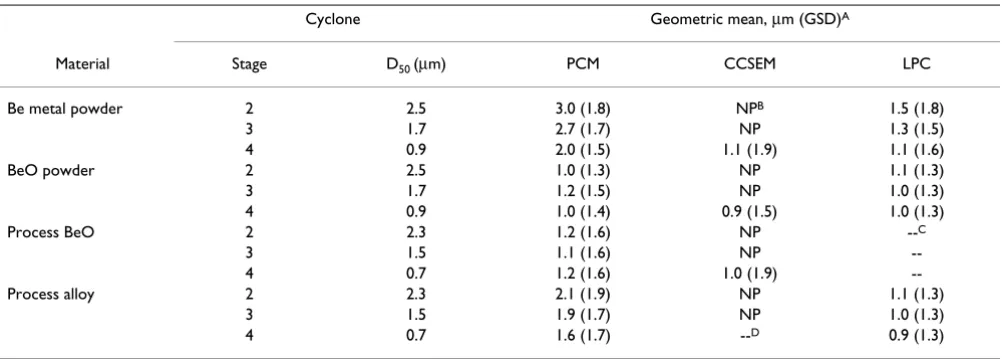
Table 1 summarizes the GM (and GSD) particle size of beryllium materials by each sizing technique. As expected, the GM Feret diameter of metal powder became smaller with decreasing aerodynamic size-fraction; however, when suspended in liquid, the GM particle size often fur-ther decreased by half (p < 0.001). A small portion of this decrease can be attributed to differences in the definition of size among the three analytical techniques and/or our inability to size small particles using PCM. For example, Stein [5], in studies using polystyrene latex spheres observed that sizing using PCM at the theoretical limit of resolution of the objective lens (0.4 μm) missed 10% of particles relative to SEM. Additionally, particle physico-chemical properties were not likely to contribute to the observed decrease in beryllium metal particle size between PCM and the wet sizing techniques. For example, the LPC measures the increase in electrical impedance that is proportional to the volume of liquid displaced by a par-ticle, which is independent of particle color, refractive
index, shape, or chemical composition. A more likely explanation for observed decrease in metal particle size is the sample preparation protocol, including the use of a liquid vehicle. Maier et al. [6] report that ultrasonic agita-tion of nanostructured titanium dioxide (TiO2) powder suspended in artificial lung fluid, dipalmitoyl phosphati-dyl-choline (DPPC) dispersed in physiological saline, broke apart particles and formed an ultrafine particle frac-tion. Thus, it is possible that ultrasonic agitation of sus-pensions prior to LPC analysis might have broken apart particles (see Figure 1A2), resulting in the observed down-ward shift in the particle size distribution. Interestingly, for beryllium metal, particle size also shifted downward without the use of ultrasonic agitation prior to CCSEM analysis (see Figure 1A3). Thus, a plausible explanation for the LPC and CCSEM results is that smaller submicrom-eter size metal particles attached to the surface of larger particles detached from the larger particles and/or particle agglomerates detached when suspended in liquid, thereby shifting the particle size distribution downward. Detach-ment of metal particles could significantly change the expected aerosol size distribution when liquid is used as the vehicle for particle delivery to an exposure subject.
The size of each BeO material appeared similar among siz-ing techniques (see Figures 1, images B1 to B3); however, values determined using PCM and the LPC were statisti-cally different (p < 0.001), with the exception of stage 4 BeO powder (p = 0.49). For BeO, these small differences in GM particle size may be attributed to differences in par-ticle size definition. For these materials, aerodynamic cluster size will dictate deposition in the lung, but primary particle size may influence biological activity.
The GM Feret diameter of particles sampled from the alloy production line became slightly smaller with decreasing aerodynamic size fraction; however, when suspended in liquid for CCSEM and LPC analyses, GM particle size decreased by up to a factor of two (p < 0.001). Thus, these beryllium-containing alloy particles probably also detach in liquid, thereby shifting the size distribution smaller.
Representative SEM images of the different particle sizing preparations of beryllium metal and beryllium oxide evaluated in the study
Figure 1
Publish with BioMed Central and every scientist can read your work free of charge "BioMed Central will be the most significant development for disseminating the results of biomedical researc h in our lifetime."
Sir Paul Nurse, Cancer Research UK
Your research papers will be:
available free of charge to the entire biomedical community
peer reviewed and published immediately upon acceptance
cited in PubMed and archived on PubMed Central
yours — you keep the copyright
Submit your manuscript here:
http://www.biomedcentral.com/info/publishing_adv.asp
BioMedcentral
ultrafine carbon black exhibit varying degrees of dispersa-bility in liquids such as physiologic saline, artificial lung fluid, and rat and mouse bronchoalveolar lavage (BAL) fluid. Thus, on a material-by-material basis, detailed knowledge of the effect of the sample preparation condi-tions, including the use of a liquid vehicle (water, physio-logical saline, artificial lung surfactant, BAL fluid, etc.), on measured physicochemical characteristics of aerosols gen-erated for toxicology studies is essential.
We conclude that careful attention is needed when char-acterizing exposure aerosols for pulmonary toxicology studies. A suite of complimentary analytical techniques may be necessary for understanding particle size distribu-tion. When estimating size distribution, consideration must be given to the use of a liquid vehicle, which may alter the expected aerosol size distribution.
Competing interests
The author(s) declare that they have no competing inter-ests.
Authors' contributions
ABS conceived, designed, acquired, analyzed, interpreted the data, and drafted the manuscript. MDH aerodynami-cally size-separated the powders, interpreted the data, and drafted the manuscript. RMD imaged the study materials and interpreted the data. GAD collected the process-sam-pled particles. PNB drafted the manuscript. RCS collected the process-sampled particles and drafted the manuscript. All authors read and approved the final manuscript.
Acknowledgements
The authors thank A.F. Hubbs at NIOSH for critical review of this manu-script and W.E. Miller for statistical support. This project was supported by NIOSH Research Grant 1R03 OH007447-01. ABS received support from NIEHS Training Program in Environmental Health Sciences ES07141. The findings and conclusions in this report are those of the authors and do not necessarily represent the views of the National Institute for Occupational Safety and Health.
References
1. Stefaniak AB, Hoover MD, Day GA, Dickerson RM, Peterson EJ, Kent MS, Schuler CR, Breysse PN, Scripsick RC: Characterization of physicochemical properties of beryllium aerosols associated with prevalence of chronic beryllium disease. J Environ Mon
2004, 6:523-532.
2. Oberdörster G, Maynard A, Donaldson K, Castranova V, Fitzpatrick J, Ausman K, Carter J, Karn B, Kreyling W, Lai D, Olin S, Monteiro-Riviere N, Warheit D, Yang H: Principles for characterizing the potential human health effects from exposure to nanomate-rials: elements of a screening strategy. Part Fibre Toxicol 2005,
2:8.
3. Rao GVS, Tinkle S, Weissman DN, Antonini JM, Kashon ML, Salmen R, Battelli LA, Willard PA, Hoover MD, Hubbs AF: Efficacy of a technique for exposing the mouse lung to particles aspirated from the pharynx. J Toxicol Environ Health A 2003, 66:1441-1452.
Table 1: Geometric mean diameter of beryllium powders and process-sampled particles
Cyclone Geometric mean, μm (GSD)A
Material Stage D50 (μm) PCM CCSEM LPC
Be metal powder 2 2.5 3.0 (1.8) NPB 1.5 (1.8)
3 1.7 2.7 (1.7) NP 1.3 (1.5)
4 0.9 2.0 (1.5) 1.1 (1.9) 1.1 (1.6)
BeO powder 2 2.5 1.0 (1.3) NP 1.1 (1.3)
3 1.7 1.2 (1.5) NP 1.0 (1.3)
4 0.9 1.0 (1.4) 0.9 (1.5) 1.0 (1.3)
Process BeO 2 2.3 1.2 (1.6) NP --C
3 1.5 1.1 (1.6) NP
--4 0.7 1.2 (1.6) 1.0 (1.9)
--Process alloy 2 2.3 2.1 (1.9) NP 1.1 (1.3)
3 1.5 1.9 (1.7) NP 1.0 (1.3)
4 0.7 1.6 (1.7) --D 0.9 (1.3)
A GSD = geometric standard deviation
B NP = analysis not performed for this size-fraction
C For the sake of efficiency in experimental design, separate LPC analyses were not performed for the process BeO material because the BeO powder material was considered representative of the process BeO material.
Publish with BioMed Central and every scientist can read your work free of charge "BioMed Central will be the most significant development for disseminating the results of biomedical researc h in our lifetime."
Sir Paul Nurse, Cancer Research UK
Your research papers will be:
available free of charge to the entire biomedical community
peer reviewed and published immediately upon acceptance
cited in PubMed and archived on PubMed Central
yours — you keep the copyright
Submit your manuscript here:
http://www.biomedcentral.com/info/publishing_adv.asp
BioMedcentral
4. Hoover MD, Castorina BT, Finch GL, Rothenberg SJ: Determina-tion of the oxide layer thickness on beryllium metal parti-cles. Am Ind Hyg Assoc J 1989, 50:550-553.
5. Stein F: Particle size measurement with phase contrast microscopy. Powder Tech 1969, 2:327-334.
6. Maier M, Hannebauer B, Holldorff H, Albers P: Does lung sur-factant promote dissaggregation of nanostructured titanium dioxide? J Occup Environ Med 2006, 48:1314-1320.
7. Sager TM, Porter DW, Robinson VA, Lindsley WG, Schwegler-Berry DE, Castranova V: Improved method to disperse nanoparticles for in vitro and in vivo investigation of toxicity. Nanotoxicology