O BIT U AR Y
Open Access
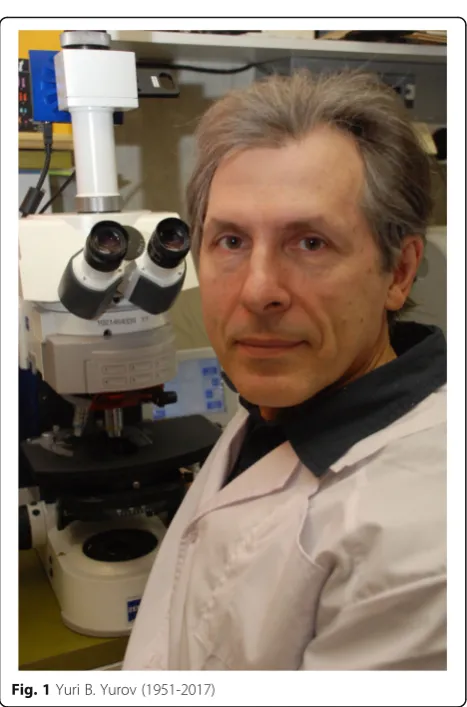
Yuri B. Yurov (1951-2017)
Ivan Y. Iourov
1,2*and Svetlana G. Vorsanova
1,2—
It will take people ten years to forget!
—
It will indeed be honored across two epochs!
Marina I. Tsvetaeva
On 12 December, 2017, Professor Yuri Borisovich
Yurov (Fig.
1
) passed away peacefully at the Federal
Scientific Clinical Center for Resuscitation and
Rehabilita-tion, a renowned resuscitation/rehabilitation institute
located not far from Moscow. The tragic, albeit inevitable,
ending of Yuri
’
s courageous fight against a devastating
cancer has suddenly stricken all his colleagues and friends.
Our deepest sorrow has paralyzed our capacity to do
any-thing, leading us to recognize the vital need for
reevaluat-ing Yuri
’
s scientific and personal legacy.
Yuri
’
s life is an example of unselfish devotion to
bio-science. His contribution to genetics and practical
medi-cine is hard to estimate. It is truly immense! Since Yuri
’
s
personality can be defined using such epithets as
“
bright
intelligence
”
,
“
overwhelming kindness
”
, and, especially,
“
extreme modesty
”
, it is not surprising that he was always
skeptical about
“
aggressive public relations efforts
”
to
advance careers and theories, which are so popular in
modern biomedicine. Thus, one should not be surprised
about the lack of annoyingly large lists of his awards,
honors, commitments, etc. Certainly, Yuri
’
s research was
awarded local and international prizes and grants from
time to time. These, however, are a poor reward for his
tremendous endeavors to organize, undertake, and present
such a groundbreaking body of work. To redress this
historical injustice, we decided to describe Yuri
’
s life in a
biographical review instead of a traditional obituary
lim-ited to a short rueful notification. We do hope that our
ef-fort to share the experience of being alongside this
brilliant researcher and bright person gives a succinct
understanding of Yuri
’
s profound, albeit non-explicit,
im-pact on biomedicine and neuroscience.
Yuri was born on 11 December, 1951, in Zhukovsky, a
city near Moscow known as a home to several major
research institutes involved in designing aircraft, to a
family of an engineer-researcher. While graduating from
school, he chose biology as a field of further higher
education. Today, we know that it was a good choice.
His admission to the Faculty of Biology at Lomonosov
Moscow State University was associated with a story
that picturesquely exposes the essence of Yuri
’
s personality.
The initial results of the matriculation examination did not
allow his admission to the biological faculty of Lomonosov
Moscow State University, but still allowed him to enter the
Faculty of Biology at Moscow State Pedagogical Institute.
Later on, he unintentionally told his father that he is
“
100%
sure
”
to pass the matriculation examination at Lomonosov
Moscow State University. His father decided to appeal to
the university in this regard, which revealed that Yuri was
right. As a result, he was admitted to the faculty of biology
at Lomonosov Moscow State University. There, he made
the ultimate decision to become a researcher in genetics.
In the beginning, Yuri studied DNA replication [
1
].
Initially, his research was performed at Kurchatov
’
s Institute
of Moscow with Dr. Evgenii Ananiev, a recognized Russian
geneticist who contributed to the research of mobile
genetic elements and plant chromosomes [
2
,
3
]. He
pursued the research of DNA replication at Institute of
Medical Genetics (Academy of Medical Sciences of the
USSR, Moscow) and made appreciable progress thereof
[
4
–
10
]. In 1977, Yuri defended his Ph.D-thesis
“
Replica-tional organization of chromosomal DNA in cultured
normal and abnormal cells of humans and animals
”
.
However, he was obliged to cease studying DNA
repli-cation. As we previously implied, Yuri was completely
disinterested in backroom intrigues and local politics.
This was not the case for the majority of group leaders
and administration representatives at the medical
gen-etics institutes at the end of seventies and beginning of
the eighties. Fortunately, psychiatric genetics was a
re-search focus of the All-Union Mental Health Rere-search
Center (Academy of Medical Sciences of the USSR,
Moscow), where Yuri was invited to develop new
* Correspondence:[email protected] 1
Laboratory of Molecular Genetics and Cytogenomics of the Brain, Mental Health Research Center, Zagorodnoe shosse 2/16, 117152 Moscow, Russia 2Veltischev Research and Clinical Institute for Pediatrics of the Pirogov
Russian National Research Medical University, Ministry of Health of Russian Federation, Moscow 125412, Russia
techniques for studying the human genome at the
chromosomal level in brain disorders by Professor
Marat E. Vartanian, who had then become the head of
this center. Henceforth, his research career would be
tightly linked to Mental Health Research Center, where
he successfully completed his doctoral dissertation for
receiving the degree of Doctor of Science (the highest
academic degree achieved through defending a thesis
significantly more voluminous than a canonical Ph.D
thesis)
— “
Molecular cytogenetics of heterochromatic
regions in the human genome
” —
and became the head
of the Cytogenetics Laboratory (laboratory of
cytogen-etics and genomics of mental disorders).
So began Yuri
’
s molecular cytogenetic odyssey. He was
among the first researchers in the world to develop a
technique of in situ hybridization with cloned DNA
se-quences for the analysis of human chromosomes [
11
].
Almost immediately, the results of these developments
were found applicable for molecular cytogenetic diagnosis
of chromosomal abnormalities. Unfortunately, the article
describing these applications was published two years later
after the submission along with other articles reporting
similar results [
12
]. His molecular cytogenetic studies were
based on a part of his immense research activity referred to
molecular, cytogenetic and evolutionary analysis of alpha
satellite DNA and constitutive heterochromatin [
13–19
].
Evolutionary molecular (cyto)genetic studies have also
underlined long-standing friendship and collaboration with
Professor Gérard Roizès (Institut de Biologie,
Montpel-lier, France) [
20
], with whose team (équipe) he worked
for several years. During this period, he had a family
tragedy. His stepson
—
Dr. Ilia V. Soloviev, a prodigious
young researcher and a pioneer of molecular
cytogenet-ics and cytogenetic genome research, whose brilliant
work and original ideas still form research directions in
our labs
—
tragically passed away. This sorrow led to
re-assessing life priorities. More intense research was
undertaken to decrease the suffering.
Inspired by the first success of his molecular cytogenetic
research and diagnosis [
21–25
], Yuri together with his
clos-est colleagues undertook further studies to increase the
effi-ciency and scope of molecular cytogenetics. Thus, a series
of (ultra) rapid fluorescence in situ hybridization (FISH)
protocols was proposed [
26
,
27
]. One rapid protocol, based
on microwave activation [
26
], was developed 10-15 years
before the introduction of such approaches to diagnostic
and research practice. Additionally, FISH-based molecular
cytogenetic techniques for the identification of marker
chromosomes were proposed [
28–30
]. At that time, the
essential issue of Yuri
’
s research was the creation of an
original DNA probe collection [
16
,
17
,
31
], which formed a
firm basis for almost all our further studies and
develop-ments in molecular cytogenetics. For instance, interphase
detection of chromosome 21 aneuploidy for prenatal
diag-nosis was significantly improved [
27
,
32
]. Multicolor
inter-phase FISH with centromeric (chromosome-enumeration)
DNA probes was the next major breakthrough of research
headed by Yuri [
33
]. This technique is still very popular
and is actually the most direct way to analyze numerical
chromosomal changes in large cellular populations at
single-cell level. It was also found applicable for studying
sperm providing new opportunities for reproductive
genet-ics [
34
]. These studies can be designated as the main basis
for the first generation interphase (molecular) cytogenetics
developments allowing the analysis of chromosomal
loci or ambiguous/amorphous chromosome territories
(chromosomal parts
’
territories) without an integral view
of the whole interphase chromosomes.
Another layer of Yuri
’
s research is represented by
studying X-linked diseases [
35–37
], more precisely, Rett
syndrome. The studies of Rett syndrome performed
with his participation were global [
38
,
39
]. These included
the confirmation of an X-linked nature of the syndrome
[
40–42
], mutational analysis in Russian Rett syndrome
cohorts [
43
], uncovering pathoepigenetic mechanisms
specific for Rett syndrome (i.e. alterations to
chromo-somal DNA replication, X-linked bi-allelic expression,
parent-of-origin-like effects on X chromosome inactivation)
[
40–42
,
44–46
], and discovering the microdeletion nature
of
MECP2-mutation negative Rett syndrome cases [
47
,
48
].
The success of Rett syndrome studies culminated in 2016,
when the VIII World Rett Syndrome Congress
(scientific-ally organized with active Yuri
’
s participation) was held in
Kazan, Russia. The congress highlighted true success and
recognition of Rett syndrome research in Russia, which
is, in turn, the result of Yuri
’
s efforts. Regretfully, due
to numerous unexpected problems, we have not still
published the article describing this congress.
Nonethe-less, we await this article to be published in
Molecular
Cytogenetics
soon.
Yuri
’
s original collection of DNA probes was found
useful in numerous studies performed by our labs and
his collaborators all over the world. These studies
in-cluded, but were not limited to, analyses of
chromo-somal abnormalities and instability (mosaicism) in a
variety of human tissues [
49–52
], mapping breakpoints
of structural chromosome rearrangements [
52–55
],
dis-covering the role of chromosomal mosaicism (mosaic
aneuploidy and polyploidy) in spontaneous abortion [
56–
60
]. However, there was a real need to widen the spectrum
of molecular cytogenetic techniques, especially for studying
interphase chromosomes and genomic (chromosomal)
vari-ations at single-cell level in different tissues [
61–65
]. In this
context, it is to mention one of the major theoretical
contri-butions to bioscience made by Yuri.
It has been postulated without any evidence that all
cells of an organism possess identical genomes. Taking
into account simply the amount of mitoses needed to
generate the required amount of cells of an organism,
we inevitably come to a conclusion that these postulates
are nonsense. Although the scale of mosaicism in somatic
tissues is to be determined more thoroughly, one had to
admit the existence of overlooked cellular fractions
fea-tured by unshared genomes [
66
]. Regardless of being
pre-sented as an encyclopedic knowledge [
67
], intercellular/
somatic genomic variations were more-or-less recognized
as an important mechanism for interindividual diversity in
health and disease during the last few years only.
More-over, we had proposed a neurocytogenetic hypothesis
sug-gesting that genetic mechanisms of brain diseases are
more likely to be related to cellular populations with
ab-normal genomes primarily affecting the brain. In other
words, Yuri insisted that we should perform genetic
ana-lysis of the brain to uncover the mechanisms of central
nervous system diseases [
68
]. As one can guess, the idea
encountered serious resistance from skeptical ignorance
to aggressive denial. It is rare for a researcher to prefer to
break a tradition to the detriment of its
“
publicability
”
and
funding opportunities. When the overwhelming majority
of studies in psychiatric (medical) genetics are made using
DNA isolated from blood, it is naïve to think that such
ideas may be accepted quietly. Yuri did not care much
about it. He preferred creating trends to following trends.
Interestingly, this approach to brain diseases is quite
popular in the latest neuroscience literature, unfortunately
often without appropriate references to the original
theor-etical articles.
To succeed in studying somatic genome variations in
the brain, new molecular cytogenetic techniques were
strongly required. Using positive experience in developing
original computer-assisted analysis of FISH results [
69
],
we elaborated a quantitative FISH protocol [
70
,
71
]. The
latter was found applicable for analysis of chromosomal
heteromorphisms/pericentromeric regions (i.e.
identifica-tion of parental origins of homologous chromosomes with
efficiency comparable to PCR-based methods) [
72
],
distin-guishing between interphase chromosome loci pairing or
associations and chromosomal loss [
73
], and determining
specific genome architecture within human interphase
nuclei [
74
]. Still, the possibility to see an interphase
chromosome in its integrity was not available. To offer the
opportunity to see a banded interphase chromosome, we
took advantage of a collaboration with Professor Thomas
Liehr (Jena, Germany) for developing a new method for
analysis of interphase chromosomes in their integrity,
en-titled interphase chromosome-specific multicolor banding
(ICS-MCB) [
75–78
]. Finally, there was a lack of protocols
for obtaining cellular suspensions from postmortem brain
specimens applicable for specific FISH-based approaches
to single-cell interphase chromosome analysis. The
prob-lem was soon solved [
79
] and became a continuously
ap-plicable method for human molecular neurocytogenetics
[
80
]. The results of these interphase cytogenetic
achieve-ments were summarized in quite a highly cited (for
non-canonical cytogenetics) review [
81
] and in quite a
widely read book [
82
].
Yuri
’
s idea about the link between pathogenesis of
psy-chiatric, neurodevelopmental, and neurodegenerative
diseases and genetic pathology exclusively affecting the
central nervous system required the knowledge
concern-ing the background rate of sporadic (chromosomal)
muta-tions in the unaffected brain. Under his leadership with
the valuable help of Professor Sergei Kutsev, who provided
the unique specimens, we performed analysis of
chromo-somes in the developing human brain [
83
–
86
]. As a result,
it had been sensationally reported that the overall
percent-age of aneuploid cells is 30
–
35% in the developing brain
indicating aneuploidization and developmental
chromo-somal instability to be an additional pathological
mechan-ism for neuronal genome diversification at molecular and
cellular levels [
86
]. In the unaffected postnatal brain, these
rates are significantly lower [
75
,
84
,
87
,
88
].Therefore,
Yuri
’
s hypothesis was supported at this stage.
attention to mosaicism confined to the brain showing
chromosomal abnormalities/instability causative for mental
illness [
89
]. This is mainly due to the fortunate availability
of the Mental Health Research Center collection of
post-mortem brain specimens managed by Dr. Viktor Vostrikov
and Professor Natalia Uranova (Mental Health Research
Center, Moscow, Russia). Interestingly, somatic mosaicism,
even in a wider sense (i.e. unconfined to a tissue), was not a
focus of psychiatric genetics research at all at that time
[
90
]. During the next years, Yuri
’
s neurocytogenetic
re-search of schizophrenia was successful. We were able to
demonstrate the disease association with chromosome
1-specific aneuploidy (instability) and to show the
involve-ment of brain-specific low-level post-zygotic aneuploidy in
schizophrenia and comorbid psychiatric disorders [
91–94
].
Neurodegenerative diseases were another focus of Yuri
’
s
neurocytogenetic research [
87
]. First, Alzheimer
’
s disease
was found to be associated with aneuploidy confined to the
brain. Moreover, it marked the end of debates about
paral-lels between Alzheimer
’
s disease and Down syndrome.
Consequently, it was postulated that Alzheimer
’
s disease is
associated with chromosome 21-specific aneuploidy and
instability in the brain, but it is not a subtype of Down
syndrome (trisomy 21) [
87
,
95
,
96
]. This devastating
neuro-degenerative disease is likely to result from a complex
mechanism involving abortive cell cycle re-entry,
replica-tion stress in postmitotic neural cells, genome instability,
and deposition of amyloid beta-peptide [
97
]. Furthermore,
additional studies showed a link between cytogenetic
markers of aging and Alzheimer
’
s disease pathogenesis
[
98
]. Accordingly, numerous hypotheses about
mecha-nisms for Alzheimer
’
s disease were merged together to
form the Alzheimer
’
s disease pathogenetic cascade.
The support, provided by Ataxia Telangiectasia Children
’
s
Project, significantly helped Yuri to pursue his
neurocytoge-netic research of neurodegenerative diseases. Yuri focused
on an intriguing paradox of ataxia telangiectasia: exclusive
cerebellar neurodegeneration [
99
]. This neurodegenerative
disease was found to exhibit chromosome instability in the
brain [
87
]. In addition, ataxia telangiectasia also
demon-strated a link between area- and chromosome-specific
in-stability and neurodegeneration [
100
]. These findings were
then suggested to be a likely basis for the therapeutic
interventions in neurodegenerative diseases mediated
by chromosome instability [
101
]. Thus, the first evidence
that genome/chromosome instability is able to produce
neurodegeneration, whereas it is generally assumed to be
associated with cancer, was provided.
Parallelly, somatic (cyto)genomic variations were studied
in autism. As a result, it was discovered that somatic
mosaicism (aneuploidy) is a genetic risk factor for autism
[
102
]. Furthermore, these studies demonstrated an
unpre-cedentedly high prevalence of chromosomal
heteromor-phisms in autistic children [
103
,
104
]. So far, these two
types of genomic variations seem to be the most common
ones in this pervasive neurodevelopmental disorder.
Theoretically, these data were applicable for explaining
the male-to-female ratio in autism [
105
]. Furthermore,
chromosomal heteromorphisms and instability were
then shown to co-segregate with mental illness in
autis-tic pedigrees [
106
,
107
]. These studies were followed by
neurocytogenetic analysis of the autistic brain. We do
hope to present the results in the nearest future.
This area of Yuri
’
s research allowed proposing a
“
global
mosaicism pathway
”
for human intercellular/interindividual
diversity and disease pathogenesis throughout the ontogeny
[
108
]. Interestingly, it was associated not only with
aneu-ploidy, but also with structural chromosome abnormalities
(i.e. dynamic mosaicism, tissue- (or sub-tissue) specific
mo-saicism and local tissue-specific increase of chromosome
instability [
100
,
109
]. Furthermore, this
“
global mosaicism
pathway
”
highlighted developmental chromosome
instabil-ity as a possible cause of cancer in early childhood [
110
].
Fi-nally, the pathway explained cell senescence and aging of
tissues composed of postmitotic cells through the
accumu-lation of somatic (chromosomal) mutations [
111
]. All these
experimental and theoretical analyses underlined the basis
of molecular cytogenomics, which aggregated and
corre-lated data on heritable and non-heritable (somatic
mosai-cism) genomic variations [
112
]. It is noteworthy that the
term
“
cytogenomics
”
was suggested by Yuri ten years
before it started to be widely used in similar contexts. This
enormous body of research culminated in publishing a
spe-cial issue on somatic genome variations (mosaicism) in
Current Genomics
[
113
]. In that issue, Yuri and colleagues
provided three main directions of studying somatic genome
variations: somatic mosaicism
’
s role in health and disease
[
114
], somatic genome variations in the ontogenetic context
[
115
], and diagnostic issues of studying somatic genome
variability [
116
]. The paradigm of somatic genomics
was then repeatedly postulated indicating the global
contribution of genome/chromosome instability to brain
diseases [
117–120
]. Finally, somatic genomic theory
sug-gested a new generalized pathway, linking
germline/herit-able
genome
variations,
somatic
mosaicism
and
genetic-environmental interactions [
121
]. Yuri
’
s research
of somatic genome variations is another example of his
major contribution to bioscience. He did succeed to
per-suade biomedical researchers that genomes of somatic
cells are not identical. So, the human is not a parody of a
huge unicellular organism anymore.
protocols [
123
]. However, more sophisticated approaches
specially elaborated for molecular cytogenetics were soon
found to be required. As a result, a new dimension
(in silico dimension) in molecular cytogenetics was
discovered [
124
]. In silico molecular cytogenetics was
shown to uncover molecular and cellular mechanisms of
diseases associated with chromosomal imbalances and copy
number variations. Additionally, it became a basis for
ori-ginal algorithms of fusion and network-based classification
of molecular cytogenetic data [
125
] as well as proposing
global pathways of neuropsychiatric diseases for therapeutic
interventions [
126
]. These algorithms were
success-fully used for uncovering mechanisms of chromosomal
instability and somatic mosaicism [
127
,
128
]. Moreover, in
silico approaches to chromosomal imbalances are
applic-able for developing successful treatments of chromosomal
abnormalities, which are considered incurable genetic
conditions [
129
]. To this end, we recently proposed a
practical in silico protocol for molecular cytogenetic
diag-nosis of neuropsychiatric diseases [
130
]. As one can see,
Yuri made a significant input in clinical (genomic)
bioinformatics. His efforts in this field resulted in
signifi-cant quality of life increase (or even healing) of children
suffering from presumably hopeless genetic diseases.
Yuri
’
s contribution to practical medicine or more
pre-cisely molecular diagnosis was immense. His diagnostic
research was intimately related to working at laboratory
of molecular cytogenetics of neuropsychiatric diseases at
Veltischev Research and Clinical Institute for Pediatrics
of the Pirogov Russian National Research Medical
University (Institute of Pediatrics and Pediatric Surgery),
Moscow, Russia. Since the late eighties, numerous
reports were published about the increase of
diag-nostic efficiency of molecular cytogenetic techniques
[
21
,
24
,
25
,
28
,
49–51
,
102–107
,
112
,
116
,
117
,
130
,
131
].
For instance, the first Russian array CGH (comparative
genomic hybridization) study of a clinical population was
the result of Yuri
’
s tremendous efforts [
131
,
132
]. His
diagnostic research was not limited to chromosome
abnormalities and copy number variations. Under Yuri
’
s
supervision, an approach to molecular diagnosis of
epigen-etic diseases was proposed [
133
]. This led to a discovery of
a new epigenomic mechanism of neurodevelopmental
diseases in childhood [
134
]. His approaches to molecular
diagnosis of structural genomic variations in autism and
intellectual disability including uncovering mechanisms
and possible therapies were recently found highly effective
[
135
]. Finally, it is important to mention that Yuri
’
s efforts
resulted in elevating the educational level in the field of
mo-lecular genetic diagnosis. Our laboratories receive consistent
thanks of almost all Russian-spoken specialists from all over
the world because of his co-authored books [
136–142
],
which are the only books describing real cytogenetics,
mo-lecular cytogenetics and cytogenomics in Russian.
The latest results of Yuri
’
s research formed a firm basis
for molecular cytogenetics earning its well-deserved place
in postgenomic biomedicine. These efforts resulted in a
special issue of
Current Genomics, which uncovers new
realities and dimensions of molecular cytogenetics
—
cytogenomics or molecular cyto(post)genomics [
143
]. In
this issue, Yuri and his colleagues reported a part of
aneu-ploidy research in the schizophrenia brain and comorbid
psychiatric disorders [
94
]. Additionally, our original
bio-informatic techniques were shown to be truly applicable
for basic and applied cytogenomics to uncover molecular,
cellular, physiological and even neuropsychological
mech-anisms of diseases caused by chromosome imbalances
[
144
]. Furthermore, we proposed an original cytogenomic
hypothesis suggesting that human behavior might be
regulated through changes in proportions of somatic
mosaicism levels resulted from complex interaction
between mutational burden and environment [
145
].
Unfortunately, the issue was published at that time,
when Yuri was unable to see it (posthumously), even
though its content was prepared in 2016-2017.
A very special part of Yuri
’
s research life was
Molecular
Cytogenetics, the journal founded in 2008 with his
essen-tial participation [
146
]. It all started as a joke. In 2005,
during a conversation with our good friend and colleague
Professor Thomas Liehr, somebody said that it is always
challenging for a group of independent scientists (i.e.
re-searchers uninvolved in large sophisticated collaborative
webs and hierarchical relationships) to publish an article
containing bold ideas, unique, albeit logic and scientific,
views, and own conclusions in their original form,
espe-cially in the field of cytogenetics. Jokingly, it was said that
there is an easy solution to this problem: one just had to
establish a new journal dedicated to chromosome biology
and molecular cytogenetics based on a principle,
some-thing like
“
good music for good people
”
with the only
ex-ception of being a scientific journal. It is well-known that
“
there is a grain of truth in every joke
”
. It was a solution,
but not an easy one. It took three years to begin the
jour-nal. Yuri became one of the Editors-in-Chief as one of the
founders. From that time onwards it took then five years
to receive the first official impact factor [
147
]. Further
success was achieved when the journal was ranked first
out of all journals specifically dedicated to cytogenetics.
The editorship of
Molecular Cytogenetics
was Yuri
’
s
honorable duty. We are only starting to understand the
extent of his contribution to the journal
’
s success.
It is not a secret that Yuri
’
s family is the core of team
members of three laboratories which have performed
such a great body of biomedical research. He is a
grand-father of three granddaughters, who remember him as
the kindest and nicest person in the world. Thus, this is
also a grievous personal loss for us, his family.
We miss him a lot! The gap in our life resulted from
this untimely and unacceptable loss cannot be filled. We
would like to express our thanks to all the friends and
colleagues for their kind support. The only thing we can
do now is to multiply and to share the legacy of such an
outstanding researcher as Professor Yuri B. Yurov.
Authors’contributions
IYI drafted the manuscript. SGV provided information. Both authors read and approved the final manuscript.
Competing interests
The authors declare that they have no competing interests.
Publisher
’
s Note
Springer Nature remains neutral with regard to jurisdictional claims in published maps and institutional affiliations.
Received: 18 April 2018 Accepted: 14 May 2018
References
1. Iurov IB. DNA replication in a primary culture of human hepatocytes. Dokl Akad Nauk SSSR. 1976;229(2):472–5.
2. Anan'ev EV, Iurov IB, Polukarova LG. Rate of DNA synthesis and the size of replication units in cell culture of Drosophila melanogaster. Mol Biol (Mosk). 1976;10(5):987–97.
3. Ananiev EV, Polukarova LG, Yurov YB. Replication of chromosomal DNA in diploid Drosophila melanogaster cells cultured in vitro. Chromosoma. 1977; 59:259–72.
4. Yurov YB. DNA replication in human diploid cells of different origin. Cell Differ. 1977;6:95–104.
5. Iurov IB. Replication of chromosomal DNA in Chinese hamster cells, cultivated at different temperatures. Tsitologiia. 1977;19(9):1064–7. 6. Yurov YB. Replication of chromosomal DNA in cultured abnormal human
cells. Hum Genet. 1978;43:47–52.
7. Yurov YB. The rate of fork movement during DNA replication in mammalian cells. Chromosoma. 1979;74:347–53.
8. Yurov YB. Do clusters of replication units in the mammalian cells exist? Exp Cell Res. 1979;123:369–74.
9. Yurov YB. Rate of DNA replication fork movement within a single mammalian cell. J Mol Biol. 1980;136:339–42.
10. Iurov IB, Vorsanova SG. DNA replication in cultured amniotic fluid cells. Biull Eksp Biol Med. 1981;92(9):349–52.
11. Iurov IB. Optimization of the conditions for the in situ hybridization of cloned DNA sequences and for the differential staining of human chromosomes. Biull Eksp Biol Med. 1984;97(5):595–8.
12. Vorsanova SG, Yurov YB, Alexandrov IA, Demidova IA, Mitkevich SP, Tirskaia AF. 18p- syndrome: an unusual case and diagnosis by in situ hybridization with chromosome 18-specific alphoid DNA sequence. Hum Genet. 1986;72: 185–7.
13. Yurov YB, Mitkevich SP, Alexandrov IA. Application of cloned satellite DNA sequences to molecular-cytogenetic analysis of constitutive
heterochromatin heteromorphisms in man. Hum Genet. 1987;76:157–64. 14. Iurov IB, Mitkevich SP, Aleksandrov IA. Molecular cytogenetic research on
the polymorphism of segments of the constitutive heterochromatin in human chromosomes. Genetika. 1988;24(2):356–65.
15. Alexandrov IA, Medvedev LI, Mashkova TD, Kisselev LL, Romanova LY, Yurov YB. Definition of a new alpha satellite suprachromosomal family characterized by monomeric organization. Nucleic Acids Res. 1993;21:2209–15.
16. Yurov YB, Laurent AM, Marcais B, Vorsanova SG, Roizes G. Analysis of pericentromeric chromosome 21 specific YAC clones by FISH: identification of new markers for molecular-cytogenetic application. Hum Genet. 1995;95:287–92.
17. Solov'ev IV, Iurov IB, Vorsanova SG, Marcais B, Rogaev EI, Kapanadze BI, BrodianskiĭVM, IankovskiĭNK, Roizes G. Study of alpha-satellite DNA in cosmid libraries, specific for chromosomes 13, 21, and 22, using fluorescence in situ hybridization. Genetika. 1998;34(11):1470–9. 18. Marzais B, Vorsanova SG, Roizes G, Yurov YB. Analysis of alphoid DNA
variation and kinetochore size in human chromosome 21: evidence against pathological significance of alphoid satellite DNA diminutions. Tsitol Genet. 1999;33(1):25–31.
19. Vorsanova SG, Yurov YB, Brusquant D, Carles E, Roizes G. Two new cases of the Christchurch (Ch1) chromosome 21: evidence for clinical consequences of de novo deletion 21P. Tsitol Genet. 2002;36(1):46–9.
20. Roizes G, Marcais B, Yurov Y. Les centromères des chromosomes de mammifères. Med Sci. 1994;10(3):282–95.
21. Vorsanova SG, Iurov IB, Aleksandrov IA, Demidova IA, Mitkevich SP. Molecular-cytogenetic diagnosis of hereditary diseases associated with diverse anomalies of X chromosome. Pediatriia. 1989;1:76–80.
22. Vorsanova SG, Yurov YB, Kurbatov MB, Kazantzeva LZ. Translocation t(1;17)(q12; q25) with a clinical picture like of a proximal deletion of 1q: identification by in situ hybridization with chromosome 1-specific satellite DNA probes. Hum Genet. 1990;86:173–4.
23. Iurov IB, Selivanova EA, Deriagin GV. Human alpha-satellite DNA specific to chromosomes 13 and 21: use for the analysis of polymorphism of acrocentric chromosomes and the origin of the additional chromosome 21 in Down's syndrome. Genetika. 1991;27(9):1637–47.
24. Vorsanova SG, Iurov IB, Deriagin GV, Solov'ev IV, Bytenskaia GA. Method of diagnosing aneuploidies using in situ hybridization: analysis of interphase nuclei. Biull Eksp Biol Med. 1991;112(10):413–5.
25. Vorsanova SG, Iurov IB, Demidova IA, Vekhova NV. Chromosomal anomalies in children with undifferentiated forms of mental retardation based on molecular cytogenetic research data. Tsitol Genet. 1993;27(3):72–8. 26. Soloviev IV, Yurov YB, Vorsanova SG, Malet P. Microwave activation of
fluorescence in situ hybridization: A novel method for rapid chromosome detection and analysis. Focus. 1995;16:101–2.
27. Soloviev IV, Yurov YD, Vorsanova SG, Malet P, Zerova TE, Buzhievskaya TI. Double color in situ hybridization of alpha-satellite chromosome 13, 21 specific cosmid clones for a rapid screening of their specificity. Tsitol Genet. 1998;32(4):60–4. 28. Vorsanova SG, Yurov YB, Soloviev IV, Demidova IA, Malet P. Rapid
identification of marker chromosomes by in situ hybridization under different stringency conditions. Anal Cell Pathol. 1994;7:251–8. 29. Plattner R, Heerema NA, Yurov YB, Palmer CG. Efficient identification of
marker chromosomes in 27 patients by stepwise hybridization with alpha-satellite DNA probes. Hum Genet. 1993;91:131–40.
30. Vorsanova SG, Yurov YB, Passarge I, Schmidt A, Zerova TE, Demidova IA, Buzhiyevskaya TI. Identification of marker chromosomes by in situ hybridization technique using alpha and "classical" satellite DNA probes with relative chromosomal specificity. Tsitol Genet. 1994;28(3):67–70. 31. Yurov YB, Vorsanova SG, Soloviev IV, Demidova IA, Alexandrov IA,
Sharonin VO, Beresheva AK. Original collection of DNA probes for preimplantational, fetal prenatal and postnatal diagnosis of chromosomal analysis by FISH. In: Macek M, Bianchi D, Prague CH, editors. Early prenatal diagnosis, fetal cells and DNA in mother, present state and perspectives; 2002. p. 275–83.
32. Soloviev IV, Yurov YB, Vorsanova SG, Fayet F, Roizes G, Malet P. Prenatal diagnosis of trisomy 21 using interphase fluorescence in situ hybridization of post-replicated cells with site-specific cosmid and cosmid contig probes. Prenat Diagn. 1995;15:237–48.
33. Yurov YB, Soloviev IV, Vorsanova SG, Marcais B, Roizes G, Lewis R. High resolution multicolor fluorescence in situ hybridization using cyanine and fluorescein dyes: rapid chromosome identification by directly fluorescently labeled alphoid DNA probes. Hum Genet. 1996;97:390–8.
34. Yurov YB, Saias MJ, Vorsanova SG, Erny R, Soloviev IV, Sharonin VO, Guichaoua MR, Luciani JM. Rapid chromosomal analysis of germ-line cells by FISH: an investigation of an infertile male with large-headed spermatozoa. Mol Hum Reprod. 1996;2:665–8.
36. Iurov II, Vorsanova SG, Iurov IB. Nervous and mental diseases in boys and mutations inMECP2gene. Zh Nevrol Psikhiatr Im S S Korsakova. 2004;104(10):73–80.
37. Iurov II, Willard L, Vorsanova SG, Demidova IA, Goiko EA, Shal'nova SA, Shkol'nikova MA, Olfer'ev AM, Iurov IB. X chromosome inactivation pattern in elderly women over 70 years of age. Tsitol Genet. 2004;38(4):49–54. 38. Vorsanova SG, Ulas VI, Demidova IA, Kravets VS, Iurov IB. Contemporary
views on Rett's syndrome: clinical, cytogenetic and molecular studies. Zh Nevrol Psikhiatr Im S S Korsakova. 1999;99(3):61–9.
39. Vorsanova SG, Iourov IY, Yurov YB. Neurological, genetic and epigenetic features of Rett syndrome. J Pediatr Neurol. 2004;2:179–90.
40. Vorsanova SG, Demidova IA, Ulas VY, Soloviev IV, Kazantzeva LZ, Yurov YB. Cytogenetic and molecular-cytogenetic investigation of Rett syndrome: analysis of 31 cases. Neuroreport. 1996;8:187–9.
41. Vorsanova SG, Demidova IA, Ulas VI, Solov'ev IV, Kravets VS, Kazantseva LZ, Iurov IB. Cytogenetic and molecular genetic diagnostics of Rett syndrome in children. Zh Nevrol Psikhiatr Im S S Korsakova. 1998;98(4):53–6.
42. Vorsanova SG, Yurov YB, Ulas VY, Demidova IA, Sharonin VO, Kolotii AD, Gorbatchevskaia NL, Beresheva AK, Soloviev IV. Cytogenetic and molecular-cytogenetic studies of Rett syndrome (RTT): a retrospective analysis of a Russian cohort of RTT patients (the investigation of 57 girls and three boys). Brain Dev. 2001;23(1):S196–201.
43. Vorsanova SG, Ulas VI, Iurov IB, Giovanucci-Uzielli ML, Demidova IA, Gianti L, Villard L, Iurov II, Beresheva AK, Novikov PV. Genotype-phenotype correlations in Rett syndrome: the study of Russian cohort of patients. Zh Nevrol Psikhiatr Im S S Korsakova. 2002;102(10):23–9.
44. Vorsanova SG, Yurov YB, Kolotii AD, Soloviev IV. FISH analysis of replication and transcription of chromosome X loci: new approach for genetic analysis of Rett syndrome. Brain Dev. 2001;23(1):S191–5.
45. Yurov YB, Vorsanova SG, Kolotii AD, Iourov IY. Molecular-cytogenetic investigation of skewed chromosome X inactivation in Rett syndrome. Brain Dev. 2001;23(1):S214–7.
46. Iurov II, Vorsanova SG, Voinova-Ulas VI, Villard L, Demidova IA, Giunti L, Guivabyccu-Uzielli ML, Budilov AV, Beresheva AK, Novikov PV, Iurov IV. Epigenetic study of Rett's syndrome as an adequate model for autistic disorders. Zh Nevrol Psikhiatr Im S S Korsakova. 2005;105(7):4–11. 47. Vorsanova SG, Iurov II, Voinova VI, Kurinnaia OS, Zelenova MA, Demidova IA,
Ulas EV, Iurov IB. Subchromosomal microdeletion identified by molecular karyotyping using DNA microarrays (array CGH) in Rett syndrome girls negative forMECP2gene mutations. Zh Nevrol Psikhiatr Im S S Korsakova. 2013;113(10):63–8.
48. Iourov IY, Vorsanova SG, Voinova VY, Kurinnaia OS, Zelenova MA, Demidova IA, Yurov YB. Xq28 (MECP2) microdeletions are common in mutation-negative females with Rett syndrome and cause mild subtypes of the disease. Mol Cytogenet. 2013;6:53.
49. Vorsanova SG, Iurov IB. Molecular cytogenetic pre- and postnatal diagnosis of chromosomal abnormalities. Vestn Ross Akad Med Nauk. 1999;11:12–5. 50. Vorsanova SG, Iurov IB, Solov'ev IV, Demidova IA, Sharonin VO, Male R,
Zhiollant M, Beresheva AK, KolotiĭAD, Kravets VS, Ruazes Z. Current methods of molecular cytogenetics in pre- and postnatal diagnosis of chromosome aberrations. Klin Lab Diagn. 2000;8:36–9.
51. Iurov IB, Vorsanova SG. Molecular cytogenetic studies of chromosomal abnormalities and disorders in nervous and mental diseases: search for biological markers for diagnosis. Vestn Ross Akad Med Nauk. 2001;7:26–31. 52. Iourov IY, Vorsanova SG, Yurov YB. Recent patents on molecular
cytogenetics. Recent Pat DNA Gene Seq. 2008;2:6–15.
53. Vorsanova SG, Yurov YB, Kolotii AD, Demidova IA, Novikova IM. 16q subtelomeric deletion in proband with congenital malformations and mental retardation. Tsitol Genet. 2000;34(6):72–4.
54. Vorsanova SG, Iourov IY, Demidova IA, Kolotii AD, Soloviev IV, Yurov YB. Pericentric inversion inv(7)(p11q21.1): report on two cases and genotype-phenotype correlations. Tsitol Genet. 2006;40(3):45–8.
55. Vorsanova SG, Iourov IY, Voinova-Ulas VY, Weise A, Monakhov VV, Kolotii AD, Soloviev IV, Novikov PV, Yurov YB, Liehr T. Partial monosomy 7q34-qter and 21pter-q22.13 due to cryptic unbalanced translocation t(7;21) but not monosomy of the whole chromosome 21: a case report plus review of the literature. Mol Cytogenet. 2008;1:13.
56. Vorsanova SG, Kolotii AD, Iourov IY, Monakhov VV, Kirillova EA, Soloviev IV, Yurov YB. Evidence for high frequency of chromosomal mosaicism in spontaneous abortions revealed by interphase FISH analysis. J Histochem Cytochem. 2005;53:375–80.
57. Vorsanova SG, Kolotii AD, Iurov II, Kirillova EA, Monakhov VV, Beresheva AK, Solov'ev IV, Iurov IB. Diagnosis of numerical chromosomal aberrations in the cells of spontaneous abortions by multicolor fluorescence in situ hybridization (MFISH). Klin Lab Diagn. 2005;11:30–2.
58. Vorsanova SG, Iourov IY, Demidova IA, Kirillova EA, Soloviev IV, Yurov YB. Chimerism and multiple numerical chromosome imbalances in a spontaneously aborted fetus. Tsitol Genet. 2006;40(5):28–30.
59. Vorsanova SG, Yurov YB, Iourov IY. Maternal smoking as a cause of mosaic aneuploidy in spontaneous abortions. Med Hypotheses. 2008;71(4):607. 60. Vorsanova SG, Iurov II, Kolotii AD, Beresheva AK, Demidova IA, Kurinnaia
OS, Kravets VS, Monakhov VV, Solov'ev IV, Iurov IB. Chromosomal mosaicism in spontaneous abortions: analysis of 650 cases. Genetika. 2010;46(10):1356–9.
61. Iourov IY, Vorsanova SG, Soloviev IV, Yurov YB. Interphase FISH: detection of intercellular genomic variations and somatic chromosomal mosaicism. In: Liehr T, editor. Fluorescence In Situ Hybridization (FISH)—Application Guide (Springer Protocols). Berlin, Heidelberg: Springer-Verlag; 2009. p. 301–11. 62. Yurov YB, Vorsanova SG, Iourov IY. In: Yurov YB, Vorsanova SG, Iourov IY,
editors. Introduction to interphase molecular cytogenetics. in: Human Interphase Chromosomes (Biomedical Aspects). New York, Heidelberg, Dordrecht, London: Springer; 2013. p. 1–8.
63. Vorsanova SG, Yurov YB, Iourov IY. Technological solutions in human interphase cytogenetics. in: Human Interphase Chromosomes (Biomedical Aspects). In: Yurov YB, Vorsanova SG, Iourov IY, editors. . New York, Heidelberg, Dordrecht, London: Springer; 2013. p. 179–203.
64. Iourov IY, Vorsanova SG, Yurov YB. Detection of Nuclear DNA by Interphase Fluorescence In Situ Hybridization. In Encyclopedia of Analytical Chemistry, R. A. Meyers (Ed.). 2016.https://doi.org/10.1002/9780470027318.a9474. 65. Iourov IY, Vorsanova SG, Yurov YB. Interphase FISH for detection of
chromosomal mosaicism. In: Liehr T, editor. Fluorescence In Situ Hybridization (FISH)—Application Guide (Springer Protocols Handbooks). Second ed. Berlin, Heidelberg: Springer-Verlag; 2017. p. 361–72. 66. Iourov IY, Vorsanova SG, Yurov YB. Intercellular genomic (chromosomal)
variations resulting in somatic mosaicism: mechanisms and consequences. Curr Genomics. 2006;7:435–46.
67. Iourov IY, Vorsanova SG, Yurov YB. Somatic Genome Variations. In eLS, (Ed.). 2012.https://doi.org/10.1002/9780470015902.a0023889.
68. Iourov IY, Vorsanova SG, Yurov YB. Chromosomal variation in mammalian neuronal cells: known facts and attractive hypotheses. Int Rev Cytol. 2006;249:143–91.
69. Iurov IB, Khazatskii IA, Akindinov VA, Dovgilov LV, Kobrinskii BA, Vorsanova SG. Development of an original computer program FISHMet: use for molecular cytogenetic diagnosis and genome mapping by fluorescent in situ hybridization (FISH). Klin Lab Diagn. 2000;8:34–6.
70. Iourov IY, Soloviev IV, Vorsanova SG, Monakhov VV, Yurov YB. An approach for quantitative assessment of fluorescence in situ hybridization (FISH) signals for applied human molecular cytogenetics. J Histochem Cytochem. 2005;53:401–8.
71. Iurov II, Solov'ev IV, Monakhov VV, Vorsanova SG, Iurov IB. Quantitative analysis of fluorescence in situ hybridization (FISH) signals for molecular cytogenetic diagnosis. Klin Lab Diagn. 2005;11:33–6.
72. Vorsanova SG, Iourov IY, Beresheva AK, Demidova IA, Monakhov VV, Kravets VS, Bartseva OB, Goyko EA, Soloviev IV, Yurov YB. Non-disjunction of chromosome 21, alphoid DNA variation, and sociogenetic features of Down syndrome. Tsitol Genet. 2005;39(6):30–6.
73. Iurov II, Vorsanova SG, Solov'ev IV, Iurov IB. Original molecular cytogenetic approach to determining spontaneous chromosomal mutations in the interphase cells to evaluate the mutagenic activity of environmental factors. Gig Sanit. 2011;5:90–4.
74. Iourov IY, Vorsanova SG, Yurov YB. Fluorescence intensity profiles of in situ hybridization signals depict genome architecture within human interphase nuclei. Tsitol Genet. 2008;42(5):3–8.
75. Iourov IY, Liehr T, Vorsanova SG, Kolotii AD, Yurov YB. Visualization of interphase chromosomes in postmitotic cells of the human brain by multicolour banding (MCB). Chromosome Res. 2006;14:223–9.
76. Iourov IY, Liehr T, Vorsanova SG, Yurov YB. Interphase chromosome-specific multicolor banding (ICS-MCB): a new tool for analysis of interphase chromosomes in their integrity. Biomol Eng. 2007;24:415–7.
78. Iourov IY, Liehr T, Vorsanova SG, Yurov YB. Interphase chromosome-specific multicolor banding. In: Yurov YB, Vorsanova SG, Iourov IY, editors. Human Interphase Chromosomes (Biomedical Aspects). New York, Heidelberg, Dordrecht, London: Springer; 2013. p. 161–9.
79. Iourov IY, Vorsanova SG, Pellestor F, Yurov YB. Brain tissue preparations for chromosomal PRINS labeling. Methods Mol Biol. 2006;334:123–32. 80. Yurov YB, Vorsanova SG, Soloviev IV, Ratnikov AM, Iourov IY. FISH-based
assays for detecting genomic (chromosomal) mosaicism in human brain cells. Neuromethods. 2017;131:27–41.
81. Vorsanova SG, Yurov YB, Iourov IY. Human interphase chromosomes: a review of available molecular cytogenetic technologies. Mol Cytogenet. 2010;3:1. 82. Yurov YB, Vorsanova SG, Iourov IY. Human Interphase Chromosomes:
Biomedical Aspects. New York: Springer; 2013.
83. Yurov YB, Vostrikov VS, Monakhov VV, Iourov IY, Vorsanova SG. Evidence for large scale chromosomal variations in neuronal cells of the fetal human brain. Balkan J Med Genet. 2003;6:95–9.
84. Yurov YB, Iourov IY, Monakhov VV, Soloviev IV, Vostrikov VM, Vorsanova SG. The variation of aneuploidy frequency in the developing and adult human brain revealed by an interphase FISH study. J Histochem Cytochem. 2005;53:385–90. 85. Yurov YB, Vorsanova SG, Vostrikov VM, Monakhov VV, Soloviev IV, Iourov IY.
In vitro cultivation of fetal brain cells induces aneuploidy: a caution for neural stem cell therapy? Int J Neuroprotec Neuroregener. 2006;2:209–11. 86. Yurov YB, Iourov IY, Vorsanova SG, Liehr T, Kolotii AD, Kutsev SI, Pellestor F,
Beresheva AK, Demidova IA, Kravets VS, Monakhov VV, Soloviev IV. Aneuploidy and confined chromosomal mosaicism in the developing human brain. PLoS One. 2007;2:e558.
87. Iourov IY, Vorsanova SG, Liehr T, Yurov YB. Aneuploidy in the normal, Alzheimer's disease and ataxia-telangiectasia brain: differential expression and pathological meaning. Neurobiol Dis. 2009;34:212–20.
88. Iurov IB, Vorsanova SG, Solov'ev IV, Iurov II. Instability of chromosomes in human nerve cells (normal and with neuromental diseases). Genetika. 2010;46(10):1352–5.
89. Yurov YB, Vostrikov VM, Vorsanova SG, Monakhov VV, Iourov IY. Multicolor fluorescent in situ hybridization on post-mortem brain in schizophrenia as an approach for identification of low-level chromosomal aneuploidy in neuropsychiatric diseases. Brain Dev. 2001;23(1):S186–90.
90. Iurov II, Vorsanova SG, Iurov IB. Chromosome abnormalities in schizophrenia. Zh Nevrol Psikhiatr Im S S Korsakova. 2006;106(3):75–82.
91. Iourov IY, Vorsanova SG, Yurov YB. Molecular neurocytogenetics demonstrates oncogenic parallels in schizophrenia: implications for neuroprotection and neuroregeneration. Int J Neuroprotec Neuroregener. 2006;2:212–4. 92. Yurov YB, Iourov IY, Vorsanova SG, Demidova IA, Kravetz VS, Beresheva AK,
Kolotii AD, Monakchov VV, Uranova NA, Vostrikov VM, Soloviev IV, Liehr T. The schizophrenia brain exhibits low-level aneuploidy involving chromosome 1. Schizophr Res. 2008;98:139–47.
93. Yurov YB, Vorsanova SG, Demidova IA, Kravets VS, Vostrikov VM, Soloviev IV, Uranova NA, Iourov IY. Genomic instability in the brain: chromosomal mosaicism in schizophrenia. Zh Nevrol Psikhiatr Im S S Korsakova. 2016;116(11):86–91. 94. Yurov YB, Vorsanova SG, Demidova IA, Kolotii AD, Soloviev IV, Iourov IY.
Mosaic brain aneuploidy in mental illnesses: an association of low-level post-zygotic aneuploidy with schizophrenia and comorbid psychiatric disorders. Curr Genomics. 2018;19:163–72.
95. Iourov IY, Vorsanova SG, Yurov YB. Genomic landscape of the Alzheimer's disease brain: chromosome instability—aneuploidy, but not tetraploidy —mediates neurodegeneration. Neurodegener Dis. 2011;8:35–7. 96. Potter H, Granic A, Iourov I, Migliore L, Vorsanova S, Yurov Y. Alzheimer’s
insight. The New Scientist. 2011;211(2824):32.
97. Yurov YB, Vorsanova SG, Iourov IY. The DNA replication stress hypothesis of Alzheimer's disease. ScientificWorldJournal. 2011;11:2602–12.
98. Yurov YB, Vorsanova SG, Liehr T, Kolotii AD, Iourov IY. X chromosome aneuploidy in the Alzheimer's disease brain. Mol Cytogenet. 2014;7:20. 99. Iourov IY, Vorsanova SG, Yurov YB. Ataxia telangiectasia paradox can be
explained by chromosome instability at the subtissue level. Med Hypotheses. 2007;68:716.
100. Iourov IY, Vorsanova SG, Liehr T, Kolotii AD, Yurov YB. Increased chromosome instability dramatically disrupts neural genome integrity and mediates cerebellar degeneration in the ataxia-telangiectasia brain. Hum Mol Genet. 2009;18:2656–69.
101. Yurov YB, Iourov IY, Vorsanova SG. Neurodegeneration mediated by chromosome instability suggests changes in strategy for therapy development in ataxia-telangiectasia. Med Hypotheses. 2009;73:1075–6.
102. Yurov YB, Vorsanova SG, Iourov IY, Demidova IA, Beresheva AK, Kravetz VS, Monakhov VV, Kolotii AD, Voinova-Ulas VY, Gorbachevskaya NL. Unexplained autism is frequently associated with low-level mosaic aneuploidy. J Med Genet. 2007;44:521–5.
103. Vorsanova SG, Iurov II, Demidova IA, Voinova-Ulas VI, Kravets VS, Solov'ev IV, Gorbachevskaia NL, Iurov IB. Variations of heterochromatic chromosomal regions and chromosome abnormalities in children with autism: identification of genetic markers in autistic spectrum disorders. Zh Nevrol Psikhiatr Im S S Korsakova. 2006;106(6):52–7.
104. Vorsanova SG, Yurov IY, Demidova IA, Voinova-Ulas VY, Kravets VS, Solov'ev IV, Gorbachevskaya NL, Yurov YB. Variability in the heterochromatin regions of the chromosomes and chromosomal anomalies in children with autism: identification of genetic markers of autistic spectrum disorders. Neurosci Behav Physiol. 2007;37:553–8.
105. Iourov IY, Yurov YB, Vorsanova SG. Mosaic X chromosome aneuploidy can help to explain the male-to-female ratio in autism. Med Hypotheses. 2008;70:456. 106. Vorsanova SG, Voinova VI, Iurov II, Kurinnaia OS, Demidova IA, Iurov IB.
Cytogenetic, molecular cytogenetic, clinical and genealogical study of mothers of children with autism: a search for family genetic markers of autistic disorders. Zh Nevrol Psikhiatr Im S S Korsakova. 2009;109(6):54–64. 107. Vorsanova SG, Voinova VY, Yurov IY, Kurinnaya OS, Demidova IA, Yurov YB.
Cytogenetic, molecular-cytogenetic, and clinical-genealogical studies of the mothers of children with autism: a search for familial genetic markers for autistic disorders. Neurosci Behav Physiol. 2010;40:745–56.
108. Iourov IY, Vorsanova SG, Yurov YB. Chromosomal mosaicism goes global. Mol Cytogenet. 2008;1:26.
109. Iourov IY, Vorsanova SG, Liehr T, Monakhov VV, Soloviev IV, Yurov YB. Dynamic mosaicism manifesting as loss, gain and rearrangement of an isodicentric Y chromosome in a male child with growth retardation and abnormal external genitalia. Cytogenet Genome Res. 2008;121:302–6. 110. Iourov IY, Vorsanova SG, Yurov YB. Developmental neural chromosome
instability as a possible cause of childhood brain cancers. Med Hypotheses. 2009;72:615–6.
111. Yurov YB, Vorsanova SG, Iourov IY. GIN'n'CIN hypothesis of brain aging: deciphering the role of somatic genetic instabilities and neural aneuploidy during ontogeny. Mol Cytogenet. 2009;2:23.
112. Iourov IY, Vorsanova SG, Yurov YB. Molecular cytogenetics and cytogenomics of brain diseases. Curr Genomics. 2008;9:452–65.
113. Yurov YB, Iourov IY. Somatic genome variations: first steps towards a deeper understanding of an underappreciated source of biodiversity and disease. Curr Genomics. 2010;11:377–8.
114. Iourov IY, Vorsanova SG, Yurov YB. Somatic genome variations in health and disease. Curr Genomics. 2010;11:387–96.
115. Yurov YB, Vorsanova SG, Iourov IY. Ontogenetic variation of the human genome. Curr Genomics. 2010;11:420–5.
116. Vorsanova SG, Yurov YB, Soloviev IV, Iourov IY. Molecular cytogenetic diagnosis and somatic genome variations. Curr Genomics. 2010;11:440–6. 117. Tiganov AS, Iurov IB, Vorsanova SG, Iurov II. Genomic instability in the brain:
etiology, pathogenesis and new biological markers of psychiatric disorders. Vestn Ross Akad Med Nauk. 2012;9:45–53.
118. Hultén MA, Jonasson J, Iwarsson E, Uppal P, Vorsanova SG, Yurov YB, Iourov IY. Trisomy 21 mosaicism: we may all have a touch of Down syndrome. Cytogenet Genome Res. 2013;139:189–92.
119. Iourov IY, Vorsanova SG, Yurov YB. Interphase chromosomes of the human brain: the biological and clinical meaning of neural aneuploidy. in: Human Interphase Chromosomes (Biomedical Aspects). In: Yurov YB, Vorsanova SG, Iourov IY, editors. . New York, Heidelberg, Dordrecht, London: Springer; 2013. p. 53–83.
120. Iourov IY, Vorsanova SG, Liehr T, Yurov YB. Mosaike im Gehirn des Menschen. Diagnostische Relevanz in der Zukunft? Medizinische Genetik. 2014;26:342–5.
121. Iourov IY, Vorsanova SG, Yurov YB. Somatic cell genomics of brain disorders: a new opportunity to clarify genetic-environmental interactions. Cytogenet Genome Res. 2013;139:181–8.
122. Iourov IY, Vorsanova SG, Yurov YB. Single cell genomics of the brain: focus on neuronal diversity and neuropsychiatric diseases. Curr Genomics. 2012;13:477–88.
124. Iourov IY, Vorsanova SG, Yurov YB.In silicomolecular cytogenetics: a bioinformatic approach to prioritization of candidate genes and copy number variations for basic and clinical genome research. Mol Cytogenet. 2014;7:98.
125. Yurov YB, Vorsanova SG, Iourov IY. Network-based classification of molecular cytogenetic data. Curr Bioinform. 2017;12:27–33.
126. Vorsanova SG, Yurov YB, Iourov IY. Neurogenomic pathway of autism spectrum disorders: linking germline and somatic mutations to genetic-environmental interactions. Curr Bioinform. 2017;12:19–26.
127. Iourov IY, Vorsanova SG, Demidova IA, Aliamovskaia GA, Keshishian ES, Yurov YB. 5p13.3p13.2 duplication associated with developmental delay, congenital malformations and chromosome instability manifested as low-level aneuploidy. Springerplus. 2015;4:616.
128. Iourov IY, Vorsanova SG, Zelenova MA, Korostelev SA, Yurov YB. Genomic copy number variation affecting genes involved in the cell cycle pathway: implications for somatic mosaicism. Int J Genomics. 2015;2015:757680. 129. Iourov IY, Vorsanova SG, Voinova VY, Yurov YB. 3p22.1p21.31 microdeletion
identifies CCK as Asperger syndrome candidate gene and shows the way for therapeutic strategies in chromosome imbalances. Mol Cytogenet. 2015;8:82. 130. Iourov I, Vorsanova S, Yurov Y. Systems biology analysis and literature data
mining for unmasking pathogenic neurogenomic variations in clinical molecular diagnosis. In Proceedings of the 11th International Joint Conference on Biomedical Engineering Systems and Technologies - Volume 4: Bioinformatics. 2018;160-165.
131. Iourov IY, Vorsanova SG, Kurinnaia OS, Zelenova MA, Silvanovich AP, Yurov YB. Molecular karyotyping by array CGH in a Russian cohort of children with intellectual disability, autism, epilepsy and congenital anomalies. Mol Cytogenet. 2012;5:46.
132. Vorsanova SG, Iurov II, Kurinnaia OS, Voinova VI, Iurov IB. Genomic abnormalities in children with mental retardation and autism: the use of comparative genomic hybridization in situ (HRCGH) and molecular karyotyping with DNA-microchips (array CGH). Zh Nevrol Psikhiatr Im S S Korsakova. 2013;113(8):46–9.
133. Iourov IY, Vorsanova SG, Kurinnaya OS, Kolotii AD, Demidova IA, Kravets VS, Yurov YB. The use of molecular cytogenetic and cytogenetic techniques for the diagnosis of Prader-Willi and Angelman syndrome. Zh Nevrol Psikhiatr Im S S Korsakova. 2014;114(1):49–53.
134. Iourov IY, Vorsanova SG, Korostelev SA, Zelenova MA, Yurov YB. Long contiguous stretches of homozygosity spanning shortly the imprinted loci are associated with intellectual disability, autism and/or epilepsy. Mol Cytogenet. 2015;8:77.
135. Iourov IY, Vorsanova SG, Korostelev SA, Vasin KS, Zelenova MA, Kurinnaia OS, Yurov YB. Structural variations of the genome in autistic spectrum disorders with intellectual disability. Zh Nevrol Psikhiatr Im S S Korsakova. 2016;116(7):50–4. 136. Vorsanova SG, Yurov YB, Chernyshov VN. Chromosomal syndromes and
anomalies: classification and nomenclature. Rostov-on-Don: Rostov State Medical University; 1999.
137. Yurov IY, Vorsanova SG, Yurov YB. Modern progress in the molecular cytogenetic diagnosis of hereditary diseases (a lecture). Klin Lab Diagn. 2005;11:21–9.
138. Vorsanova SG, Yurov YB, Chernyshov VN. Medical cytogenetics. Medpraktika: Moscow; 2006.
139. Vorsanova SG, Iourov IY, Soloviev IV, Yurov YB. Heterochromatic regions of human chromosomes: medical and biological aspects. Moscow: Medpraktika; 2008.
140. Iourov IY, Vorsanova SG, Yurov YB. Genomic and chromosomal disorders of the central nervous system. In: Molecular and cytogenetic aspects. Moscow: Medpraktika Moscow; 2014.
141. Vorsanova SG, Iourov IY, Demidova IA, Kravetz VS, Yurov YB. Cytogenetics and molecular cytogenetics of autism. Moscow: The publishing house of The Russian Academy of Natural History; 2016.
142. Vorsanova SG, Iourov IY, Kurinnaia OS, Yurov YB. Idiopathic intellectual disability in children: cytogenetic and molecular cytogenetic aspects. Moscow: The publishing house of The Russian Academy of Natural History; 2017. 143. Yurov YB, Iourov IY. Molecular Cyto(post)genomics. Current Genomics.
2018;19:157.
144. Iourov IY, Zelenova MA, Voinova VY, Yurov YB. 4q21.2q21.3 duplication: molecular and neuropsychological aspects. Curr Genomics. 2018;19:173–8. 145. Vorsanova SG, Zelenova MA, Yurov YB, Iourov IY. Behavioral variability and
somatic mosaicism: a cytogenomic hypothesis. Curr Genomics. 2018;19:158–62.
146. Yurov YB, Liehr T, Shaffer LG, Iourov IY, Vorsanova SG. A new open access journal for a rapidly evolving biomedical field: introducing Molecular Cytogenetics. Mol Cytogenet. 2008;1:1.