Customer Scanning Process At A Banking
Agency
Rafael Mendes Araujo1, Tiago Nazaré Bittencourt2, João Vitor Machado Mariquito3,
Lethícia de Almeida Garcia Silva4
1,3,4
Student of Industrial Engineering – FIC/UNIS 2
Master in Engineering Systems Management – Universidade Católica de Petrópolis Cataguases/MG, Brazil
Abstract - Over the years, technology has been exponentially advancing and it is necessary to adapt to this new scenario. The present scientific production objective to be in identifying the customers of the target bank in the study who did not join the scanning process that this institution has been implementing, and mapping the reasons that motivate these customers not to join the online service facilities provided by the institution.
Were analysed various information collected through questionnaires applied to customers of this institution, in the inner of Minas Gerais, Brazil. For the mapped difficulties, solutions have been proposed to minimize them and reverse the negative numbers of customers who have not yet adhered to digital services.
Keywords — Mobile Banking, Resistance, Financial
Institution, Scanning, Customers
I.INTRODUCTION
Technological advancement has led to changes in society, including in the way they are doing business. With this development the world is becoming more digital, leaving the ways traditional to back, being necessary that organizations supplying and services suited if and adapt in this new scenario. The emergence of Fintech s and the restructuring of the commercial sector via e-commerce demonstrates a trend of computerization of services today, and u m of the major advances that can be highlighted in the financial services industry. Thus, the proposed study is aimed at the banking sector, as it is among the largest technology investors, always aims at expanding and improving its products and services provided to its customers through automated alternative channels, facilitating the daily lives of customers. Innovation in the digital sector makes it the most competitive institution in the financial market and the most qualified in meeting customer needs.
The work is justified as many clients of traditional financial institutions are still wary of the new age of the Internet, largely because they are from Generation X and not quite as easy with this sudden advance. The first internet access in Brazil was in
mid-1995. Today the need for technological advances is essential, especially in the banking environment, since with the spread of the global internet network, most banking operations are performed virtually, with the support today. Of virtual servers, for mobile applications, and even by an account manager in the palm of your hand. It is possible to mention institutions that have adopted the service through bots , virtual servers that talk to the customer and collect preliminary data for care, as for example the Energisa, dispenser of electricity in Brazil, has an assistant virtual call Gisa available 24 hours, and you can contact her through the whattsapp, provides ing various solutions to the customer. The virtual attendant of the mobile phone network OI , Eduardo , is yet another example of automated service procedures designed to pre-collect customer data, optimizing the consultation service provided and giving time to personal telemarketing attendants. End your current calls.
This is provided to make it easier for many customers and the possibility of eliminating setback for those who have difficulty computerize, is a lack of resources , such as access to the internet, or to even the knowledge of how and where to access, and is safe. In banks, even investing in technology for the security of their information and their customers, it is possible to verify the existence of users who do not transact or even a simple query by the application.
The emergence of Fintechs, a term originating from the merger of English words financial (financial) and technology (technology) concerns the financial institutions with the technological base and provide services in the banking and financial sector so online, which made that traditional banks suffer an institutional shock and see a change in the financial structure. The rapid and gradual consumer acceptance of a virtual system that you gave convenience and time savings in solving problems has required the intensification of the process of service via internet banking and the provision of applications, pages online and software that enable customers traditional institutions have greater practicality in managing their finances.
and the reduced time required to request the processes offered by the bank branch, without having to face queues, making the process more agile. And pre will toxic. The advancement of technology and man becomes a unity, where as the human being lives in a globalized world where the internet connecting people in real time. Every day brings new technologies to make the optimized time, allowing the person holding the media, as you know use it does correctly, can become more independent of the institutions and more master of its own time , managing -o the way you suit . According to bank Itaú, in 2008 about 26% of its customers transacted via the internet and electronic channels, while in 2014 this number rose to about 60%. The information collected points to a trend towards customer computerization, so that they can take advantage of the channels and resources that the bank has to offer in the best possible way, so the relevance of making a study directed to a bank branch in the state of Minas Gerais, Brazil.
The purpose of the article is to identify, through data collected from customers in the target financial institution in the study, analyse the collected information in order identifies the problem those not directly influence the scanning of clients and propose solutions to the demands of the same . So check their gaps, their difficulties in using the digital services already available by the bank, and what needs for customers to switch from conventional to digital services. This proposal was designed to facilitate the daily lives of customers, making interaction with the bank more comfortable and satisfactory, preparing them for the next technological changes to come, and focusing on the solution that has the greatest need to adapt the channels of communication. Digital calls.
This proposal was designed to facilitate the day to day of customers, making interaction with the bank more comfortable and satisfactory, preparing the s for the next technological changes to come, focusing on the solution that has the greatest need to adapt the digital service channels.
II.LITERATUREREVIEW
A. Technology and innovation
Technology is growing exponentially each year, making interaction between systems and people more frequent. According to Silva (2018), the way to conduct a business and the way to relate with customers are becoming increasingly digital, and the need for changes and updates is emerging. In the banking service sector this is no different, making this technological advance become a competitive differential, innovating tools capable of replacing certain services, including queries of bank statements, payment of bills, investment applications, allowing the customer greater convenience and autonomy in the processes, making des necessary to going to an ATM or even bank branch for any occasion
resolution one to these situations among others not mentioned above. This change aims to better serve the customer, making your experience with the bank faster, easy and safe, and also enabling the service anytime and anywhere. Even as a very used tool, the mobile banking still causes resistance to the user least accustomed to the virtual environment. So the service made by the agency with individuals transmits the customer higher reliability due to personal treatment and greater confidence in the manager responsible for the process, showing a service channel for customers who still have to resistance in use channels alternative, as the own internet banking or mobile banking .
B. Mobile Banking
According to Salgado (2011), Mobile Banking is a grouping of banking services through the use of technological means and mobile devices that are connected to mobile telecommunications networks, enabling bank customers to perform financial transactions and other services, with greater practicality. Among the main services of Mobile Banking can relate: consultations transactions with credit cards; credit recharges of cell phones; automatic debit payments; domestic and international financial transactions and remittances, investment fund investment and redemption. According to the author, besides the banks, there are other companies involved in this process and that are of great importance, such as mobile phone operators and credit card companies, such as Redecard and Cielo.
According to the Brazilian Federation of Banks (FEBRABAN) (2017), Automated Alternative Channels are understood as channels or digital media that replace face-to-face or personal service at bank branches. In these channels the user becomes an active subject in the use and execution of services provided by the bank. Among these channels, we can highlight the self-service terminals (ATMs), call center, internet banking, mobile banking, customer service - SAC and Ombudsman. Digital channels, such as internet banking and mobile banking, are the main means of offering banking services in the country.
In the report of FEBRABAN Research Banking Technology 2018 (base year 2017) we find the following statement:
strong focus on resources allocated to software. In isolation, investments alone were 13% higher, reaching R $ 6 billion, the highest level since 2014. (FEBRABAN, 2018, p 04)
Seger (2007) says:
The quality of banking services offered is based on the ability to bring customers into the system online in real time, integrated, interactive and decentralized. While selected banks remain with their increasingly independent, customer-oriented agencies, their competitive position depends on the client's offering, at home or in the workplace, complete information that can be used for business decision making. as many products as possible. (SEGER, 2007, p.29).
C. Resistance to mobile banking
By investing in technology, banks seek to provide customers with more convenience and independence in service, but it is noteworthy that not everyone is prepared to deal with such technologies. In many places, because of the difference in reality and culture, reactions to technology can range from good acceptance to resistance in this regard.
According to Seger (2007) “maintaining a standardization is important because the procedures will be performed in a homogeneous manner, that is, in the same way and with the same quality, regardless of which client is using that tool”. But with the fact that automation is depersonalized, where there is personal interaction, may lead to increased customer resistance. On the other hand, the customer service tends to feel more valued, which generates greater security and reliability.
III.METHODOLOGY
For the development of this scientific research we used a bibliographic review through the Google Scholar platform and the host of scientific works Scielo, regarding the themes technology and innovation, mobile banking and resistance to mobile banking. The case study was conducted at an agency of a financial institution located in a city in the interior of the state of Minas Gerais, which has approximately 1,200 account holders.
To determine the quantity and profile of clients that are resistant to the digitization process, information was obtained by applying questionnaires to clients at the financial agency itself, using sampling methodology. With data collection the next step is to identify why such customers are resisting the digitization process. The questionnaire was designed with the didactic of being answered with practicality by customers, having the essential information to be able to propose a viable solution for the customer to engage in online service programs.
The volume of questionnaires applied was obtained from the sample calculation, where it was identified that of the 1200 customers holders (population), 64 should be interviewed (sample), the degree of confidence 95% and an error margin of 10% . The responses from the questionnaires were inserted into the software and excel is possible to perform dynamic analysis and generate graphics for better visualization of items responsible for customer resistance. The questionnaires were applied to the bank branch in printed form and completed at the time of service within the period from August 15, 2019 to October 25, 2019.
The survey monkey is a research platform that enables application questionnaire s simple or complex s, filled directly on the platform by random people and different places or even for one small group specie get. This gives you the data you need to analyse a product to be launched or even a company barbecue. This is possible because the tool has a simple platform where data collection is easy and helps to understand the information obtained, using sample calculation based on the requested confidence level and the acceptable margin of error based on your research.
According to survey monkey (2019), the size of a sample is a number of answers obtained in a questionnaire. So it is called a sample and therefore represents only part of a group, where opinions are considered important for the study. You can randomly sample respondents by selecting random people from the population. We can understand the size of a sample based on two terms that are used to calculate population size and margin of error, the smaller the margin of error the greater the specific confidence level.
IV.RESULTSANDDISCUSSIONS
The questionnaire was applied in order to identify the clients greatest difficulties in accessing the bank's digital channels. The questions were framed as follows: gender, age, household income, internet access, know the channels, owning a smartphone if you have already used the channels if you have difficulty and reason not to use digital channels.
Fig. 1: Survey Monkey Platform
The volume of questionnaires applied was obtained from the sample calculation, where it was identified that of the 1. 200 holders should be interviewed 64, to obtain a degree of confidence 9 5 % and margin of error of 10 %.
In collecting the data it was identified that many of the customers know or have heard of the electronic channels through the media or a relative that uses, as shown in Figure 2.
Fig. 2:% customers who know the institution's
digital channels
The graph shows that 66% of customers know the institution's electronic channels and 34% of customers do not know the solutions.
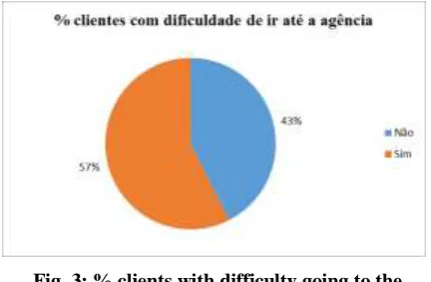
In the survey, customers were asked if they had any difficulty moving to the bank's physical agency to perform their financial operations, and the result can be viewed through Figure 3.
Fig. 3: % clients with difficulty going to the agency
57% of respondents reported having difficulty going to the bank, claiming mobility difficulties, not having available time, matching work with the institution's working hours, health problems, among others.
Using mobile banking is a practical and easy solution to move from anywhere at any time without having to travel to an agency, saving customers no time.
Another question was held to customers if had m any difficulty accessing the digital channels, the data obtained can be seen in Figure 4.
Fig. 4: % customers who have difficulty accessing digital channels
72% of customers have difficulty accessing digital channels. We asked why customers do not use electronic channels as shown in Figure 5.
Fig. 5: Reasons for not using electronic channels
The data captured by the figure show that 45% of respondents lack knowledge to access or disconnect electronic channels, 26% already use the channels, 17% do not access the channels for not having internet applications on smartphones, 6% are unsecured with mobile banking for fear of being stolen, the other 6% are customers who do not have a smartphone.
With the graphical analysis of figure 4, note that lack of knowledge and lack of an internet package total 62% of the interviewed clients, being the largest execution.
approach through a skilled employee who can guide and teach these customers with questions, assisting with first-time access and teaching them how to use the features. Offered by mobile banking. The solution may seem simple and it already exists, but in financial intuitions the service time is limited for each customer, with queuing times that if extrapolated can lead to intuitions that do not meet the expected service time, this employee would be exclusively focused on digitizing the institution's clients, making them increasingly digital.
For customers who do not have internet access due to lack of data package, one solution is the partnership between financial intuition and mobile companies, which is already available, allowing to revert the fee package charged by the institution in an advantage plan with Internet bonus. The joint action aims to establish a unit where the user and bank branch benefit, so that customers not only access the bank's digital channels, they can use to navigate and adapt to this new digital age.
V.CONCLUSION
The aforementioned problem has customers who have been identified with resistance or difficulty accessing the bank's digital channels. A questionnaire was applied to the clients of the financial institution, aiming to identify the main offenders that limit the use of digital services. Such data were tabulated using Excel software, allowing the generation of graphs with information needed for the article. The analysis identified problems that directly influence the non-digitization of clients, proposing solutions to customer demands, focusing on the digitization of clients who have greater access difficulties. It was identified among the interviewees the main points to work on, 45% of clients with lack of knowledge and 17% who do not have internet package. As a solution to clients who claim lack of knowledge, it has been proposed to have a trained employee to guide and teach these clients, assisting in the first access and teaching them how to use the features offered by the bank. In the case of interviewed customers who reported problems with lack of internet access packages, the suggested solution is to present them with the bank's advantage plan to account holders, a plan that reverses the amount paid on internet bonuses, enabling that these consumers use such bonus to access the banking channels and make their movements with more convenience and convenience. Therefore, customers who could not previously access the channels for the main reasons discussed can use it, incorporating the proposals mentioned, improving the daily life of account holders of the institution and making them more satisfied with the service provided.
REFERENCES
[1] Kiehl, Luiz Fernando. O tamanho da amostra na pesquisa de mercado. Acesso em 03 de Novembro de 2019. Disponível
emhttp://www.scielo.br/scielo.php?pid=S0034-75901970000400010&script=sci_arttext
[2] FINTECHS E BANCOS TRADICIONAIS: PARCERIA OU COMPETIÇÃO. Acesso em 28 de Outubro de 2019.
Disponível em:
https://www.facet.br/gc/artigos/completo.php?artigo=129&f ormato=pdf
[3] Associação Brasileira de Empresas de Pesquisa. CRITÉRIO BRASIL 2019. Acesso em 25 de Outubro de 2019. Disponível em: http://www.abep.org/criterio-brasil [4] Survey Monkey. Acesso em 07 de Outubro de 2019.
Disponível em: https://pt.surveymonkey.com/
[5] Justiça do Brasil. Acesso em 20 de Outubro de 2019.
Disponível em:
https://coad.jusbrasil.com.br/noticias/417309817/bancos-estimulam-migracao-de-clientes-para-atendimento-digital. Acesso em 18/03/2019
[6] Itaú Unibanco Disponível em: https://portalcorp.itau-unibanco/sites/institucinal/pt/acontecenoitauunibanco [7] SALGADO, Lucas Moraes Teixeira. Mobile Banking no
contexto das estratégias de Bancarização no Brasil. Trabalho de conclusão de curso de especialização em economia. UNICAMP: Campinas, 2011.
[8] SEGER, Cândida. Canais Alternativos de resistência, Confiabilidade e segurança na percepção dos clientes pessoa física da agência de Dom Feliciano. Trabalho de conclusão de curso de pós-graduação. Rio Grande do Sul: UFRGS, 2007.
[9] FEBRABAN – Federação Brasileira de Bancos. Pesquisa FEBRABAN de tecnologia bancária 2017. Acesso em 08 de
Abril de 2019. Disponível em:
https://portal.febraban.org.br/#.
[10] GOMES, Denis Ferreira. Resistência ao uso dos canais alternativos de atendimento: um estudo em uma agência bancária 2013. Acesso em 05 de Abril de 2019. Disponível em:
http://fapam.web797.kinghost.net/admin/monografiasnupe/a rquivos/10042014213349Denis_F_Gomes.pdf.