International Journal of Educational Methodology
Volume 4, Issue 1, 37 - 43.
ISSN: 2469-9632 http://www.ijem.com/
Students’ Feedback of mDPBL Approach and the Learning Impact towards
Computer Networks Teaching and Learning
Sri Winarno *
Dian Nuswantoro University, INDONESIA Multimedia University, MALAYSIA Kalaiarasi Sonai Muthu Multimedia University, MALAYSIA Lew Sook Ling
Received: January 16, 2018 ▪ Revised: January 28, 2018 ▪ Accepted: February 10, 2018
Abstract: This study presents students’ feedback and learning impact on design and development of a multimedia learning in Direct Problem-Based Learning approach (mDPBL) for Computer Networks in Dian Nuswantoro University, Indonesia. This study examined the usefulness, contents and navigation of the multimedia learning as well as learning impacts towards mDPBL approach which used. A total of 276 students who took Computer Networks subject from two different departments participated in this study of a quasi-experiment in year 2016. Two different ways of teaching, one the normal of teaching/traditional approach, another one using mDPBL approach of teaching. However, the purpose of this study, Analysis and report in this study only the feedback of the students participated in mDPBL group (n=136). Nearly all students have positive feedback of the multimedia learning especially usefulness, contents and navigation, and also they have positive feedback of the mDPBL teaching approach. While, the overall feedback towards mDPBL approach presented in the findings/results section.
Keywords: Feedback, mDPBL approach, learning impact, computer networks.
To cite this article: Winarno, S., Muthu, K. S., & Ling, L. S. (2018). Students’ feedback of mdpbl approach and the learning impact towards computer networks teaching and learning. International Journal of Educational Methodology, 4(1), 37-43. https://doi.org/10.12973/ijem.4.1.37
Introduction
Many universities, including those in Indonesia are finding new means to traditional methods in order to bridge learning efficiency with technology. Rapid evolution and progression in the multimedia technology, it has become feasible to integrate multimedia technology into the teaching and learning process. In the multimedia learning environment, the teacher plays a part in guiding and supporting the student’s development and understanding of the content rather than just delivering information to the student. In Addition, Neo & Neo (2001) add that multimedia is an interactive application to convey an information to a student which includes a combination of various media types such as text, images and sound.
Currently, teaching and learning process in Computer Networks subject of Informatics Engineering and Information System Department, Dian Nuswantoro University Indonesia using direct instruction approach (DIA). However, DIA of teaching and learning Computer Networks causes low students’ interest. The other problem is that the lecturer complete syllabus through lecturer using verbal communication, white board media, and static slide presentation. Moreover, teaching and learning materials and approach causes students’ bored and they are too busy writing down the information presented by lecturer. Therefore, in the current teaching, an innovation is required to increase students’ interest while teaching and learning. Multimedia teaching and learning in the Direct Problem-Based Learning (mDPBL) for Computer Networks teaching and learning was used. This study discussed the students’ feedback of mDPBL approach and the learning impact towards Computer Networks teaching and learning.
Literature Review
Direct Instruction Approach (DIA)
The major population of institutions follows a direct instruction approach (DIA) of teaching and learning when it comes to Computer Networks subject (Vinay & Rassak, 2015), in which teacher-centred (Blumberg, 2000) and teachers as the
*Corresponding Author:
Sri Winarno , Dian Nuswantoro University, Faculty of Computer Science, Indonesia.
controller of the learning environment as one of the characteristics of DIA. However, DIA causes low students’ interest and students’ problem-solving skills (Choi, Lindquist, & Song, 2014). Problem-Based Learning (PBL) is one of the most appropriate teaching approaches to improve students’ problem-solving skills. PBL is described as an approach that is student-centred and builds problem-solving skills (Becker & Maunsaiyat, 2004). Many educational institutions has resulted in a shift in their curriculum model using problem-based learning (PBL). Tan (2000) added that via a PBL environment, the learning focus is moving from content to problems to create an educational methodology which “higher order thinking, communication and teamwork skills as well as independents learning”. In addition, Yusof, Hasan, Jamaludin, & Harun, (2012) stated that PBL is a realistic learning approach to improve students' problem-solving skills.
Direct Problem-Based Learning (DPBL) Approach
The DPBL approach is a combination of DIA and PBL approach. According to Carnine (2000), that DIA have three characteristics includes using face-to-face interaction when teacher deliver of subject, sequenced deliberately, and small groups. Meanwhile of problem-based learning using four characteristics by Barrow (1996) and Savery (2006) namely: student-centred approach, real word problem in the ill-structured design, teacher as a facilitator, and no larger than nine student into small groups.
Methodology
Research Objectives
The objectives of this study is focus of students’ perception, feedback and learning impact of mDPBL approach includes to examine the design (Usefulness, contents, navigation) of multimedia learning and to examine the design teaching approach of the mDPBL approach. These research objectives are in line of the research question which in context of mDPBL is what is the learning impact of mDPBL as perceived by students?
Research Design
The Computer Networks teaching and learning process was tested using the mDPBL teaching and learning approach. Informatics Engineering and Information System department in Dian Nuswantoro University, Indonesia with four classes of students selected in this study. They used it for three weeks includes the introduction to the multimedia learning and group design, Content explanation and group task, and group presentation.
A total of 276 students who took Computer Networks subject from two different departments participated in this study of a quasi-experiment in year 2016. Two different ways of teaching, one the normal of teaching/traditional approach, another one using mDPBL approach of teaching. However, the purpose of this study, Analysis and report in this study only the feedback of the students participated in mDPBL group (n=136). The instrument contains dimensions of learning measures towards mDPBL approach. Those dimensions are: Usefulness, Navigation, Contents, and learning impact.
mDPBL approach for Computer Networks teaching and learning
Figure 1. An animation of the Routing process
Figure 1 depicts contents various feature of Computer Networks such as concept description and routing algorithm. The description of routing concept includes objective, kind of routing and benefit. While, forward search algorithm as one of the routing algorithm explained of the routing algorithm feature.
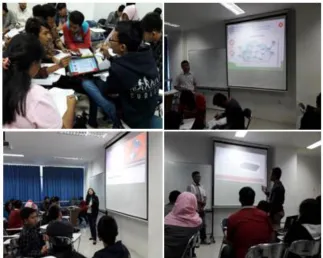
Fig.2 depicts teaching and learning process using mDPBL approach. Students divided into small groups which consist of four to six members. The topics presented using multimedia learning. The groups presents the work report.
Findings / Results
This section presents the survey results on mDPBL approach gathered the student’s participants of mDPBL group, after they were using mDPBL approach for their learning group.
Feedback of usefulness in multimedia learning for Computer Networks
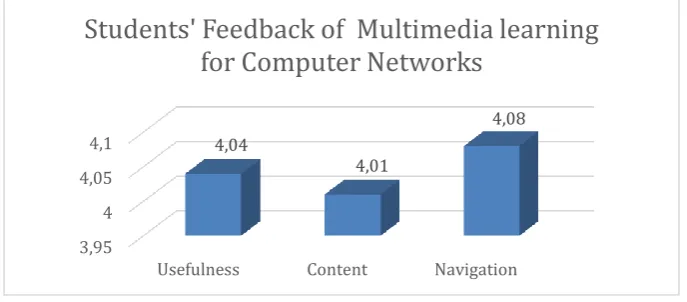
Nearly all students have a positive response to usefulness of multimedia learning for Computer Networks, with aggregate mean value = 4.04 (fig.3). Students’ feedback on usefulness in multimedia learning for Computer Networks
indicated that items q1, q3, q4, and q6 shows higher mean scores (mean ≥ 4.0). Many of them have positive response that usefulness in multimedia learning were useful and suitable for Computer Networks.
Table 1. Usefulness feedback
Statements(items) n(%) DA n(%) U n(%) A Mean
Multimedia learning for Computer Networks is useful for learning (q1). 2(1.5) 3(2.2) 111(96.3) 4.13 Multimedia learning for Computer Networks is informative (q2). 4(2.9) 24(17.6) 108(79.4) 3.92 Multimedia learning for Computer Networks is easy to use (q3). 16(11.8) 120(88.2) 4.16 Multimedia learning for Computer Networks is easy to understand (q4). 21(15,4) 115(84.6) 4.12 If I do not understand the lesson, I can repeat again(q5). 4(2.9) 21(15.4) 111(81.6) 3.90
I can view the lesson at anytime(q6). 2(1.5) 15(11) 119(87,5) 4.04
n = 136
DA=Disagree/negative response, U=Undecided, A=Agree/positive response.
Feedback of contents in multimedia learning for Computer Networks
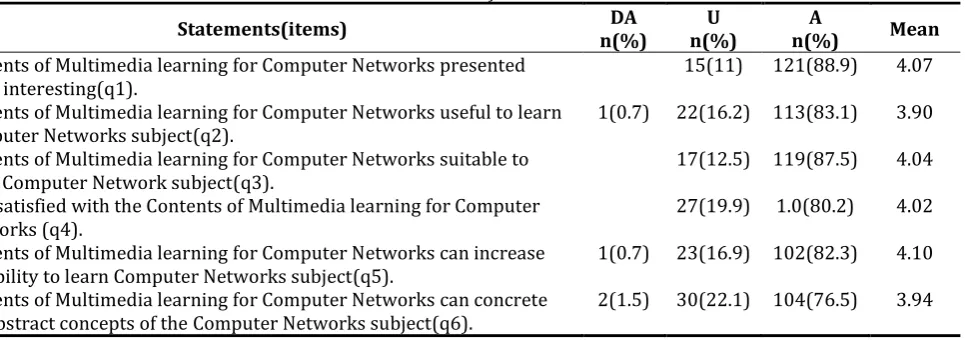
Nearly all students have a positive response to contents of multimedia learning for Computer Networks, with aggregate mean value = 4.01 (fig.3). Students’ feedback on contents in multimedia learning for Computer Networks indicated that items q1, q3, q4, and q5 shows higher mean scores (mean ≥ 4.0). Many of them have positive response that contents in
multimedia learning were suitable for Computer Networks.
Table 2. Contents feedback
Statements(items) n(%) DA n(%) U n(%) A Mean
Contents of Multimedia learning for Computer Networks presented
more interesting(q1). 15(11) 121(88.9) 4.07
Contents of Multimedia learning for Computer Networks useful to learn
Computer Networks subject(q2). 1(0.7) 22(16.2) 113(83.1) 3.90
Contents of Multimedia learning for Computer Networks suitable to
learn Computer Network subject(q3). 17(12.5) 119(87.5) 4.04
I am satisfied with the Contents of Multimedia learning for Computer
Networks (q4). 27(19.9) 1.0(80.2) 4.02
Contents of Multimedia learning for Computer Networks can increase
my ability to learn Computer Networks subject(q5). 1(0.7) 23(16.9) 102(82.3) 4.10 Contents of Multimedia learning for Computer Networks can concrete
the abstract concepts of the Computer Networks subject(q6). 2(1.5) 30(22.1) 104(76.5) 3.94 n = 136
DA=Disagree/negative response, U=Undecided, A=Agree/positive response.
Feedback of navigation in multimedia learning for Computer Networks
Nearly all students have a positive response to navigation of multimedia learning for Computer Networks, with aggregate mean value = 4.01 (fig.3). Students’ feedback on navigation in multimedia learning forComputer Networks
indicated that all items shows higher mean scores (mean ≥ 4.0). Many of them have positive response that navigation in
Table 3. Navigation feedback
Statements n(%) DA n(%) U n(%) A Mean
The interface is interesting (q1). 14(10.3) 122(89,7) 4.07
The interface is interest of Multimedia learning for Computer Networks
is clear and easy to understand(q2). 13(9.6) 123(90.5) 4.10
The interface of Computer Networks multimedia learning is
user-friendly (q3). 9(6.6) 127(93.4) 4.10
I know how to use Multimedia learning for Computer Networks without
much help(q4). 23(16.9) 113(83.1) 4.05
The colours used for design the Multimedia learning for Computer
Networks are appropriate(q5). 1(0.7) 29(14) 116(85.3) 4.06
n = 136
DA=Disagree/negative response, U=Undecided, A=Agree/positive response.
Feedback of learning impact of mDPBL approach
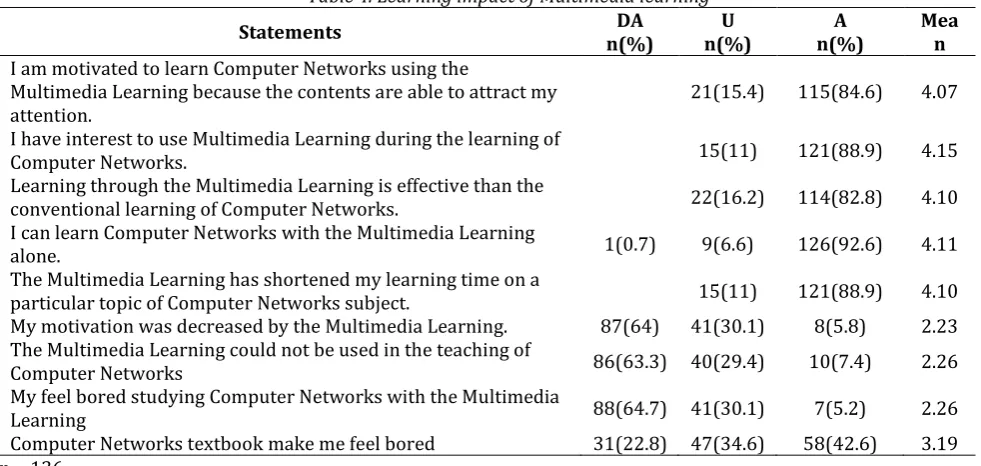
This section presents the students’ feedback of the learning impact of mDPBL approach. Table 4 shows the students’ feedback of multimedia learning for Computer Networks. While, table 5 shows the students’ feedback of DPBL
approach. Table 4 shows that students have a positive response to multimedia learning for Computer Networks.
Learning impacts using multimedia learning for Computer Networks indicated that all items shows higher mean scores. In addition, multimedia learning were motivated to learn Computer Networks, it was effective and interactive than traditional teaching.
Table 4. Learning impact of Multimedia learning
Statements n(%) DA n(%) U n(%) A Mean
I am motivated to learn Computer Networks using the
Multimedia Learning because the contents are able to attract my
attention. 21(15.4) 115(84.6) 4.07
I have interest to use Multimedia Learning during the learning of
Computer Networks. 15(11) 121(88.9) 4.15
Learning through the Multimedia Learning is effective than the
conventional learning of Computer Networks. 22(16.2) 114(82.8) 4.10
I can learn Computer Networks with the Multimedia Learning
alone. 1(0.7) 9(6.6) 126(92.6) 4.11
The Multimedia Learning has shortened my learning time on a
particular topic of Computer Networks subject. 15(11) 121(88.9) 4.10
My motivation was decreased by the Multimedia Learning. 87(64) 41(30.1) 8(5.8) 2.23 The Multimedia Learning could not be used in the teaching of
Computer Networks 86(63.3) 40(29.4) 10(7.4) 2.26
My feel bored studying Computer Networks with the Multimedia
Learning 88(64.7) 41(30.1) 7(5.2) 2.26
Computer Networks textbook make me feel bored 31(22.8) 47(34.6) 58(42.6) 3.19 n = 136
DA=Disagree/negative response, U=Undecided, A=Agree/positive response.
Table 5. Learning impact of DPBL approach
Statements n(%) DA n(%) U n(%) A Mean
I like teaching and learning with DPBL teaching approach of the
Computer Networks 11(8.1) 125(92) 4.12
Learning through the DPBL is effective than the conventional
learning of the Computer Networks 2(1.5) 16(11.8) 118(86.7) 4.04
The DPBL teaching approach able to improve my knowledge 2(1.5) 10(7.4) 124(91.2) 4.07 I have interest in the DPBL class situation. 1(0.7) 7(5.1) 128(94.1) 4.07 In the DPBL teaching approach, I free for giving idea 1(0.7) 8(5.9) 127(93.3) 4.10 In the DPBL teaching approach, I do the task with group. 2(1.5) 18(13.2) 116(85.3) 4.00 My motivation was increased by the DPBL learning model. 12(8.8) 124(91.2) 4.07 In the DPBL teaching activities, I always discuss with our group 8(5.9) 124(94.1) 4.12 The DPBL teaching approach make me feel bored 103(85.7) 24(17.6) 9(6.6) 2.09 n = 136
DA=Disagree/negative response, U=Undecided, A=Agree/positive response.
Overall Feedback
This section presents the survey results about feedback of usefulness, feedback of contents and feedback of navigation in Computer Networks teaching and learning. The survey results indicated that students have positive response for overall feedback of multimedia learning for Computer Networks. The data had been collected from results of the questionnaires as presented in Table 1 to 5.
The findings and summarized of students’ feedback towards multimedia learning for Computer Networks presented in
Figure 3. The graph indicated that majority of students have positive responses towards multimedia learning for Computer Networks, particularly in the navigation that provided in multimedia learning for Computer Networks with mean value = 4.08.
Figure 3. Students’ feedback towards multimedia learning for Computer Networks
Discussions
This work presents a study of the students’ feedback of the mDPBL approach towards Computer Networks teaching and learning process. This study was conducted due to the increasing challenge of teaching an abstract subject (e.g. Computer Networks). Computer Networks concepts and protocols are very abstract for many students. Image, Text, Animation, audio media was incorporated as the key component in multimedia based learning. Multimedia based learning was used to increase students’ interest and attitude. While, DPBL was used to increase students’ creative thinking and teamwork skill.
Nearly all students have a positive response to the multimedia learning (i.e. usefulness, content, and navigation) and DPBL as teaching approach. Mainly, this could be due to the scarce usage of mDPBL for teaching activity in the classroom, and they felt it useful and interesting. Having said that, the students’ feedback shows that all aspect evaluated of the mDPBL had a high response. The content level has also high response but lower than usefulness and navigation levels. Further development of the mDPBL approach is to include more contents related to the topic of Computer Networks to improve students’ interest, attitude, knowledge as well as students' problem-solving skills towards Computer Networks.
3,95 4 4,05 4,1
Usefulness Content Navigation
4,04
4,01
4,08
Conclusions
The study on students’ Feedback of mDPBL approach was conducted of Computer Networks subject especially routing section. Multimedia and DPBL approach was incorporated as the key component in mDPBL integrated framework. Findings indicated that majority the students have a positive response to the usefulness, content, navigation and DPBL as teaching approach. Students’ feedback on usefulness of multimedia indicated that many of students have positive response that usefulness in multimedia learning for Computer Networks were useful and suitable for Computer Networks. Students’ feedback on contents and navigation of multimedia indicated that many of students have positive response that multimedia has many contents and navigation as well as visual example in multimedia help students learn better, they can learn alone and make discussion among the group member, it was increase students’ interest. Nearly all of students have a positive feedback to DPBL approach. Learning impacts of DPBL approach indicated that all items shows higher mean scores. Many of them agreed and strongly agreed that DPBL approach were improved students’ knowledge, it was increased students’ creative thinking and teamwork skill.
Students’ feedback on the learning impact of mDPBL approach indicated that students were motivated to learn Computer Networks using mDPBL approach. The contents of multimedia learning were able to attract students’ attention. Students did not feel bored studying Computer Networks with mDPBL approach.
References
Barrows, H. S. (1996). Problem-Based Learning in Medicine and Beyond: A Brief Overview. New Direction for Teaching and Learning, 68, 3-12. doi: 10.1002/tl.37219966804.
Beker, K. H., & Maunsaiyat, S. (2004). A comparison of students; achievement and attitudes between constructivist and traditional classroom environment in Thailand vocational electronics programs. Journal of Vocational Education Research, 29(2), 133-153. doi: 10.5328/JVER29.2.133.
Blumberg, P. (2000). Evaluating the evidence that Problem-Based learners are self-directed learners: A review of the literature. In D. H. Evensen, & E. E. Hmelo (Eds.), Problem-Based Learning: A research perspective on learning interactions (pp. 199-226). Mahwah, NJ: Erlbaum.
Carnine, D.W., Silbert, J., Kamenui, E.J., & Tarve, S.G. (2000). Direct Instruction Reading. Prentice Hall. Pp. 5-6; Traub, 1999).
Choi, E., Lindquist, R., & Song Y. (2014). Effect of Problem-Based Learning vs. Traditional lecture on Korean nursing students’ critical thinking, problem-solving, and self-directed learning. Nurse Education Today, 34, 52-56. doi: 10.1016/j.nedt.2013.02.012.
Guses, A., Dogar, C., & Gunesm K. (2015). A New Approach for Learning: Interactive Direct Teaching Based Constructivist Learning (IDTBCCL). Procedia-Social and Behavioral Sciences, 197, 2384-2389. doi.: 10.1016/j.sbspro.2015.07.296.
Hattie, J. (2009). Visible learning: A synthesis of over 800 meta-analyses relating to achievement. London and New York: Routledge.
Neo, M., & Neo, K.T.K. (2000). Multimedia Learning: Using multimedia as a platform for instruction and learning in higher education. Paper presented at the Multimedia University International Symposium on Information and Communication.
Neo, M., & Neo, K.T.K. (2001). Innovative teaching: Using multimedia in a problem-based learning environment. Educational Technology & Society, 4(4), 19-31.
Stockard, J. (2010). Improving elementary level mathematics achievement in a large urban district: The effects of Direct Instruction in the Baltimore City Public School System. Journal of Direct Instruction, 10, 1-16.
Tan, O. S. (2000). Thinking Skills, Creativity and Problem-Based Learning. Paper presented at the 2nd Asia Pacific
Conference on Problem - Based Learning: Education a cross Disciplines, December 4-7, 2000, Singapore.
Vinay, M., & Rassak, S. (2015). A technological Framework for Teaching-Learning Process of Computer Networks to Increase the Learning Habit. International Journal of Computer Applications, 117(4). doi: 10.5120/20539-2904 Yusof, K. M., Hasan, S. A. H. S., Jamaludin, M. Z., & Harun, N. F. (2012). Cooperative Problem-Based Learning (CPBL):