Coal Project Responsibility
Scheduling Model
Binay KumarSamanta
Director, Projects & Environment Consultants; Researcher IIT(ISM) Dhanbad, India
Abstract- Sustainability in mining depends upon right project design and timely execution. Because of unforeseen geo-technical problems, some project activities have to be prioritized, requiring more attention of project officials by monthly scheduling and monitoring. Coal Project Responsibility Scheduling Model ‘mbo’ was developed for responsibility monitoring on monthly basis. Analysis was done by Key Result Areas (KRA), Strength, Weakness, Opportunity and Threat or SWOT Analysis, Managerial Effectiveness. IPR found important between superior, subordinate and colleagues for teamwork in projecting position-wise responsibility. Objective Setting by Action Plan, Responsibility Charting by Decision Chart by Confidence Factor CF. With experience as General Manager in a large mining company, computerized model program ‘mbo’ on key tasks for different management positions has been designed on key tasks for different management positions. Sample run (mbo.bat) for a particular project for a particular month shown.
KEYWORDS- Key Result Areas (KRA); Strength, Weakness, Opportunity and Threat (SWOT) Analysis; Job Effectiveness Description (JED); Decision Chart; Confidence Factor (CF).
1. INTRODUCTION
Doyens of management have stressed the priority of controlling men, and in project management very close manpower monitoring is required. It has been observed in Public Sector set up the general tendency among officials is passing the buck. Because of geological reasons, no two mines are alike and during project construction period, many unprecedented situations develop. If the coalmine project officials are not responsive to the changing situations, and stick to routine duties, the project would suffer. Overlapping responsibility creates confusion among workmen and so there is need for responsibility scheduling. Objective Setting by Action Plan, Responsibility scheduling with Decision Chart by Confidence Factor CF and then an Expert System is
exemplified. In programming mbo.java, 24 key tasks for 13 different management positions taken by the researcher and sample run mbo.bat displays for a particular project for certain month.
Professional project construction companies in private sector, have specialist crews hopping between projects as scheduled from the company in matrix type of organization. In public sector set up, trade unions and officers associations vehemently oppose such kinds of frequent transfers. In coal industry, General Managers and Project Officers/ Agents become accountable for everything, while other executives take advantage of flux. Critical activities and priorities in mine projects vary widely and dynamic nature of responsibilities to be specified. In
multi project monitoring the exercise of
responsibility scheduling every month for each project could help in timely completion.
Assignment of key tasks of coalmine projects to different management positions from done from a standard Decision Chart and altering it by programming, according to the exigencies of the project at the time of review. Manpower is the most important and vital of all resources and therefore, its effective utilization and accountability should be the prime concern of any organization, especially coal projects with frequent changes in scope of work with additions and alterations of schedules.
Managerial effectiveness, Key Result Areas (KRA),
Strength, Weakness, Opportunity and Threat
(SWOT) Analysis, Objective setting, measurement control, review system, Inter Personal Relationships (IPR), MBO survey can be utilized for better project
administration and achieving milestones on
2. OBJECTIVE SETTING
After the effectiveness areas and standards for a manager’s position is established, objective setting in measurable terms of priorities, time, cost, and level is done. A result-oriented company must have a Mission, long term plans (5-10 years), division/ department/ area wise plans (1-5 years) and short term plans. Methods for objective setting: -
a) SWOT Analysis,
b) KRA,
c) Brain Storming.
MBO plans or Action plans are then drawn up deciding departments, areas and units with activity networks, review and corrective actions: -
1. Strategy- Maximize effective use of
manpower;
2. Schedules- Activities designed in a manner
to complete the project on time;
3. Responsibility- Framing JED and Duty
chart;
4. Budget- Estimated activity wise including
overheads;
5. Facilities etc- Availability optimized within
company resources.
The following factors have been considered for deciding on the objective: -
i. Corporate plan- Coal production target,
project schedule, quality etc;
ii. Associated positions- Both horizontal and
vertical hierarchy of management;
iii. Budget available- Equity and external
resources;
iv. Skill of manpower- Aptitude and experience
based;
v. Appropriate training- Vocational as well as
refresher and advanced courses;
vi. Past performance etc.- Higher goals and
targets could be set.
Sound objectives have been set based on criteria: -
a) Measurable- Like production in
tonnes/day, activity progress in % schedule etc.
b) Specific- By developing JED of all
executives;
c) Result oriented-By monitoring in close
intervals;
d) Realistic- By goal setting in
comparison to similar projects;
e) Time-bound- Ensured by proper
communications to prevent escalations.
In Coal Mine Regulations, some statutory duties of mine officials are prescribed, but Project Manager is not a statutory post. A manager achieves the output requirement of his position, by focusing on goal of his role, with the help of subordinates and within timeframe. Job Effectiveness Description (JED) is a list of jobs, for each managerial position for all different units, linked to team objectives.
A rule and knowledge based consultation system for coal mine project key tasks for different management positions, as compared to a standard decision chart has been developed by the researcher, with a computer model for ease in web applications.
Effectiveness Areas would be different for various
functional areas, like production, material
management, marketing, personnel, finance etc. Role Clarity is to assign effectiveness areas for attaining the team objective, as per Managerial Objective Document (MOD), for each position, with maximum under-lap and minimum overlap. IPR between superior, subordinate and colleagues should be excellent to reduce conflicts and increase morale.
Effectiveness Standards are subdivisions of
Effectiveness Areas, like profit could be gross and net etc. and such other measurement criteria for each managerial position.
However, the researcher has attempted to create JED from his experience in coal mine projects. Table No- 1 shows JED of a mine Project Manager, developed by the researcher, based on study.
TABLE NO-1: JED OF A MINE PROJECT MANAGER
Responsible to Subordinates directly supervised
Agent/Project Officer Heads of Mining, E&M, Civil, Survey, Finance
General Manager Heads of all departments of areas, Personnel, Security etc.
Key Tasks Standard of Performance Review/Information 1.Continue construction activities a) The schedules per shift should not fail at any cost. Daily
POL, timber etc.
2.Follow mining legislations a) Construction related to mining and industry be safe as per statute.
Weekly
b) Risky construction should be critically supervised. Daily c) Proper safety training of manpower should be ensured. Monthly 3. Proper maintenance of
machinery.
a) Preventive maintenance schedules of machinery should be observed.
Routine
b) Critical stocks of spares should be available. Daily
c) Machinery down time should be minimal. Daily
4.Effective Cost control a) Proper resource allocation between activities. Weekly
b) Variable cost items should be brought down to minimum.
Weekly
c) Control and reporting systems should be streamlined. Monthly 5.Review of Activities a) Achievement of schedules and milestones should be
monitored.
Weekly
b) Resources should be diverted to critical activities. Weekly c) Actual measurement of progress against target cost and
time.
Weekly
6.Rescheduling of activities in network
a) Critical path of network of activities should be found. Monthly
b) Crashing of activities with extra resources. Weekly
c) Pursue revised schedules. Daily
d) Expedite supply of inputs Daily
3. DUTY CHARTING
Management by exception or delegation is usually preferable by subordinates as motivating. In project management practice, OBS is replaced with activity schedules and PERT networks, with responsibility of resources activity-wise.
In a coalmine project, different management positions and their key tasks are compared to a standard Decision Chart and the query based computer program is able to produce a revised Decision Chart, of any month for any project. Essentially, management is dynamic in nature and MBO helps to evolve proper system like in coal industry, as shown in Figure No: 1.
Each mine is planned in a different manner, with widely varying activities and master scheduling network are unique in each case. It is quite unlike in manufacturing industries, where mass production of designed model with automation is very much straight-jacketed. Mine Project Manager realizes and gives some impromptu instructions to different officials, which sometimes are forgotten and not followed. On detail studies, outcome of this process to standardize coal project key tasks against different management positions is shown in Table No- 2.
4. RESPONSIBILITY SCHEDULING MODEL
The program development process was started with selection of key-tasks and important positions in a coal mine project management: -
a) To assist the General Manager of the project;
b) To assign responsibilities to his subordinates;
c) Collecting information about key-tasks in different positions of management
d) To provide additional check for slippages to provide facilities for change if any and
Usually, verbal responsibility scheduling is done in practice, but often creates confusion, because of under lap or overlap of functions. A monthly printout would help project officials to follow their responsibilities. Major reasons for increasing ES applications in coalmine projects as computers already in use for many other functions: -
i) Advent of high powered Workstations, Minicomputers,
ii) Commercial availability of AI language programs,
iii) Online computer networking in LAN, WAN, INTERNET, COALNET etc.
Algorithm of MBO/* for responsibility scheduling
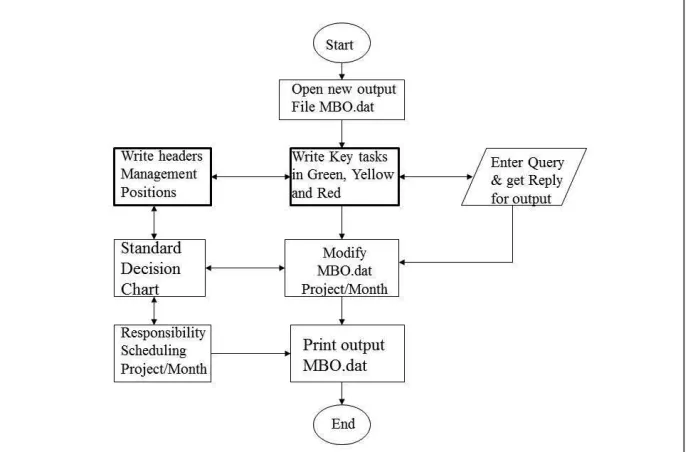
Step 1: Open for output new File "MBO.dat" for read-write.
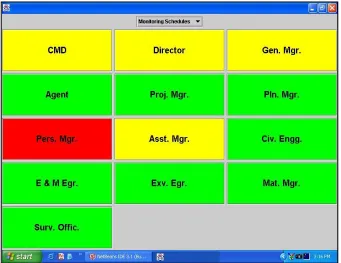
Step 2: Write headers for different management positions for displaying key tasks in Green colour for must attend, Yellow colour for should attend and Red colour need not attend.
Step 3: C-M-D DIR(T) GEN-MGR AGENT PRJ-MGR FIN-MGR PERS-MGR AST-MGR CIV-EGR EM-EGR EXC-EGR MAT-MGR SRV-OFR
Step 4: The output is based on Querry, Reply from the key board assessing the current situation of the project activities.
Step 5: Standard Decision Chart is consulted to vary according to criticality in a project in the month of review. Step 6: The output of mbo.dat is checked and printout taken for consultations with higher authorities.
Step 7: If necessary further rerun with modifications can be easily done and copy of the print is for distribution among concerned officials for effective follow-up.
It has been observed that Project Officers/ Agents and Managers are overloaded with responsibility, while many other executives idle away. Clear perceptions and study was required for designing such effective program, so that even a novice in project management could use it to improve performance of projects and achieving desired results, targets and goals.
5. EXECUTIVE FUNCTION MONITORING
TABLE NO- 2: MINE PROJECT MANAGEMENT DECISION CHART
Flowchart of model for Responsibility Scheduling ‘MBO’ is shown in Figure no- 2. Key Tasks CMD Dire-
ctor Gen-
Mgr
Agent Proj- Mgr
Fin- Mgr
Pers- Mgr
Asst- Mgr
Civ- Egr
E&M- Egr
Exv- Egr
Mat- Mgr
Srv- Ofr
Project Network Y Y C Y C C N C C C C C C Monitor Schedules C C C Y Y Y N C Y Y Y Y Y
Prospecting C Y C N C C C N C N N N C
Land Acquisition C Y Y C C Y C N Y N N N Y
Manpower Posting Y C C C Y C Y Y N Y Y N N
Budgeting C C Y C C Y N C Y Y Y Y N
Cost Accounting N C C Y Y Y N Y N N N N N Contract Manage C Y C N N Y N C Y C C Y C Service Building C Y Y T Y N Y Y Y Y Y C Y Residential Building C C Y C C N Y C Y C C C C Roads/Culverts C C C Y C N Y C Y N N N C Water Supply C C C Y Y N C Y Y C C C N
Furniture/Fittings C N C Y C Y N C C Y N N N Power Supply Y C Y C C C C C N C Y Y C Pumping Water C C Y Y Y C N C Y C C Y N
Ventilation C C Y Y Y N N Y N C C C Y
Workshop M/C C Y C C C C N N N C Y C N Prod. Machinery Y C Y C Y C N Y Y C Y C N Trans. Machinery C Y Y Y Y C N Y Y Y Y C N Railway Siding Y C Y C C Y C C Y Y N N C
Vehicles C Y C C C N Y C C N C C N
Mine Entry C Y Y Y Y N C N Y N C N Y
Mine Development C Y Y Y Y N N Y C C C Y Y
Table No-3 shows Model Run of MBO for a Particular Project for the Review Month as MBO.dat.
TABLE N0- 3: MODEL PROGRAM RUN OF MBO
6. CONCLUSIONS
Owing to geological anomaly, no two mines are alike and during project construction period, many unprecedented situations develop. If the coalmine project officials are not responsive to the changing situations, and stick to routine duties, the project would suffer and so there is need for responsibility
scheduling. Objective Setting by Action Plan,
Responsibility scheduling with Decision Chart by Confidence Factor CF and then an Expert System is exemplified. In programming mbo.java, 24 key tasks for 13 different management positions taken by the researcher and sample run mbo.bat displays for a particular project for certain month. Critical activities and priorities in mine projects vary widely and dynamic nature of responsibilities to be specified.
In multi project monitoring the exercise of responsibility scheduling every month for each project could help in timely completion.3-D Theory of managerial effectiveness, as propounded by W. J. Reddin, encompasses not only managerial style and effectiveness but also technology up-gradation.
The salient points are: -
1. Application of such program on MBO in
project management has emphasized maximum utilization of manpower with the highest efficiency.
2. More concentration by more officials on
critical activities to complete project within budget and timeframe planned.
3. Maximum utilization of resources could be
achieved taking in to account exigencies of the situation by responsibility scheduling.
4. Incentive or reward for excellent
achievement and punishment for poor work should be implemented to manage occasional rescheduling of responsibilities.
5. In Public sector setup, it is difficult to
convince employees for fixing responsibility, without which desired results could not be attained and the program developed by the researcher should be very helpful.
Computer printout of the responsibility scheduling for the month should be given in advance to the officials, so that there was no alibi. Fundamental points worth noting are that in a coalmine project: -
a) Key tasks are dynamic and more
management positions have to concentrate on critical tasks, when needed,
b) CF marked under certain management
c) In a multi-project company, diversion of manpower for critical tasks is comparatively easier and so crew scheduling is another aspect for optimum use of crew.
d) Responsibility scheduling in a project is
difficult, as even officials are controlled by their associations. A judicious and tactful approach should be taken to convince the officials that equitable distribution of duties would be allotted, although slightly changed from routine.
ACKNOWLEDGEMENT
Gratitude is expressed for help and guidance to late
Dr. D.K.Sinha, former Director, ISM, Dr.
A.S.Prasad, Chair Professor, ISM, Dr. K.K.Guin, Head VGSOM, IIT, Kharagpur, Dr.A.B.Samaddar, former Director, MNNIT and many others. The author is indebted to Prof. Dr. D.C. Panigrahi, Director, IIT(ISM), and Prof. Dr. P.Sen HOD (ME), ISM for help and encouragement in finalizing the research work.
REFERENCES
[1] Anderson D & Verna A, Project Management is a Capital Investment Process; Journal of Management & Engineers, Oct 2005, Vol.24, No.4, ISS0742-597X, 2005.
[2] Arora, Rajesh, Techno-Commercial Evaluation of Coal
Mining Project; 3rd Asian Mining Congress, 22 - 25 January
2010, Kolkata, India, The Mining, Geological and Metallurgical Institute of India (MGMI), 2010.
[3] Dinsmore Paul C. and Cabanis-Brewin Jeannette,AMA
Handbook of Project Management; American Management
Association, USA, 2009.
[4] Dutta, A, Geo-environmental Impact of Mining on
Coalfields; National Seminar on Development of Indian
Mineral Industry Looking Ahead- August – MMGI, Kolkata, 2003.
[5] Furman U,Improving Network Access in the Mining
Sector;Aust MM Bulletin, No.1, Jan/ Feb 2007.
[6] Glasserman, P and Staum, J,Resource Allocation among
Simulation Time Steps; Operation Research, Nov &Dec,
USA, 2003.
[7] Guo H, Zhu K, Ding C, Li L, Intelligent Optimization for Project Scheduling of the First Mining Face in Coal Mining;
Expert Systems with Applications: An International Journal, Volume 37, Issue 2- Pergamon Press, New York, 2010. [8] Jha, N.C,Sustainable Development of Indian Coal Industry –
Daunting Challenges; 4th Asian Mining Congress, 29-31
January 2012, Kolkata, India: The Mining, Geological and Metallurgical Institute of India (MGMI), 2012.
[9] Kerzner, Harold, Project Management: A Systems Approach
to Planning, Scheduling, and Controlling; –
Amazon.com,2009
[10] Mitchell, Paul,Achieving Major Capital Project Effectiveness
and Corporate Performance; Effective Capital Project
Execution Mining and Metals, Ernst & Young, © 2011 EYGM Limited. Australia, 2011.
[11] Noort, D J and Adams, C, Effective Mining Project
Management Systems; International Mine Management
Conference, Melbourne, Vic, 16 - 18 October 2006. [12] OSullivan, A,Dispersed Collaboration in firm,
Multi-team, Product Development Project; Journal of Engineering
and Technology Management, 20-93-116 Elsevier, Amsterdam, 2003.
[13] Panigrahi, D.C,Sustainable Mining and Environment – The
Indian Context; 4th Asian Mining Congress, 29-31 January
2012, Kolkata, India: The Mining, Geological and Metallurgical Institute of India (MGMI), 2012.
[14] Samanta, B.K,Break-Even Point Monitoring of Collieries
with Database Programming;Minetech Vol.17, No.5,
pp.34-37, Sept-Oct.1996.
[15] Samanta, B.K,Computerized Coal Multi-project
Monitoring;Minetech, Vol. 19, No.6, Nov- Dec.’98,
CMPDI, Ranchi, 1998.
[16] Samanta, B.K. &Samaddar, Dr. A. B,Formulation of Coal
Mining Projects by Expert System; pp202- Journal of
Mines, Metals and Fuels, ISSN 0022-2755, Kolkata, June 2002.
[17] Samanta, B.K,Coalnet- A Developing Intranet; XXXVII National Convention 2002 of Computer Society of India, October 29th to 31st 2002, Bangalore, India.No.42, pp251- Tata McGraw-Hill Publishing Company Limited, New Delhi, 2002.
[18] Samanta, B.K.,IT Applications in Reorganization of
Quarries; RIT 2003- National Seminar on Role of IT in the
Present Scenario of Globalization, CMRI & CSI- 1-2 February, Dhanbad, 2003.
[19] Samanta, B.K, Mine Project Responsibility Scheduling;
International Symposium on Advances in Mining Technology and Management; IIT, Kharagpur, Nov 30- Dec 2; 2005
[20] Samanta, B.K,Advances in Computerized Project Scheduling & Monitoring; All India Seminar on Advances in Computer and Information Technology- IE(I), Dhanbad Chapter, ISM GJ Auditorium, 11-12 March, 2006. [21] Samanta, B.K, Emerging Computerized Project Scheduling
Networks; Recent Advances on Information Technology
(RAIT-2007); Proceedings of the National Seminar, Allied Publishers Pvt. Ltd-Department of Computer Science & Engineering; Indian School of Mines University, Dhanbad-826004, Feb 26-27, 2007.
[22] Samanta, B.K,Developments in Computerized Multi-Project
Management for Sustainable Mining; 4th Asian Mining
Congress, Sustainable Mining in Asia – Challenges and Opportunities, The Mining, Geological, & Metallurgical Institute of India (MGMI), 29-31 January, Kolkata, 2012. [23] Samanta, B.K, Mining Multi-Project Monitoring Computer
Model for Summarized Assessment; National Convention of
Mining Engineering of IE(I), Kolkata in collaboration with BESU; 23-24 Feb’ 2012.
[24] Samanta, B.K, Multi Criteria Decision Model for Mining
Projects; Journal of Modern Project Management,
January-April 2017; pp.113, 2017.
[25] Samanta, B.K, Environment & Safety Challenges in Oil & Gas Projects; International Conference on Challenges and Prospects of Petroleum and Processing Industries, PEDJP-2017, 12-14 January; IIT(ISM), Tech Session VI-PEDJP/098, 2017.
[26] Samanta, B.K, Strategies to Achieve National Demand of
Coal and Mineral Production;The Indian Mining &
Engineering Journal, January 2017.
[27] Sarkar, B. N and Samanta, B.K, Mine Mechanisation with
Machine Safety and System Safety; XIII World Congress on
Occupational Safety and Health, New Delhi. 1993. [28] Singh, A.K, Indian Coal Industry – Concerns of Resources
and Reserves; 4th Asian Mining Congress, 29-31 January
2012, Kolkata, India: The Mining, Geological and Metallurgical Institute of India (MGMI), 2012.
[29] Sinha, Amalendu, R&D for Sustainable Mining in India-
The Way Forward; 4th Asian Mining Congress, 29-31