Best-Practice Guidelines for Physical Activity
at Child Care
abstract
Research has indicated that the child care center is a very strong predictor of preschool-aged children’s physical activity levels, making this an important setting to help young children obtain physical activity that is appropriate for their health and development. However, some evidence suggests that organized child care may not adequately sup-port children’s physical activity needs. Although many organizations provide recommendations, guidelines, or standards for motor skill development and physical activity opportunities, no set of guidelines exist that directly target the overall physical activity environment at child care. Because of the lack of comprehensive recommendations, the Nutrition and Physical Activity Self-assessment for Child Care best-practice guidelines for healthy weight development were created on the basis of an extensive review of existing guidelines, research evi-dence, and expert review. The purpose of this article is to present these physical activity best-practice guidelines and provide data on how these guidelines compare to current practice in a large sample (N⫽ 96) of child care centers in North Carolina. These best-practice guide-lines include recommendations for 8 unique components of the child care environment, including active opportunities, fixed play environ-ment, portable play environenviron-ment, sedentary opportunities, sedentary environment, staff behavior, staff training/education, and physical ac-tivity policies. Our results showed that only a few of the best-practice guidelines were achieved by a majority of the 96 North Carolina child care centers that participated in this study. Establishing comprehen-sive guidelines for physical activity at child care could result in higher activity levels and healthier children, but more research is needed. Pediatrics2009;124:1650–1659
The rapidly increasing prevalence of childhood obesity is of great pub-lic health concern.1Nationwide data show that the percentage of obese children (BMIⱖ95th percentile) aged 2 to 5 years increased more than 30% between 2001 and 2004.2As is well known, obesity can lead to such chronic health problems as type 2 diabetes, hypertension, and hyper-lipidemia. These conditions may be even more serious if obesity devel-ops at younger ages3; however, regular physical activity seems to help protect against obesity during the preschool-age period.4In addition, physical activity contributes to a child’s motor development and pro-vides a foundation for health benefits both during childhood and into the future.5–7
One of the best opportunities to promote the development of physically active lifestyles among a large number of young children lies in child care settings.8,9In the United States, more than half of all 3- to
6-year-AUTHORS:Christina McWilliams, MPH,aSarah C. Ball, MPH, RD,aSara E. Benjamin, PhD, MPH, RD,bDerek Hales, PhD,aAmber Vaughn, MPH, RD,aand Dianne S. Ward, EdDc
aCenter for Health Promotion and Disease Prevention and cDepartment of Nutrition, University of North Carolina, Chapel
Hill, North Carolina; andbDepartment of Ambulatory Care and
Prevention, Harvard Medical School and Harvard Pilgrim Health Care, Boston, Massachusetts
KEY WORDS
child care, physical activity, environment, guidelines
ABBREVIATIONS
NASPE—National Association for Sport and Physical Education NAPSACC—Nutrition and Physical Activity Self-assessment for Child Care
EPAO—Environmental and Policy Assessment and Observation ECERS—Early Childhood Environment Rating Scale
www.pediatrics.org/cgi/doi/10.1542/peds.2009-0952
doi:10.1542/peds.2009-0952
Accepted for publication Jun 10, 2009
Address correspondence to Dianne S. Ward, EdD, University of North Carolina, Center for Health Promotion and Disease Prevention, 1700 Martin Luther King Jr Blvd, CB 7426, Chapel Hill, NC 27599. E-mail: [email protected]
PEDIATRICS (ISSN Numbers: Print, 0031-4005; Online, 1098-4275).
Copyright © 2009 by the American Academy of Pediatrics
olds are enrolled in center-based child care, and those who attend such cen-ters spend an average of 24.8 hours there per week.10 In North Carolina alone, there are 5052 child care cen-ters with 248 607 children enrolled, and the majority of the children are between the ages of 2 and 5 years.11
The importance of the child care set-ting in helping young children obtain physical activity levels that are appro-priate for health and development is reinforced by recent research that in-dicated that the child care center is a very strong predictor of preschoolers’ physical activity levels.12 However, other evidence has suggested that or-ganized child care may not adequately support children’s physical activity needs. For example, Sturm13noted an inverse relationship between time spent in child care and time spent en-gaged in active play. In addition, re-search by Pate et al14showed that chil-dren spend more than 80% of their time in sedentary activities while at child care, and only 2% to 3% of their physical activity could be classified as moderate or vigorous.
In 2002, the National Association for Sport and Physical Education (NASPE) put forth the first physical activity guidelines specifically for preschool-aged children.6 They recommended that children accumulate at least 60 minutes of unstructured (free-play) and at least 60 minutes of structured (adult-led) activities daily. Although the NASPE described the type and amount of activity children should re-ceive, their recommendations pro-vided no specific guidance for the child care setting. Other organizations have provided some recommendations for supporting physical activity opportuni-ties at child care but often lacked spec-ificity and failed to consider the com-prehensive array of environmental factors that influence children’s phys-ical activity (a full listing of existing
na-tional recommendations for physical activity in preschool-aged children is available on request from the corre-sponding author).
The purpose of this article is to present a set of physical activity best-practice guidelines and data to show how these guidelines compare to cur-rent practice in a large sample of child care centers in North Carolina. Results from this comparison are used to iden-tify areas that could benefit from artic-ulated guidelines.
METHODS
Development of Best-Practice Guidelines
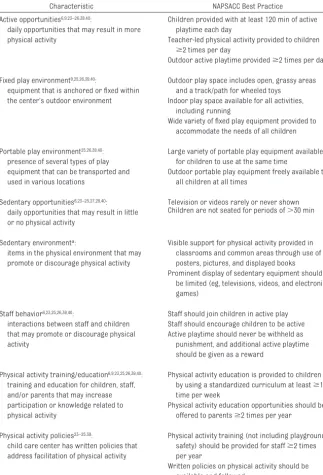
The Nutrition and Physical Activity Self-assessment for Child Care (NAPSACC) was developed to promote healthy weight in young children in child care settings. It was designed to address environments, policies, and practices thought to influence nutrition and physical activity behaviors of children. Because of the lack of comprehensive recommendations specific to the child care setting, the NAPSACC best-practice guidelines for healthy weight develop-ment were created. Although our best-practice guidelines were based on a careful search of physical activity rec-ommendations and standards from a number of authoritative organiza-tions,15 no single organization pro-vided adequate guidance. In addition, most existing recommendations and standards failed to provide specific guidance. Where only general or no recommendations existed, a best-practice guideline was developed by using re-search evidence and expert opinion from a national panel of physical activ-ity researchers and a group of North Carolina public health and child care professionals.15The NAPSACC guidelines for physical activity and a list of the national organization source docu-ments from which these best practices were drawn are shown in Table 1.
Procedures
The NAPSACC program uses a center-based self-assessment instrument center-based on the NAPSACC guidelines to help child care providers identify and plan nutrition and physical activity changes appropriate for their facility.15As part of the evaluation of the NAPSACC, base-line assessments of centers’ physical activity and nutrition environments were conducted in the fall of 2005 by research staff; data from the physical activity component are presented in this article. All study procedures and activities were approved by the Univer-sity of North Carolina’s Institutional Re-view Board.
Sample
A convenience sample of 96 child care centers from 33 counties across North Carolina was recruited to participate in this study. These child care centers represented all 3 regions of North Carolina (western, eastern, and cen-tral Piedmont). Most (n ⫽ 84) were part of an evaluation of the NAPSACC intervention,16but data from 12 addi-tional centers were collected as part of an exploratory study to test the use-fulness of the self-assessment instru-ment alone. Details about center re-cruitment can be found elsewhere.16
Assessment of the Physical Activity Environment
gold-standard observer. To prevent observer drift, all staff periodically underwent retraining on the EPAO protocol.17
The full-day EPAO observation was scheduled at the center’s convenience and took place in a classroom for 3-, 4-, or 5-year-olds that was chosen by the center director. Children and center staff were observed, beginning with
the first morning meal and continuing until the last child in the observed classroom left for the day. In addition, center documents were reviewed for evidence of physical activity training of staff, systematic physical activity edu-cation of children, and efforts to com-municate physical activity information to parents and documentation of writ-ten physical activity policies. In this
direct observation and document re-view, 8 specific environmental charac-teristics were assessed: active oppor-tunities (3 items); fixed and portable play environment (7 items); sedentary opportunities (3 items); sedentary en-vironment (3 items); staff behavior (3 items); physical activity training and education (4 items); and physical ac-tivity policies (5 items). Items from the EPAO instrument parallel the NAPSACC best-practice guidelines and describe the degree to which centers achieve this standard. Reliability and validity evi-dence for the instrument demonstrate strong agreement between observers within centers (intra-correlation coeffi-cient: 0.47–1.00).17Although the EPAO in-strument does not measure child physi-cal activity directly, previous research has shown that children at centers with higher EPAO scores (above median) get more moderate or vigorous physical ac-tivity and less sedentary acac-tivity com-pared with children at centers with lower EPAO scores.18A copy of the EPAO is available on request from the corre-sponding author.
RESULTS
Center Demographics
Using the North Carolina 1- to 5-star rating system,19with 5 stars being the highest, ⬃50% were 3-star centers, whereas 5% held 1-star ratings and 11% had 5-star ratings. Ninety-three percent of the centers were open until at least 4:30PM, allowing for a full day
of care; only 7% closed at or before 3:30PM. Median center enrollment was
66 children, and nearly half of those enrolled were 3- to 5-year-olds. More than 75% of the centers participated in the Child and Adult Care Food Pro-gram.20The race/ethnicity distribution of the children who were attending these centers was similar to the de-mographics of North Carolina’s pop-ulation: 60% white, 28% black, 4.2% Native American, and 3.6% Hispanic/ TABLE 1 NAPSACC Best-Practice Recommendations
Characteristic NAPSACC Best Practice
Active opportunities6,9,23–26,39,40:
daily opportunities that may result in more physical activity
Children provided with at least 120 min of active playtime each day
Teacher-led physical activity provided to children ⱖ2 times per day
Outdoor active playtime providedⱖ2 times per day
Fixed play environment9,25,26,39,40:
equipment that is anchored or fixed within the center’s outdoor environment
Outdoor play space includes open, grassy areas and a track/path for wheeled toys
Indoor play space available for all activities, including running
Wide variety of fixed play equipment provided to accommodate the needs of all children
Portable play environment25,26,39,40:
presence of several types of play equipment that can be transported and used in various locations
Large variety of portable play equipment available for children to use at the same time
Outdoor portable play equipment freely available to all children at all times
Sedentary opportunities6,23–25,27,28,40:
daily opportunities that may result in little or no physical activity
Television or videos rarely or never shown Children are not seated for periods of⬎30 min
Sedentary environmenta:
items in the physical environment that may promote or discourage physical activity
Visible support for physical activity provided in classrooms and common areas through use of posters, pictures, and displayed books Prominent display of sedentary equipment should
be limited (eg, televisions, videos, and electronic games)
Staff behavior6,23,25,26,39,40:
interactions between staff and children that may promote or discourage physical activity
Staff should join children in active play Staff should encourage children to be active Active playtime should never be withheld as punishment, and additional active playtime should be given as a reward
Physical activity training/education6,9,23,25,26,39,40:
training and education for children, staff, and/or parents that may increase participation or knowledge related to physical activity
Physical activity education is provided to children by using a standardized curriculum at leastⱖ1 time per week
Physical activity education opportunities should be offered to parentsⱖ2 times per year
Physical activity policies23–25,39:
child care center has written policies that address facilitation of physical activity
Physical activity training (not including playground safety) should be provided for staffⱖ2 times per year
Written policies on physical activity should be available and followed
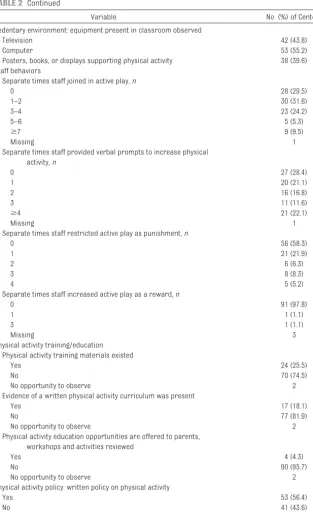
Latino. On average, centers had been in operation for 17 years. Data from these centers and how well they met the best-practice guidelines are de-scribed below and summarized in Table 2.
Meeting Best-Practices Guidelines
Active Opportunities
The active opportunities guideline ad-dresses total activity time, teacher-led activities, and time spent outside by children at a center. Although only 13.7% of the centers met the NAPSACC best-practice guideline of 120 minutes of active playtime per day, nearly one third of them provided more than 90 minutes of activity on the day of obser-vation. However, 6 centers provided only 15 minutes of activity time. Teacher-led activity was observed in 70% of the centers, but the amount of structured activity time ranged from⬍15 minutes in 36% of the centers to more than 60 minutes in 1 center. As for meeting the best-practice guideline, 40% of the centers provided 2 or more occasions of teacher-led physical activity. A large proportion (88%) of centers included outdoor play on the day of observation, and children at more than half of the centers went outside 2 or more times. In this assessment, specific amounts of outside time provided for the children were not recorded.
Fixed Play Environment
This best-practice guideline refers to fixed or anchored equipment, open and grassy outdoor spaces that clude paths for wheeled toys, and in-door space appropriate for gross mo-tor movement. Nearly all the centers (96%) had sandboxes, tunnels, and slides, and almost as many (95%) had large climbing structures. However, only 16% of the centers had indoor play space suitable for a variety of gross motor activities (eg, running and large group games).
TABLE 2 Meeting NAPSACC Best-Practice Recommendations on the Basis of the EPAO Instrument
Variable No. (%) of Centers
Active opportunities Total active play, min
0–14 6 (6.3)
15–30 10 (10.5)
31–45 10 (10.5)
46–60 13 (13.7)
61–90 24 (25.3)
91–120 19 (20.0)
⬎120 13 (13.7)
Missing 1
Total structured physical activity, min
0 29 (30.5)
1–14 34 (35.8)
15–30 23 (24.2)
31–45 7 (7.4)
46–60 1 (1.0)
⬎60 1 (1.0)
Missing 1
Occasions of structured activity,n
0 29 (30.2)
1 29 (30.2)
2 20 (20.8)
3 15 (15.6)
ⱖ4 3 (3.1)
Outdoor play occasions,n
0 11 (11.7)
1 33 (35.1)
2 46 (48.9)
ⱖ3 4 (4.3)
Missing 2
Fixed play environment Fixed equipment
Climbing structures 92 (95.8)
Balancing surfaces 79 (82.3)
Swinging equipment 39 (40.6)
Running spaces (open space to run and play) 96 (100) Miscellaneous play structures (sand boxes, slides, etc) 92 (95.8) Space present
Indoor play space allows for
Quiet play only 5 (5.2)
Limited movement 54 (56.3)
Some active play 22 (22.9)
All activities 15 (15.6)
Portable play environment: portable play equipment
Floor play equipment (tumbling mats, carpet squares, etc) 52 (54.2) Jumping play equipment (hula hoops, jump ropes) 33 (34.4) Twirling play equipment (scarves, batons, ribbons) 30 (31.6) Miscellaneous portable play equipment available (shovels, buckets,
trucks, balls, tricycles, etc)
64 (66.7)
Sedentary opportunities Children seated for⬎30 min,n
0 77 (81.9)
1 12 (12.8)
2 5 (5.3)
ⱖ3 0
Missing 2
Television-viewing time (in classrooms with television present), min
0 5 (11.9)
1–14 4 (9.5)
15–30 8 (19.1)
31–45 9 (21.4)
46–60 7 (16.7)
Portable Play Environment
This best-practice guideline refers to the availability and accessibility of play equipment that can be transported and used in various locations (eg, jump ropes, hula hoops, tumbling mats, batons, balls). Portable
equip-ment was present at all 96 centers; however, the variety and amount var-ied. Floor equipment, such as tumbling mats, was available in nearly half the centers, whereas only one third of the centers provided jumping and twirling equipment. Balls and other
miscella-neous equipment items were available in approximately two thirds of the centers.
Sedentary Opportunities and Sedentary Environment
These 2 guidelines address sedentary time and the sedentary environment within which children spend their time. Of the 96 centers that partici-pated in the study, children were rarely seated for more than 30 min-utes at a time; only 18% of the centers failed to meet this best-practice guide-line. In 5 of those centers, children were seated for more than 30 minutes on 2 separate occasions. Television-viewing is a popular sedentary oppor-tunity, and although television was present in less than half (44%) of the observed classrooms, television-viewing was observed in nearly all (89%) of these centers. On the day of observation, 17% of the centers al-lowed children to watch between 31 and 60 minutes of television, and 9% of the centers allowed children to watch more than 60 minutes of television. On a more positive note, nearly 40% of the centers displayed some physical activ-ity promotional material in the ob-served classrooms.
Staff Behavior
Staff behavior at child care centers can be influential in the amount of physical activity that children receive during the day. This best-practice guideline addresses the number of times staff members joined in active play, used verbal prompts to increase activity, and restricted physical activ-ity as punishment. At 61% of the cen-ters, the staff members either failed to join in active play with children or did so only 1 or 2 times during the full-day observation. However, in some centers (15%), center staff participated 5 or more times. Staff in 40% of the centers used verbal prompts 3 or more times, whereas 1 or no prompts were ob-served in 49% of the centers. Center TABLE 2 Continued
Variable No. (%) of Centers
Sedentary environment: equipment present in classroom observed
Television 42 (43.8)
Computer 53 (55.2)
Posters, books, or displays supporting physical activity 38 (39.6) Staff behaviors
Separate times staff joined in active play,n
0 28 (29.5)
1–2 30 (31.6)
3–4 23 (24.2)
5–6 5 (5.3)
ⱖ7 9 (9.5)
Missing 1
Separate times staff provided verbal prompts to increase physical activity,n
0 27 (28.4)
1 20 (21.1)
2 16 (16.8)
3 11 (11.6)
ⱖ4 21 (22.1)
Missing 1
Separate times staff restricted active play as punishment,n
0 56 (58.3)
1 21 (21.9)
2 6 (6.3)
3 8 (8.3)
4 5 (5.2)
Separate times staff increased active play as a reward,n
0 91 (97.8)
1 1 (1.1)
3 1 (1.1)
Missing 3
Physical activity training/education Physical activity training materials existed
Yes 24 (25.5)
No 70 (74.5)
No opportunity to observe 2
Evidence of a written physical activity curriculum was present
Yes 17 (18.1)
No 77 (81.9)
No opportunity to observe 2
Physical activity education opportunities are offered to parents, workshops and activities reviewed
Yes 4 (4.3)
No 90 (95.7)
No opportunity to observe 2
Physical activity policy: written policy on physical activity
Yes 53 (56.4)
No 41 (43.6)
staff were observed restricting active play as punishment at 40% of centers visited, whereas increasing active play as a reward was observed at only 2 centers.
Physical Activity Training/Education
This best-practice guideline refers to staff training, the use of a specific physical activity curriculum, and pro-vision of physical activity education to parents. Documents reviewed in-cluded completed physical activity training certificates and available training materials. At 25% of the cen-ters, documentation showed that at least 1 staff member had obtained some sort of training in physical activ-ity. Only 18% of the centers provided visual evidence of a formal physical ac-tivity curriculum; however, use of the curriculum was not evaluated in this study. Only 4% of the centers docu-mented that they provided physical ac-tivity education for parents (eg, work-shops or other specific activities).
Physical Activity Policies
This best-practice guideline supports the use of written policies associated with physical activity. Fewer than 60% of the centers had evidence of formal, written physical activity policies. Of those with written policies, nearly all had a policy about either active play or inactive time; 48% included a state-ment about active play, and 56% had a policy about inactive time. However, the majority of these “policies” in-cluded such vague statements as “go outside daily, weather permitting.” The policies did not include specific details about the amount of outdoor or indoor active playtime to be provided. Among the written policies that did exist, there were other references related to tele-vision use and teletele-vision-viewing (3%), the play environment (8%), supporting physical activity (6%), and physical ac-tivity education (1%).
DISCUSSION
Physicians, public health leaders, and national organizations recognize the potential influence that child care en-vironments have on young children’s diet and activity behaviors and, hence, their weight development.21–23 Provid-ing opportunities for and promotProvid-ing participation in physical activity are prime examples of how child care pro-viders can contribute to children’s en-ergy balance. Although a number of organizations (eg, the American Acad-emy Pediatrics,24–26 National Associa-tion of the EducaAssocia-tion of Young Chil-dren,27,28 Head Start,29 and NASPE6) have addressed aspects of physical ac-tivity for young children, most docu-ments have provided only general guidance. NASPE guidelines do provide specific recommendations for the amount of active playtime (both free and structured) that preschool-aged children should obtain each day; how-ever, these recommendations are not specific to the child care setting.
In this article, we describe the first ef-fort to integrate existing recommenda-tions from authoritative organizarecommenda-tions, evidence from the research literature, and feedback from expert panels into a set of comprehensive best practices for physical activity at child care cen-ters. The NAPSACC best-practice guide-lines include recommendations for 8 separate components of the child care environment and were designed to promote physical activity levels of young children. Although research ev-idence is limited, results of cross-sectional studies have suggested that environmental characteristics of the child care setting are associated with the young child’s physical activity.18,30,31
The active-opportunities guideline sug-gests specific time for free play (120 minutes). Although some studies have shown that provision of active play-time is associated with child physical activity,18,30the optimal amount of time
that should be provided is unclear. Currently, the only national recom-mendation for the amount of physical activity that preschool-aged children should receive daily is the NASPE 120-minute recommendation6 (free play and structured activity time com-bined), which is not specific for the child care setting. At the time of this publication, only 3 states had specific time requirements for physical activity at child care, and these ranged be-tween 20 and 60 minutes/day.32,33 How-ever, in this study we observed that 57% of the centers already offered more than 60 minutes of active play-time, most of which was designated as free play. On the basis of available rec-ommendations and other information, we felt that 120 minutes of active play-time across a full day would give chil-dren generous opportunities to de-velop their motor skills, expend energy, improve fitness, and develop important social/behavioral skills and still be within a center’s ability to provide this amount of time in its schedule.
specify 60 minutes of structured physi-cal activity daily.6We felt that requiring 60 minutes of structured physical activ-ity every day might limit children’s ac-cess to important free playtime38and be difficult for centers to provide because of the limited background and training of providers in children’s physical activity. Occasions of physical activity could be provided through less formal teaching opportunities (eg, using music for spon-taneous dancing or adding motor skills to interactive story time). These occa-sions could be easier for teachers to ini-tiate throughout the day; however, re-search is needed to determine if these short occasions are beneficial to the development of preschool-aged chil-dren’s gross motor skills.
Although some literature (eg, Caring for Our Children,39Early Childhood En-vironment Rating Scale [ECERS],40 Head Start29) recommends time out-side, NASPE guidelines do not mention time outdoors.6We feel that, along with total activity time, specifying multiple occasions of outdoor playtime is im-portant. It has been observed that chil-dren are most active during the first 10 minutes of active play periods.34In fact, authors of a recent study of Latino chil-dren at a Head Start center found that adding 30 minutes to an existing 30-minute outdoor play period for morn-ing and afternoon time on 2 separate days did not increase accelerometer-measured physical activity.41 Thus, having multiple outdoor sessions may produce more physical activity than single, longer sessions.
The fixed- and portable-play-environment guidelines specify that child care settings should have an indoor play space available for a variety of gross motor activities and an outdoor play space that includes open, grassy ar-eas, a track/path for wheeled toys, and a large variety of fixed equipment. In addition, portable play equipment for use inside and outside should be
pro-vided. Indoor active play areas are lim-ited at child care settings but may be an important provision for physical ac-tivity in certain geographical regions with climate extremes. Research has shown that when children have a large and open play space, they modify their behavior to include more physical ac-tivities such as tag and other games that require running and chasing.42 Quality outdoor environments may af-ford children greater amounts of phys-ical activity and provide a stimulating learning environment; however, this research area is in its infancy.43Play equipment has also been shown to prompt children’s participation in more physically challenging activities; conversely, its absence is associated with more sedentary and inactive games.42Bower et al18found that most centers had fixed play equipment (eg, large climbing structures) but a mini-mal variety and quantity of portable equipment (eg, balls, hoops, ropes). However, it was not fixed equipment but portable equipment that was found to be associated with greater amounts of physical activity, which has been confirmed in other studies.18,31It is difficult, however, to quantify the op-timal amount of either fixed or porta-ble equipment necessary to affect chil-dren’s activity levels. Although these best-practice guidelines offer some guidance to child care professionals, more research in this area is needed.
Another critical component to promot-ing energy balance in children is limit-ing time spent in sedentary activities (sedentary opportunities). Recent ob-servational studies have shown that children spend the majority of their time at child care being seden-tary.14,18,30,44–48Brown et al49recently re-ported that a large sample (n⫽539) of children spent 89% of their time in sedentary pursuits, 8% in light activity, and only 3% of their time in moderate or greater physical activity.
There-fore, our best practices include a sed-entary opportunities guideline that specifies avoiding continuous sitting for more than 30 minutes. This best-practice guideline also recommends that television/video be rarely or never used, which is consistent with many other recommendations (eg, ECERS, National Association of the Education of Young Children), although the Amer-ican Academy Pediatrics recommends less than 2 hours of television/video use across the total day (including time at home). Because television-viewing has consistently been asso-ciated with risk for overweight,50we feel that this guideline is appropri-ate. Although sedentary opportunities and sedentary environment were ini-tially represented as two discrete best-practice guidelines, future ver-sions should integrate these two into a single guideline called “sedentary opportunities.”
The staff-behavior best-practice guide-line advises center staff members to encourage children to be active, to join children in active play, and, rather than withhold active playtime from children who misbehave, to reward good behavior with extra playtime. Al-though we observed some verbal prompting and activity modeling, re-striction of activity was widespread (observed in ⬎58% of the centers). This guideline may be necessary to clearly establish the important role that staff members play in the promo-tion of physical activity for children at child care settings.
docu-ment, this component will be inte-grated into the active opportunities guidelines, and a component will be added to the staff-behaviors guideline that encourages informal teacher-led activity sessions (eg, dancing to music or outdoor games such as relay races). In addition to addressing for-mal child education, the education/ training guideline treats staff training as an equally important component. When child care staff lack knowledge of existing recommendations for phys-ical activity, fail to comprehend their role in affecting child activity, or have no familiarity with activity resources, some studies have revealed that lower levels of physical activity occur.18,30 Lack of training may explain the failure of staff to be actively involved in the children’s physical activity and the in-appropriate staff behaviors that we observed. Research has shown a posi-tive association between increased ed-ucation and experience of teachers and time that children spend on phys-ical activity30,31,54and motor skill devel-opment.54The ECERS-R instrument, one of the most widely used rating scales of child care quality, encourages staff to assist children with needed skill development by using appropriate equipment and providing creative ideas to enhance play.40 Along with providing structured physical activ-ity, adult supervision could encour-age children during play and stimu-late their participation (and time spent) in fundamental movement
skills, including manipulative skills such as catching and throwing.55
Finally, few centers had written, com-prehensive policy documents that ad-dressed important components of the child care environment. Most of the policies that did exist related to time that the children would spend outside. Only a couple of the centers were concerned with staff behavior, staff training, or specific time for physical activity. Adoption of specific, written physical activity policies should con-tribute to more children being active during their child care day.
CONCLUSIONS
Although the NAPSACC best-practice guidelines may need additional modifi-cation, they represent the first effort to create a single set of comprehensive guidelines for physical activity for child care centers. Originally designed as part of a healthy weight interven-tion,15these guidelines are based on a review of existing recommendations from authoritative groups, additional research evidence, and advice from a panel of experts. Currently, no state has a set of existing policies and/or standards comparable in detail and/or breadth to the NAPSACC best practices as evidenced by 2 review articles.32,33 Therefore, it is not surprising that only a few of the best-practice guidelines were adhered to by a majority of the 96 North Carolina child care centers that participated in this study. Recent research showed that child-initiated
play is being eliminated from kindergar-ten classrooms and viewed as unimpor-tant compared with more academic learning.56 Because the preschool set-ting prepares children for kindergar-ten, child-initiated play and active playtime could be at risk of elimina-tion.56 Policy makers and child care providers would undoubtedly benefit from more specific physical activity recommendations and standards, and the NAPSACC best-practice guidelines provides a useful start toward this dis-cussion. In addition, future research should address components of these guidelines relative to their importance and potential for promoting healthy weight development in preschool-aged children in the child care setting.
ACKNOWLEDGMENTS
This work was supported by a Poten-tial Extramural Projects grant from the Centers for Disease Control and Pre-vention/Associations of Schools of Public Health and a contract from the North Carolina Department of Health and Human Services, Division of Public Health.
We thank Kristin Copeland, MD, for thoughtful review of this manuscript, and Stephanie Goss and Joan Yasen-chak for their long days in child care centers collecting observation data. We also thank Ziya Gizlice, biostatistician at the University of North Carolina Center for Health Promotion and Disease Pre-vention for technical assistance.
REFERENCES
1. Ludwig DS. Childhood obesity: the shape of things to come.N Engl J Med.2007;357(23): 2325–2327
2. Ogden CL, Carroll MD, Curtin LR, McDowell MA, Tabak CJ, Flegal KM. Prevalence of over-weight and obesity in the United States, 1999 –2004.JAMA.2006;295(13):1549 –1555
3. Must A, Strauss, RS. Risks and consequences of childhood and adolescent obesity.Int J Obes Relat Metab Disord.1999;23(suppl 2): S2–S11
4. Reilly JJ. Physical activity, sedentary be-haviour and energy balance in the pre-school child: opportunities for early obe-sity prevention.Proc Nutr Soc.2008;67(3): 317–325
5. Haywood KM, Getchell N.Lifespan Motor De-velopment. 3rd ed. Champaign, IL: Human Kinetics; 2001
6. National Association for Sport and Physical Education.Active Start: A Statement of Physical Activity Guidelines for Children
Birth to Five Years. Reston, VA: NASPE Publications; 2002
7. Gabbard CP.Lifelong Motor Development. 3rd ed. Madison Dubuque, IA: Brown and Benchmark; 2000
8. Federal Interagency Forum on Child and Family Statistics. America’s Children in Brief: Key National Indicators of Well-being, 2006. Washington, DC: US Government Print-ing Office; 2006
Bright Futures in Practice: Physical Activity. Arlington, VA: National Center for Education in Maternal and Child Health; 2001
10. Iruka IU, Carver PR.Initial Results From the 2005 NEHS Early Childhood Program Partic-ipation Survey. US Department of Education; 2006. NCES 2006075
11. North Carolina Division of Child Develop-ment. Division of Child Development monthly statistical summary. Available at: http://ncchildcare.dhhs.state.nc.us/general/ Child㛭Care㛭Statistical㛭Report.asp. Accessed April 2, 2009
12. Finn K, Johannsen N, Specker B. Factors associated with physical activity in pre-school children. J Pediatr. 2002;140(1): 81– 85
13. Sturm R. Childhood obesity: what we can learn from existing data on societal trends, part 1.Prev Chronic Dis.2005;2(1):A12
14. Pate RR, McIver K, Dowda M, Brown WH, Addy C. Directly observed physical activity levels in preschool children.J Sch Health. 2008;78(8):438 – 444
15. Ammerman AS, Ward DS, Benjamin SE, et al. An intervention to promote healthy weight: Nutrition and Physical Activity Self-assessment for Child Care (NAP SACC) the-ory and design.Prev Chronic Dis.2007;4(3): A67
16. Ward DS, Benjamin SE, Ammerman AS, Ball SC, Neelon BH, Bangdiwala SI. Nutrition and physical activity in child care: results from an environmental intervention.Am J Prev Med.2008;35(4):352–356
17. Ward D, Hales D, Haverly K, et al. An instru-ment to assess the obesogenic environ-ment of child care centers.Am J Health Be-hav.2008;32(4):380 –386
18. Bower JK, Hales DP, Tate DF, Rubin DA, Ben-jamin SE, Ward DS. The childcare environ-ment and children’s physical activity.Am J Prev Med.2008;34(1):23–29
19. North Carolina Division of Child Develop-ment. Rated license for child care centers with preschool and school age classrooms. Available at: http://ncchildcare.dhhs.state. nc.us/general/mb㛭revisedratedlicense.asp. Accessed June 6, 2007
20. US Department of Agriculture, Food and Nu-trition Service. Child & adult care food pro-gram. Available at: www.fns.usda.gov/cnd/ care/cacfp/cacfphome.htm. Accessed October 13, 2009
21. Story M, Kaphingst KM, French S. The role of child care settings in obesity prevention. Fu-ture Child.2006;16(1):143–168
22. Va´squez F, Salazar G, Andrade M, Va´squez L, Díaz E. Energy balance and physical activity
in obese children attending day-care cen-tres.Eur J Clin Nutr.2006;60(9):1115–1121 23. Maher EJ, Li G, Carter L, Johnson DB.
Pre-school child care participation and obesity at the start of kindergarten. Pediatrics. 2008;122(2):322–330
24. American Academy of Pediatrics, Commit-tee on Public Education. Children, adoles-cents, and television. Pediatrics. 2001; 107(2):423– 426
25. American Academy of Pediatrics, Commit-tee on Nutrition. Prevention of pediatric overweight and obesity.Pediatrics.2003; 112(2):424 – 430
26. American Academy of Pediatrics, Commit-tee on Sports Medicine and Fitness. Fitness, activity, and sports participation in the pre-school child. Pediatrics. 1992;90(6): 1002–1004
27. National Association for the Education of Young Children. Accreditation Criteria & Procedures of the National Association for the Education of Young Children. Washing-ton, DC: National Association for the Educa-tion of Young Children; 1998
28. National Association for the Education of Young Children. Technology and Young Children: Ages 3 Through 8. Washington, DC: National Association for the Education of Young Children; 1996
29. US Department of Health and Human Ser-vices, Administration for Children and Fam-ilies, Head Start Bureau. Office of Head Start: legislation & regulations. Available at: www.acf.hhs.gov/programs/ohs/legislation/ index.html. Accessed August 21, 2008
30. Dowda M, Pate RR, Trost SG, Almeida MJ, Sirard JR. Influences of preschool policies and practices on children’s physical ac-tivity. J Community Health.2004;29(3): 183–196
31. Dowda M, Brown WH, McIver KL, et al. Poli-cies and characteristics of the preschool environment and physical activity of young children.Pediatrics.2009;123(2). Available at: www.pediatrics.org/cgi/content/full/ 123/2/e261
32. Benjamin SE, Cradock A, Walker EM, Slining MM, Gillman MW. Obesity prevention in child care: a review of U.S. state regulations.BMC Public Health.2008;8:188
33. Kaphingst KM, Story M. Child care as an un-tapped setting for obesity prevention: state child care licensing regulations related to nutrition, physical activity, and media use for preschool-aged children in the United States.Prev Chronic Dis.2009;6(1):A11 34. McKenzie TL, Sallis JF, Elder JP, et al.
Physi-cal activity levels and prompts in young chil-dren at recess: a two-year study of a
bi-ethnic sample. Res Q Exerc Sport.1997; 68(3):195–202
35. Hinkley T, Crawford D, Salmon J, Okely AD, Hesketh K. Preschool children and physical activity: a review of correlates.Am J Prev Med.2008;34(5):435– 441
36. Baranowski T, Thompson WO, DuRant RH, Baranowski J, Puhl J. Observations on phys-ical activity in physphys-ical locations: age, gen-der, ethnicity, and month effects.Res Q Ex-erc Sport.1993;64(2):127–133
37. Klesges RC, Eck LH, Hanson CL, Haddock CK, Klesges LM. Effects of obesity, social inter-actions, and physical environment on phys-ical activity in preschoolers.Health Psychol. 1990;9(4):435– 449
38. Burdette HL, Whitaker RC. Resurrecting free play in young children: looking beyond fit-ness and fatfit-ness to attention, affiliation, and affect.Arch Pediatr Adolesc Med.2005; 159(1):46 –50
39. American Academy of Pediatrics; American Public Health Association; National Re-source Center for Health and Safety in Child Care. Caring for Our Children: National Health and Safety Performance Stan-dards—Guidelines for Out-of-Home Child Care Programs.2nd ed. American Academy of Pediatrics, Elk Grove Village, IL; 2002. Available at: http://nrckids.org/CFOC/ index.html. Accessed October 6, 2009
40. Harms T, Clifford RM, Cryer D.Early Child-hood Environment Rating Scale. Revised ed. New York, NY: Teachers College Press; 2005
41. Alhassan S, Sirard JR, Robinson TN. The ef-fects of increasing outdoor play time on physical activity in Latino preschool chil-dren.Int J Pediatr Obes.2007;2(3):153–158 42. Dhingra R, Manhas S, Raina A. Play pattern in preschool setting.J Hum Ecol.2005;18(1): 21–25
43. DeBord K, Moore R, Hestenes L, Cosco N, McGinnis J.Preschool Outdoor Environment Measurement Scale (POEMS). Lewisville, NC: Kaplan Early Learning Company; 2005
44. Boldemann C, Blennow M, Dal H, et al. Im-pact of preschool environment upon chil-dren’s physical activity and sun exposure. Prev Med.2006;42(4):301–308
45. Finn KJ, Specker B. Comparison of Acti-watch activity monitor and Children’s Activ-ity Rating Scale in children.Med Sci Sports Exerc.2000;32(10):1794 –1797
46. Pate RR, Pfeiffer KA, Trost SG, Ziegler P, Dowda M. Physical activity among children attending preschools. Pediatrics. 2004; 114(5):1258 –1263
nonoverweight preschool children. Int J Obes Relat Metab Disord. 2003;27(7): 834 – 839
48. Trost SG, Fees B, Dzewaltowski D. Feasibility and efficacy of a “move and learn” physical activity curriculum in preschool children. J Phys Act Health.2008;5(1):88 –103
49. Brown WH, Pfeiffer KA, McIver KL, Dowda M, Addy CL, Pate RR. Social and environmental factors associated with preschoolers’ non-sedentary physical activity.Child Dev.2009; 80(1):45–58
50. Gortmaker SL, Must A, Sobol AM, Peterson K, Colditz GA, Dietz WH. Television viewing as a
cause of increasing obesity among children in the United States, 1986 –1990.Arch Pedi-atr Adolesc Med.1996;150(4):356 –362
51. Dunn C, Thomas C, Pegram L, Ward D, Schmal S. Color me healthy, preschoolers moving and eating healthfully.J Nutr Educ Behav.2004;36(6):327–328
52. SPARK Early Childhood Physical Activity Pro-gram. SPARK early childhood physical activ-ity program. Available at: www.sparkpe. org/programEarlyChildhood.jsp. Accessed October 13, 2009
53. Williams CL, Carter BJ, Kibbe DL, Dennison D. Increasing physical activity in preschool: a
pilot study to evaluate animal trackers. J Nutr Educ Behav.2009;41(1):47–52 54. Parish LE, Rudisill ME, St Onge PM. Mastery
motivational climate: influence on physical play and heart rate in African American toddlers. Res Q Exerc Sport. 2007;78(3): 171–178
55. Taggart A, Keegan L. Developing fundamen-tal movement skills in outdoor settings: three case studies of children playing. ACH-PER Healthy Lifestyles J.1997;44(4):11–17
56. Miller E, Almon J.Crisis in the Kindergarten: Why Children Need to Play in School. College Park, MD: Alliance for Childhood; 2009
Poison Centers Being Fiscally Poisoned:The nation’s health care crisis is now affecting the survival of our state poison centers—at least in California, according to a recent article (Arquist S.The New York Times, June 30, 2009, p. D9). A proposed plan to close a 24.3 billion dollar budget deficit would result in a 6 million dollar cut to the four regional poison centers in that state. The theory is that a national poison center line could relieve the state of its responsibility by having calls answered elsewhere. However, other states are also facing budget constraints and could not simply absorb the volume of calls, or take over the data collection and public education that currently being done by the regional centers in California. Of note, the federal government currently provides about 20 percent of poison center financing—the rest must come from states.
DOI: 10.1542/peds.2009-0952 originally published online November 16, 2009;
2009;124;1650
Pediatrics
and Dianne S. Ward
Christina McWilliams, Sarah C. Ball, Sara E. Benjamin, Derek Hales, Amber Vaughn
Best-Practice Guidelines for Physical Activity at Child Care
Services
Updated Information &
http://pediatrics.aappublications.org/content/124/6/1650
including high resolution figures, can be found at:
References
http://pediatrics.aappublications.org/content/124/6/1650#BIBL
This article cites 38 articles, 5 of which you can access for free at:
Subspecialty Collections
cal_fitness_sub
http://www.aappublications.org/cgi/collection/sports_medicine:physi
Sports Medicine/Physical Fitness
following collection(s):
This article, along with others on similar topics, appears in the
Permissions & Licensing
http://www.aappublications.org/site/misc/Permissions.xhtml
in its entirety can be found online at:
Information about reproducing this article in parts (figures, tables) or
Reprints
http://www.aappublications.org/site/misc/reprints.xhtml
DOI: 10.1542/peds.2009-0952 originally published online November 16, 2009;
2009;124;1650
Pediatrics
and Dianne S. Ward
http://pediatrics.aappublications.org/content/124/6/1650
located on the World Wide Web at:
The online version of this article, along with updated information and services, is
by the American Academy of Pediatrics. All rights reserved. Print ISSN: 1073-0397.