254 | P a g e
NEXT GENERATION SMART MESSAGING APP
Bhosale Priyanka
1, Chougule Sayali
2, Kothawade Kunal
3, Kulkarni Pooja
41,2,3,4
Computer Department, PGMCOE, Pune University (India)
ABSTRACT
Now a day, Android become the latest technology in the Smartphone’s which provide the open sourcing and potent
application API. So, that, the utilization of instant messaging Now a day is more than calling the function itself. The
main objective of this paper is to introduce some methodology to provide instant messaging accommodation over
the cyber world. So, we introduce application that provides next generation features like Profile picture privacy,
Messages Received after unblock the block User, Download Images,files facility for user any time, Communication
among different selected application at a time, and Enable or Disable option for Received Messages.
Keywords:
Android Test, Android App, Controlling, Messaging App, QR Code, Smart Chat, Test
Automation, Test Framework, Virtualization.
I. INTRODUCTION
The attention of the social network is increasing rapidly, as a consequence, various services based on the social
network are provided recently. Internet-based messaging applications allow users to send/receive messages over the
internet. It requires an internet connection to transfer messages from one device to another device. The number of
people using a smart phone is increasing tremendously and so that, the number of people using messaging
application. There are various applications like WhatsApp, Hike, We-Chat etc. are messengers used for
communication over the internet.
Most of the young Generation need‟s an instant change in their social services. So, that we introduce the next
generation application which gives a big relief to users who needs an instant broadcasting text messaging. The
application provides a privacy that gives users their own space in social networking. This Application Provide
Display Profile picture privacy, after block the particular user messages send from that user is received after unblock
the same user, This Application also provides Received Images, Documents, Files Can be downloaded any time
when needed. another feature of this application is providing instant text messages sending from our application to
different selected application at a time. Also, provide an enable disable option for reading the received messages
255 | P a g e
we design or develop an application that, provide feature which gives Profile Picture Security by hiding thecurrently changing desktop image from unwanted user‟s so that we can share our profile picture with only selected
peoples.
The Available chat application‟s does not have facility to receive messages after unblock any block user but we
provide a special feature that after unblock the block user the text messages send by that user is received by receiver.
Another Feature is that if the user does not download the received images, documents, and Files instantly. but after
2-3 months if user wants those received images, documents, and files then user can easily download it any time,
most of the recent application does not have facility to download those images After particular duration.
All the currently available messaging application‟s send text to only similar application at a time, considering this
point in this paper we provide facility to select different application from our application for sending the messages at
a time to different application in our smart device.
Also, we implement enable disable option for received messages. In this feature, person decides that message read
by himself is visible to the sender or not. User read the received message but by using enable option the received
message read by receiver does not visible to the sender.
In this paper, we are presenting a new application having a feature up to an expectation of next generation like
Profile Picture Security, messages send from the block user is received after unblock the same user, download
images, files facility any time, Instant text messaging from our application to different selected application at a time,
manually select an enable or disable option for reading the received messages. also, provide some features of present
applications.
II. LITERATURE REVIEW
Himali BajajRajni Jindal[1] the main objective of this paper is to introduce that new all in one app having feature
upto the expectations of next generation like virtual social platform, organizational attributes, communication in all
languages, animation and should be capable to solve some major issues of the country like health.Miss. Rachana N.
Sawade Prof. P. V. Dudhes[2] the main objective of this paper is to introduce a methodology to provide flexible
media content sharing by exploiting collaborative amongst WiFi devices via the temporarily-established links over
the local server which is based on heterogeneous mobile which is having different mobile platform, users connected
to the server like computer System via Wi-Fi.
Priya Mehrotra, Tanshi Pradhan and Payal Jain [3] the main objective of this paper is to introduce a methodology to
provide instant Messaging Service over the intranet which is addressed to android based smartphone and tablet users
256 | P a g e
intranet server via Wi-Fi connection without the need of taking any service from mobile service provider andwithout the use of internet connection.
Mi-Young Jeon, Ji-Hoon Jeong and Gu-Min Jeong[3] this paper design and develop a social chatting application
which has the feature of one-off connection in this paper. This application can be used for sharing the information
with unspecified individuals through Wi-Fi connection.
III
MATHEMATICAL MODEL
1. Mapping
1] One system will be used by many users. Hence one to many relationship is observed here.
2] One user can send and receive manymessages. Hence one to many relationship is observed here.
3] One proposed application will follow one cryptographic technique. Hence one to one relationship will be
257 | P a g e
2. Set theory:
System S = {Input, Output, Constraints, Functions}
Input:
During Registration:-
Input = {User1 Registration Details, User2 Registration Details ……. Usern Registration Details}
User Registration Details D = {Firstname, Lastname, Username, Email, Mobile Number}
During Login:-
Input = {Login Credentials}
Login Credentials L = {Username, Mobile Number}
Username U = {U1, U2…..Un}
Mobile NumberM = {M1, M2…..Mn}
Output:
During Registration: -
Output = {Account Creation Confirmation}
During Login: -
Output = {Message Status}
Message Status = {Fail, Success}
Constraints:
Constraints C = {C1, C2}Where,
C1 = “User should have an registered account on proposed chatting application” C2 = “The mobile phone of user should be connected in a network”
Functions:
Functions F = {F1, F2, F3, F4, F5, F6, F7, F8} Where,
F1 = login()
F2 = register()
F3 = send Message()
F4 = receiveMessage ()
F5 = send Video()
F6 = send Image()
F7 = encrypt Message()
258 | P a g e
IV ALGORITHM
The more popular and widely adopted symmetric encryption algorithm likely to be encountered nowadays is the
Advanced Encryption Standard (AES). It is found at least six time faster than triple DES.
A replacement for DES was needed as its key size was too small. With increasing computing power, it was
considered vulnerable against exhaustive key search attack. Triple DES was designed to overcome this drawback
but it was found slow.
The features of AES are as follows −
Symmetric key symmetric block cipher
128-bit data, 128/192/256-bit keys
Stronger and faster than Triple-DES
Provide full specification and design details
Software implementable in C and Java
Operation of AES
AES is an iterative rather than Feistel cipher. It is based on „substitution–permutation network‟. It comprises of a
series of linked operations, some of which involve replacing inputs by specific outputs (substitutions) and others
involve shuffling bits around (permutations).
Interestingly, AES performs all its computations on bytes rather than bits. Hence, AES treats the 128 bits of a
plaintext block as 16 bytes. These 16 bytes are arranged in four columns and four rows for processing as a matrix −
Unlike DES, the number of rounds in AES is variable and depends on the length of the key. AES uses 10 rounds for
bit keys, 12 rounds for 192-bit keys and 14 rounds for 256-bit keys. Each of these rounds uses a different
128-bit round key, which is calculated from the original AES key.
AES Analysis:
In present day cryptography, AES is widely adopted and supported in both hardware and software. Till date, no
practical cryptanalytic attacks against AES has been discovered. Additionally, AES has built-in flexibility of key
length, which allows a degree of „future-proofing‟ against progress in the ability to perform exhaustive key
259 | P a g e
V PROPOSED SYSTEM
Fig No. Proposed system for diff Features
1.
Registration:
After installation of any application in any device user needs to do registration forauthentication purpose.
User needs to select my contact. After that server send OTP number on mobile.user type that OTP number in mobile
and generate his account. User can also upload profile picture,name and account is successfully created.
2.
Profile Picture Privacy:
In Profile Picture Privacy, we can hide the recent profile picture from unwanted user‟s. we can Share our profile
picture with only selected peoples. We provide three options for profile picture privacy.
1) Everyone 2) Selected 3) Nobody.
by using above options user can display his profile picture. sometime there is miss use of profile photo‟s in social
media anybody can use the profile photo and easily download in his device .user have many unknown or different
contacts like plumber, driver, security guard etc. they can also see our profile picture and anybody can misuse it.so
that we provide privacy or security by using this feature. from this feature if user choose selected option only
selected users can see his profile picture.
3.
Messages Received after unblock the block User:
Currently Available chat application‟s does not have facility to receive messages after unblock any block user but
260 | P a g e
receiver. In recent chat application if any user block some another user and the block user send messages or imagesto receiver after block. then the receiver cannot receive those messages or images after unblock the same user from
block Listed users but in this application receiver can receive those messages or images form that unblock user.
In currently available applications after block the user received messages or images are discarded from the server
those messages cannot receive by receiver but, in this application those messages are stored into the server and if
user unblock that block person then those messages are received by receiver from the server.
4.
Download Images facility any time:
In available chat application, the user does not download the received images, documents, or Files instantly. but
after few months user wants those received images, or documents, or files urgently but user cannot download it from
that location, most of the recent application does not have facility to download those images After particular
duration. hence we implement the feature that gives user to download those messages or images instantly.
Those received images, or documents, or files stored on server if user does not download or deleted that particular
images, or documents, or files then that backup is stored on server and whenever receiver wants those images, or
documents, or files from the server backup, receiver download that content easily any time.
5.
Communication among different selected application at a time:
In each recent application text messages send from one application to similar other application in two different
devices. so that for sending text messages from application we must open that application but in our application user
can select different application for sending text message at a time. Using AES algorithm, we can implement this idea
of sending the messages among different selected application at a time. If the user is offline we can send SMS to that
user. Receiver does not require all application but sender required all selected application in his device.
6.
Enable or Disable option for Received Messages:
In this feature, user decides that message read by himself is visible to the sender or not. We provide enable or
disable option manually choose by user that decide whether the message read by receiver is visible to sender or not.
User read the received message but by using enable option the received message read by receiver does not visible to
the sender. or by selecting disable option the received message read by receiver is visible to the sender.
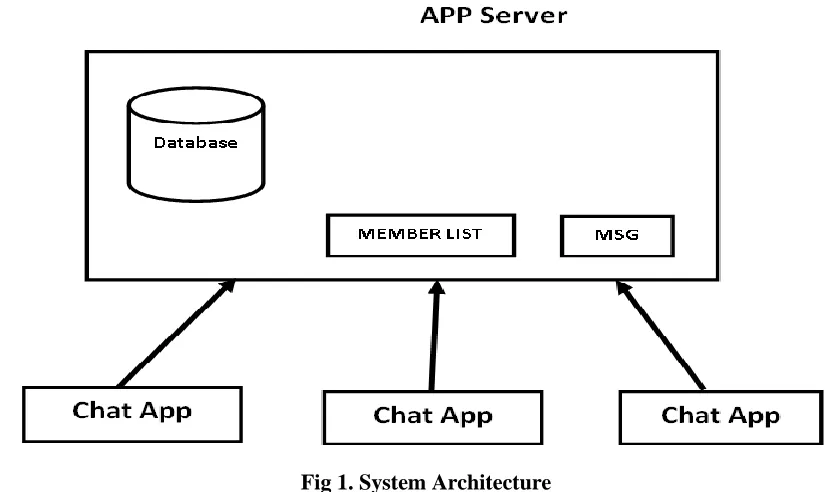
VI SYSTEM ANLYSIS AND DESIGN
261 | P a g e
Fig 1. System Architecture
VII CONCLUSION
In this paper, we design and implement next generation smart messaging application. this application can easily
communicate with same or other messaging application. User does not require to install all similar type of
application. User can send messages, images, and files to different messaging application. Also, present a new
feature for receiving messages providing some privacy by enabling or disabling it by itself. So, this way it reduces
the cost of communication and increases the communication between various devices which gives compatibility
between the users which provide an efficient communication by increasing its performance. It can be downloaded
free of cost, so it is economical also.
VIII ACKNOWLEDGEMENT
It gives us great pleasure in presenting the preliminary paper on „Next Generation Smart Messaging App‟. We
would like to take this opportunity to thank my internal guide Prof. Abidali Shaikh for giving us all the help and
guidance we needed. we are grateful to them for their kind support. Their valuable suggestions were very helpful.
we are also grateful to Prof. Shrikant dhamdere , Head of Computer Engineering Department for his indispensable
support, suggestions. In the end our special thanks to Other Person Name for providing various resources such as
262 | P a g e
REFERENCES
[1] Himali Bajaj, Rajni Jindal Thinking beyond WhatsApp
[2] Miss. Rachana N. Sawade Prof. P. V. Dudhe Wifi AP Based Secure Data Sharing Among Smartphones And
Computer System
[3] Priya Mehrotra, Tanshi Pradhan and Payal Jain Instant Messaging Service on Android Smartphones and Personal
Computers
[4] Mi-Young Jeon, Ji-Hoon Jeong and Gu-Min Jeong Proximal Social Chatting App for Smartphones using