SMART TRAVELLING SYSTEM USING RFID BASED
FRAMEWORK
1
Pravin Suresh Bhave,
2Preeti Balu Kudal,
3Vishakha Nilesh Pawar,
1Dept. of Computer Engineering , Freelance Consultant, Nashik, (India)
2,3Lecturer, Dept. of Computer Engineering, Guru Gobind Singh Polytechnic, Nashik, (India)
ABSTRACT
This paper proposes a system to monitor a person travelling from any place (source) to any another place
(destination). The proposed system would monitor the person during the travel to enhance the safety and
security of the person. Tracking of the person and objects (luggage) could be done by using RFID tags. The
proposed system will be based on the rampant technology of RFID (Radio Frequency IDentifcation) to provide
facilities like people identification, object tracking. The aim of the proposed system is to address issues like
misleading passengers, charging high amount to traveler, avoiding unforeseen situations like kidnapping etc.
The proposed system comprises of reader, tags. Reader reads the tags when they come under the influence of
RFID reader. Here, RFID tags would be allotted to people. Similarly, RFID tags shall also be allotted to the
transportation vehicles like auto rickshaws, taxis. RFID reader shall be placed strategically in appropriate
location to capture the information of passengers as to from where they are travelling [1]. The details regarding
the auto, taxi shall also be recorded. The recorded information shall be stored in database, which can be further
manipulated as and when required to track passenger.
Keywords— RFID, Passenger Safety, Woman & Children Security, Safe Transportation, RFID
Reader, RFID Tag, Object Tracking
I
INTRODUCTION
Considering present condition of transportation system, the world is now becoming shorter and shorter. There is
no place which is local, as global is now becoming new local. There are people who travel very often from one
place to another place. However, unfortunately, whenever people travel to new place they often confront bad
experiences. These bad experiences are likely to develop a feeling of hatred against those tourist destinations.
Government of India is promoting a campaign to attract foreign tourists to promote development of travel and
tourism in India. This campaign is very well known as, „Athiti Devo Bhava‟. However, whenever a foreign
tourist or even a local passenger visits a new place the situation is different.
The problems faced by passengers are mentioned below:
i. When passengers arrive at new location, they are heavily overcharged.
ii. This maligns the image of city and country.
467 | P a g e iv. Unforeseen cases like kidnapping, robbing etc happen.
The proposed system targets at addressing the issues mentioned above by using RFID. The rest of the paper is
organized as follows; the related work of the proposed system is reviewed in Section II. Section III presents the
system design. Section IV presents the proposed architecture of the system proposed. Finally, section V
concludes the paper.
II
RELATED
WORK
This section presents the related work to the issues which are addressed by this paper.
In [1], a system is proposed to track travelling passengers. This system helps to identify passenger boarding from a place and getting down at destination. A token shall be given to passenger to track his travel. Passenger information shall be captured at source terminal and destination terminal. This is how the system will track the travelling of passenger. However, other details are not captured by the system over here. For example, details of the auto rickshaw or taxi by which the passenger travelled. It also doesn‟t captures, who was the driver person during the travel.
In [2], a system is proposed to monitor the daily bus pickup and drop-off of children to enhance the overall safety of the daily bus transportation. When a child enters or exits the bus, the system here would automatically detect. It also sends a message when a child does not enter or exit the bus. This helps to reduce the parents‟ concerns about daily transport of their children. Rather, this ensures the parent do not have to take care of their child being lost or forgotten. The problem with this system is that it depends on microcontroller based system to interface RFID system with the computer terminal. Hardware based system tend to malfunction over period, they might produce inappropriate results and lead to wrong conclusions.
In [3], the system makes the use of sensors to provide intelligent transportation system. As hardware sensors are used, it surely raises the question on the degree of certitude that the system will offer. Hardware sensors could produce improper results due to wear and tear of the system over the period.
In [4], the system uses the combined technology of Global Positioning Satellites (GPS), Assisted GPS (AGPS) and Radio Frequency Identification (RFID). Here, the system incorporates usage of multiple technologies. Performance of the system is related to input and output of multiple subsystems which could hamper the working of system.
In [5], the system is comprised of RFID with Automatic Train Identification System (ATIS) to track moving locomotive. ATIS System can identify the running train and the train information exactly. The railway board gets accurate information, when a train arrives at a station [5].
In [6], the system uses Multi-Hop RFID scheme for Intelligent Transportation System (ITS). Here, the system collects information from outside the communication distance of RFIDs and transmit it to a vehicle, in real time. The approach employs multiple RFIDs which don‟t seem to be an affordable approach.
III
SYSTEM
DESIGN
transceivers). Tags can transmit and respond to the signals sent by RFID readers whereas; readers are capable of transmitting and receiving the signals [1].
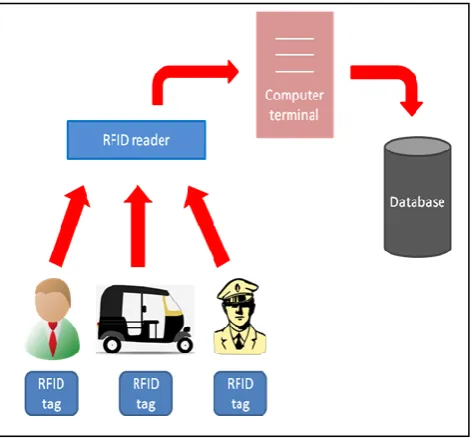
Fig. 1.
Communication between RFID and Computer
RFID reader emits electromagnetic waves around itself. Whenever an RFID tag is detected by a reader, it sends back unique id which is present within the tag. This is a unique code, which acts like an identification number to the tag. The reader can only read tag, but it is not able to manipulate the information sent by tags. It needs some support of an intelligent device, which is nothing but a computer. Computer processes the information sent by reader and stores the information into a database. In order to transmit data, the reader can connect with the computer network through a standard interface, and transmits the read data to the computer through the network to analysis and process [7]. The middleware, application which lies between reader and the computer hardware system, fetches the records from the database.
Radio frequency identification (RFID) employs wireless communications between electronic tags and readers that reads/writes information from/to the tag [8]. RFID readers are available as single tag reader or multitag reader. Single tag reader can read only one tag at a time, unlike multitag reader which can simultaneously read many tags. There are also variations available such as wired or wireless reader, which could be preferred as per the need of the application.
469 | P a g e RFID tags are also available in various types like, active tags and passive tags. Active tags make use of battery which increases their range for tracking. However, passive tags completely rely on RFID reader‟s waves to communicate. As far as standards go, the protocols that the tags and readers use to communicate can be described as the air interface protocol[10]. These tags charge themselves by the waves transmitted by RFID reader.
Fig. 3.
RFID Tag (standard clamshell passive tag)
RFID provides a strong alternative to present Barcode technology. The challenges faced by barcode are given below:
1. Barcode is simply a printed paper.
2. The information could get wiped away, washed away. 3. It could be easily tampered.
4. Duplicate barcode could be created by photocopying. 5. They are not weather (climate) resistant
6. Barcode requires a line of sight, for proper reading. 7. Any obstacle would make it impossible to
8. The technology is no longer reliable.
Features of RFID that overcome challenges of barcode: 1. RFID doesn‟t require line of sight.
2. RFID could read tags through the obstacle. 3. RFID is weather resistant, tamper proof. 4. RFID proves to be a reliable technology.
IV
MATHEMATICAL
MODEL
The proposed system uses a model to calculate fare. The fare could be predefined for a route or else the fare could be calculated from the following set of steps:
F(r) = D(s,d) R where,
- F = Amount of Fare …{F>0)
- r = route travelled …{ , , … } - D = Distance travelled
- d = destination terminal
- R = Rate per kilometer … {R > 0}
Post calculating the total amount (fare), the amount will be deducted from the previous balance of passenger‟s account.
= - F(r) where, - = Updated balance after travelling …{ > 0}
- = Previous balance (before travelling) …{ >0} - F(r) = Fare calculated for the route ‘ r’
The updated balance (after deduction of the balance) cannot be greater than previous balance, however must be greater than 0.
V
ALGORITHM
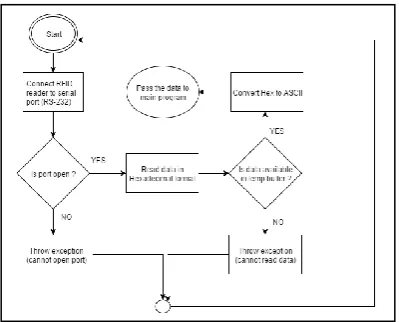
Shown below is algorithmic model to read data from RFID tag, which uses serial communication as a mode of interface.
Fig. 4.
Algorithmic steps to read data from tag
VI
PROPOSED
SYSTEM
ARCHITECTURE
471 | P a g e
Fig. 5.
Proposed architecture of the system
The proposed system will follow the given procedure to achieve the objectives:
To enhance passenger security - Auto/taxi driver details would be scanned by a smart-card reader. So, passengers travelling in an auto/taxi could be identified later if any unforeseen situation arises.
To avoid cases of kidnapping, theft, malpractices - When a person will travel the proposed system will record the details of the driver and the vehicle.
To facilitate cashless transaction- The desired amount of money shall be deducted by the system, from the passenger‟s account.
To increase women & children safety – As driver details and vehicle details are recorder it would help in providing women safety.
To improvise existing public transportation system - Smart card would carry all the personal details along with balance which is needed to travel. It will help in reducing ambiguities of the existing system.
To remove obsolete procedures in existing system - Refilling of the balance, voice-based verification could be done at collection center.
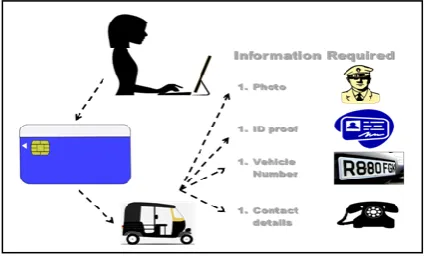
Fig. 6.
Details of transport vehicle will be stored in tag
appropriately, there would be a significant decrease in the numbers of unforeseen cases of misleading, kidnapping, and overcharging passengers.
VII
RESULT
AND
DISCUSSION
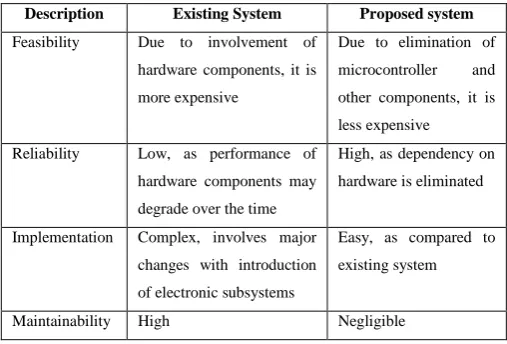
The aforementioned system is yet to be implemented; however, having said that, there are certain expected outcomes which are likely to be present, regardless of complete implementation. These aspects are discussed as the form result outcomes in the table given below:
TABLE I.
DISCUSSION ON EXISTING VS PROPOSED SYSTEMSDescription Existing System Proposed system
Feasibility Due to involvement of
hardware components, it is
more expensive
Due to elimination of
microcontroller and
other components, it is
less expensive
Reliability Low, as performance of
hardware components may
degrade over the time
High, as dependency on
hardware is eliminated
Implementation Complex, involves major
changes with introduction
of electronic subsystems
Easy, as compared to
existing system
Maintainability High Negligible
VIII
CONCLUSION
This paper presented an RFID-based system that target enhancing the safety of passenger during the daily transportation, thereby improving existing process of transportation. RFID reader located at the terminals detects the RFID tags carried by the travelers. RFID reader strategically located records the details of vehicle and its driver. It then sends the recorded data to the system database. The system records which passenger boarded from place A (source terminal) and exited at place B (destination terminal). In addition, the system captures the payment made at the destination terminal and updates the database. Voice based response will assist users to identify details like deducted balance, updated balance. The details recorded at the terminals could be used later in case of unforeseen cases. Future scope of the system could be designing a surveillance network using CCTV for more effective control.
IX
ACKNOWLEDGMENT
473 | P a g e
REFERENCES
[1] Pravin S. Bhave, Prof. M. M. Naoghare,“Review on RFID-based System for Enhancement of Transportation Safety”, International Journal for Research in Engineering Application & Management (IJREAM)”, ISSN : 2454-9150 Vol-01, Issue 09, Dec 2015.
[2] Anwaar Al-Lawati, Shaikha Al-Jahdhami, Asma Al-Belushi, Dalal Al-Adawi, Medhat Awadalla and Dawood Al-Abri, “RFID-based System for School Children Transportation Safety Enhancement”, Proceedings of the 8th IEEE GCC Conference and Exhibition, Muscat, Oman, 1-4 February, 2015.
[3] Chao Wang, Xi Li1, Aili Wang, Feng Yang, Xuehai Zhou, “An Intelligent Transportation System using RFID based Sensors” 2013 IEEE International Conference on High Performance Computing and Communications & 2013 IEEE International Conference on Embedded and UbiquitousComputing, 2013. [4] Ricardo O. Mitchell, Hammad Rashid, Fakir Dawood & Ali AlKhalidi, “Hajj Crowd Management and
Navigation System - People Tracking and Location Based Services via Integrated Mobile and RFID Systems”, 2013.
[5] XUE Xiao-ping, MEI Su-ping, CHEN Chen-hui , ZHANG Hai-juan “RFID and ATIS Information System based Railway Container Transportation Management” in The 1st International Conference on Information Science and Engineering, ICISE2009.
[6] Hiroaki Togashi, Shigeki Yamada, “An Information provision system based on a Multi-Hop RFID scheme for ITS (Intelligent Transportation System)” in 2010 IEEE Conference on Open Systems (ICOS 2010), December 5-7, 2010.
[7] Qiu Xinyun, Xiao Xiao, “The Design and Simulation of Traffic Monitoring System Based on RFID” in IEEE, 2014.
[8] Alwyn J. Hoffman, Daniel J. S. Geldenhuys and Albertus B. Pretorius, “Securing Number plates based on Digital Signatures and RFID”, Proceedings of the 16th International IEEE Annual Conference on Intelligent Transportation Systems (ITSC 2013), The Hague, The Netherlands, October 6-9, 2013.
[9] Thomas Buckel, Frédéric Thiesse, “Paving the way to a productive RFID system: A novel action research based study from fashion retail”, presented at 47th Hawaii International Conference on System Science, 2014.
[10]Patrick J. Sweeney II, RFID For Dummies, Wiley Publishing, Inc, ISBN:0-7645-7910-X.
[11] Alwyn J. Hoffman, Daniel J. S. Geldenhuys and Albertus B. Pretorius, “Securing Number plates based on Digital Signatures and RFID”, Proceedings of the 16th International IEEE Annual Conference on Intelligent Transportation Systems (ITSC 2013), The Hague, The Netherlands, October 6-9, 2013.
[13] Farzana Rahman, Drew Williams and Sheikh I. Ahamed, Ji-Jiang Yang and QingWang “PriDaC: Privacy Preserving Data Collection in Sensor Enabled RFID based Healthcare Services”, 2014 IEEE 15th International Symposium on High-Assurance Systems Engineering.
[14] Binod Vaidya, Dimitrios Makrakis, Hussein T. Mouftah, “Authentication Mechanism for Mobile RFID based Smart Grid Network”, CCECE 2014.