55 | P a g e
CLUSTERING PERFORMANCE IN SENTENCE
USING FUZZY RELATIONAL CLUSTERING
ALGORITHM
Purushothaman B
PG Scholar, Department of Computer Science and Engineering
Adhiyamaan College of Engineering Hosur, Tamilnadu (India)
ABSTRACT
Data Mining is defined as extracting the information from the huge set of data. Clustering is the process of grouping or aggregating of data items. Sentence clustering mainly used in variety of applications such as
classify and categorization of documents, automatic summary generation, organizing the documents. In
comparison with hard clustering methods, in which a pattern belongs to a single cluster, fuzzy clustering
algorithms allow patterns to belong to all clusters with differing degrees of membership. This is important in
domains such as sentence clustering, since a sentence is likely to be related to more than one theme or topic
present within a document or set of documents. Size of the clusters may change from one cluster to another. The
traditional clustering (hard clustering) algorithms have some problems in clustering the input dataset. The
problems are instability of clusters, complexity and sensitivity. To overcome the drawbacks of these clustering
algorithms, this paper proposes an algorithm called Fuzzy Relational Eigenvector Centrality-based Clustering
Algorithm (FRECCA) which is used for the clustering of sentences. Contents present in text documents contain
hierarchical structure and there are many terms present in the documents which are related to more than one
theme hence FRECCA will be useful algorithm for natural language documents.
Keywords - Data mining, FRECCA, Fuzzy clustering, Hard clustering, Sentence level clustering.
1. INTRODUCTION
56 | P a g e
.Each group, called cluster, consists of objects that are similar between themselves and dissimilar to objects of other groups .Clustering has become an increasingly important topic with the explosion of information available via the Internet. It is an important tool in text mining and knowledge discovery. Representing data by fewer clusters necessarily loses certain fine details, but achieves simplification. It represents many data objects by few clusters, and hence, it models data by its clusters.
There are several algorithms available for clustering. Each algorithm will cluster or group similar data objects in a useful way. This task involves dividing the data into various groups called clusters. The application of clustering includes Bioinformatics, Business modelling, image processing etc. In general, the text mining process focuses on the statistical study of terms or phrases which helps us to understand the significance of a word within a document. Even if the two words didn‟t have similar meanings, clustering will takes place. Clustering can be considered the most important unsupervised learning framework, a cluster is declared as a group of data items, which are “similar” between them and are “dissimilar” to the objects belonging to other
clusters. Sentence Clustering mainly used in variety of text mining applications. Output of clustering should be related to the query, which is specified by the user.
Similarity between the sentences [2] is measured in terms of some distance function; such functions are Euclidean distance or Manhattan distance. The choice of the measure is based on our requirement that induces the cluster size and formulates the success of a clustering algorithm on the specific application domain. Current sentence clustering methods usually represent sentences as a term document matrix and perform clustering algorithm on it. Although these clustering methods can group the documents satisfactorily, it is still hard for people to capture the meanings of the documents since there is no satisfactory interpretation for document cluster.
Similarity measure, which is generally defined on the attributes of a data set, has a major impact on clustering results and it must be selected according to the clustering needs. Moreover, not every similarity measure can be used with every clustering algorithm. For instance, similarity metrics that are only defined between data objects cannot be used with algorithms that define pseudo points in the data space during the clustering process, such as k-means [13]. Nowadays, large amount of data is available in the form of texts. It is very difficult for human beings to manually find out useful and significant data. This problem can be solved with the help of text summarization algorithms.
57 | P a g e
second step, they are implementing Expectation Maximization (EM) Clustering Algorithm to find out sentence similarity between the sentences. This is important in domains such as sentence clustering, since a sentence is likely to be related to more than one theme or topic present within a document or set of documents.
II
BASIC
CONCEPTS
AND
DEFINITIONS
2.1 Cluster Analysis
There are several algorithms available for clustering. Each algorithm will cluster or group similar data objects in a useful way. This task involves dividing the data into various groups called clusters. The application of clustering includes Bioinformatics, Business modeling, image processing etc. In general, the text mining process focuses on the statistical study of terms or phrases which helps us to understand the significance of a word within a document. Even if the two words didn‟t have similar meanings, clustering will takes place. Clustering
can be considered the most important unsupervised learning framework, a cluster is declared as a group of data items, which are “similar” between them and are “dissimilar” to the objects belonging to other clusters.
Sentence Clustering mainly used in variety of text mining applications. Output of clustering should be related to the query, which is specified by the user.
2.2 Similarity Measure
Similarity between the sentences [7] is measured in terms of some distance function such functions are Euclidean distance or Manhattan distance. The choice of the measure is based on our requirement that induces the cluster size and formulates the success of a clustering algorithm on the specific application domain. Current sentence clustering methods usually represent sentences as a term document matrix [6] and perform clustering algorithm on it. Although these clustering methods can group the documents satisfactorily, it is still hard for people to capture the meanings of the documents since there is no satisfactory interpretation for each document cluster. Based on the similarity or dissimilarity values of clustering performance will take place.
2.3 Hierarchical clustering
Hierarchical clustering outputs a hierarchy, a structure that is more informative than the unstructured set of clusters returned by flat clustering. Hierarchical clustering does not require us to pre specify the number of clusters and most hierarchical algorithms that have been used in Information Retrieval (IR) are deterministic. These advantages of hierarchical clustering come at the cost of lower efficiency.
III RELATED WORKS AND EXISTING ALGORITHMS
3.1 K-Means Algorithm
58 | P a g e
This obviously does not work well with a categorical attributes, it has the good geometric and statistical sense for numerical attributes. K-means [13] has problems when clusters are of differing Sizes, Densities, Non-globular shapes and K-means has problems when the data contains outliers.
3.2 K-Medoids Algorithm
When medoids [10] are selected, clusters are defined as subsets of points close to respective medoids, and the objective function is defined as the averaged distance or another dissimilarity measure between a point and its medoid. K-medoid [10] is the most appropriate data point within a cluster that represents it. Representation by k-medoids has two advantages. First, it presents no limitations on attributes types, and, second, the choice of medoids is dictated by the location of a predominant fraction of points inside a cluster and, therefore, it is lesser sensitive to the presence of outliers. Like k-Means, methods based on k-Medoids [10] are highly sensitive to the initial (random) selection of centroid, and in practice it is often necessary to run the algorithm several times from different initializations. To overcome these problems, the Affinity Propagation, a technique which simultaneously considers all data points as potential centroid (or exemplars). Treating each data point as anode in a network, Affinity Propagation recursively transmits real-valued messages along the edges of the network until a good set of exemplars (and corresponding clusters) emerges. These messages are then updated using simple formulas that minimize an energy function based on a probability model.
3.3 Vector Space Model
The vector space model has been successful in IR because it is able to adequately capture much of the semantic [14] content of document-level text. This is because documents that are semantically related are likely to contain many words in common, and thus are found to be similar according to popular vector space measures such as cosine similarity [7], which are based on word co-occurrence .However, while the assumption that (semantic) similarity can be measured in terms of word co-occurrence may be valid at the document level, the assumption does not hold for small-sized text fragments such as sentences, since two sentences may be semantically related despite having few, if any, words in common. To solve this problem, a number of sentence similarity measures have recently been proposed .Rather than representing sentences in a common vector space, these measures define sentence similarity as some function of inter-sentence word-to-word similarities, where these similarities are in turn usually derived either from distributional information [14] from some corpora (corpus-based measures), or semantic information represented in external sources such as Word Net(knowledge-based measures) of computing time.
3.4 Fuzzy Algorithm
59 | P a g e
3.5 Fuzzy C Means
Ruspini [11] introduced a fuzzy c-partition p = (p1,p2….pc) by the extension to allow pi(x) to be functions assuming values in the interval (O ,l) such that P1(x) +. . . + pc(x) =1 since he first applied the fuzzy set in cluster. In fuzzy object data clustering, on the other hand, the problem of classifying N objects into C types is typically solved by, first, finding C prototypes, which best represent the characteristics of as many groups of objects, and then building a cluster around each such prototype, by assigning each object a membership degree that is as much higher as greater its similarity degree with the prototype is. A prototype may be either a cluster centre, or the most centrally located [12] object in a cluster, or a probability distribution, etc., depending on the type of available data and the specific algorithm adopted. It should be noted that the knowledge of prototypes, which are a condensed representation of the key characteristics of the corresponding clusters, is also an important factor. Here the distance calculations for stable clusters in the iterative process, when the number of proceeding iterations increases the cluster center number will also increases .In the FCM algorithm, a data item may belong to more than one cluster with different degrees of membership. To analyzed a several popular robust clustering methods [16] and established the connection between fuzzy set [15] theory and robust statistics. The rough based fuzzy c-means [3] algorithm to arbitrary (non-Euclidean) dissimilarity data. The fuzzy relational data clustering algorithm can handle datasets containing outliers and can deal with all kinds of relational data. Parameters such as the fuzzification degree greatly affect the performance of FCM [12].
IV
PROPOSED
ALGORITHM
In this work, we analyze how one can take advantage of the efficiency and stability of clusters, when the data to be clustered are available in the form of similarity [2] relationships between pairs of objects. More precisely, we propose a new fuzzy relational clustering algorithm [1], based on the existing fuzzy C-means (FCM) algorithm, which does not require any restriction on the relation matrix. FRECCA will give the output as clusters which are grouped from text data which is present in a given documents. In this FRECCA algorithm, Page Rank algorithm is used as similarity [2] measure.
4.1 Page Rank
60 | P a g e
4.2 EM AlgorithmIt is an unsupervised method, which does not need any training phase; it tries to find the parameters of the probability distribution that has the maximum likelihood of its parameters. Its main role is to parameter estimation. It is an iterative method, which is mainly used to finding the maximum likelihood parameters of the model. The E-step involves the computation of cluster membership probabilities. The probabilities calculated from E-step are re estimated with the parameters in M-step.
4.3 Fuzzy Relational Clustering – FRECCA
A fuzzy [15] relational clustering approach is used to produce clusters with sentences, where each of them corresponds to some content. The output of clustering indicates the strength of the association among the data elements. Andrew Skabar and Khaled Abdalgader [1] proposed a novel fuzzy relational clustering algorithm called FRECCA (Fuzzy Relational Eigen Vector Centrality based Clustering Algorithm). The algorithm involves the following steps. Unlike Gaussian mixture models, which use a likelihood function parameterized by the means and covariance of the mixture components, the algorithm uses the Page Rank score of an object within a cluster as a measure of its centrality to that cluster.
Initialization: cluster membership values are initialized randomly, and normalized. Mixing
coefficients are initialized.
Expectation: Calculates the Page Rank value for each object in each cluster.
Maximization: Updating the mixing coefficients based on membership values calculated in the
Expectation Step.
4.4 Performance Evaluation
The performance evaluation of the proposed FRECCA clustering algorithm is based on certain performance metrics. The performance metrics used in this paper are Partition Entropy Coefficient (PE), Purity and Entropy, V-Measure, Rand Index and F-Measure. The sentence similarity measure is based on the following metrics.
Purity: The fraction of the cluster size that the largest class of objects assigned to that cluster.
Entropy: It is a measure of how mixed the objects within the clusters present.
V -measure: It is defined as the harmonic mean of homogeneity and completeness.
Rand Index and F-measure: It based on a combinatorial approach.
V IMPLEMENTATION AND RESULTS
61 | P a g e
Table 1: Clustering PerformanceTechniques Purity Entropy V-meas Rand F-meas
FRECCA 0.800 0.324 0.646 0.862 0.601
ARCA 0.622 0.451 0.524 0.815 0.462
Spec.Clus 0.690 0.475 0.508 0.800 0.444
Kmedoids 0.720 0.457 0.546 0.779 0.459
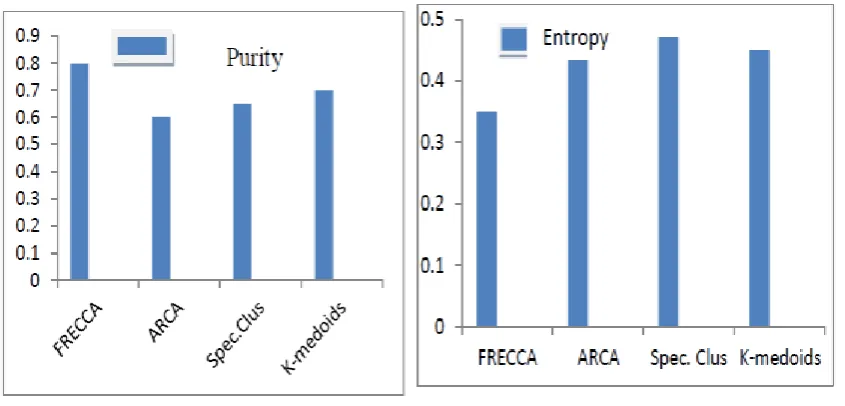
Figure 1 shows purity comparison and Figure 2 shows entropy comparison of various clustering algorithms.
Fig.1: Purity Comparison Fig.2: Entropy Comparison
VI
CONCLUSION
62 | P a g e
ARCA is a better choice. Among the different fuzzy clustering techniques FRECCA algorithm is superior to others. It is able to overcome the problems in sentence level clustering. But when time is critical factor then we cannot adopt fuzzy based approaches. A good clustering of text requires effective feature selection and a proper choice of the algorithm for the task at hand. It is observed from the above analysis that fuzzy based clustering approaches provide significant performance and better results.
REFERENCES
[1] Andrew Skabar,& Khaled Abdalgader 2013,„Clustering Sentence-Level Text Using a Novel Fuzzy Relational Clustering Algorithm‟, IEEE Trans. Knowledge and Data Eng., vol. 25, no. 8,pp.
1138-1150, No1.
[2] Chen Y, Garcia E.K, Gupta M.R, Rahimi A, & Cazzanti L 2009, „Similarity-Based Classification: Concepts and Algorithms‟. Machine Learning Research, vol. 10, pp. 747-776.
[3] Corsini P, Lazzerini P, & Marcelloni F 2005, „A New Fuzzy Relational Clustering Algorithm Based on the Fuzzy C-Means Algorithm‟, SoftComputing, vol. 9, pp. 439-447.
[4] Hatzivassiloglou V, Klavans J.L, Holcombe M.L, Barzilay R, Kan M , & McKeown K.R 2001, „SIMFINDER: A Flexible Clustering Tool for Summarization‟, Proc. NAACL Workshop Automatic
Summarization, pp. 41-49.
[5] Hofmann T & Buhmann J.M 1997, „Pairwise Data Clustering by Deterministic Annealing‟, IEEE Trans. Pattern Analysis and Machine Intelligence, vol. 19, no. 1, pp. 1-14.
[6] Lee D & Seung H 2001, „Algorithms for Non-Negative Matrix Factorization‟, Advances in Neural Information Processing Systems,vol. 13, pp. 556-562.
[7] Li Y, McLean D, Bandar Z.A, O‟Shea J.D, & Crockett K 2006,„Sentence Similarity Based on Semantic Nets and Corpus Statistics‟, IEEE Trans. Knowledge and Data Eng., vol. 8, no. 8,pp.
1138-1150.
[8] Luxburg U.V 2007, „A Tutorial on Spectral Clustering‟, Statistics and Computing, vol. 17, no. 4, pp. 395-416.
[9] MacQueen J.B 1967, „Some Methods for Classification and Analysis of Multivariate Observations‟, Proc. Fifth Berkeley Symp. Math.Statistics and Probability, pp. 281-297.
[10]Noor Kamal Kaur, Usvir Kaur & Dheerendra Singh 2014, „K-Medoid Clustering Algorithm- A Review‟, IJCAT) Volume 1 Issue 1 ISSN: 2349-1841.
[11]Ruspini, E.H 1969, „A new approach to clustering‟, Information and Control, vol. 15, pp. 22-32. [12]Subhagata Chattopadhyay 2011, „A comparative study of fuzzy c-means algorithm and entropy-based
fuzzy clustering algorithms‟,Computing and Informatics, Vol. 30, 701–720.
[13]Tapas Kanungo, David Mount M, Nathan, J.D, Netanyahu, &Angela Y. Wu 2002, „An efficient k-means clustering algorithm: Analysis and Implementation‟, IEEE Trans. Pattern analysis and machine
63 | P a g e
[14]Wang D, Li T, Zhu S, & Ding C 2008,„Multi-Document Summarization via Sentence-Level Semantic Analysis and Symmetric Matrix Factorization‟, Proc. 31st Ann. Int‟l ACM SIGIR Conf.Research and
Development in Information Retrieval, pp. 307-314.
[15]Yang, M.-S 1993, „A Survey of Fuzzy Clustering‟, Math. Computer Modelling, vol. 18, no. 11, pp 1-16.