(PLATES 17-28) Summary
Trenches on the north and south flanks of the Temple of Zeus revealed additional evidence for the history and sequence of the Temples. On the west side of the Sanctuary, west of the Nemea River, parts of one or more large structures were found, heavily damaged, but with enough remaining to indicate their alignment and orientation. On the east side of the Sanctuary a votive deposit was discovered containing athletic gear relevant to the pentathlon and pottery dating to the third quarter of the 6th century B.C. Further speculations concern- ing the location of the Early Stadium in this area are presented. On the south side of the Sanctuary investi- gations directly south of the Bath revealed a complicated series of monuments, most of which extend outside the boundaries of the 1982 trenches. The latest of these remains is a house of the Early Christian period. Below are several segments of walls and aqueducts which pre-date the Bath. Beneath these features the major east-west road was found to continue westward toward the Nemea River during the Archaic period. A date for the Bath in the 4th century B.C. was confirmed.
AREAS OF EXCAVATION at Nemea in 1982 were, once again, at least partially de- teAtermined by forces beyond our control.1 Heavy winter rains had again raised the water table to form a veritable lake around the Temple, thereby substantially covering the remains of the 4th century B.C. It proved possible, however, to undertake exploration on the north and south flanks of the Temple near its east end and in areas east of the Temple, south of the Bath, and (later in the season) west of the Nemea River.2 The following report is topographically arranged.
1 The staff consisted of Paula Hensley of Stanford University, Kalliope Kritikakou of the University of Athens, Mark E. Landon of the University of California at Berkeley, Professor John McEnroe of the Univer- sity of Virginia with his wife Catherine as assistant, Anna Pappi of the University of Athens, and Paula Perlman of the University of California at Berkeley as excavators; Katherine Patey and Christina Malango of the University of California at Berkeley as photographer and assistant photographer, respectively; James P. McLane, III of the University of California at Berkeley as architect; Patricia A. Felch of the University of California at Berkeley as museum technician, cataloguer, and restorer. Professor Stephen G. Miller was Director with the undersigned serving as Assistant Director. The hard and cheerful work of all these people is- most gratefully acknowledged.
Thanks also go to many people who have been helpful and supportive in different ways. First, we ac- knowledge the assistance of the Greek Archaeological Service, particularly our colleagues at the Nauplion Ephoreia of Antiquities and of them especially Dr. Aikaterina Demakopoulou-Papantoniou, Ephor, and Zoe Aslamatzidou, Epimelitria. For continued support from the American School of Classical Studies at Athens and the University of California at Berkeley under its Chancellor, I. M. Heyman, we are also deeply grateful. The operating expenses at Nemea in 1982 were supported by a gifts-and-matching grant from the National Endowment for the Humanities and by gifts from 244 donors. We thank all those sources who make our continued work at Nemea possible.
Works frequently cited are abbreviated as follows:
Blegen, "Nemea, 1924" = C. W. Blegen, "The American Excavation at Nemea, Season of 1924," Art and Archaeology 19, 1925, pp. 175-184
Blegen, "Nemea, 1926" = C. W. Blegen, "Excavations at Nemea 1926," AJA 31, 1927, pp. 421-440 2 For previous work at Nemea see "Excavations at Nemea, 1973-1974," Hesperia 44,1975, pp. 144-172; "Excavations at Nemea, 1975," Hesperia 45, 1976, pp. 174-202; "Excavations at Nemea, 1976," Hesperia 46, 1977, pp. 1-26; "Excavations at Nemea, 1977," Hesperia 47, 1978, pp. 58-88; "Excavations at Nemea,
American School of Classical Studies at Athens is collaborating with JSTOR to digitize, preserve, and extend access to
Hesperia
THE TEMPLE OF ZEUS Sections L 12 and L 14
Two small trenches, one off the northeast corner of the Temple (at L/13,18-12/3,16) and one near its southeast corner (at L/2,5-14/1,10 with a small wedge of Section L 13 at
5
i
5 sNAISKO:
6 6
NEMEA
SANCTUARY OF ZEUS
~~~~~~~~~~~~~~l3 9
0 10
I L
__ _---_ CYPRESS CRUVE5
12 S 12
/^~ B ATH - ~:
0 ::-:5r, XENON
N~~U~ ~ ~ ~~ ' HO,ES C 'RE 2
2o__________ -I 2
D
1I 16
_.
n0 cUrSSS S 2Ro e
21 21~~~~~~~~~~a d O
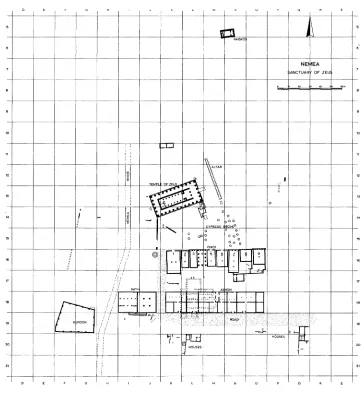
FIG. 1. Restored plan of the Sanctuary of Zeus, Archaic to Hellenistic periods
1978," Hesperia 48, 1979, pp. 73-103; "Excavations at Nemea, 1979," Hesperia 49, 1980, pp. 178-205; "Excavations at Nemea, 1980," Hesperia 50, 1981, pp. 45-67; "Excavations at Nemea, 1981," Hesperia 51, 1982, pp. 19-40. In the following presentation specific bibliographic references to previous work will be made only in the case of particularly important or arguable points.
It will be noted that the report does not fulfill the promise of last year with regard to work on the prehis- toric hill Tsoungiza; cf. J. C. Wright, "Excavations at Tsoungiza (Archaic Nemea): 1981," Hesperia 51, 1982, pp. 375-397. Excavations there during the regular season proved to be impossible. Work undertaken subsequently will be discussed in the next report.
1
0
L/5-13/20), were opened with a view to learning more about both the standing 4th-century
Temple and its Archaic predecessor. Removal of Temple blocks which had until recently littered the area3 made this investigation feasible.
The characteristically shaped Early Christian farming trenches were revealed in both sections and provided once again evidence that at least some parts of the Temple remained standing into later antiquity, in any case as late as the latter part of the 6th century after
Christ.4
As elsewhere on the site, the upper layers were heavily disturbed by this farming activ- ity which had obviously churned up and destroyed material of much greater antiquity.5
Among the debris were several small fragments of inscriptions (I 98, P1. 17:a; I 99-I 101,
P1. 17:b); a handsomely carved marble piece which must originally have crowned an altar or
stele (A 184, P1. 17:c); and a few tantalizing bits of black- and red-figured pottery (P 876
and P 874, PI. 17:d), of which the latter is particularly interesting as the portrayal of an athlete in jumping pose. Yet another lead tablet was discovered which, when unrolled, re-
vealed the single name EYANAPOI (IL 416, PI. 17:e); and the familiar terracotta horse- and-rider type of figurine was also represented in a fragmentary example (TC 162, P1. 18:a). A few coins of unusual interest, although all deriving from these upper disturbed layers and thus out of context, are shown here (PI. 17:f, g).6 Of these the coin of Agrippina
Junior, C 2258 (A.D. 15-59), is especially noteworthy since it belongs to a period when, ac-
cording to all indications, the Nemean Games had ceased to be celebrated at Nemea itself. There is, however, other evidence best documented in the Stadium which suggests activity at this time at Nemea, but of unknown nature.7
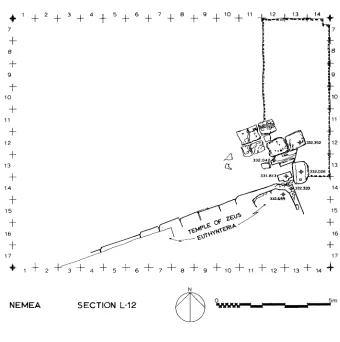
Of particular interest in Section L 12 were the several blocks toward the southern end near the Temple (Fig. 2; PI. 18:b). It was hoped that evidence would be forthcoming con- cerning their function and chronology. The blocks were first uncovered in 1925 during investigation of the Temple foundations. Blegen's suggestion in his 1927 report was that the blocks were "evidently the foundation of a monument" which he speculated might, from their oblong shape, have supported an equestrian group, "but the ruinous state of the con-
struction permits no more than the conjecture."8 Blegen is presumably referring to the five
clustered blocks at slight remove from the Temple (at L/10,13-12/11,12, Fig. 2). Investiga- tions in 1982 revealed that these blocks apparently rest on disturbed modern fill, and al- though their uniformity in dimensions might suggest that they originally belonged together, a modern date for their present position and arrangement cannot be precluded.
The three blocks closer to the Temple (at L/12,13-12/12,14, Fig. 2) are a different matter. Although they are nowhere mentioned in the excavation notebooks, they must also
3 For aerial photographs taken before clearing of Temple blocks see Hesperia 47, 1978, pl. 10. For re-
moval of blocks see Hesperia 50, 1981, p. 48.
4
Pottery lots L 12:2, 3; L 14:43. See discussion of the later history of the Temple, Hesperia 48, 1979, p. 74. 5Pottery lots L 12:1-3; L 14:39-43.
6 C 2072, Chalkis; C 2257, Corinth; C 2262, Alexander the Great; C 2258, Agrippina Junior. More informative chronologically is a Roman minimus (C 2264) found in one of the farming trenches itself and corresponding well with the date of the late Roman pottery discovered with it (pottery lot L 14:43).
7 Cf. Hesperia 49, 1980, pp. 198-199. 8
+ 1 + 2 3 + 4 + 5 + 6 + 7 + 8 + 9 + 10+ 11 +
8 ' _
-t- 9
1 -
+ -
1 332.352
13 C13
14 >"-7 332.333 14
+
'
... +
156 T\^M 16+
17 17
+ 1 2 3 +4 + 5 + 6 + 7 + 8 + 9 + 10 + 11 + 12 + 13 + 14
N
NEMEA SECTION L-12 5
FIG. 2. Section L 12
have been uncovered during early examination of the Temple foundations. Since their top surfaces are roughly level with the bottom edges of the first group it is reasonable in any case to suppose that their history is different. One of these blocks (the closest to the cluster just discussed, at L/12,13-12/12,13) displays a confusing number of cuttings which are not fully understood and may represent several periods of use and re-use. It and its larger neighbor just off the northeast corner of the Temple (at L/1 3-12/13,14) are similar to those we associate, for good reasons, with the Early Temple of Zeus.9 The smaller irregular fragment just to the west along the Temple foundations (at L/12,13-12/13,14), although lacking distinctive cuttings, may be part of an Early Temple block as well. The two larger blocks rest on the "landscaping fill" associated with construction of the 4th-century Temple of Zeus,10 and their function (so far unknown) may be related to that of blocks (also re-used Early Temple blocks) found off the northwest and southwest corners of the standing
9 For a discussion of some of these blocks see Hesperia 49, 1980, pp. 184-185, pls. 37:a, b, 38:d. 10
Temple.11 The presence of cuttings on the crepidoma of this Temple (here, too, on the
course just below the euthynteria, Fig. 2) strongly suggests as much.
Excavation of lower levels in Sections L 12 and L 14 revealed additional information
concerning the history and sequence of the Temples of Zeus. The construction layer for the 4th-century Temple, disturbed in Section L 14, was discerned and excavated in L 12. As is
so frequently the case, however, pottery from this important layer was generally rather too
early, dating mainly to the 5th century. It included, most notably, a votive krateriskos (P 844, PI. 18:d).12 Evidence for the building of the Early Temple was found in two layers;
in L 14 they were particularly impressive because of the heavy concentration throughout the trench of large chunks and chips of poros, many of which had worked faces (cf. detail, P1. 18:e, where the 4th-century Temple foundations appear toward the left). Pottery from
these layers appears to descend to arond the middle of the 6th century B.C.,13 although the
most impressive pieces are obviously much earlier: a fragmentary Corinthian conical oino- choe (P 886, PI. 18:c) and a segment of a large Argive krater (P 887, PI. 19:a).14 Possible evidence for repairs to the Early Temple prior to its destruction in the late 5th century15 was also retrieved from a construction layer in L 14. Although the pottery of this layer itself was not susceptible of close dating, the two successive layers directly above dated to the last
quarter of the 5th century or earlier, the latter producing among othelr objects, a large,
handsome, fragmentary cooking vessel (P 890, PI. 19:b).16 The lowest levels in both
trenches, although dated by their latest pieces to the 6th century B.C., produced substantial
amounts of 7th-century pottery.17 The second from the lowest level in L 14 contained a fragmentary painted terracotta horse and rider (TC 164, PI. 18:a). Both trenches had to be halted before virgin soil was reached because of the height of the water table. Nonetheless, the ceramic evidence clearly indicates a substantial increase in activity in the Sanctuary in
the late 8th and 7th centuries B.C.
In addition to such exploration, the architectural study of the Temple continued. A brief stay at the site by the architectural study crew enabled final details to be added and checks of field measurements to be made.18 Drawings of the extant remains and restored elevations of the Temple as it once appeared are being prepared. These will serve the two-
11 Hesperia 49, 1980, pp. 182-183. 12
Pottery lot L 12:8.
13
Pottery lots L 12:14; L 14:53, 54. 14
For a related krater see P. Courbin, Etudes peloponnesiennes. Tombes geometriques d'Argos I, Paris 1974, pl. 40 (C.915).
15 On possible repairs see Hesperia 50, 1981, p. 54 (Section K 12, 13, north of the Temple) and Hesperia 47, 1978, p. 64 (Section K 14, south of the Temple).
16 Construction layer: pottery lot L 14:50; layers above: pottery lots L 14:46-49; layer below: pottery lot L 14:51.
17 Pottery lots L 12:15-20; L 14:55-58.
18 This ongoing project is continuing under the direction of Professor Frederick A. Cooper of the Univer-
fold purpose of providing a proper scholarly presentation of the Temple and its remains on the one hand and, on the other, of forming the basis for possible eventual reconstruction of at least some parts of the building.
THE WESTERN SIDE OF THE SANCTUARY OF ZEUS Sections G 14 and F 16
The western side of the Sanctuary of Zeus, west of the Nemea River, has long awaited
further exploration.19 Excavations in Sections G 14 and F 16, dug relatively late in the 1982 season when the receding water table at last permitted work, uncovered tantalizing remains,
although heavily damaged, of one or possibly two structures.
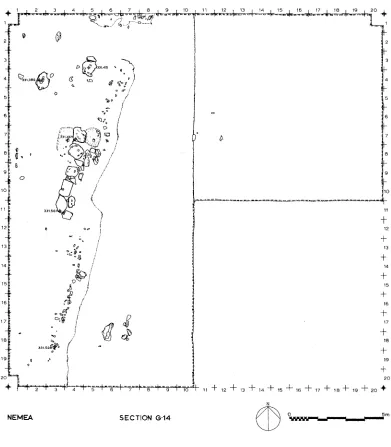
In Section G 14 a series of large limestone blocks was discovered to be arranged in an approximately northeast-southwest direction in the western part of the trench at G/3,5- 14/3,11 (Fig. 3; PI. 19:c). The blocks display on their exposed upper surfaces such charac- teristic features as anathyrosis and "ice-tong" lifting holes which indicate their original use in some Archaic structure (PI. 19:d); these features are clearly like those of the series of
blocks associated with the Early Temple of Zeus.20 The line of the blocks proceeds for some five meters, then is interrupted by a gap of ca. 2.50 m. at its northern end (at G/4,5-14/4,6) before another block of similar type appears (at G/5-14/3,4, Fig. 3). The earth surround- ing these blocks (and including the area of interruption) is a distinctive white claylike soil. Lack of time prevented the necessary deeper stratigraphic exploration, but a mug from the white clay layer (P 904, P1. 19:e) suggests a 4th-century date for the earth in which the blocks lie.21 All fill down to this level contained modern material mixed with earlier remains,22 such as the two coins illustrated (PI. 19:f, g).23 Running along the east side of these blocks, in nearly continuous sequence and extending further than the large re-used blocks, is an irregular line of smaller, seemingly broken-up stones similarly embedded in the white claylike soil (G/3,7-14/3,19). The significance of this line which appears to represent a destruction of some sort will emerge only with further investigation of the area.
Additional investigation will also be required to comprehend the findings of Section G 14 and perhaps relate them to the discoveries in F 16. In this trench there appeared two large rectangular worked blocks (at F/16,17-16/10,11 and at F/16-16/4,5, visible on Plate 20:a and b, where they areshown before and after digging around them, respectively) and jumbles of broken-up worked stones in a northeast-southwest line (cf. Fig. 1, shown in broken lines) and surrounded by white clay similar to that of G 14. This layer, however,
19 Probes in Sections C 11, D 11, E 12, F 12, C 14, and F 4 in 1974 (cf. Hesperia 44,1975, pp. 153-155) revealed ancient activity including part of an ancient roadway. H 14 produced the slight remains of an east- west wall of rubble construction whose date appears to be earlier than the late 5th century B.C. (cf. Fig. 3 and Hesperia 49, 1980, pp. 190-191). The Heroon, in Sections F 18, F 19, G 18, and G 19, is the single major monument known so far on the west side, and it awaits further exploration when conditions of water table permit (cf. Hesperia 50, 1981, pp. 60-65).
20 See footnote 9 above. 21
Pottery lot G 14:3. On the mug type see C. K. Williams, II, "Corinth, 1978: Forum Southwest," Hesperia 48, 1979, pp. 140-142, fig. 7 (C-36-2461).
22 Pottery lots G 14:1, 2.
STELLA G. MILLER
2 3 i 4 5 . 6 9... 7 _ 8 _ 10 . 11 i 12
i
... -- J -.1- - I.-... 13 - 1- bi. -_ -. 14 L t 15 ._ 1 -. _- i 16 1 17 i , -- i, - 1 18 .. 1 19 _- _.1. . ..
1
%W- ,
6 ,,
0
i2
V
00
4 20 + Ldi fl |2 3 r 4- 5
?
i6 7F
V 6r
', 8
13 9 + 10 11 13 14
_7 +
16 + 17 18 i 19
a~~~~~~~~~~~ ~~~~20
\tr 8L ( 9"' " 10 i 11 + 12 + 13 + 14 + 15 + 16 + 17 + 18 + 19 + 20 +
SECTION G-14
N
l9 5m
FIG. 3. Section G 14
preserved only in patches in the trench, first appeared just below the ground surface and at an elevation approximately a meter higher than in G 14 (discernible on Plate 20:a). Inter-
estingly enough, the white clay in F 16 contained ceramic material of the 4th century,24 as
well as considerable quantities of lead (some of it melted) and numerous pieces of smashed and burned worked blocks. Subsequent digging revealed various pits and deep trenches whose scanty pottery suggested a 4th-century date as well.25 No trace, however, of robbing
24 Pottery lot F 16:5. 25 Pottery lots F 16:3, 4, 6. 76
4- + 1
2
31
4 133.38e
-s- 5{ -l 5 16 171 -4 r 11 12 15:
16 4
18|
20^68 + M-fiu
or foundation trenches for the original positioning of the blocks appeared in further excava- tion. The nature of the material indicates clearly that we have discovered parts of a badly destroyed structure. The material from the layer surrounding this debris dated to the 4th century and was perhaps churned up with the destruction. The true date of the destruction
may well be later. What this structure may have looked like and how it might relate to the
line of stones in G 14 remains to be investigated, but the alignment and similar orientation of blocks and debris in both trenches (shown in solid and broken lines, Fig. 1) may prove to be significant.
One additional feature deserves to be mentioned. A test trench running east-west at F/1,10-16/9,10 revealed a tall, upright block at F/10-16/10 (preserved to a height of 0.70 m. and measuring 0.40 m. by 0.28 m. across). It was found implanted in gray-white claylike soil whose elevations are not much higher and in some places equal to the clay level of G 14 discussed above. Pottery recovered from the layer which surrounded the upright block ap-
pears to date to the 4th century.26 Although this block remained isolated, there is reason to
hope, judging by surface indications, that more blocks will emerge with digging to the west. It is too early to determine the significance of the remains on the west side, but the absence so far at Nemea of a gymnasium and a palaestra as well as a hippodrome quite naturally gives rise to such specific speculation.
THE EASTERN SIDE OF THE SANCTUARY OF ZEUS Sections P 12, P 13, P 14, 0 13
In an attempt to learn more about the eastern side of the Sanctuary27 a series of sections
east of the Temple of Zeus were explored or partially explored in the 1982 season. Heavy modern overburden lay above the ubiquitous Early Christian farming trenches which here
caused particularly extensive damage. Specifically, it appears that at least part of an ancient
building was totally destroyed beyond hope of recovery by the farming activity. Chunks of
very fragmentary soft white poros, the characteristic foundation stone for so many buildings
at Nemea,28 were found heaped up and running in a more or less north-south direction at P/12,13-12/17,19 (P1. 20:e at upper left). This line continued in P 13 (separated by a baulk two meters wide) at P/10,11-13/2,6 so that the approximate length of the line of the debris extends for ca. 9.50 m. with a width of ca. 1.00 m. (Fig. 1, shown in broken lines). This material was thoroughly churned up by the farming activity around and below it,29 but even
though nothing is in place, it seems an inescapable conclusion that the debris represents the remains of a displaced ancient wall foundation. Whether any of the several antefixes found
in both trenches (AT 145 from P 13, PI. 20:c; AT 147 from P 12, PI. 20:d)30 have anything
to do with this putative wall cannot, of course, be demonstrated.
The only other permanent feature in P 12 is a mysterious stretch of large field stones forming a nearly north-south line for a distance of ca. 3.50 m. at P/17,18-12/12,16 (Fig. 1;
26
Pottery lot F 16:12.
27 Note the excavations in N 12 which produced no architectural remains (Hesperia 44, 1975, p. 157). 28 For example, the Oikoi, Hesperia 47, 1978, pp. 67-78.
29 Cf. pottery lots P 12:5; P 13:4.
30 Another smaller antefix fragment (AT 146) from P 12 is so heavily battered that its original decoration
P1. 20:e, foreground). Because of the depth of the disturbance nothing could be ascertained
as to their original function.
Chronologically, the fill above these remains, so scrambled by the Early Christians of the 5th and 6th centuries, included besides pottery, lamps, and coins of this latest period a wide range of highly fragmentary material from the Mycenaean period and the 7th through 2nd centuries B.c.31 Therefore, nothing can be suggested as to the probable date of the pre- Christian remains in the area. Noteworthy finds include a bronze intaglio ring with a dove much like the familiar device on Sicyonian coins (GJ 76, P1. 21:a). A test trench at P/10,13-
12/10,19 uncovered a layer whose ceramic date was Hellenistic,32 and a further layer ended on virgin soil after producing a small amount of pottery which probably dates to the Archaic
period.33
The fate which Section P 13 suffered at the hands of the Early Christian farmers is graphically illustrated by the photograph, Plate 21:b. Rescued from the fill of the clearly visible farming trenches and overburden above were earlier coins and again a wide range of
ceramic material spanning the 7th to at least the 3rd centuries B.C. and the 5th to 6th cen-
turies after Christ.34 Noteworthy finds include a fragment of a handsome terracotta column,
possibly the stand for a perrirhanteriion, whose flutes are decorated with acanthus leaves in
low relief (AT 153, PI. 21:c), and votive objects such as a fragmentary terracotta figurine
(TC 163, PI. 21:d)35 and a small cup (P 861, PI. 21:e). Chronologically significant is a
globular lamp (L 131, PI. 21:f) dating to the late 2nd and into the 1st century B.C., a period
not well documented at Nemea.36 Most interesting, however, is a group of fragments evi-
dently from a large bronze statue, of which selections are illustrated (BR 992, BR 996, BR 998, BR 1002, BR 1003, BR 1007; PI. 21:g). The recognizable pieces (PI. 22:a) include a life-sized bronze eyelid with lashes (BR 990), a segment with wavy lines probably indicat- ing hair (BR 999), a fragment with indentations perhaps representing drapery (BR 1014), and two pieces with featherlike design (BR 1000, BR 1001). We are thus surely dealing with a fully life-sized human figure, probably draped, very likely accompanied by a bird. Speculation concerning the identity of this figure leads to a statue of Zeus with his eagle, but the tenuousness of the suggestion is obvious. The discovery of nearly all the several dozen statue fragments in the northeast corner of P 13 (within the range of P/15,19-13/2,6)
suggests that wherever it once stood, the statue was destroyed in this vicinity.
Votive Deposit P 13:1
Deep and distressing as the farming activity was in this area, the southwest corner of Section P 13 was spared the general devastation associated with the farming and produced
31
Pottery lots P 12:1-5.
32
Pottery lot P 12:6.
33 Pottery lot P 12:7. 34 Pottery lots P 13:1, 2, 4.
35 Of these finds the figurine alone comes from a more closely definable context. It was discovered in a
small pit at P/11,12-13/12 which contained burned soil and animal bones and pottery with a range from the late 6th to the early 4th centuries B.c. (pottery lot P 13:3).
36 R. H. Howland, The Athenian Agora, IV, Greek Lamps and their Survivals, Princeton 1958, Type 39,
material of exceptional interest. In the course of removing the layer which filled the farming
trenches themselves37 a roughly rectangular pit measuring 1.70 x 1.50 m. and ca. 0.50 m.
deep, was discovered at P/3,5-13/16,17 (Fig. 1; Pl. 22:b).
The soil which filled this pit contained carbon and ash, particularly dense in the north- east part, in addition to animal bones and a number of olive pits. Within the fill quantities of
pottery were discovered38 among which Corinthian skyphoi were particularly numerous
(e.g., P 867-P 870, P1. 22:c). Also in it were a small globular oinochoe (P 866, PI. 22:c) and fragments of kraters and bowls. Of special interest is a shoulder piece of a handsome figured
Corinthian krater of Late Corinthian date (P 865, P1. 22:d).39 On it, beneath a row of
tongues, is preserved the helmeted head of a warrior to the left with the upper part of a large shield decorated with some now indistinct device. A large bird flies behind. It is noteworthy that many of the vessels were discovered upside down, having perhaps been deliberately smashed in this way (see P. 22:b, at upper right). Chronologically, the date of the deposit,
as indicated by the pottery, lies in the the ird quarter of the 6th century. Layers surrounding
the pit, which presumably once covered it, produced pottery and coins of late 5th-century
B.C. date (C 2254, C 2255, PI. 23:a-d).40
In the pit there were also several metal objects of iron and bronze which help clarify the nature of the deposit (PI. 23:e). An iron discus (IL 419, Pls. 23:e, 22:b toward the upper left as discovered), a lead jumping weight (IL 418), two iron javelin points (IL 420 a, b,
letic charact o th te nts. Among the enumerous iron pieces a shaft with a partly
preserved protrusion shaped like a half-moon (IL 421, PI. 23:f, left of center) is probably to be identified as an obel, as is perhaps IL 424 as well.41 It is not impossible that other pieces (IL 422, IL 423, IL 425-IL 428, PI. 23:f) had significance either votive or athletic which will emerge with further study. It must be noted that whereas a few of the pieces, including the jumping weight (IL 418) and one of the javelin points (IL 435), were not found in the pit itself, they were discovered so close by that they may be considered with some degree of security to be associated with the pit.
Two items of athletic gear are of particular interest and deserve further comment: the discus and the jumping weight. Although the diameter of the discus, 0.205 m., is well within the range of the normal, it is unusually thick (0.027-0.037 m.) and heavy with a weight of approximately 8.5 kg.42 The only other iron discus known to us is one from a Sicilian grave
37 Pottery lot P 13:2.
38 Pottery lot P 13:5.
39 A piece related chronologically appears in H. Payne, Necrocorinthia, Oxford 1931, p. 330, pl. 41:3.
40
Pottery lots P 13:9, 10. For pottery associated with the pit, of which several fragments join vessels in the deposit itself, see pottery lot P 13:7.
41
On obeloi see A. E. Furtwangler, "Zur Deutung der Obeloi im Lichte samischer Neufunde," Tainia, Roland Hampe Festschrift, H. A. Cahn, E. Simon, edd., Mainz 1980, pp. 81-98; see esp. p. 84, fig. 4:f for a handle similar to ours. I am indebted to Ch. Kritsas for this reference.
IL 424 is a rod, square in section, which may also be part of an obelos (PI. 20:e, right of center). It was found near the votive pit (at P/3-13/18) and is very likely to be associated with it. Another similar fragment, IL 431, also comes from near by (P/7-13/18) from a context of the second half of the 6th century B.C. (pottery
lot P 13:17). 42
of the 5th century B.c.; although its diameter is larger (0.264 m.), it is thinner (0.015 m.) and much lighter, weighing only 4.9 kg.43 In general, the average weight of discuses (other- wise of bronze and stone) lies in the range of 2-3 kg.44
The Nemea discus bears an inscription which has not fully emerged in the cleaning of its still partly encrusted surface; a retrograde epsilon is clear, and strokes suggestive of additional letters indicate that more information should be forthcoming, perhaps even the name of the dedicant. It seems possible to suggest, in view of both its inscription and its excessive weight, that the discus was not used in actual competition but was intended only for dedicatory purposes.
The jumping weight, by contrast, is familar both as to shape and weight, and it seems a
very convenient piece for normal use by an athlete (L. 0.151 m., average Th. 0.02 m., weight ca. 2.5 kg.).45 Chance produced this year from Section L 14 the red-figured sherd already mentioned above, which represents an athlete who is surely in jumping pose and must once have held weights in his missing hands (P 874, PI. 17:d). The absence of an
inscription and the completely utilitarian character of the jumping weight suggest that it was an actual piece of equipment used in athletic contest. Whether this observation has a bearing on the question of the nature of the discus will perhaps be determinable with fur- ther study.
The character of the pit with evidence of burning, animal bones, and smashed over-
turned vessels indicates that it is votive. The athletic nature of the metal finds points toward
the votive dedication of an athlete.46 Furthermore, since the tye of athletic gear (discus, javelin point, and jumping weight) is appropriate for the pentathlon the dedicator was very
probably a pentathlete. Whether our athlete dedicated his gear with appropriate ceremony
in the flush of victory or whether we must imagine a frustrated pentathlete offering his
precious equipment after a final contest cannot, of course, be determined.
On the west and south sides of this votive pit (at P/2,7-13/17,19) a layer of yellow
claylike soil was discovered which looked much like an intentionally laid floor. Pottery from
it yielded a date of the second half of the 6th century B.C.47 The hope of learning more about
this highly distinctive layer spurred further investigation to the south and west where it was
indeed found to continue.
sions see table, p. 156) and J. Jiithner, Die athletischen Leibesubungen der Griechen II, i, Vienna 1968, pp. 225-250 (for dimensions see p. 241).
43 Cf. Jiithner, op. cit., pp. 236-237. It is currently on display with other finds in the Archaeological
Museum of Syracuse.
44 Unusually heavy discuses include a bronze from Olympia which weighs 6.63 kg. (Jiithner, op. cit., p.
241, no. 9) and the Roman Asklepiades discus, also bronze and also from Olympia, which weighs 5.707 kg. (ibid., p. 242, fig. 60). Gardiner lists two stone discuses, both inscribed, which approach these two in weight (op. cit. [footnote 42 above], p. 156).
45 On jumping weights see Gardiner, op. cit. (footnote 42 above), pp. 144-153; and Jiithner, op. cit.
(footnote 42 above,), pp. 162-182.
46 On dedications of athletic gear see W. H. D. Rouse, Greek Votive Offerings, Cambridge 1902, pp. 160-163.
Sections 0 13 and P 14
The yellow claylike layer reappeared in the adjacent part of Section 0 13 (at 0/16,19- 13/14,19) in probes beneath the Early Christian farming activity.48 The layer just above produced two skyphoi (P 894, P 895, P1. 23:g) with other material dating to the second half
of the 6th century B.C.49 The clay layer itself proved to date to the same period on the basis of
its ceramic remains.50 Similarly, in Section P 14, below the Early Christian farming trenches, a small test trench (at P/1,4-14/2,5) produced yet another stretch of the same clay
layer.51 This last earth was not excavated to verify its date, however, because lying on top of
it were quantities of jumbled stones and tiles (preserved only in the northwest corner at P/1,4-14/3,5, PI. 24:a, visible in the foreground). This mass appears to extend to south and west but could not be further excavated for lack of time. It has very much the appearance of a deliberate packing of some sort. Pottery removed from the soil which surrounded the
stones and tiles dates to the first half of the 5th century B.C.52 Further investigation of this as
well as of the yellow clay layer will be needed before their significance is fully understood. In the meantime, however, we can establish that the 6th-century yellow clay layer extends, at a minimum, over an area measuring some 12 meters north-south by 12 meters east-west (allowing for interruptions occasioned by both Early Christian disturbance and archaeo- logical baulks). Its full extent will emerge only with further excavation.
The potential significance of this layer and its possible relation to the votive pit leads to speculation which, pending further excavation must, of course, remain tentative. The evi- dence that the votive pit and the yellow clay layer are linked chronologically suggests that there might also be a functional connection. Obviously, at a Panhellenic festival center such as Nemea, the dedication of athletic gear is eminently suitable. But the placement of this particular deposit is especially intriguing with regard to the question of the location of the Early Stadium.
Now the extant Stadium at Nemea has been shown conclusively to be a part of the widespread 4th-century building program which saw also the construction of the standing
Temple of Zeus and other structures.53 Since there is no predecessor on the same spot the
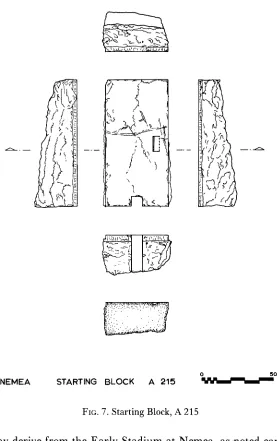
earlier Stadium must be sought elsewhere in the sanctuary. That it might be located close to and east of the Temple of Zeus is an obvious assumption by analogy with the known situa- tion at both Isthmia and Olympia.54 There exist several bits of further evidence for its existence at Nemea somewhere within the Sanctuary proper. One such hint derives from the discovery of a starting block of early type re-used in the Xenon as a threshold in Hellen-
48 Note that a baulk 2.00 m. wide was left between Sections P 13 and 0 13.
49 Pottery lot 0 13:4.
50
Pottery lot 0 13:6.
51 Note that, again, a baulk 2.00 m. wide was left between Sections P 13 and P 14.
52
Pottery lot P 14:11. 53 Hesperia 48, 1979, p. 103.
54 Cf. O. Broneer, Isthmia, II, Topography and Architecture, Princeton 1973, pp. 46-66 (and comments
istic times (discovered at N/19,20-18/20).55 It surely is indicative of an early race track in
the vicinity. An additional piece of evidence derives from the re-use (perhaps as early as the 4th century) of two water-channel blocks as a curbing on the eastern face of the Altar of Zeus at its northernmost preserved end (at M/5,6-11/17,19).56 Finally, the discovery in
4th-century context of a pair of "grooved rollers" (BR 456, BR 457) in Section 0 16 and a
bronze pulley (BR 256) near by in Section N 16 has led to speculation that they may have to do with parts of the starting mechanism or hysplex of the Early Stadium.57
It is an almost inescapable conclusion that the Early Stadium, long out of use by the Hellenistic period, actually lay east of the Temple of Zeus and close to the newly discovered athletic deposit. The yellow clay layer, evidently deliberately laid, had something to do with this Stadium. Thus, in summary, the 1982 season produced tantalizing evidence bearing on the issue of the location of the Early Stadium. Obviously, however, much further explora- tion in all directions is required before conclusions may be reached.
Besides these interesting developments, several further highly significant layers were discovered in P 14. In a test trench dug below the Early Christian farming at the southeast part of the trench (at P/6,9-14/16,20) an amorphous pit58 was discovered to contain car-
bon, animal bones, snail shells in quantity, a bronze arrowhead (BR 1050), and a.consid-
erable amount of ceramic material including a number of skyphoi (P 898, P 899, P 908, P1. 24:b). The latest material dates to the first half of the 5th century.59 Of particular inter- est, however, is a lower level discovered both in this area and in a test at the northeast part of
the trench (at P/4,9-14/2,5, PI. 24:a, visible at the top after excavation). Quantities of Mycenaean material appeared in both trenches,60 including two figurines (TC 165, TC 166, PI. 24:c). A few pieces of later pottery, together with the early material, may be intrusive. In any case, here too, extensive excavation will be necessary to determine the extent and nature of this development. In the meantime, the quantity and the fresh, crisp character of the material is particularly encouraging. All this indicates, for the first time, significant Mycenaean activity in the region east of the Nemea River.61
THE SOUTHERN SIDE OF THE SANCTUARY OF ZEUS
South of the Bath: Sections I 19 and J 19
The bath was substantially excavated in 1924 and 1926 by Carl Blegen and his asso-
ciates. The foundations of all walls and interior column bases were exposed, and the tripar-
55 Cf. Hesperia 46,1977, p. 21 and D. G. Romano, "An Early Stadium at Nemea," Hesperia 46, 1977, pp.
27-31. 56
Cf. Hesperia 45, 1976, pp. 180-182, fig. 4, pl. 30:d. Note that the evidence indicates that the earliest possible period of installation of this curbing is the early 4th century B.C. but that the Hellenistic period is not
to be excluded.
57 Cf. Hesperia 47, 1978, pp. 73-75. The "grooved rollers" were both discovered at 0/20-16/11; the pulley appeared in Byzantine context at N/9-16/1. Two other "grooved rollers" have appeared in Roman context in Sections K 14 (BR 544) and Q 20 (BR 970); Hesperia 48, 1979, p. 75 and Hesperia 51, 1982, p. 32, respectively.
58 The pit itself at P/7,9-14/16,18 covers an area of roughly 2.50 m. on a side. 59
Pottery lot P 14:5. 60
Pottery lots P 14:10, 14. 61
tite sunken chamber in the southwest corner was excavated (Fig. 1).62 In order to carry out this investigation it was necessary to reroute a portion of the Nemea River which in the
1920's crossed over and through the ancient structure.63 Its relocation just west of the Bath approximates its ancient position as is shown by the water outlet at the western end of the sunken chamber, where waste water from the Bath obviously spilled directly into the river.64 The holes for admitting water into the Bath were noted by Blegen, and some parts of
the water conduit or reservoir outside on the south were investigated.65
It is clear from the records that Blegen encountered not only modern intrusions but also Early Christian activity right down into the level of the ancient foundations.66 Other chronological evidence is less certain. Thus, Blegen's proposed construction date for the Bath in the 4th century, which has always seemed eminently reasonable, has never been substantiated by archaeological documentation.67
Among the primary aims, then, in opening the northern parts of Sections J 19 and I 1968 was to try to establish definitively the chronology of the ancient Bath and to search for
the water system which fed it. An additional goal was to ascertain whether the ancient east- west road which borders the south side of the Xenon continued westward behind the Bath toward the Nemea River (Fig. 1). It was soon discovered that answers to these questions would have to await the investigation of a substantial Early Christian house, which lay above in J 19, and the removal of farming trenches of the same period in I 19.
62 The published preliminary reports of this building include Blegen, "Nemea, 1924," pp. 176-179 (there called a "gymnasium") and idem, "Nemea, 1926," pp. 430-431 (referred to as a "palaestra"). It is currently called the Bath as the simplest descriptive name (cf. B. H. Hill and C. K. Williams, II, The Temple of Zeus at Nemea, Princeton 1966, pl. I).
63 It was indeed the protrusion of ancient blocks from the banks of the river which led to investigation of
the building (Blegen, "Nemea, 1924," pp. 176-177). The southern extension of the river, behind the Bath in Blegen's time, was excavated in 1982 (see discussion below and Fig. 6). A road which ran parallel to and east of the river was also removed by Blegen (a plan appears in Nemea Notebook 2, 1924, p. 107).
64 Exploration of segments of the Nemea River, which has meandered considerably over the ages, has taken place in Sections I 14 (Hesperia 49, 1980, pp. 187-190, Mycenaean and Archaic to Hellenistic levels); in I 12 (Hesperia 45, 1976, pp. 177-178, Byzantine period); and G 18, G 19 (Hesperia 50, 1981, pp. 60-62, Early Christian period).
65 Blegen, "Nemea, 1924," p. 178, speaking of the water in the central pool, says: "The small opening by
which it entered from a large conduit, which passes behind the room on the south side, is still preserved." Record of the reservoir-conduit's excavation cannot be found, although the 1982 excavation revealed evidence of previous digging. On the other hand, it must also be noted that repairs undertaken in the 1950's by the Archaeological Service to the "substantial shelter" erected by Blegen over the sunken chamber (Blegen, "Nemea, 1926," p. 430, partly visible on Plates 24:e, 27:a, upper right) caused considerable damage south of the Bath. This damage was not confined to stratigraphic violation but resulted in severe mutilation of parts of the reservoir-conduits, particularly west of center; see discussion below.
66 Cf. Blegen's discussion of "Byzantine" walls and floors which reached some considerable depth ("Nemea, 1926," p. 177). Note also the presence of an Early Christian burial dug through the foundations of the north wall of the Bath at 1/4,5-18/1 (Nemea Notebook 2, 1924, pp. 86-87). The skeleton was never removed and still lies there.
67 For Blegen's 4th-century dating of the Bath, see "Nemea, 1926," p. 179. R. Ginouves (Balanevtike. Recherches sur le bain dans l'antiquite grecque, Paris 1962, p. 133) agrees with a date probably still in the 4th century.
Early Christian Activity
The rubble walls of an Early Christian house began to emerge directly below the modern ground surface in J 19. The plan of the multi-roomed house which they represent has not been fully recovered (cf. Fig. 4) since walls clearly extend southward and eastward. Excavations in Section 1 19 revealed that they did not continue to the west, but references in the records of 1924 to crude rubble walls, large amounts of tiles, and late floors69 indicate that the house probably once extended northwards. It will be noted on the plan, Figure 4, that the well-built wall along the northern edge of J 19 is the south wall of the Bath's eastern room (cf. Fig. 1; PI. 24:e, where it appears to the right). The scarp left by earlier digging is shown just south of the Bath wall (Fig. 4).
The portion of the House currently recovered consists of parts of nine and possibly ten rooms. The walls were built primarily of rough field stones and tiles with the occasional use (particularly in the eastern part) of earlier architectural blocks, including members of the 4th-century Temple of Zeus.70 The walls were approximately 0.50-0.60 m. wide and stood to an average height of 0.10-0.20 m. above floor level. Over this low rubble wall there will probably have been mud-brick upper walls. Bits of plain plaster were found to adhere to the rubble on one wall (so noted on Figure 4 at J/5-19/7).71 The rooms formed by these walls varied in dimensions from roughly one by two meters to a large size of nearly four by more than six and a half meters. Patches of flooring made of flat stone and broken tile were detected in two rooms; otherwise, floors were apparently of the usual beaten earth. The rim of a pithos, partly sunk below the floor level, at J/13,14-19/3,4 (PI. 24:e, f), formed the mouth of something like a shallow basin which was perhaps once fed by a terracotta water channel (of which a segment was found in the north wall of the room at J/13-19/2).72
A thick layer of destruction debris consisting mainly of roof tiles blanketed the area within each room.73 Mixed in with this debris were fragmentary lamps dating to the 5th and 6th centuries after Christ (L 122, L 123, L 145), fragments of glass goblets (GL 24, GL 25, PI. 25:a), much utilitarian coarse ware including amphoras (P 847, PI. 25:b) and lids of several large storage jars (P 846, PI. 25:c), and the arm of a sliding scale, calibrated on three sides (BR 988, PI. 25:d).
The domestic character of the structure is thus well documented, and it is tempting to connect the house with the Early Christian Basilica located not far away to the northeast. Quite possibly the house supplied quarters for the clergy who served the Basilica at some time during its history; certainly, this is the only other substantial construction known to us of this date within the Sanctuary.
69 Nemea Notebook 2, 1924, pp. 61-64. Cf. Blegen, "Nemea, 1926," p. 177.
70 From the Temple of Zeus: a lateral sima fragment, A 186; an Ionic column-base fragment, A 189; an Ionic column fragment, A 191. Note also Blegen ("Nemea, 1926," p. 177) who comments on re-use of Temple blocks in rubble walls over the east room of the Bath. Also re-used in the Early Christian house were other architectural blocks such as a segment of Doric frieze, A 188, which appears to belong to the same series as a triglyph fragment found in Section L 20 (A 149, Hesperia 48, 1979, p. 92, pl. 33:b).
71 One substantial piece was inventoried, Misc. 8; the remainder was kept as pottery lot J 19:72. 72 The pithos rim, not complete, was preserved as pottery lot J 19:71.
I r (
I
2 334,057
/ I
3348 2
334.35 ,.., 34 35
3-iC~~~~~~~~~~~~~~~~~~~~~~~~~~~~~~~~~~~~~~~3&4 DOOR_I
~.~ 333 862 33&924
3 3
5
33AO81 4i5r 3375
~+ +334,1617
+~~~~~~~~~~~~~~~~
4 ~~~~~~~~~~~~~~~~~~~~~~~~~~~~~~~~~~~~~~~~~~~~~~~~~~~~~~~~333.937
Ccawt,if
+ -t- 333 334187 +
- 333.933 3 34.251
5~~~~~~~~~~~~~~~~~~~~~~~~~~~~~~ 7
~Q033srA51
+
4 8
o lO
6
334143 31;
+_ PLASTER
334299~~~~~~~~~~~~~~~~~~~~~~~~~
rWALL 7322
7 33410441
+ 333.157 3 +
0 1
CID 3441
9 334248 s
334391 334.506'
0 10
++++-V+[-+ 12 +3 4 +5 6 7 87 9 + -F- +- 0 1 12 13 +14 +15+16 ++ 17 + 18 19 20 +
SECTION J-19 EARLY CHRISTIAN LEVELS l
FIG. 4. Section J 19, Early Christian levels
H
z >
z
C?
Z
N)
NEMEA
5m
A bit of evidence emerged which shows a relative time sequence between the two build- ings, all the more welcome because of the difficulties encountered so far in attempts to establish a closer dating for the Basilica. The new evidence appeared in the form of a marble offering-table fragment found below the floor of the Early Christian house in context of the 5th to 6th century after Christ (A 185, PI. 25:e).74 On its reverse is a ligature, perhaps most appropriately interpreted as NEO)YTOY (P1. 25:f).75 This piece matches and must be part of the fragmentary table found re-used face down as a floor slab of the baptismal font,
belonging to the Early Christian church (Fig. 1).76 The fragments from the baptistry and
below the house obviously must once have functioned together as an offering table. This will presumably have occurred in connection with some earlier pre-baptistry phase of the Basil- ica. Therefore, the newly discovered house must, like the baptistry, postdate the earliest phase of the Basilica.
Fixing the date more precisely for construction and destruction of the house is, as so often in this period, difficult. It is thus fortunate that certain material discovered beneath the floor levels is closely datable and provides evidence for a very short-lived history of the
house. In addition to lamps of familiar type (L 125, L 126, L 128, PI. 25:g)77 and more fragmentary glass goblets (GL 26, GL 27, P1. 25:a),78 two coins and a plate are extremely
helpful. Of the coins, which are both issues of Justin II (A.D. 565-578, PI. 26:b, c), one was
discovered well below the floor of the easternmost room (C 2223).79 The other appeared in
the fill found with removal of walls in the northwest corner of the same room (C 2234). The
fragmentary plate is a rare (for Nemea) example of African Red Slip Ware. On it are the
poorly preserved traces of two standing figures: they represent the standing emperor wear- ing a tunic and holding a scepter in his right hand, an orb in his left (P 859 a, b, PI. 26:a; the outline of shoulders and arms with orb are visible on the larger piece), and the legs and feet
of a second figure on the smaller fragment.80 The plate is datable to the third quarter of the
6th century after Christ or a bit later.81
Nothing demonstrably later than the coins of Justin II was discovered in the trench. It thus appears that the structure had a very compact history of construction, use, and destruc- tion over a very few decades, probably within the second half of the 6th century. Since there is no evidence of violent destruction in the nature of fire or deliberate demolition, it can best be concluded that the house suffered abandonment and gradual decay until ultimately its tiled roof caved in. The presence of many useful household goods and quantities of coins would seem to suggest that the abandonment was precipitous. Historically, the obvious culprits to have caused such upheaval are the Slavs who swooped down in the 580's. The
74
Pottery lot J 19:17.
751 I am grateful to Ch. Kritsas for this suggestion.
76 For recent investigations in the Basilica see Hesperia 50, 1981, pp. 55-59.
77 L 125 and L 126 come from a pit at J/10-19/7,8 (Deposit J 19:1, pottery lot J 19:17). An iron chisel
(IL 434) was discovered in this same context. L 128 also comes from a sub-floor level (pottery lot J 19:12).
78 From a pit at J/11,12-19/7,8 (Deposit J 19:2, pottery lot J 19:23). Of the fifteen coins in the pit, one
(C 2204) is clearly identifiable as an issue of Anastasius I (A.D. 491-518).
79 From a pit at J/18,19-19/3,5 (pottery lot J 19:38).
80 The larger pieces were found in a pit at J/16,18-19/3,9 just below the destruction layer (pottery lot
J 19:35); the smaller fragments came from well below the floor level (pottery lot J 19:37). 81
suspected consequences of their arrival have been documented elsewhere at Nemea as well.82
There does not appear to have been any architectural predecessor to the newly discov- ered house, but there was a certain amount of farming activity beneath it toward the west- ern side of the Section (at J/5,8-19/3,7).83 It was indeed this activity which evidently led to
the discovery and partial destruction at J/5,7-19/2,3 of a reservoir of the Bath dating to the
4th century B.C. (Fig. 5; P1. 27:a). While excavating this late disturbance a little bronze lion-
head applique was found (BR 1040, P1. 26:d).4 The back surface of the lion's head is quite flat and penetrated by a hole near the center. It must therefore once have been doweled to some flat surface, perhaps a chest or the like.85 Activity, farming or otherwise, was clearly taking place in this area during the period from about the middle of the 5th into the early 6th century, as is documented by lamps86 and coins from levels below the house (C 2240,
Marcian, A.D. 450-457; C 2181, Theodoric, King of the Ostrogoths, A.D. 493-526, PI. 26:b,
c; and C 2177, C 2204, both of Anastasius I, A.D. 491-518, PI. 26:b, c).
Although farming was thus very limited in J 19, it flourished in the adjacent area of
Section I 19 (from which it was separated by a baulk two meters wide). The farming trenches in I 19 ran wide and deep throughout the Section in a north-south direction.87
Whether the inhabitants of the house just to the ease thoued farmed is area cannot be proved, but
it seems a reasonable assumption. The farming trenches themselves were cut into a layer
broadly datable by its ceramic material to the 6th and 5th centuries B.C.88
A grave discovered at 1/5,6-19/4,5 was a further manifestation of later activity in 119. Unusual about this grave was the disarrayed condition of the bones which lay in a basically north-south direction (PI. 26:e). A large storage vessel (P 911, PI. 26:f)89 marked the north end of the grave. Stones found strewn around as well as over the grave may be evidence that the burial was disturbed; certainly, it is singular to find a grave apparently belonging to an Early Christian with this uncanonical orientation. Chronologically, we are aided by the presence of a lamp (L 150) dating to the 6th century after Christ which appeared in the
layer cover ing the grave.90
82
Cf. the situation in the Stadium tunnel where refuge was apparently sought (Hesperia 48, 1979, p. 99; Hesperia 49, 1980, pp. 199-200). For evidence of violent destruction at this period see the Early Christian structures in Sections G 37 and H 36 (Hesperia 45, 1976, p. 202).
83 An elongated pit or gully running north-south at J/4,8-19/2,8 was found dug through a limited series
of east-west farming trenches (pottery lot J 19:64). 84 Pottery lot J 19:69.
85 A precise parallel for the head with its stylized mane, deep-set eye socket, and protruding eyeballs does
not come readily to hand. In general, see H. Gabelmann, Studien zum fruihgriechischen Lowenbild, Berlin 1965; I owe this reference to G. Schmidt.
86 Lamps of this date, preserved in fragments, include L 129 (J. Perlzweig, The Athenian Agora, VII, Lamps of the Roman Period, Princeton 1961, no. 2016, second half of the 4th century after Christ); L 139 (ibid., no. 1743, mid-4th century after Christ); L 137 (A. Bovon, Etudes peloponnesie'nnes, V, Lampes d'Argos, Paris 1966, no. 545, 5th century after Christ).
87 Pottery lots I 19:3, 4. 88 Pottery lot I 19:7. 89
A second, more fragmentary coarse vessel, P 912 a, b, is visible in the photograph, Plate 26:e (pottery lot 119:20).
90 Cf. Bovon, op. cit. (footnote 86 above), nos. 639ff. and Perlzweig, op. cit. (footnote 86 above), no. 2591,
This grave was discovered on the east bank of the river bed found (and then transferred westward) by Blegen, as noted above (p. 83). Fill in the area excavated (at I/2,5-19/2,6, Fig. 6) produced, not surprisingly, modern material.91 The course of the river in Early Christian times was considerably further to the west; its west bank has been discovered some 25 meters west of the 1920's course.92
Hellenistic to Archaic Remains
The remains of earlier times in J 19 are plentiful but, for the most part, enigmatic. Below the Early Christian levels there appeared toward the east a hard, white concretelike
paving (well preserved at J/16,18-19/4,8, Fig. 5; PI. 27:a in the foreground).93 Its surface
was found riddled with pits and cuttings, some of which were shown to postdate the use of the surface. This paving corresponds well with the "plateia" surface of the later 4th cen-
tury B.C. discovered elsewhere in the Sanctuary.94
Beneath this surface was what appeared to be an artificially dumped fill of yellowish
silty earth datable to the 4th century B.C.95 In the course of digging a part of this fill a terra-
cotta aqueduct was discovered at J/12,16-19/6,8 running northeast-southwest (Fig. 5; P1. 27:a, b). Made of terracotta tiles, U-shaped in section, and covered by fragmentary cover tiles and stone slabs, it is highly irregular and unstable in construction and presupposes the silt fill to cover and support it. It is most reminiscent of the similar but better built aqueduct which runs along the south side of the Xenon.96 The assumption has long been that the Xenon aqueduct would be found to continue straight westward to bring water for the Bath. To find it suddenly angling off in a southwesterly direction (if indeed this is one and the same water system) is puzzling.
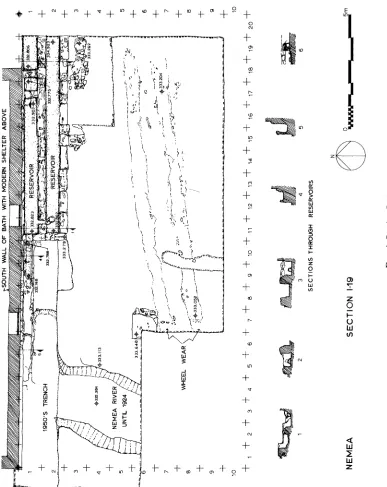
That part of the water system which obviously does have to do with at least the most immediate water supply for the Bath, namely the double-channeled reservoir, also presents some mysteries (Figs. 1, 5, 6; PI. 27:a, c). The system divides into east and west segments separated by a low north-south barrier wall at 1/11-19/1. These segments may best be considered separately, starting with the better preserved eastern part.
The two eastern channels, each ca. 0.60 m. wide, are preserved to a maximum height of 0.75 m. with nothing left to indicate their total original height. Their inner surfaces were once well coated with waterproof plaster, now preserved only sporadically. From their inception at
J/7-19/2 the channels proceed in a westward direction with no visible interconnection until
I/1 1-19/2 where a narrow channel pierces the central dividing wall. A small stone, evidently serving as a stopper, was found wedged in the opening of this narrow channel. Water was thus obviously permitted (at least at times) to flow from the outer southern channel into the inner northern one. Once in the inner channel, it could either flow down a hole in the south wall of the Bath (at I/1 1-19/1) to service the central plunge pool inside or it could continue to
91 Pottery lot I 19:17.
92
See Hesperia 50, 1981, pp. 60-61.
93 Substantial patches appeared at J/13,15-19/5,8 and J/15,17-19/2,3.
94
E.g., in Sections L 14, M 14, M 15, N 15 (Hesperia 46, 1977, pp. 6, 9).
95 Cf. pottery lots J 19:78, 79.
+- +
10
4- 2 +
3
-h
4
4- 6 +
7
+ 8 +
9
+10 10
1-3, + 2 + 3 4 5 6 8 7 8 9 10 + 11 + 12 13 + 14 + 15 + 16 + 17 + 18 + 19 + 20 +
NEMEA SECTION J-19
N
CLASSICAL- HELLENISTIC LEVELS a P^N
00
\0
FIG. 5. Section J 19, Archaic to Hellenistic periods
tz7
X
0
C-
z 0
cn
ts^
1-
1
2
+-
3 +-
5
4-
6
-t
7
-H
c)
tt
t-41
tTI
0
4 t-1 t'l Lt
9 +
10
+ 1 ? 2 - -' 3 ?4 + 5 + 6 ? 7 + 8 + 11 12 13 + 14 15 16 17 + 18 19 20
?~~~81?0
3 4
SECTIONS THROUGH RESERVOIRS
5 6
N
l'
SECTION 1-19 5m
FIG. 6. Section 1 19 10
2
NEMEA
back up toward the east until it reached a barrier at I/17-19/1. Returning to the eastern end of the reservoir and following the northern channel westward, we find it reaching a barrier at I/18-19/1. This barrier, however, is provided with a hole which, when open, allowed water to flow into a tiny square chamber at 1/17,18-19/1 (Fig. 6; PI. 27:c). From here the water could feed into a channel through the south wall of the Bath to the eastern set of tubs. The westernmost stretch of the system, west of the barrier wall at I/1 1-19/1, is much damaged both by the sometime flowing of the Nemea River over it and by more recent destruction.97 Therefore, relatively little can be determined about its original appearance and functioning. No traces remain of a southern channel, and so it is not certain that the western segment of the
aqueduct was double. That it operated on a reduced scale is suggested by the relatively nar-
row width of its partially preserved northern channel which is scarcely more than half the width of its eastern neighbor (measuring ca. 0.35 m. in width). The northern channel is pre- served foy a length of only 2.70 m. at its eastern end, and although it obviously must once have
brought water to the western set of tubs, the direct connection is lost forever. A depression, ca.
0.32 m. wide, in the barrier wall at I/1 1-19/1 suggests that the western extension was fed by an overflow of water from the east across that wall.
It is clear that the Bath boasted in this installation a reservoir system of some sophisti- cation. Is it possible that the extensive holding troughs were intended to take advantage of solar heat?98 Whatever the significance of the arrangement, it is distressing not to have
discovered the source of water which obviously must have fed it. One can only conclude that
some unknown aqueduct must have brought water through an aperture at a higher level on the reservoir walls, no longer preserved. The hypothetical aqueduct will presumably have
disappeared with late disturbances in the area. It is to be hoped that future excavations further south will shed light on this question and also reveal the significance and destination
of the apparently contemporary terracotta aqueduct discovered in J 19.
A verification of dating in the 4th century for the Bath itself emerged with the excava- tion of its foundation trench (along the south side of its south wall) and a segment of a construction layer at J/15,17-19/2,3. Since this construction layer was covered, in part, by patches of the 4th-century "plateia" surfacing and since a 4th-century date emerged from the (admittedly meager) pottery from foundation and construction layers,99 the hypothesis that this structure was part of the large-scale building program of the 4th century is sub-
stantiated.100 Material from an Early Christian context in an upper layer within the reser-
voir channels in I 19 included a pair of handsome terracotta antefixes (AT 148, AT 149, PI. 28:c).101 It is reasonable to suppose that they may once have decorated the roof of the Bath. A lower, cleaner, silty fill produced a lamp fragment (L 146) dated around the 1st
century B.C. to the 1st century after Christ. This may provide a reliable terminus ante quem
for the silting up of the reservoir and the final functioning in antiquity of the Bath.102
97 See footnote 65 above.
98 Cf. Ginouves,
op. cit. (footnote 67 above), pp. 199-200 on heating installations in Greek baths. 99 Pottery lot J 19:91.
100 See footnote 67 above. 101 Pottery lot I 19:12.
102