Research Article
Physiochemical changes in oranges
during different storage durations and
temperatures
Ijaz Hussain
1*, Abdur Rab
2, Shah Masaud Khan
1, Khalid Naveed
1,
Sardar Ali
1, Izhar Hussain
1, Muhmamad Sajid
3and Asif ur Rehman
Khan
41. Department of Agricultural Sciences, University of Haripur-Pakistan
2. Department of Horticulture, Khyber Pakhtunkhwa Agriculture University, Peshawar-Pakistan 3. Department of Agriculture, Hazara University, Mansehra-Pakistan
4. Hazara Agriculture Research Station, Abbottabad-Pakistan
*Corresponding author’s email: [email protected]
Citation
Ijaz Hussain, Abdur Rab, Shah Masaud Khan, Khalid Naveed, Sardar Ali, Izhar Hussain, Muhmamad Sajid and Asif ur Rehman Khan. Physiochemical changes in oranges during different storage durations and temperatures. Pure and Applied Biology. Vol. 6, Issue 1, pp394-401. http://dx.doi.org/10.19045/bspab.2017.60039
Received: 23/11/2016 Revised: 28/02/2017 Accepted: 04/03/2017 Online First: 06/03/2017
Abstract
Sweet oranges were stored in cold storage at room temperature, 2oC, 6 oC and 10oC storages for 0, 15, 30, 45 and 60 days storage durations. After each storage interval, sweet orange fruits were taken outside the cold storage and immediately the data was recorded for different parameters (Juice content, juice acidity, pH, reducing and non-reducing sugars, TSS, Sugar Acid Ratio). After additional seven days of simulated marketing at room temperature (20±2 oC), the data was
recorded for similar parameters and the difference was calculated and analyzed. Highest increase in TSS (0.89), reducing sugars (0.65) and pH (0.27) was observed in 60 days storage. Fruit quality at room temperature deteriorated and registered highest decrease in juice content (5.31), non-reducing sugars (0.29) and highest increase in TSS (0.80), reducing sugars (0.57), pH (0.18) and sugar acid ratio (4.65). Storage temperature of 10 oC proved to be beneficial having lowest increase in TSS (0.28), reducing sugars (0.16) and pH (0.07). It can be concluded that the oranges could be stored at lower temperature below 10 oC for 45 days, however, storage beyond this result in chilling injury which could be avoided by storing the oranges at 10 oC.
Keywords: Sweet oranges; Storage; Chilling injury Introduction
Sweet orange is an important fruit that is
consumed both fresh fruit and juice. It is cultivated over 137 countries is being
produced in all six continents having more production than deciduous fruit. The orange juice is consumed worldwide due to its flavor, nutritional value and biological
active compounds, such as potassium, vitamin C, and amino acids. Limited harvesting period of citrus fruit results market glut, which triggers postharvest losses. The horticulture crops lose their quality quickly during postharvest [1]. The
major limitations in the postharvest
developing countries include ineffective handling and transportation and poor storage [2]. Cold storage slows down metabolic processes during storage. Therefore, most fruits and vegetables are stored at low temperatures to prolong their storage life. However, tropical and subtropical fruits result chilling injuries by storage at lower temperature. Citrus fruits chilling injury symptoms are surface pitting, and fruit weight loss. Chilling injury symptoms may surface during storage but are more significant after shifting the commodity to ambient conditions. Chilling injury of the stored produce results in degradation of the cells structures that release metabolites, which encourage microbial growth. Thus, fruits show increase susceptibility to decay when exposed to very low temperature or for extended duration [3]. Therefore, the present study was conducted to assess the response of sweet orange fruits (cv. Blood Red) in cold storage with additional simulate marketing time.
Materials and methods
Sweet orange fruits (cultivar Blood Red) were harvested from an orchard in District Dir, Malakand Division and transported to Horticulture Lab, Khyber Pakhtunkhwa, Agricultural University, Peshawar Pakistan. Healthy and mature fruits were selected and stored in cold storage at 2 oC for 0, 15, 30, 45 and 60 days storage durations. After each storage interval, sweet orange fruits were taken outside the cold storage and immediately the data was recorded for different parameters (Juice content, juice acidity, pH, reducing and non-reducing sugars, TSS, Sugar Acid Ratio). After keeping the sweet orange fruits at room temperature (20±2 oC) for seven days of simulated marketing time (SMT), again the data was recorded for similar parameters and
the difference (increase or decrease) was calculated and analyzed.
The total soluble solids (TSS) levels of the fruit were determined according to AOAC method [4] by using hand refractometer. Titratable acidity was determined by the standard methods of AOAC [4]. The pH of sweet orange fruit juice was recorded according to AOAC [5]. To estimate the sugars in juice of each treated sample, the method described by Hortwitz (1960) [6] was used. The percent juice contents were calculated by using the following formula;
Percent juice contents = juice weight ÷ fruit weight x 100
Sugar acid ratio/Total soluble solid to acidity ratio (TSS: acidity) was calculated by dividing the total soluble solids by percent acid.
TSS: Acid = °Brix value / Percentage acid Results and discussion
Percent juice content
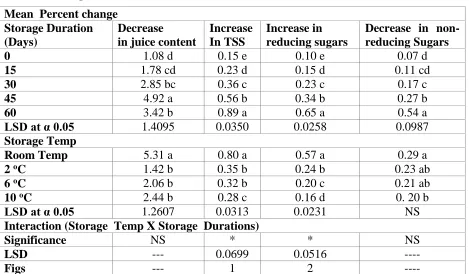
Percent decrease in juice content varied
significantly at different storage
temperatures and durations in sweet orange fruits after shifting the sweet orange fruits to room temperature. Percent decrease in juice content continued non-significantly up to 30 days storage duration from where it registered a highest significant increase of 4.92 % at 45 days storage duration (Table 1). The highest significant decrease of 5.31 % in percent juice content was recorded in room temperature followed significantly by 2.44 % at 10 oC while lowest decrease of 1.42 % was observed at 2 oC. The reduction
in percent juice content at higher
temperatures in both during and after simulated period might be due to increased metabolic activities at higher storage
temperatures leading to enhance
Table 1. Physico-chemical attributes of oranges affected by storage temperatures and durations during shelf life
The means followed by similar letter (s) are not differ significantly. NS= Non-Significant and *= Significant at 5 % level of probability
Total soluble solids (%)
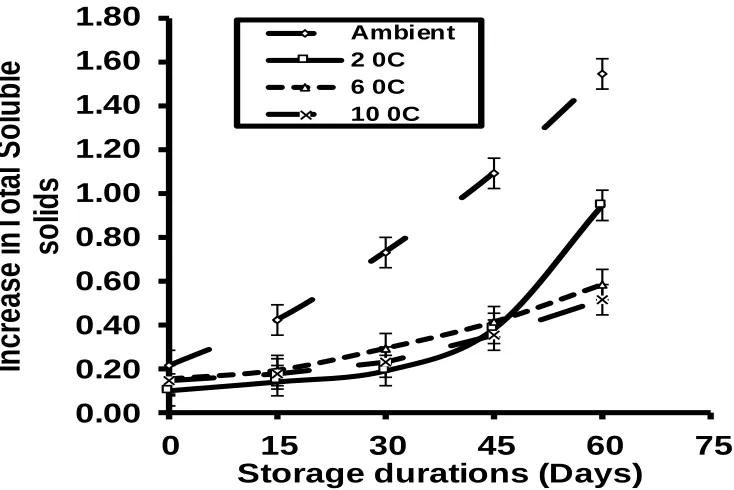
Increase in TSS of sweet orange fruits stored varied significantly at different storage durations, temperatures and their interaction when the sweet orange fruits were shifted to simulated marketing period. The uptick in TSS climbed from the lowest of 0.15 at time zero during shelf life to the significant increase of 0.89 in 60 days storage duration (Table 1). In case of storage temperature, the highest increase of 0.80 in TSS was observed in room temperature followed significantly by 0.35 at 2 oC. The lowest
recorded increase in TSS was 0.28 at 10 oC followed significantly by 0.32 at 6 oC. The highest increase of TSS (1.54) was recorded at interaction of room temperature in 60 days storage period while lowest increase of 0.1 was noticed at 2 oC in zero storage duration with additional SMT (Figure 1). The increased TSS in room temperature can
[8]. Whereas, increased TSS at 2 oC in SMT reflects the onset of chilling injury [9]. Percent reducing sugars
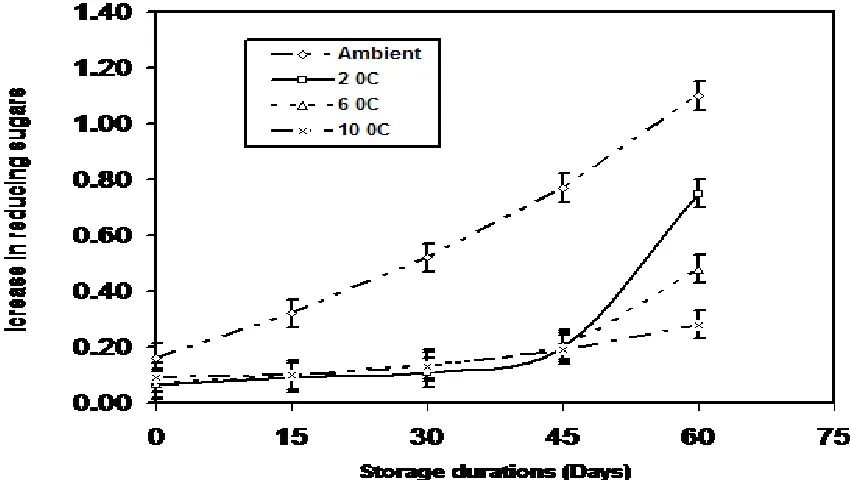
Shifting of the sweet orange fruits to subsequent simulated marketing period witnessed a significant variation in increase in percent reducing sugars at different storage temperatures, durations and their interaction. Increase in percent reducing sugars progressed with the increase in storage duration. The highest increase of 0.65 % was observed at 60 days storage period followed significantly by 0.34 % at 45 days storage duration while lowest increase of 0.1 % was recorded in zero storage duration after SMT followed significantly (0.23 %) at 30 days storage duration (Table 1). In response to different storage temperatures the highest significant increase of 0.57 % was observed in room temperature followed significantly (0.24 %) Mean Percent change
Storage Duration (Days)
Decrease in juice content
Increase In TSS
Increase in reducing sugars
Decrease in non-reducing Sugars
0 1.08 d 0.15 e 0.10 e 0.07 d
15 1.78 cd 0.23 d 0.15 d 0.11 cd
30 2.85 bc 0.36 c 0.23 c 0.17 c
45 4.92 a 0.56 b 0.34 b 0.27 b
60 3.42 b 0.89 a 0.65 a 0.54 a
LSD at α 0.05 1.4095 0.0350 0.0258 0.0987
Storage Temp
Room Temp 5.31 a 0.80 a 0.57 a 0.29 a
2 oC 1.42 b 0.35 b 0.24 b 0.23 ab
6 oC 2.06 b 0.32 b 0.20 c 0.21 ab
10 oC 2.44 b 0.28 c 0.16 d 0. 20 b
LSD at α 0.05 1.2607 0.0313 0.0231 NS
Interaction (Storage Temp X Storage Durations)
Significance NS * * NS
LSD --- 0.0699 0.0516 ----
0.00
0.20
0.40
0.60
0.80
1.00
1.20
1.40
1.60
1.80
0
15
30
45
60
75
In
cr
ea
se
in
T
o
ta
l S
o
lu
b
le
so
lid
s
Storage durations (Days)
Ambient2 0C 6 0C 10 0C noted at 10 oC followed significantly by
0.20 % 6 oC. This data manifests that during storage the increase in percent reducing
sugars is smaller at lower storage
temperature and it further ascended as the storage temperature progresses whereas the data during shelf life shows the opposite trend where the increase in percent reducing
sugars is more at lower storage
temperatures. Interaction of storage
temperature and duration was highest (1.1 %) in room temperature at 60 days storage followed significantly by 0.77 % in same storage temperature after 45 days storage period (Figure 2). While lowest increase
(0.06 %) in reducing sugars was observed at interaction of 2 oC in zero time with additional SMT followed non-significantly by (0.07 %) at 6 oC in same storage period. In subsequent storage period, the highest increase in percent reducing sugars at 2 oC
manifests the onset of chilling injury. These findings are endorsed by Perez-Tello et al [10] who studied the storage of mamey sapote fruit (Pouteria sapota) at different temperatures and reported that sugars (sucrose and fructose) increased at chilling temperature of 2oC and 10oC in mamey
sapote fruits and attributed this phenomenon to chilling injury.
Figure 2. Mean increase in reducing sugars in response to different storage durations and temperatures during shelf life
Percent non-reducing sugars
Vetting the data on percent decrease in non-reducing sugars displays non-significant effect of different storage temperatures
while storage duration significantly
influenced percent decrease in non-reducing sugars in sweet orange fruits during shelf life. Percent decrease in non-reducing sugars aggravated with the increase in storage period. It increased from 0.07 % in fresh fruits after SMT to a significant increase of highest reduction of 0.54 % at 60 days of storage duration (Table 1). In case of storage
temperatures the highest significant
reduction of 0.29 % was recorded in room temperature followed non-significantly by 0.23 % at 2 oC while lowest reduction of
0.20 % was observed in 10 oC followed non-significantly by 0.21 % at 6 oC. It suggests that the reduction in percent non-reducing sugars which were high at higher storage temperatures during cold storage turned to be lower at higher cold storage temperatures
and were lowest at 10 oC during shelf life. Highest decrease of 0.71 % was found at interaction of room temperature storage temperature and 60 days storage duration followed non-significantly (0.66%) at 2 oC in similar storage period while lowest reduction of 0.04% was observed at 2 oC in
zero storage duration with additional SMT followed non-significantly by (0.06 %) 6 oC in similar storage duration.
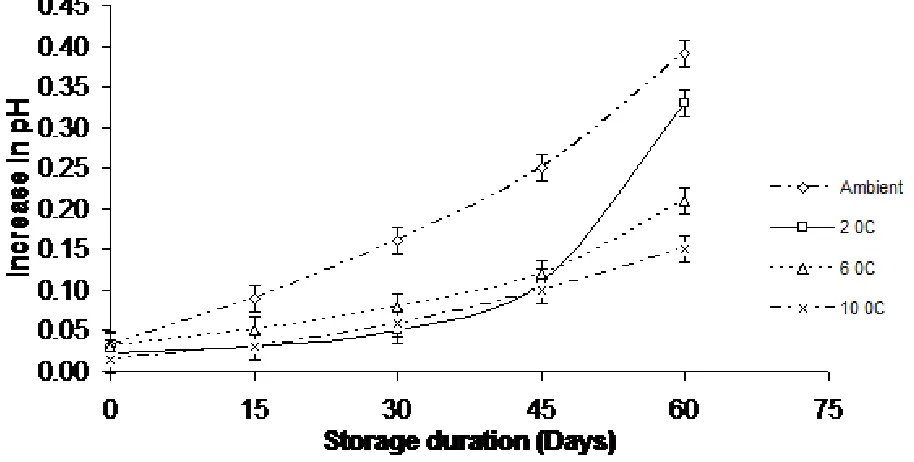
Fruit pH
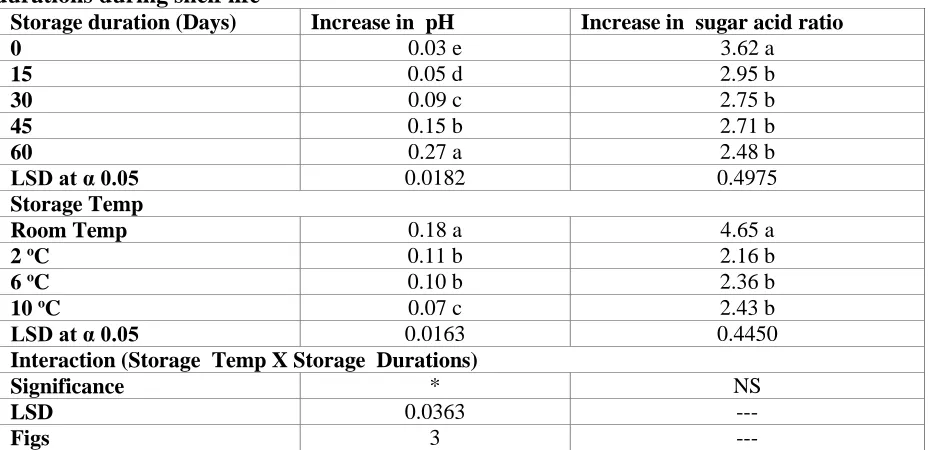
followed significantly (0.11) at 2 oC while lowest increase (0.07) was witnessed at 10
oC followed significantly (0.1) at 6 oC .
Interactive effect was highest (0.39) in room temperature at 60 days storage period followed significantly by 0.33 at 2 oC in
same storage period while lowest increase of 0.01 was recorded at 10 oC after SMT followed (0.02) non-significantly at similar storage period at 2 oC storage temperature (Figure 3). While studying the physiology
and handling of fruits and vegetables. The pH value increased as storage period prolonged. There was a gradual increase in pH during storage of apple from 4.22 at day one to 4.71 at 60 days storage duration [11]. Increased biochemical processes at lower temperature of 2oC in sweet oranges fruits after SMT can be referred to chilling injury that led to rise in pH. The increase in pH might be due to the breakup of acids with respiration during storage of litchi fruits.
Table 2. Physico-chemical attributes of oranges affected by storage temperatures and durations during shelf life
Storage duration (Days) Increase in pH Increase in sugar acid ratio
0 0.03 e 3.62 a
15 0.05 d 2.95 b
30 0.09 c 2.75 b
45 0.15 b 2.71 b
60 0.27 a 2.48 b
LSD at α 0.05 0.0182 0.4975
Storage Temp
Room Temp 0.18 a 4.65 a
2 oC 0.11 b 2.16 b
6 oC 0.10 b 2.36 b
10 oC 0.07 c 2.43 b
LSD at α 0.05 0.0163 0.4450
Interaction (Storage Temp X Storage Durations)
Significance * NS
LSD 0.0363 ---
Figs 3 ---
Figure 3. Mean increase in pH in response to different storage durations and temperatures during shelf life
Sugar acid ratio
Increase in sugar acid ratio during shelf life was significantly affected by different storage temperatures and durations. Increase in ratio was highest (3.62) at zero storage duration during shelf life period followed significantly by 2.95 at 15 days of storage period from where the increase in sugar acid ratio decreased non-significantly to the lowest increase of 2.48 in 60 day’s storage period (Table 2). In case of storage temperatures the highest increase in sugar acid ratio of 4.65 was recorded in room temperature followed significantly (2.43) at 10oC. While lowest increase of 2.16 was witnessed at 2 oC followed non-significantly by 2.36 at 6 oC [12].
Conclusion
It is concluded that oranges can be stored below 10 oC for 45 days and further than this results in chilling injury which can be prevented by storing the oranges at 10 oC.
Authors’ contributions
Conceived and designed the experiments: I
Hussain & A Rab, Performed the
experiments: I Hussain, Analyzed the data: SM Khan, K Naveed & S Ali, Contributed materials/ analysis tools: I Hussain & M Sajid, Wrote the paper: I Hussain & AUR Khan.
References
1. PHDEB (2008). Pre-feasibility study cold
storage. Pakistan Horticulture
Development and Export Board.
2. Rosa S (2006). Postharvest management of fruit and vegetables in the Asia-Pacific region /Asian Productivity Organization. Food and Agricultural Organization pp 312.
3. Mulas MM & Schirra M (2007). The effect of heat conditioning treatments on the postharvest quality of horticultural crops. Stew Postharvest Rev 3: 1-6. 4. Anonymous (1990). Official Methods of
Analysis. Association of Analytical Chemists. 15th Ed. Virginia, Arlington, USA.
analytical Chemists 14th Ed. Washington DC.
6. Horwitz W (1960). Official and Tentative Methods of Analysis, 9th Ed. Association
of Official Agricultural Chemists,
Washington, D.C. 314–320.
7. Shahid NM & Nadeem AA (2011). Effect of bee wax coatings on physiological changes in fruits of sweet orange cv. “Blood red”. Sarhad J Agric 27 (3): 385-394.
8. Rab A, Saeedul H, Shahid AK & Ali SG (2010). Fruit quality and senescence related changes in sweet orange cultivar blood red uni-packed in different packing materials. Sarhad J Agric 26 (2): 222-227.
9. Cohen E, Shapiro B, Shalom Y & Klein JD (1994). Water loss: a nondestructive indicator of enhanced cell membrane
permeability of chilling injured Citrus fruit. J Am Soc Hortic Sci 119: 983-986. 10. Perez-Tello, GO, MA Martinez-Tellez,
Vargas-Arispuro I & Gonzalez-Aguilar GA (2009). Chilling injury in mamey
sapote fruit (Pouteria sapota):
Biochemical and physiological responses. Am J Agric Biol Sci 4: 137-145.
11. Sabir MS, Shah SZA & Afzal A (2004). Effect of chemical treatment, wax coating, oil dipping and different wrapping materials on physio-chemical characteristics and storage behavior of apple (Malus domestica Borkh). Pak J Nutrition 3(2): 122-127.