©2015 JNAS Journal-2015-4-6/687-693 ISSN 2322-5149 ©2015 JNAS
Study of Relationship between customer
involvement and satisfaction, trust and
commitment of customer (Case study: Electronic
banking services of Ansar Bank)
Masoud saleh
1and Amir Akhavanfar
2*1- Department of Executive Management, Islamic Azad University, Golestan Science and Research Branch, Gurgan, Iran
2- Assistant Professor of Payame Noor University, Department of management, Payame Noor University, Gurgan, Iran
Corresponding author: Amir Akhavanfar
ABSTRACT: The purpose of this study is to survey contributing of customer in satisfaction, trust and commitment to achieve this level of customer service survey used simple random sampling method and survey questionnaire Frome customers of Electronic Banking of Ansar bank to collect data From 385. Results analysed statistically using LISREL 9.2 Software. Results of analysis showed that there is a significant Relationship between of customers and satisfaction, trust and commitment of them. Also there is significant relationship between cooperation (permanent partnership) and satisfaction and also between partnership in purchase (partnership) and satisfaction of customer. Also there is a significant relationship between involvement and trust. Also there is a significant Relationship between participation in purchase and commitment. Also Results showed a significant relationship between satisfaction with trust, satisfaction with commitment and trust with involvement commitment.
Keywords: customers involvement, cooperation (permanent participation). Partnership in purchase, (involvement in). Satisfaction. Trust, commitment. Ansar Bank.
INTRODUCTION
Nowadays, the banking industry divided into inside and outside subsidiaries, or in other words, traditional banking and electronic banking which it is inevitable for providing effective financial and banking services, using of information technology and Internet application. In fact, Electronic banking is an optimal integration of all activities in a bank through the application of information technology that can provide all the services required for customers.
Customer satisfaction defined as providing the needs, aspirations and demands of customers. Evaluation of customer satisfaction with the product or service, according to whether the product or service are able to satisfy customer needs and expectations or not? Failure to satisfy the needs and expectations will lead to dissatisfaction about the product or service. Customer satisfaction, increased customer loyalty, and loyal customers spend more money to buy their products or Services of companies.
688
Customer commitment can be defined as a permanent desire to maintain a valuable relationship. It means that committed customers cannot easily influenced by more attractive and alternative relationship. So customer commitment has the same sense of emotional /feeling honesty and perseverance. Many studies have examined the relationship between satisfaction, trust and commitment; they reported that satisfaction, strengthen users’ decision to participate in the delivery services and cover them. It has been found that satisfaction leads to the desired results, such as cooperation, long-term orientation, honesty and commitment in the relationship. (Shankar , 2003) showed satisfaction can impact on honesty and perseverance of customer in online relationships more than offline relationships. Customers can mark more easily their favorite store or even website and announce the next order to services provider. (Fassnacht, , 2007; Garbarino and Johnson, 1999) as well as satisfaction is an evaluation of purpose of the trust and therefore it is precedence on trust. (Geyskens , 1996) Finally, is considered trust as one of the preliminaries of commitment - a long term orientation. . (Dwyer , 1987; Morgan and Hunt, 1994), the relationship which has mutual trust between the parties, helps them to keep their commitments. In the other hand, involvement is a moderator in the relationship between satisfaction, trust and commitment of customers. The results of Sanchez-Franco research (2009) prove the role of the moderation of involvement customer in relations between the satisfaction, trust and commitment of customer. Involvement shows the importance of personal relationships of an object or event. (Park and Young, 1986) according to basic incentives were separated two involvement s: Ego involvement (lasting involvement ) and Purchase involvement (Temporary Involvement ). On the one hand, Ego involvement (or permanent involvement ) refers to a knowledge of the products and services that a customer gets over time. Thus Ego involvement is a function of past experiences of services. On the other hand, Purchase involvement (or Temporary Involvement ) involves time, efforts and invested expense in the shopping which includes Internal and external research and maybe it is preceded on the transaction.
The results of Sanchez-Franco research (2009) show the impact of satisfaction on commitment is dramatically stronger for users with high involvement rates, In contrast, the impact of satisfaction on trust is weaker , but customer trust has a strong effect on the commitment of customers with high involvement and a weak effect on commitment of customer with lasting involvement .
According to the Cited articles, the present study is trying to answer this question, is there any meaningful relation between involvement of customers on satisfaction, trust and commitment of ANSAR bank customers who use electronic services?
Hypotheses of research
1. There is a meaningful correlation between Ego involvement (lasting involvement ) and customers’ satisfaction.
2. There is a meaningful correlation between Purchase involvement (Temporary Involvement ) and customers’ satisfaction.
3. There is a meaningful correlation between Ego involvement (lasting involvement ) and customers’ trust. 4. There is a meaningful correlation between Purchase involvement (Temporary Involvement ) and customers’
trust.
5. There is a meaningful correlation between Ego involvement (lasting involvement ) and customers’ commitment.
6. There is a meaningful correlation between Purchase involvement (Temporary Involvement ) and customers’ commitment.
7. There is a meaningful correlation between customer trust and their commitment. 8. There is a meaningful correlation between customer satisfaction and their commitment. 9. There is a meaningful correlation between customer satisfaction and their trust.
Literature review Customer satisfaction
689
Zhvran defined Customer satisfaction in this way: Customer satisfaction is a condition that the customer feels that the features of product conform to his expectations. Zhvran considered dissatisfied or discontent of customers as a separate concept, defined it like this: Customer dissatisfaction, is a condition which the defects and disadvantages of products cause inconvenience, complaints and customer criticism. According to the scientist, satisfaction and dissatisfaction of customer are not antithetical. In fact, customer satisfaction comes from features of offered product or service, which encourages customer to buy and use it. On the other hand customer dissatisfaction derived of defects and deficiencies in the product or service which causes customers annoyance and complaint. However, it should be noted that even many products that don’t cause customer dissatisfaction, still have low level marketing; the reason for this is the other competitors offer for the product with higher level of features to customer satisfaction (zanjani, 2010: 73).
In general, public and accepted method for understanding customer satisfaction is the Oliver disapproval expecting model. This model disagrees with the attitudes of the shopping experience. Product or service leads to the formation of expectations in the mind of the consumer. After the consumer buys the product or service and uses it, they evaluate the shopping experience and performance of product or service compared to expectations before using, which the results of this assessment determines the attitude of satisfaction or dissatisfaction about the product or service (Carpenter, 2008: 359).
Richheld and Sasser were studied the impact of fight of losing of customers on profit and identified the value of keeping more customers for different industry. The researchers demonstrated that fighting against the losing of only five percent of customers will increase annual income between 25% to 85% for the supplier company; depending on different industries;. Generally customer satisfaction is the main condition for keeping customers although it can be improved customers keeping power with more attention on customer satisfaction. Also customer satisfaction increases the duration of endurance of the customers. In addition, focusing on customer satisfaction role will reduce the development of a negative message by dissatisfied customers of company to the lowest level (zanjani, 2010: 72).
On the basis of a research centers’ studies, it is known that 90% of dissatisfied customers of another company, will never use the intended products or services and to provide their needs will refer to competitors. Also each of these dissatisfied customers will tell their issue to at least 9 people, and 13 percent of these people, will deliver the subject of dissatisfied person to more than 20 others.
There are several reasons that customer satisfaction has a positive impact on the profitability of company:
1. Customers satisfaction result increasing of customer loyalty and affect the purpose of customers future shopping behavior.
2. Customers with high satisfaction will pay extra prices with more willingness and less price sensitivity. 3. Customers satisfaction lead to an increase in entire prestige or credibility of the Company (Yee, 2010: 111).
Trust and electronic trust
Researchers have done extensive studies in the field of trust, For example, researchers have been working in the fields of physics, psychology, sociology, economic exchanges, organization theory and information theory about this issue, But since trust is a multidimensional concept, each of the researchers defined it from their perspective. Therefore presenting one single and agreed definition of researchers perspective is not simply possible. From the psychological perspective, related studies on trust are tended to focus on differences of personality or interpersonal relationships. While from the perspective of sociology, definition of trust is very complex and difficult.
Because trust can be used in different types of relationships and various fields and multiple dimensions. In general, among the various definitions of trust, Benevolence and reliability are known as the components of the infrastructure and basis of trust. Reliability means that the seller has the necessary expertise to perform whole duties effectively and efficiently, while benevolence means the seller positive intentions and that he will behave in a favorable manner with opponent, even when there is no commitment between two parties (Moolering, 2004). Emri and Maccred (2003) defined trust as the intention of voluntary acceptance a person in a psychological state based on positive expectations or behavior which has from others. Also Marsch (1994) defined trust as the acceptance and approval or a tool that reduces the complexity. In another definition, trust as an attitude, is like expectations or persons’ trust which is directly in the same line with a specific topic (Zareie Matin, 2004). Finally, the trust is an individual personality trait that affects on persons’ interactions with the extensive environment that surrounds (Oleary , 1997). Giffen et al (2003) with respect to the previous studies classified the conception of trust into three categories:
1. A set of features, including benevolence, ability and rectitude 2. General belief that the other side can be trusted
690
Also, with the emergence of electronic commerce and extensive transactions through it, discussion of electronic trust in e-commerce issues is propounded and constantly increased the importance of it. In this regard, various definitions of e-commerce have been introduced which some cases point out here. Electronic trust is in the concept of willingness to risk and exposure from other sector activities, based on the expectation that the other part of a particular activity is important for Confiding, regardless of ability for monitoring and controlling that the other side will carry out. In another definition, trust electronic is a personal attitude expected in a situation of trust in online risk which the persons’ vulnerability will not misuse (Qasemzadeh and Safari, 2001). Finally, electronic trust is the willingness of customers to do online transactions with this expectation that the company will fulfill its obligations and will not misuse of its ability to monitoring and controlling (Alvani and Danayifar, 2001).
Customer Commitment
Customer commitment can be defined as a permanent desire to keep a valuable relationship. This means that committed customers cannot easily influence by an alternative relationship with a little more attraction. So customer commitment has the same sense of honesty and emotional / feeling loyalty (Oliver, 1999) and thus should be an evident relationship in targets.
Customer involvement
Involvement shows the importance of personal connections of an object or event. (Park and Young, 1986) according to basic motives separated two type of involvement : Ego involvement and Purchase involvement (situational)
Ego involvement (permanent involvement )
Ego involvement (permanent involvement ) refers to the knowledge about the products and services that a customer gets over time. Therefore Ego involvement is a function of past experiences of services.
Purchase involvement (situational involvement )
Purchase involvement (or Temporary Involvement ) involves time, efforts and invested expense in the shopping which includes Internal and external research and maybe it is preceded on the transaction. Purchase involvement depends on targets and includes individual concern about reduction of risks related with services selection (Bloch, 1983).
The research model
Chart 1. The research model based on the perspective of Sanchez-Franco (2009)
MATERIALS AND METHODS
691
Statistical population, sample volume and sampling method
The study population is consisted of all ANSAR bank customers of the city Ardabil that using of e-services (internet banking, instant banking, mobile banking, telephone banking, ATMs and terminals sales users). Due to the uncertainty of the number of customers, number of sample size was selected according to the formula krejcie - Morgan 385, which was performed by simple random sampling method.
Methods and data collection tools
To develop theoretical basis of research used library method and field data was collected through a questionnaire. At the beginning to prepare questionnaire each of the indices of variables defined, and in consultation and guidance of experts and employees of bank and respectful professors, according to Sanchez-Franco questionnaire (2009), and using of 5 degrees scale of Likert (from very Agree to Strongly Disagree) Designing of questionnaire was conducted. Reliability for variable commitment, satisfaction, trust, Purchase involvement and Ego involvement were 0.8, 0.984, 0.916, 0.875 and 0.730 respectively and total reliability of test was 0.954.
Analysis techniques
In this research, descriptive and inferential statistical methods were used to analyze the data. Which at the beginning each variable described in tables and graphs and statistical indicators through LISREL software and then it is used of path analysis to analyzing the data, hypotheses test and generalizing the results of the sample to Statistical population. Standard estimation table and its significant level are used to investigate the hypothesis.
Table 1. Covariance matrix between the studied variables
Purchase involvement Ego involvement Satisfaction Trust Commitment Purchase involvement 44.725
Ego involvement 12.578 5.356
Satisfaction 14.178 5.269 13.853
Confidence 32.666 10.841 20.33 47.801
Commitment 9.569 3.216 5.825 11.518 6.008
Table 2. summarizes the correlation matrix between the studied variables
Purchase involvement Ego involvement Satisfaction Trust Commitment Purchase involvement 1
Ego involvement 0.812 1
Satisfaction 0.569 0.612 1
Confidence 0.706 0.678 0.790 1
Commitment 0.584 0.576 0.638 0.680 1
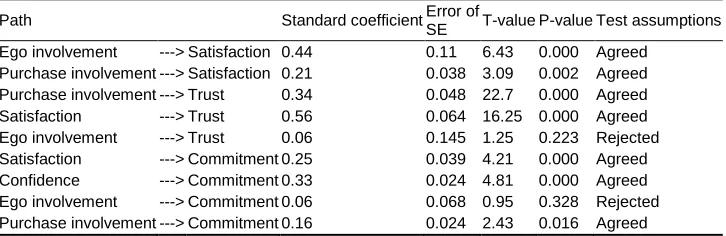
According to Table (3) it becomes clear that there is a meaningful relation between Ego involvement and satisfaction (t ≥1. 96, p≤0.05) and the path coefficient is equal to 0.44. Also there is a meaningful relation between satisfaction and Purchase involvement (t ≥1.96, p≤0. 05) and the path coefficient is equal to 0.21. Also there is a meaningful relation between Purchase involvement and trust (P≤0.05) and the path coefficient is equal to 0.34, between satisfaction and trust (t ≥1.96, p≤0.05) and the standard coefficient is equal to 0.56, Also Satisfaction and commitment (0.25) trust and commitment (0.33) and Purchase involvement commitment (0.16) (t ≥1.96, p≤0.05). In other assumptions because significant level is more than 05/0 thus the null hypothesis is not rejected in them.
Table 3. standard and non-standard variable coefficients
Path Standard coefficient Error of
SE T-value P-value Test assumptions Ego involvement ---> Satisfaction 0.44 0.11 6.43 0.000 Agreed
Purchase involvement ---> Satisfaction 0.21 0.038 3.09 0.002 Agreed Purchase involvement ---> Trust 0.34 0.048 22.7 0.000 Agreed
Satisfaction ---> Trust 0.56 0.064 16.25 0.000 Agreed
692
Discussion and comparison
The results show a meaningful relation between customers involvement (Purchase involvement and Ego involvement) and their satisfaction. In explanation of that, It can be said customers who use electronic banking services of ANSAR bank in their everyday life. It means they are permanently in association with this service and will show Greater incentive to avoid of dissatisfaction after their shopping (Young, 2006). On one hand customers with high levels of permanent involvement and with knowledge and awareness about the shopping services are made better decision which ultimately it increases their satisfaction level (Shaffer, 1997; quoted by Sanchez-Franco, 2009). On the other hand Purchase involvement helps customers during shopping, give considerable time and effort to achieve a wise choice and consequently have a better shopping and satisfaction of service.
It also showed that involvement shopping has a meaningful correlation with Consumer trust. In explanation of that it can be said that customers who have high Purchase involvement, get more familiar with the service and this knowledge leads to ongoing expectations of websites and services which can have a positive impact on their trust (Bourne, 2002). On the other hand customers with high situational Purchase involvement, for reducing level of online risks and increase trust in online services, seek information from official and unofficial sources which this would damage to the trust of these customers.
The results showed a significant correlation between Purchase involvement and their trust. In explaining of that it can be said, when customers are concerned about their decision actually they have deeply interaction in the process of shopping i.e. they have high Purchase involvement, which this leads to a good shopping and as a result, customers will have a great desire to create trust (Sanchez-Franco, 2009).
The results also showed a significant relationship between customers trust and their commitment. In explaining this result, we can say that trust is the most important factor which affecting perseverance and commitment of customer (Sanchez-Franco, 2009). It shows before customer develop its commitment to a service, should have created its trust to the service (Fullerton, 2011). In fact, customer with creating trust dramatically reduces anxious of electronic banking service.
The results showed a significant correlation between customer satisfaction and their commitment. In explaining of this result, it can be noted that satisfaction affects customer's decision to continue to use of banking services. In fact the result of previous studies indicates that satisfaction can lead to desirable outcomes, such as cooperation, long-term orientation, honesty and commitment in the relations. (Ganesan, 1994) (Lam , 2004).
The results of this study also indicate that customer trust and satisfaction has a significant relations. In explanation of this result can be said that customers with high level of trust to electronic banking services avoid of dissatisfaction after shopping and keep the level of their satisfaction of their trusted service.
Suggestions based on results
According to the results of study, as much as customer’s involvement be higher, the satisfaction, trust and commitment of customers of electronic services of ANSAR Bank will be more. Therefore, banks should strive to strengthen the following:
1) Easy and comfortable access to the electronic banking services
2) Design the bank's website properly, so that search and find services easily also beautify the appearance of the website can be a contributing factor in increasing customer involvement .
3) Simplify and shorten the procedures and the process of banking transactions.
4) Advertising and educating customers with providing brochures or TV advertising can also have a positive influence on the increasing of customers involvement .
5) providing the majority of services that presents by Bank subsidiaries through systems like, Internet banking, telephone banking and instant banking, visiting of customers to banks decrease and banking services can receive after office hours and in all time.
6) The existence of necessary security system for electronic banking transactions and funds transporting will provide adequate assurance in customers. This raises customers' trust and consequently will create customer commitment. 7) Discussion about financial insurance taken seriously against any online abuse and possible errors in the payment or receipt of funds, till in the future with development of these systems and raise awareness of customers, tends of permanent involvement in the Bank's electronic services increase in them.
693
REFERENCES
Alwani SM and Danayifar H. 2001. public administration and public confidence, knowledge management; (55)
Bloch Peter H and Marsha Richins L. 1983. “A Theoretical Model for the Study of Product Importance Perceptions,” Journal of Consumer Research, 47(3), 69–81.
Blount Y, Castleman T and Swatman P. 2005. Employee development strategies in the B2C banking enviroment: two australian case stadies. Melbourne: Deakin University.
Bruce Ho CT and Lin WC. 2010. Measuring the service uality of internet banking: scale development and validation. European Business Review , 22, 5-24.
Carpenter Jason M. 2008. consumer shopping value, satisfaction and loyalty in discount retailing. Journal of retailing and consumer services, 15,358-363
“Customer Value, Satisfaction, Loyalty, and Switching Costs. 2004. An Illustration from a Business-to-Business Service Context,” Journal of the Academy of Marketing Science, 32(3), 293–311.
Dwyer FR, Paul Schurr H and Sejo OH. 1987. “Developing Buyer–Seller relationships,” Journal of Marketing, 51(2), 11–27. Fassnacht M and Köse I. 2007. “Consequences of Web-based Service Quality: Uncovering a Multi-faceted Chain of Effects,”
Journal of Interactive Marketing, 21(3), 35–54.
Fullerton G. 2011. Creating advocates: The roles of satisfaction, trust and commitment, Volume 18, Issue 1, January 2011, Pages 92–100.
Ganesan S. 1994. “Determinants of Long-Term Orientation in Buyer–Seller Relationships,” Journal of Marketing, 58(2), 1–19. Garbarino E and Mark Johnson S. 1999. “The Different Roles of Satisfaction, Trust, and Commitment in Customer Relationships,”
Journal of Marketing, 63(2), 70–87.
Geyskens I, Jan-Benedict Steenkamp EM, Scheer LK and Kumar N. 1996. “The Effects of Trust and Interdependence on Relationship Commitment: ATrans-Atlantic Study,” International Journal of Research in Marketing, 13(4), 303–17. Kotler P and Armstrong G. 1999. Principles of Marketing (8th ed.). New Jersey, USA: Pretice Hall Inc.
Lam Shun Y, Shankar V, Krishna Erramilli M and Bvsan M. 2004. “Customer Value, Satisfaction, Loyalty, and Switching Costs: An Illustration from a Business-to-Business Service Context,” Journal of the Academy of Marketing Science, 32(3), 293– 311.
Sanchez-Franco and Manuel J. 2009. The Moderating Effects of Involvement on the Relationships Between Satisfaction, Trust and Commitment in e-Banking, Journal of Interactive Marketing 23, 247–258.
Meyer T. 2006. “Online Banking. What We Learn from the Differences in Europe,” In: Frankfurt Am Main, editor. E-Banking Snapshot, Deutsche Bank Research. DB; 2006.
Meyer T. 2006. “Online Banking. What We Learn from the Differences in Europe,” In: Frankfurt Am Main, editor. E-Banking Snapshot, Deutsche Bank Research. DB; 2006
Morgan RM and Shelby Hunt D. 1994. “The Commitment–Trust Theory of Relationship Marketing,” Journal of Marketing, 58(3), 20–38.
O’leary D, Kuokka D and Plant R. 1997. "Artificial intelligence and virtual organizations", Communications of the ACM, Vol. 40, No. 1, pp 52-59
Oliver Richard L. 1999. “Whence Consumer Loyalty?," Journal of Marketing, 63(4), 33–44. Oliver Richard L. 1999. “Whence Consumer Loyalty?," Journal of Marketing, 63(4), 33–44.
Park Whan C and Young MS. 1986. “Consumer Responses to Television Commercials: The Impact of Involvement and Background Music on Brand Attitude Formation,” Journal of Marketing Research, 23(2), 11–24.
Qasemzadeh F and Safari H. 2001. to the e-government program for Iran, knowledge management, (55)
Shaffer Teri R and Daniel Sherrell L. 1997. “Consumer Satisfaction with Health-Care Services: The Influence of Involvement,” Psychology and Marketing, 14(3), 261–85.
Shankar V, Smith AK and Rangaswamy A. 2003. “Customer Satisfaction and Loyalty in Online and Offline Environments,” International Journal of Marketing Research, 20(2), 153–75.
Vazir zanjani HR, Motameni A and Mousavi Dlazyany H. 2010 Measuring customer satisfaction and after sales service in the industry over the marketing mix for commercial vehicles, Reviews Commerce, No. 40.
Yang SC, Hung WC, Sung K and Farn CK. 2006. “Investigating Initial Trust toward E-Tailers from the Elaboration Likelihood Model Perspective,” Psychology and Marketing, 23(5), 429–45.