PLATE II
In pursuance of the policy of giving annually a general comprehensive account of the progress of the excavation of the American Zone of the Athenian Agora a report is here presentedl of the third campaign of excavation which was begun on February 6, 1933 ancl was continued until July 8. The administrative organization of the enterprise remained the same as it was in the preceding year and the project continued to receive the cordial cooperation of the archaeological and executive authorities of the Greek Government. Several changes in the scientific staff should be noted. The withdrawals were F. 0. Waage who had completed a three years' term of service as Agora Fellow, Mrs. Artlhlur Parsons who rendered valuable service in the cataloguing department, and Mrs. Mary Wyckoff Simpkin who had completed a three year term an d whose subsequent untimely death brouoght to an end a most promising career as an archaeological artist. The additions to the staff were J. H. Oliver and A. W. Parsons, Agora Fellows, Miss Gladys Baker and Miss Mary Zelia Pease in the coin department, Mrs. Joan Bush, photographer, and Piet de Jong, artist.
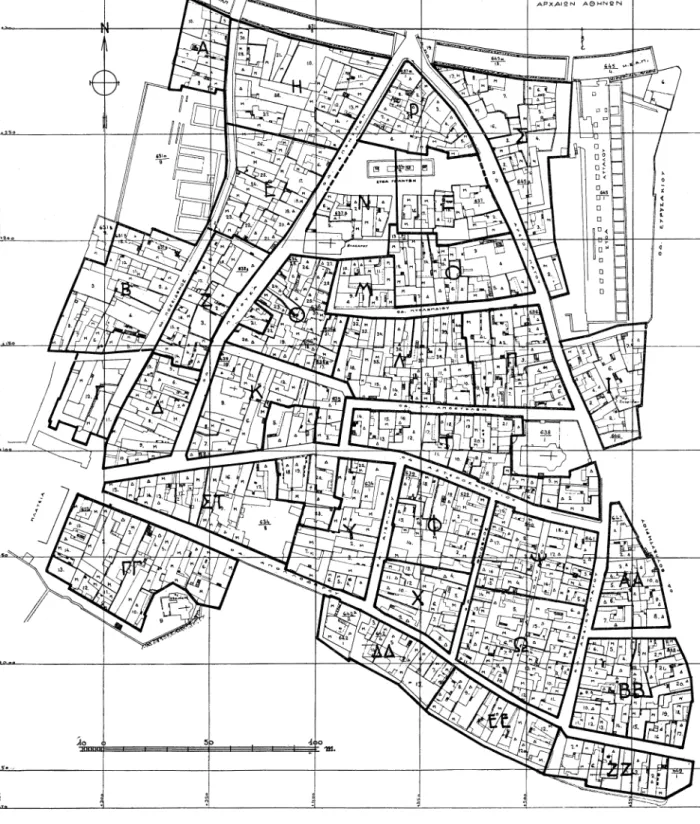
Excavations were conduieted in four city blocks after the modern lhouses there located had been demolished and removed, and in the course of the seasoni 23,000 tons of earth were cleared from a total area of about two acres. The sectors of excavation, whicih are designated by the Greek letters Eta (HI), Zeta (Z), Theta ((), and Iota (I) are marked on the plan of the American Zone which is reproduced in Fig. 1. The relation of the excavated area to the neighboring landmarks is clearly shown in the photograph taken at the close of the season from the air by the Greek Air Service through the courtesy of the Mlinistry of Communications, and reproduced as the Frontispiece of this Number (Plate II). The limits of the Zone can be readily identified by the roadbed of the Athens-Peiraeus electric railway on the north, by the Stoa of Attalos on the east, by the Acropolis and Areopagcus on the south, and by the "Theseum" on the west. The view also illustrates the position of the American Zone in reference to the site of the excavations of the German Institute at the Kerameikos in the upper left corner; and in the right centre of the picture appears the Roman Agora which is being excavated by the Greeks.
American School of Classical Studies at Athens is collaborating with JSTOR to digitize, preserve, and extend access to
Hesperia
'7 4.~~~~~~~~~~~
/ 3 3~~~~~~~~~~~~~~~~~~~~~~~~~~~~~~~~~~L
7. 33.7~~~~~~~~~~~~~~~~~~~~~~~~~~~~~~~
3. 3 '72 33. 33 8.3~~~~~~~~~~~~~~~~~~~~~~~~~~~~~~~~~~~~~~~~~~~~~~~~~~~~~~~~~~~C -1-~~~~~~
4. 7 3~~~~~~~~~~~~~~~~~~~
3
~ ~ ~ ~ ~ ~ ~
~~~~~~~~3.-~~~~~~~~ 833~~~~~~~~~~13
33~~~~~~~~~~~~~~~~~~~~~~~~~~~~~~~3
3 ~~~~~~. 3 '7~~~~~~Z
12~~~~~~~~~~~~~~~~~~~~~~~~~~~~~~~~~~~~~~~~~~~~~~~~~~~~~~~~~~~~~~~~~~~~2
SECTION ETA
The most northern area of the excavations, Section Eta, is situated between Poseidon and Eponymon Streets, east of the Kolonos Agoraios on which stands the " Theseum." Because of the large size of this area it was divided longitudinally for excavation with Dr. Thompson in charge of the work on the west side and Dr. Oliver supervising that
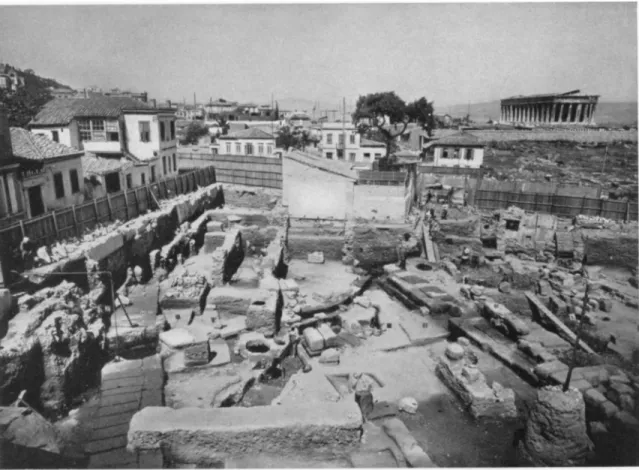
Fig. 2. Section Eta during Excavation
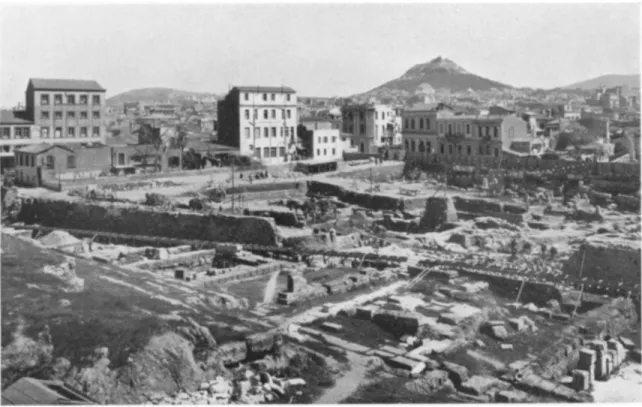
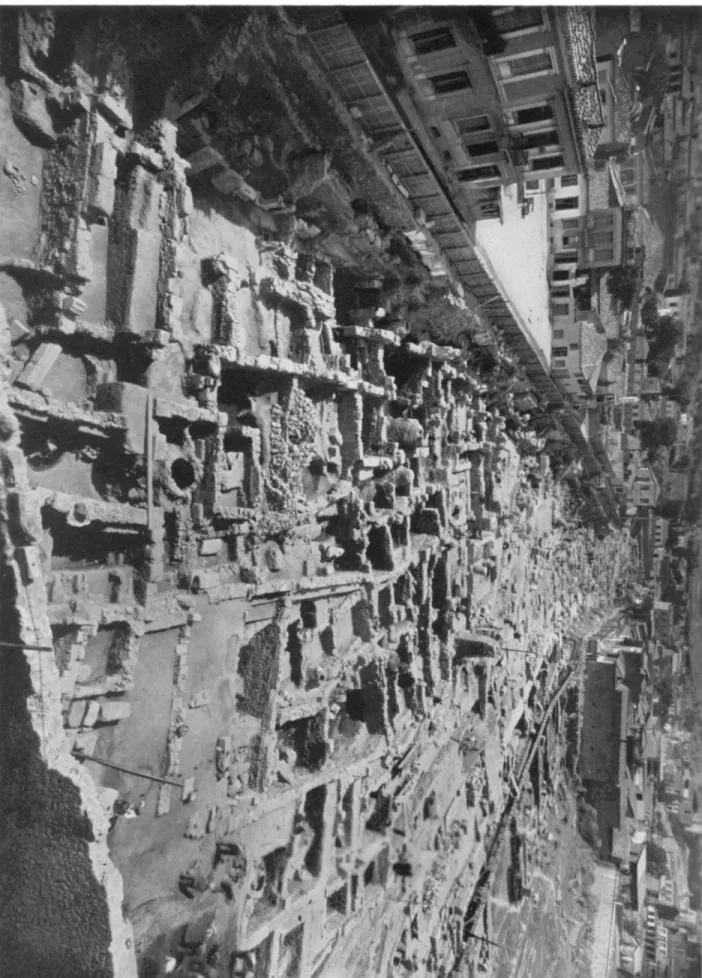
on the east. A view of the area as it appeared durino the progress of the excavation is shown in Figure 2. The picture which was made from the terrace in front of the " Theseum " gives a view towards the northeast with Mt. Lyeabettus in the distant background. In the foreground are the ancient foundations which were uncovered by the Germans in 1896 and by the Greeks in 1907. The partly demolished wall extendingr across the centre of the picture is all that remains of the northern end of Poseidon Street and this, too, had been removed by the end of the season when the photograph reproduced in Figure 3 was made.
l
* i l
I
-
N -
lI |
I _ , I I 1, , | 1 1;
l
I S ,,1
I 1 1
l
| 1
| 1
I-
|
z C l
l
l
building. Many smiiall fragmiients of architectural memlbers had much blue color preserved on them and thev, as well as two drums of Doric columns, exhibit a fine type of workmanshil) characteristic of the style of the latter part of the fifth century B.C. Indeed.,
thle earth in front of tlhe stoa was filled with broken pieces of mlarble and among these were lying shattered fragmenits of two marble statues of a wingeod Nike. of wlhich one is fairly well preserved and will be described in a later article in this Number of Ilesperia.
The date when the general (lestructioli occurred in this region is proved by the lamps, pottery and coins in the (lebris to be the end of the fourth century after Christ.
At a depth of ten to twelve feet below the modern surface this area is crowde(d with walls of houses of the Byzantine period. The walls at the north end constitute a single large buildinig. These walls appear in the right foreground. of Figure 3, which gives a view fromyi the northl of the complete extent of the area of excavations on the west side. T'he east, south and west limits of the Byzantine building are preserved, but on the north it is cut by the railroa(l. It measures 48 m. froiy east to west and over 30 in. from north to southi, andc is divided into. 28 iooms that are groupe(d about a central couLrt. The fouiidations are of rubble, be(dded in clay and laid in narrow trenches. and the floors were made, of packed dirt. It may be deduced from the plan of the buildin(r as well as fr om its unpretentious construction that the rooms were used for shops or for modest private (dwellings.
Evideilce for dating the structture is provi-\ded by coins found directly under the floors that belongb to the elev-enth and twelfth centuLries. None was secure(l that is later than the twelfth centuiry. The filling ovTer the floors containe(1 mostly Franikish coins and the building, therefore, seemns to have been aban(lone(d in the thirteenth or fourteenth century. 13eneath this building, traces of a strtucture of earlier Byzantine times were noted, and at a lower level appeared the walls of a Rtomnan building.
The walls of the Roiman period have a different orientation fromn those of the later buildings. This difference is clearly visible in the photograph from the air shown in Figure 4. The suiperimposed walls (mlarked by an arrow) appear in the centre of the excavated area, just south of the railroa(l. The plan of the buildinig, which measures 27.50 rn. by 24.80 m., consists of a series of rooms that occupy the four sides of a rectangle and aire separated by a continuous corridor, ca. 3.20 m. wide, from an interior rectainguilar area, wlhich was perhaps a colonnaded courtyard. Four rooms are on the south side anid five oni the west. The foundation walls are made of hard concrete that was poured into treniches cut in the earth. No traces of the floor are preserved since it was thoroughly destroyed in the construction of the Byzantine buildings above.
T'he approximate date of the Roman building is derived from the context of the stratificationi around a water-pipe which passes throuLgh its west wall near the northwest cornier. This pipe is imbedde(d in the concrete and must, therefore, be contemporary with the building. The layer of earth about it yielded late Roman pottery arid late larnps of the type dated in the 4th to 5th centuries A.D. Sinmilar objects of like date
I
| 1i
l
!
l
I E
E
I .
!
I r
r. i sW
immediately after the laying of the pipe for otherwise the pipe would have been trampled and broken. Confirmatory chronological evidence is provided by the coins found in this stratum, which include three of Constantius II, 323-361 A.D., one each of
Valens, 364-378, Valentinianus II, 375-392, Arcadius, 395-405, and three of illegible type of the Roman fourth century period.
Dr. Thompson, from whose report of this excavation is taken the account here given, suggests that the construction of the Roman building, which must be dated at earliest
;, - ;~~~~~~. .. VI"
Fig. 5. Site of Mycenaean Grave
A surprising discovery in this sector was that of a Mycenaean burial. In a small area surrounded by the walls of Byzantine houses the scant remains of three skeletons were lying close together just beneath the floor level of the classical period. Figure 5 shows this pocket with the Byzantine walls on either side of it. The bones had been disturbed and the pottery associated witlh them was in fragmentary condition. Parts of
Fig. 6. Sher-ds from Mycenaean Grave
five vases were secured, as illustrated in Figure 6, but all are far from complete. The shapes include a one-handled jug- and a small jar with horizontal handles which is decorated with spirals on its shoulder. Thie ware belongs to the late Mycenaean period (L.H. 1II), dating- from about 1200 B.c. The burial also yielded one blue glass bead and
a gold
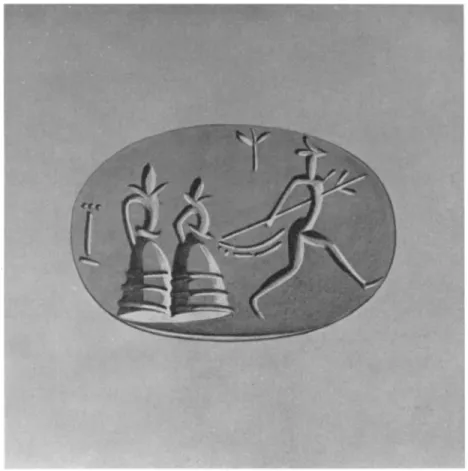
signet ring.'The ring, is decorated with an interesting scene that evidently has religrious or sacrificial signifi6ance (Fig. 7). A group of three persons, two women and a man, is
IThe dimensions of the ring are: diaim. of hoop: 0.016 in.; length of bezel: 0.019 in.; width of
represented. On the right the man, who is apparently nude except for a loin-cloth, is striding to the right holding a long staff in his right hand. Near the top of the staff are two prongs which, however, extend upwards and not downwards. This is nlot a suitable shape for the tip of a spear, nor does the smooth straight shaft resemble the branch of a tree. The object may be more reasonably interpreted as a scepter. The man's left arm is concealed by his body, but he is evidently holding with the left hand one end of a double cord of which the other end is fastened to the waist of the foremost of the two women. A small stroke extends diagonally beyond the man's left shoulder but its significance is not apparent. The women are dressed in characteristic Creto- Mycenaean costume, with ruffs around the neck, with thick rolls about the waist, and with longf flounced skirts. The position of
their hands behind their backs gives the im- pressioln that they are bound.
The heads of the figures are of the crude unformed type that frequently appears on the seals. This characteristic is well illustrated in the enlarged drawing by Mr. Piet de Jong reproduced in Figure 8. The head of the goddess on the Late Minoan gold signet from Mochlos is represented in a similar sketchy form (R. Seager, Explorations in the Island of Mochlos, p. 90, fig. 52. Cp. A. Evans, The Palace of
Ilinos, II, 1, p. 250, fig. 147). But on the seal from the Agora a distinction in shape is made between the head of the man and those of the women. The aspect of the head of the male
figure suggests an animal type and I have proposed the interpretation of the figure as the bull-headed man, the minotaur, wlho is leading the captive Athenian womien to the sacrifice (A.J.A., XXXVII, 1933, p. 540). If it be arg-ued that the conventional rendering of the women's heads implies a similar convention for the head of the man, thiere still remains the significant scene of two captive women being, conducted by a man who is carrying what may be possibly interpreted as a scepter. Such a group may be quite as cogently associated with the later legend of King Miinos and the Athenian maidens as the scene on a gold seal from Thisbe is with Oedipus slaying the sphinx (Evans, Palace of Minos, III, p. 418, fig. 282), or as that on a sealing from Knossos is with Odysseus and the dog-headed monster Skylla (Ibid., I, p. 698, fig. 520).
Seals of this type usually bear cult scenes, as Mr. Seager lias pointed out (op. cit., p. 90), and in the present instance the sacral significance is indicated by a small column on a base with a top made of three small beams. There are slight traces of an object, perhaps a bird, above the table, but they are so indistinct that they were not included in de Jong's drawing. In the space between the man and the women, near the upper
edge of the bezel, a symbol is represented that resembles a Minoan alphabetical sign (Evans, Palace of Mlinos, III, pp. 406 and 407, figs. 269 and 270). But since we are evidently dealing with a sacrificial or cult scene this object may have some occult significance and may be interpreted as the soul of the dead appearingf as a highly con- ventionalized butterfly (cp. ibid., pp. 151 and 152). The ring clearly has close Minoan
Fig. 8. Design on Bezel of Ring. Scale 4: 1
affiliations but it is impossible to determine whether it was itself imported from Crete or was made locally by an immigrant artist.
repairs were made. All the objects found in the drain antedate the beginning of the fifth century of the Christian era, and the orientation of the Roman building at the north end of the area is adjusted to the course of the drain, while the overlying Byzantine walls are built in disregfard of it. But in spite of the clogging of its channel with earth this drain must always have served to some extent to carry away by seepage the surplus water of the district. It has now been thoroughly cleared so as again to function, as it did in antiquity, as the principal drain of tlle Agora.
On the east side of the area, at a depth of between five and seven metres, substantial foundations of the Greek period were uncovered. They have an east to west orientation, but since they pass out of the area beneath Eponymon Street their further investigation mtust await the expropriation arid excavation of the blocks lying east of the street.
SECTION ZETA
The second area of excavation, Zeta, is also situated between Eponymon and Poseidon Streets, and is bordered on the north and south by two areas previously excavated, Sections Epsilon and Delta. The air views again distinctly show how the clearance of this area revealed the extension of the great drain that passes through the lnorthern sectors. It here makes a bend to the east and at the eastern edge of the area branches into two forks, of which one leads to the east and the other to the southwest. Since the drain followed the course of the ancient road it is clear that two routes led out of this part of the Agora, one passing between the Acropolis and the Areopagus and the other between the Areopag-Lus and the Pnyx.
The drain in this section, as elsewhere, was originally constructed of polygonal masonry in the style of the sixth century B.C., and was repaired at sundry later times.
It had been observed that in Section Epsilon inscribed stelae had been re-used in connection with such repairs so that no surprise was experienced when stelae were found similarly used here. But it was cause of much gratification that one stele, which was inscribed with a lolng decree, was completely- preserved. The inscription happens to present some serious chronological problems which have not yet been solved. The decree was issued in the year of the archon Philon, "the one after Menedemos." Philon was archon in 178-177 B.C., and the style of the writing and the deme of the secretary
accord with that date. But Menedemos is placed on ratlher scanty evidence in 92-91. The new document, therefore, necessitates a change in the position of Menedemos and the assumption of another anterior archonship of Philon of which nothing is otherwise known. The inscription is now being studied by the epigraphical specialists of the staff.
According to the usual interpretation of the description of the itinerary of Pausanias the sanctuary of the Mother of the Gods should be located in the vicinity of this area of the excavations. Topographical significance, therefore, is attached to the discovery
here of several roof-tiles with dedications to that goddess. Figure 9 shows part of one of the tiles with the inscription partially preserved. By the combination of other frag- mentary tiles the entire inscription is found to read: IEPAN MHTPI EEQN AIONYXIOX KAI AMMQNIOM (cp. I.G., III, 206).
Besides the tiles, marble statuettes of the goddess in relief were also found. In one case she is seated on a throne in a small shrine and has a lion by her side, while another example represents her as holding a tiny lion on her lap. These reliefs are illustrated in a later article in this Number dealing with the sculptural discoveries of the year. We know that the cult statue of the sanctuary was made by Phidias or his
Fig. 9. Roof-tile with Dedication to the Mother of the Gods
pupil Agorakritos and that the goddess was represented as seated with a cymbal in her hand and with a lion beneath the chair. Although some foundations of substantial buildings, were uncovered on the west side of this area it was not possible to make any definite topographical identifications prior to the extension of the excavations to the block adjoining, on the west.
SECTION THETA
course that was afterwards abandoned, and the later of ashlar masonry. At the south end of the drain, where it reaches the limit of the current excavations, a water source was tapped from which flows a small but steady stream, that caused much inconvenience to the progress of the work. With the clearance of the entire channel at the close of the season this water was directed in its natural course throug,h the drain to empty into the main city pipe at the north edge of the American zone.
Fig. 10. Foundations of South Stoa
The principal discovery of topographical interest in this area is the foundation of a large rectangular building which extends east and west through the entire sector for a distance of 53 m. Since the building passes beyond the excavated zone at both the east and the west sides its complete dimensions will not be available until the adjoining areas will have been cleared. The north and south walls are powerfully constructed of four courses of large blocks of conglomerate, with a row of bases for columns set in a parallel line half way between them (Fig. 10). The archaeological evidence, such as pottery, lamps, and coins, found in the trenches cut for the setting of the walls, proves
that the foundations date from the Hellenistic period, perhaps the second century B.C.
The foundations are later than the water channel that passes through them because the construction of the wall at that point is adjusted to the necessity of leaving the course of the channel unimpeded. The size and shape of this building suggest its interpretation as a large stoa that may have bordered the Agora on its south side.
On the west side of the area the walls of a small building were partially cleared. The investigation of them has not been completed because on the south they pass beneath the modern house that serves as an office for the Director of Excavations and could
Fig. 11. Room with Trianguilar Base
The clearance of several wells in this area brought to light objects of varied date and character. One well, which contained a uniform deposit dating from the second and the early part of the third century after Christ, was lined with superimposed series of large curved terracotta tiles. The shaft extended to a depth of 11.50 metres. Between the seven and nine-metre levels forty-five inscribed lead tablets, plus some fragments, were found in association with many
coarse pots, lamps, and terracotta figurines. The tablets, with two ex- ceptions, are tightly rolled and folded as may be observed in the case of the group selected for illustration in Figure 12. The two fragmentary tablets, which were found in an unfolded state, are closely covered with writing in cursive script of the second century after Christ. They belong to the familiar group of curse tablets, tabellae defixionum, and contain curses in the names of strange deities, Sabaoth, etc., such as are associated with the Gnostic religion (see the collection of such tablets published by Wiinsch in I.G., III, 3, Appendix). Similar tablets were discovered in the sanctuary of Demeter at Knidos and in shrines of other underworld deities, but they are usually found in wells. The practice seems to have been to invoke the curses of the gods on one's enemies, listing them carefully by name, then to fold the tablet so securely that only the gods could know the contents, and
finally to cast it into a well. In addition to the improbability of the object being fished out of the well, the water may have been considered to have had some magical significance. Or a deep well may have been regarded as an appropriate receptacle of something destined for the underworld.
Only one other object from this area will be illustrated here. This is a black-figured scene of the combat between Herakles and the Amazons that is painted in bright colors on a panel within a meander border (Fig. 13). The piece is slightly curved and evidently formed one of the legs of the support for a vase such as a brazier or a pyxis. It is chipped at the top and is broken on the left side but the shape precludes any considerable
extension of the scene to the left. Herakles is represented in battle with four Amazons. He is advancing to the right with a spear poised in his upraised right hand. The shaft of the spear is rippled but since the weapon is held in the hand this rippling can hardly be intended as the conventional representation of the quivering of a shaft in flight (Cp. J.H.S., XXXII, 1912, p. 349). Herakles is wrapped in a large lion's skin that is spotted with purple dots. In front of him one Amazon is prostrate on the ground, dying from the effect of wounds
,,~~~~~~~~~~~~~~~~~~~e
__
t~~~~~
M
_VN,~~~~~~~~P
Fig. 13. Combat of Herakles and Amazons on Black-figured Panel
SECTION IOTA
The fourth area of the current excavations is situated on the extreme eastern edge of the American zone, just south of the stoa of Attalos. This area was selected for investigatioil because of the promising depth of soil, because of the fair degree of
I I 11 | 111 *11 111 | 11 | I 1|1 1 - | I 1||||l *||1 1~~~~~~~~~~~~~~~~~~~~~~~~~~~~~~~~~~~~~~~~~~~~~~~~~~~~~~~~~~~~~~~~~~~~~~~~~~~~~~~~~~~.E" 0,1.1
Fig. 14. Section Iota frorn Northeast
preservation of the walls at the south end of the stoa, and because of the desirability of making a trial at some distance from the main field of excavation. The important results achieved confirmed the wisdom of the selection.
frescoes which will be discussed by Miss Alison Frantz in a separate article in this Number of Ilesperia.
The excavation of this area was conducted under the supervision of A. W. Parsons and his notes furnish the basis for the account here given. A street passed from north to south throug,h this part of the Agora and its course was probably continued on the east side of the Areopagus to the entrance of the Acropolis. Just south of the stoa of
Fig. 15. Marble Pilasters and Threshold
in the middle of the west face, where the discoloration of the marble indicates the original presence of a decorative bronze spout, such as a lion's head. Although this portal is later in date than the stoa of Attalos its exact period has not yet been determined. It certainly belongs to the Roman age when it was one of the main routes between the Greek and the Roman markets.
The most conispicuous monument that was uncovered in this sector is a great wall which extends in a general north and south direction throughout the area. This wall is
Fig. 16. Columns used in Filling, of Wall
disposition of the blocks as building material for the wall. Since the series of units does not exceed four.it seems probable that the original structure had only four columns. One of the columns has been drawn by Charles Spector (Fig. 18). It has not yet been possible to identify the building to which these columns belong.
The variety of style and type of the re-used architectural members proves that they are from more than one building and inscribed dedications suggest possible sources for them. One inscription on an arch-itrave block bears the name of the archon Herodes, son of Eukles, in whose term of office the building from which the block came was
Fig. 17. Drums of Columns and Marble Blocks in Wall
constracted. This archonship is probably to be dated in the. middle of the first century A.D., according to Oliver who has published the inscription in this Volume of
Hes.peria, p. 59.
Another inscription is cut on a -large lintel block, 2.62 m. long, from the doorway of a previously unrecorded building. The stone is built into the east side of the wall just below the southwest corner of the Byzantine chapel. It is shown in the position in which it was found in Figure 19. The block is edged with a series of neatly carved mouldings within which is a dedication in four lines with handsome letters. The dedication reads as follows:
SecundLilla, has dedicated from his own means the outer stoas, the peristyle, the library with its books and all the decorations in the building.
Since Trajan is here called Germanicus but not Dacicus, a title granted in 102, the date of the inscription must be close to 100 A.D. The reference is evidently to a pretentious
0~
a
4? ~5CAL E ON E 4MET 2E vE A5 FI FTY vMETZ2 S
o 3 4M
Fig. 18. IReconstructed Column from Drums and Capital in Wall
cp. P. Graindor, Ch1ronologie des Archontes Athe'niens sous l'Empire, p. 109). It is surprising that a library dedicated to Trajan should have existed in such close proximity to the Library of Hadrian. Its discovery is of importance both from the historical and from the topographical points of view, and is an instructive reminder of the many gaps that must exist in our list of the monuments of the Agora, compiled from the references recorded in ancient writings.
Figure 20 gives a view of the wall from the south with the Byzantine chapel on the east side and the stoa of Attalos extending in the distance to the north. A section of
Fig. 19. Dedicatory Inscription of Library
the wall in front of the stoa was demolished when that building, was excavated but definite evidence for its date has never been secured, so that it has been assigned to periods as diverse as those of Valerian, 253-260 A.D., of Justinian, 527-565, and of the
-
-M-
-~~~~~~~~~~~~~~~~~~~~~~~~~~~~~~~~~~~~M
-
-
-
thus fixed in the latter part of the third century, is not far from the reign of Valerian. Already in the fourth century, beginning in the time of Constantius II, 323-361, layers of debris had begun to be piled up against the lower courses of the wall on the side adjoining the street. It is planned to conduct further investigations about the wall, at the conclusion of which the subject will be fully discussed in a special article by Mr. Parsons. Two towers were uncovered in the area, one at the north end and the other at the south; the latter appears in Figure 21 with the paved street of the Roman period beside it.
Fig. 21. Corner of the South Tower of the Wall
Since these towers abut on the west side of the wall it is clear that it was built to protect the limited part of the city lying to the east. Not only were architectural blocks used in their construction but pieces of sculpture were also employed for the same purpose, as they were in the wall of Themistokles many centuries earlier. A marble base with the relief decoration of a quadriga was taken from a wall of the north tower, and a statue of a woman was found imbedded in the south tower. Both these sculptures will be discussed in a later article.
interesting conduits, and the one which happens, also, to be the best preserved, is illustrated in Figure 22. This system consists of terracotta sections that are fastened together with double interlocking joints in which no trace of cement or lead has been
Fig. 22. Water-pipe of Sixth Century B.c.
channel that is cut in the bedrock. All the potsherds from the earth in this channel date from the sixth century B.C., and nothingf later than that period was found there.
It is, therefore, certain that the pipe was laid at that time, and apparently the troug,h was not opened at any later time for the purpose of cleaning the interiors of the sections. This deduction is confirmed by the tight fit of the stoppers which show no traces of ever having been pried open. The size of the pipe, the care in its construction, the close-fitting joints, and the provision for cleaning indicate that this was a conduit for
gf Z .4 .S S t
L O N G I T V D I N A L fE C T I N E L E V A T I O N OF
T O P E L E V A T I O N M A L L E N D
02 4 6 8o40 5 20 P5 30 3M 40 45
Jf C A L E LL l I | X I I I Xl | | I I I I Mi C M Jf
Fig. 23. Sectional Plan of Water-pipe
fresh drinking water. At a later stage of the excavations, when a larger area of the Ag,ora shall have been cleared, it may be possible to trace this pipe to its source, and it may prove to be part of the same conduit to which belong the sections of pipe of very similar construction that were found in the excavation of Dorpfeld's Enneakrounos at the base of the Pnyx and are dated in the time of Peisistratos (see Fr. Graber in Ath. Mitt., XXX, 1905, pp. 24-25, figs. 7-8).
In the southwestern corner of this same area a rectangular pit, with walls solidly built of large stone blocks, was packed with masses of coarse Roman pottery. The floor, that was reached at a depth of 2.25 metres, was paved with eight marble roof- tiles (Fig. 24), of which two are intact and the others, though broken, are completely preserved. They vary somewhat
in size but the dimensions of one of the complete pieces are 0.77 m. by 0.69 m. They are thus somewhat smaller than the marble tiles of the temple of Artemis at Sardis (0.856 m. by 0.72 m. See H. C. Butler, Sardis, II, p. 52) and very nmuch smaller than those of the temple at Bassae (cp. Anderson-Spiers-Dinsmoor, The Architecture of Ancient Greece, p. 115). They presumably belonged to one of the buildings from which came other fine architectural pieces lying in the neighborhood. Besides the Roman pottery the contents of the pit in- cluded lamps and bronze coins of the Athenian Imperial type that are dated in the latter part of the second and in the early part of the third century A.D.
The purpose of this pit is not clear but since water now runs into it and remains there to a depth of about 0.60 m. it may have formed part of the early drain of this district and later may have served as a reservoir in connection with the adjacent water system.
Among the objects in the pit was the terracotta mask shown in Figure 25. This mask is sufficiently large to fit the human face. It has openings for the eyes and mouth, and breathing holes for the nostrils, and small holes at the top and on the sides by which it can be fastened to the head. It is possible, therefore, that it was intended for actual use by actors in the plays. But it is a heavy object and would be extremely inconvenient to wear on the face, so that it may have served merely a dedicatory pur- pose. In appearance it conforms to the type of comic mask with distorted mouth and exaggerated eyebrows that is described by ancient writers (see Daremberg and Saglio, Dict. des Antiq., IV, p. 411).
23
-~~~~~~~~~~~~~~~~~~-
- -~~~~~~~~~~~~~~~~~~~~~~~~~~t
The objects in the various archaeological groups, found during the season, are large in number and high in interest and quality. The specimens of pottery represent a long period extending from the prehistoric age down to Byzantine and Turkish times. In the field of epigraphy the new pieces include many types of documents and cover a range of a thousand years, from the sixth century B.C. to the fourth A.D. A particularly
important group of the discoveries of the present campaign consists of decrees of the third and second centuries B.C. which, besides fur-
nishing other valuable historical information, have necessitated some thirty additions and correc- tions to the list of Athenian archons as it had been previously con- stituted. These inscriptions are being studied and currently published by Professor Meritt and his assistants. The Agora ex- cavations have more than fulfilled the most sanguine expectations of the Greek epigraphists, and the new documents will greatly supplement the Corpus of Attic Inscriptions and will provide material for a large addition to the Prosopographia Attica.
A vast number of coins, fifteen thousand, was secured during the campaign, and these added to the nine thousand previously found make a present grand total of twenty-four thousand in the Agora collection. In order to handle this material it has been necessary to enlarge the coin department of the staff and to add to the cleaning apparatus. The difficult and important work of cleaning, identifying, and cataloguing these coins has been entirely in charge of Mrs. Josephiine P. Shear. The efficiency with which this department is functioning may be judged by the statistics on the coins found in Section Iota. From this area 2,483 coins were secured, of which 2,159, or about 87%, have been identified and catalogued. 218 disintegrated in the cleaning process and only 106, 40/0 of the total number, were illegible. This is a remarkable record in view
Fig. 25. Terra otta Mask
of the badly corroded condition in which the coins come out of the damp earth of the Agora.
The two largest groups of coins, as in the previous campaigns, are those of Athens and the Imperial Roman coins of the fourth century A. D. But in the vast aggregate
there are also representative pieces from many foreign cities situated in all parts of the Mediterranean world,' as was to be expected in view of the widespread commercial relations of the city.
An interesting problem is presented by a group of silver-plated bronze coins, consisting of nine specimens found near together. It is possible that these were coins of necessity issued when the city lacked bullion because it was shut off from access to the silver mines at Lauriuni. Such a crisis occurred during the Peloponnesian war in the archonship of Kallias, 406/5 B.C., when the Spartans had possession of the mines. The style of the
new coins, however, is later than that date. The head of Athena is more advanced in style, the eye is much more in profile, the owl on the reverse is less carefully finished and the crescent moon is lower on its back. These coins may have been issued during some other financial and political crisis of the city during the fourth century, or they may be simply skilful ancient forgeries. They should be dated on the evidence of style between 365 and 339, and probably nearer to the later than to the earlier year.
The usual host of minor objects has accumulated in the course of the season, and in the case of some groups the collections have attained a large size and considerable importance. This is especially true of the lamps and the terracottas. The total number of Greek and Roman lamps catalogued by the end of the year was 1173, and they represent a wide range of type and date. The collection of figurative terracotta objects includes many moulds from which the figures were cast; clear evidence that factories for the production of terracottas existed in the neighborhood.
Thus in brief review the major results achieved in the past campaign have been presented. The year has been rich in artistic and historical discoveries of which the ftull import will be appreciated only after long and intensive study.
T. LESLIE SHEAR