GSJ© 2018
GSJ: Volume 6, Issue 7, July 2018, Online: ISSN 2320-9186
www.globalscientificjournal.com
ANALYSIS OF CONSUMER ACCEPTANCE ON MARINATE
WITH DIFFERENT TYPE OF FRESHWATER FISH
Ranti Rahmadina, Eddy Afriyanto, Rosi
d
ah and Junianto
Laboratory of Fisheries Processing Product, Padjadjaran University, Indonesia. E-mail: [email protected]
KeyWords
Keywords: Marinate, Salt, Golden Fish, Carp Fish, Catfish, Nile Fish, Organoleptic
ABSTRACT
The objective of this research is to sort the kind of fresh water fish by the likeness level of panelist on Marinade Processing. The research was started from February until March of 2018 in Laboratory of Fishery Processing, Faculty of Fishery and Marine, Padjadjaran University. The method which used in this research was Experimental Method by four ways, A) Salting of Golden Fish Fillet on 5% Saline Solution, B) Salting of Carp Fillet on 5% Saline Solution, C) Salting of Iridescent Shark Fillet on 5% Saline Solution, and D) Salting of Nile Fish Fillet on 5% Saline Solution. With Parameter based on Organoleptic Sense, which includes Sight (Visibility), Smell (Aroma), Touch (Texture), and Taste
(Taste). The result showed that Marinated Fresh Water Fish was categorized to be liked by Panelist, but the most like one was The Marinated Nile Fish Product, based on the parameter such as Sight, Smell, Touch, and Taste. Marinated Nile Fish had white light, Solid and Tough Touch,
GSJ© 2018
INTRODUCTION
Marinate is a traditional processed product originating from countries in Europe. Marinate is characterized by the distinctive aroma and flavor of fermentation by acid or salt (Meyer 1965). The marinate soaking medium may consist of salt, and spices. Marinate aims to enhancing flavors, shaping textures and can be exploited to extend shelf life (Brooks 2011).
Generally, the fish used in marinate is a fresh fish, has a bright color of meat, the thick one, easy to obtain and have a high nutritional content. According to the West Java Provincial Government (2017), they has a variety of freshwater fish species that are classified as national flagship commodities. Fish commodities that are seeded are catfish, carp, tilapia and goldfish. Those fish is a potential fish to be raw materials for marinate products.
Each type of fish will give the different final characteristics of marinate products. It is based on the fish characteristics itself. Differences characteristics fish can be influenced by various factors, one of which is the feed. So each type of fish will have different flavor, taste and meat texture that can affect the final characteristics of a marinate product. Based on the explanation above, it is necessary to conduct a research on the analysis of marine salt preferences level of some freshwater fish species.
METHOD OF RESEARCH
Place and Time of Research
The research of analysis of consumer acceptance on marinate with different type of freshwater fish was conducted in Laboratory of Fisheries Products Processing Technology, Faculty of Fishery and Marine University of Padjadjaran. The research was conducted in February-March 2018.
Research Materials
The materials used in this research include common carp with total weight of 4 kg, carp with total weight of 4 kg, Patin Fish with total weight of total 4 kg, Tilapia with total weight of 4 kg, salt, aquades, oil .
Process
The marinating process was performed according to Mayer (1965) and consisted of the following stages: heading and gutting, cutting off the tail, filleting, washing, brining (in a bath with 5% of NaCl -food gradefor 1 hour at temperature 10 °C with a fish:solution ratio of 1:1,5).
Method
The method used in this research is an experimental method. This research uses four samples, namely catfish (code sample 101), carp (sample code 202), tilapia (code sample 303), common carp (code sample 404) Observations made include organoleptic test. Organoleptic test using hedonic test on organoleptic characteristics consisting of appearance, aroma, texture and taste to know the level of panelist's preference for the use of several fish species on marinate.
Data Analysis
Hedonic test data results were analyzed by Friedman's statistic test. The statistical formulas used in the Friedman test are as follows (Sudrajat 1999):
Keterangan (explanation): x = Friedman's statistic test b = Repetition
k = Treatment
Rj = Total rank of each treatment
If there is exact same number, calculation of correction factor (FK) should be done with the following formula:
𝑥2= 12
𝑏𝑘 𝑘 1) 𝑅𝑗)2− 3𝑏 𝑘 + 1)
𝑥
GSJ© 2018
𝐻
𝐶= 𝐹𝐾𝑥²
FK = 1 − bk k∑ T2− 1)
Explanation : T = N(t3-t)
T = The same number of observation values for one rank
N = The number of the same observations value for a rank with the same t value
Decision rule for the hypothesis is: Test method used to know product value chosen priority is bayes method (marimin 2004). The bayes equation as follows:
Explanation:
Total value = total final value from alternative to-i Nilaiij = alternative value— i in kriteria of— j
Kritj = The importance level (weight) criteria of— j
i = alternative value number j = the number of criteria
RESULT AND DISCUSSION
Appearance
The Friedman statistic test shows there is a real difference. If its viewed from the median results, the observations of four treatment appearances have lower values than others, but the four are classified into hedonic scales above or equal to 5, meaning that the use of different fish species in salt marinade is still acceptable or favorable by panelists (Table 1).
Table 1. Average Appearance of marinate salt products based on different types of fish in marine salt.
Fish Species Median Average
Catfish 7.00 6.06a
Carp fish 7.00 7.12a
Tilapia 7.00 7.12a
Goldfish 5.00 5.82b
Explanation: The average rate of treatment followed by the same letter shows no significant difference according to the multiple comparison test of 5% level.
The highest average value of marinate salt appearance is on the treatment by using tilapia and carp with a brilliant appearance, the meat color is white, bright, tidy and intact. The lowest average value is on the use of carp meat with a brilliant appearance, the pink color to gray, neat and intact.
Common carp have a basic color of meat that tends to be redder compared with the other three fish. According to Harahap (2010) in his research shows, the red color found in common carp meat caused by high hemoprotein content. Red muscle carp meat has a high lipid content and contains a large number of iron, making it more sensitive to oxidation than white muscle.
Gray color is owned by the common carp meat caused by the oxidation process that resulted color damage in fish meat. The color-forming compounds in fish meat such as myoglobin turn into methyoglobin and methemoglobin, thus act causing the color of the fish to be gray (Lestari et al., 2013).
Tilapia has a low hemoprotein content, so it has a white flesh color. The color of fish meat that tends to white due to the content of Fe inside the meat is not too high because the number of hemoprotein is not that much especially myoglobin and hemoglobin. This thing makes the white fish flesh not susceptible to oxidation due to at least prooxidant (Varga et al. 2010).
The marinate process will make the brightness level of the meat increased (Jittrepotch et al 2015). Coloredness increased of the fish meat is affected by the Ca ions presence that play a role in increasing the color of fish bright in the salt solution. The cross
𝑇𝑜𝑡𝑎𝑙 𝑛𝑖𝑙𝑎𝑖𝑖= 𝑁𝑖𝑙𝑎𝑖𝑖𝑗 𝑚
𝑖−1
GSJ© 2018
effect of Ca ions will make denaturation and precipitate proteins that cause increased brightness (Szymczak et al., 2012). According to Lauritzsen et al. (2004) in his study stated, Ca muscle content showed a significant positive correlation with the brightness and compactness of the fillet in salt solution immersion. Salt Immersion with low concentration will result in fish meat changes to be more shiny while at too high concentration will cause color fading in fish meat (Haryati 2008).
Odor
Friedman statistic test shows that there is a real difference. The analysis results explain that the treatment of catfish has a lower value than the others, but the four have hedonic scale values above or equal to 5, meaning that the use of different fish species in salt marinade is still acceptable or favorable by panelists (Table 2) .
Table 2. The average of marinate salt product odor based on different types of fish in marine salt.
Fish Species Median Average
Catfish 5.00 5.35b
Carpfish 5.00 5.94a
Tilapia 7.00 6.76a
Goldfish 7.00 6.76a
Explanation: The average rate of treatment followed by the same letter shows no significant difference according to the multiple comparison test of 5%
The highest average aroma value is 6.76 on the use of tilapia and common carp with the aroma of fresh fish and fishy odor on fillets thats not remain smell, while the lowest average value is 5.35 on the use of catfish with fresh fish aroma with the smell of mud a little wafted. Fresh aroma in all fish is influenced by aldehyde, ketone, and aldehyde 6-8, and 9-carbon alloys derived by lipoxygenase conversion of unsaturated fatty acid fish characteristics (Chambers et al 2015)
Changes that occur in marinate products due to reduced water content in fish meat, where the initial scent of fish initially smelled strong then with salt-specific salt immersion of fish will disappear and the specific smell of marinate salt products more pronounced. The specific marinate product aromas found in all four fish species are influenced by aldehyde, ketone, and esters which contribute to the scent of marinate products. These compounds are stronger due to lipid oxidation, lipid enzymes and protein breakdown (Tamang and Kailasapathy 2010). The fat oxidation process that has not been exceeded continues, resulting in a specific aroma favored by the consumer (Rahayu et al. 1992).
Catfish have a neutral aroma and in some types of cultivation can have a mud smell (Thamapat et al. 2010). The mud smell on catfish is caused by the presence of a soluble compound which can be easily absorbed by fish through gills and then stored in fatty web (Hafiluddin 2014). These compounds include geosmin and methyl-iso borneol (MIB) which can give the aroma of musty and earthy, thereby decreasing the level of consumer acceptability (Ho et al., 2007).
According to Yamprayoon et al. (2012) in the study showed, in immersion of fish with salt solution for 2 hours, the content of geosmin in fish decreased to 19.8 ug / kg from the original content of geosmin in fish which is 21.9 ug / kg. It proves that fish immersion in salt solution can curb the mud scent but it is not effective to remove the mud smell in fish without acid addition.
Texture
Based on the Friedman statistic test showed there is a marked difference to the use of different fish species on marinate salt products. The analysis results explain that the treatment of catfish has a lower value than the others, but the four have hedonic scale values above or equal to 5, it means that the use of different fish species in salt marinade is still acceptable or favorable by panelists (Table 3) .
Table 3. The average of marinate salt product texture based on different types of fish in marine salt.
Fish Species Median Average
Catfish 5.00 5.47b
Carpfish 7.00 7.00a
Tilapia 7.00 7.12a
Goldfish 7.00 6.65a
Explanation: The treatment average rate followed by the same letter shows no significant difference according to the multiple comparison test of 5% level.
GSJ© 2018
compact, and chewy meat texture. Kayan et al. (2015) in his research explains, the content of insoluble collagen tilapia is classified moderate that is equal to 1% of total collagen in fresh fish that is 0.66. The concentration of collagen and its solubility also affects the texture of the meat in which the higher insoluble collagen proportions will result toward the meat be more dense texture (Jaturasitha et al., 2008).
The lowest average score is 5.35 on the use of catfish with a compact meat texture, slightly chewy and slightly mushy. Catfish meat is quite thick, white and elastic texture and chewy (Suryaningrum 2008). Patin belong to the type of fish with high water content that is 79,65%. High water content can affect the texture of the fish produced, if the water content is too high, it will make the meat texture soft and soft (Pratama et al 2018). In contrast to the level of panelist acceptance, the higher the moisture content is, the lower panelist judgment of patin filet texture (Suryaningrum et al. 2010).
In addition, the texture of fish fillet meat is too soft and soft can be due to the level of salt concentration used in this study has not been able to improve the test of soft catfish meat, this is because each type of fish has their own level of stability in the process of salt absorption into the meat fish. Salt penetration in fish depends on the fat content of the fish, the process is slower in fish with higher fats (above 2%) compared with fish with lower fat. This is because salt is classified into large molecules and can not easily penetrate lipid bilayer on the membrane directly (Oladele et al. 2008).
Marinate process with salt solution will make the meat texture increased to be more dense (Jittrepotch et al 2015). The addition of salt causes salt diffusion into the fish body where the fish muscle takes salt and the water content in muscle decreases (Jeyasanta et al 2016). The concentration of salt in fish immersion will cause denaturation of the protein (Thorarinsdottir et al., 2003), thus making hydrophobic (non-binding water) areas in the protein increasing and resulting in less space for water, therefore the water retention capacity decreases and the shrinkage of muscle making the texture of meat more dense (Thorarinsdottir 2004).
Taste
Friedman statistic test results show that there is no significant difference in marinate salt product characteristics with the treatment of several types of freshwater fish. The results of the analysis explain that all treatments have almost uniform value, meaning that fish species do not give significant effect toward marinate salt product taste.
Table 4. Average taste of marinate salt products based on different types of fish in salt marinade.
Fish Species Median Average
Catfish 5.00 5.82a
Carpfish 7.00 5.94a
Tilapia 7.00 6.88a
Goldfish 5.00 5.35a
Explanation: The average rate of treatment followed by the same letter shows no significant difference according to the multiple comparison test of 5% level.
The highest average taste value is 6.88 on the use of tilapia with the taste of tasty and salty meat which is perfect, while the lowest average value is 5.35 on the use of carp with a good taste of meat and little bit salty taste and specific types taste.
The difference in value on the average value of the marinate product shows that there is a difference in the taste value of marinate product although not very significant. The difference is due to higher fat content of carp and catfish causing reduced absorption which means the process of ingress of salt into the meat becomes slow compared with tilapia and carp, so saltiness found in salt will be more felt in the tilapia fish and carp . It is appropriate that the higher fat content of fish (fat> 2%), then the absorption of salt into the fish meat will be slower. Similarly, salt diffusion will be slower in thicker fish flesh (Yamprayoon et al., 2012).
The saltiness present in the marinate salt product is produced by the ingredients used in the preparation of a soaking solution, salt. It is appropriate that several factors affecting the taste of a product that is, the type of fish (protein content), freshness level, seasonings given, and the composition of the material (Rini 2011).
Savory taste is commonly found in foods with L-glutamate, Disodium Inosinate (IMP) and Disodium Gluanylate (GMP) reactions with synergies. The intensity of umami taste in GMP is stronger when compared with IMP or MSG, but, with the reaction of the three of them can gain a strong umami taste. Mixing glutamate and inosinate greatly improves umami taste. Inosinates are commonly found in fish products (Hajep and Jinap 2015). Inosinate is an enzymatically susceptible compound after dead fish to avoid marinate, fermentation, cooking, and fish drying (Lioe et al. 2010).
Lioe et al. (2010), in his research explains that savory flavors can be generated on products containing free glutamic acid and salt with a higher content of hydrophobic amino acids (can not bind water). This phenomenon leads to a study that proves a taste relationship between MSG, hydrophobic amino acids, and salt.
GSJ© 2018
The existence of savory taste marinate marinate products favored by consumers. The umami flavoring compound gives a varied and dynamic hedonic effect depending on the food matrix used. At each salt concentration can be seen the higher the umami taste in food product hence the higher level of fondness to be (Adawiyah 2017).
Decision making by bayes method
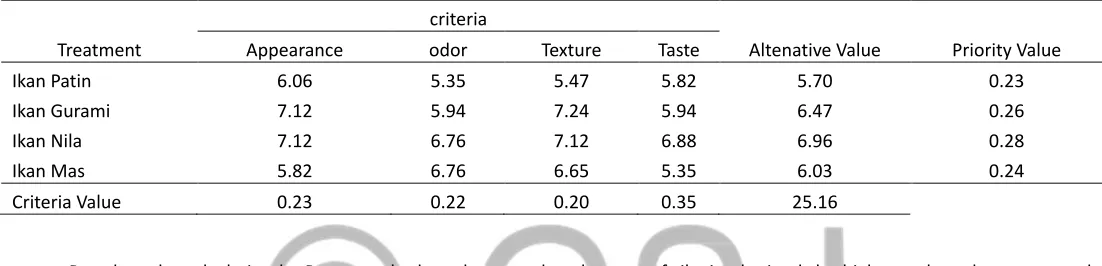
Decision-making on the value of alternative weights and the appearance, smell, texture, and taste criteria of marinate salt products was performed by paired comparison test. Completion of the result of pairing comparison is done by matrix manipulation to determine the weight criterion. The calculation of comparison result on the critical weight of the appearance, aroma, texture and taste of marinate salt can be seen in Table 5.
Table 5. Decision Matrix of Marinate Salt Assessment with Bayes Method
Based on the calculation by Bayes method can be seen that the type of tilapia obtained the highest value when compared with the other three fish, which is 6.96 Fish gouramy has an alternative value of 6.47. common carp has A lternative value of 6.03 and the catfish has the lowest alternative value of 5.70. Based on this result, it can be concluded that marinate salt by using tilapia is most favored compared to the use of three other fresh fish.
Conclusion
Based on the results of the research on marinate salt products with the treatment of freshwater fish various types use which included to the favored category by the panelists, but the treatment with the use of tilapia species on marinate salt products is preferred compared to other products based on parameters such as appearance, aroma, texture and taste . Marinate tilapia has the characteristics of a brilliant white appearance, dense and chewy texture, distinctive aroma and have no fishy smell, and savory and salty taste that fits the median appearance value 7 (preferred), aroma 7 (preferred), texture 7 (preferred) and taste 7 (strongly preferred).
References
[1] Brooks, Chance. 2011. Marinating of Beef for Enhancement. Nasional Cattlemen’s Beef Association. 1-3 hlm.
[2] Chambers, Lucy, Keri, McCrickerda and Martin, R., Yeomans. 2015. Optimising foods for satiety. Trends in Food Science & Technology. 41 : 149 – 160 hlm
[3] Endah Hasrati dan Rini Rusnawati. 2011. Kajian Penggunaan Daging Ikan Mas (Cyprinus Carpio Linn) Terhadap Tekstur dan Cita Rasa Bakso daging Sapi. Jurnal kampus. 29 (1) : 17 – 31 hlm.
[4] Hafiluddin. yudhita, Perwitasari. Slamet Budiarto. 2014. Analisis Kandungan Gizi Dan Bau Lumpur Ikan Bandeng (Chanos Chanos) Dari Dua Lokasi Yang Berbeda. Jurnal Kelautan. 7 (1) : 33 – 44 hlm
[5] Harahap, Binanga, P., D. 2010. Perubahan Karakteristik Fisik Dan Kimia Surimi Hasil Pengkomposisian Ikan Mas (Cyprinus Carpio) Dan Ikan Lele Dumbo (Clarias Gariepinus) Selama Penyimpanan Suhu Dingin. Skripsi. Fakultas Perikanan Dan Ilmu Kelautan. Institut Pertanian Bogor. Bogor
[6] Ho, L., Hoefel, D., Bock, F., Saint, C. P. & Newcombe, G. 2007 Biodegradation rates of 2-methylisoborneol (MIB) and geosmin through sand filters and in bioreactors. Chemosphere 66(11), 2210–2218
[7] Jaturasitha, S., Srikanchai, T., Kreuzer, M., and Wicke, M. 2008. Difference in carcass and meat characteristics between chicken indigenous to northern Thailand (blackboned and Thai native) and imported extensive breeds (Bresse and Rhode Island Red). Poult. Sci. Vol. 87 Hal. 160-169 [8] Jeyasanta K. Immaculate, Sinduja Prakash, Jamila Patterson. 2016. Wet and dry salting processing of double spotted queen fish Scomberoides lysan
(Forsskål, 1775). International Journal of Fisheries and Aquatic Studies. 4 (3) : 330 – 338 hlm.
Treatment
criteria
Altenative Value Priority Value Appearance odor Texture Taste
Ikan Patin 6.06 5.35 5.47 5.82 5.70 0.23
Ikan Gurami 7.12 5.94 7.24 5.94 6.47 0.26
Ikan Nila 7.12 6.76 7.12 6.88 6.96 0.28
Ikan Mas 5.82 6.76 6.65 5.35 6.03 0.24
GSJ© 2018
[9] Jinap, S dan Hajep, P. 2010. Glutamate Its Applications in Food and Contribution to Health. Journal Appetite. 55 : 1- 10 hlm.
[10] Kayan, Autchara, Ittipong, Boontanb , Sanchai, Jaturssithab , Michael, Wickec , and Michael, Kreuzerd. 2015. Effect of Slaughter Weight on Meat Quality of Nile Tilapia (Oreochromisniloticus). Agriculture and Agricultural Science Procedia. Vol 5 Hal. 159 – 163
[11] Lestari, Feny, D,. Rohula, Utami. dan Kawiji. 2013. Pengaruh Penambahan Minyak Atsiri Jahe Merah (Zingiber Officinale Var. Rubrum) Pada Edible Coating Terhadap Kestabilan Ph Dan Warna Fillet Ikan Patin Selama Penyimpanan Beku. Jurnal Teknosains Pangan. 2 (4) : 91 – 95 hlm.
[12] Lioe, H., Nuryani, Jinap, Selamat, And Masaaki, Yasuda. 2010. Soy Sauce And Its Umami Taste: A Link From The Past To Current Situation. Journal Of Food Science. 75 (3) : 71 – 76 hlm.
[13] Meyer, V. 1965. Fish as food. Academic Press. London and Newyork. Vol. 3 489 hlm.
[14] Oladele, A.K., and J.O., Odedeji. 2008. Osmotic Dehydration of Catfish (Hemisynodontis membranaceus): Effect of Temperature and Time. Pakistan Journal of Nutrition. Nigeria. 7 (1) : 115 – 122 hlm.
[15] Oliveira, Helena, Śonia, Pedro, Maria, Leonor, Nunes, Rui, Costa, and Paulo, Vaz-Pires. 2012. Processingof Salted Cod (Gadus spp.): A Review.
Comprehensive Reviews in Food Science and Food Safety. 11 : 546 – 564 hlm.
[16] Stien LH, Hirmas E, Bjornevik M, Karlsen O, Nortvedt R, RoraAMB,Sunde J, Kiessling A. 2005. The effects of stress and storage temperature on the color and texture of pre-rigor filleted farmed cod (Gadus morhua L.). Aquaculture Res. 36 : 1197 – 1206 hlm
[17] Suryaningrum. Dwi. 2008. Peneliti pada Balai Besar Riset Pengolahan Produk dan Bioteknologi Kelautan dan PerikananIkan Patin: Peluang Ekspor, Penanganan Pascapanen dan Diversifikasi Produk Olahannya. Balai Besar Riset Pengolahan Produk dan Bioteknologi Kelautan dan Perikanan. 3(1) : 16 – 23 hlm.
[18] Suryaningrum, D.T., Muljanah, I., dan Tahapari, E., 2010. Profil Sensori dan Nilai Gizi Beberapa Jenis Ikan Patin dan Hibrid Natunus. Jurnal pascapanen dan Bioteknologi Kelautan dan Perikanan. 5 (2) : 153 – 164 hlm.
[19] Szymczak, M., Kolakowski, E. And Felisiak, K. 2012. Influence Of Salt Concentration On Properties Of Marinated Meat From Fresh And Frozen Herring (Clupea Harengus L.). Int. J. Food Sci. Tech. 47, 282–289.
[20] Tamang, J. P., & Kailasapathy, K. (2010). Fermented Foods and Beverages Of the World. U.S.A.: CRC Press. 434 hlm.
[21] Thorarinsdottir, K., Anna, Sigurjon, Arason, Sigurdur, G., Bogason, and Kristberg, Kristbergsson. 2004. The effects of various salt concentrations during brine curing of cod (Gadus morhua). International Journal of Food Science and Technology. Vol. 39
[22] Varga, D,. A. Szabo, dan R. Romvari, dan Cs. Hancz. 2010. Comparative study of the meat quality of common carp strains harvested from different fish ponds. Acta Agraria Kaposv{riensis. 14 (2) : 301 – 306 hlm.