Developing Leader Behaviours among the Students of an Educational
Leadership Programme
Martin Thomas∗ Margaret Madden †
Abstract: Educationists have been showing considerable interest in knowing factors affecting leader effectiveness. In the midst of ineffective educational leadership and educational leadership development pro-grammes, leader behaviours are considered one of the important predictors of leadership effectiveness and thus to be developed in educational programmes. This One-Group Pretest-Posttest Experimental Research explored the extent to which the participation in a course unit of the Educational Leadership Programme, offered by the Centre of Educational Leadership Development (CELD), Karachi, Pakistan, developed the required leader behaviours among the postgraduate level students. Fleishman’s Leadership Opinion Questionnaire (Pierce & Newstrom,2005a) was used for the pretest and the posttest. Participants of the research were eighty four (84) Postgraduate Certificate in Educational Leadership or Master of Educational Leadership students, who studied the Perspectives of Leadership unit. It was expected that this unit would not only assist students to build the strong knowledge base and acquire certain leadership skills, but also develop high level of appropri-ate behaviours which would prepare them to cope with the scope of the challenges which face them as well as create or maintain a positive, thriving organisational climate in their schools. Contrary to expected outcomes, the research revealed that the unit participants exhibited significant but relatively moderate orientation to-wards the expected leader behaviours. The research has challenged the legitimacy of the approaches used to teach the course and recommended a thorough study of the factors that contribute to the development of leader behaviours among leadership students.
Keywords: Leader behaviours, initiating structure, consideration behaviour, leadership skills, organizational climate.
Introduction
School principals are considered leaders of human resource development as they as-sist, lead and motivate the school staff (Hashmi,2015). Thus factors influencing leader effectiveness have increasingly become an area of considerable interest amongst edu-cationists who concede that possessing simple knowledge about the role, function and skills of leadership does not necessarily produce good educational leaders (Robert,2012). Where a study byGuo, Dai, and Yang (2016) found insignificant relationship between task-behaviour, relationship behaviour and job performance, outcomes of other research studies such as Judge and Piccolo and Judge, Piccolo and Ilies, indicated that leader be-haviours are fundamental predictors of effective leadership (Derue, Nahrgang, Wellman,
∗
Iqra University, Karachi, Pakistan. E-mail: [email protected]
†
& Humphrey,2011) as employees’ attitudes, behaviours, emotions, morale and percep-tion are influenced by the way they observe their leaders behave (Momeni, as cited in (Holloway,2012)). The work ofDerue et al.(2011) indicates that leader behaviours speak a more definitive language of effectiveness than do leader traits. Consequently behaviours either channel the creation and maintenance of a positive, thriving organizational climate or they fail to do so and produce negative effects (Holloway,2012). The behavioural work ethic of leaders, exhibited in their confidence, high energy, personal conviction, positive use of power and assertiveness, builds the self-belief and confidence of those they lead (Tabbodi & Prahallada, 2009) and acts as an extrinsic motivator that breeds extra effort amongst employees (Webb,2007) and satisfaction with their supervisors (Robert,2012).
Educational leadership programmes are known to have considerable effect on educa-tional leaders’ behaviour development and consequently school improvement. A range of proponents of educational leadership programmes, however, prefer self-initiated partic-ipation of individuals in leadership programmes over imposed mandatory particpartic-ipation (Schleicher,2012) as the former can infuse more motivation among the programme par-ticipants than the latter one. Educational programmes remain ineffective if they do not meet the needs of the participants of the programmes. For example, (Loew & Wentworth,
2013) found that leadership concerns appeared to be a great factor that impacted hiring, retention and performance of the workforce. Loe and Wentworth further indented that almost 75 percent of the organizations participated in a survey rated their leadership pro-grammes ineffective. This One-Group Pretest-Posttest Experimental Research explored the extent to which self-initiated participation of students in a course unit of the Educa-tional Leadership Programme offered by the Centre of EducaEduca-tional Leadership Develop-ment (CELD), Karachi, Pakistan (pseudonym), developed the knowledge and practice of required leader behaviours among students undertaking the Postgraduate Certificate in Educational Leadership or Masters in Educational Leadership courses.
Review of Related Literature
Leader Behaviours
low concern for people; (3) The country-club leader who exhibits a high concern for peo-ple and low concerns for production; (4) The middle-of-the-road leader who demonstrates blended and medium concerns for both production and people; and (5) The team leader who expresses high concerns for both production and people (Lunenburg & Ornstein,
2012;Lussier & Achua,2007). An investigation of these styles of leadership was a compo-nent of both the knowledge content of the unit of study and the research data gathering design.
Fielder’s theoretical position presents an illustration of the reciprocal link between a leader’s consistent system of interaction and the group with whom he/she works as a de-terminant of the favourableness of the work environment. The use of Fielder’s least pre-ferred co-worker (LPC) scale assists in determining the orientation of a leader’s prepre-ferred behaviour towards either achieving quality interpersonal relationships or successful task performance. House, also a contingency theorist, advocates servant leadership and his path-goal model demonstrates a leader’s behaviour as not power driven but as facilitat-ing, enabling employees to reach their and the organisation’s goals. House terms effective leader behaviours as: (1) directive leadership which informs co-workers what is expected of them; (2) supportive leadership encourages the creation of a friendly and approachable environment where leaders are concerned with the needs and well-being of co-workers; (3) participated leadership ensures that co-workers are consulted and their ideas are in-corporated into decision making; and (4) achievement-oriented leadership sets targets for co-workers and shows confidence in their abilities to achieve them. Tannenbaum and Schmidt conceived a leadership behaviour continuum representing the degree of leader authority used ranging from the boss-centred to the subordinates-centred or autocratic to laissez-faire leadership behaviour. They depicted five typical leadership styles identifi-able along the continuum, namely: telling, in which the leader identifies a problem and suggests a solution; selling, in which the leader persuades the group to accepts solutions; testing, where the leader identifies a problem, proposes a tentative solution and asks for the reactions of those who will implement it; consulting, means the leader presents the problem and asks the subordinates to identify a number of solutions and then selects the most appropriate one; and joining, where the leader becomes one of the members of the group to make decisions (Lunenburg & Ornstein,2012;Lussier & Achua,2007). In deciphering some of leader behaviours that encourage co-workers’ satisfaction and com-mitment, Folkman’s research presented effective leaders as those whose way of acting inspire and motivate others; strive for a pre-determined result; communicate a strategic perspective; work in collaboration; walk the talk; trust the co-workers’ abilities to per-form the tasks; develop and support others; and build relationship and courage among the employees and between the employees and the leader (Folkman,2010).
and those which facilitate team interaction and/or development which form the person-focused category. Task-oriented behaviour is similar to initiating structure (Robert,2012;
Hamid et al.,2012) and the person-focused behaviour reflects consideration behaviour (Robert,2012;Hamid et al.,2012).
Development of Leader Behaviours
A constructive organizational climate is positively correlated with workers’ motivation and their efficacy (Webb, 2007; Tabbodi & Prahallada, 2009; Robert, 2012) and leader behaviours (Holloway,2012), Enhancing workers’ motivation and efficacy is contingent on the match between leader’s behaviour and co-workers needs. Moorthy(2014) noted that a significant percentage of workforces in the current scenarios of the workplaces is a youngest cohort, who were born after 1980, and are known as the millennials or Gener-ation Y. They demand more perks, faster promotion and greater work-life benefits than other generations. This implies that educational leaders need to develop a leader be-haviour which is more flexible and motivating.Petrie(2014), on the other hand, differenti-ated between horizontal and vertical development and argued that horizontal leadership development demands focusing on developing technical skills, abilities and behaviours whereas vertical development requires developing critical and analytical thinking skills among the leaders so that they can understand the world around them. The inference for leadership programmes, therefore, is that they must overtly emphasize the develop-ment of both initiating-structure behaviour that encourages leaders to acquire technical skills of managing organizational activities and consideration behaviour that allows lead-ers to critically examine needs of both the organization and worklead-ers and motivate co-workers to channelize their skills, abilities and behaviours towards the development of the organization.
For the development of leader behaviours among the potential and practicing educa-tors in Pakistan, three courses were introduced by CELD under its Educational Leader-ship Programme umbrella and offered in a mixed mode fashion. These courses include the Master of Educational Leadership, the Postgraduate Certificate in Educational Lead-ership and the Graduate Certificate in Educational LeadLead-ership. The leadLead-ership courses aimed to provide candidates with values, attitudes, knowledge and skills in educational leadership that could enable them to infuse their systems and organisations with a com-mitment to the highest ethical and moral standards and, at the same time, facilitate effi-cient and effective leadership and administrative practices.
leadership students selected from the private sector schools across Pakistan would exhibit reasonably high levels of expected initiating-structure behaviour. These were anticipated as assigning different tasks to employees and guiding them to complete their tasks within the given time as well as consideration behaviour, such as, treat employees equally and involving them in decision making. The CELD Educational Programme had a crucial in-tent not only to develop leadership skills but also to inculcate moral and ethical leadership values in its participants along with the development of people-oriented, consideration or transformational leader behaviours (Khan, Ramzan, Ahmed, & Nawaz,2011).
Conceptual Framework
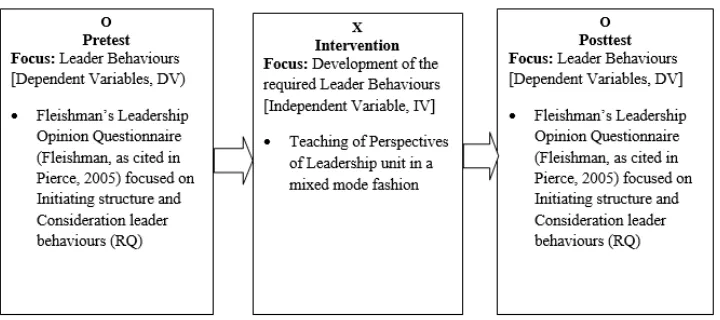
Pierce and Newstrom (2005b) cited Fleishman who offers a Leadership Opinion Ques-tionnaire whose eight statements explore personal leadership orientation. Four of the eight statements focus on initiating-structure leader behaviour and four focus on con-sideration leader behaviour. Respondents are expected to indicate on a five point scale, the frequency of their engagement in the particular behaviour. To determine the effect of treatment in the current experimental research, the Leadership Opinion Questionnaire suggested by Fleishman was administered before and after the treatment.
The Perspectives of Leadership unit was offered in a mixed mode fashion where stu-dents attended two weeks’ full time face-to-face sessions; followed by the first round of two and half months field work; a two days’ check point after the first round of field work; second round of two and half months field work; and one day evaluation session at the completion of the unit. During the face-to-face sessions, the educational leader-ship students explored historical, organizational and evolving perspectives of educational leadership and critically examined theoretical underpinnings of these three perspectives. During the field work, these students applied various theories in their schools and re-flected on the processes and outcomes of the application and later shared their learning from the field work during the check point and evaluation sessions. The educational leadership students participating in the unit were engaged either in leadership positions in different private schools of Pakistan or they were potential leaders, earmarked for a school or system leadership position. The pretest enabled the researchers to identify the students’ frequency of engagement in initiating-structure behaviour or consideration be-haviour while performing their leadership roles prior to participating in the unit of study or it identified their opinions about the engagement of leaders in these behaviours. The posttest determined the effect of the intervention, namely their workplace behaviours af-ter completing the unit of study.
The following research question and hypotheses guided the analysis of data.
To what extent was the Perspectives of Leadership course unit of the CELD Educa-tional Leadership Programme effective in developing initiating-structure and considera-tion behaviours to be demonstrated among its participants?
Ho1=µ1−µ2= 0
Ho3=µ1=µ2
Ho4=µ3=µ4
Where,µ1=population mean for average pretest (consideration),µ2=population mean
for posttest (consideration) andµ3=population mean for pretest (nitiating structure)µ4=population
mean for posttest (nitiating structure).
Figure 1 illustrates the conceptual framework underpinning the study adapted from
Fraenkel et al.(2012).
Figure 1
Conceptual Framework
Methodology
Research Design
Instrument
The Fleishman’s Leadership Opinion Questionnaire (Fleishman, as cited in (Pierce & New-strom,2005b)) was used for the pretest and posttest in the current research. The Fleish-man’s Leadership Opinion Questionnaire had two sets of statements. Statements 1 to 4 focused on consideration leader behaviour and the respondents indicated the frequency of their engagement in the behaviour by encircling the choices from 1 to 5 where 1 rep-resented the highest frequency and 5 indicated none. These statements were: (1) Put suggestions made by people in the work group into operation; (2) Treat all people in the work group as equal; (3) Back up what people under you do; and (4) Reject suggestions for change. Statements 5 to 8 focused on initiating-structure leader behaviour and the re-spondents were required to indicate in a like manner the frequency of their engagement in the behaviour by encircling the choices from 1 to 5. These statements comprised: (1) Talk about how much should be done; (2) Assign people in the work group to particular tasks; (3) Offer new approaches to problems; and (4) Emphasize meeting the deadlines.
Participants
Data Analysis
Initial Data Analysis Technique Suggested by Fleishman
The data gathering and its analysis was guided by FleishmanPierce and Newstrom(2005b) through the use of Fleishman’s Leadership Opinion Questionnaire and his particular data analysis technique in which the scores of each respondent to statements 1, 2 and 3 were subtracted from 6 and then added up the remaining score to the sums of statements 1, 2, 3 and 4 and divided by 4. The remaining score was considered as the leader behaviour score. Similarly, the score of each respondent to statements 5, 6, 7 and 8 were subtracted from 6 and then added up the remaining score to the sums of statements 5, 6, 7 and 8 and divided by 4. The remaining score was initiating-structure leader behaviour score. A high score (4 and greater) suggested relatively strong orientation towards particular leader behaviour. A moderate score (above 2 and less than 4) was considered a satisfac-tory orientation towards particular leader behaviour. A low score (2 and less) suggested a relatively weak orientation towards particular leader behaviour.
Table 1
Consideration Leader Behaviour
Level Range Pretest (%) Posttest (%) Difference (%)
Low 2 and less 46 57 -11
Moderate above 2 and less than 4 50 39 11
High 4 and above 4 4 0
Table 1 indicates that a reasonable percentage of the participants holding consideration leader behaviour declined. For example the difference between the percentages of moder-ate level leadership behaviour and low level leadership behaviour during the pretest and posttest was 11 and -11 respectively which indicates that a sizable percentage of students moved from a moderate level of consideration leader behaviour to a low level of consid-eration leader behaviour. On the contrary, a small percentage of students holding a high level of consideration leader behaviour remained unchanged.
Table 2
Initiating-structure Leader Behaviour
Level Range Pretest (%) Posttest (%) Difference (%)
Low 2 and less 68 71 -3
Moderate above 2 and less than 4 18 25 -7
High 4 and above 14 4 10
Hypotheses Testing
After the initial data analysis, data were tabulated and further analysed to test the hy-potheses using the Statistical Package for Social Sciences (SPSS) 22nd version.
Paired Sampling t-test
A paired sample t-test was conducted to evaluate: (1) whether or not a statistically signif-icant difference exists among the educational leadership students between their means of average pretest scores and mean scores on consideration leadership behaviour scale after participating in the Perspectives of Leadership course unit of the CELD educational lead-ership programme. (2) Whether or not a statistically significant difference exists among the educational leadership students between their mean of average pretest scores and mean initiating-structure leadership behaviour scores after participating in the Perspec-tives of Leadership course unit of the CELD educational leadership programme.
Prior to conducting the paired-sample t-test, normality distribution of data was as-sessed and to make the data normally distributed twelve (12) outliers were identified and removed. The skewness values for valid cases (n = 72) ranged from .51 to 1.92 for average pretest and pretest (consideration) and posttest (insitiating-structure) which were below 1.96 (Fraenkel et al.,2012) indicating that the data were normally distributed.
Hypothesis 1
Paired sample t-test was run to identify whether or not pre-intervention pretest (MAvePreT = 1.91, SD = .51) and post-intervention consideration leader behaviour means (MPoT-Cons= 2.19, SD = .81) were equal (see Table 4). The results of the paired sample t-test were significant, t (71) = - 2.80, p<0.007, indicating that there was a significant difference between the mean of average pretest scores and mean consideration leader behaviour scores of the educational leadership students after participating in the Perspectives of Leadership course unit of the educational leadership programme (see Table 3). Thus the null hypothesisHo1was rejected and the alternative hypothesisH1was accepted.
Ho1:µ1−µ2= 0(Rejected)
H1:µ1−µ26= 0(Accepted)
Table 3 Paired Sample t-test
Paired Differences Effect
Mean Std. Deviation Std. Error Mean 95% Confidence t df Sig. (2-tailed) Cohen’s d
Lower Upper d = M/SD
Hypothesis 2
A paired sample t-test was used to investigate whether or not the mean of average pretest scores (MAvePreT = 1.91, SD = .51) and the post-intervention initiating-structure leader behaviour means (MPoTIns = 1.76, SD = .82) were equal (see Table 1.4). The results of the paired sample t-test were insignificant, t (71) = 1.51, p<.136, indicating that there was no significant difference between the mean of average pretest and mean initiating-structure leader behaviour scores of the educational leadership students after participating in the Perspectives of Leadership course unit of the educational leadership programme (see Ta-ble 3). Thus the null hypothesisHo2was retained and the alternative hypothesisH2was
rejected.
Ho2:µ3−µ4= 0(Retained)
H2:µ3−µ46= 0(Rejected)
Hypothesis 3
Table 4 reveals that the post-intervention consideration leader behaviour mean scores (MPoTCons = 2.19, SD = .81) were greater than the mean of average pretest scores (MAveP-reT = 1.91, SD = .51). It can therefore be concluded that intervention in the form of teaching of Perspectives of Leadership course unit contributed significantly to develop considera-tion leader behaviour among the students of educaconsidera-tional leadership programme offered by CELD.
Table 4
Paired Sample Statistics
Mean N Std. Dev S.E Mean
Pair 1 Consideration Ave. Pretest 1.91 72 0.51 0.06 Ave. Posttest 2.19 72 0.81 0.1
Pair 1 Initiating-Structure Ave. Pretest 1.91 72 0.51 0.06 Ave. Posttest 1.76 72 0.82 0.1
Cohen(1988) proposed the Cohen’s d technique to calculate standardized difference between two groups. Thus Cohen’s d for the difference of means between average pretest and post-intervention consideration leader behaviour scores were calculated as 0.33 (see Table 1.3). The effect size (d = 0.33) indicates that the effect of the intervention on the posttest was significant but medium and the participants’ scores after the intervention were at the 62 percentile of the pretest scores indicating 21.3 percent non-overlap distribu-tion of the scores between the pretest and posttest (Cohen,1988). Thus the null hypothesis Ho3was rejected and the alternative hypothesisH3was accepted.
Ho3:µ1=µ2(Rejected)
Hypothesis 4
Data presented in Table 1.4 identifies that the post-intervention initiating-structure leader behaviour mean scores (MPoTIns = 1.76, SD = .82) were smaller than the mean of average pretest scores (MAvePreT = 1.91, SD = .51). It can therefore be inferred that intervention in the form of teaching of Perspectives of Leadership course unit contributed insignificantly to develop initiating-structure leader behaviour among the students of educational lead-ership programme offered by CELD. Thus the null hypothesis Ho4 was retained and the alternative hypothesis H4 was rejected.
Ho4:µ3=µ4(Retained)
H4:µ3> µ4(Rejected)
Result
In order to answer the research question To what extent was the Perspectives of Leader-ship course unit of the CELD Educational LeaderLeader-ship Programme effective in developing initiating-structure and consideration behaviours to be demonstrated among its partici-pants, the results of the current research were derived from the inferences made from the initial data analysis and hypotheses testing. The subsequent paragraphs highlight two main trends identified from the data analysis.
Trend 1: Intervention provided little guidance to educational leadership students in making choices between initiating-structure and consideration leader behaviours.
The initial data analysis revealed that a decline in percentages of students adopting both initiating-structure and consideration leader behaviour exhibits that studying the Perspectives of Leadership course unit showed the students’ inability to make a choice between two extremes of leader behaviours. This signifies that the intervention could not guide the educational leadership students to decide whether they should acquire a leader behaviour which provides guidance for co-workers to solve their problems, com-plete tasks assigned by the institutes and meet deadlines or adopt a flexible, employees-centred leader behaviour which involves co-workers in decision making and other insti-tutional activities. Such a result compels the educators to challenge the legitimacy of the approaches used to teach the course unit. It is extremely important that the unit lectur-ers use constructivist learning approaches and allow educational leadlectur-ership students to construct their own knowledge while working on practical scenarios and bridge the gaps between leadership theory and practice.
It was inferred that the Perspectives of Leadership course unit encouraged its edu-cational leadership students to move away from the initiating-structure oriented leader behaviour. The data presented above are inconsistent with Waqar and Siddiqui (2008) who found that educational leaders in Pakistan from private schools would exhibit a rea-sonably high level of initiating-structure leader behaviour. If initiating-structure and con-sideration are two extremes of a leader behaviour continuum, then the trend was a grad-ual movement from the initiating-structure oriented leader behaviour to the considera-tion leader behaviour. This trend affirms that the educaconsidera-tional leadership students taking the Perspective of Leadership course unit were encouraged to be inclined towards more flexible, employee-centred behaviour. These students were expected to support their co-workers in their work related activities and provide them with equal opportunities to par-ticipate in institution wide decision making. The result from hypotheses testing indicates that there was a significant difference between the mean consideration and the mean of the average pretest scores of leadership students participating in the Perspectives of Lead-ership course unit of the educational leadLead-ership programme offered by CELD. The result also found that there was insignificant difference between the mean initiating-structure leader behaviour scores and the mean of average pretest scores of the leadership students. Recent research findings have highlighted the importance of developing both initiating-structure or transactional or task-oriented behaviour among educational leaders so that they may work for achieving organisational goals through co-workers (Khan et al.,2011). Initiating-structure leader behaviour, however, is associated with a tall structured and operationally rigid bureaucratic organisation (Lunenburg & Ornstein,2012). In the cur-rent research, a reduced mean of the initiating-structure behaviour during the posttest (MAvePreT = 1.91 and MPoTIns = 1.76) indicates that the educational leadership stu-dents moved from a strong or moderate orientation to a weak orientation towards the initiating-structure oriented behaviour. This trend was considered positive as educational leadership students were gradually moving from a rigid initiating-structure oriented or production-centred behaviour extreme to a flexible consideration or employees-centred extreme (Lunenburg & Ornstein,2012). Insignificant difference between mean of average pretest scores and mean initiating-structure leader behaviour was also considered posi-tive because developing initiating-structure behaviour among the educational leadership students at some level was important for preparing them to achieve organisational goals through co-workers (Khan et al.,2011).
Lead-ership unit was able to develop consideration leader behaviour among the educational leadership students at a medium yet significant level. This trend was considered positive as educational leadership students moved from a rigid behaviour and reduced sense of responsibility (Diamond, Randolph, & Spillane,2004) to an increased sense of responsi-bility and flexible behavioural style.
Conclusion
References
Burke, C. S., Stagl, K. C., Klein, C., Goodwin, G. F., Salas, E., & Halpin, S. M. (2006). What type of leadership behaviors are functional in teams? A meta-analysis. The Leadership Quarterly,17(3), 288–307.
Cohen, J. (1988). Statistical power analysis for the behavioral sciences. Erlbaum Associates, Hillsdale.
Derue, D. S., Nahrgang, J. D., Wellman, N., & Humphrey, S. E. (2011). Trait and behav-ioral theories of leadership: An integration and meta-analytic test of their relative validity. Personnel Psychology,64(1), 7–52.
Diamond, J. B., Randolph, A., & Spillane, J. P. (2004). Teachers’ expectations and sense of responsibility for student learning: The importance of race, class, and organizational habitus.Anthropology & Education Quarterly,35(1), 75–98.
Folkman, J. (2010). Top 9 leadership behaviors that drive employee commitment. Avail-able online at: www.zengerfolkman.com.
Fraenkel, J. R., Wallen, N. E., & Hyun, H. H. (2012). How to design and evaluate research in education. McGraw-Hill: New York.
Guo, W., Dai, R., & Yang, J. (2016). The effect of leadership task behavior and relational behavior on job performance: Investigating the moderating role of work alienation. Journal of Service Science and Management,9(2), 97–110.
Hamid, M. A., Ab Rahman, N. M. N., & Nor, N. M. (2012). Leadership behavior and performance: A case study of Takaful representatives in Malaysia.African Journal of Business Management,6(6), 2291–2298.
Hashmi, K. (2015). Principals’ leadership and human resource development in schools of pakistan: An exploratory study. Journal of Education & Social Sciences,3(1), 209–223. Holloway, J. B. (2012). Leadership behavior and organizational climate: An empirical
study in a non-profit organization.Emerging Leadership Journeys,5(1), 9–35.
Khan, M. M., Ramzan, M., Ahmed, I., & Nawaz, M. (2011). Transformational, transac-tional, and laissez-faire styles of teaching faculty as predictors of satisfaction, and extra effort among the students: Evidence from higher education institutions. Inter-disciplinary Journal of Research in Business,1(4), 130–135.
Lodhi, S. A., & Ahmad, M. (2010). Dynamics of voluntary knowledge sharing in organi-zations. Pakistan Journal of Commerce & Social Sciences,4(2), 120–131.
Loew, L., & Wentworth, D. (2013). Leadership: The state of development programs 2013. Delray Beach, FL: Brandon Hall Group.
Lunenburg, F., & Ornstein, A. (2012). Educational administration: Concepts and practices. Belmont, CA: Wadsworth Cengage Learning.
Lussier, R. N., & Achua, C. F. (2007). Leadership: Theory, application, & skill development. Mason, Ohio: South-Western College.
Moorthy, R. (2014). An empirical study of leadership theory preferences among gen Y in Malaysia.Review of Integrative Business and Economics Research,3(2), 398–421. Nawab, A. (2012). The informal learning approaches of teachers in a secondary school
Petrie, N. (2014). Future trends in leadership development. Ottawa, Ontario: Center for Creative Leadership.
Pierce, J. L., & Newstrom, J. W. (2005a). Leaders and the leadership process: Readings, self-assessments and applications. Boston: McGraw-Hill.
Pierce, J. L., & Newstrom, J. W. (2005b). Leaders and the leadership process: Readings, self-assessments and applications. Boston: McGraw-Hill.
Robert, W. L. (2012). The impact of motivation and leader behavior on satisfaction in nonprofits. Proceedings of ASBBS,19(1), 520–543.
Schleicher, A. (2012). Preparing teachers and developing school leaders for the 21st century: Lessons from around the World. OECD publishing, available online at: http://dx.doi.org/10.1787/9789264xxxxxx-en.
Tabbodi, M. L., & Prahallada, N. (2009). The effects of leadership behavior on efficacy: A comparative study of faculty of two Universities from Iran and India. Journal of Social Sciences,20(3), 169–173.
Waqar, S. H., & Siddiqui, K. (2008). A study about the leadership styles of public and private school principals. Journal of Elementary Education,18(1-2), 5–20.