On the Computational Complexity of
Designing and Reconfiguring
Component-based Software Systems
Todd Wareham
∗ Department of Computer Science Memorial University of NewfoundlandSt. John’s, NL Canada
[email protected]
Marieke Sweers
Radboud University Nijmegen Donders Institute for Brain, Cognition, andBehaviour
Nijmegen, The Netherlands
[email protected]
ABSTRACT
Though Component-Based Development (CBD) is a pop-ular approach to mitigating the costs of creating software systems, it is not clear to what extent CBD is preferable to other approaches to software engineering or to what extent the core component selection and adaptation activities of CBD can be implemented to operate without human inter-vention in an efficient and reliable manner. In this paper, we use computational complexity analysis to compare the computational characteristics of software system design and reconfiguration byde novodesign, component selection, and component selection with adaptation. Our results show that none of these approaches can be implemented to operate both efficiently and reliably either in general or relative to a surprisingly large number of restrictions on software system, component, and component library structure. We also give the first restrictions under which all of these approaches can be implemented to operate both efficiently and reliably.
Categories and Subject Descriptors
D.2.13 [Software Engineering]: Resuable Software—Reuse models; D.2.2 [Software Engineering]: Design Tools and Techniques; F.2.2 [Analysis of Algorithms and Prob-lem Complexity]: Nonnumerical algorithms and problems—
computations on discrete structures
General Terms
Algorithms, Design, Measurement, Performance, Theory
Keywords
component-based development, parameterized computational complexity
∗Corresponding Author
1.
INTRODUCTION
Component-based development (CBD) is a popular approach to mitigating the monetary and time costs of creating and maintaining software systems [1, 3, 12]. In CBD, previously-developed software modules called components are stored in libraries and connected together (possibly with some adap-tation of the component code and architecture) as needed to generate new software systems from given requirements. Over the last 20 years, a number of technologies have been implemented to assist human programmers in creating com-ponent-based systems, e.g., CORBA, CCM, EJB, COM+, and much effort has been put into automating the key CBD activities of component selection and adaptation.
There are two ongoing issues of great importance in the CBD community: (1) the circumstances (if any) under which the cost of selecting and adapting components is less than the cost of developing software systems from scratch, i.e., de novo [10] and (2) the need for CBD to operate fully auto-matically and efficiently to accommodate ubiquitous and au-tonomic computing systems which need to create and recon-figure software without or with minimal human intervention at runtime [7, 13]. To address these issues, it would be most useful to know if efficient and reliable methods are available for selecting and adapting components in CBD and, if so, under what circumstances these methods outperform other approaches to software engineering.
In this paper, we present results addressing both of these questions. First, using computational complexity analysis [8], we show that both creating and reconfiguring software systems either by de novodesign, component selection, or component selection with adaptation are all N P-hard and thus intractable in general. Second, using parameterized complexity analysis [5], we give restrictions under which all of these activities are tractable and prove that surpris-ingly few restrictions on either software system structure or the allowable degree of adaptation render these activities tractable. Though these results are derived relative to basic models of software systems and components, we show that they also apply to more realistic models.
The remainder of this paper is organized as follows. In Sec-tion 2, we present our software system, component, and com-ponent library models and formalize the problems ofde novo
BICT 2015, December 03-05, New York City, United States Copyright © 2016 ICST
and component-based software system design and reconfig-uration relative to these models. Section 3 demonstrates the intractability of all of these problems in general. Sec-tion 4 describes a methodology for identifying condiSec-tions for tractability, which is then applied in Section 5 to identify such conditions for our problems. In order to accommodate conference page limits and focus in the main text on the implications of our results for CBD, proofs of selected re-sults are given in Appendix A. Finally, our conclusions and directions for future work are given in Section 6.
1.1
Related Work
Computational complexity analyses of the component selec-tion problem have been done previously [2, 16, 17]. How-ever, the formalizations used in these analyses focused on the satisfaction of sets of desired system objectives, and did not include specifications of software system and component structure that are detailed enough to investigate the con-ditions under which restrictions on these structures would make component selection tractable. They also did not ad-dress the issue of component adaptation.
2.
FORMALIZING COMPONENT-BASED
DESIGN AND RECONFIGURATION
Our goal in this paper is to assess whether or not component-based development has advantages over conventional ware engineering relative to different activities in the soft-ware life cycle. This assessment can be stated most simply along two dimensions:
1. Software design mode: creating software using only components drawn from component libraries versus creating software by adapting components drawn from component libraries or creating softwarede novothat is organized in a specified component-like fashion.
2. Software lifecycle activity: designing the initial version of a software system relative to a set of requirements versus reconfiguring an existing system to accommo-date one or more changes to the requirements.
The possibilities implicit in these dimensions result in the following six informal computational problems:
Software Design
Input: Software requirementsR, software-structure specifi-cationX
Output: A software system S whose structure is consistent withX and whose operation satisfiesR.
Software Design from Adapted Components
Input: Software requirementsR, a set of software-component librariesC={C1, C2, . . . , C|C|}.
Output: A software system S whose structure consists of connected components derived from components drawn from the libraries inCand whose operation satisfiesR.
Software Design from Components
Input: Software requirementsR, a set of software-component librariesC={C1, C2, . . . , C|C|}.
Output: A software system S whose structure consists of
connected components drawn from the libraries in C and whose operation satisfiesR.
Software Reconfiguration
Input: A software system S whose structure is consistent with specification X and whose operation satisfies require-mentsR, new software requirementsRnew.
Output: A software systemS′ derived fromS whose struc-ture is consistent withX and whose operation satisfiesR∪
Rnew.
Software Reconfiguration from Adapted Components
Input: A software system S whose structure consists of connected components from a set of software-component li-brariesC={C1, C2, . . . , C|C|}and whose operation satisfies
requirementsR, new software requirementsRnew.
Output: A software systemS′ derived fromS whose struc-ture consists of connected components derived from com-ponents drawn from the libraries inC and whose operation satisfiesR∪Rnew.
Software Reconfiguration from Components
Input: A software system S whose structure consists of connected components from a set of software-component li-brariesC={C1, C2, . . . , C|C|}and whose operation satisfies
requirementsR, new software requirementsRnew.
Output: A software systemS′ derived fromS whose struc-ture consists of connected components drawn from the li-braries inCand whose operation satisfiesR∪Rnew.
To assess the computational difficulty of and (if necessary) explore algorithmic options for efficiently solving these prob-lems, we need formalizations of all of the entities comprising these problems. There is a vast existing literature on various types of software requirements, system-structures, structure specifications, and components and component libraries. We want to avoid introducing spurious computational difficulty due to powerful formalisms, as this would complicate the in-terpretation our results. Hence, we shall choose the simplest such formalizations1(additional advantages gained by such
a parsimonious approach are given in Section 5.2):
• Software Requirements: The requirements will be a set
R = {r1, r2, . . . r|R|} of situation-action pairs where
each pair rj(sj, aj) consists of a situation sj defined
by a particular set of truth-valuessj=hv(i1), v(i2), . . . v(i|I|)i,v(ik)∈ {T rue, F alse}, relative to each of the
Boolean variablesikin setI={i1, i2, . . . , i|I|}and an
actionajfrom setA={a1, a2, . . . a|A|}.
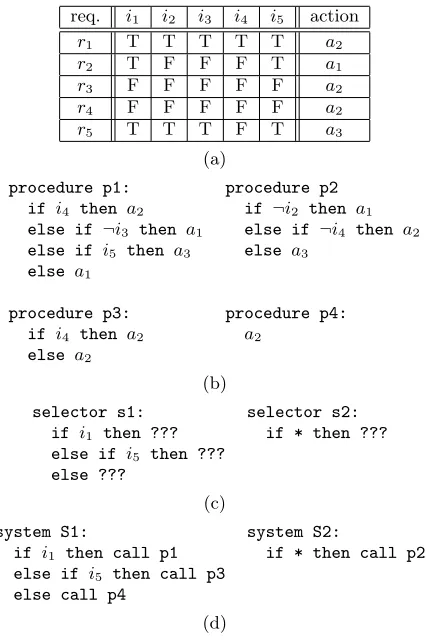
• Software system-structure: We will here consider the simplest possible complex structure consisting of a mul-tipleIF-THEN-ELSEstatement block (aselector) whose branches are in turn other IF-THEN-ELSE statement blocks (procedures) whose branches execute actions fromA. Each selector and procedureIF-THEN condi-tion is a Boolean formula that is either a variable from
I e.g.,ij, or its negation,e.g.,¬ij. Each selector and
1
req. i1 i2 i3 i4 i5 action
r1 T T T T T a2
r2 T F F F T a1
r3 F F F F F a2
r4 F F F F F a2
r5 T T T F T a3
(a)
procedure p1: procedure p2 if i4 then a2 if ¬i2 then a1
else if ¬i3 then a1 else if ¬i4 then a2
else if i5 then a3 else a3
else a1
procedure p3: procedure p4: if i4 then a2 a2
else a2
(b)
selector s1: selector s2: if i1 then ??? if * then ???
else if i5 then ???
else ???
(c)
system S1: system S2:
if i1 then call p1 if * then call p2
else if i5 then call p3
else call p4
(d)
Figure 1: Example Requirements, Procedures, Se-lectors, and Software Systems. (a) Software re-quirementsR={r1, r2, r3, r4, r5}defined on
situation-variables I = {i1, i2, i3, i4, i5} and action-set A =
{a1, a2, a3}. (b) Four procedures. (c) Two selectors as
they would appear in a selector-component library with blank procedure calls. (d) Two software sys-tems created by instantiating the procedure-calls in the selectors from (c) with procedures from (b).
procedure with one or more situation-variable condi-tions terminates in a finalELSEstatement. In addition, the selector may consist of single special statementIF * THEN which evaluates to T rue in all cases (the de-fault selector) and a procedure may consist of a single executed action; such selectors and procedures have no associated conditions.
• Software components and component libraries: Two-level software systems of the form above consist of two types of components, selectors and procedures, which shall be stored in librariesLselandLprc, respectively.
• Software structure specification: The basic character-istics of two-level software systems of the form above are the situation-variable and action sets on which they are based (I and A), the maximum number of condi-tions allowed in the selector (|sel|) and the maximum number of conditions allowed in any procedure (|prc|).
Examples of these entities are given in Figure 1.
This allows us to formalize various actions and properties in the problems given above as follows:
• A software system S is consistent with a structure-specification X = hI, A,|sel|,|prc|i if it has the two-level structure described above where IF-THEN con-ditions are (un)negated members ofI, all procedure-executed actions are drawn fromA, the number of con-ditions in the selector is at most|sel|, and the number of conditions in each procedure is at most |prc|. For example, both software-systems in Figure 1(d) are con-sistent withX={{i1, i2, i3, i4, i5},{a1, a2, a3},2,3}.
• A software systemS is constructed from components drawn fromC={Csel, Cprc}if the selector-component
is from Csel and each procedure-component is from
Cprc. Note that a member ofCprc may appear zero,
one, or more times in S. For example, both soft-ware systems in Figure 1(d) are constructed from C
={{s1,s2},{p1,p2,p3,p4}}.
• The operation of a software systemSsatisfies require-mentsRif for each situation-action pair (s, a) inR, the execution ofSrelative to the truth-settings insresults in the execution ofa. For example, software systemS1 in Figure 1(d) satisfies the requirements in Figure 1(a) but software systemS2does not (because it produces different outputs (a3, a1, a1, anda2 respectively) for
requirementsr1,r3,r4, andr5).
We can now state the following formal problems:
Software Design(SDes-Spec)
Input: Software-structure specificationX=hI, A,|sel|,|prc|i, software requirementsRbased on setsI andA.
Output: A software systemS whose structure is consistent withX and whose operation satisfiesR, if such anS exists, and special symbol⊥otherwise.
Software Design from
Adapted Components(SDes-CompA)
Input: Software requirementsRbased on setsIandA, a set of software-component libraries C = {Csel, Cprc}, positive
integersd, cc≥0.
Output: A software systemSwhose structure consist of con-nected components derived by at mostccchanges to at most
dcomponents drawn from the libraries inC and whose op-eration satisfies R, if such anS exists, and special symbol
⊥otherwise.
Software Design from Components(SDes-Comp)
Input: Software requirementsRbased on setsIandA, a set of software-component librariesC={Csel, Cprc}, a positive
integerd≥0.
Output: A software systemSwhose structure consist of con-nected components based on at mostd components drawn from the libraries in C and whose operation satisfies R, if such anSexists, and special symbol⊥otherwise.
Software Reconfiguration(SRec-Spec)
Input: A software system S whose structure is consistent with specificationX = hI, A,|sel|,|prc|i and whose opera-tion satisfies requirements R, a setRnew of new
Output: A software systemS′derived by at mostccchanges
to S whose structure is consistent with X and whose op-eration satisfiesR∪Rnew, if such an S′ exists, and special
symbol⊥otherwise.
Software Reconfiguration from Adapted Components(SRec-CompA)
Input: A software system S whose structure consists of connected components from a set of software-component li-braries C = {Csel, Cprc} and whose operation satisfies
re-quirementsR, a setRnewof new situation-action pairs based
onI andA, positive integerscl, cc, d≥0.
Output: A software systemS′ derived fromSby at mostc
l
component-changes relative to the libraries inCandcc
code-changes whose structure consist of at mostd types of con-nected components and whose operation satisfiesR∪Rnew,
if such anS′exists, and special symbol⊥otherwise.
Software Reconfiguration from Components(SRec-Comp)
Input: A software system S whose structure consists of connected components from a set of software-component li-braries C = {Csel, Cprc} and whose operation satisfies
re-quirementsR, a setRnewof new situation-action pairs based
onI andA, positive integerscl, d≥0.
Output: A software system S′ derived fromS by at most cl component-changes relative to the libraries in C whose
structure consists of at most dtypes of connected compo-nents and whose operation satisfiesR∪Rnew, if such anS′
exists, and special symbol⊥otherwise.
We have included parameterdin all component-based prob-lems to allow control over the number of retrievals from li-braries. The two types of adaptation and reconfiguration changes are: (1) changes to the system code: changing the condition in or action executed by anyIF-THEN-ELSE state-ment (cc) and (2) changes to the system component-set:
using a different selector-component fromCsel or changing
any used procedure-component to another from Cprc (cl).
Note in the case of a selector-change, both the original and new selector must have the same number ofIF-THEN state-ments and the procedures called by the original selector are mapped to the corresponding positions in the new selector.
3.
COMPONENT-BASED DESIGN AND
RE-CONFIGURATION ARE INTRACTABLE
Following general practice in Computer Science [8], we define tractability as being solvable in the worst case in time poly-nomially bounded in the input size. We show that a problem is not polynomial-time solvable, i.e., not in the class P of polynomial-time solvable problems, by proving it to be at least as difficult as the hardest problems in problem-class
N P (see [8] for details).
Result A: SDes-Spec, SDes-CompA, SDes-Comp, SRec-Spec, SRec-CompA, and SRec-Comp areN P-hard.
Modulo the conjecture P 6= N P which is widely believed to be true [6], the above shows that even the basic versions of component-based design and reconfiguration considered here are not solvable in polynomial time. ThisN P-hardness hold for problems SRec-Spec and SRec-CompA when the new requirements consist of a single situation-action pair.
Two frequently-adopted responses to intractability are to consider poly-time algorithms which generate solutions that (1) approximate within provable bounds the wanted solu-tions,e.g., software systems whose structure are close to the values specified inX or which satisfy a large proportion of the requirements in R[14], or (2) are of acceptable quality most of the time,e.g., genetic or simulated annealing algo-rithms [11]. In the remainder of this paper, we will consider a third option described in more detail in the next section.
4.
A METHOD FOR IDENTIFYING
TRACTABILITY CONDITIONS
A computational problem that is intractable for unrestricted inputs may yet be tractable for non-trivial restrictions on the input. This insight is based on the observation that someN P-hard problems can be solved by algorithms whose running time is polynomial in the overall input size and non-polynomial only in some aspects of the input called param-eters. The following states this idea more formally.
Definition 1. Let Π be a problem with parametersk1, k2, . . .. Then Π is said to befixed-parameter (fp-) tractable
for parameter-set K = {k1, k2, ...} if there exists at least
one algorithm that solves Π for any input of sizen in time
f(k1, k2, ...)nc, wheref(·) is an arbitrary function andc is
a constant. If no such algorithm exists then Π is said to be
fixed-parameter (fp-) intractablefor parameter-setK.
In other words, a problem Π is fp-tractable for a parameter-set K if all superpolynomial-time complexity inherent in solving Π can be confined to the parameters inK.
There are many techniques for designing fp-tractable algo-rithms [4, 5], and fp-intractability is established in a man-ner analogous to classical polynomial-time intractability by proving a parameterized problem is at least as difficult as the hardest problems in one of the problem-classes in the W -hierarchy {W[1], W[2], ...}(see [5] for details). Additional results are typically implied by any given result courtesy of the following lemmas:
Lemma 1. [20, Lemma 2.1.30] If problemΠis fp-tractable
relative to parameter-set K then Π is fp-tractable for any parameter-set K′ such thatK⊂K′.
Lemma 2. [20, Lemma 2.1.31] If problemΠis fp-intract-able relative to parameter-setKthenΠis fp-intractable for any parameter-setK′ such thatK′⊂K.
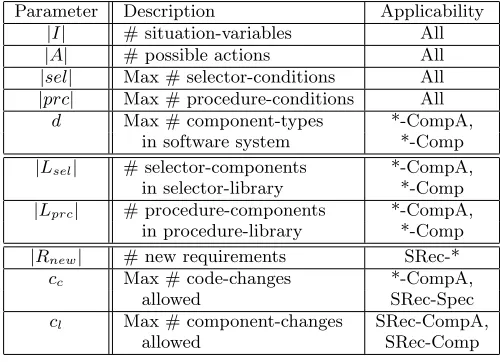
Table 1: Parameters for Component-based Design and Reconfiguration Problems
Parameter Description Applicability
|I| # situation-variables All
|A| # possible actions All
|sel| Max # selector-conditions All
|prc| Max # procedure-conditions All
d Max # component-types *-CompA, in software system *-Comp
|Lsel| # selector-components *-CompA,
in selector-library *-Comp
|Lprc| # procedure-components *-CompA,
in procedure-library *-Comp
|Rnew| # new requirements SRec-*
cc Max # code-changes *-CompA,
allowed SRec-Spec
cl Max # component-changes SRec-CompA,
allowed SRec-Comp
5.
WHAT MAKES COMPONENT-BASED
DESIGN AND RECONFIGURATION
TRACTABLE?
Our component-based software design and reconfiguration problems have a number of parameters whose restriction could render these problems tractable in the sense defined in Section 4. An overview of the parameters that we consid-ered in our fp-tractability analysis is given in Table 1. These parameters can be divided into three groups:
1. Restrictions on system and component structure (|I|,|A|,|sel|,|prc|,d);
2. Restrictions on component libraries structure (|Lsel|,|Lprc|); and
3. restrictions on reconfigurability (|Rnew|, cc,cl).
We will assess the fixed-parameter tractability of our prob-lems relative to the parameters in Table 1 (Section 5.1), show how these results apply in more general settings (Sec-tion 5.2), and discuss the implica(Sec-tions of these results for component-based development (Section 5.3).
5.1
Results
Our parameterized intractability results are as follows:
Result B: SDes-Spec isW[2]-hard for{|A|,|sel|,|prc|}when
|A|= 2 and|sel|= 0.
Result C: SDes-CompA isW[2]-hard for{|A|,|sel|,|prc|, d,
|Lsel|,|Lprc|, cc} when |A| = d = 2, |sel| = 0, |Lsel| =
|Lprc|= 1.
Result D: SDes-Comp isW[2]-hard for{|A|, d,|Lsel|}when
|A|= 2 and|Lsel|= 1.
Result E: SRec-Spec isW[2]-hard for{|A|,|sel|,|prc|,|Rnew|, cc}
when|A|= 3,|sel|= 0, and|Rnew|= 1.
Result F: SRec-CompA isW[2]-hard for{|A|,|sel|,|prc|, d,
|Lsel,|Lprc|,|Rnew|, cl, cc}when |A|= 3, |Rnew|=|Lsel|=
|Lprc|= 1,d= 2, and|sel|=cl= 0.
Result G: SRec-Comp isW[2]-hard for{|A|, d,|Lsel|}when
|A|= 3 and|Lsel|= 1.
At present, we have the following fp-tractability results:
Result H: SDes-Spec, SDes-CompA, SDes-Comp, SRec-Spec, SRec-CompA, and SRec-Comp are fixed-parameter tractable for{|I|}.
Result I: SDes-Comp and SRec-Comp are fixed-parameter tractable for{|sel|,|Lprc|}.
Note that Results B, C, E, F, and H in combination with Lemmas 1 and 2 completely characterize the parameterized complexity of problems SDes-Spec, SDes-CompA, SRec-Spec, and SRec-CompA relative to the parameters in Table 1.
5.2
Generality of Results
Our intractability results, though defined relative to basic models of software requirements, software systems, compo-nents, and component libraries, have a broad applicability. Observe that the models for which these results hold are in fact restricted versions of more realistic alternatives,e.g.,
• software requirements that explicitly list all situations to which software should respond are a special case of more complex requirements which are based on com-pact specifications of software behaviour such as finite-state automata or finite-statecharts and/or incorporate other required properties of software systems such as degree of reliability and response time;
• two-level selector / procedure software systems that act as simple functions are a special case of more com-plex persistent software systems whose components in-voke each other in more complex manners;
• components consisting of a single condition-statement block procedure without input parameters or return values and which have no dependencies on other com-ponents are a special case of more complex comcom-ponents consisting of multiple data types and complex proce-dures which have dependencies on other components such as data-type sharing or inheritance; and
• component libraries that are simply lists of compo-nents are a special case of component libraries that incorporate component behaviour-specifications and / or metadata to aid in selection and adaptation.
Intractability results for these alternatives then follow from the observation that intractability results for a problem Π also hold for any problem Π′ that has Π as a special case
(suppose Π is intractable; if Π′ is tractable by algorithmA,
thenAcan be used to solve Π efficiently, which contradicts the intractability of Π — hence, Π′must also be intractable).
5.3
Discussion
We have found that designing and reconfiguring software systems byde novodesign, component selection, and compo-nent selection with adaptation are allN P-hard (Result A). This implies that it is unlikely that deterministic polynomial-time methods exist for any of these problems. It also answers the question of which ofde novo design, component selec-tion, or component selection with adaptation is best for cre-ating software systems – computationally speaking, all three methods are equally good (or bad) in general.
This N P-hardness has interesting additional implications. It is widely believed thatP=BP P [21, Section 5.2] where
BP Pis considered the most inclusive class of problems that can be efficiently solved using probabilistic methods (in par-ticular, methods whose probability of correctness can be ef-ficiently boosted to be arbitrarily close to probability one). Hence, our results also imply that unlessP =N P, there are no probabilistic polynomial-time methods which correctly design or reconfigure software systems using the three ap-proaches considered here with high probability for all inputs. Taken together, the above constitutes the first proof that
nocurrently-used method (including search-based methods based on evolutionary algorithms (see [11, Section 5] and ref-erences) can guarantee both efficient and correct operation for all inputs for these problems.
As described in Section 4, efficient correctness-guaranteed methods may yet exist relative to plausible restrictions on the input and output. It seems reasonable to conjecture that some restrictions relative to the parameters listed in Table 1 should render these problems tractable. However, almost none of these restrictions or indeed many possible combina-tions of these restriccombina-tions can yield tractability, even when the parameters involved are restricted to very small con-stants (Results B–G). We do have some initial fp-tractability results (Results H and I). Taken together, our fp-results paint a disconcerting picture for problems Spec, SDes-CompA, SRec-Spec, and SRec-SDes-CompA, as they suggest that making both the software systems and the degree of al-lowable adaptation small under the approaches encoded in these problems does not yield tractability. However, the sit-uation for problems SDes-Comp and SRec-Comp may not be so dire. To date, we have not been able to prove fp-intractability relative to a number of the individual param-eters and parameter-combinations considered here for these problems. Hence, if fp-tractability holds in at least some of those cases, this would constitute proof that component selection without adaptation is tractable in a wider set of circumstances than eitherde novodesign or component se-lection with adaptation.
Two valid objections to our fp-tractability results are that (1) the algorithms underlying these results are crude and rely on brute-force search and (2) the running times of these algorithms are (to be blunt, ludicrously) impractical. These objections are often true of the initial fp-algorithms derived relative to a parameter-set. However, once fp-tractability is proven, surprisingly effective fp-algorithms are often subse-quently developed with greatly diminished non-polynomial terms and polynomial terms that are quadratic or even lin-ear in the input size (see [4, 5] and references).
A final very important proviso is in order – namely, as il-luminating as the results given here are in demonstrating basic forms of (in)tractability for software design and recon-figuration problems relative to the three approaches consid-ered, these results do not necessarily imply that methods currently being applied to design or reconfigure software are impractical. Differing software and component models, the particular situations in which these currently-used methods are being applied, and accepted standards by which method practicality is assessed may render the results given here irrelevant. For example, current methods may already be implicitly exploiting restrictions on the input and output such that both efficient and correct operation (or operation that is correct with probability very close to one) are guar-anteed. That being said, not knowing the precise condi-tions under which such practicality holds could have serious consequences,e.g., drastically slowed software creation time and/or unreliable software operation, if these conditions are violated. These consequences would be particularly damag-ing in the case of runtime-based applications like ubiquitous and autonomic computing. Given that reliable software op-eration is very important and efficient software design and reconfiguration is at the very least desirable, the acquisition of such knowledge via a combination of rigorous empirical and theoretical analyses should be a priority. With respect to theoretical analyses, it is our hope that the techniques and results in this paper comprise a useful first step.
6.
CONCLUSIONS
We have presented a formal characterization of the prob-lems of software system design and reconfiguration by de novodesign, component selection, and component selection with adaptation. Our complexity analyses reveal that, while these problems are computationally intractable in general, there are restrictions that render them tractable. Though the immediate practical utility of our tractability results is questionable given the basic models of software require-ments, software systems and components relative to which they were derived, our intractability results give the first rigorous computational comparison between the three ap-proaches to software design considered here. In particular, our results as a whole establish that all three approaches are equally computationally difficult in general but suggest that software creation by component selection may be tractable under more circumstances than the other two approaches.
7.
ACKNOWLEDGMENTS
The authors extend most grateful thanks to Iris van Rooij and Maria Otworowska (Donders Institute for Brain, Cog-nition, and Behaviour, Radboud University Nijmegen) with whom they collaborated on the formalization of the adaptive toolbox theory of human decision-making that underlies the formalizations of component-based design and reconfigura-tion analyzed here. They would also like to thank the three reviewers for comments that helped greatly to improve the presentation of this paper. TW was supported by NSERC Discovery Grants RGPIN 228104-2010 and 228104-2015.
8.
REFERENCES
[1] P. Allen and S. Frost.Component-Based Development for Enterprise Systems: Applying the Select
Perspective. Cambridge University Press, 1997. [2] R. G. Bartholet, D. C. Brogan, and P. F. Reynolds Jr.
The computational complexity of component selection in simulation reuse. InProceedings of the 2005 Winter Simulation Conference, pages 2472–2481, 2005. [3] A. Brown.Large-Scale Component-Based Software
Development. Prentice-Hall PTR, 2000.
[4] M. Cygan, F. V. Fomin, L. Kowalik, D. Lokshtanov, D. Marx, M. Pilipczuk, M. Pilipczuk, and S. Saurabh.
Parameterized Algorithms. Springer, 2015. [5] R. Downey and M. Fellows.Fundamentals of
Parameterized Complexity. Springer, Berlin, 2013. [6] L. Fortnow. The Status of the P Versus NP Problem.
Communications of the ACM, 52(9):78–86, 2009. [7] W. B. Frakes and K. Kang. Software reuse research:
Status and future.IEEE transactions on Software Engineering, 21(7):529–536, 2005.
[8] M. R. Garey and D. S. Johnson.Computers and Intractability. W.H. Freeman, 1979.
[9] G. Gigerenzer and P. Todd. Fast and frugal heuristics: The adaptive toolbox. InSimple Heuristics that Make Us Smart, pages 3–34. Oxford University Press, 1999. [10] R. Gonz´alez and M. Torres. Critical issues in
component-based development. InProceedings of The 3rd International Conference on Computing,
Communications and Control Technologies, 2005. [11] M. Harman, S. Mansouri, and Y. Zhang. Search-based
software engineering: Trends, techniques and
applications.ACM Computing Surveys, 45(1):11, 2012. [12] G. Heineman and B. Councill, editors.
Component-Based Software Engineering: Putting the Pieces Together. Addison-Wesley, 2000.
[13] H. M¨uller and N. Villegas. Runtime evolution of highly dynamic software. InEvolving Software Systems, pages 229–264. Springer, 2014.
[14] M. Nouri and J. Habibi. Approximating component selection with general costs. InAdvances in Computer Science and Engineering, pages 61–68. Springer, 2008. [15] M. Otworowska, M. Sweers, R. Wellner, M. Uhlmann,
T. Wareham, and I. van Rooij. How didHomo Heuristicusbecome ecologically rational? In
Proceedings of the EuroAsianPacific Joint Conference on Cognitive Science, pages 324–329. 2015.
[16] E. H. Page and J. M. Opper. Observations on the complexity of composable simulation. InProceedings of the 31st Winter Conference on Simulation,
volume 1, pages 553–560. ACM, 1999.
[17] M. Petty, E. Weisel, and R. Mielke. Computational complexity of selecting components for composition. InProceedings of the Fall 2003 Simulation
Interoperability Workshop, pages 14–19, 2003.
[18] U. Stege. The Impact of Parameterized Complexity to Interdisciplinary Problem Solving. In H. L.
Bodlaender, R. Downey, F. V. Fomin, and D. Marx, editors,The Multivariate Algorithmic Revolution and Beyond, number 7370 in Lecture Notes in Computer Science, pages 56–68. Springer, Berlin, 2012. [19] M. Sweers.Adapting the Adaptive Toolbox: The
Computational Cost of Building Rational Behaviour. M.Sc. thesis, Radboud University Nijmegen, 2015. [20] T. Wareham.Systematic Parameterized Complexity
Analysis in Computational Phonology. Ph.D. thesis, University of Victoria, 1999.
[21] A. Wigderson. P, NP and mathematics — A
computational complexity perspective. InProceedings of ICM 2006: Volume I, pages 665–712, Zurich, 2007. EMS Publishing House.
APPENDIX
A.
PROOFS OF SELECTED RESULTS
All of our intractability results will be derived using reduc-tions from the followingN P-hard problem:
Dominating set[8, Problem GT2]
Input: An undirected graphG= (V, E) and an integerk.
Question: DoesGcontain a dominating set of size≤k,i.e., is there a subsetV′⊆V,|V′| ≥k, such that for allv∈V′,
eitherv∈V′or there is av′∈V′ such that (v, v′)∈E?
For each vertex v ∈ V, let the complete neighbourhood
NC(v) ofvbe the set composed ofvand the set of all vertices
inGthat are adjacent tovby a single edge,i.e.,v∪{u|u ∈
V and (u,v)∈E}. We assume below an arbitrary ordering on the vertices ofV such thatV ={v1, v2, . . . , v|V|}.
Lemma 3. Dominating Setpolynomial-time many-one reduces to SDes-Spec such that in the constructed instance of SDes-Spec, |A|= 2, |sel|= 0, and|prc|is a function of
k in the given instance ofDominating Set.
Proof. Given an instance hG= (V, E), kiof Dominat-ing set, the constructed instancehI, A, R, X=h|sel|,|prc|ii
of SDes-Spec hasI ={i1, i2, . . . i|V|},A={0,1},|sel|= 0,
and|prc|=k. There are|V|+ 1 situation-action pairs inR
such that (1) for ri= (si, ai), 1≤i≤ |V|,v(ij) =T rueif
vj∈NC(vi) and isF alseotherwise andai= 1, and (2) for
r|V|+1= (s|V|+1, a|V|+1), allv(ij) areF alseanda|V|+1= 0.
Note that the instance of SDes-Spec described above can be constructed in time polynomial in the size of the given in-stance ofDominating set.
If there is a dominating set of size at most k in the given instance of Dominating set, construct a software system
1 and the finalELSEstatement has action 0. Observe that this software system satisfies all situation-action pairs inR
and has|sel|= 0 and|prc|=k.
Conversely, suppose that the constructed instance of SDes-Spec has a software system satisfyingR with|sel|= 0 and
|prc| ≤k. The selector in this system must be the default selector as it is the only selector with|sel|= 0. As for the single procedure attached to that selector, it has two possible structures:
1. No negated situation-variable conditions: Asr|V|+1has
no situation-variables set to T rue, it can only be pro-cessed correctly by the finalELSE-statement, which must thus execute action 0. In order to accept all other situation-pairs in R, the k conditions must then have situation-variables whose corresponding vertices form a dominating set inGof size at mostk.
2. Negated situation-variables are present: Let c be the first negated situation-variable condition encountered moving down the code in the procedure, C be the set of unnegated situation-variable conditions encountered before c, and R′ ⊆ R be the set of situation-action pairs not recognized by the situation-variables inC. As
|prc| ≤k,|C| ≤k−1. Moreover, as situation-action pair r|V|+1 has no situation-variable with value T rue
and hence cannot be recognized by an IF-THEN state-ment with an unnegated situation-variable condition,
r|V|+1∈R′.
Let R′′ ⊂R be such that R′ = R′′∪ {r|V|+1}. IfR′′
is empty, then the variables inCmust have recognized all situation-action pairs inRexceptr|V|+1, and hence
the vertices corresponding to the situation-variables in
C form a dominating set in G of size at mostk−1. If R′′ is not empty, situation-variable c cannot have valueF alsefor any of the situation-action pairs inR′′
because having either 0 or 1 as the action executed by the associated IF-THEN statement would result in the procedure executing the wrong action for at least one situation-action pair inR′(if 0, at least one of the situation-action pairs in R′′; if 1, r|V|+1). However,
this implies that all situation-action pairs in R′′ have valueT rueforc, which in turn implies that the vertices corresponding to the situation-variables inC∪{c}form a dominating set inGof size at mostk.
Hence, the existence of a satisfying software system for the constructed instance of SDes-Spec implies the existence of a dominating set of size at mostk for the given instance of
Dominating Set.
To complete the proof, note that in the constructed instance of SDes-Spec,|A|= 2,|sel|= 1, and|prc|=k.
Lemma 4. Dominating Setpolynomial-time many-one
reduces to SDes-Comp such that in the constructed instance of SDes-CompA,|A|= 2,|Lsel|= 1, andd is a function of
kin the given instance ofDominating Set.
Proof. Given an instancehG= (V, E), ki of Dominat-ing set, the constructed instancehI, A, R, Lsel, Lprc, di of
SDes-Comp hasI={i1, i2, . . . i2|V|}andA={0,1}. There
are |V|+ 1 situation-action pairs in R such that (1) for
ri= (si, ai), 1≤i≤ |V|,v(ii) =T rue,v(i|V|+j) =T rueif
vj ∈ NC(vi), all other v(ij) are F alse, and ai = 1, and
(2) for r|V|+1 = (s|V|+1, a|V|+1), all v(ij) = F alse and
a|V|+1= 0. There is a single selector inLsel whose|V| −1
IF-THENstatement conditions are the first|V| −1 situation-variables in I. There are |V|procedures inLprc such that
procedurei, 1≤i≤ |V|, has anIF-THENstatement for each of the vertices in NC(vi) whose condition is the
situation-variable associated with that vertex and which executes ac-tion 1 and anELSEstatement that executes action 0. Finally, letd=k+1. Note that the instance of SDes-Comp described above can be constructed in time polynomial in the size of the given instance ofDominating set.
If there is a dominating set of size at most k in the given instance ofDominating Set, construct a software system consisting of the single selector inLseland the at mostk
pro-cedures fromLprccorresponding to the vertices in the
domi-nating set. For each of the|V|−1IF-THENstatements in the selector, call the procedure encoding the neighbourhood of the vertex in the dominating set which dominates the vertex corresponding to the situation-variable in that statement’s condition. For the ELSE statement in the selector, execute the procedure encoding the neighbourhood of the vertex in the dominating set that dominates vertexv|V|. Observe that
this software system satisfies all situation-action pairs inR
and hasd=k+ 1.
Conversely, suppose that the constructed instance SDes-Comp has a software system constructed from at mostd=
k+ 1 distinct components fromLselandLprc that satisfies
all of the situation-action pairs inR. As the selector is con-structed such that each of the first|V|situation-action pairs inR has its own associated procedure and each procedure accepts the vertices in a specific vertex-neighbourhood inG, in order for these situation-action pairs to be satisfied, the distinct procedures in the software system must correspond to a dominating set for G(note that bothr|V| andr|V|+1
are satisfied by the procedure associated with theELSE state-ment in the selector). Asd=k+ 1 and the system had to incorporate a selector fromLsel, this means that there are
at most k such procedures and hence a dominating set of size at mostkin the given instance ofDominating Set.
To complete the proof, note that in the constructed instance of SDes-Comp,|A|= 2,|Lsel|= 1, andd=k+ 1.
Result A:SDes-Spec and SDes-Comp areN P-hard.
Proof. Follows from the N P-hardness of Dominating Setand the reductions in Lemmas 3 and 4, respectively.
Result B:SDes-Spec isW[2]-hard for{|A|,|sel|,|prc|}when |A|= 2 and|sel|= 0.