Educating Diversely: The Artist Talk Platform
Arianna Garcia-Fialdini
Concordia University
ABSTRACT
Artist-teachers can inspire diverse audiences to adopt innovative
teaching practices through artist talks fueled by a social justice and
awareness-raising agenda. This article presents ways to incorporate
social problematics like mass displacement and pressing international
immigration policies into diverse art classrooms and unconventional
pedagogical platforms (in this case, through artist talks). It focuses on
an artist talk given in collaboration with the Immigrant Workers Centre,
a non-profit organization of newly arrived immigrants and refugees
located in Montreal, Canada, and explores how the artist-talk platform
reaches communities outside the traditional classroom and creates
space for an exchange of ideas, artistic intervention, and learning from
diverse participants. Additionally, I discuss my observations on potential
pedagogical exchanges based on experiences from the event, concluding
by further exploring the relevance and potential development in personal
artistic and teaching practices for and with this specific community.
KEYWORDS: artist talks, social justice, pedagogical platforms, diverse
audiences
members. In so doing, these artists have a better chance to address
and more openly discuss cultural conflicts as well as local and global
issues, such as violations of human rights, newcomers’ rights to basic
social services, and their encounters with racism, gender inequality,
and injustice.
I am interested in the many potential conversations that artistic
narratives inspire – in the form of artist talks – among the artistic
community and diverse multi-cultural groups with different levels
of artistic background and knowledge. These creative investigations
and interactions between artists, immigrants, and many other
members of society (for example, social workers, government agents,
law enforcers, NGO representatives), excite contemplation, raise
questions, and confront subjectivities and information that may not
be easily accessible while exploring social problems or larger conflicts
such as racism, inclusion, diversity, hate crimes, etc. These processes
of research for both artists and the audience they are engaging
in dialogue with (Sullivan & Gu, 2017) construct and arrange
educational mechanisms and methods to create new knowledge
that can change and influence our perception of human experience.
Sullivan and Gu (2017) believe that if communicated widely and
made more accessible, these new perceptions and newly acquired
knowledge of human experience can result in offering individuals
and communities new spaces, prospects, and objectives for making
positive changes and making sense of the worlds we live in. By doing
this, we begin to “draw on personal knowledge and life experience”
(Sullivan & Gu, 2017, p. 50) in order to achieve positive changes both
individually and as a community.
By the same token, Rolling (2013) points out that arts-based research
– in this case in the form of artist talks – is a cultural process and “a
form of interdisciplinary inquiry because it opens up spaces within
and across art, culture, research and teaching” (p. 54). Artist talks can
therefore, in turn, be seen as methods of creative interrogation and
forms of research. This implies that artist-practitioners not only share
their work, but in so doing also obtain valuable input. The creative
experiences artist-practitioners facilitate within distinct spaces often
generate profound responses. I think it is also worth mentioning
that to this point, I acknowledge Garber’s (2010) perspective on
participatory democracy and social justice as well as the need for
educators and artists to contribute to the learner’s educational
well-being and growth as an important and direct influence on my current
thinking and articulation of this matter of collaborating and engaging
artistically and socially with marginalized demographics.
Relevant figures in the field like Suzanne Lacy and Kerry Freedman
discuss artistic narratives and discourse as significant pedagogical
moments. Lacy (1995) offers a possible suitable approach to address
engagement with society and social issues, and I have begun to
conceive of the artist as a socially engaged (Kester, 2013) “border
crosser”
1(Gaztambide-Fernandez, 2008).
I have worked closely on several artistic projects
2over the past few
years with various groups of newly arrived immigrants and refugees.
Through this work, I have seen art open up a productive space for
narratives in which immigrants were able to explore their evolving
identities in unfamiliar and productive ways. From this stance, I
advocate for art and artistic practices in programming for displaced
persons because of art’s power to reach beyond the capabilities of
speech and oral language or idiom. Art can positively affect the
conversations we need to be having about immigrants’ integration
into a new culture by making space in which diverse members of
society, including immigrants, can exchange opinions on these topics,
which involve conflicting world views and competing cultural values
and belief systems. As an immigrant
artist from Mexico, a developing
researcher, and a teacher working and studying in Montreal, Canada,
the topic of diversity and offering diverse, accessible pedagogical
platforms to disenfranchised demographics is of particular interest to
me. By diverse pedagogical platforms, I mean specifically structured
and organized encounters that take place within informal,
non-academic community settings, such as coffee shops, hookah lounges,
and restaurants. This includes but is not limited to artist talks,
workshops and/or working group meetings held in community
centers or in non-profit organization common rooms, potluck/
meal-sharing events, commemoration group gatherings, and
discussions. My own evolving migration story and the experiences
I have informally been subjected to while engaged in artmaking
and creative exchange in this specific type of setting have convinced
me of art’s extensive reach over barriers. Some of these barriers are
associated with language, culture, and education, and they can limit
a newcomer’s ability to articulate complex ideas. Throughout this
paper, I explore the potential for an immigrant artist-teacher to inform
audiences outside the boundaries of a mainstream classroom setting
by addressing how art and art education are implicated in our shifting
cultural landscape. By teaching from unorthodox platforms such as
artist talks, artists as educators can practice and cultivate arts
with diverse and potentially disenfranchised learners and community
1
Writer, academic, and musician Ruben Gaztambide-Fernandez identifies the artist through the concepts of “border crosser” from the context of vigorously intervening and holding a self-beneficial position regarding influential institutions in a critical, engaged, and challenging manner.of community-based art education inspired me to consider further
developing these informal artist talks with this specific demographic
as a form of empowering outreach for the community.
Ulbricht (2005) argues that focusing on local art and culture helps
enrich learning by making art more accessible. Artist talks by socially
engaged artists are able to focus on local art and culture, start a
discussion with the community, and thus make art with them rather
than merely about them. More precisely, it became clear to me that this
group of newcomers would not have easy access to art education in a
conventional classroom or lecture setting due to their socio-economic
realities, nor would that type of setting necessarily be comfortable or
inclusive for many of them.
Community and Affiliation
The IWC in Montreal seeks economic and social justice for newly
arrived immigrants entering the Canadian workplace. Throughout
my collaboration with the IWC, I have engaged in creative and artistic
projects with large groups of newly arrived immigrants for over two
years.
A small art collective within the IWC, called the Artist Bloc (AB),
uses art as a tool to advocate for social change. The AB hosts artistic
interventions, actions, and campaigns through various mediums
such as painting, sculpture, mixed media creations, theatre, and
music. You can find them on Facebook at www.facebook.com/
blocartistesCTI/?ref=page_internal. Most members and participants
involved with the IWC and the Artist Bloc have migrated from Latin
America, the Caribbean, and Africa and hold status in Canada as
refugees, temporary migrant workers, and, at times, undocumented
citizens. They have one thing in common: all members have been
forced out of their countries of origin, many leaving behind most,
if not all, of their personal belongings and loved ones. The change
in environment – a new place, a new language, and a new culture –
often leads to their feeling shocked and overwhelmed. The members
in this group form a diverse cultural audience. They often have little
experience with art making and can be skeptical about the power
of art to influence, empower, and, at times, heal disenfranchised
communities.
My main artistic role at the AB has been to apply my technical,
studio-based visual arts expertise and background to art projects that
support the group’s visions. I have facilitated workshops for drawing
and sketching, painting, collage, mixed media, and ephemeral murals.
Throughout my time there, I have presented artist talks regarding art
practices that advocate for human rights issues. These talks addressed
diverse socio-political realities and human rights violations around
heavy, controversial issues through art. Using a new genre public art
lens (Irish, 2010), Lacy explores social themes and urban issues by
entering into conversations with diverse communities (Lacy, 1995). On
the other hand, Freedman (2000), from a much more pedagogical and
theoretical perspective, seems to focus on inquiries into community
and social perspectives on art education, including a concern with
issues of ethnicity, body identities, cultures, communities, and
political conditions. She concentrates on a common thread shared
by these diverse perspectives that the visual arts are fundamental
to all populations, stating that “representations of education should
seek to reveal its complexity, diversity, and integral cultural location”
(Freedman, 2000, p. 314). Freedman (2000) goes on to suggest that:
these perspectives represent the lived meanings
of arts communities through…collaborative
instructional methods and community action. Social
reconstructionist versions of these perspectives are
also founded on the belief that education can make a
difference in student understanding of action in the
world and that difference can enrich and improve
social life. (p. 314)
I have begun to investigate this argument in my developing research
on the notion of unusual environments and settings for learning and
teaching.
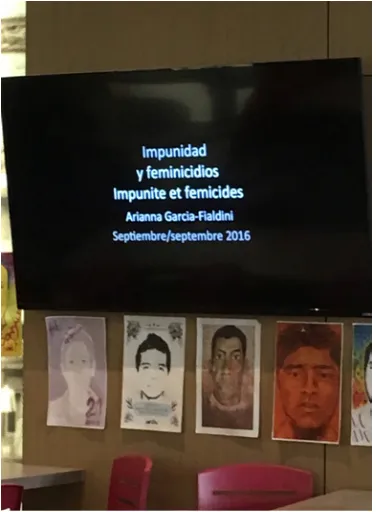
make for the event was propped up next to the large overhead screen.
As the public walked in and took their seats, the lights were dimmed
and I began my presentation:
Mexicans and global citizens around the world gather
together on the 26th and 27th of September to
com-memorate the forced disappearance of 43 university
students in Iguala, Mexico, since 2014. The
disappear-ances were provoked by a series of violent episodes
caused by Iguala’s municipal police force, where they
chased and attacked students from the Normal Rural
School of Ayotzinapa, in the state of Guerrero near
Mexico City. In this confrontation, journalists and
civilians were injured – fewer than 10 people reported
dead and 43 students disappeared to this day. Despite
countless attempts from family and citizens
demand-ing justice and thorough investigation towards
find-ing the students, not one has been reported found,
dead or alive.
As an immigrant Mexican woman, being asked to
speak through my artwork specifically on this
sub-ject is a great privilege, possible in large part due to
my new geographical whereabouts. I am grateful
for the opportunity to continue building awareness
through my art on the important and growing theme
of violence, which affects us all in a very real way,
universally. As an immigrant, I constantly analyze
the reasons behind choosing to leave my country.
The analysis seems to consistently return to the idea
of the search for safety and harmony. My country of
origin continues to be plagued by impunity,
corrup-tion, gender inequality, and organized crime. This is
an important reality to face that continues to fuel my
artistic drive and work for various years now, and
prompts me to make artwork that denounces the fact
that this reality in Mexico has existed for far too long.
A large part of my artwork examines my country
of origin and the current social challenges it faces,
where for over 20 years there has continued to be
an uncontrollable loss of small girls, teenagers, and
grown women as part of the phenomenon universally
the world that directly affect a large portion of the population of
immigrants entering Canada. The talks covered the importance of
advocating for basic human rights and raising awareness of these
realities to bring injustice to a halt through the artmaking process and
sharing of artworks.
4Through my relationship with the Artist Bloc, I have been able to help
the group express diverse narratives through art, bring the difficult
realities faced by members of the IWC to the art research sphere
in Canada, and use my position as an artist to teach and learn in a
more inclusive setting. Additionally, it allows me the opportunity
to appeal to a more heterogeneous audience that rarely has access
to pedagogical exchange that raises social awareness and promotes
participatory democracy (Garber, 2010).
Artist Talk as an Alternative Pedagogical Platform
In September 2016, I delivered an artist talk through the IWC and
a sister organization by the name of Mexicanxs Unidos por la
Regularizacion that served as a vehicle for sharing artistic narratives
at the commemoration of the disappearance of 43 university students
in Ayotzinapa, Mexico two years before. I prepared a presentation
that showcased visual examples of the print media and paint work I
have done related to similar issues, and I was asked to prepare a work
of art to memorialize this important date. The work of art served as
the backdrop during my presentation. Diverse cultural backgrounds
were represented at the event, with participants from Mexico,
Haiti, Colombia, Chile, Venezuela, and Canada. During a previous
workshop, members were asked to read some of the letters that family
members of the 43 disappeared university students left on their
make-do memorial graves in the region of Ayotzinapa. Participants made
large drawing portraits of the missing students that included some
of the heartfelt messages from nostalgic letters left behind. These
drawings were hung around the event venue to put faces to each of
the 43 “missing”
5students. The work of art I was commissioned to
4
My artistic work over the past 10 years in paint and print media has dealt with issues raising awareness of gender-based violence and social change. More recently, I have explored the conditions of women from the margins. In many ways, my work serves as a direct comment on the social realities I study (formally and informally). My current artistic work focuses on storytelling in the form of portraits and large-scale murals that humanize and represent socio-po-litical experiences while expressing my own perspective as a form of activism on diverse situations. Examples of the works shown throughout the artist talk presen-tation are included in Figures 1-6.Figure 2. Sin titulo, Untitled. Artist: Garcia-Fialdini Example of works displayed throughout the artist talk.
Figure 3. Madre en espera, Mother awaits. Artist: Garcia-Fialdini Example of works displayed throughout the artist talk.
known as Femicide.
6Throughout the research that goes into informing my
art practice, it has become increasingly clear that the
Mexican government has failed to do what is needed
to keep more girls and women from disappearing
and dying due to gender inequality and misogyny.
The same can be argued in this specific case marked
by the date commemorating the missing students of
Ayotzinapa, but applies in this instance to men and
women alike. Impunity continues to defeat justice.
My artwork aims to call universal attention to this
global problem and raise awareness to inform and
start ensuring a real change in upholding human
rights.
The artist talk ended here. The following images are visual examples
of the artworks that accompanied the presentation.
Figure 1. Desaparecidos, The disappeared. Artist: Garcia-Fialdini Example of works displayed throughout the artist talk.
Figure 6. Justicia, Justice. Artist: Garcia-Fialdini Example of works displayed throughout the artist talk
.
Comments and questions followed the presentation. An intimate,
spontaneous space for concerns and opinions opened up. The
experience of sharing artistic narratives through this platform (in
the context of this specific event) had indirectly and unintentionally
brought to life a very real and powerful pedagogical stage.
The reactions from the audience included aesthetic suggestions
as well as many others related to context depiction. One audience
member, for example, suggested incorporating some of the text from
the relatives’ letters to further personalize and remind the viewer
of the direct and deep impact that this terrible situation brought on
specific members of a large community. A different audience member
talked about how the size of each work brought intimacy to the
subject matter, allowing them to engage with the difficult context of
the situation without necessarily imposing or forcing these atrocities
down their throats. This observation was followed by the remark
that this ensured a welcoming approach into learning more about a
sensitive and difficult subject matter that can encourage larger groups
of people to hear or learn more about it. On a separate note, another
member of the audience continued to suggest working on future
imagery that denounced the impunity and terror that the government
cast upon the citizens of this region and the country as a whole, as
opposed to only concentrating on the people it directly affected.
One audience member addressed the notion of incorporating
more explicit symbolism or imagery in the artworks to catch larger
audience attention in denouncing the real violence of the situation.
To this, another audience member seemingly intuitively reacted,
expressing their opinion in considering the importance of tact and
Figure 4. Discriminate. Artist: Garcia-Fialdini Example of works displayed throughout the artist talk.
those theories. This profound breach of traditional ideas challenges
conventional notions of power and language, which I am still
exploring.
As I begin to delve further into the power of discourse, I become
more aware of the political and ethical commitment of challenging
“traditional ideas” (Wandel, 2001), viewing them as almost
historically complicit with the exercise of power. This seems
imperative specifically when exploring the construction of oppression,
in this case particularly in the context of “othered” groups, such as
migrant workers, refugees, and immigrants.
My personal, informal reflection on the reactions and comments from
both participants and attendees helped reinforce my belief in the
importance of art reaching large groups of people to help facilitate
and encourage growth and raise awareness of social issues like
diversity. As the audience engaged with the material and connected
the aesthetic to the topic, it reinforced my consideration that there
are far more possibilities and potentials to explore in the power of
images and art when used as tools for social awareness and change.
As McClure (2010) suggests, “through this collaborative experience…
educators are able to re-envision themselves and their future teaching
practice as they collaborate with one another and with
community-based educators to serve populations with whom they may
previously have had little contact” (p. 222). In addition, this highlights
the importance of celebrating the genuine idea that pedagogy should
allude to the approach and process of teaching as an analytical
perception or theory and a scholarly subject (Sawada, 1972).
Fewer than half the audience members, according to a prompted
show of hands, had heard about the missing students in Ayotzinapa
before the talk. Many audience members’ feedback and comments,
given informally during a post-talk conversation, reflected that the
talk had been a dynamic, transferable, rich, communicative, and
promising pedagogical experience. The audience members similarly
reported to have successfully felt part of a safe creative exchange
environment where they could in turn share their own thoughts
on the topic and work presented, exchange differences in opinion,
and relate experiences pertaining to similar themes of human rights
violations.
This type of event would likely translate well to a university setting.
The university would benefit by opening its academic doors and
offering access to resources and information to communities such
as these of newly arrived immigrants. Recording and analyzing the
ways in which the community is affected by having access to this
resource and exchange would be a promising, valuable, and profitable
one for the IWC, the Artist Bloc, and for future research developments
sensitivity when approaching these issues, as opposed to imposing
violent images onto viewers.
As I shared with the audience that day, I have heard these arguments
before, but I struggle artistically with the notion of adding to the
violent imagery repertoire of our consistently oversaturated visual
culture. I disclosed that I feel a real responsibility toward the images
I produce and put out into the world, and I fear that a more explicit
use of imagery might repel viewers from engaging with the work
and learning more about the subject matter, forcing them to look
away for lack of sensitivity or tact on these already difficult topics.
I continually struggle with these dilemmas in my developing art
practice, especially when visualizing my smaller drawings or works
as maquettes for large, potentially imposing, future murals in
community settings.
Conclusion and Questions
As an immigrant artist-teacher, sharing this body of work and
experiences with a culturally diverse demographic outside the
potentially excluding restrictions of a mainstream classroom setting,
allowed me to participate in today’s shifting cultural debate and
conversation. The artist-talk platform acted as a powerful mechanism
to raise awareness about the social and political issues addressed
in my talk, and it created space for the participants to discuss social
justice more generally. By making these artistic narratives and
inclusive conversations more accessible, artists as art educators can
reach diverse and potentially disenfranchised audiences.
Exchanges like these are valuable in opening further discussions
and conversations around the notion of education through art and
artmaking, specifically when dealing with diverse audiences in
atypical settings. Garber (1995) articulates this idea further, affirming
that “we can start with a work of art or with the thematic approach.”
She explains, “I will begin with learning about the other by searching
for meanings and nutrient experiences and move to developing new
ways of thinking and valuing” (p. 224).
Figure 7. Ayotzinapa, Corazon y Memoria, Atoyzinapa, Heart and Mind Artist: Garcia-Fialdini
Commissioned work for the event.
and possibilities in the field of community-based art education.
Academia needs to prioritize integrating conversations of accessibility
and exchange of information to marginalized communities and
individuals into scholarly dialogues and discourses. Through
my position as a socially engaged artist and art educator, I feel a
responsibility to integrate these exchanges into the larger conversation
of art education in the academy to further expose some of the many
audiences – temporal workers, newcomers, refugee claimants – and
the abounding effects and reactions that art can have in prompting
and influencing change, for instance, the potential that artist talks
have to empower, inform, raise awareness, cultivate personal growth,
and make accessible basic citizen rights.
The act of recording my participation in the artist talk in the form of
this article has motivated me to continue to share these perspectives.
A wide range of disenfranchised audiences like the ones previously
mentioned can benefit from collaborations through art and artmaking.
I intend to build on the privileged exchange I hold with the IWC/
Artist Bloc and report on future collaborations, results, and promises
to the academic community and beyond. Perhaps reporting in the
form of other future articles and experiences with artist talk lectures
or workshops can serve to highlight the effect that education through
art and artmaking has on individuals outside of the conventional
classroom and the many unknown or unheard of experiences of
newly arrived adult immigrants in Canada.
Figure 10. Event Documentation
Figure 11. Event Documentation
Figure 8. Event Documentation
Figure 14. Event Documentation
References
Artist Bloc. (2016). Home. Retrieved November 27, 2016, from https://www. facebook.com/blocartistesCTI/?ref=page_internal
Freedman, K. (2000). Social perspectives on art education in the U.S.: Teaching visual culture in a democracy. Studies in Art Education, 41(4), 314–329. Garber, E. (1995). Teaching art in the context of culture: A study in the borderlands.
Studies in Art Education, 36(4), 218–232.
Garber, E. (2004). Social justice and art education. Visual Arts Research, 30(2), 4–22. Garber, E. (2010). Global and local: Rethinking citizenship in art and visual culture
education. Encounters on Education, 11, 117–133.
Gaztambide-Fernandez, R. A. (2008). The artist in society: Understandings, expectations, and curriculum implications. Curriculum Inquiry, 38(3), 233–265.
Irish, S. (2010). Suzanne Lacy: Spaces between. Minneapolis, MN: University of Minnesota Press.
IWC, Immigrant Workers Centre. (2010). Mission. Retrieved November 26, 2016 from http://iwc-cti.ca/information/about-us/
Kester, G. H. (2004). Conversation pieces: Community and communication in modern
art. Oakland, CA: University of California Press.
Lacy, S. (Ed.). (1995). Mapping the terrain: New genre public art. Toronto: Bay Press. McClure, M. (2013). Riding through the borderlands: Sustainable art, education,
and social justice. In E. P. Clapp (Ed.), 20under40: Re-inventing the Arts
and Arts Education for the 21st Century (pp. 220–234). Bloomington, IN:
AuthorHouse.
Rolling, J. H. (2013). Art-based research primer. New York, NY: Peter Lang. Sawada, D. (1972). Piaget and pedagogy: Fundamental relationships. The
Arithmetic Teacher, 19(4), 293-298.
Sullivan, G., & Gu, M. (2017). The possibilities of research: The promise of practice. Journal of National Art Education Association, 70(2), 49–57.
Ulbricht, J. (2005). What is community-based art education? Art Education, 58(2), 6–12
Wandel, T. (2001). The power of discourse: Michel Foucault and critical theory. Journal for Cultural Research, 5(3), 368–382.
World Health Organization. (2012). Understanding and addressing violence against women: Femicide. Retrieved December 1, 2016, from http://apps.who. int/iris/bitstream/10665/77421/1/WHO_RHR_12.38_eng.pdf Figure 12. Event Documentation