IJSRR, 8(1) Jan. – Mar., 2019 Page 1160
Research article Available online www.ijsrr.org
ISSN: 2279–0543
International Journal of Scientific Research and Reviews
A Review:Engineering application of Metal Matrix Composites.
SagramHembrom
*Department of Metallurgical Engg.B.I.T. Sindri, Dhanbad,Jharkhand, India Email: [email protected]
ABSTRACT
Metal matrix composites possessto develop new structural materials with higher strength to
weight ratios is one of the biggest challenges in the aerospace as well as various industry. The Properties
like high specific strength, stiffness, better wear resistance ie excellent physical and mechanical
properties. The filler reinforcement into the metallic matrix improves the stiffness, specific strength,
wear, creep and fatigue properties compared to the conventional engineering materials.
KEYWORDS:
Aluminium metal matrix composites, Reinforcement.*Corresponding author
SagramHembrom
Assistant Professor,
Department of Metallurgical Engg. B.I.T. Sindri,
Dhanbad,Jharkhand, India
IJSRR, 8(1) Jan. – Mar., 2019 Page 1161
INTRODUCTION
MMCs (Metal matrix composites) uses metal matrix dispersed with other metal, ceramic or
organic compounds. Reinforcements are usually done to improve the various properties of the base
metal. The particle distribution plays a very important role in the properties of MMCs. Copper,
Magnesium and Aluminium has attracted most attention as base metal in metal matrix
composites.These MMCs are widely used in aircraft, aerospace, automobiles, defence and various
other fields . The most commonly used reinforcements are Silicon Carbide (SiC), TiO2, Aluminium
Oxide (Al2O3), B4C, Y2O3, Si3N4, AlN
3,4,5,6,7
. Al2O3 reinforcement shows good compressive strength
and wear resistance. Boron Carbide is one of hardest known elements. It has high fracture toughness
and elastic modulus. The addition of Boron Carbide (B4C) in MMCs increases their hardness, but
does not improve the wear resistance significantly. Fibers play very important role as reinforcement,
as they transfer strength to the matrix which results in the enhancement of their physical and
mechanical properties as desired. Zircon is usually used in hybrid reinforcement for improving the
wear resistance. In the last decade, lot of work has been done on fly ash reinforced MMCs. Due to
their low cost and availability as waste by-product in thermal power plants. It improves the
electromagnetic shielding effect of the MMCs . Based on the stated potential benefits of MMCs this
paper investigates the affect of various dispersion on the mechanical properties of MMCs, processing
methodology and their applications. MMCs using several metallic materials as matrix have been
studied by many researchers. Among all, the most interesting metals for industrial applications are
Al, Mg, Ti, Cu and their alloys. Pure and alloyed aluminium is the most investigated material as
matrix in MMCs. Al-based composites are good candidates for structural application. Various
nano-sized oxides like (Al2O3, Y2O3), nitrides (Si3N4, AlN) , carbides (TiC,SiC) , hydrates (TiH2) and
borides (TiB2)have been used as dispersion. As ceramic reinforcements Carborundum, Sic and
alumina are widely used in these MMCs. Moreover, different allotropes of carbon like carbon black,
fullerenes and carbon nanotubeshave also been investigated by several researchers. CNTs are
potential candidates as they confer very high mechanical properties to the metal matrix. They also increase
the electrical conductivity, which makes MMCs very attractive materials for electrical applications. Single
wall carbon nano tubes (SWCNT) and multi wall carbon nano tubes (MWCNT) both are used as
reinforcement in MMCs. Copper-0.1 wt.% MWCNT composites revealed a 47% increase in hardness and
bronze-0.1 wt.% SWCNT showed a 20% improved electrical conductivity 18,19. Intermetallic compounds like
(NiAl, Al3Ti) have also been dispersed in MMCs
15-19
. Al–Al3Ti nano composite showed good mechanical
IJSRR, 8(1) Jan. – Mar., 2019 Page 1162
1. ALUMINIUM OXIDE REINFORCED AMC:
Abouelmagd.G21
s
tudied the hot deformation and wear resistance of powder metallurgy aluminium metal matrix composites. It was found that the addition ofAl2O3 andAl4C3 increases the hardness andcompressive strength. The addition ofAl4C3 improved the wear resistance of the MMC.
Tjong.et.al. S.C22compared the properties of two aluminium metal matrix composites,Al-B2O3-TiO2
system and Al-B-TiO2 system. It was found that the reactive hot pressing of the composites resulted
in the formation of ceramic Al 2O3 and TiB2 particulates as well as coarse intermetallicAl3Ti
blocks.Al-B-TiO2 had higherAl3Ti content and showed high tensile strength, but low tensile
ductility.Al-B2O3-TiO2 had more fatigue strength than Al-B-TiO2.
Kok.M23 fabricated the Al2O3 particle reinforced 2024 Al alloy composites by vortex method and
studied their mechanical properties and found the optimum conditions of the production process with
a pouring temperature of 700 0C, preheated mould temperature of
550 0C, stirring speed of 900 rev/min, particle addition rate of 5 g/ min, stirring time of min and with
a applied pressure of 6 MPa. The wettability and the bonding between Al alloy/Al2O3 particles were
improved by applied pressure but porosity will be decreased by this pressure.
Kannan and Kishawy.S24conducted orthogonal cutting tests to study the effect of cutting parameters and particulate properties on the micro-hardness variations on the machined Al2O3
particulate reinforced AMC. They found that themicro- hardness is higher near the machined surface
layer.Micro-hardness variations were higher for low volume fraction and coarse particles.
Park.B.G. et.al.25 investigated the effect of Al2O3 in Aluminium for volume fractions varying from
5-30% and found that the increase in volume fraction of Al2O3 decreased the fracture toughness of
the MMC. This is due to decrease in inter-particle spacing between nucleated micro voids.
Park et al.26 investigated the high cycle fatigue behavior of 6061 Al-Mg-Si alloy reinforced Al2O3
microspheres with the varying volume fraction ranging between 5%and 30%. They found that the
fatigue strength of the powder metallurgy processed composite was higher than that of the
unreinforced alloy and liquid metallurgy processed composite.
Kumar.Abhisheket.al.27 experimentally investigated the characterization ofA359/Al2O3MMC using
electromagnetic stir casting method. They found that the hardness and tensile strength of MMC
increases and electromagnetic stirring action produces MMC with smaller grain size and good
particulate matrix interface bonding. That why tensile strength and hardness of the composite
IJSRR, 8(1) Jan. – Mar., 2019 Page 1163
2. FLY ASH REINFORCED AMC:
Fly ash particles are potential discontinuous dispersoids used in metal matrix composites due
to their low cost and low density reinforcement which are available in large quantities as a waste by
product in thermal power plants. Addition of fly ash particle as reinforcement in MMCs is
advantageous for obtaining higher structural homogeneity with minimum possible porosity levels,
good interfacial bonding, higher mechanical strength, uniform distribution of reinforcement and act
as a load bearing constituents28-31. The major constituents of fly ash are SiO2, Al2O3, Fe2O3, and
CaO. Rajanet al
.
32 compared the effect of the three different stir casting methods on the properties offly ash particles reinforced Al-7Si-0.35Mg alloy. The three stir casting methods are liquid metal stir
casting, compo-casting and modified compo-casting followed by squeeze casting. The compression
strength of the composite fabricated by modified compo-casting cum squeeze casting is improved
compared to the matrix alloy. However, the tensile strength was found to be reduced. A well
dispersed and porosity free fly ash particle dispersed composite was produced by the modified
compo-casting cum squeeze casting process. The electromagnetic interference shielding
effectiveness properties of the 2024.Al alloy-fly ash composites was investigated by Dou et al.. The
composite have effective shielding property in the frequency range of 30 KHz- 1.5 GHz. But, the
tensile strength of the composites decreased with the addition of fly ash particulate. Ramachandra.et
al. experimentally found that the wear resistance of Al MMC increases with the increase in fly ash
content, but decreases with increase in normal load and sliding velocity, and also observed that the
corrosion resistance decreases with the increase in fly ash content.
3.PREPARATION METHODS AND PROPERTIES:
Preparation of MMCs by conventional casting processes results in an inhomogeneous
distribution of particles within the matrix due to low wettability of ceramic nano-particles. For the
large-scale production of metal matrix nano composites, the main problem to face is the low
wettability of ceramic nano-particles, which does not allow the preparation of MMCs by
conventional casting processes since the result would be an inhomogeneous distribution of particles
within the matrix. The high surface energy results in the agglomeration of nano particles, which are
not effective in hindering the movement of dislocations and can hardy generate a physical-chemical
bond to the matrix, thus reducing significantly the strengthening capability of nano particles. Several
preparation methods have been adopted by researchers to overcome the wettability issue, either by
formation of the reinforcement by in situ reaction or by ex situ addition of the ceramic reinforcement
IJSRR, 8(1) Jan. – Mar., 2019 Page 1164
4.SOLID STATE FABRICATIONMETHODS:
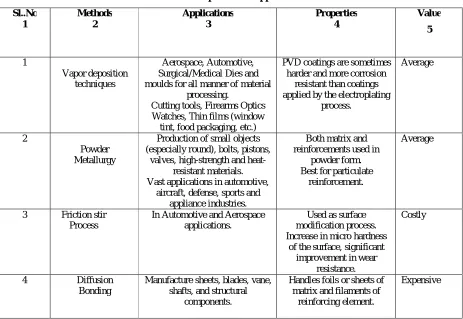
Table 1: Properties and applications:
Sl..No 1 Methods 2 Applications 3 Properties 4 Value 5 1 Vapor deposition techniques Aerospace, Automotive, Surgical/Medical Dies and moulds for all manner of material
processing.
Cutting tools, Firearms Optics Watches, Thin films (window
tint, food packaging, etc.)
PVD coatings are sometimes harder and more corrosion
resistant than coatings applied by the electroplating
process.
Average
2
Powder Metallurgy
Production of small objects (especially round), bolts, pistons,
valves, high-strength and heat-resistant materials. Vast applications in automotive,
aircraft, defense, sports and appliance industries.
Both matrix and reinforcements used in
powder form. Best for particulate
reinforcement.
Average
3 Friction stir Process
In Automotive and Aerospace applications.
Used as surface modification process. Increase in micro hardness
of the surface, significant improvement in wear
resistance.
Costly
4 Diffusion
Bonding
Manufacture sheets, blades, vane, shafts, and structural
components.
Handles foils or sheets of matrix and filaments of
reinforcing element.
Expensive
5.POWDER METALLURGYMETHOD:
Powder metallurgy is the process of blending finepowdered materials, pressing them into a desired shape (compacted), and then heating the
compressed material in a controlled atmosphere to bond the material (sintering). The powder
metallurgy process generally consists of four basic steps: (1) powder manufacture, (2) powder
mixing and blending, (3) compacting, (4) sintering. Compacting is generally performed at room
temperature, and the elevated-temperature process of sintering is usually conducting at atmospheric
pressure.
CONCLUSION:
The different techniques are used for the preparation of MMCs. Metal matrix nano
composites have a lot of potential to be used in a large number of industrial applications.It was found
that the addition ofAl2O3 andAl4C3 increases the hardness and compressive strength and addition
ofAl4C3 improved the wear resistance of the MMC.The increase in reinforcement ratio and decrease
in reinforcement particle size significantly improves the mechanical and fatigue properties of AMCs.
The addition of fly ash particles as reinforcement is advantages for obtaining high structural
IJSRR, 8(1) Jan. – Mar., 2019 Page 1165
properties they also proved to be excellent. Adoption of these metal matrix composites, could be a
good replacement of expensive conventional monolithic alloys used for structural and functional
applications.
REFERENCE
1. Tjong, S.C, KC Lau, SQ Wu ,:Wear of Al-based hybrid composites containing BN and SiC
particulates. Metall Mater Trans A 1999; 30(9): 2551- 2555.
2. T Rajmohan, K Palanikumar, S Ranganathan : Evaluation of mechanical and wear properties
of hybrid aluminium matrix composites. Trans Nonferrous Met Soc China2013; 23(9):
2509-2517.
3. VijayaRamnath B, C Elanchezhian, M Jaivignesh, S Rajesh, C Parswajinan, et al. :
Evaluation of mechanical properties of aluminium alloy– alumina–boron carbide metal
matrix composites. Mater Des,2014; 58: 332- 338.
4. Ravindran P,Manisekar K, S Vinoth Kumar, P Rathika: Investigation of microstructure and
mechanical properties of aluminum hybrid nano-composites with the additions of solid
lubricant. Mater Des 2013; 51: 448-456.
5. N Panwar, A Chauhan :Development of aluminum composites using Red mud as
reinforcement – a review. Engineering and Computational Sciences (RAECS)2014; 1-4.
6. Gikunoo, O Omotoso,Oguocha,INA : Effect of fly ash particles on the mechanical properties
of aluminium casting alloy A535. MatSciTechnol, 2005; 21(2): 143-152.
7. Rohatgi PK, A Daoud, BF Schultz, TPuri: Microstructure and mechanical behavior of die
casting AZ91D-Fly ash cenosphere composites. Compos Part Appl. Sci.Manuf 2009; 40(6-7):
883-896.
8. VenkatPrasat, R Subramanian:Tribological properties of AlSi10Mg/fly ash/graphite hybrid
metal matrix composites. Ind.Lubr.Tribol2013; 65(6): 399-408.
9. Moorthy A, DN Natarajan, R Sivakumar, M Manojkumar, M Suresh: Dry sliding wear and
mechanical behavior of aluminium/fly ash/ graphite hybrid metal matrix composite using
taguchi method. Int J Mod Eng Res IJMER,2012; 2(3): 1224-1230.
10.David Raja Selvam J, DS Robinson Smart, IDinaharan: Synthesis and characterization of
Al6061-Fly Ashp-SiCp composites by stir casting and compocasting methods. Energy
Procedia,2013; 34: 637-646.
11.Escalera-Lozano. R, CA Gutiérrez, MA Pech-Canul, MI Pech-Canul:Corrosion
characteristics of hybrid Al/SiCp/MgAl2O4 composites fabricated with fly ash and recycled
IJSRR, 8(1) Jan. – Mar., 2019 Page 1166
12.Alaneme KK, BO Ademilua, MO Bodunrin: Mechanical properties and corrosion behaviour
of aluminium hybrid composites reinforced with silicon carbide and bamboo leaf ash.
TribolInd,2013; 35(1): 25-35.
13.Prasad DS, C Shoba, N Ramanaiah: Investigations on mechanical properties of aluminum
hybrid composites. J Mater Res Technol2014; 3(1): 79-85.
14.Alaneme K.K, TM Adewale : Influence of rice husk ash – silicon carbide weight ratios on the
mechanical behaviour of Al-Mg-Si alloy matrix hybrid composites. Tribol. Ind, 2013; 35(2):
163-172.
15.Alaneme K.K, EO Adewuyi: Mechanical behaviour of Al-Mg-Si matrix composites
reinforced with alumina and bamboo leaf ash. Metall Mater Eng.,2013;19(3): 177-187.
16.AlanemeK.K , TM Adewale, PA Olubambi : Corrosion and wear behaviour of Al-Mg-Si
alloy matrix hybrid composites reinforced with rice husk ash and silicon carbide. J Mater Res
Technol,2014; 3(1): 9-16.
17.Divecha AP, SG Fishman: Mechanical Properties of Silicon Carbide Reinforced Aluminum,
in Proc. Conf. on Composite Materials,1979; 3: 351.
18.Dehong Lu, Yehua Jiang, Rong Zhou: Wear performance of nano- Al2O3 particles and CNTs
reinforced magnesium matrix composites by friction stir processing Wear.,2013; 305(1-2):
286-290.
19.Amal M.K Esawi, Mostafa A El Borady :Carbon nanotube-reinforced aluminium strips.
Composites Science and Technology,2008; 68: 486-492.
20.Hiroyuki Fukuda, KatsuyoshiKondoh, Junko Umeda, BunshiFugetsu: Interfacial analysis
between Mg matrix and carbon nanotubes in Mg–6 wt.% Al alloy matrix composites
reinforced with carbon nano tubes. Composites Science and Technology, 2011; 71: 705-709.
21.Abouelmagd.G // Materials Processing Technology2004; 155: 1395.
22.Tjong.S.C,Wang,G.S., Gen.L and Mai.Y.W // Composites Science and Technology,2004;
64,1971.
23.Kok. M // Materials processing Technology,2005; 161 , 381.
24.Kannan, S. and Kishawy.H.A : International Journal of Machine Tools & Manufacture,2006;
46; 2017.
25.Park. B.G, Crosky. A.G and Hellier. A.K // Composites: Part B,2008; 39: 1270.
26.Park. B.G, Crosky.A.G andHellier.A.K. // Composites: Part B,2008; 39: 1257.
IJSRR, 8(1) Jan. – Mar., 2019 Page 1167
28.Ogel, B., and Gurbuz, R., :“Microstructural characterization and tensile properties of hot
pressed Al-SiC composites prepared from pure Al and Cu powders”, Mater. Sci. Eng.
A.,2001; 301; 213-220.
29.Onat, A., Akbulut, H., and Yilmaz, F., : “Production and characterization of silicon carbide
particulate reinforced aluminium–copper alloy matrix composites by direct squeeze casting
method”, J. Alloys Compounds,2007; 436; 375–382.
30.Rohatgi, P., Guo, R. R.,: “Opportunities of using fly ash particles for synthesis of
composites”, Pro. of the 59th Annual American Power Conference, Chicago,1997; 828.
31.Rohatgi, P., Weiss, D., and Gupta, N.,: “Applications of fly ash in synthesizing low-cost
MMCs for automotive and other applications”, J. Miner. Metals Mater. Soc.,2006; 58:71-76.
32.Rajan T. P. D., Pillai, R. M., Pai, B. C., Satyanarayana K. G. and Rohatgi P. K., :
“Fabrication and characterisation of Al–7Si–0.35Mg/fly ash metal matrix composites
processed by different stir casting routes”, Compos. Sci. Technol.,2007; 67: 3369-3377.
33.Dou, Z., Wu, G., Huang, X., Sun, D., and Jiang, L.:“ Electromagnetic shielding effectiveness
of aluminum alloy–fly ash composites”, Composites Part A: Applied Science and
Manufacturing,2007; 38: 186-191.
34.Ramachandra.M.andRadhakrishna K.: “Effect of reinforcement of flyash on sliding wear,
slurry erosive wear and corrosive behavior of aluminium matrix composite”, Wear,