Iridium
Losses
During Oxidation
REACTIONS AT HIGH TEMPERATURES
IN
LOW-PRESSURE OXYGEN ATMOSPHERES
By
Hermann Jehn, Reinhart Volker and Muhamed
I.
Ismail
Max-Planck-Institut fur Metallforschung, Institut fur Werkstoffwissenschaften,Stuttgart, West Germany
Iridium reacts with oxygen at high temperatures forming volatile oxides, the evaporation of which considerably increases the iridium losses i n oxygen- containing atmospheres, when compared with high-vacuum conditions. This paper describes investigations carried out to determine the metal losses from polycrystalline iridium discs, by means of a magnetic suspension balance, at low pressures and high temperatures. The results are presented and discussed, and a strong temperature and pressure dependence is noted.
At high temperatures the platinum metals and alloys are increasingly used as thermo- couple pairings and as a crucible material for liquid glasses and oxides, that is for the growth of single crystals. In both fields iridium metal and iridium alloys have con- siderable advantages due to their high melting points and good physical and mechanical properties. They also show good chemical stability even in oxidising atmospheres. At low temperatures thin protective oxide films are formed' but at temperatures above about I I O O " ~ the oxides decompose and the metal surfaces remain bare. However, volatile oxides are formed and increase the metal losses when compared with the evaporation of the pure metal in high vacuum. In that temperature range the oxidation rates in air of the various platinum metals show differ- ences up to about six orders of magnitude
(1,2). Platinum and rhodium have the lowest
metal losses, followed by iridium and ruth- enium, while osmium has the highest losses. The high-temperature oxidation of iridium metal has only rarely been studied (2 to 7). In a recently published paper by Wimber et al, systematic investigations extended over a wider pressure and temperature range, 10-
to 1.3 x10⁵ pascals of oxygen and 1675 to
226ooC, have now been reported (7).
In the present study the metal losses of polycrystalline iridium in an oxygen atmos- phere have been determined gravimetrically at high temperatures of 1500 to
ZIOO'C
and low pressures of 0.1 to IOO pascals of oxygen.Experimental
The experiments were performed under a flow of 99.99 volume per cent oxygen in a high vacuum apparatus, shown schematically in Figure I . The pressures were adjusted by a needle valve and were measured by an ionisation gauge, and the temperature of the inductively heated specimen was measured by an optical micropyrometer.
The weight change of the iridium discs was determined by a suspension balance having an accuracy of I ~ N . The oxidation anneals were interrupted for weighing be- cause the electromagnetic forces did not allow continuous weighing during the induc- tion heating. The oxidation periods were chosen in a manner which gave reliable readings of the weight changes.
Polycrystalline iridium discs 10 mm dia-
degassed by a v a c u m heat treatment at 18oo0C for 15 minutes. When the same sample was used for different runs it was vacuum annealed, at 18oo0C for 10 minutes,
before each series, to give defined starting conditions. An analysis of the impurities found in the samples is given in the Table.
Results
The weight change of the iridium speci- mens as a function of oxidation time is shown in Figure 2. I t can be seen that the linear weight loss strongly increases with increase- ing pressure, at a constant temperature of 2000°C; and with increasing temperature, at a pressure of I pascal. From these curves the volatilisation rates and recession rates, respectively, of iridium have been calculated. I n Figure 3 these rates are plotted versus r/temperature. Each line in Figure 2 is represented by one point in Figure 3. The curves show a continuous increase with rising temperature and at lower pressures approach the straight line plot of the evapora- tion of the pure metal in vacuum. The temperature dependence of the oxidation
Impurities in the Iridium Disc Specimens
Element
Platinum
Rhodium
Palladium
Ruthenium
Iron
Nickel
Copper
Magnesium
Boron
Silver
Gold
Chrome
Weight, ppm
520
280
220
25
60
20
20
10
10
6
5
<5
process lies in the range of 125 kJ/mol. Figure 3 shows that a marked increase of the iridium losses exists when it is annealed in oxygen atmospheres, which extends up- wards to several orders of magnitudes, especially in the lower temperature range. I n the upper temperature range the increase of the iridium losses by the oxygen atmos- phere is less pronounced.
Figure 4 shows the iridium weight loss plotted against the oxygen pressure. The pressure dependence follows the relation v a p o a 3 between I and IOO pascals and a t temperatures between 1500 and 20oo0C. At lower pressures and at temperatures greater than 2000°C the recession rate becomes
pressure. I n Figure 4 the pure metal evapora- direct conclusion can be drawn on the tion rate at 1900 and 2000°C is plotted mechanism of the reaction between oxygen additionally at the ordinate. and iridium. T h e weight change gives the iridium losses due to the pure iridium metal
Discussion
evaporation together with the iridium com-From the gravimetrical determination of ponent of the volatilising iridium oxides. T h e oxygen component is not determined because in the steady state between the oxygen sorption from the gas phase and the evapora- tion of the volatile oxides this part is con- tinuously compensated.
By mass spectrometric investigations (9) the oxides IrO,(g) and IrO,(g) have been detected by the Knudsen cell technique and partial pressures in the range of 10 pascals within the cell. T h e oxide evaporation from a free iridium surface in the non-equilibrium kinetically controlled process has not been investigated up to now as it has been done in similarly reacting systems, for example molybdenum ( IO), tungsten (I I) and rhenium
(12). In analogy to the rhenium system the
oxygen atoms can desorb as 0 atoms, as 0, photographically measuring the reduction molecules, and as oxide molecules (predo- of the wire diameter during the oxidation minantly IrO, and Ir03). All reactions take anneal. Both studies cover pressure range place in the adsorption layer and the oxygen
atoms are mobile on the surface at the ex- perimental temperatures. The total iridium loss vIr can be described by the relation:
Where kIIO2, kIrOs and k,, are temperature dependent rate constants of the volatilisation of I r 0 2 , IrO, and Ir, respectively, and 0, is the oxygen coverage ( 5 , 12, 13). The oxygen is balanced by the absorption and desorption reactions, equalising their rates :
I n the lowpressure range under considera- tion the kinetics of all processes are surface- controlled and neither true equilibrium states between gas phase and adsorption layer are established nor mass transfer in the gas phase or through a gaseous boundary layer near the surface have to be regarded, as in the case of high-pressure oxidation (7, 8).
from about 0.1 pascal up to annospheric pressure, and temperatures from 1500 to
2260OC. In the overlapping pressure and temperature range the agreement i s good. Again it is evident that at low pressures the
weight losses become pressure independent
at high temperatures, when rhe weight losses are predominantly caused by the pure
iridium metal evaporation, for exampIe at 2260,2110 and 2000'C with oxygen pressures less than 2, less then 0.2 and less than o a r pascals, respectively.
average composition of the volatile oxides of I r 0 2 . 5 the weight loss can be estimated from these values but the results obtained seem to be too high by about two orders of magnitude. T h e theoretical treatment of the oxidation process at higher pressures is rather difficult (6 to 8) since in addition to the chemical surface reactions, eventually occurring equili- brium reactions, the mass transfer in the gas phase and natural or forced convection have to be taken into consideration. Specifically, the influence of the convection fluxes cannot be definitely determined due to geometrical parameters like shape and size of the sample and of the receiver. A theoretical treatment of iridium oxidation based on the diffusion of the evaporating species through the gaseous boundary layer is given by Wimber et a1 (6, 7). T h e strong influence of the sample dimen- sions is shown, for example, by Fryburg (8) studying the oxidation of platinum wires 0.29 to 2.2 mm diameter. Further difficulties
may arise in an inert gas/oxygen mixture like air, where the inert gas pressure reduces the evaporation rate (14,15).
Finally, in Figures 6 and 7 the results of oxidation studies in air are compiled. Figure 6 shows the weight loss of iridium during oxidation at reduced pressures, 10 to 6 . 7 ~
104 pascals, reported by Wimber et a1 (7). Compared with oxygen the iridium losses lie half an order to one order of magnitude lower. Figure 7 gives the iridium losses during the oxidation in the range of atmos- pheric pressure. A relatively fair agreement is obtained over the large temperature range (800 to 2260OC) taking into consideration the difficulties of measuring the very low weight losses at low temperatures, and the factors influencing the oxidation rate, which were mentioned above. I n particular at tem- peratures below 2o0o3C the iridium losses are enlarged by several orders of magnitude when compared with pure evaporation in vacuum.
Muhamed I . lsmail has been on leave of absence from the University oJ Alexandriu, Faculty of
Engineering, Alexandria, Egypt.
References
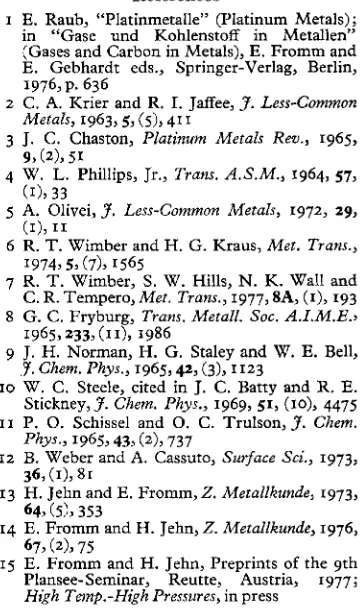
I E. Raub, “Platinmetalle” (Platinum Metals) ; in “Gase und Kohlenstoff in Metallen” (Gases and Carbon in Metals), E. Fromm and E. Gebhardt eds., Springer-Verlag, Berlin,
2 C. A. Krier and R. I. Jaffee,
3.
Less-Common Metals, 1963~5, W J 4 1 13 J. C. Chaston, Platinum Metals Rev., 1965, 9, ( Z ) , 5 1
4 W. L. Phillips, Jr., Trans. A . S . M . , 1964, 57,
5 A. Olivei, J . Less-Common Metals, 1972, 29,
6 R. T. Wimber and H. G. Kraus, Met. Trans.,
7 R. T. Wimber, S. W. Hills, N. K. Wall and
C . R. Tempero, Met. Tram., 1977, SA, (I), 193 8 G. C. Fryburg, Trans. Metall. SOC. A.I.M.E.3 9 J. H. Norman, H. G. Staley and W. E. Bell,
7. Chem. Phys., 1965,42, (3), 1123
10 ‘W. C. Steele, cited in J. C . Batty and R. E. StickneyJ. Chem. Phys., 1969, 51, (IO), 4475 1 1 P. 0. Schissel and 0. C. Trulson,
3.
Chem.IZ B. Weber and A. Cassuto, Surface Sci., 1973,
17 H. Jehn and E. Fromm, Z . Metallkunde, 1973,
1976, P- 636
( I h 3 3
( I ) , I I
1974.51 (71, I565
1965> 233, (II), 1986
Ph~s.7 1965,43, (2), 737
36, (I),81
. ..
- 64>15!>353
ILL E. Fromm and H. Tehn, - .Z . Metallkunde, - 1976, _ . .
67J (’)> 75
15 E. Fromm and H. Jehn, Freprints of the 9th Plansee-Seminar, Reutte, Austria, 1977; High Temp.-High Pressures, in press
A Review
of
Fuel Cell Development
As the industrial countries of the world continue to search for satisfactory alternatives to their present sources of energy a timely review of twenty-five years of fuel cell de- velopment has been published ( J . Electrochem.Well supported by a bibliography listing 33 major titles on fuel cells and related sub- jects, and with 187 references from inter- national literature, the review by K. V. Kordesch-formerly with the Union Carbide Corporation, and now at the Technical Uni- versity of Graz, Austria-covers a third cycle of interest in fuel cells, which is considered to start after the second world war. During this period numerous systems have of course been investigated and in many of them the properties of the platinum group metals have been utilised with advantage.
I n the future, if the technology of fuel cells is better supported by basic scientific studies of the principles involved, further improve- ments in efficiency could result.