Multiobjective Programming With Continuous
Genetic Algorithm
Adugna Fita
Abstract: Nowadays, we want to have a good life, which may mean more wealth, more power, more respect and more time for our selves, together with a good health and a good second generation, etc. Indeed, all important political, economical and cultural events have involved multiple criteria in their evolution. Multiobjective optimization deals with the investigation of optimization problems that possess more than one objective function. Usually there is no single solution that optimizes all functions simultaneously, we have solution set that is called nondominated set and elements of this set are usually infinite. It is from this set decision is made by taking elements of nondominated set as alternatives, which is given by analysts. But practically extraction of nondominated solutions and setting fitness function are difficult. This Paper will try to solve problems that the decision maker face in extraction of Pareto optimal solution with continuous variable genetic algorithm and taking objective function as fitness function without modification by considering box constraint and generating initial solution within box constraint and penalty function for constrained one. Solutions will be kept in feasible region during mutation and recombination.
Keywords: Chromosome, Crossover, Heuristics, Mutation, Optimization, Population, Ranking,Genetic Algorithms, Multi-Objective, Pareto Optimal Solutions, Parent selection.
————————————————————
1.
Introduction and Literature Survey.
EVERYDAY we encounter varies kinds of decision making problems as manager, resource planner, designers, administrative officers, mere individuals, and so on. In these problems, the final decision is usually made through several steps; the structural model, the impact model, and the evaluation model even though they sometimes not be perceived explicitly. Though the process, the objective of the problem and alternatives to perform it are specified. Hereafter, we shall use the notation 𝑌for the objective and 𝑋 for the set of alternatives, which is supposed to be a subset of an n-dimensional vector space. In order to solve our decision making problem by some systems analytical methods, we usually require that degrees of objectives be represented in numerical terms, which may be of multiple kinds even for one objective. In order to exclude subjective value judgment at this stage, we restrict these numerical terms to physical measures (for example money, weight, length, and time). As a performance index, for the objective 𝑌𝑖 an objective function 𝑓𝑖: 𝑋 → ℝ1 is introduced. Where 𝑅1
denotes one dimensional Euclidean space. The value 𝑓𝑖(𝑥)
indicates how much impact is given on objective 𝑌𝑖 by performing an alternative 𝑥. In this paper we assume that a smaller value for each objective function is preferred to large one. Now we can formulate our decision making problems as: a Multiobjective optimization problem:
Minimize𝑓(𝑥) = (𝑓1 𝑥 , 𝑓2 𝑥 , … , 𝑓𝑝 𝑥 )𝑇,over,𝑥 ∈ 𝑋.b (1.1)
Where: X = {x ∈ Rn: g
j(x) ≤ 0, j = 1,2, … , m, x ≥ 0 (1.2)
𝑌 = {𝑦 ∈ 𝑅𝑝: 𝑦
1= 𝑓1 𝑥 , 𝑦2= 𝑓2 𝑥 , … , 𝑦𝑝 = 𝑓𝑝 𝑥 , 𝑥 ∈ 𝑋}
(1.3)
In some cases, some of the objective functions are required to be maintained under given levels prior to minimizing other objective functions. Denoting these objective functions by 𝑔𝑗 𝑥 , we require that
𝑔𝑗 𝑥 ≤ 0, 𝑗 = 1,2, … , 𝑚, (1.4)
Such a function 𝑔𝑗 𝑥 is generally called a constraint
function. According to the situation, we consider either the problem (1.1) itself or (1.1) accompanied by the constraint conditions (1.4) Of course, an equality constraint 𝑘 𝑥 = 0 can be embedded within two inequalities 𝑘 𝑥 ≤ 0 𝑎𝑛𝑑 −
𝑘 𝑥 ≤ 0, and hence, it does not appear explicitly in this paper. (R. E. Steuer, (1986), We call the set of alternatives 𝑋 the feasible set of the problem. The space containing the feasible set is said to be a decision space, whereas the space that contain the image of the feasible set 𝑌 = 𝑓(𝑋) is referred to as criterion space. Unlike the traditional mathematical programming with a single objective function, an optimal solution in the sense of one that minimizes all the objective function simultaneously does not necessarily exist in multiobjective optimization problem, and hence, we are in trouble of conflicts among objectives in decision making, the final decision should be made by taking the total balance of objectives into account. Here we assume a decision maker who is responsible for the final decision. [Y. Sawaragi, H. Nakayama and T. Tanino, 1985] The decision maker’s value is usually represented by saying whether or not an alternative 𝑥 is preferred to another alternative 𝑥′ or equivalently whether or not 𝑓(𝑥) is preferred to (𝑥′) . In other words, the decision maker’s value is represented by some binary relation over 𝑋 or 𝑓(𝑋). Since such a binary relation representing the decision maker’s preference usually become an order, it is called a preference order and it is supposed to be defined on the so called criteria space 𝑌, which includes the set 𝑓(𝑋). Several kind of preference orders could be possible, sometimes the decision maker cannot judge whether or not 𝑓(𝑥) is preferred to 𝑓(𝑥′). Such an order that admits incomparability for a pair of objects is called partial order, whereas the order requiring the comparability for every pair of objects is called a weak order or total order. In practice, we often observe a partial order for the decision maker’s preference. Unfortunately, __________________________
Adugna Fita is currently lecturer and researcher at
Adama Science and Technology University,
Department of Mathematics, Adama, Ethiopia
136 however, an optimal solution in the sense of one that is
more preferred with respect to the order, hence the notion of optimality does not necessarily exist for partial orders. Instead of strict optimality, we introduce in multiobjective optimization the notion of efficiency. A vector 𝑓(𝑥′) is said to be efficient if there is no 𝑥 ∈ 𝑋 such that 𝑓(𝑥) is preferred to 𝑓(𝑥′) with respect to the preference order. The final decision is made among the set of efficient solutions. Scalarization approach is one of the solution methods in multiobjective programming that is studied by different scholars, In solving scalarized problems which are obtained by weighting sum of objective functions to single objective. Each substitute problem is characterized by a unique [13] weighting parameter vector, the entries of which are the specific weights for the individual objective functions. Solutions to these problems constitute so-called properly efficient points with respect to our initial multiobjective optimization problem. The advantage of this approach is it can be solved efficiently by well-known algorithms, for example by interior-point methods. Using this algorithm a single solution is obtained at a time. To get all Pareto front we have to run the algorithm many times by applying different weigh. A fundamental challenge lies in the selection of the ’right’ weighting parameters that lead to different optimal solutions. The other problem is assigning large weight to the best objective does not result in desired solution. Besides, stochastic methods and evolutionary approaches as well as different deterministic optimization techniques such as branch and bound algorithms for example are other established strategies for solving multiobjective optimization problems. Vector evaluated genetic algorithm (VEGA) Schaffer (1985) presents one of the first treatments of multi-objective genetic algorithms, although he only considers unconstrained problems. The general idea behind Schaffer’s approach, called the vector evaluated genetic algorithm (VEGA), involves producing smaller subsets of the original population, or populations, within a given generation, [1], [4]. One sub-population is created by evaluating one objective function at a time rather than aggregating all of the functions. The selection process is composed of a series of computational loops, and during each loop, the fitness of each member of the population is evaluated using a single objective function. Then, certain members of the population are selected and passed on to the next generation, using the stochastic selection processes. This selection process is repeated for each objective function. The process is based on the idea that the minimum of a single objective function is a Pareto optimal point (assuming the minimum is unique). Such minima generally define the vertices of the Pareto optimal set. However, considering only one objective function at a time is comparable to setting all but one of the weights to zero. The vector of weights represents a search direction in the criterion space, and if only one component of the vector is non-zero, then only orthogonal search directions, parallel to the axes of the criterion space, are used (Murata et al. 1996). Such a process can be relatively ineffective. Goldberg (1989), and Fonseca and Fleming (1993) provide detailed explanations and critiques of Schaffer’s ideas. A class of alternatives to VEGA involves giving each member of a population a rank based on whether or not it is dominated (Goldberg 1989; Fonseca and Fleming 1993; Fitness then is based on a design’s rank
points. Thus, these techniques foster an even spread of points (in the criterion space). Genetic multi-objective algorithms tend to create a limited number of niches; they converge to or cluster around a limited set of Pareto points. Fitness sharing is a common niche technique the basic idea of which is to penalize the fitness of points in crowded areas, thus reducing the probability of their survival to the next generation (Goldberg and Richardson 1987; Deb 1989; Srinivas and [3] The fitness of a given point is divided by a constant that is proportional to the number of other points within a specified distance in the criterion space,[4]. Narayana and Azarm (1999) present a method in which a limit is placed on the Euclidean distance in the criterion space between points (parents) that are selected for crossover. If the distance is too small, then the parents are not selected for crossover. In addition, the authors suggest that only non-dominated points (points with a rank of 1) be evaluated for constraint violation. Those points that violate constraints then receive a fitness penalty, which is imposed by reassigning their rank to be a large number (e.g., the population size). However, Pareto ranking is the most appropriate way to generate an entire Pareto front in a single run of a Genetic algorithm and its main advantage is that the approach is less susceptible to the shape or continuity. The primary questions when developing genetic algorithms for multi-objective problems are how to evaluate fitness, how to determine the potential solution points that should be passed on to the next generation, and how to incorporate the idea of Pareto optimality. The approaches that are described so far collectively address these issues. Different techniques are discussed that serve as potential issues in a genetic multi-objective optimization algorithm. In accordance with much of the literature on multi-objective genetic algorithms, constraints are not addressed directly. It is assumed that a penalty approach is used to treat constraints. But those approaches are difficult to model the fitness function that best evaluates the solution (chromosomes) for further selections and keeping those solutions in feasible region during mutation and recombination [16]. In this paper objective function and variables are taken without modification and continuous variable genetic algorithm is used. Variables are considered in box constraint and initial solution will be generated within box constraint and will keep in feasible region during mutation and recombination.
2.
Mathematical preliminaries
In this chapter we investigate optimization problems with feature more than one objective function. In the beginning fundamental concepts that are essential for multiobjective optimization are established. That is, cone, and ordering cones are introduced and key properties of efficient sets are examined in detail. Subsequently, the existence of efficient points and techniques to compute these are analyzed.
2.1 Convex set
Definition 2.1.1 (algebraic sum of two sets) [9]
1. The algebraic sum of two sets is defined as
𝑆1 + 𝑆2∶= 𝑧1 + 𝑧2 𝑧1∈ 𝑆1, 𝑧2 ∈ 𝑆2In case 𝑆1
= {𝑧1} is a singleton we use the form 𝑧1 + 𝑆2
instead of {𝑧1} +𝑆2.
2. Let 𝑠, 𝑠1, 𝑠2 ⊂ ℝ𝑝 and 𝛼 ∈ ℝ. The multiplication of
a scalar with a set is given by 𝛼𝑆 ∶= {𝛼𝑧 | 𝑧 ∈ 𝑆},
in particular −𝑆 {−𝑧 | 𝑧 ∈ 𝑆}
Definition 2.1.2
i. The point 𝑋 ∈ ℝ𝑛 is said to be a convex
combination of two points 𝑥1, 𝑥2 ∈ ℝ𝑛 if 𝑋 =
𝛼𝑥1+(1 - 𝛼) 𝑥2, for some 𝛼 ∈ ℝ, 𝑂 ≤ 𝛼 ≤ 1.
ii. The point 𝑋 ∈ ℝ𝑛 is said to be a convex
combination of 𝑚 points 𝑥1, 𝑥2, … , 𝑥𝑚 ∈ℝ𝑛 if
𝑋 = 𝛼𝑖𝑥𝑖 𝑚 𝑖=1
, 𝑓𝑜𝑟 𝛼𝑖≥ 0, 𝛼𝑖 𝑚 𝑖=1
= 1 .
Definition 2.1.3 A set 𝐶 ⊂ ℝ𝑛 is said to be convex if for
any 𝑥1, 𝑥2 ∈ 𝐶 and every real number 𝛼 ∈ ℝ, 𝑂 ≤
𝛼 ≤ 1, the point 𝛼𝑥1+(1 - 𝛼) 𝑥2∈𝐶
In other words, 𝐶 is convex if the convex combination of every pair of points in 𝐶 lies in 𝐶.
The intersection of all convex sets containing a given subset 𝐶 of ℝ𝑛 is called the convex hull of 𝐶 and denoted
by conv(𝐶).
Definition 2.1.4 (Cone) 𝐶 ⊂ ℝ𝑝 is called a cone if 𝛼𝑐 ∈ 𝐶
for all𝑐 ∈ 𝐶 and for all 𝛼 ∈ ℝ, 𝛼 > 0. A cone 𝐶 is referred to as:
Nontrivial or proper, if 𝐶 ≠ ∅ 𝑎𝑛𝑑 𝐶 ≠ ℝ𝑝.
Convex, if 𝛼𝑑1 + 1 − 𝛼 𝑑2 ∈ 𝐶 for all
𝑑1 𝑎𝑛𝑑 𝑑2 ∈ 𝐶 for all 0 < 𝛼 < 1
Pointed, if for 𝑑 ∈ 𝐶, 𝑑 ≠ 0, −𝑑 𝐶, 𝑖 𝑒. 𝐶 ∩ −𝐶 ⊆ 0
Theorem 2.1.1 A cone 𝐶 is convex if and only if it is closed under addition. In other words,
α𝑐1 + (1 −α)𝑐2∈ 𝐶 𝑐1 + 𝑐2∈ 𝐶 ∀ 𝑐1, 𝑐2 ∈ 𝐶,
∀𝛼 ∈ [0, 1]
Proof first, assume that the cone 𝐶 is convex. Then we can conclude for 𝑐1, 𝑐2 ∈ 𝐶 and 𝛼 = 1/2 in
combination with the cone property of 𝐶 that
1 2 𝑐
1 + 1 −1 2 𝑐
2 ∈ 𝐶
2( 1 2 𝑐
1 + 1
2 𝑐
2) ∈ 𝐶
𝑐1 + 𝑐2 ∈ 𝐶.
Secondly, suppose that the cone 𝐶 is closed under addition. Exploiting the fact that 𝐶 is a cone we deduce for 𝑐1,𝑐2 ∈
𝐶 and 𝛼 ∈ [0, 1] that 𝛼𝑐1 ∈ 𝐶 and (1 − 𝛼) 𝑐2 ∈ 𝐶.
Furthermore, since the cone is closed under addition we derive for these elements that
138 function, and 𝑋 is a feasible decision set. The basic binary
relation > means strict preference i.e y > 𝑧 for y, z ∈ Y means objective value y is preferred to z.
Definition 2.2.1 (Binary relation) Let 𝑆 be any set. A binary relation 𝑅 on S is a subset of 𝑆 × 𝑆. It is called [5]
1. 𝑟𝑒𝑓𝑙𝑒𝑥𝑖𝑣𝑒, 𝑖𝑓 𝑠, 𝑠 ∈ 𝑅 for all 𝑠 ∈ 𝑆, 2. 2. 𝑖𝑟𝑟𝑒𝑓𝑙𝑒𝑥𝑖𝑣𝑒 𝑖𝑓 𝑠, 𝑠 𝑅 for all 𝑠 ∈ 𝑆,
3. 3. 𝑠𝑦𝑚𝑚𝑒𝑡𝑟𝑖𝑐 𝑖𝑓(𝑠1,𝑠2) ∈𝑅⇒ ( 𝑠2, 𝑠1) ∈𝑅 for all 𝑠1,
𝑠2∈ 𝑆,
4. 4. 𝑎𝑠𝑦𝑚𝑚𝑒𝑡𝑟𝑖𝑐 𝑖𝑓 (𝑠1,𝑠2) ∈ 𝑅 ⇒ ( 𝑠2, 𝑠1) 𝑅 for all
𝑠1, 𝑠2 ∈ 𝑆,
5. 5. 𝑎𝑛𝑡𝑖𝑠𝑦𝑚𝑚𝑒𝑡𝑟𝑖𝑐, 𝑖𝑓 (𝑠1,𝑠2) ∈ 𝑅 and (𝑠2, 𝑠1) ∈
R ⇒ 𝑠1=𝑠2 for all 𝑠1, 𝑠2∈ 𝑆,
6. 6. 𝑡𝑟𝑎𝑛𝑠𝑖𝑡𝑖𝑣𝑒, 𝑖𝑓(𝑠1,𝑠2) ∈ R and (𝑧2, 𝑧3) ∈ 𝑅⇒ (𝑠1,
𝑠3) ∈𝑅 for all 𝑠1, 𝑠2, 𝑠3 ∈ 𝑆,
7. 7. 𝑛𝑒𝑔𝑎𝑡𝑖𝑣𝑒𝑙𝑦 𝑡𝑟𝑎𝑛𝑠𝑖𝑡𝑖𝑣𝑒 𝑖𝑓 (𝑠1, 𝑠2) 𝑅 and (𝑠2,
𝑠3) R ⇒ (𝑠1, 𝑠3) R for all 𝑠1, 𝑠2, 𝑠3∈ 𝑆,
8. 8. 𝑐𝑜𝑛𝑛𝑒𝑐𝑡𝑒𝑑 𝑖𝑓(𝑠1,𝑠2) ∈ R or ( 𝑠2, 𝑠1) ∈𝑅 for all 𝑠1,
𝑠2∈𝑆 with 𝑠1 ≠ 𝑠2,
9. 9. strongly connected (or total) if (s1, s2) ∈ 𝑅 or ( 𝑠2,
𝑠1) ∈ 𝑅 for all s1, s2 ∈ 𝑆.
Definition 2.2.2 A binary relation R on a set 𝑆 is a preorder (quasi-order) if it is reflexive and transitive. Instead of (𝑠1,
𝑠2) ∈𝑅 we shall also write 𝑠1𝑅𝑠2. In the case of 𝑅 being a
preorder the pair (𝑆, 𝑅) is called a preordered set. In the context of (pre)orders yet another notation for the relation R is convenient. We shall write 𝑠1≤ 𝑠2as shorthand for (𝑠1,
𝑠2) ∈ 𝑅 and 𝑠1 ≰ 𝑠2 for (𝑠1, 𝑠2) 𝑅 and indiscriminately
refer to the relation R or the relation≤. This notation can be read as “preferred to’’.[6],[2] Given any preorder ≤, two other relations are closely associated with ≤.
We define them as follows: s1 < s2 ⟺ s1≤ s2and 𝑠2≰ 𝑠1,
s1 ∼ s2 ⟺ s1 ≤ s2 and s2 ≤ s1.
Actually, < and ∼ can be seen as the strict preference and equivalence (or indifference) relation, respectively, associated with the preference defined by preorder ≤.
Definition 2.2.3 A relation is named a partial order if it is reflexive, transitive and antisymmetric. If 𝑅 solely satisfies the first two properties it is denoted as a preorder (or
quasi-order). Preference order (and more generally, binary
relationship) on a set 𝑌 can be represented by a point-to-set map from 𝑌 in to 𝑌. in fact, a binary relationship may be considered to be a subset of the product set 𝑌𝑥𝑌, and so it can be regarded as a graph of a point-to-set map from 𝑌 in to 𝑌. That means we identify the preference order ≻ with the graph of set valued map P: [13],[15]
P(y) ∶= {y′ ∈ Y | y ≻ y′ }
(P(y) is the set of elements in 𝑌 less preferred to y) [C. J. Goh and X. Q. Yang, (2002)], Another approach for specifying preferences of the decision maker are the so called domination structures (ordering cone) where the preference order is represented by a set-valued map.
Therefore for all y ∈ ℝP, we define the set of domination
factors
C(y) ∶= {d ∈ ℝp | y ≻ y + d} ∪ {0}
is defined where y ≻ y′ means that the decision maker
prefers y more than y′. A deviation of d ∈ C(y) from y is
hence less preferred than the original y. The most important and interesting special case of a domination structure is when C(. ) is a constant set-valued map, especially if C(y) equals a pointed convex cone for all y ∈ ℝP i.e. C(. ) = C.
A cone C is called pointed if C ∩ −C = 0p .Given an order relation 𝑅 on ℝ𝑝, we can define a set
𝐶𝑅∶= { 𝑦2− 𝑦1∶ 𝑦1R 𝑦2}, (**)
Which we would like to interpret as the set of nonnegative elements of ℝ𝑝 according to 𝑅 It is interesting to consider
the definition (**) with y1 ∈ ℝp, fixed, i.e., C
R( y1) = { y2−
y1∶ y1R y2}. If R is an order relation, y1 + C
R( y1) is the
set of elements of ℝp, that y1 is preferred to (or that are
dominated by y1). A natural question to ask is: Under what
conditions is CR (y) the same for all y ∈ ℝp ? In order to
answer that question, we need another assumption on order relation R.
Definitions 2.2.4 [5]
1.
A binary relation R is said to be compatible with 𝑑1 = 𝑦2 − 𝑦1 ∈ 𝐶𝑅addition if ( y1+z, y2+z) ∈ R
for all
z ∈ ℝp, and all ( y1, y2) ∈ R.
2.
A binary relation R is said to be compatible with scalar multiplication if (αs1, αs2) ∈ R holds for all(s1,s2) ∈ R and for all α ∈ ℝ, and α > 0Theorem 2.2.1 Let 𝑅 be a relation which is compatible with scalar multiplication, then 𝐶𝑅is a cone.
Proof Let d ∈ 𝐶𝑅 then 𝑑 = 𝑦2− 𝑦1 for some 𝑦1, 𝑦2∈ ℝ𝑝
with ( 𝑦1, 𝑦2) ∈ R.Thus, (α 𝑦1, α 𝑦2) ∈ R for all α > 0, Hence
𝛼𝑑 = α ( 𝑦2− 𝑦1) = α 𝑦2 − α 𝑦1 ∈ 𝐶
𝑅,for all 𝛼 > 0. □ The
following result constitutes how certain properties of a binary relation 𝑅 affects the characteristics of the cone 𝐶𝑅 .
Lemma 2.3.1 If R is compatible with addition and 𝑑 ∈ 𝐶𝑅then 0𝑅𝑑.
Proof Let 𝑑 ∈ 𝐶𝑅. Then there are 𝑦1, 𝑦2 ∈ ℝ𝑝 with 𝑦1R 𝑦2
such that 𝑑 = 𝑦2− 𝑦1. Using z = − 𝑦1, compatibility with
addition implies ( 𝑦1+ 𝑧) 𝑅 ( 𝑦2+ 𝑧) or 0𝑅𝑑. The above
Lemma indicted that if R is compatible with addition, the sets 𝐶𝑅(𝑦), 𝑦 ∈ ℝ𝑃, do not depend on y. In this report, we
will be mainly concerned with this case.□
Theorem 2.2.2 Let R be a binary relation on ℝ𝑝 which is
compatible with scalar multiplication and addition. Then the following statements hold.
1.
0 ∈ 𝐶𝑅 if and only if 𝑅 is reflexive.2.
𝐶𝑅 is pointed if and only if 𝑅 is antisymmetric.Proof [5] Let R be reflexive and let 𝑦 ∈ ℝ𝑝. Then
𝑦𝑅𝑦 and 𝑦 − 𝑦 = 0 ∈ 𝐶𝑅. Let 0 ∈ 𝐶𝑅. Then there is some 𝑦 ∈ ℝ with 𝑦𝑅𝑦. Now let 𝑦′∈ ℝ𝑝. Then 𝑦′ = y +z for
some 𝑧 ∈ ℝ𝑝. Since 𝑦𝑅𝑦 and R is compatible with addition
we get 𝑦′𝑅𝑦′ 2. Let 𝑅 be antisymmetric and let 𝑑 ∈ 𝐶 𝑅 such
that −𝑑 ∈ 𝐶𝑅, too. Then there are 𝑦1, 𝑦2 ∈ ℝ𝑝 such that
𝑦1𝑅𝑦2 𝑎𝑛𝑑 𝑑 = 𝑦2−𝑦1 as well as 𝑦3, 𝑦4 ∈ ℝ𝑝 such that
𝑦3 𝑅𝑦4 and −𝑑 = 𝑦4 − 𝑦3 . Thus, 𝑦2−𝑦1 = 𝑦3 − 𝑦4 and
there must be y ∈ ℝ𝑝 such that 𝑦2 = 𝑦3 + 𝑦 and𝑦1 =
𝑦4 + 𝑦. Therefore compatibility with addition implies 𝑦2 𝑅𝑦1
. Antisymmetry of R now yields 𝑦2 = 𝑦1 and therefore,
𝑑 = 0, i.e. 𝐶𝑅 is pointed. Let 𝑦1 , 𝑦2 ∈ ℝ𝑝 with 𝑦1 𝑅𝑦2 and
𝑦2 𝑅𝑦1 . Thus, 𝑑 = 𝑦2 − 𝑦1 ∈ 𝐶
𝑅 and −𝑑 = 𝑦1 − 𝑦2 ∈
𝐶𝑅. If 𝐶𝑅 is pointed we know that {𝑑, −𝑑} ⊂ 𝐶 implies
𝑑 = 0 and therefore 𝑦1 = 𝑦2 , i.e., R is antisymmetric. 3.
Let 𝑅 be transitive and let 𝑑1 , 𝑑2 ∈ 𝐶
𝑅. Since R is
compatible with scalar multiplication, 𝐶𝑅 is a cone and we
only need to show 𝑑1 + 𝑑2 ∈ 𝐶
𝑅. By Lemma 2.3.1 we have
0𝑅𝑑1 and 0𝑅𝑑2. Compatibility with addition implies 𝑑1𝑅(𝑑1+
𝑑2), transitivity yields 0𝑅(𝑑1+ 𝑑2), from which 𝑑1 + 𝑑2 ∈
𝐶𝑅. Let 𝐶𝑅 be convex and let 𝑦1 , 𝑦2 , 𝑦3 ∈ 𝑅𝑝 be such that
𝑦1 𝑅𝑦2 and 𝑦2 𝑅𝑦3 .Then and 𝑑2 = 𝑦3 − 𝑦2 ∈ 𝐶 𝑅.
Because 𝐶𝑅 is convex, 𝑑1 + 𝑑2 = 𝑦3 − 𝑦1 ∈ 𝐶 𝑅 By
Lemma 2.3.1 we get 0𝑅(𝑦3− 𝑦1 ) and by compatibility with
addition 𝑦1 𝑅𝑦3 . □ Example The weak component wise
order ≤ is compatible with addition and scalar multiplication. 𝐶≤ = ℝ+𝑃 contains 0, is pointed, and convex.
We have defined cone 𝐶𝑅 given a relation R. We can also
use a cone to define an order relation. The concept of a constant set-valued map defining a domination structure has a direct connection to partial orderings. We recall the definition of partial orderings
Definition 2.2.2 [2],[8
i) A nonempty subset 𝑅 ⊂ ℝ𝑃 ×ℝ𝑃 is called a
binary relation on ℝ𝑃. We write 𝑥𝑅𝑦 for
𝑥, 𝑦 ∈ 𝑅.
ii) A binary relation ≤ on ℝ𝑃 is called a partial
ordering on ℝ𝑃 if for arbitrary 𝑤, 𝑥, 𝑦, 𝑧 ∈ ℝ𝑃:
(1) 𝑥 ≤ 𝑥 (Reflexivity),
(2) 𝑥 ≤ 𝑦, 𝑦 ≤ 𝑧 ⇒ 𝑥 ≤ 𝑧 (Transitivity), (3) 𝑥 ≤ 𝑦, 𝑤 ≤ 𝑧 ⇒ 𝑥 + 𝑤 ≤ 𝑦 + 𝑧
(Compatibility with addition), (4) 𝑥 ≤ 𝑦, 𝛼 ∈ ℝ+ ⇒ 𝛼𝑥 ≤ 𝛼𝑦
(Compatibility with the scalar
multiplication).
iii) A partial ordering ≤ on ℝ𝑃 is called
antisymmetric if for arbitrary 𝑥, 𝑦 ∈ ℝ𝑃 𝑥 ≤
𝑦, 𝑦 ≤ 𝑥 ⇒ 𝑥 = 𝑦.
A linear space ℝPequipped with a partial ordering is called a
partially ordered linear space. An example for a partial ordering on ℝP is the natural (or component wise) ordering
≤p defined by
≤p: = {(x, y) ∈ ℝP × ℝP | x
i≤ yi for all i = 1, . . . , p}.
Partial orderings can be characterized by convex cones. Any partial ordering ≤ in ℝP defines a convex cone by [3] as
C ∶= {x ∈ ℝP |0p ≤ x} and any convex cone, then also
called ordering cone, defines a partial ordering on ℝP by
≤C: = {(x, y) ∈ ℝP × ℝP | y − x ∈ C}.
For example the ordering cone representing the natural ordering in ℝP is the positive orthant ℝ
+ p
A partial ordering ≤C is antisymmetric if and only if C is pointed. Thus,
preference orders which are partial orderings correspond to domination structures with a constant set-valued map being equal to a convex cone. The point-to- set map 𝐶: 𝑌 → ℝ𝑝
reprsents preference order and we call C domination structure (ordering cone)
3.
Properties And Existence Of The Efficient
Solution
3.1 Efficient Solutions
The concept of optimal solutions to multiobjective optimization is not trivial. It is closely related to the preference attitudes of the decision makers. The most fundamental solution concept is that of efficient solution (non dominated, or noninferior) solution with respect to the domination structure of the decision maker. [5] Let 𝑌 = 𝑓 𝑋 be the image of the feasible set 𝑋 and 𝑦 = 𝑓 𝑥 for 𝑥 ∈ 𝑋. Hence, a multiobjective optimization problem is given by
Minimize 𝑓 𝑥 = (𝑓1(𝑥), . . . , 𝑓𝑝(𝑥)) (3.1)
subject to 𝑥 ∈ 𝑋 ⊂ ℝ𝑛.
A domination structure representing a preference attitude of the decision maker is supposed to be given as a point-to-set map 𝐶 from 𝑌 to ℝ𝑛 .Hence, the optimization problem
3.1 can be restated as: ′′𝑀𝑖𝑛′′ 𝑦 = 𝑓(𝑥) (3.2)
𝑠. 𝑡. 𝑦 ∈ 𝑌 = 𝑓 𝑋 .
Definition 3.1.1 (Efficiency via order relations) An element 𝑦∗ ∈ 𝑌 is denoted as efficient, if there exists no other
element 𝑦 ∈ 𝑌, that differs from 𝑦∗ and is less than it with
respect to the employed ordering relation ≤𝐶. That is, ∄y ∈ Y ∶ y ≠ y∗, y ≤
C y∗
Definition 3.1.2 [R. I. Bot, S-M. Grad, G. Wanka, (2009)], (Eciency via ordering cones) Let Y be a set and 𝐶 a related ordering cone. Then 𝑦∗∈ 𝑌 is called efficient, if there exists
no y ∈ 𝑌 such that 𝑦∗− 𝑦 ∈ 𝐶\{0}.Moreover, all efficient
elements for problem (P) are combined into the efficient sen 𝐸(𝑌, 𝐶) ∶= {𝑦 ∈ 𝑌 | 𝑌 ∩ (𝑦 − 𝐶) = {𝑦}}. In addition, if 𝑌 is the image of the feasible set 𝑋, 𝑥∗∈ 𝑋 is labelled as
Pareto optimal if 𝑦∗∈ 𝑌, satisfying 𝑦∗= 𝑓(𝑥∗) is efficient.
Definition 3.1.3 A feasible solution 𝑥′∈ 𝑋 is called Pareto
optimal, if there is no other 𝑥 ∈ 𝑋 such that 𝑓(x) ≤𝑓(𝑥′). If
𝑥′ is Pareto optimal, 𝑓 (𝑥′) is called nondominated point. If
𝑥1, 𝑥2 ∈ 𝑋 and 𝑓(𝑥1) ≤ 𝑓(𝑥2) we say 𝑥1 dominates 𝑥2 and
𝑓(𝑥1) dominates 𝑓 𝑥2 . A feasible vector 𝑥′∈ 𝑋 is called
efficient or Pareto optimal (𝐶 = ℝ+𝑝), if there is no other decision vector 𝑥 ∈ 𝑋 such that 𝑓𝑖(x) ≤ 𝑓𝑖(𝑥′) for all 𝑖 =
1,2, . . . , 𝑝, and 𝑓𝑖 (𝑥)≤ 𝑓𝑖 𝑥′ for at least one objective
function. In this case, 𝑓 𝑥′ − ℝ + 𝑝
∩ 𝑌 = {𝑓 𝑥′ } or
140 (𝑌 − 𝑓 𝑥′ ) ∩ (−ℝ
+
𝑝 = 0 . 𝑥′∈ 𝑋
is called weak Pareto optimal solution to the problem if there does not exist another decision vector 𝑥 ∈ 𝑋 such that 𝑓(x) < 𝑓(𝑥′). This means,
(𝑌 − 𝑓 𝑥′ ) ∩ (−𝑖𝑛𝑡𝐶 = 0 . (3.2)
(𝑌 − 𝑓 𝑥′ ) ∩ (−𝐶 ∖ {0} = 0 . (3.3)
(𝑌 − 𝑓 𝑥′ ) ∩ (−𝑖𝑛𝑡ℝ + 𝑝
= ∅ (3.4)
(If there is no other decision vector 𝑥 ∈ 𝑋 such that
𝑓𝑖(x) < 𝑓𝑖(𝑥′) for all 𝑖 = 1,2, . . . , 𝑝.
Proposition3.1.1 Let 𝑌 and 𝑍 be two sets in ℝ𝑝, and let 𝐶
be constant ordering cone on ℝ𝑝then 𝐸(𝑌 + 𝑍, 𝐶) ⊂
𝐸(𝑌, 𝐶) + 𝐸(𝑍, 𝐶)
Proof Let 𝑦∗∈ E(Y + Z, C), then 𝑦∗= 𝑦 + 𝑧 for some
𝑦 ∈ 𝑌, 𝑧 ∈ 𝑍.We want to show 𝑦 ∈ E(Y, C) and 𝑧 ∈ E(Z, C). Suppose not, then there exist 𝑦′∈ 𝑌 and 0 ≠ 𝑑 ∈ 𝐶 such
that 𝑦 = 𝑦′+ 𝑑. Then 𝑦∗= 𝑦′+ 𝑧 + 𝑑 and 𝑦′+ 𝑧 ∈ 𝑌 + 𝑍
which contradict the supposition 𝑦∗∈ E Y + Z, C . Similarly
we can show for 𝑍. □
Theorem 3.1.1 Let 𝐶 be a pointed convex cone, then 𝐸(𝑌, 𝐶) = 𝐸( 𝑌 + 𝐶, 𝐶)
`
Figure1.
Proof The result is trivial if 𝑌 = ∅, because Y + C = ∅ and the nondominated subsets of both are empty, too. So let 𝑌 ≠ ∅. First, assume 𝑦 ∈ E Y + C, C , but 𝑦 ∉ E(Y, C) . There are two possibilities. If 𝑦 ∉ 𝑌 there is 𝑦′ ∈ 𝑌 and
0 ≠ 𝑑 ∈ 𝐶 such that 𝑦 = 𝑦′ + 𝑑 . Since, 𝑦′ = 𝑦′ + 0 ∈
Y + C ,we get 𝑦 ∉ E Y + C, C wich is a contradiction. If 𝑦 ∈ 𝑌 there 𝑖𝑠 𝑦′ ∈ 𝑌 such that 𝑦′ ≤ 𝑦. Let 𝑑 = 𝑦 − 𝑦′ ∈
𝐶. Therefore y = 𝑦′+ d and 𝑦 ∉ E(Y + C, C), again
contradicting the assumption. Hence in either cases 𝑦 ∈ E(Y, C) Second, assume 𝑦 ∈ E Y, C but 𝑦 ∉ E(Z + C, C). Then there is some 𝑦′∈ 𝑌 + 𝐶 with 𝑦 − 𝑦′ = 𝑑′ ∈ 𝐶. That
is 𝑦′= 𝑦′′+ 𝑑′′ with 𝑦′′ ∈ 𝑌, 𝑑′′ ∈ 𝐶 and therefore
𝑦 = 𝑦′+ 𝑑′ = 𝑦′′ + (𝑑′+ 𝑑′′) = 𝑦′′ + 𝑑 with 𝑑 = 𝑑′+
𝑑′′ ∈ 𝐶 . This implies 𝑦 ∉ E(Y, C), contradicting the
assumption. Hence, 𝑦 ∈ E Y + C, C . □
Theorem 3.1.2 Let 𝐶 be a nonempty ordering cone with 𝐶 ≠ {0}.Then 𝐸(𝑌, 𝐶) ⊆ 𝑏𝑑(𝑌).
Proof Let ( 𝐶 = ℝ+𝑝), and 𝑦 ∈ E Y, C and suppose 𝑦 ∉ 𝑏𝑑(𝑌). Therefore 𝑦 ∈ 𝑖𝑛𝑡𝑌 and there exists an
ε-neighborhood 𝐵(𝑦, 𝜀) of y (with 𝐵(𝑦, 𝜀) ∶= 𝑦 + 𝐵(0, 𝜀) ⊂ 𝑌, 𝐵(0, 𝜀) is an open ball with radius ε centered at the origin). Let 𝑑 ≠ 0, 𝑑 ∈ 𝐶. Then we can choose some 𝛼 ∈ ℝ, 0 < 𝛼 < 𝜀 such that 𝛼𝑑 ∈ 𝐵(0, 𝜀). Now, 𝑦 − 𝛼𝑑 ∈ 𝑌 with 𝛼𝑑 ∈ 𝐶\ {0}, 𝑖. 𝑒. 𝑦 ∉ E Y, C . □
Theorem 3.1.3 If 𝑌 is a closed and convex set and the section (𝑦 − 𝐶) ∩ 𝑌 is compact for all 𝑦 ∈ 𝑌, then 𝐸(𝑌, 𝐶) is connected. Proof [5]
3.2 Existence of efficient solution
Definition 3.2.1 Let (𝑆, ≤𝐶) be a preordered set, i.e. ≤𝐶 is reflexive and transitive. (𝑆, ≤𝐶) is inductively ordered, if every totally ordered subset of (𝑆, ≤𝐶) has a lower bound. A
totally ordered subset of (𝑆, ≤𝐶) is also called a chain.
Definition 3.2.2 A set 𝑌 ⊂ ℝ𝑝 is called C-semicompact if
every open cover of 𝑌 of the form{ 𝑦𝑖 – 𝑐𝑙𝐶 𝑐: 𝑦𝑖∈ 𝑌, 𝑖 ∈ 𝐼}
has a finite subcover. For some indexed set IThis means that whenever 𝑌 ⊂ 𝑦𝑖 – 𝑐𝑙𝐶 𝑐
𝑖∈𝐼 there exist 𝑚 ∈ 𝑁 and
{𝑖1, . . . , 𝑖𝑚} ⊂ 𝐼 such that 𝑌 ⊂ 𝑚 𝑦𝑖𝑘 – 𝑐𝑙𝐶 𝑐
𝑘=1 here
𝑦𝑖 – 𝑐𝑙𝐶 𝑐denotes the complement 𝐶 \ (𝑦𝑖 – 𝑐𝑙𝐶) of
(𝑦𝑖 – 𝑐𝑙𝐶). Note that these sets are always open.
Theorem 3.2.1 If 𝐶 is an acute convex cone and 𝑌 is nonempty 𝐶-semicompact set in ℝ𝑝, then 𝐸 𝑌, 𝐶 ≠ ∅.
Figure. 2.
Proof [5] As 𝐶 ⊂ 𝑐𝑙𝐶 E Y, clC ⊂ E Y, C It is enough to show the case in which 𝐶 is a pointed closed convex cone. In this case, 𝐶 define a partial order ≤𝑐 on 𝑌 as 𝑦1≤𝑐 𝑦2 iff
𝑦 −2𝑦1∈ 𝐶. An element in E Y, C is a minimal element with
respect to ≤𝑐. therefore we can show that 𝑌 is inductively ordered and applying Zorn’s lemma to establish the existence of minimal element. Now, suppose the contrary that Y is not inductively ordered, then there exist a totally ordered set 𝑌 = {𝑦𝛶: 𝛶 ∈τ} in 𝑌 which has no lower bound in
𝑌. Thus [𝑦𝛶 – 𝐶 ∩ 𝑌]
𝛶∈τ = ∅.Otherwise any elements of
this intersection is a lower bound of 𝑌 in 𝑌. Now it follows that for any 𝑦 ∈ 𝑌 there exist 𝑦𝛶∈ 𝑌 such that 𝑦𝛶∉ 𝑌 − 𝐶.
since 𝑦𝛶 – 𝐶 is closed, the family of {(𝑦𝛶 – 𝐶) 𝑐: 𝛶 ∈ 𝜏} forms
an open cover of Y. Moreover, 𝑦𝛶 – 𝐶 ⊂ 𝑦𝛶′ – 𝐶 iff
𝑦𝛶≤ 𝑐𝑦𝛶
′
, and so they are totally ordered by inclusion. Since 𝑌 is C-semicompact, the cover admits finite subcover, and hence there exist a single 𝑦𝛶∈ 𝑌 such that 𝑌 ⊂
(𝑦𝛶 – 𝐶)𝑐. However, this contradicts the fact that 𝑦𝛶∈ 𝑌.
difficult. Therefore, in the next chapter one of a global search heuristics which find the true or approximate of near optimal solutions to problems is discussed. This method is less susceptible to the connectivity and convexity of feasible (search space). In addition to this continuity and differentiability of objective functions does not require.
4.
Continuous Variable Genetic Algorithm.
4.1. Introduction
Genetic algorithms is a class of probabilistic optimization algorithms inspired by the biological evolution process uses concepts of “Natural Selection” and “Genetic Inheritance” (Darwin 1859) originally developed by John Holland (1975), [12]. Particularly well suited for hard problems where little is known about the underlying search space. The specific mechanics of the algorithms involve the language of microbiology and, in developing new potential solutions, through genetic operations. A population represents a group of potential solution points. A generation represents an algorithmic iteration. A chromosome is comparable to a design point, and a gene is comparable to a component of the design vector. Genetic algorithms are theoretically and empirically proven to provide robust search in complex phases with the above features. Genetic algorithms are capable of giving rose to efficient and effective search in the problem domain. Hence the application is now widely spread in business, sciences and engineering. These algorithms are computationally less complex but more powerful in their search for improvement. These features have motivated the researchers to study different approaches of genetic algorithm.
4.2. Genetic Algorithm
Many search techniques required auxiliary information in order to work properly. For e.g. Gradient techniques need derivative in order to chain the current peak and other procedures like greedy technique requires access to most tabular parameters whereas genetic algorithms do not require all these auxiliary information. GA is blind to perform an effective search for better and better structures they only require objective function values associated with the individual strings. A genetic algorithm (or GA) is categorized as global search heuristics used in computing to find true or approximate solutions to optimization problems. Genetic algorithms is a particular class of evolutionary algorithms that use techniques inspired by evolutionary biology such as inheritance, mutation, selection, and crossover (also called recombination). Genetic algorithms are implemented as a computer simulation in which a population of abstract representations (called chromosomes or the genotype or the genome) of candidate solutions (called individuals, creatures, or phenotypes) to an optimization problem evolves toward better solutions. [1] Traditionally, solutions are represented in binary as strings of 0s and 1s, but other encodings are also possible. The evolution usually starts from a population of randomly generated individuals and happens in generations. In each generation, the fitness of every individual in the population is evaluated, multiple individuals are selected from the current population (based on their fitness), and modified (recombined and possibly mutated) to form a new population. The new population is then used in the next iteration of the algorithm. Commonly,
the algorithm terminates when either a maximum number of generations has been produced, or a satisfactory fitness level has been reached for the population.
4.2.1 Initialization of GA with real valued variables Initially many individual solutions are randomly generated to form an initial population. The population size depends on the nature of the problem, but typically contains several hundreds or thousands of possible solutions. Commonly, the population is generated randomly, covering the entire range of possible solutions (the search space). Occasionally, the solutions may be "seeded" in areas where optimal solutions are likely to be found. To begin the GA, we define an initial population of Npop chromosomes. A matrix represents the population with each row in the matrix being a 1 x Nvararray (chromosome) of continuous values. Given an initial population of Npop chromosomes, the full matrix of Npop x Nvar random values is generated by:
Pop = rand (Npop, Nvar)
If variables are normalized to have values between 0 and 1, If not the range of values is between Xlb and Xub, then the unnormalized values are given by, [12]:
X =(Xub−Xlb)Xnorm+Xlb
Where Xlb: lowest number in the variable range
Xub: highest number in the variable range
Xnorm: normalized value of variable.
But one can generate an initial feasible solution from search space simply as,
for i=1:Npop
pop(i,:)=(Xub−Xlb).*rand(1, nvar) + Xlb; end for;
This generate real valued population Npop x Nvar population matrix. Generally data encoding and generation of initial solution is problem dependent, possible individual’s encoding can be:
Bit strings
Real numbers
Permutations of element; ... any data structure...
4.2.2 Evaluation (fitness function)
142 better chance to be the next generation. In many GA
algorithm fitness function is modeled according to the problem, but in this paper we use objective functions as fitness function.
Cost = f(chromosome) that means Cost1 = f(X1 X2 X3 X4 …. Xnvar) Cost2 = f(X1 X2 X3 X4 …. Xnvar) Cost3 = f(X1 X2 X3 X4 …. Xnvar)… Sorting cost according to cost1
[cost1 , ind] = sort(cost); % min cost in element 1 Chro = Chro (ind,:); % sort chromosome cost1 = f1 ( pop) ;
cost2 = f2 ( pop);… [cost, ind] = sort {cost1} reorder based on sorted cost1 cost2 =cost2 (ind1) …. pop =pop( ind1) rank =1
Reorder based on sorted cost1 assign chromosome on Pareto front cost = rank remove all chromosome assigned the value of rank from the pop.
rank = rank +1
4.2.3 Parent Selection
During each successive generation, a proportion of the existing population is selected to breed a new generation. Individual solutions are selected through a fitness-based process, where fitter solutions (as measured by a fitness function) are typically more likely to be selected. Certain selection methods rate the fitness of each solution and preferentially select the best solutions. Other methods rate only a random sample of the population, as this process may be very time-consuming. Most functions are stochastic and designed so that a small proportion of less fit solutions are selected. This helps keep the diversity of the population large, preventing premature convergence on poor solutions. Popular and well-studied selection methods include roulette wheel selection and tournament selection and rank based selections.
4.2.3.1 Roulette wheel selection
In roulette wheel selection, individuals are given a probability of being selected that is directly proportionate to their fitness. Two individuals are then chosen randomly based on these probabilities and produce offspring. Roulette Wheel’s Selection Pseudo Code:
for all members of population sum = fitness of individuals end for
for all members of population
probability = sum of probabilities + (fitness / sum) sum of probabilities = probability
end for
loop until new population is full do this twice
number = Random between 0 and 1 for all members of population
if number > probability but less than next probability then you have been selected
end for
end
create offspring
end loop
4.2.3.2. Tournament-based selection
For K less than or equal to the number of population, extract K individuals from the population randomly make them play a “tournament”, where the probability for an individual to win is generally proportional to its fitness.
M=ceil ((pop size-keep)/2); number of mating
Picks = ceil(keep*rand(K, M));
Repeat M time. The parameter for tournament selection is the tournament size Tour. Tour takes values ranging from 2 - Npop (number of individuals in population). Selection intensity increases with Tournament size.
4.2.4 Reproduction
The next step is to generate a second generation population of solutions from those selected through genetic operators: crossover (also called recombination), and mutation. For each new solution to be produced, a pair of "parent" solutions is selected for breeding from the pool selected previously. By producing a "child" solution using the above methods of crossover and mutation, a new solution is created which typically shares many of the characteristics of its "parents". New parents are selected for each child, and the process continues until a new population of solutions of appropriate size is generated. These processes ultimately result in the next generation population of chromosomes that is different from the initial generation. Generally the average fitness will have increased by this procedure for the population, since only the best organisms from the first generation are selected for breeding, along with a small proportion of less fit solutions, for reasons already mentioned above.
4.2.5 Crossover
The most common type is single point crossover. In single point crossover, you choose a locus at which you swap the remaining alleles from one parent to the other. This is complex and is best understood visually. As you can see, the children take one section of the chromosome from each parent. The point at which the chromosome is broken depends on the randomly selected crossover point. This particular method is called single point crossover because only one crossover point exists. Sometimes only child 1 or child 2 is created, but oftentimes both offspring are created and put into the new population. Crossover does not always occur, however. Sometimes, based on a set probability, no crossover occurs and the parents are copied directly to the new population.
4.2.6 Crossover (Real valued recombination)
Recombination produces new individuals in combining the information contained in the parents The simplest methods choose one or more points in the chromosome to mark as the crossover points. Some of Real valued recombination (crossover).
• Line recombination
Real valued recombination: a method only applicable to real variables (and not binary variables). The variable values of the offspring's are chosen somewhere around and between the variable values of the parents as:
Offspring = parent 1 + λ(parent 2 − parent 1) For example consider the two parents to be: parent1= [Xm1 Xm2 Xm3 Xm4…. XmNvar]
parent2= [Xd1 Xd2 Xd3 Xd4…. XdNvar]
Crossover points are randomly selected, and then the variables in between are exchanged:
Offspring1= [Xm1 Xm2 Xd3 Xm4 … ↓Xm7 …. XmNvar] Offspring2= [Xd1 Xd2 ↑Xm3 Xd4 …↑ Xd7…. XdNvar]
The extreme case is selecting Nvar points and randomly choosing which of the two parents will contribute its variable at each position. Thus one goes down the line of the chromosomes and, at each variable, randomly chooses whether or not to swap the information between the two parents.
This method is called uniform crossover:
Offspring1 = [Xd1 Xm2 Xm3… Xd6…. XmNvar] Offspring2 = [Xm1 Xd2 Xd3… Xm6…. XdNvar]
The problem with these point crossover methods is that no new information is introduced: Each continuous value that was randomly initiated in the initial population is propagated to the next generation, only in different combinations and this strategy work fine for binary representations. There is now a continuum of values, and in this continuum we are merely interchanging two data points. The blending methods remedy this problem by finding ways to combine variable values from the two parents into new variable values in the offspring. A single offspring variable value, Xnew, comes from a combination of the two corresponding offspring variable values:
Xnew = λXmn+(1− λ)Xdn
Where:
λ: random number on the interval −𝑎, 𝑎 + 1 𝑖𝑓 𝑎 = 0 𝑡𝑒𝑛 𝜆 ∈ (0,1)
Xmn: nth variable in the mother chromosome
Xdn: nth variable in the father chromosome
The same variable of the second offspring is merely the complement of the first. If λ =1, the Xmn propagates in its entirety and Xdn dies. In contrast, if λ =0, then Xdn propagates in its entirety and Xmn dies. When λ =0.5, the result is an average of the variables of the two parents. Choosing which variables to blend is the next issue. Sometimes, this linear combination process is done for all variables to the right or to the left of some crossover point. Any number of points can be chosen to blend, up to Nvar values where all variables are linear combination of those of the two parents. The variables can be blended by using the same λ for each variable or by choosing different λ’s for each variable. However, they do not allow introduction of values beyond the extremes already represented in the population. Top do this requires an extrapolating method.
The simplest of these methods is linear crossover. In this case three offspring are generated from the two parents by:
Xnew1 = 0.5Xmn +0.5 Xdn
Xnew2 = 1.5Xmn − 0.5Xdn
Any variable outside the bounds is discarded in favor of the other two. Then the best two offspring are chosen to propagate. Of course, the factor 0.5 is not the only one that can be used in such a method. Heuristic crossover is a variation where some random number, λ, is chosen on the interval [0,1] and the variables of the offspring are defined by:
Xnew = λ(Xmn−Xdn)+Xmn
Variations on this method include choosing any number of variables to modify and generating different λ for each variable. This method also allows generation of offspring outside of the values of the two parent variables. If this happens, the offspring is discarded and the algorithm tries another λ. The blend crossover method begins by choosing some parameter α that determines the distance outside the bounds of the two parent variables that the offspring variable may lie. This method allows new values outside of the range of the parents without letting the algorithm stray too far. The method used for us is a combination of an extrapolation method with a crossover method. We want to find a way to closely mimic the advantages of the binary GA mating scheme. It begins by randomly selecting a variable in the first pair of parents to be the crossover point:
α = roundup(random*Nvar) We’ll let
parent1 = [Xm1 Xm2 Xm3… Xmα…. XmNvar] Parent 2 = [Xd1 Xd2 Xd3 … Xdα….XdNvar]
Where the m and d subscripts discriminate between the mom and the dad parent, then the selected variables are combined to form new variables that will appear in the children:
Xnew1 = Xmα − λ[Xmα−Xdα] Xnew2 = Xdα + λ[Xmα−Xdα]
Where λ is also a random value between 0 and 1, the final step is to complete the crossover with the rest of the chromosome as before:
Offspring1 = [Xm1 Xm2 Xm3… Xnew1…. XmNvar] Offspring2 = [Xd1 Xd2 Xd3… Xnew2…. XdNvar]
If the first variable of the chromosomes is selected, then only the variables to the right to the selected variable are swapped. If the last variable of the chromosomes is selected, then only the variables to the left of the selected variable are swapped. This method does not allow offspring variables outside the bounds set by the parent unless λ >1.
Eg. Intermediate recombination parent 1 : 12 25 5
144 lambda are:
sample 1: 0.5 1.1 -0.1 sample 2: 0.1 0.8 0.5
The new individuals are calculated
offspring = parent 1 + λ (parent 2 − parent 1) offspring 1: 67.5 1.9 2.1
offspring 2: 23.1 8.2 19.5
4.2.7 Mutation
After selection and crossover, you now have a new population full of individuals. Some are directly copied, and others are produced by crossover. In order to ensure that the individuals are not all exactly or the same, you allow for a small chance of mutation. You loop through all the alleles of all the individuals, and if that allele is selected for mutation, you can either change it by a small amount or replace it with a new value. The probability of mutation is usually small. Mutation is, however, vital to ensuring genetic diversity within the population. We force the routine to explore other areas of the cost surface by randomly introducing changes, or mutations, in some of the variables. We chose a mutation rate,
Nmut = ceil(popsize*Nvar*mutrate); Total number of
mutations.
Next random numbers are chosen to select the row and the columns of the variables to be mutated.
mrow = 𝑐𝑒𝑖𝑙(𝑟𝑎𝑛𝑑(1, 𝑁𝑚𝑢𝑡) ∗ (𝑝𝑜𝑝𝑠𝑖𝑧𝑒 − 𝑒𝑙𝑖𝑡𝑒)) + 𝑒𝑙𝑖𝑡𝑒;
𝑚𝑐𝑜𝑙 = 𝑐𝑒𝑖𝑙(𝑟𝑎𝑛𝑑(1, 𝑁𝑚𝑢𝑡) ∗ 𝑁𝑣𝑎𝑟);
A mutated variable is replaced by a new random variable. The following pairs were randomly selected: for Example
mrow = [7 3 2 11] mcol = [2 2 1 3]
The first random pair is (7,2). Thus the value in row 9 and column 2 of the population matrix is replaced with random number from the feasible region. To keep the solution in feasible region after mutation apply:
Pop = (ub(mcol) − lb(mcol)).∗ rand(1, Nmut) + lb(mcol);
3.2.8 Elitism
With crossover and mutation taking place, there is a high risk that the optimum solution could be lost as there is no guarantee that these operators will preserve the fittest string. To counteract this, elitist preservation is used. Elitism is the name of the method that first copies the best chromosome (or few best chromosomes) to the new population. In an elitist model, the best individual from a population is saved before any of these operations take place. After the new population is formed and evaluated, it is examined to see if this best structure has been preserved. If not, the saved copy is reinserted back into the population and the rest of the population is constructed in ways described above. Elitism can rapidly increase the performance of GA, because it prevents a loss of the best found solution [10]. In this paper chromosome on Pareto
front is used as elite children and not participate in mutation operations.
4.2.8 Parameters Of Genetic Algorithm
There are two basic parameters of GA - crossover probability and mutation probability. Crossover probability: how often crossover will be performed. If there is no crossover, offspring are exact copies of parents. If there is crossover, offspring are made from parts of both parent's chromosome. If crossover probability is 100%, then all offspring are made by crossover. If it is 0%, whole new generation is made from exact copies of chromosomes from old population (but this does not mean that the new generation is the same!). Crossover is made in hope that new chromosomes will contain good parts of old chromosomes and therefore the new chromosomes will be better. However, it is good to leave some part of old populations survive to next generation. Mutation probability: the probability of mutation is normally low because a high mutation rate would destroy fit strings and degenerate the genetic algorithm into a random search. Mutation probability value in some literature is around 0.1% to 0.01% are common, these values represent the probability that a certain string will be selected for mutation i.e. for a probability of 0.1%; one string in one thousand will be selected for mutation. If there is no mutation, offspring are generated immediately after crossover (or directly copied) without any change. If mutation is performed, one or more parts of a chromosome are changed. If mutation probability is 100%, whole chromosome is changed, if it is 0%, nothing is changed. Mutation generally prevents the GA from falling into local extremes. Mutation should not occur very often, because then GA will in fact change to random search. If the mutation rate is too high, the GA searching becomes a random search, and it becomes difficult to quickly converge to the global optimum. There are also some other parameters of GA. One another particularly important parameter is population size. Population size: how many chromosomes are in population (in one generation). If there are too few chromosomes, GA has few possibilities to perform crossover and only a small part of search space is explored. On the other hand, if there are too many chromosomes, GA slows down. Research shows that after some limit (which depends mainly on encoding and the problem) it is not useful to use very large populations because it does not solve the problem faster than moderate sized populations.
4.2.9 Termination conditions
Commonly, the algorithm terminates when either a maximum number of generations has been produced, or a satisfactory fitness level has been reached for the population. If the algorithm has terminated due to a maximum number of generations, a satisfactory solution may or may not have been reached. Thus generational process is repeated until a termination condition has been reached. Common terminating conditions can be:
• A solution is found that satisfies minimum criteria • Fixed number of generations reached
• Allocated budget (computation time) reached • The highest ranking solution's fitness is reaching or
• Manual inspection
• Any Combinations of the above.
Simple GA flows chart • Initialize P(t) • Evaluate P(t)
• cost1 = f1 ( P(t)) ;cost2 = f2 ( P(t)) • [cost, indx1] = sort {cost1} • reorder based on sorted cost1; • cost2 =cost2 (indx1 ) ; • P(t) =P(( ind1) • rank =1
• assign chrom .on Pareto front • cost = rank
• remove all chrom . assigned the value of rank from the pop
• rank = rank +1 • Selection
• Apply crossover on P(t) to yield C(t) • Apply mutation on C(t) to yield D(t) • Select P(t+1)
• from P(t) and D(t) based on the fitness • Stopping criteria
• Stop
4.2.10 Test functions
1. A two objective linear programming problem
𝑀𝑖𝑛 𝑓(1) = 3 ∗ 𝑥(1) + 𝑥(2; 𝑀𝑖𝑛 𝑓(2) = −𝑥(: ,1) − 2 ∗ 𝑥(2); 𝑠. 𝑡. 3 ∗ 𝑥(1) − 𝑥(2) ≤ 6 𝑥(2) ≤ 3;𝑥 1 , 𝑥(2) ≥ 0
Figure 1a. Simulation Results
Figure 1b. Simulation Results
2. bi-objective nonlinear problem (Rendon) Minimize 𝑓1 = 1/((𝑥1 − 3)2+ (𝑥2 − 3)2+ 1);
Minimize 𝑓2 = (𝑥1 − 3)2 + 3(𝑥2 − 3)2+ 1;
s.t [0 ≤ 𝑥1, 𝑥2 ≤ 6]
Figure 2a. Simulation Results
Figure 2b. Simulation Results
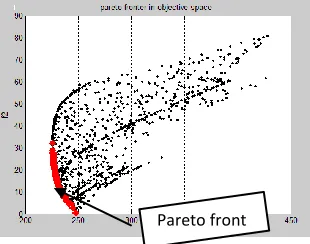
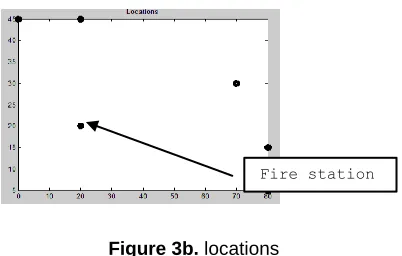
3. Two-objective warehouse location problem that minimize the total distance to five location so that the distance from fire station at (20,20) is less than 10 unit.(using Euclidian distance)
[(0,45);(20,45);(70,30);(80,5);(80,15);(20,20)]
%f(:,1)=sqrt((0-x(:,1)).^2+(45-x(:,2)).^2)+sqrt((5-x(:,1)).^2+(10-x(:,2)).^2)...
+sqrt((20-x(:,1)).^2+(45-x(:,2)).^2)+sqrt((70-x(:,1)).^2+(30-x(:,2)).^2)...
+sqrt((80-x(:,1)).^2+(5-x(:,2)).^2)+sqrt((80-x(:,1)).^2+(15-x(:,2)).^2);
f(:,2)= abs(sqrt((20-x(:,1)).^2+(20-x(:,2)).^2)-10);
Figure 3a.Simulation Results
Pareto front
Pareto front
146 Figure 3b. locations
5 A two-objective with two variable minimization problem introduced by Deb (2001) is chosen to illustrate the function of SPEA2.
Minimize f1(x) = x1; Minimize f2(x) =(x2 + 1)/x1 Subject to 0.1≤x1 ≤ 1; 0 ≤x2 ≤5:
Figure 4a. Simulation Results
Figure 4b. Simulation Results
5. Constraint Handling a two-objective with two variable minimization problem introduced by Deb
(2001) is chosen to illustrate the function of SPEA2 Minimize f1(x) = x1;
Minimize f2(x) =(x2 + 1)/x1 Subject to −𝑥2 − 9𝑥1 ≤ −6; 𝑥2 − 9𝑥1 ≤ −1
0.1≤x1 ≤ 1; 0 ≤x2 ≤5 (Using external appropriate penalty)
Figure 5a. Simulation Results
Figure 5b. Simulation Results
6. Three-Objective test problems Min f1 = X1;
Min f2 = (X2 +2) /X1; Min f3 = X1 2 + X2; ub=[4,3]; lb=[0.1,1 ];
Figure 6. Simulation Results
7. Unconstrained linear minimization 𝑀𝑖𝑛 𝑓1 = 𝑋1 − 3𝑋2;
𝑀𝑖𝑛 𝑓2 = 3𝑋1 + 𝑋2 𝑀𝑖𝑛 𝑓3 = 𝑋3 − 2 𝑋2; 𝑢𝑏 = [2,2 ,2]; 𝑙𝑏 = [ 1 , 1 ,0];
Figure 7. Simulation Results
8. Comet problem (Deb 2001) Min F1 =(1+X3)*(X1)3 *(X2)2-10X1-4X2); Pareto front
Pareto Surface Fire station