United Kingdom Vol. VI, Issue 5, May 2018
Licensed under Creative Common Page 745
http://ijecm.co.uk/
ISSN 2348 0386
TRAINING AND DEVELOPMENT: AN EFFECTIVE
MANAGEMENT TOOL FOR INCREASED PERFORMANCE
Ronald Bunule Wulnye
Wa Polytechnic, Business School, Department of Secretaryship and Management Studies, Ghana [email protected]
Emmanuel Aikins
Wa Polytechnic, Business School, Department of Secretaryship and Management Studies, Ghana
Ibrahim Abdul-Fatawu
Wa Polytechnic, Business School, Accountancy Studies, Ghana
Abstract
Employee training and development is an important tool that equips employees with various
skills and knowledge for effective execution of tasks. The purpose of the study was to
investigate the effect of training and development on employee performance at Ghana Health
Service (GHS), Upper West Regional Health Directorate. The approach in terms of data
collection involved the use of questionnaires. A total of 200 questionnaires were administered
by the researcher out of which 160 valid questionnaires were retrieved from respondents. These
responses were analyzed using Microsoft Excel. The study revealed that training and
development have positive impact on employees’ performance. The employees agreed that
they are able to transfer the knowledge and skills acquired to their working environment.
Though effectiveness of the training and development is high, the study revealed that there is
inconsistency in the application of training and development policies and procedures. Based on
the findings of the study it is recommended that management should have well planned;
systematic and coordinated training and development programs throughout the organization
and also ensure that there is adequate budget allocation to finance the implementation of
training and development programs in the company.
Keywords: Training, development, management tool, policies and procedures, training needs,
Licensed under Creative Common Page 746
INTRODUCTION
Every organization needs well-adjusted, trained, and experienced people to perform its activities (DeCenzo and Robbins, 2005). Jobs in today dynamic organization have become more complex leading to increase in employee education. Noe, (2010) posits that the technologies, rapid development of knowledge, globalization of business and development of e-commerce have also made organizations to experience great change. This has led to increased employee education. The design of office furniture and equipment, office layout, and such environmental conditions as lighting, temperature, humidity, sound, and color as well as quality raw materials can make production possible, but Asare-Bediako, (2008) argued that it is the human resources that actually make production occurs. In order to sustain economic and effective performance of the human resource, it is important to enhance the input of this resource to achieve the organizational goals through training and development. Training prepares the employees to make use of technologies functions in new work systems, communicate and cooperate with peers or customers who may be from different cultural background (Noe, 2010) and ensures adequate supply of employees that are technically and socially competent for both departmental and management positions (Mullins, 2007).
The achievement of organizational goals depends on accurate management and usage of resources. Heathfield (2012),stated that the right employee training, development and education at the right time, provides big payoffs for the organization to increase productivity, knowledge, loyalty and contribution. It is important to note that people are the most important single resource in organizational and managers have responsibilities to plan towards the training and development of the personnel to do the right thing at the right time and place. The human resource of any organization is expected to bring about the competitive difference, since the success or failure of an organization depends on the quality of this resource as well as its orientation. This is based on the notion that human resource is the competitive advantage a business organization has.
Employee training and development activities are essential for all categories of staffs. They offer opportunities to expand the knowledge base of all employees with an aim to improve performance. An organization has no choice but to train its employees if it wants to compete in today’s competitive world. However, some organizations view training and development
Licensed under Creative Common Page 747
throw more light into relationship of training and development effectiveness and management employee performance and providing suggestions to the organization as how best they can use training and development programs to make employees perform well on their jobs. However, deficiencies tend to constrain training and development activities.
LITERATURE REVIEW
Concept of Training
An important variable in increasing organizational performance is training. It is an essential and effective tool in successful achievement of the firm’s objectives and goals resulting in higher
productivity (Columbo&Stanca, 2008; Sepulveda, 2005; Konnings&Vanormelingen, 2009). Employee training refers to a learning experienced that involves changing skills, knowledge, attitudes, or behavior (Duncan, Selby-Lucas, and Swart, 2002), a planned efforts by a company to facilitate employees learning of job related competencies critical for successful job performance (Noe, 2010; Chiaburu and Telkleab, 2005),) and provides employees with specific, identifiable knowledge and skills for use in their present jobs and affects organizational competitiveness, knowledge, revenue and performance (Mathis and Jackson, 2010), and a learning process in which employees acquire knowledge, skills, experience and attitudes needed to perform their job better for the achievements of their organizational goals (Ngirwa, 2009). Training is also the planned and systematic modification of behavior through learning events, programs and instructions, which enable individuals to achieve the levels of knowledge, skill and competence needed to carry out their work effectively (Gordon, 1992; Armstrong, 2008). Training is not only to develop employees but also help an organization to make best use of their human resources in favor of gaining competitive advantage. This means that training helps trainees to acquire new skills, technical know-how and problem-solving capabilities, thereby improving the performance of the employees.
Licensed under Creative Common Page 748
Training Policies and Resources
The Organization for Economic Co-operation and Development (OECD, 2012) pointed out that policies aimed at enhancing workers’ skills and contributing to an improvement in employment
performance. Training policies are expressions of the training philosophy of the organization (Armstrong, 2006), formulated to give guides to action and to set boundaries to decision making on what should be done in certain conditions and how particular requirements and issues must be dealt with (Armstrong & Stephen, 2005). Training policies and practices in many countries are the right of management and are not recommended by the law (Tayeb, 2005). In France, medium and large organizations are by law required to spend a certain percentage of their annual revenue on employee training whiles German and United States organizations spend a large amount of their time and finances on training their employees upon also later recruitment and through their job career. For example, USA business firms spend billions of dollars each year on formal courses and training programs to develop workers skills (Galvin,2003), and spend more than $126 billion annually on training and development or more than $1,000 per employee on average professionals (Aquinis and Kraiger, 2009). For example, studies of training conducted in USA indicated that training is rated as very important by 94% of human resources (Joyce, 2006).
The Concept of Development
Development is about incorporating new ideas, beliefs, or values (Beck & Cowan, 2006), increasing the capacity to operate at higher levels of task complexity, or complexity of reasoning (Ross, 2008),bringing someone to another threshold of performance, or a new role in the future (McNamara (2010), an unfolding process that enables people to progress from a present state of understanding and capability to a future state in which higher-level skills, knowledge and competencies are required (Armstrong, 2006). Development happens within an individual, between people and as an increase ability to deal with complexity (Harris and Kuhnert, 2008). Development takes the form of learning activities that prepares people to exercise wide or increased responsibilities. It does not concentrate on improving performance in the present job. Successful development of capable and highly motivated employees is a prerequisite for organizational innovation (Collins & Smith, 2006).
Employee Training and Development
Licensed under Creative Common Page 749
gap between current performance and expected future performance (Weil and Woodall, 2005).
Training and development typically involves providing employees the knowledge and skills needed to do a particular job or task (Wermer& DeSimone, 2006), enhances skills, knowledge, abilities and capabilities and ultimately employee performance and productivity in organizations(Cole, 2002). One of the key factors in employee motivation and retention is the opportunity employees want to continue to grow and develop job and career enhancing skills is through training and development. For Acheampong (2006) training and development is the process of exposing junior employees to specific knowledge and skills in order to enable them perform specific job tasks while development on the other hand is the process of providing senior employees with conceptual skills for performing new techniques of production in an organization. Asare-Bediako (2002) stressed that employees must be trained and where possible, developed to meet their own career needs and needs of the organization. As training is task or job oriented and aimed at enabling the individuals to perform better on the current jobs, development is career focus aimed at preparing people for higher responsibilities in the future (Asare-Bediako, 2002). Organizations must therefore have the responsibility to develop and implement training and development systems and programs that best help employees to achieve their objectives. Whilst some human resource professionals consider training and development an after recruitment program, Asare-Bediako (2002) believes that it must be incorporated into orientation programs for newly recruited staff. Training and development should emphasize the area of facilitating change and maintaining the organization’s culture. The importance of training and development should be reinforced
through continuous efforts such as frequent reminders, meeting, and others.
Acheampong (2006) identifies the functions of training and development to include; investing in human resource to increases employee’s productivity, enhancing job motivation
and satisfaction, reducing problems which are associated with the supervision of employees, increasing workers value to an organization for promotion. It is also imperative to note that apart from these functions of training and development, Goldstein and Gilliam (1990) also reiterated that investment in training and development can help gain competitive advantage: increase employee knowledge, help ensure that employees have the basic skills to work with new technology, help employees understand how to work effectively in teams to contribute to service quality, and ensure that the company’s culture emphasizes innovations, creativity and
Licensed under Creative Common Page 750
Benefits of Training and Development Program
The main purpose of training is to enhance skills and knowledge and to bring change of attitudes or behavior and it is also one of the crucial viable motivators which can lead to much possible importance for both individuals and the organization. McNamara (2010)explained that training increase job satisfaction and employee morality, improve the employee motivation, improving the efficiencies in processes and financial gains, increasing the ability to secure technologies, developing the innovation in strategies and products and reducing employee turnover are other important benefits of training.
Noe (2010) added that training and development better prepare employee to achieve the organizational goals, become more productive a staff that to meet the challenges of change in the organization during learning and work on new programs. Noe is of the view that with training and development activities, the organization will be more successful at attracting and retaining employees, has a pool of employees who are prepared to replace those leaving. As stated by McNamara (2008),the reasons for an employee to commence training and development include:
When a performance appraisal indicates performance improvement is needed
To "benchmark" the status of improvement so far in a performance improvement effort
As part of an overall professional development program
As part of succession planning to help an employee be eligible for a planned change in
role in the organization
To "pilot", or test, the operation of a new performance management system
To train about a specific topic
Again Asare-Bediako (2002), stated that developmental activities are designed to reinforce strength, overcome limitations, provide relevant, new competencies, and broaden outlook. Such development activities usually include formal courses, acting assignment, attachments, job rotation, and delegation. According to him, ideally, at the time of employing staff or just after employment, a career development plan should be prepared for the employee. This should clearly indicate personal profile of the staff, the educational qualification and training, work experience with dates, past training and time, major strengths, major limitations, progression projections and timings and training and development plan and timing.
Determining Training Needs
Licensed under Creative Common Page 751
training needs. Only if training focuses on these needs it can be productive for the organization. The training of the organizational members is typically a continuing activity. Even employees who have been with the organization for some time have undergone initial orientation on skills training need continued training to improve their skills.
To Armstrong (2001), training need is concerned with defining the gap between what is happening and what should happen. This is what has to be filled by training. That is, the difference between people who know and can do and what they should know and be able to do. To Armstrong, training needs should be analyzed, first, for the organization as a whole-corporate needs; second, for department, teams, functions within the organization-group needs; and third, for individual employee’s needs. A training need is any shortfall in terms of employee
knowledge, understanding, skill and attitudes in what is required by the job, or the demands of organization change (Cole, 2000).
Training and Development Methods
Armstrong, (2001) stated that training and development methods are critical to the success of organizational training programs. Different types of methods exist for evaluating training methods (Forman, 2003). They include coaching learning, workshop, induction, mentoring, job instructions, induction courses and job rotation (Mullins, 2007).On-the-job-training and off-the-job-training learning opportunities of employees are available to both public and private sector organizations. The on-the-job form of training is applied while the employee is normally working within the daily activities to get specific skill. It is the most common type of training at all levels in an organization because it saves the cost of sending employees away for training and avoids the cost of outside trainers it is flexible, relevant to what employees do (Tyler, 2010).This type of training is needed to improve the employee that had insufficient qualification for the job execution. Among the on-the-job techniques that is used to develop employees capabilities for doing several different jobs is job rotation (Allysson, Costa and Mirrales, 2009). The off-job-Job training is usually used to train employees away from their workstation. Some knowledge and skills are problematic to teach at the worksite, therefore, off-site training will be important. This method allows for the use of greater difference of training processes, which involves: apprenticeships, lectures, assistantships, internships, specially study, films, television conferences or discussions, case studies, role playing, simulation programmed instruction and laboratory training (Cole, 2002).
Licensed under Creative Common Page 752
and business strategies should be conducted (Goldstein, 1991). Adults learning theory is especially important to consider in developing training program because the participants for many training and development programs tends to be adults, and most of whom are scared by mathematics and finance (Murphy, and Zandiakili, 2000). Adults learning styles are different, so for employers to achieve the intended purposes of training various learning modalities based on the workplace environment and the results of the assessment should be used. Many adults believed in learning through practice and so trainers should provide chances for trainees to involve in something new and discuss or review training materials based on experience. Bringing few practice will serve as resources to the learning environment (Taylor, 2009).
According to Robins and Coulter (2002) managers are responsible for deciding what type of training employees need, when they need it, and what form that training should take. They further grouped employees’ skills into technical, interpersonal and problems solving.
Training can be offered on-the-job and off-the-job (Onyango and Wanyoike, 2014). The most common type of training at all levels of organizations is on-the-job training because it is flexible and relevant to what employees do (Tyler, 2008) and can be effective if well-planned and well executed (Blazquez and Salverda, 2008). The views of Robins and Coulter on training methods state that most training takes place on-the-job-training because this approach is simply to implement and is usually inexpensive. Beside, on- the-job-training cannot disrupt the workplace and result in increased in errors while learning take place.
Evaluation of Training and Development
Licensed under Creative Common Page 753
received $230 in increased productivity for every dollar spent on training. For DeCenzo and Robbins (2005), such “claim is valueless unless training is properly evaluated”. Apart from the
general reactions of the participants and managers, training should be evaluated in relations to how much the participants learn, how well they apply their new skills on the jobs, and whether the training program reduces turnover, increase customer services, etc. (Gay and LaBonte, 2003; Catalano and Kirpatrick, 1968). Noe (2010) suggested that a training program should be evaluated to: identify the program strengths and weaknesses, assess whether the content, organization and administration of the program including the schedule, accommodations, trainers and materials contribute to learning and the use of the training content on the job, identify what trainees benefits most or least from the program, assist in marketing programs through collection of information from participants about whether they would endorse the program to others, why attending the program, and their level of satisfaction with the program, determine the financial benefits and cost of the program to compare the cost and benefits of training versus non-training investments, compare the cost and benefits of different training program to choose the best program.
Training evaluation is a systematic process of collecting information for and about a training activity. This information can be used for guiding decision making and for assessing how well the course is progressing and the objectives are being met. Evaluation is not merely an activity at the end of the training course, but is a continuous process throughout the training. Evaluation of training program is part of the control process of training Cole (2000). To him evaluation methods are aimed to obtain feedback about the results or outputs of training, and to it to assess the value of the training, with a view for improvement, where necessary. Management should value its effectiveness after the training program has been completed Certo (2003). As a control process, training evaluation is concerned with setting the appropriate standards of training in the form of policies, objectives, adherence to external standards and standards of training. Clearly, the more precise the standards are set, the easier it is to evaluate the success of training.
Armstrong (2001) emphasized that it is important to evaluate the worth of the training so as to measure whether it is producing the specific learning outcomes and to indicate where improvement or changes are required to make training more effective. Neil et al. (2002) also added that the benefits of evaluating training programs help to identify whether the program is meeting the objectives, enhancing learning and resulting in transfer of training to the job. Also, Pynes (2009) and Cascio (1986) proposed the following four levels upon which training programs can be evaluated: the participant’s reaction to the training programs, the measures
Licensed under Creative Common Page 754
knowledge, skills and abilities that were deemed important, the measure whether participants have been able to transfer to their jobs the skills, knowledge and attitudes they learned in training and the impact the training has had on the organization.
Added to the above, Kirkpatrick (2006) also suggested the following as evaluation training programs: how training participants react to it, the extent to which participant change attitudes, increase knowledge and/or increase skills, the extent to which change in behavior occurred, and final result that occurred as a result of training. For DeCenzo and Robbins (2007)evaluating training effectiveness need substantive data to determine whether training is correcting the deficiencies in skills, knowledge, or attitudes that were assessed as needing attention. Horwitz (1999) stated that reliance on information feedback from line manager and trainees and formal course evaluations, more systematic, objective measures for evaluating the transfer of learning from classroom to the job and more difficult are measured which systematically evaluate the effectiveness of HRD practices and initiative in enhancing competitive goals. For Neil et al. (2002), company norms regarding evaluation, cost of designing and conducting and evaluation, the need for speed in obtaining program effective information and purpose of the training are factors that need to be considered in evaluating training program. Whiles DeCenzo and Robins ( 2007) and Pynes (2009) are of the opinion that the four levels of evaluation training is crucial in evaluating training effectiveness, Lane and Crane (2002), Prett and Bennet (1990) argued that the most refined method of evaluating training is the measuring of performance before and after training.
Challenges Confronting Training and Development of Programs
In their study of training and development program among India and British companies Yadapadithaya and Stewart (2003) identified lack of systematic and comprehensive training and needs analysis, absence of transfer of learning, lack of clear written policy on training and development, failure to evaluate the effectiveness of training and development programs more rigorously, weak interaction between the industries or services seeking and the institutions providing training.
It is worth noting that little over 65% of the Indian organization perceived the “absence of transfer of learning‟ from the training to the workplace as the major deficiencies of their training
and development system. On the other hand, 61.5% of the British organization reported their “inability to evaluate the effectiveness of training and development programs more rigorously‟
Licensed under Creative Common Page 755
the acquisition and transfer of new skill and ideas (Tannenbaum, 1997).It follows that the major challenges were the firm’s ability and willingness to commit major resources and adequate time
to training and development; to gain the willing corporation and support of the line manager; to link organizational, operational, and individual training need to clearly create connection between strategic business objectives and training and development; and to ensure employees retention after training.
The Impact of Training and Development
Jacobs and Washington (2003) mentioned that investing in the training and development of employees is an effective plan to develop a competitive human resource pool. Training and development increase success of quality project, reduce project failures and defects, reduces staff turnover, minimizes supervision, and enables progress, greater capabilities to carry out more project and changes in employees behavior(Nel et al., 2004) and prepares the employee for future job requirements (Solomon, 2016). Development programs allow management to keep a workforce that can sufficiently take over existing employees who may leave the company or who are moved to other areas and allows employees to cope with newly developed technology, and ensures that adequate human resources are available for expansion into new areas.
A well-trained and developed employees increase productivity and profits, improves customer satisfaction and creating new service ideas, saves labor by reducing time spent on problem-solving and saves money in the long run by producing a better workforce. Evans and Lindsay (1999) proposed that the quality of employees and their development through training are major factors in determining long-term profitability and optimum performance of organizations. Neo(2000) lamented the lack of training and development by employers in the United States when they stated that only 16% of United States employees have never received any training from their employers. Neo reiterated that as a result of this, General Electric, Texas Instruments and Federal Express now invest between 3% and 5% of their payroll in training. In a study in America on the impact of human capital investments such as employer-provided training and development, Black and Lynch (1996) citing Bishop (1994) indicated that employer-provided training and development raises subjective productivity and performance measure by almost 16%.
Licensed under Creative Common Page 756
performance as well as increasing productivity, and eventually putting companies in the best position to face competition and stay on top. This means that, there is a significant difference between the organizations that train their employees and those that do not (Appiah, 2010).
With the constantly changing environment, the skills acquired in the academic institutions no longer provide a guarantee for future advancement for middle-aged employees. Employees differ greatly in the abilities as far as the work environment is concerned. It becomes necessary to shape the ability for changing job environment through training and development. To perform the required job, intellectual ability, inherent intelligence and psychomotor ability that includes physical abilities to perform works are to be coordinated; hence effective training and development need to match the abilities of employees with the job requirements.
Performance
It is understood that employee training and development increases performance. Performance has been an argumentative issue among many scholars (Barney, 1997). The term performance has been used to refer to the organization’s ability to achieve its goals by using resources in the
most efficient and effective way (Daft, 2000), ability of the organization to achieve its goals and objectives (Ricardo & Wade, 2001), and is equivalent to the famous economy, efficiency, and effectiveness 3Es) (Jones, 2006). Furthermore, performance refers to a range of measurements comprising input efficiency, output efficiency and transactional efficiency (Stannack, 1996) profitability as a main measurement for organizational performance in business organizations (Hamel&Prahalad, 1989), the achievement of specific tasks measured against predetermined or identified standards of accuracy, completeness, and cost and speed (Afshan et al., 2012), a measure of the ability of individual to accomplish a specific task or the degree of effort at individual makes to attain the objectives of the organization (Khalid et al.,2012). And may be related to numerous factors within the workplace, such as overall job satisfaction, knowledge, and management (Amisano, 2009).
Licensed under Creative Common Page 757
RESEARCH METHODOLOGY
Research Design
Denzin & Lincoln (2005) stressed that the research design is the methodological connection between researcher philosophy and subsequent choice of method to collect and analyses data. The design that was considered for the research was the mixed methods research. According to Field (2008), this type of research mixes quantitative and qualitative methods to support one another. The quantitative research uses structured questionnaires to facilitate collection of data. The structured questionnaires were completed with interviews. The case study approach that was adopted took place at Ghana Health Service (GHS) at Upper West Regional Health Directorate. The case study method was chosen because case study is often seen as being problem-centered, small scaled and manageable.
Population of the Study
Population describes the entire group of people that the researcher desires to learn about (Strangor, 2011) and all the elements that meet the criteria for inclusion in a study (Burns and Grove, 2013),The population of Ghana Health Service at Upper West Regional Health Directorate is estimated to be two hundred and fifty (250) which comprises senior level and junior level officers involved in the day to day policing operations. It is out of this population that the sample was been drawn.
Sample Size and Sample Techniques
A sample is a sub group of elements of the population selected for participation in the study (Malhotra and Birks, 2007). Barbie (1990) advocates that the sample should be representative in the sense that each sampled unit represents the characteristics of a known number of units in the population. Sekaran & Bougie (2009) suggested that a sample size of 30 – 500 participants
is adequate for most research studies. The researchers involved eighty percent (80%) of 250 staff. A total of 200 officers from all functional areas of the service were sampled for the study. The involvement of all areas is to make the finding capable of being generalized since every sector of the services operation has been involved in the study.
Licensed under Creative Common Page 758
respondents. The researcher used the simple random sampling technique in the selection of the sample.
Data Collection Instrument
Data collection enables a person or organization to answer relevant questions, evaluate outcomes and make predictions about future probabilities and trends (Rouse, 2016).Several methods are used to collect data in a social science research (Saunders et al., 2012). The researchers used questionnaires and interviews to collect data from respondents. Questionnaires were used because it is economical in terms of effort and can be duplicated and distributed to many respondents to produce a large amount of data (Wallen&Fraenkel, 2001). The interview was also used because it provides opportunities for the researcher to collect rich and meaningful data (Roulston, 2010). Through the interview process the researchers listened to participants and build an understanding based on their opinions (Creswell, 2003).
Data Analysis
For the purpose of answering the research questions the descriptive statistical approach of analyzing data was followed as a common method for quantitative business and social research (Frankfort-Nachmias and Nachmias, 2008). Before the analysis was done, the researchers edited the responses to ensure that all the questionnaires had been properly answered. The Statistical Package for Social Scientists (SPSS) because of its simplicity in use to analyze the data gathered was used. Appropriate tables, graphs and charts were used to present the results. The qualitative data from interviews and secondary documents were analyzed using content and logical analysis techniques.
ANALYSIS AND RESULTS
Demographic Characteristics of the Respondents
Demographic data gathered from staff were age range, gender and educational background, position, division, length of service among others. The data was necessary since it assisted the researcher to determine whether these affected the training needs and its effect on the worker.
Gender Distribution of Respondents
Licensed under Creative Common Page 759
Table 1: Gender Distribution of Respondents
Gender Frequency Percentage (%)
Males 156 97.5
Females 4 2.5
Total 160 100
Job Categories of Respondents
The occupation classes of the respondents were examined to figure out if they were junior or senior staff and additionally which of these two employment classes was prevailing in the organization. Table 2 has shown that out of the population of valid respondents, 45(28.13%) represented senior staff whilst 115(71.87%) were junior staff. This indicates that majority of the employees were at the operational level at the time of this research.
Table 2: Job Classes Distribution of Respondents
Respondents Status Frequency Percentage (%)
Junior staff 115 71.87
Senior staff 45 28.13
Total 160 100
Educational Levels of Respondents
Levels of education distribution of respondents were examined and the results presented in Table 3 shows that out of 100% responses received, 92(57.5%) of the respondents had tertiary education whilst 46(28.75%) of the respondents represented those who obtained secondary education. The data in table 4.3 also indicated that 22(13.75%) of the respondents received basic education. It could be seen from the table that every respondent have had at least, basic education.
Table 3: Level of Education
Educational Level Frequency Percentage (%)
None 0 0
Basic 22 13.75
Secondary 46 28.75
Tertiary 92 57.50
Licensed under Creative Common Page 760
Work Experience of Respondents
Work experiences distribution of respondents was examined and the results presented in Table 4. Regarding the years of work experience 45(28.12%) of respondents had worked between 0 and 5 years; while 38(23.75%) have put in between 5-10 years; 42(26.25%); and 35(21.87%) have spent more than 15 years.
Table 4: Work Experience
Work Experience Frequency Percentage (%)
0- 5 45 28.12
5- 10 38 23.75
10- 15 42 26.25
More than 15 35 21.87
TOTAL 160 100
Evaluation of Training and Development Policies and Procedures
Research questions were designed to find out if GHS have training and development policies and procedures that are used for their training activities in the organization and these were the responses from the employees. When the Human Resource Officer and other respondents were contacted, they indicated that GHS has policies and procedures for which they are committed to creating an enabling and stimulating working environment, which values the contribution of each employee and empowers them across all levels. GHS recognizes that a deliberate continuous training and development of employees is essential in ensuring that they realize their full potential, in order to achieve and maintain the optimum performance standards, leading to the attainment of organizational goals. The respondents were equally asked if there are existing training and development policies and procedures in GHS.
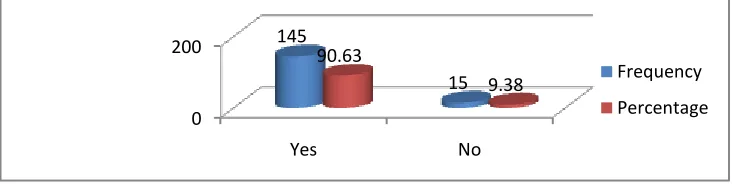
Figure 1: Evaluating Training and Development Policies and Procedures
0 200
Yes No
145
15 90.63
Licensed under Creative Common Page 761
The figure 1 clearly establishes that employees know the existence of training and development policies and procedures in the organization because 145(90.63%) respondents responded yes, meaning that they have knowledge of the existence of training and development policies and While only 15(9.38%) respondents responded no, meaning that they do not know the existence such policies. Policies and procedures assist training and development needs of employees for appropriate tailored training and development programs for present and potential future roles. This would help match training and development programs with the specific needs of employees, and the needs of the organization.
Training and development policies establish the framework for selection and implementation of internal and external Human Resource Department programs to comply GHS’s Management systems and meet GHS Strategic Goals. The policies also enable to meet
the regulatory and with legislative compliance requirements of GHS for statutory positions of employees and also ensure that adequate budgetary allocation is made available for employees training and developmental needs and eventually position the organization as an attractive employer.
Respondents’ Awareness of the Training and Development Policies
Training and development is very essential to any public sector organization in order to improve the performance and capability of its employees. Most of the public sector organizations in Ghana including GHS train and develop their employees every year.
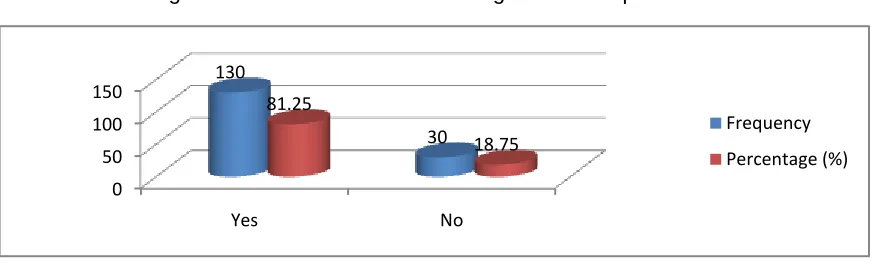
Figure 2: Awareness of the Training and Development Policies
Figure 2 represents that employees have a clear knowledge of training and development policies and procedures in GHS. One hundred and thirty 130(81.25%) respondents responded yes, they are aware of the training and development policies and 30(18.75%) respondents responded no, they are not aware. The outcomes infer that most employees are aware that the training and development policies exist and are executed in the GHS. This discloses that
0 50 100 150
Yes No
130
30 81.25
18.75
Licensed under Creative Common Page 762
training and development policies are well broadcast for the knowledge and awareness of training and development policies. This is an essential prime factor in the development of an effective program.
Medium of Communicating Training Policy
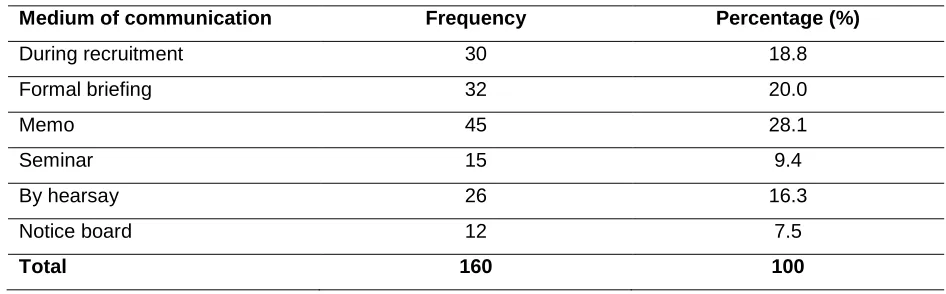
It can be observed from table 5 that the common means by which the training and development policy was communicated to staff was during recruitment 30(18.8%), formal briefings 32(20%), by memo 45(28.1%), seminars 15(9.4%), by grapevine 26(16.3%) and notice board `12(7.5%). Thus, GHS used diversified means to communicate information on training and development policy to the staff. Citing the example of Wainwright industries, Evans and Lindsay (1999), indicated that training begins right from the first day on the job and senior managers explain the company’s approaches to continuous improvement to new recruits. In addition, follow ups were
held 24 and 72 hours after the start of employment.
Table 5: Medium of Communicating Training Policy
Medium of communication Frequency Percentage (%)
During recruitment 30 18.8
Formal briefing 32 20.0
Memo 45 28.1
Seminar 15 9.4
By hearsay 26 16.3
Notice board 12 7.5
Total 160 100
The awareness initiatives and communication of training policy to staff at GHS, if indeed there was any such thing, was a far cry from what prevails at Wainwright industries. Also, Asare-Bediako (2002) believes that training and development must not be thought of as an after recruitment program, but rather it must be incorporated into orientation programs for newly recruited staff. According to Asare-Bediako, the training and development unit should explain to new employees what T&D means and what programs and facilities are available to employees.
Nature of the Training and Development Procedures
Licensed under Creative Common Page 763
Training and development policies in the GHS are planned and systematic. This is because there is specific training and development unit or department and also they do allocate funds to meet the costs of training and development. Table 6 shows how employees view the nature of training and development procedures on health.
Table 6: Nature of the Training and Development Procedures
Variable Frequency Percentage (%)
Planned 85 53
Unplanned 50 31
Not sure 25 16
Total 160 100
Respondents were asked as to whether the training and development program is planned and systematic. The results from table 6 point out that, 85(53.13%) of the respondents answered that it is planned and systematic while 50 (31.25%) of the respondents indicated that it was unplanned and not systematic. The remaining 25(16%) respondents indicated that they are not sure. Therefore, the responses from the respondents together with that of the Training and Development manager shown that, training activities in the GHS do follow a recognized and standard process and procedures. So, it is established that training and development program in the GHS might be planned and systematic. Therefore, there will be effective training and development function to effect performance of the employees.
Participation in Training and Development in the GHS
The significance of training and development for the employees of GHS program is well acknowledged. The respondents were asked if they had taken part in any training since they have been working in GHS.
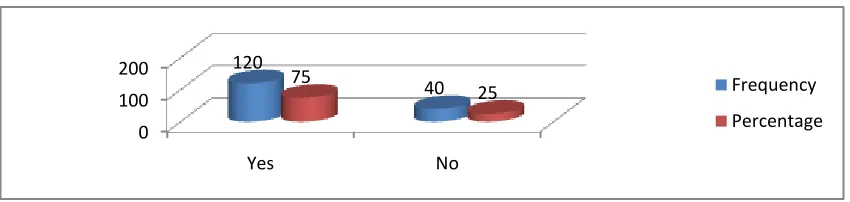
Figure 3: Participation in the Training and Development Programs
0 100 200
Yes No
120
40 75
25 Frequency
Licensed under Creative Common Page 764
Data from figure 3 depicts that 120(75%) of respondents being the majority of the sample group has attended training and development. and 40(25%) respondents signifying that have not participated in any type of training since they were employed in GHS.
Selection of the Trainees
It has been perceived that training of employee is costly. Consequently it is essential to carefully select the employees according to the need of the organization. Literatures indicate that electing participants through a careful manner of training needs identification is therefore the suitable process of commencing training and development. The researchers wanted to know the standards that GHS use when selecting the employees to go for training and development activities.
Table 7 establishes that a total of 29(18.12%) respondents recognized and requested for the courses they want to study themselves and then applied through the management to release them to go for those trainings. Those who were chosen based on the organization request were 76(47.5%) Finally, 55(34.37%) respondents indicated that they were being asked by their managers to participate in the training activities.
The interview with the Human Resource Officer pointed out that there is specific training and development program with procedures for selection of employees who has to go through training and development. Therefore training and developing of the employees depends with the policies and procedures of the organization and the availability of funds to support training and development program which normally goes with the demand of the organization. Hence the responses from the respondents together with that of the Human Resource Officer discovered that the training and development program is systematic and orderly organized. He indicates that there is formal plan to hold employees to participate in training and development for the success of the organization and in effect the employees use the skills acquired to work for the organization effectiveness.
Table 7: Selection for Training
Research variable Frequency Percentage (%)
Employees demand the courses 29 18.12
Request by your manager 55 34.37
Request of the organization 76 47.5
Licensed under Creative Common Page 765
Effect of Training and Development on Employee Performance in GHS
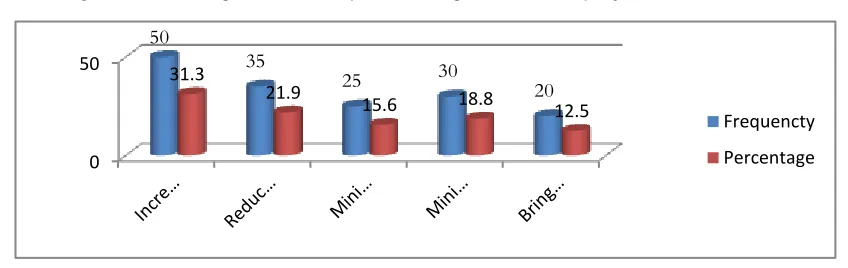
The second section of our research was to find out about the effects of training and development on employee performance. The literature indicates to us that employees will not carry out well at their work no matter how hard they try and irrespective of how much they want to until they know what they are supposed to do and how they are supposed to do it. It is skills and knowledge attained for the job that makes employees effective and competent. Training is the way by which skills and knowledge are obtained by employees to improve performance and change their approaches or actions. The responses from questionnaires administered to the sampled employees depicts from figure 4 that, 50(100% indicated yes, that their performance has improved and there were no respondents who said no. This is substantial since the reason of training and development is to improve individual employees and organizational performance most of the respondents attest that training has a positive influence on their performance of work.
Figure 4: Training and Development Program and Employees’ Performance
Skills and Knowledge Acquired Through Training and Development
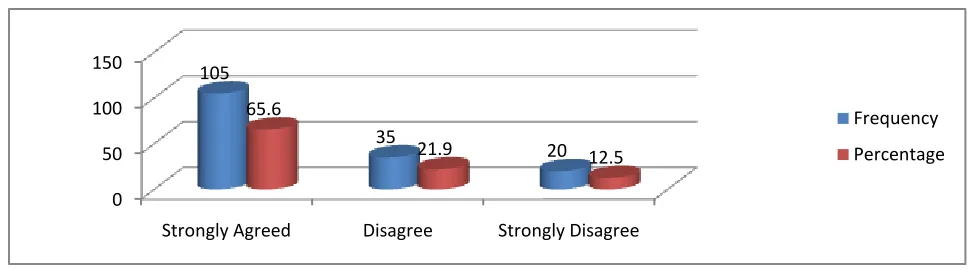
Figure 5 indicated that, 105(65.6% ) respondents strongly agreed that training and development equipped them acquire skills and knowledge, 35 (21.9%)respondents disagree that training and development impart new skills and knowledge, while 20(12.5%) strongly disagreed that raining does not prepare them with new skills.
This suggests that the training and development prepare the employees with new skills and technical knowledge of executing their work. Compared to the untrained employees, the trained employee is capable of doing their job well. Those who have attended training can perform various activities with confidence. The trained employee for instance can take the notes of the meetings correctly, they can use computers in operating the accounts, and they are also good organizers. Furthermore, training has facilitated them to increase the quality of work. This is important because the reason of training at Ghana Health Service at Upper West Regional
0 50
50
35
25 30 20
31.3
21.9
15.6 18.8 12.5
Licensed under Creative Common Page 766
Health Directorate is to increase skills and knowledge so as to increase performance at the workplace. So the result validates the theoretical background.
Figure 5: Skills and Knowledge Acquired through Training and Development
Effect of Training and Development Activities of GHS
The researchers seek to find out about the effects of training and development undertakings for Ghana Health Service. Training and development are the key impact on the achievement of an organization. It is a tool for improving job-related performance and organizational efficiency. Like any public organization, the Ghana Health Service at Upper West Regional Health Directorate also needs stable, trained and skillful employees to perform its activities. Nowadays the nature of work in the Ghana Health Service at Upper West Regional Health Directorate has become more difficult; it needs experienced and capable employees. Hence training of employees is unavoidable.
The interview with the Human Resource Officer revealed that the Ghana Health Service at Upper West Regional Health Directorate has improved compared to previous years. Presently the Upper West Regional Health Directorate is becoming enhanced with the trained employees. Relating the untrained with the trained, the trained employees are more efficient and effective in their work. They are capable and can do their job without control or supervision, and they are informed with new expertise connected to their job. There is a transformation in their work performance. The outcomes from the hypothetical background indicate a positive effect of training and development activities on the performance of the employees. This suggests that, training and development programs improve employees’ performance at work.
Therefore there is a positive influence on the performance of the employees after being trained. The practical skills and new knowledge attained for the job makes the employees to be efficient and effective.
0 50 100 150
Strongly Agreed Disagree Strongly Disagree 105
35
20 65.6
21.9 12.5
Licensed under Creative Common Page 767
Relationship between Training, Developments at Ghana Health Service
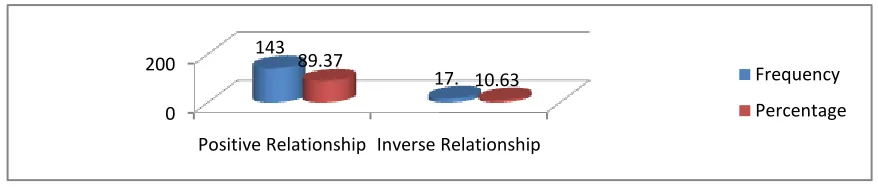
Figure 6 depicts the extent to which training and development relate. The relationship displays that out of total respondents who answered this question, 143(89.37%) respondents responded that there is a positive relationship between the training and development while, 17(10.62%) respondents responded that there is an inverse relationship between training and development. This analysis in figure 6 shows that training and development have a positive correlation. As training increases, employee development also goes up and eventually employee performance improves. In other words, this assumes that training and development should be tailored to improve employee’s skills and performance driven goals. This will clear any perception of
doubts in the minds of the employees. Hence, if managers and employees see training and development policies and procedures as common formalities, it benefits and objectives will not be achieved in the long run and for that matter, resources and productivity will suffer.
Figure 6: Relationship between Training and Development
Effectiveness of Training and Development Methods in Ghana Health Service
The data from figure 7 showed that 64(40%) respondents indicated that the training methods were effective and 96(60%)respondents responded that the training methods were not effective. It could be inferred that, many of the employees of Ghana Health Service at Upper West Regional Health Directorate were not satisfied with the way training methods are being carried out. This might be because it is unplanned and not systematic. Thus the researcher concluded that the whole process of training program have to be revised.
Figure 7: Effectiveness of Training and Development Methods in Ghana Health Service
0 200
Positive Relationship Inverse Relationship 143
17. 89.37
10.63 Frequency
Percentage
0 100
Effectice Not Effective
64 96
40 60 Frequency
Licensed under Creative Common Page 768
The literature indicates that, job satisfaction can come from feeling having the happiness within the organization, job expertise and even from the knowledge that an employee can work hard and get elevated. Trained and developed employee becomes more poised and motivated and led to more satisfied employees who perform at remarkable altitudes. Therefore, the respondents were asked about the effectiveness of the training and development methods in GHS.
Training Influence on Individual Performance
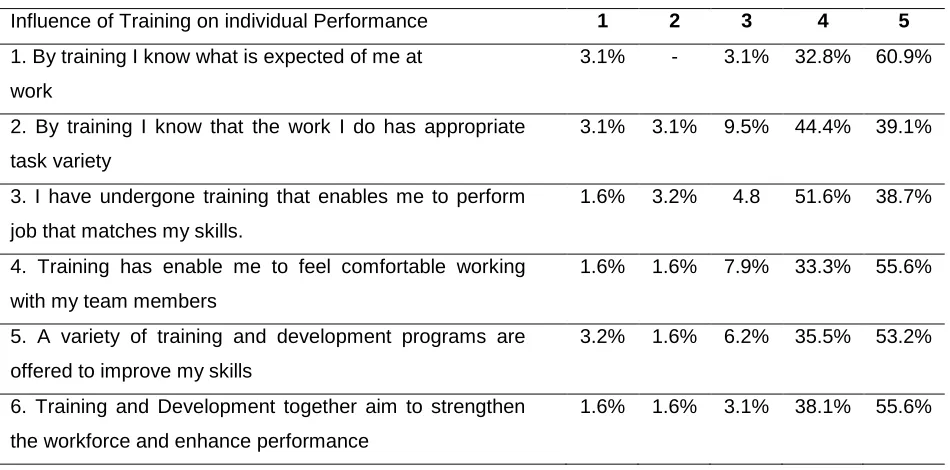
Table 8: Training Influence on Individual Performance
Rating: 1 = Strongly Disagree, 2= Disagree, 3 = Neutral, 4= Agree and 5 =Strongly Agree
Influence of Training on individual Performance 1 2 3 4 5
1. By training I know what is expected of me at
work
3.1% - 3.1% 32.8% 60.9%
2. By training I know that the work I do has appropriate
task variety
3.1% 3.1% 9.5% 44.4% 39.1%
3. I have undergone training that enables me to perform
job that matches my skills.
1.6% 3.2% 4.8 51.6% 38.7%
4. Training has enable me to feel comfortable working
with my team members
1.6% 1.6% 7.9% 33.3% 55.6%
5. A variety of training and development programs are
offered to improve my skills
3.2% 1.6% 6.2% 35.5% 53.2%
6. Training and Development together aim to strengthen
the workforce and enhance performance
1.6% 1.6% 3.1% 38.1% 55.6%
Licensed under Creative Common Page 769
Kenney et al. (1992) stated that employee's performance is measured by the performance standards set by the organization. It can be deduced from the responses that employees are performing well as a result of training they receive. This research also supports the proposition in Appiah (2010) who agree that training generates benefits for the employee as well as the organization by positively influencing employee performance through the development of employee knowledge, skills, ability, competencies and behavior.
Challenges of Training and Development Policy Implementation at GHS
Organizations and individuals alike face many problems with regard to training and development. This section seeks to examine the challenges GHS face in the implementation of its training and development activities include inadequate budgetary allocation. On the challenges GHS face in implementing its human resource training and development plans, the AC-Training stated budgetary and logistical constraints as the main challenge.
Budgetary Challenges
Consequently, when the AC-Training was asked if the resources available for training were adequate, the answer was a big "NO". When asked about the sources of funds for training programs, the AC-Training indicated that they relied on various sources of funds in implementing their training plans. These included internal support from government and external support from the US government, destination inspection companies.
The results in Fig 8 show the budgetary allocation for human resource training programs at GHS for the past five years (2004-2008). The picture that emerged was that both the budgeted and the actual amount spent on training increased over the period under reviews with annual average increases of about GH¢16,425 and GH¢14,999 respectively. However, the actual amount spent on training lags behind the budgeted amount for almost all the five years by about 1% (GH¢7,699.37) in the year 2007, to as much as about 33.1% (GH¢262,813.23) in year 2006. The only period that actual amount spent on training exceeded the budgeted amount was in the 2004 (by 29.4%, that is GH¢78,676.63).
Licensed under Creative Common Page 770
Figure 8: Budgetary Allocations/Actual Amount Spent on Training at GHS (2004-2008)
According to Evans and Lindsay (1999) companies committed to quality invest heavily in training and education and cited the example of Wainwright industries which invests up to 7% of its payroll in training and education. Noe et al. (2000) also indicated that General Electric and Federal Express now make substantial investments of between 3% and 5% of their payroll in training after the realization of the important role that training plays in improving productivity, quality and competitiveness. Perhaps GHS was yet to come to this realization and follow in the footpath of the above listed companies.
SUMMARY OF FINDINGS
Training and Development Policies and Procedures
Training and development policies do exist in Ghana health Service (GHS) with many
forms of training and development policies designed and most employees are aware of the existence and use of those policies and procedures.
Training and development procedures at GHS were effective and some respondents
were even of the idea that the policies were highly operative.
Though there is existence of training and development policies and the level of
usefulness of those policies and procedures in Ghana Health Service, management sometimes face some challenges such as failure of management to educate workers on training issues, irregularity in the application of training and development policies and procedures.
Biased and unreliable application of training and development policies and procedures
Licensed under Creative Common Page 771
Effect of training and development on employee and performance
The effect of training and development on employee performance was positive. Because
training and development activities had provided new skills and knowledge, therefore enriched employee performance.
There is a relationship with training and development activities on employees’
performance in the Ghana Health Service with regards to effectiveness of training and development on employees and a positive effect of training and development on the performance of the organization was revealed during the interview with the Human Resource Officer.
The trained employees are more effective and efficient than untrained ones. Hence, the
effects necessitate the hypothetical back ground that there is a significant positive effect of training and development program on the performance of the employees.
Relationship between Training and Development
There is a relationship between training and development. It was obvious that the more
employees are being trained for the work, the more the employee performance goes high, all other things being equal.
Effectiveness of Training and Development Methods
Sixty percent (60%) of respondents indicated that there is no effectiveness in the training
and development methods.
Respondents were of the view that to ensure effectiveness in the training methods
training and development procedures must be well communicated to all employees
GHS should amend performance plans and changes to some of the old system of
training and development methods where an employee needs to work for more than five years before he/she could be sponsored for training.
Low satisfaction, lack of organizational commitment and low job involvement are some
of the causes of inadequate training and development.
CONCLUSION
Licensed under Creative Common Page 772
employees are performing in their current role. Job performance of an employee depends on several factors but several researches have reinstated the fact that training and development plays the most significant part in improving performance of the employees.
It is important to consider the nature of the benefits in relation to training and the impact of training on individual performance. In other words, if training, ultimately aims to change behavior then the measurement of benefits must be concerned with those benefits, which are associated with the behavior of job holders under a scrutiny. Thus, improvements in productivity, reduction in staff turnover, improvements in employee satisfaction, reduced wastage, etc., are the results of changes in individual actions, possible, as the result of training and development received. As a result, employee training and development is the most important function in an organization and very critical for the employee, the organization and its efficiency.
RECOMMENDATIONS
In order to meet the productivity requirements the researchers recommended that GHS must observe the following:
GHS should ensure that there is training needs assessment and the needs must fit for the successes of organizational objectives. This should be done by Human Resource Officers in collaboration with the heads of other departments.
Management of GHS should openly state the outcomes for each employee, what change in employee, skills, knowledge, behaviors and attitudes and there should be enough training and development prospects for all employees in the organization. This will enhance their ideas and will assist them to know more about the current changes in technologies
GHS should embark on innovative training and development programs. Training and learning must extend far beyond conventional classroom training courses in order to discover learning in virtually every new experience.
GHS should prioritizing training and development by focusing on the areas which will yield best benefit.
SCOPE FOR FURTHER RESEARCH
Licensed under Creative Common Page 773
REFERENCES
Afshan, S. Sobia, I. Kamran, A & Nasir, M. (2012). Impact of training on employees performance: a study of telecommunication sector in Pakistan. Interdisciplinary Journal of Contemporary Research in Business.
Allysson, M. Costa, M. and Mirrales, C. (2009). “Job Rotation in Assembly Lines Employing Disabled Workers,” International Journal of Production Economics, vol. 112, p. 1016
Amisano, C. (2009). Relationship between Training & Employee Performance. Retrieved on March 20 (2010).
How.comhttp://www.ehow.com/facts_5848845_relationship-between-training-employeesperformance.htm/#ixzz/Gs98adwm
Armstrong, M. (1996).A handbook of human resource management practice (3rd ed.). London:Kogan Page.
Appiah, B. (2010). “The Impact of Training on Employee Performance: A Case study of HFC Bank (GHANA)”, pp. 15-17
Aquinis, H. &Kraiger, K. (2009). “Benefits of training and Development for Individual and teams, Organizations and Society,” Annual Review of Psychology. Vol. 60, pp. 451-474
Armstrong, J.S. (2001). Principles of Forecasting: A Handbook for Researchers and Practitioners. Springer.p. 86. ISBN: 0792379306 .
Armstrong, M. (2006).A handbook of Human Resource Management Practice (10th edition) 2006, Kogan Page, London ISBN 0-7494-4631-5
Armstrong, M. & Stephen, T. (2005).A Handbook of Management and Leadership. A guide to managing for results.Kogan Page Ltd.
Barney, J. B. (1997). Firm resources and sustained competitive advantage. Journal of Management, vol. 1(17), pp. 99-120
Barrington, K. and Stimpson, P. (2002).Business Studies. 2nd Edition.Muray Publishers, London
Beck, D.& Cowan, C. C. (2006). Spiral dynamics: mastering values, leadership and change: explaining the new science of memetics. Oxford Blackwell.
Bishop, A. J. (1994). Cultural conflicts in mathematics education. Research agenda for the Learning of Mathematics, vol. 14(2), pp. 15-18
Black, S. E. & Lynch, L. M. (1996).Human-capital investment and productivity. The American Economic Review, vo;. 86(2), pp. 23-44
Burns, N. & Grove, S. K. (2009). The Practice of Nursing Research, Synthesis and Generation Evidence
Blazquez, M. and Salverda, W. (September, 2008). “How Wage Employment and the Role of Education and On-the-Job Training,” EALE Annual Conference (Amsterdam), pp. 1-27. Maryland Heights, Missouri: Saunders Elsevier, pp. 379.
Cascio, W. F. (2003). Managing Human resource Productivity, Quality of Work Life, Profits. (4th Edition).London: Mcgraw-Hill Incorporation
Catalano, R. E. and Kirpatrick, D. L. (May, 1968). “Evaluating Training Programs: The State of the Art” Training and Development Journal, pp. 2-9
Certo, S.C. (2003). Modern Management.(9th edition). Prentice Hall: Upper Saddle River, NJ.
Chiaburu, D. S. and Teklab, A. G. (2005).Individual and contextual influences on multiple dimensions of training effectiveness.In: Journal of European Industrial Training, vol. 20, pp. 282-290
Cole, R.A. (2000). Issues in Web-based pedagogy: A critical primer. Westport, Connecticut: Greenwood Press. Collins, C. J. & Smith, K. (2006). Knowledge exchange and combination: The role of human resource practices in the performance of high-technology firms. Academy of Management Journal, vol. 49, pp. 544-560
Creswell, J. W (2007).Qualitative Enquiry & Research Design – Choosing Among Five Approaches. Thousand Oaks, Ca: SAGE Publications, Inc.
Licensed under Creative Common Page 774 DeCenzo D.A. and Robbins S.P. (2007).Fundamentals on Human Resource Management.(9thedition). John Wiley and Sons Inc. USA, P. 456
DeCenzo, D.A. and Robbins, S.P. (2002).Human Resource Management. (7th Edition) Danvers , MA.: John Wiley & Sons, Inc.(USA). P. 462
DeCenzo, D.A. and Robbins, S.P. (1999).Human resource management.John Wiley and Sons. p. 546 Delahoussaye, M. (2002). “Show Me the Results,” Training, p. 28
Duncan, C. S., Selby-Lucas, J. D. and Swart, W. (March, 2002). “Linking Organizational Goals and Objectives to Employee Performance: A Quantitative Perspective” Journal of American Academy of Business, pp. 314-318 Evans, J. R. & Lindsay, W. M. (1999).The management and control of quality (4thed.). Cincinnati, Ohio: South- Western College Publishing.
Fidel, R. (2008). Are we there yet? Mixed methods research in library and information Science. Library & Information Science Research, 30, pp. 265-272
Forman, S. D. (September, 2003). “Eleven common-Sense Learning Principles: Lessons from Experienbce Sages and Each Other” Training and Development, pp. 39-47
Frankfort-Nachmias, C. &Nachmias, D. (2008). Research Methods in the Social Sciences (7thed.). New York: Worth Publishers
Galvin, T. (June, 2003). “You Don’t Always Get What You Pay For,” Training and Development, p. 20-29
Gay, D. L. and LaBonte, T. L. (July, 2003). “Demystifying Performance: Getting Started: This Conclusion to Article 1 (May) Spells Out How to Build Confidence and Credibility” Training and Development, pp.40-51
Goldstein, I. L. (1991).Training in work organizations. In Dunnette, M. D. & Hough, L. M, (Eds)”, Handbook of industrial and organizational psychologists Press, Palo Alto CA: Consulting Psychologists Press, pp. 507-619 Gordon, M. (1992).The handbook on manpower planning (1sted.). London: Blackwell Publishers.
Hamel, G. and Prahalad, C. K.(1989). Collaborative with your competitors and win.Harvard Business Review, vol. 67(1), pp.133-139
Harris, L.& Kuhnert, K. W. (2008). Looking through the lens of leadership: A constructive developmental approach. Leadership and Organizational Development Journal, 29(1), pp. 47-67
Heathfield, S. M. (2012). Training: Your investment on people development and retention. About.com Guide. Human resource [on-line] Assessed on January 20, 2012 from the World WideWeb.http://humanresources.about.com/od/educationgeneral/a/training_invest.htm
Horwitz F.M. (1999). The Emergence of Strategic Training and Development.Journal of European Industrial Training 23(4/5): 180 – 190.
Jacobs, R. L.& Washington, C. (2003), Employee development and organizational performance: A review of literature and directions for future research. Human Resource Development International, vol. 6, pp. 343-354 Jones, M. D. (2006). Which is a better predictor of job performance: job satisfaction or life satisfaction? Journal of Behavioral and Applied Management, vol. 8(4), pp. 22-42
Kenney, T. (1992).Management made easy (1sted.). South Carolina: Omron Publishers Joyce, A. (November 20, 2006). “Bosses Strive for Fair Job Reviews,” Omahaworld Herald, D!
Khalid, A., Murtaza, G., Zafar, A., Zafar, M. A., Saqib, L., &Mushtaq, R. (2012).Role of supportive leadership as a moderator between job stress and job performance.Information Management and Business Review, vol. 4(9), pp. 487-495
Khan, S. H., Azhar, Z., Parveen, S., Naaen, F., &Sohall, M. M. (2011). Exploring the impact of infrastructure, pay incentives, and workplace environment on employees performance. (A case study of Sargodha University). Asian Journal of Empirical Research, vol. 2(4), pp. 118-140.
Kirpatrick, D. (2006). Learning and Training Evaluation Theory. Available from: http://istdkochi.org/pdf/kirkpatrick -pdf.