3493
Performance Analysis Of Pamsimas Iii Program
Reviewed From The Quality, Quantity, And
Continuity Aspect In Panca Jaya District, Mesuji
District, Lampung Province
Irma Prima Sari, Mona Foralisa Toyfur, Saloma , SarinoAbstract: As a rural area, synonymous with the difficulty of clean water sources, this is also experienced by the District of Panca Jaya, Mesuji Regency. In 2017, Panca Jaya District received assistance from the Pamsimas III Program with 4 village locus listed in the Decree stipulated by the Ministry of Public Works and Public Housing. Based on the results obtained in the field, that only around 2,990 people or around 17% of the 17,124 inhabitants of a total of 4 villages received assistance from the Pamsimas III program. This study aims to analyze the performance of the Pamsimas III Program in terms of quality, quantity and continuity based on community perceptions. The results of the study co nducted found that the quality, quantity, and continuity were not in accordance with what was expected by the community, seeing the value of the performance indicators reached 70% with the category Good Enough.
Index Terms: Rural area, clean water, performance indicators.
—————————— ——————————
1
INTRODUCTION
Drinking water is a vital requirement for human life, therefore fulfilling its needs becomes a joint responsibility and concern [1,2]. In general, the basic problem regarding the provision of clean water is the low coverage of drinking water services, especially in rural communities, both from the limited availability of clean water sources, poor water quality and the management and management of clean water [3,4]. But for rural areas, this is a problem because of relatively large rural areas, the number of poor people is relatively higher, and has a low fiscal capacity that impacts on limited economic capacity, so that requires financial support to provide basic services to the community both for physical investment in the form of facilities and infrastructure and physical investment in the form of facilities and infrastructure, as well as non-physical investments in the form of management, technical support and capacity development [5,6]. The low coverage of clean water services and poor management certainly have an impact on all aspects of community life, especially on aspects of health and the environment [7]. Mesuji Regency has participated in the Pamsimas III Program for two years, and to date there are 46 beneficiary villages in various stages and villages from 105 villages in Mesuji Regency with various water supply options [8]. Pamsimas program has empowered the community to manage and develop the infrastructure that has been built. Mesuji Regency consists of 7 districts namely Tanjung Raya District, Panca Jaya District, Rawa Jitu Utara District, Way Serdang District, Simpang Pematang District, Mesuji District, and Mesuji Timur District .
Whereas in this study the focus was on Panca Jaya District. Panca Jaya Subdistrict consists of 7 villages and 4 of them are Pamsimas recipient villages in 2017, namely Fajar Indah Village, Fajar Asri Village, Adimulyo Village, and Adi Luhur Village. The selection of the research location is based on the operation of the building and has been felt by residents at the study site. So that performance can be calculated and assessed based on public perception.
2 RESEARCH
METHODS
This study uses quantitative by using validity and reliability tests to measure the performance of the Pamsimas III program in terms of quality, quantity aspects, and continuity aspects [9,10]. Validity and reliability tests are used to complete each of the subvariables valid and reliable so that the data can be used in further research [11]. Based on these three aspects, it is then broken down into several sub-variables [12]. The subvriable quality aspect is divided into aspects of air color, odor in the air, taste in the air, and small animals in the air. Meanwhile, quantity are divided into subvariables agreed in the morning, approved in the afternoon, approved in the afternoon, discussed at night, discussed the dry season, and published the rainy season. And for the aspect of continuity, subvariables that determine between the number of people who are willing to pay, the amount of contributions incurred, the amount of operational costs incurred, the activity of the drinking water management agency, and the management supplier [13,14]. In this research, a random sampling technique is used, which is a random technique . This technique was chosen because every resident in the four villages was entitled to get the same treatment in assessing the performance of the Pamsimas III Program.
TABLE 1. SAMPLING RESEARCH
No Village Beneficiary (person)
Number of Samples (people)
1 Adi Luhur 780 27
_______________________________
• Irma Prima Sari is master student in Civil Engineering, Faculty of Engineering, Sriwijaya University, Indonesia.
• Mona Foralisa Toyfur, Civil Engineering Department, Faculty of Engineering, Sriwijaya University, Indonesia. Corresponding Email: [email protected]
• Saloma, Civil Engineering Department, Faculty of Engineering, Sriwijaya University, Indonesia.
2 Adi Mulyo 762 26
3 Mukti Karya 717 20
4 Fajar Asri 731 24
Total 2990 97
Based on the Solvin formula above, the samples obtained in this study 97 people that spread in 4 areas. The data collection technique used to collect data in this study was a questionnaire. Questionnaires are data collection techniques carried out by giving a set of written questions to respondents to be answered, can be given in person or by post or internet [15]. There are two types of questionnaires, namely closed and open. The questionnaire used in this case is a closed questionnaire that is a questionnaire whose answers have been provided, so that respondents simply choose and answer directly [16,17]. This questionnaire is intended for the public to get assistance from the Pamsimas III Program. The measurement scale uses a linkert scale. According to Sugiyono, the Likert Scale is used to measure the attitudes, opinions, and perceptions of a person or group of people about social phenomena [16]. In research, this social phenomenon has been specifically determined by the researcher, hereinafter referred to as the research variable. The scale used in this study is scale 5.
3 TEST RESULTS
TABLE 2. QUALITY ASPECTS
Aspects / Indicators
Rating Score Perf orm anc e Scor e C ri t e ri a
1 2 3 4 5
Q u al it y Color of the Water
Σ 0 8 14 40 35
81.0 3% E x c e ll e n t ( % ) 0 % 7. 8 % 13. 6% 38. 8% 36. 1% Smell of the Water
Σ 2 10 36 38 11 69.4 8% G o o d ( % ) 1. 9 % 9. 7 % 37. 1% 39. 2% 11. 3% Taste of the Water
Σ 0 8 45 30 14 70.3 1% G o o d ( % ) 0 % 7. 8 % 46. 4% 30. 9% 14. 4% Small Animals in the Water
Σ 0 4 38 38 17 74.0 2% G o o d ( % ) 0 % 4. 1 % 39. 2% 39. 2% 17. 5% Total
Σ 2 20 133 146 77 73.7 1% G o o d ( % ) 0. 5 % 5. 3 % 35. 2% 38. 6% 20. 4%
Based on table 2above, the community's perception of the PAMSIMAS III performance program is based on the quality of the water produced. The community considered that the quality of water released was clear (38.8%), very clear (36.1%), quite clear (13.6%) and less clear (7.8%). For people
3495
of responses (39.2%), there were no animals at all (17.5%). The community assessment of the performance of the implementation of the PAMSIMAS III Program was seen from the disturbance of small animals in the water in the good category. Basically, small animals will definitely be there depending on the season, especially in the rainy season, nyamut larvae, ants or others certainly there. The type of animal that is usually often entered in the reservoir is an ant, usually the ant will be on the edge of the pool like a shelter or outside the shelter. Besides mosquito larvae that pooled on the surface and at the bottom of the shelter (can not be seen as a whole considering the very large water reservoir). Besides that the most dangerous if left too long are the lives of millions of microbes such as bacteria and protozoa that cannot be seen by the eye. Therefore, the function of periodic cleaning of the water reservoir tendons is very necessary to maintain the cleanliness of the water. It can be concluded that the community statement stated that they were satisfied with the water quality implemented by the Pamsimas III Program. This can be seen by the community's evaluation of the overall performance of the implementation of the PAMSIMAS III Program in the good category.
TABLE 3 QUANTITY ASPECTS
Aspects/ Indicators
Rating Score Perform ance Score
Crit eria
1 2 3 4 5
Qu anti ty
Availability in the Morning
Σ 4 4 39 40 14
73.20% Go od ( % ) 3. 9 % 3. 9 % 40 .2 % 41 .2 % 14 .4 % Availability in the Afternoon
Σ 0 0 17 37 43
85.36% Exc elle nt ( % ) 0 % 0 % 17 .5 % 38 .1 % 44 .3 % Availability during the Day
Σ 0 0 4 36 57
90.93% Exc elle nt ( % ) 0 % 0 % 4. 1 % 37 .1 % 58 .8 % Availability at Night
Σ 1 1 8 50 37
84.95% Exc elle nt ( % ) 1. 0 % 1. 0 % 8. 2 % 51 .5 % 38 .1 % Availability in the Dry Season
Σ 11 11 7 0 0
25.15% Poo r ( % ) 11 .3 % 11 .3 % 7. 2 % 0 % 0 % Availability in the Rainy Season
Σ 6 6 24 39 28
78.35% Exc elle nt ( % ) 6. 2 % 6. 2 % 24 .7 % 40 .2 % 28 .9 % Total
Σ 80 22 99 20 2 17 9 179 30.8% 72. 99 % ( % ) 13 .8 % 3. 8 % 17 % 34 .7 % 30 .8 %
Based on table above, community perceptions relate to the performance of the PAMSIMAS III program based on water quantity. The community assessment of the performance of the implementation of the PAMSIMAS III Program was seen from the availability of water in the morning in the good category. The majority of the community responded that the availability of water from the performance of the PAMSIMAS III program could be used to meet the daily needs of the
little (81.4%), few (11%) and quite a lot (7.2%). The results of observations in almost all villages in Mesuji Regency included areas prone to clean water during the dry season. The amount of raw water stored in water reservoirs has not been able to meet the needs of the population, so new sources of water and innovation are still needed so that prone to clean water during the dry season can be avoided. Different when the rainy season the availability of water a lot. Based on the results of the public perception of the availability of water a lot (40.2%), very much (28.9%) and quite a lot (24.7%), few and very few (6.2%). However, the water produced is sometimes turbid in the rainy season with a higher intensity every day. This is because the condition of the area is still dominated by red clay.
TABLE 4 CONTINUITY ASPECTS
Aspects/ Indicators Rating Score Performa nce Score
Criter ia
1 2 3 4 5
Conti nuity
Number of Populati on Who Are Willing to Pay
Σ 3
5 36 25 1 0
38.3% Good (
% )
3 6 %
37 %
25
% 1% 0%
Amount of Contribu
tions Issued
Σ 0 4 36 37 20
75.05% Excel lent (
% )
0 %
3. 9 %
35. 0%
38 %
19. 4%
Amount of Operatio
nal Costs Issued
Σ 4
3 34 15 3 2
33% Less Good (
% )
4 4 %
35 %
15 % 3%
2 %
The Respon sivenes s of the Drinking
Water Manage ment Institute
Σ 2
5 19 40 13 0
53% Fair (
% )
2 5 %
19 %
41 %
13 % 0%
Manage ment Transpa
rency
Σ 1 35 27 20 8
56% Fair (
% )
1 %
36 %
27 %
20 % 8%
Innovati on
Σ 2 41 22 30 2
28% Bad (
% )
2 %
42 %
22. 7%
30. 9% 2%
Total 51.07% Fair
Based on table above, community perceptions relate to the performance of the PAMSIMAS III program based on institutional continuity. The community assessment of the performance of the implementation of the PAMSIMAS III program is seen from the availability of the community making poor payment categories. The community perception in the PAMSIMAS III program for the availability of clean water where there is seen a lack of community enthusiasm in making payments (37%), very few (36%) and enough a lot (25%). This explains that there are still many people who are less aware of the obligation to make payments for the management of PAMSIMAS III's physical structures. The community is required to pay contributions once a month, as
3497
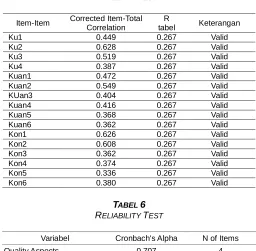
evaluation monitoring, and the amount of fees that have been determined and the organization of drinking water management organizations in the village. However, this is not actively managed, some managers make improvements if there is only evaluation or mentoring from the center. Basically, Institution has a very important role for the sustainability of clean water infrastructure. With the independence of management in the provision of clean water in the community will be able to overcome other factors that affect sustainability in the implementation of the PAMSIMAS III program. The management performance system evaluation for the PAMSIMAS III program seen from the transparency of management is considered quite good. Public perception of management transparency is considered to be non-transparent (36%), sufficiently non-transparent (27%), non-transparent (20%), very transparent (8%). For the majority of people, transparency in the management of mandatory outputs is very necessary, given that this is in the common interest. This could be in line with the large number of people not making payments because transparency from managers is considered to be less transparent. This should be a re-evaluation for the managers of the PAMSIMAS III Program all forms of expenditure or income must be well coordinated and transparent to the community. Performance evaluation of the implementation of the PAMSIMAS III program is seen from the change or innovation category that is not good. Community perception of Innovation needed in the Pamsimas III Program is considered to be small (42%), many (30.9%), quite innovating (22.74%). So far the innovations in the Pamsimas III Program are very few or almost no periodic innovations. Innovation that is needed by the community is to increase the distribution of clean water, especially if during the dry season at least with the innovation the lack of water in the dry season can be overcome. In addition, the most important thing is innovation for water purification, especially if it is in the dry or rainy season. Then the community hopes for an organized institutional administrative service and can facilitate the public for complaints and problems. Basically, institutional continuity has an important role as coordination between the community and the village, regional and central government. Institution in the management of the PAMSIMAS III Program as a management so that the need for clean water for the community can be maintained and well managed. Overall, the community assessment of the performance of the implementation of the PAMSIMAS III program in terms of institutional continuity is considered quite good. As for the concern is the awareness of the community primarily to orderly pay clean water contributions to the manager. This is because these costs can be used as allocation for maintenance of water reservoirs, cleanliness, maintenance of pipes in the event of damage or leakage, etc. In addition to the management to re-do the realignment to be active again in the manager of the program. Coordination of budget allocations in and out is more transparent so that the public is aware of the allocation of funds. The condition might be due to the inactive management coordination so that there is no community coordinating to carry out contribution obligations. In addition, the hope of the community for innovative innovations is that the need for clean water is increasing. Especially during the dry season, people's expectations with innovations in water shortages can be overcome. Based on table the total correlated item values are obtained to see the valid or invalid question items. Each question item is said to be valid if the
calculated r value is greater than the value of r table (0.267). From the table above, we get the entire value of the question items that have the calculated r value greater than the value of the r table. Therefore the question items of each variable on the questionnaire that were declared valid were as many as 16 items, so it can be concluded the question items on the respondents' perception questionnaire were 100% worthy of being used for further research.
TABEL 5 VALIDITY TEST
Item-Item Corrected Item-Total Correlation
R
tabel Keterangan
Ku1 0.449 0.267 Valid
Ku2 0.628 0.267 Valid
Ku3 0.519 0.267 Valid
Ku4 0.387 0.267 Valid
Kuan1 0.472 0.267 Valid
Kuan2 0.549 0.267 Valid
KUan3 0.404 0.267 Valid
Kuan4 0.416 0.267 Valid
Kuan5 0.368 0.267 Valid
Kuan6 0.362 0.267 Valid
Kon1 0.626 0.267 Valid
Kon2 0.608 0.267 Valid
Kon3 0.362 0.267 Valid
Kon4 0.374 0.267 Valid
Kon5 0.336 0.267 Valid
Kon6 0.380 0.267 Valid
TABEL 6 RELIABILITY TEST
Variabel Cronbach's Alpha N of Items
Quality Aspects 0.707 4
Quantity Aspects 0.688 6
Continuity Aspects 0.711 6
Based on the tables, each variable the value of Cronbach’s alpha. The above results also show that the value of Cronbach's alphabet is greater than the minimum reliable limit of 0.6, so it can be concluded that each item of statement that is valid on each variable can be said to be reliable or reliable for further research.
4.
CONCLUSSIONS
animals in water is considered quite a lot, especially in the rainy season. Quantity aspects are assessed from the availability of water throughout the time ie morning, afternoon, afternoon, night, dry season, and rainy season. Based on the results of the level of performance achievement seen the quantity aspect is considered very good. The availability of water in certain conditions differ from the quantity obtained, especially for the morning quantity of water availability is sufficient because in the morning the highest community activity so that the need is increasing. The condition is different if during the day when there is a lot of water available considering the majority of the community is only a necessity for bathing and even then only a few, because activities on the side of the water is very rarely done. Usually the availability of water at night is more because there is no activity of using water at night by the community. In the dry season, the availability of water is insufficient for the needs of the community because almost all villages in Mesuji Regency are vulnerable to clean water during the dry season. Unlike when it is the rainy season the availability of water is very abundant so that it is able to meet the needs of the local community. The aspect of institutional continuity is assessed from management, transparency and innovation. Based on the results of the level of performance achievement seen continuity aspects are considered quite good. Continuity in community participation in making payments is considered low, where many people do not want to make payments. This is in line with the management of contributions by managers who are considered not transparent, so that the public does not know enough about the bureaucracy about the expenditure or income from the contribution of the community for the management of the PAMSIMAS III program. Basically the costs that must be paid by the community are considered to be relatively very low or few, so that in terms of the ability of the community the community is actually considered capable. This is parallel to the fairly active management of institutions where management does not work properly, which tends to be overlooked. The manager will be active if there will be an evaluation and monitoring of satisfaction. In addition, the community's expected innovation is considered sufficient, but the community's expectation for more novas is carried out mainly about water purification.
5
REFERENCES
[1]. R. Andini, M. Ulimaz, & S. Sulistijono. Evaluasi Kinerja Penyediaan Air Bersih di Kelurahan Baru Ulu, Kecamatan Balikpapan Barat, Kota Balikpapan. Journal of Regional and Rural Development Planning, Vol. 1 No. 3, pp.307-316, 2017.
[2]. P. Apriyana. Kinerja Pelayanan Air Bersih Komunal di Wilayah Pengembangan Ujung Berung Kota Bandung’, Jurnal Perencanaan Wilayah dan Kota.
Journal of Regional and City Planning, Vol.21 No.2, pp. 95-110, 2010.
[3]. R.Y. Rottie. Pengembangan SistemPenyediaan Air Besih di Desa SeaKecamatan Pineleng KabupatenMinahasa”. Jurnal Sipil Statik, Vol. 3 No. 9, pp. 662-668, 2015.
[4]. B. Chatib. Penyediaan dan Teknologi Pengelohan Air Minum. Makalah disajikan pada kursus penyegaran teknologi dan pengelolaan lingkungan, 2001.
[5]. E. Bisung, S. J. Elliott, C. J. Schuster-Wallace, D. M. Karanja, & A, Bernard, Social capital, collective action
and access to water in rural Kenya. Social science & medicine, No. 119, pp.147-154, 2014.
[6]. A. Nugroho, & M. Maryono. Peluang Keberlanjutan Program Penyediaan Air Minum Berbasis Komunitas
(PAMSIMAS) di Kabupaten Kendal. Jurnal
Pembangunan Wilayah & Kota, Vol.12 No.2, pp.140-153, 2016.
[7]. Yuliani, Y., Mardwi, R,. (2015). Kinerja Pelayanan Air Bersih Berbasis Masyarakat Di Kelurahan Tugurejo Kota Semarang. Jurnal Pengembangan Kota, Vol.3 No. 1, pp. 11-25.
[8]. M. Astuti, M. Rahdriawan. Evaluasi Pengelolaan Program Pamsimas di Lingkungan Permukiman Kecamatan Mijen, Semarang.Jurnal Teknik PWK Vol. 2 No. 4, 2013.
[9]. Arikunto, S. (2010).Prosedur Penelitian Suatu Pendekatan Praktik.
[10].J. W. Creswell. Research Design. Pendekatan Kualitatif, Kuantitatif dan Mixed. (S. Z. Qudsi, Ed.) (Ketiga). Yogyakarta: Pustaka Pelajar Thrakele, Maheshkumar, 2014. Expiremental Study on Foam Concrete, International Journal of Civil, Structural, Environmental and Infrastructure Engineering Research and Development, 2010.
[11].S. Azwar. Reliabilitas dan Validitas. Yogyakarta: Pustaka Pelajar, 2014.
[12].Ghozali. Aplikasi Analisis Multivariate Dengan Program SPSS. Semarang: Badan Penerbit Universitas Diponegoro, 2011.
[13].A.M.H.R. Lagu, A. Munawir, M. Fakhrul. Gambaran Penyediaan Air BersihPdam Kota Makassar Tahun 2015”, Al-Sihah : Public Health Science Journal, Vol. 8 No. 2, pp. 171-179, 2016.
[14].U. Sekaran, & R. Bougie. Research Methods For Business SixthEdition, Jakarta : Salemba Empat, 2014.
[15].E. P. Widoyoko. Teknik Penyusunan Instrumen Penelitian. Yogyakarta: Pustaka Pelajar, 2015.
[16].Sugiyono. Metode Penelitian Pendidikan Pendekatan Kuantitatif, Kualitatif dan R&D. Bandung: Alfabeta, 2015.
[17].L. J. Moleong. Metode Penelitian Kualitatif. Edisi Revisi. Bandung : PT. Remaja Rosdakarya, 2013. [18].Omarova, Alua.,Tussupova, Kamshat., Hjorth, Peder.,
Kalishev, Marat., Dosmagambetova, Raushan. (2019). Water Supply Challenges in Rural Areas: A Case Study from Central Kazakhstan. International Journal of Environmental Research and Public Health. 2019, 16, 688
[19].Patrickvv, Molly., Steenland, Maria., Dismer, Amber., Louis, Jocelyne P.,Murphy, Jennifer L., Kahler,Amy., Mull, Bonnie., Ether, Melissa D., Rossignol, Emmanuel., Boncy, Jacques Boncy., Hill, Vincent., Handzel, Thomas. (2017). Assessment of Drinking Water Sold from Private Sector Kiosks in Post-Earthquake Port-au-Prince, Haiti. The American Society of Tropical Medicine and Hygiene. Am. J. Trop. Med. Hyg., 97(Suppl 4), 2017, pp. 84–91 [20].Sekaran, Uma & Bougie, Roger. (2014). Research
Methods For Business SixthEdition, Jakarta : Salemba Empat.
3499