Recent experiments on three nucleon systems and problems to be solved
Kenshi Sagara1,a
Department of Physics, Kyushu University, Fukuoka, 812-8581, JAPAN
Abstract. After 2π3NF was found in 1998, many experiments were made on Nd elastic scattering, Nd breakup and pd capture, and many discrepancies between experiments and calculations were revealed. Systematic exper-imental data are still being accumulated. From the systematic data, 3NF other than 2π3NF such asπρ3NF and
ρρ3NF, and origins of low-energy anomalies are expected to be found in the future.
1 Introduction
One of the purposes to study three-nucleon (3N) systems is to find effects of three-nucleon forces (3NF) and to deter-mine their strengths. As is well known, Fujita-Miyazawa predicted existence of 2π-exchange three nucleon force (2π3NF) in 1957[1]. Faddeev equations for 3N systems have been numerically solved since late 1960’s. In 1980’s, it became widely known that 3H binding energy cannot be reproduced by 2NF alone and can be reproduced using 2π3NF with an adjustable parameter. To justify the value of the parameter, further evidences were necessary.
From systematic measurement of pd elastic scatter-ing cross section in energy range of Ep = 2 - 18 MeV at Kyushu University tandem laboratory (KUTL), system-atic discrepancy between experiment and calculation in the cross section minima around 110◦ was found in 1994[2].
The discrepancy was, however, paid no attention because Coulomb force was not correctly treated in pd calculations at that time. In 1996, pd scattering cross section was mea-sured at Ed =270 MeV (Ep =135 MeV) to construct a
d-beam polarimeter at RIKEN. Koike found by chance the
same discrepancy at the cross section minimum also at 135 MeV, and he introduced the discrepancy as Sagara discrep-ancy in FB15 in 1997[3]. In 1998, Witała et al., excellently solved the binding energy problem and Sagara discrepancy by introducing the same 2π3NF[4].
After 2π3NF was discovered, many theoretical studies and experiments on 3NF have been made. The experimen-tal studies have been widely made at higher energy region on Nd elastic scattering, and also made on pd breakup and
pd capture.
In pd elastic scattering, many kinds of spin observ-ables, such as analyzing powers of Ay, iT11, Ayy, Axx and
Axz, and polarization transfer coefficients have been sured. Also cross section of pd elastic scattering was mea-sured at various energies. In pd breakup, cross section and
Ay have been measured. Our experiment on pd breakup
at Ep=247 MeV is presented in this conference[5]. In pd
a e-mail:[email protected]
capture, tensor analyzing powers Ayy, Azzand also Axxhave been measured in the last decade at Ed=100 - 200 MeV.
All the experimental observables at higher energy dis-agree more or less with calculations even after 2π3NF be-ing included. The disagreements seem, at least in part, to be caused by 3NF other than 2π3NF. We report the dis-agreements in some detail later.
At low energy region, there are long-standing problems of Aypuzzle and Space Star anomaly (SS anomaly), which
seem to be irrelevant to 3NF. Now, we have sufficient data for Aypuzzle. Experimentalists are just waiting for
theoret-ical investigations. As for SS anomaly, which is a discrep-ancy between experiment and calculation in Nd breakup cross section around 10 MeV, there were a few experiments in 20th century, because there were no reliable calculations on pd breakup and SS anomaly was studied only in nd breakup. Experiments on pd breakup are far more precise and far easier than nd breakup experiments. Experimen-talists desired for a long time for pd breakup calculations. During the time, for example, combination of nd breakup Faddeev calcualtion and Watson-Migdal pp FSI formula was tried to approximate pd breakup calculation, and ex-perimental data were fairly well reproduced.
A breakthrough was made by A. Deltuva et al. in 2005[6]. They succeeded in calculations of all kinds of
pd reactions including pd breakup using fast-damping
screened Coulomb force. After the success of pd breakup calculation, we started to measure pd breakup cross section systematically, to search for origin(s) of the star anomaly.
Figure 1 illustrates discrepancies in 3N systems. We have already solved discrepancies in 3N binding energy and in pd scattering cross section minimum by 2π3NF. There are still many disagreements remaining at higher en-ergy as well as at lower enen-ergy. Some of the disagreements may indicate effects of 3NF other than 2π3NF.
DOI:10.1051/epjconf/20100305002
p dCS d iscrep an cy 1 9 9 4-1 9 9 6-1 9 9 7 ( S a g a r a d i s c r e p a n c y )
3N BE p ro blem 1 9 8 0 s
3 N F ( F M) w a s f o u n d
1 9 9 8
p d b reaku p d iscrep an cy
p d cap tu re Ajj an omaly
3 N F ? 3 N F ? r e l a t i v i t y ?
Sp ace Star an omaly 1 9 8 9
-- h ig her en erg y d iscrep an cies --p d scatt.
d iscrep an cy
-- lo wer en erg y d iscrep an cies --Off -p lan e Sar an omaly
QF S an omaly
? ? ? FM -3 NF
1 9 5 7 Fa dde e v
e qs . 1 9 6 0
Ay p uzzle 1 9 8 6
Ay p uzzle ? ? ?
Fig. 1. Discrepancies between experiments and calculations in
3N systems, in higher energy region and in lower energy region.
2 Experiments on
pd
elastic scattering at
higher energy
After 2π3NF was discovered, many experiments were made on pd elastic scattering and 2π3NF effects were ex-amined. As so many groups measured pd and nd elastic scattering, we Kyushu group did not measure it, instead, measured pd breakup and pd capture.
Below Ep = 200 MeV, the cross section minimum of elastic scattering was well reproduced by introducing 2π3NF. Above 140 MeV, it was found that the scatter-ing cross section at backward angle becomes larger than calculation, and the disagreement increases monotonically with energy. Experimental values are about twice of cal-culated values at 250 MeV[7]. This systematic disagree-ment seems to indicate effects of short-range 3NF other than 2π3NF and/or relativistic effects.
Many kinds of polarization observables of pd scat-tering have been measured. They were found to disagree with calculations. Disagreements in polarization observ-ables are complicated and are not so large as that of the cross section (for example see [8]). Besides systematic fea-ture like cross section enhancement has not been found in disagreements of polarization observables.
It may be better to investigate first the systematic dis-agreement in the cross section of elastic scattering, and to study other disagreements after the problems in the cross section are completely solved. Cross section is a basic scalar quantity, and modification of cross section influ-ences more or less polarization observables.
3 Experiments on
pd
breakup at higher
energy
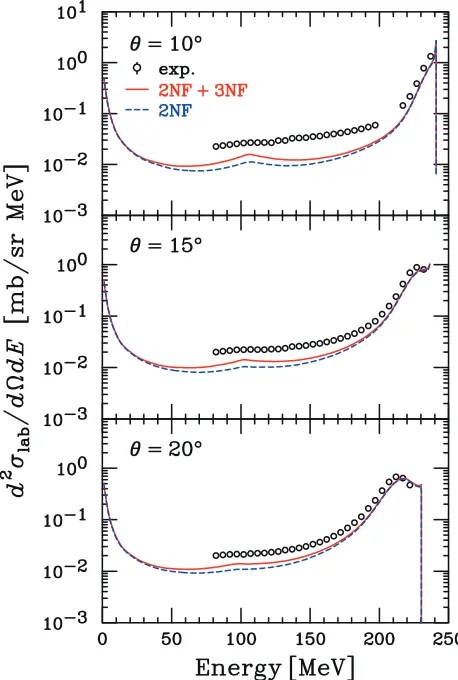
After 2π3NF was discovered, we started pd breakup ex-periment at Ep=247 MeV at RCNP. To see global feature, we first made D(p,p1)p2n experiment by detecting only one proton p1 out of three outgoing nucleons. To signif-icantly reduce backgrounds from the target, we used an al-most pure liquid D2target instead of an ordinary CD2 tar-get. We had developed the liquid hydrogen target for our
pd capture experiment described below.
Experimental results for D(p,p1)p2n cross section at 247 MeV are shown in Figure 2 with calculations by
Fig. 2. Cross section of D(p,p1)p2n at Ep=247 MeV. Solid and
dashed curves are Faddeev calculations with and without 2π3NF, respectively, by Witała.
Witała. Measured cross section is larger than calculation. The disagreement increases at forward angle. Effects of 2π3NF are not enough to explain the experiment. We mea-sured also Ayin the same experiment, but we first
investi-gate cross section disagreement.
The disagreement is of similar magnitude with the dis-agreement in pd scattering cross section at background at the same energy described above. It may be natural to think that the same origin enhances both cross sections of pd elastic scattering and of pd breakup reaction.
In order to see microscopically the enhancement of cross section in pd breakup, we recently measured D(p,p1p2)n cross section at Ep =247 MeV by detecting two protons in coincidence. We focused to investigate mi-croscopically enhancement of D(p,p1)p2n cross section at
θ1 =15◦and E1 being around 150 MeV. Another proton
p2was detected atθ2=35◦, 50◦, 65◦and 80◦on the oppo-site side of the beam axis, as reported in this conference by Kuroita[5]. In the same experiment, D(p,p1)p2n cross sec-tion was also measured again, and our previous data were completely confirmed.
Fig. 3. D(p, p1p2)n cross section induced by 24 MeV p-beam,
detected atθ1=15◦and E1=150 MeV.
where cross section is large. On the contrary, cross section enhancement is small at backwardθ2 where cross section is small. Whenθ1 and E1are fixed, the remaining pair of
p2and n has fixed total momentum, p2+pn, and absolute value of relative momentum|p2− pn|is also fixed. Atθ1 =15◦andθ
2=35◦, the three outgoing nucleons approxi-mately form a line, i.e., satisfy the collinear condition.
Above information may be useful to guess the origin of the cross section enhancement. Experimental data at more forward angle may be also useful. To measure at forward angles we need new counters, because the present two big counters cannot come to each other closer than 48◦ ( =
15◦+33◦).
4 Experiments on
pd
capture at higher
energy
By p+d →3He+γreaction, pd scattering state comes to 3He ground state. Momentum transfer is large. It is
inter-esting to search for effects of short-range 3NF in this high-momentum transfer reaction. Cross section of pd capture is, however, very small as below 1µbarn. Hence we used a liquid hydrogen target and detected3He recoils simulta-neously in a wide angular range from 20◦ to 160◦ in c.m.
system.
A polarized d-beam of energy of 196 MeV from RCNP cyclotron was used in our first experiment. The beam po-larization axis was in the vertical direction, and recoiled 3He detection was made in the horizontal plane to measure
Ayand Ayy, and in the vertical plane to measure Axx. Mea-sured Axxand Ayytook roughly the same negative values,
Axx ≈ Ayy, and Ayy roughly agreed with calculation, but
Axxremarkably disagreed with calculation.
Next we measured Axx and Ayy of pd capture at Ed =137 MeV. Preliminary data indicated again the relation of Axx ≈Ayy and remarkable disagreement in Axx. Since
pd capture cross section is small and identification of true
events was disturbed by overwhelming background events, data analysis took time.
Fig. 4. “Azz” of pd capture. Our previous data for −Axx−Ayy
(=Azz), our new data for -Axx-Ayyand those for Azz(±45◦) at Ed=
196 MeV, together with calculations at 200 MeV by Golak. KVI data for Azz(±45◦) at Ed=180 MeV are also shown.
Meanwhile, Ayyand Azzof pd capture at Ed=180 MeV and 133 MeV were measured at KVI. Their data agreed with calculations. They used a vertically polarized d-beam and a liquid hydrogen target, and detected3He andγray in coincidence. Ayy was measured by detectingγ-rays in
the horizontal plane. Azzwas measured by detectingγ-rays in two planes inclined by±45◦from the horizontal plane,
and assuming the relation Axx+Ayy+Azz = 0. KVI Ayy
data roughly agree with our data, but Azzdata are about 1.5 times smaller in magnitude than ours.
Finally, a confirming measurement was made at RCNP on Axx, Ayyand Azzof pd capture at Ed =196 MeV. The
d-beam was polarized in the vertical direction,3He recoils were detected in the vertical plane for Axx, in the horizon-tal plane for Ayy, and in two planes inclined by±45◦from
the horizontal plane for Azzin a way similar to KVI’s. Data-analysis method was improved so as to increase3He detec-tion efficiency, and both new data and previous data were analyzed by the new method.
Our previous data and new data essentially agree to each other, and indicate the relation Axx ≈ Ayy and large
discrepancy in Axx (also in Azz). Figure 4 shows various “Azz” data; -Axx-Ayy in our previous experiment at 196
MeV, -Axx-Ayy in our new experiment at 196 MeV, and
Azz(±45◦) in our new experiment at 196 MeV, together
with Azz(±45◦) in KVI experiment at 180 MeV. Curves are calculations at 200 MeV with and without 2π3NF by Go-lak. Although our “Azz” data are scattered to some extent, there is a large discrepancy between our “Azz” data and cal-culations.
In our data Axx≈Ayyrelation holds, but calculated Axx and Ayyare significantly different to each other, therefore a
large discrepancy in Axx(also in Azz) results. The relation
Axx ≈Ayymeans the symmetry of pd capture with respect
verti-cal (yz) plane and in the horizontal (xz) plane are expected
to proceed differently in general. Therefore it is natural to expect Axx,Ayyalso in the present case.
In many other d-induced reactions, a relation Axx ≈
−Ayyholds approximately. A deuteron has a prolate shape.
If a d-beam is vertically polarized and d-induced reactions take place in peripheral region of target nuclei, the reac-tions may be enhanced in vertical plane and suppressed in horizontal plane, or oppositely suppressed and enhanced.
The relation Axx ≈ Ayy in pd capture is curious. It is
interesting to investigate the origin(s) of this relation, in-cluding to estimate effects from short-range 3NF.
5 Experiments on
pd
star anomaly at low
energy
Discrepancies at higher energy have candidates for their origin(s), e.g., short-range 3NF, relativity, high-angular momentum reactions. On the contrary, discrepancies at lower energy have not apparent candidates for their ori-gin(s).
Ay puzzle is well known for a long time. We have
already enough data sets for Ay puzzle and no
system-atic measurements on Aypuzzle have been made recently.
Many theoretical attempts such as modifications of 2NF and introduction of LS dependent 3NF have been exam-ined, but Aypuzzle has not been solved yet.
Another big problem at low energy is Space-Star anomaly. SS anomaly was found first in nd breakup at En= 13 MeV and 10.5 MeV [11], and was confirmed at 13 MeV by another experiment [12]. Experiments of pd breakup at SS configuration were also made, and SS anomaly in pd breakup was first found when a reliable pd calculation was made [6].
At 13 MeV, nd breakup cross section at SS configura-tion is about 25% higher than calculaconfigura-tion, and pd breakup cross section at SS is about 15% lower than calculation. So far no theoretical suggestions have been made for SS anomaly and its large charge asymmetry.
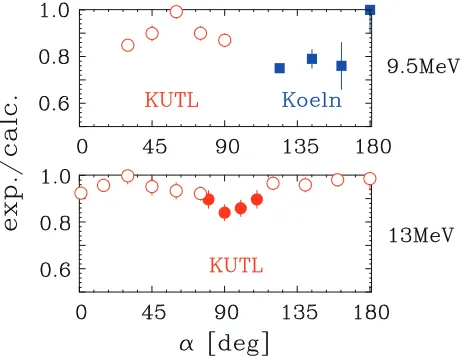
Because a reliable calculation on pd breakup has be-come available since 2005 [6], we have been making a systematic measurement of pd star cross section at Ep = 13 MeV and 9.5 MeV. At Koeln University, measurement of pd star cross section at Ed=19 MeV (Ep =9.5 MeV) was made[13].
When three outgoing nucleons from Nd breakup have the same energy and form an equilateral triangle, we call the configuration as Star. When the Star triangle is perpen-dicular to the beam axis, we call the configuration as Space Star. An angle between Star plane and the beam axis in c.m. frame is called asα, as defined in Fig. 5. We usually detect two protons from pd breakup at symmetrical angles with respect to the beam axis, and we defineα=0◦when
a p-beam is used and two detected protons are at forward angles in the horizontal plane. See Figure 5.
To see characteristics of Star anomaly,α-dependence of pd Star anomaly has been measured recently by Koeln group[13] and Kyushu group. Star configuration at α=0◦
p
n p
p
d
p
p
n
α
Fig. 5. Definition of an inclination angleαfor Star configuration.
Fig. 6. Recent results forα-dependence of pd Star anomaly at Ep =9.5 MeV (Ed=19 MeV) and at Ep=13 MeV (Ed=26 MeV).
is close to QFS configuration, and possible anomaly at QFS is also being investigated at Kyushu. Y. Maeda and Y. Eguchi report on these subjects in this conference.
As seen in Figure 6, star anomaly at 13 MeV is con-fined at around 90◦. The plane perpendicular to the beam
axis is special. Only in the perpendicular plane, pd breakup reaction is suppressed. It seems to be enough to think of curious suppression in the perpendicular plane.
At 9.5 MeV, however, remarkable Star anomaly ap-pears also at backward angles, as indicated by Koeln ex-periment at Ed =19 MeV. Complex consideration may be necessary to explain the wide-range Star anomaly.
Before thinking of origins of pd Star anomaly, it is bet-ter to make a confirming experiment at Ed =19 MeV. A polarized d-beam was used in Koeln experiment, but an unpolarized d-beam will be used in the confirming experi-ment to measure cross section alone.
Our strategy is (a) confirmation of pd Star anomaly by additional experiments, (b) investigation of origin(s) of pd Star anomaly, then (c) elucidation of nd Star anomaly. So far large charge asymmetry between nd SS anomaly and
pd SS anomaly has been reported. The large charge
to make. So we will not investigate nd Star anomaly till pd Star anomaly is completely elucidated.
6 Experiments on
pd
QFS at low energy
Cross section enhancement of 16-18% was reported in nd QFS at En=25 MeV and 26 MeV. Also cross section sup-pression in pd QFS was reported at Ep=10.5 MeV and 19 MeV.
We are making systematic measurement of pd QFS cross section at KUTL, and no apparent pd QFS anomaly has been found at both 9.5 MeV and 13 MeV. We will mea-sure pd QFS cross section at 10.5 MeV and 19 MeV to see if pd QFS anomaly exists or not.
7 Summary
Studies of 3N systems are summarized and illustrated in Figure 1. We are on the way to search for short-range 3NF at higher energy in pd scattering, pd breakup and pd cap-ture, and to investigate origins of Star anomaly as well as of
Aypuzzle at low energy. Experimental studies have made
steady progress. At low energy, success of reliable pd cal-culation enabled systematic studies of pd Star anomaly.
Challenging 3N calculations aiming to solve remaining problems in 3N reactions are expected.
Acknowledgement
The author thanks collaborators of many experiments in
pd capture, pd breakup and pd Star. The collaborators
are from Kyushu University, RCNP Osaka University, RIKEN, CNS University of Tokyo and Tohoku University at the time of experiment. The author also appreciate col-laboration of theorists, H. Kamada, H. Witała, J. Golak and A. Deltuva for their calculations and discussions. Owing to their efforts, we have made great progress in investigation of problems in 3N reactions in the last decade. The next decade will be fruitful.
References
1. J. Fujita and H. Miyazawa, Prog. Theor. Phys. 17, (1957) 360.
2. K. Sagara et al., Phys. Rev. C50, (1994) 576.
3. Y. Koike and S. Ishikawa, Nucl. Phys. A631, (1998) 683c.
4. H. Witała et al., Phys. Rev. Lett. 81, (1998) 1183. 5. S. Kuroita, Proceedings of FB19 (2010).
6. A. Deltuva et al., Phys. Rev. C72, (2005) 054004. 7. K. Hatanaka et al., Phys. Rev. C66, (2002) 044002. 8. K. Sekiguchi et al., Phys. Rev. C65, (2002) 034003 . 9. H. Witała, private communication.