Licensed under Creative Common Page 558
http://ijecm.co.uk/
ISSN 2348 0386
THE KNOWLEDGE CREATING PROCESS IN MEME EVOLUTION
Fu Xinshuang
The School of Management, Shanghai University, China [email protected]
Abstract
The current study firstly reviews the concepts of culture and meme, their knowledge nature, and
the natural selection theory and communal exchange frame of culture evolution. Next, it
integrates the principles about the relationship between practice and knowledge in on practice,
the principles of universality and particularity of contradiction in on contradiction from Mao
Tse-Tung, and the unified model of dynamic knowledge creation from Nonaka, Toyama and Konno.
Based on the deductions, it analyses the knowledge creation related to the meme evolution
across the Renaissance, the Enlightenment and the following bourgeois revolution. After
examining the contexts, processes and results of social interaction, and the input, evolving
processes and their outcomes of knowledge during the movements, it finds that it was
contradictions in practice that triggered the knowledge creating process in meme evolution, and
that differentiation of a contradiction brought about successive embedding of new SECI
processes, and the outcomes of the processes presented solutions for the contradictions. Thus
an atlas of meme evolution like a tree was formulated. At last, it gives some suggestions for
culture innovation in practice and some propositions for research in the future.
Keywords: meme; evolution; knowledge creation process; renaissance; enlightenment
INTRODUCTION
The history of the revolution and construction of China was undoubtedly a process in which the governmental system greatly changed guided by the advanced culture and lead to the modernisation of China. But at the same time, there were still some old ideas and behavior partly hidden and partly visible affecting the operation of new social system, preventing the new social pattern from coming into play, such as feudal privilege consciousness, sectarianism etc.
Licensed under Creative Common Page 559 environment for development, it can not develop through aggression like the Western powers in last several centuries. Its comprehensive revival needs the support of advanced culture, that means that it must exert superiority of its traditions while getting rid of the burden of its history, absorb foreign advanced culture while discarding the dross. So it is necessary to implement comprehensive cultural innovation, especially in the process of building an innovative country.
Besides, global or regional integration is inevitable for every nation today . Mutual collision and combination of different cultures has become an necessary trend. So understanding the general law of cultural evolution is an unavoidable task for different nations to implement the construction or innovation of culture.
As to the theoretical study of cultural evolution, scholars have explained the evolution of human culture by natural selection or communal exchange mechanism, since Dawkins proposed the concept of "cultural gene" or "meme" , but they still can not explain the innovation process .
Combining the model of knowledge creation process from Nonaka Fujiro et al. with the relevant principles in on practice and on contradiction from Mao Tse-Tung, the current study analyses the knowledge creation process of cultural evolution from the Renaissance to the bourgeois revolution, explores the drive, process and model for the evolution, and puts forward propositions for further theoretical research, also provides references for cultural construction and innovation practice.
THE CONCEPTS OF CULTURE AND CULTURAL GENE
The concept of culture. After reviewing 100 kinds of definitions of culture, America cultural anthropologist A.L. Kroeber and K.Hong Clark(1992) gave a widely accepted comprehensive definition of culture: culture exists in all kinds of implicit or explicit modes.It can be learned and communicated through symbols to form special achievements of human groups; the basic elements of culture are ideas and values deriving or chose from the traditions , among which values are the most important.
Licensed under Creative Common Page 560 entities to achieve the relations; 5) material products: the nature transformed by human being and everything created by the people, they are the tangible parts of culture.
According to the association among the elements, language and symbols are only tools of communication; spiritual elements are cognitive or theoretical basis; standard system is behavior criterion from the cognition of people for social relations ; social organisations and material products are tangible manifestation of culture. The spirit elements are the core.
After reviewing the interaction between cultural sociology and cognitive psychology, P. Dimaggio (1997) thought that treating schema as the basic unit of cultural analysis was very useful. Schema was a kind of knowledge structure that represented objects or events and provided assumptions about their characteristics, relationships, and entailments under conditions of incomplete information; at the same time it was both representations of knowledge and information-processing mechanism.
The concept of cultural gene. This word “cultural gene” is derived from the book - The Selfish Gene written by famous British scientist Dawkins(1989). He believed that cultural gene or meme was the basic unit of cultural transmission or imitation. Tune, concept, speaking, fashion, way making a pot or building an Arcade, were all memes. This concept had initiative, but it only mentioned some specific representations. It couldn‟t differentiate the internal genetic
information from its external manifestations.
Integrating the descriptions above, this paper gives a definition about the cultural gene as follows: the cultural gene is a schema that a specific group enjoys. It is basic ideas that can be absorbed and internalized in the process of communication. It decides the external expressions of the cultural gene, such as behavior norms, social organisations, or corresponding material products.
According to the philosophical definition of knowledge: "As to the content of knowledge, knowledge is reflection of the attributes and links of objective things. It is subjective images of the objective world in the brain" (Dong, 1985), the cultural gene is essentially a kind of knowledge; and the culture is a system of knowledge: the spirit culture is a collection of different schemata. it affects the specific forms of the standard system, the corresponding social relations or social organisations and material products.
EVOLUTION OF CULTURE: NATURAL SELECTION Vs. COMMUNAL EXCHANGE
Licensed under Creative Common Page 561 natural selection theory of Darwin in meme evolution. They thought culture spread out through imitation and produced random variations which were chose at the population level under the environmental pressure of scarce resource , and then formed the overall evolution of culture. However, the theory of natural selection brought many deficiencies for cultural evolution: unable to explain how cultural evolution inherited acquired characteristics; Culture didn‟t randomly
generate variations as many as in the biological world, but limited amendments for the existing knowledge structure through human intelligence activities, such as intuition, strategic thinking, and the interaction with the outside world under environmental drive; Ignorant of the internal autopoietic structure of culture (small world network);unable to explain human creative activities and observed abundancy of culture (Gabora,2008) etc.
So Gabora (2008) put forward a kind of cultural evolution framework: communal exchange. He thought what enabled complex, cumulative, open-ended culture to evolve was onset of the capacity for recursive recall, in which one thought evoked another and so forth in a chain of associations. This enabled humans to respond to dissonance, frustration, or misunderstanding by considering from different perspectives and adapting ideas to new contexts, thereby reducing entropy and re-establishing conceptual closure. In other words, the „hub‟ of cultural evolution should be a cognitive structure that generated transmittable novelty
through this kind of self-mending process. Communal exchange theory further predicted that newly discovered or artificially created life forms should be able to evolve culture if they possessed cognitive structure that (as a result of the capacity for self-mending) generated transmittable novelty.
The communal exchange theory thought that the core of cultural evolution is the change of schemata. Comparing the concept of cultural gene, we can find cultural evolution is processes of forming new cultural genes, and the chain of association is the new cultural gene chain; Also the process of cultural evolution is successive processes of knowledge creation, and this process is realized through interaction with the environment and adjustment of cognitive structure. This interaction needs to be elaborated especially for the formation of collective new cognitive structure in a nation: how is communal exchange implemented? How do these new ideas appear? What drives the formation of the association chain? How do these new ideas affect related aspects of social life? etc.
THE BASIC MODEL OF KNOWLEDGE CREATING PROCESS
Licensed under Creative Common Page 562 (i) The SECI (namely, socialisation, externalisation, combination and internalisation) process involves the process of knowledge conversion from tacit to explicit knowledge. The first term, socialisation, deals with the conversion of new tacit knowledge through shared experiences. In this process, skills, mental models, mutual trust and world views can be created and shared. Externalisation refers to the articulation of tacit knowledge into explicit knowledge. Externalisation involves the sequential use of metaphor, analogy and a model. Combination refers to the conversion of explicit knowledge into more complex and systematic units and may also involve the `breakdown' of concepts. Internalisation refers to the process whereby explicit knowledge is incorporated into an individual‟s tacit knowledge and becomes a part of the individual‟s repertoire of shared mental models or technical expertise. The movement through
the four modes of knowledge conversion can be depicted in the form of a spiral which becomes larger in scale as it moves up through the ontological levels.
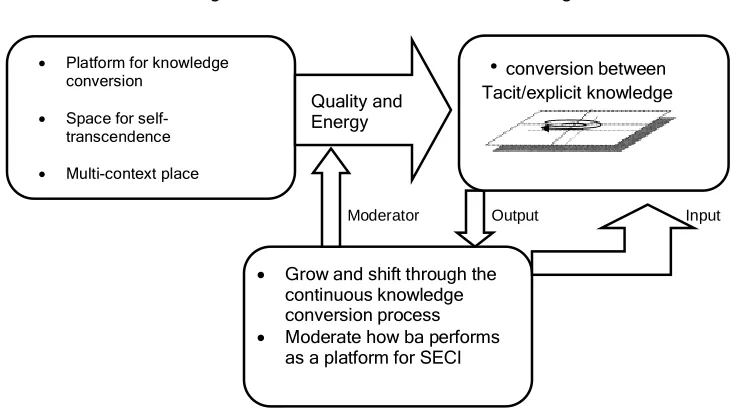
(ii) Ba is defined as a shared context in which knowledge is shared, created and utilised. Ba provides the energy, quality and location for individuals to perform the knowledge conversions and to move along the knowledge spiral. Ba is a concept that unifies physical space such as an office space, virtual space such as the internet, and mental space such as shared ideals. There are four types of ba(namely, originating ba, dialoguing ba, systemising ba and exercising ba which correspond to the four modes of knowledge conversion.
(iii) Knowledge assets are the inputs, outputs and moderating factors of the knowledge-creating process. Knowledge assets can be categorised into four types: experiential knowledge assets, conceptual knowledge assets, systemic knowledge assets and routine knowledge assets. All the three elements of the model are illustrated as follows in Figure 1.
Figure 1. Three elements of the knowledge-creating process Ba: Context-Knowledge Place SECI: Knowledge Conversion Process
Moderator Output
output
Moderator Output Input Platform for knowledge
conversion
Space for self-transcendence
Multi-context place
Grow and shift through the
continuous knowledge conversion process
Moderate how ba performs
as a platform for SECI Quality and Energy
·
conversion betweenTacit/explicit knowledge
Licensed under Creative Common Page 563 In summary, using its existing knowledge assets, an organisation creates new knowledge through the SECI process that takes place in ba. The knowledge created through this process subsequently becomes a part of the knowledge assets of the organisation, which in turn become the basis for a new spiral of knowledge creation.
RELEVANT CONCLUSIONS IN "ON PRACTICE" AND "ON CONTRADICTION"
In “on practice”, Mao Tse-Tung put forward: “Practice, knowledge, again practice, and again knowledge. This form repeats itself in endless cycles, and with each cycle the content of practice and knowledge rises to a higher level. Such is the whole of the dialectical-materialist theory of knowledge, and such is the dialectical-materialist theory of the unity of knowing and doing.”
Practice is the source, drive and end of knowledge. Practice includes production practice, scientific practice, political life etc.. Knowledge consists of perceptual knowledge and rational knowledge . Perceptual knowledge, is of feelings and impressions about phenomenon of things, separate aspects and external relations of things; Rational knowledge is of concepts, judgments and inferences about the totality, essences, internal relations of the things. Rational knowledge depends upon perceptual knowledge and perceptual knowledge remains to be developed into rational knowledge, they are unified in the practice process; at the same time the results of rational knowledge also need to go back to practice, to guide practice and to be tested and improved in practice. The paper also stressed that the movement of the objective world will never end, people‟s knowing the truth in practice will never be over (Mao,1966a).
In "On Contradiction", Mao Tse-Tung expounded the law of contradiction proposed by Lenin combining with the practice of the Chinese revolution. Everything has its internal contradiction causing its movement and development. For the development of things, internal factors are basic reasons, and external factors are conditions, which work through the internal factors. Contradictions are present in the processes of development of all things; they permeate the process of development of each thing from beginning to end. This is the universality and absoluteness of contradiction.
The contradictions in each form of motion of matter, in each process in the long course of development of each form of motion of matter, or in different stages in each process, and the different aspects of a contradiction, all have their particularities. This is the particularity and relativity of contradiction (Mao,1966b), etc.
Licensed under Creative Common Page 564 the contradictions. In fact, the knowledge creation process from Nonaka Fujiro et al. contains the cognitive process from perceptual knowledge to rational knowledge. In the stages of socialisation and externalisation, people mainly exchange perceptual knowledge, and begin to transform them into rational knowledge such as concepts; In combination stage, people combine different rational knowledge together; Internalisation is of actual application of the system of rational knowledge, which symbolizes the process "from knowledge to practice" .
As a solution to a contradiction, the new schema can become a new cultural gene; and developing contradictions can be the drive which bring new cultural gene chain. The new gene chain, namely the interconnected new cultural genes,is just the cognitive basis for human beings to transform the realistic world. These deductions need to be verified by the historical facts.
Next we have a look at the knowledge creating process in typical cultural evolution .The Renaissance and the Enlightenment laid the ideological and cultural foundation for the European countries to evolve into modern ones from the Middle Ages. And they became the sources of contemporary capitalist civilisation. It is undoubtedly significant to explore the knowledge creating process related to the cultural gene evolution within them.
PROCESSES OF KNOWLEDGE CREATION IN THE RENAISSANCE, THE ENLIGHTENMENT AND THE BOURGEOIS REVOLUTION
The Renaissance and its Knowledge Creating process
Licensed under Creative Common Page 565 After the city politically stood on its own, it also had leadership and control over culture. Culture and education monopolized by the church before, was then shared and managed by the secular people, mainly citizens. So, public literacy classes and elementary school sponsored by the city, and private schools sponsored by secular teachers began to appeared. The rate of literacy substantially increased in children, clerks, technicians, workers, apprentices; Some practical subjects, such as arithmetic, abacus, contract documents, business accounting etc. were also widespread; Accordingly, the teaching contents were mainly no longer of theology, and began to emphasise grammar and rhetoric in some public or private universities . Rhetoric could not only meet the needs of political and economic activities in the city, but also became the shortcut people learned classical works, since the model texts were all from ancient Greece and Rome‟s works.
In 1348, the government of city decided to set up the Florence University, expecting increasing greatly fame and wealth by University and scientific research . In late fourteenth Century, Florence University began to employ cultural celebrities as professors, also invited Byzantine scholars to teach Greek and classical philosophy, establishing a new system of higher education.
It was in this kind of contexts that Latin‟s farsightedness, Dante‟s masterpieces, Giotto‟s art, Weilanni‟s history, and Pytlak‟s humanism and Bio's novels in late fourteenth Century, came
into play.
By fifteenth Century, humanism in Florence comprehensively rose up. The primary manifestation was the fever to study classical culture and to finish back the works of ancient Greece and Rome. Some leaders of humanism, such as Tati Liu, Bruni, Bula Chulini, Mannetti, Pytlak and Bio, visited many ancient monasteries in Switzerland, France and Germany, and found many ancient works and caused a sensation; After Constantinople fell to Turkey, many Greek scholars in exile in Italy also brought many precious manuscripts. In addition to the academic community, the whole society was also eager to learn classical works. Private libraries of large scale and folk public libraries were established; the boarding school and quality education planning appeared, and women‟s education was also advocated .Various art
workshops, art can flourished, where Da Finch was born.
Licensed under Creative Common Page 566 spirit within them. The spirit was combined with the rational ideas of anti superstition of humanism. Coupled with the new requirements of the economic development for science and technology, scientific thinking and the view of seeking truth from facts became a part of people‟s world view. For example, found Ptolemy's "Geography" writings immediately caused a sensation. As to democratic thoughts, "the song of Florence" wrote by Bruni was actually praising the citizen politics, and the ideas of freedom, democracy and equality in it; Influenced by this paper, many papers holding the ideal of citizen politics were published, supporting the defense struggle of the Republic of Florence, and forming the political theory (Liu, Zhu& Li, 2010) climax of praising citizen politics.
Based on the results of the Florence Renaissance, the ideas of Renaissance spread and spread throughout Italy and many European countries, such as Germany, France, England, Spain, the Netherlands and other countries , producing many new achievements and impacting profoundly the social life. In the art of painting, a group of outstanding realistic art masters, such as Leonardo Da Finch, Michelangelo, Rafael, Titian, came into play in Italy. So did Mannerist painter Greco in Spanish, portrait masters Rembrandt in Netherland; In natural sciences, the modern revolution of science and technology took place. Based on the technological achievements from Arabia, China and Byzantine, and on the traditional scientific achievements from Aristotle, Platon, Euclid et al. ,mathematics, physics, astronomy, geography, geology, biology, medicine, architecture, etc. gained considerable development; Technologically, new mechanical clock and gear was developed; Military technology and navigation technology also achieved fruitful results. These achievements were directly related to the actual needs of the society, such as astronomy, geography, and navigation technology, to meet the needs of ocean exploration; medicine to cure the Black Death in Europe etc.. In the late Renaissance, establishment of new scientific methodology and experimental methods, opened up a broad road for creation of scientific and technological achievements; The humanities also began to develop in branch . Philosophy, history, literature, politics, economics, linguistics and so on, achieved fruitful results. Take "On Prince" from Machiavelli for example. Based on the realistic need to establish a unified state in Italy, it specifically analysed the specific issues in social practice, and separated the political behavior from ethical behavior, and made politics become an independent political knowledge, implementing Da Finch‟s principle "Experience Is the
Mother of the Truth", denial of the divine right of kings. There were other important achievements, such as German utopian socialism and Spinoza's theory of the state and so on (Liu, Zhu& Li,2010).
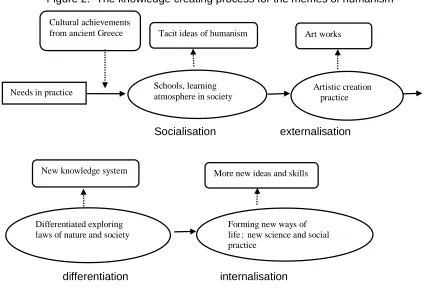
Licensed under Creative Common Page 567 in last section , we can analyse the knowledge creating process in the Renaissance (see figure 2) as follows:
Figure 2. The knowledge creating process for the memes of humanism
Socialisation externalisation
differentiation internalisation
In the face of capitalist economic development practice, people in Florence needed to explore the relationship between man and god, and the one between people and the objective world. Then all kinds of new schools and the free atmosphere to explore new knowledge(to chase classical culture) in the city republic of Florence, acted as original Ba and dialogue Ba. At the same time, external knowledge - the achievements of ancient Greek culture input, thus the basic idea of humanism, namely respect for humanity, was born which meant a new meme - the new recognition about the relationship between man and god. Externalisation of the new cultural gene was also triggered, which meant various artistic creation practice. All kinds of works of literature and art were outcomes of the externalisation. At the same time or subsequently this idea spread in parallel to the different areas: nature sciences to explore the relations between man and nature, such as astronomy, physics, physiology, psychology, architecture; social sciences to explore the relations among people, such as politics, forming the corresponding knowledge system and corresponding science and social practice. The spreading process was actually one that a universal contradiction was decomposed into a
Schools, learning atmosphere in society
Artistic creation practice
Differentiated exploring laws of nature and society
Forming new ways of life;new science and social practice
Needs in practice
Cultural achievements
from ancient Greece Tacit ideas of humanism Art works
Licensed under Creative Common Page 568 number of particular contradictions to explore the solutions. For example, the contradiction between man and nature was decomposed into contradictions between man and earth, between man and other objects in earth, among the different parts of the body of a person and so on; It was just in the process to explore the particular solutions that new SECI conversion process was opened up, and corresponding disciplines formed in natural science , such as astronomy, physics, physiology, etc. This was different from the model from Nonaka Ikujiro et al. The new science practice and social practice in different areas, and the new way of life, reflected internalisation of humanist ideas in society.
We can notice a wide range of new social organisations and corresponding standard system didn‟t formed in the process yet. The task was finished through the Enlightenment and
the bourgeois revolutions in the late.
The Enlightenment, the Bourgeois Revolutions and their Knowledge Creating Process
As the achievements of natural science accumulated as well as social and economic life further developed, political science further evolved into the enlightening movement in the 18th century : not only requiring reformation, but also denying religions by deism and materialistic ; Not only giving abstract aesthetic expressions of the new ideas , but also emphasising on economic and political demands in the social reality. Based on human's ration, the hierarchy of feudal society and folly of the church were criticised, new values were advocated such as equality, freedom, democracy and the rule of law. After absorbing both scientific and technological achievements, experiencing the real life of the masses, and investing into the reality at home and abroad, a batch of representative figures analysed each side and the whole structure of an ideal system of state. Scientists such as the philosopher John Locke and Newton in Britain, Montesquieu, Voltaire, Diderot and Rousseau in France, the philosopher spinoza in Dutch, Kant in German, etc., successively analysed people's sovereignty, state‟ features, the
scope of government responsibilities and powers, the necessity and content of the rule of law, the status of a constitution. Then they designed state systems and their operating mechanism safeguarding the rights of the individual countries, such as separation of powers (Gu,2013a). This was a progressive process from to explore each side of a state system to implement the systematic design. Obviously, the system, as a kind of coordinating knowledge, was the inevitable outcome when the economic, social life developed into a certain stage when the individual rights needed to be fully safeguard.
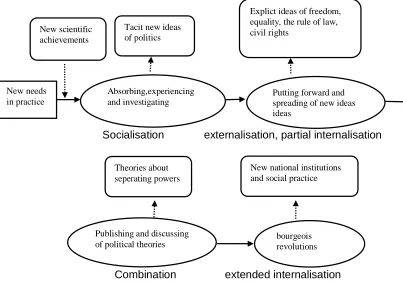
Licensed under Creative Common Page 569 Thoughts of the Enlightenment spread into main capitalist countries, such as France, the United States, Germany, Britain, Italy, Russia, Canada and so on. Its core ideas in the 19th century further influenced Japan in Asia, making Japan successfully transform into the only country to get rid of the colonial fate in Asia. But the process for every country to establish constitutional government system of capitalism, the specific contents of its constitutional system and the operating mode, each had its own national characteristics. The new system was crystallisation of ideas of the Enlightenment combined with its own cultural tradition, and also an outcome of the continuous struggle and compromise among various social forces within the nation , and it was constantly improved along with the development of the reality. Germany, for example, experienced a dual monarchy, the weimar republic, fascist dictatorship, two divided different democracy after the second world war and unity after the adjustment of the new system; Britain successively implemented modern parliamentary system, a constitutional monarchy, the normal system, cabinet, etc.; After a lot of turmoil, France opened up the semi-presidential system combining the features of presidential system with that of cabinet system(Gu,2013b,2013c), and so on. This was a process to form the new social organisations and the new system, further affecting people's ideas and behavior habits, also promoting the development of capitalist material civilization. The knowledge creating process can be seen in figure 3.
Figure 3. The knowledge creating process for the Enlightenment and the establishment of capitalist political systems
Socialisation externalisation, partial internalisation
Combination extended internalisation New needs
in practice
Absorbing,experiencing and investigating New scientific
achievements
Tacit new ideas of politics
Putting forward and spreading of new ideas ideas
Explict ideas of freedom, equality, the rule of law, civil rights
bourgeois revolutions Publishing and discussing
of political theories Theories about seperating powers
Licensed under Creative Common Page 570 The particular social environments of different countries facilitated socialisation, externalisation, combination and internalisation. For example, the basis of economic development and relatively free cultural atmosphere facilitated the formation of all kinds of political ideas, communication and systematic combination; The realisation of the system design , namely internalisation, was a process in which the various social forces participated the game to reach an equilibrium . The partial internalisation meant publishment and issue of some books of political theories partly changed people's ideas and behavior.
The "communal exchange" in practice was just embodied in socialisation, externalisation, combination and internalisation; the course in which the enlightenment expanded into different countries, was just the one in which the knowledge creation spiral crossed national borders.
THE ATLAS OF MEME EVOLUTION
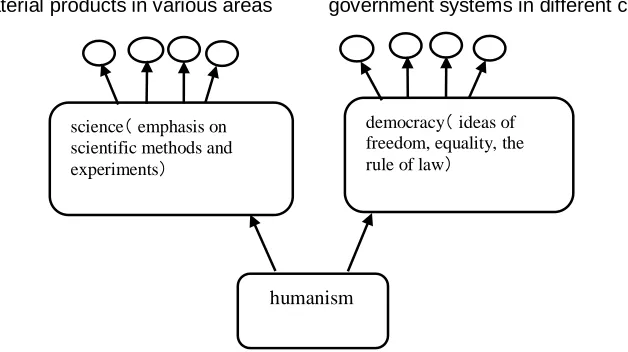
The processes of knowledge creation solved related contradictions in practice, brought new cultural genes (memes). For example, the solution of the contradiction between man and god brought the cultural gene of humanism, namely the idea respecting human nature. Thereafter the contradiction between man and the objective world was a necessary new one. It was decomposed into the contradiction between human and nature and the one within human society. After decomposition the knowledge creating process in various areas created new cultural genes, such as emphasis on scientific methods and experiments throughout all disciplines of natural science, the ideas of freedom, equality, the rule of law, people‟s sovereignty etc. in western political science. In this way, the creation and evolution of the different cultural genes, gradually formed an atlas like a tree shown in figure 4 below.
Figure 4. The basic atlas of meme evolution starting from the Renaissance
Material products in various areas government systems in different countries
democracy(ideas of freedom, equality, the rule of law)
science(emphasis on scientific methods and experiments)
Licensed under Creative Common Page 571 At the atlas, the new cultural genes came from outcomes of knowledge creating processes. Of course, not all new knowledge could become new cultural genes. Only widespread, inherited ideas in the long run could do. The reason why the cultural genes could exist so long was that they were still the solutions for existing contradictions in reality. And when new contradictions appeared in social life, it was inevitable for new culture genes to come into play. This was just “the idea chain” from the cability recursive recall mentioned by Gabora. In various areas, cultural
genes evolved with the development of practice. the corresponding material products and government systems also emerged. Thus new civilisation formed, such as the capitalist civilisation.
CONCLUSIONS AND DISCUSSION
Based principles on the relationship between practice and knowledge, the universality and particularity of contradiction as well as the general model of knowledge creation process, this paper explores the knowledge creating process in the Renaissance, the Enlightenment and the bourgeois revolutions Here are several propositions: 1) the knowledge creation of cultural evolution also conforms to the model of knowledge creation process proposed by Nonaka et al.But the forms are somewhat different; 2) It is new contradictions in new practice that trigger new knowledge creation processes, thus to form new cultural genes; 3) Differentiation of the contradictions in practice makes new SECI processes embedded in succession and form an atlas of new cultural genes like a tree.
Based on these propositions, some empirical studies can be further conducted as follows: 1) the knowledge-creating processes of some evolving memes in different civilisations: specific forms of the three elements, the roles of specific contradictions etc. 2) The atlases of cultural genes in different civilisations. In the course of globalisation, collision and blending of different cultures is inevitable. So the achievements of the empirical studies are going to be significant.
Additionally, the exploration for historical events only followed some basic threads in this paper. In fact, involved elements and their interrelatedness may be much more complex, such as the basic ideas in social sciences and their links, the links among different fields of natural science, and so on. So the exploration can be further deepened.
The implications for practice of cultural innovation lie in:
Licensed under Creative Common Page 572 2) Constructing original Ba and dialogue Ba is especially significant. Communicating among practitioners in new practice, drawing lessons from external knowledge, theoretical exploration and summary of the new practice, etc., all depend on the establishment of original Ba and dialogue Ba to fulfill socialisation and externalisation of new knowledge in new cultural genes. It is important to note: though the contemporary IT network facilitates communication and dialogue, but it is still not enough for communication and spread of tacit knowledge ;
3) As to internalisation of new cultural genes, sometimes the ideas can subtly spread by examples in practice. More attention should be paid to the institutional design and relevant education measures to realize implantation of the new cultural genes; and the design usually has distinctive national and regional characteristics.
4) The organic connection among related cultural genes must be paid close attention. Sometimes the change of the related memes is prerequisite for a specific meme to evolve, since the internal contradictions are related.
ACKNOWLEDGEMENT
Author is grateful for the support of the development fund of science and technology from the Shanghai Committee of Science and Technology and the support of the postgraduates‟ innovation fund in Shanghai University.
REFERENCES
Dawkins,R.(1989). The Selfish Gene[M].New York:Oxford University Press Inc.
Dimaggio, P. (1997). Culture And Cognition[J]. Annual Review of Sociology, 23, 263-287
Dong, C.(1985). Encyclopaedia of China·Education[Z].Beijing:Encyclopaedia of China Publishing House.
The Editorial committee of sociology in the general Editorial committee of Encyclopedia of China. (1992). Encyclopaedia of China·Sociology[Z].Beijing:Encyclopaedia of China Publishing House.
Gabora, L. (2008). The Cultural Evolution of Socially Situated Cognition[J].Cognitive Systems Research, (9), 104–114.
Gabora, L. (2013). An Evolutionary Framework for Cultural Change: Selectionism Versus Communal Exchange[J].Physics of Life Reviews,(10),117-145.
Gu,L. (2013a). Western Constitutional History( vol.3): Medieval Christianity, the Renaissance, religious reformation and Enlightenment[M]. Beijing: People's Publishing House.
Gu,L. (2013b). Western Constitutional History (vol.4): Italy, France, Germany and the United Kingdom [M]. Beijing: People's Publishing House.
Gu,L. (2013c). Western Constitutional History ( vol.5): Russia, America, Canada [M]. Beijing: People's Publishing House.
Licensed under Creative Common Page 573 Mao,T . (1966a). On Practice[C].Selected Works of Mao Tse-Tung(vol.1). Beijing:People's Publishing House.
Mao,T . (1966b).On Contradiction[C]. Selected Works of Mao Tse-Tung(vol.1). Beijing: People's Publishing House.