www.nonlin-processes-geophys.net/17/663/2010/ doi:10.5194/npg-17-663-2010
© Author(s) 2010. CC Attribution 3.0 License.
Nonlinear Processes
in Geophysics
Heavy ion acceleration at parallel shocks
V. L. Galinsky and V. I. Shevchenko
Electrical and Computer Engineering Department, University of California, San Diego, La Jolla, CA, USA
Received: 28 June 2010 – Revised: 13 September 2010 – Accepted: 11 November 2010 – Published: 22 November 2010
Abstract. A study of alpha particle acceleration at parallel shock due to an interaction with Alfv´en waves self-consistently excited in both upstream and downstream regions was conducted using a scale-separation model (Galinsky and Shevchenko, 2000, 2007). The model uses conservation laws and resonance conditions to find where waves will be generated or damped and hence where particles will be pitch-angle scattered. It considers the total distribution function (for the bulk plasma and high energy tail), so no standard assumptions (e.g. seed populations, or some ad-hoc escape rate of accelerated particles) are required. The heavy ion scattering on hydromagnetic turbulence generated by both protons and ions themselves is considered. The contribution of alpha particles to turbulence generation is important because of their relatively large mass-loading parameterPα=nαmα/npmp (mp, np and mα, nα
are proton and alpha particle mass and density) that defines efficiency of wave excitation. The energy spectra of alpha particles are found and compared with those obtained in test particle approximation.
1 Introduction
An explanation of the main characteristics of accelerated particles in astrophysical plasmas became possible due to an idea of diffusive shock acceleration (DSA) at quasi-parallel shocks (Krymsky, 1977; Axford et al., 1977; Bell, 1978a, b; Blandford and Ostriker, 1978). The DSA mechanism was first developed for astrophysical shocks following the suggestion that charged particles are accelerated through first order Fermi acceleration by clouds of Alfv´en waves excited on both sides of the shock wave. Soon after Lee (1983),
Correspondence to: V. L. Galinsky
following the work of Skilling (1975) and Bell (1978a, b), developed the quasi-linear model that describes self-consistently the ion acceleration and the wave excitation at interplanetary shocks. Lee (1983) (see also Gordon et al., 1999) assumed, that some seed population of protons is injected at the shock front into the upstream plasma and developed a mechanism to investigate the dynamics of only this population due to interaction with waves. As a result of the cyclotron instability (Sagdeev and Shafranov, 1961), Alfv´en waves are excited and scatter some particles to the downstream region creating the conditions for the first order Fermi mechanism. The main assumption in this approach, similarly to (Skilling, 1975; Bell, 1978a, b), is the near isotropicity of the distribution function. This assumption can be justified only if the time scale of particle pitch angle scattering due to cyclotron interaction is the shortest time scale of all physically relevant processes. Then the pitch-angle averaged distribution function can be found as a solution of the so-called convection-diffusion equation with right-hand side describing the ion source term (see e.g. Eq. 2.1 in Malkov and Drury, 2001). To relate this solution to observations, the flux density of the seed particles in the source term should be obtained from either direct or indirect shock measurements.
In spite of successful explanation by DSA-based analytical and numerical models (Lee, 1983; Jokipi, 1987; Gordon et al., 1999; Zank et al., 2000; Li et al., 2003, 2005; Giacolone and Kota, 2006) of many important features of the acceleration process, for example power spectra of accelerated particles, dependence of accelerated particles on the distance from the shock front and many others, there are important questions that remain open for a long time.
Drury (1983) and by Jones and Ellison (1991) and references therein). It was also shown by Malkov & V¨olk (1995) that the wave fields required for proton acceleration can be excited by a beam of the downstream tail protons injected into the upstream region. This mechanism cannot be incorporated in the macroscopic acceleration picture based on the theoretical models derived from DSA approach. The DSA-based theoretical models do not follow the dynamics of thermal plasma and hence they cannot describe the process of proton acceleration from the thermal plasma.
Another important problem is that the DSA models do not include the back reaction of the accelerated particles on the shock wave that can limit the process of acceleration (although some models were able to limit extent of acceleration by introducing wave damping; V¨olk et al., 1988). And again, this shortcoming is connected with limitations of DSA approach that evaluates only the dynamics of the high energetic tail of particle distribution. Detailed discussions of DSA-based models can be found in reviews (see e.g. Drury, 1983; Jones and Ellison, 1991; Malkov and Drury, 2001) and references therein).
Recently, a new theoretical approach and numerical model of proton acceleration at quasi-parallel shocks based on energy balance between waves and resonant particles has been proposed in Galinsky and Shevchenko (2007) (we will hereafter refer to this paper as “Paper 1”). This model automatically includes both the thermal plasma injection scenario and modification of the shock structure due to the reaction of the accelerated particles. Similarly to DSA-based models (Krymsky, 1977; Axford et al., 1977; Bell, 1978a, b; Blanford and Ostriker, 1978), the new model is one-dimensional where waves propagate parallel or anti-parallel to the magnetic field. A quasi-linear approach was used in Paper 1 for description of wave-particle interaction, similarly to the analytical consideration by Lee (1982) and Gordon et al. (1999), and the resonant wave-particle interactions were assumed to be the fastest processes in the particle acceleration problem.
However, in Paper 1, in contrast to Lee (1982), Gordon et al. (1999), plasma protons were not divided into two classes of resonant protons and thermal plasma. The evolution of the entire gyro-phase averaged proton distribution function was analyzed. Stability of the velocity distribution in the total interval of possible parallel velocities vk was investigated for each distance from the shock front at each time step. Using a quasi-linear approach, the energy exchange between particles and waves for each interval of resonant parallel velocities1vkwas analyzed to find a new velocity distribution function at the interval1vk as well as the corresponding wave power spectrum. As a result, the dynamics of the entire particle distribution and the wave power spectrum was studied as function of time and distance from the shock front. Paper 1 demonstrated for the first time how the problem of particle acceleration from the thermal distribution can be included in a natural way in
a macroscopic model of shock acceleration. The model constructed in Paper 1 takes into account the pressure of accelerated particles that can decelerate the upstream flow of the solar wind and modify the shock wave structure.
Using this model, Paper 1 studies proton acceleration in the case of a shock wave propagating parallel to the ambient magnetic field. These results showed agreement with diffusive shock acceleration (DSA) models in prediction of power spectra for accelerated particles in upstream region. However, this study has also revealed the presence of a spectral break in the high-energy part of the particle spectra. It was also found that in the downstream region close to the shock front, strong diffusion over perpendicular energy takes place for particles with small absolute values of parallel velocity vk in the shock reference frame. These particles were quite likely to cross the shock interface multiple times and interact with Alfv´en waves at cyclotron resonance conditions that are different for waves in upstream and downstream regions. As a result, particle were not only pitch angle scattered but energized as well, mainly in a perpendicular direction.
One of the most interesting problems in the shock acceleration is the problem of heavy ion acceleration. Up to now this problem was considered using a test particle approximation assuming that the waves needed for ion acceleration are excited by protons and that the wave excitation by heavy ions is not sufficient, and therefore, neglected. Using a test particle approach, various DSA models were able to explain results of observations of the abundance of various heavy ions in heliosphere with reasonable success. In brief, the analysis showed a consistent dependence of heavy ion abundances on A/Z (the atomic weight to charge ratio). The only deviation from thisA/Z ordering has been found in alpha particle behavior and in the behavior of protons themselves (Meyer, 1985; Mason, 1987). Attempts to explain this deviation by DSA models required artificially high injection rates in order for the results to be at least qualitatively consistent with observations (Tylka et al., 1999; Ng et al., 1999). We would like to note that the efficiency of the wave excitation in the solar wind is defined by the so-called mass loading parameterPα=nαmα/npmp
(see Eq. 17) that has a reasonably high value in the case of alpha particles. So it is important to understand how much a self-consistent approach to heavy ion acceleration can change the efficiency of ion acceleration.
In this paper we will study alpha particle acceleration at a shock wave that propagates parallel to the interplanetary magnetic field.
2 Equations and algorithm of numerical solution
We assume that initially the shock front atz=z0divides
the upstream and downstream plasmas with Maxwellian distributions with parameters that satisfy Rankine-Hugoniot boundary conditions (see e.g. Jones and Ellison, 1991): "
u· ˆn (
γ γ−1P+
1 2ρu
2+B2
4π )
− B · ˆn
(B·u) 4π
#up
d
=0
h
ρu u· ˆn +
P+B2/8πn−ˆ B· ˆn
B/4πiup
d
=0 (1)
B· ˆnup
d =0
ˆ
n×(u×B)up d =0
Here ρ, u, andP are the zero, first and second moments of the proton distribution function, nˆ is a unit vector in the direction of the shock normal (negative z-direction), [f (z)]up
d is the difference between initial upstream (up) and
downstream (d) values off (z)at the wave front. We would like to note that we need boundary conditions only at the time t=0. Similarly to Paper 1, we solve the spatial-temporal problem of plasma-wave dynamics by considering the upstream and downstream plasmas as one plasma with inhomogeneous parameters.
As in Lee (1983), Gordon et al. (1990 and in Paper 1, we do not use any external forces and rely only on resonant wave-particle interaction self-consistently included in the model to excite Alfv´en waves and accelerate particles. We introduce the wave action
W↔(t,z,ωk)= |Bk↔| 2/8π ω
k
which describes the wave packets propagating parallel (→) and anti-parallel (←) to the external magnetic field in a medium with varying parameters that are calculated from moments of the particle distribution function. |Bk|2 is the
spectral density of the wave magnetic field. The resonance conditions for interaction with such waves have the form
ωk−k v||∓ωc=0 (2)
Hereωkandkare the frequency and wave number of Alfv´en
waves, ωc is the proton cyclotron frequency. The∓signs
in Eq. (2) describe interactions with waves at normal and anomalous Doppler resonances correspondingly.
Cyclotron resonant interaction leads to pitch angle scattering of particles, so resonant protons interacting at both possible resonances (2) with each broadband packet W↔(t,z,ωk) diffuse along the pitch angle diffusion lines
(Vedenov et al., 1962; Rowlands et al., 1966; Kennel and Engelman, 1966)
w↔=v2⊥+vk−vph↔2=const (3) wherevph→=vAandvph←= −vA.
As a result of resonance interaction, a shell-like distribu-tion of protonsf=f (w)is formed in the interval of resonant velocitiesvz.
As was discussed above, we will study the dynamics of the wave excitation and particle acceleration relying on the thermal plasma as a source of so called seed population that excites waves needed for particle acceleration. Thus, similarly to Paper 1, we will analyze stability of the entire gyro-phase averaged proton distribution function. By averaging the proton kinetic equation over times larger than the characteristic period of oscillations we obtain in quasi-linear approximation the equation for so-called background distribution function of protonsf (t,z,v||,v⊥):
∂f ∂t +vk
∂f
∂z=QLf(f,W →,W←
) (4a)
Equations for wave actions in quasi-linear approximation have the form:
∂ W↔ ∂t +
∂ ∂z
vgz↔W↔=QL↔W(f,W↔) (5a) Here vgz↔ is z-component of the group velocity for waves propagating in parallel and anti-parallel directions.
Right-hand-side terms in Eqs. (4)–(5) are quasi-linear operators that have the following form in plasma reference frame:
QLf =
2π e2 m2
pc2
· X ∓ ˆ L "
v2⊥
ωkWk→
vk−∂ω/∂k ˆ Lf # v
k=vA(∓ωc+ω)/ω
+ ˆL "
v2⊥ ωkW ←
k
v||+∂ω/∂k ˆ Lf #
vk=−vA(∓ωc+ω)/ω
(4b)
QL↔W = v↔ph
vA
π2 n0
ω2c ωk
Wk↔ Z
v⊥3Lf d v⊥ˆ
vk=v↔ph(∓ωc+ω)/ω
(5b)
ˆ
Lψ = ∂ψ ∂vk+
ωk−k||v||
v⊥k|| ∂ψ
∂v⊥
The sum in Eq. (4b) takes into account interactions at normal and anomalous Doppler resonances. Thus, the quasi-linear term in the right-hand side of Eqs. (4a) and (4b) takes into account all four possible interactions with MHD waves propagating in both directions along the magnetic field.
stretches in both directions from the shock front. The size L of the region is chosen to be much larger than the characteristic scale of quasi-linear relaxation. We divide the region L into small intervals with locations
zi,i=1,2,3,...Nz (6)
and will solve Eqs. (4)–(5) at each interval for each time step. To do this, we introduce the wave spectrum with a wide band of possible wave numbers
ki,i=0,1,...Nk (7)
to assure that resonant cyclotron interaction samples all possible intervals of resonant velocities vk on the proton distribution function.
Similarly to Paper 1, scale-separation techniques will be used to numerically solve Eqs. (4)–(5) by assuming that characteristic temporal and spatial scales of pitch-angle diffusion (microscopic scales) are smaller than the time step and size of each spatial interval (macroscopic scales). That means that steady state of the plasma-wave system is developed at each time step at any distance from the shock front. The steady state at some interval of resonant velocities is achieved in two cases: (i) when the pitch-angle averaged distribution function is formed Lfˆ =0 or (ii) when the resonant waves are totally absorbedWk=0 at a considered
interval of resonant velocities. Thus, at the end of each time step, the right-hand-side terms in Eqs. (4)–(5) are equal to zero.
For the purpose of calculating the input from the resonant particles to the waves and vice-versa, we divide the entire region of all possible parallel and perpendicular velocities into small intervals with grid locations
vki,i=1,2,3,...Nvk (8)
v⊥i ,i=1,2,3,...Nv⊥ (9)
To calculate energy transfer from waves to resonant particles and vice-versa, we need to find the free energy available in the particle distribution for each resonant velocity interval. The amount of free energy available in n-th interval of resonant velocities vk∈ [vkn−δvk,vnk+δvk] is defined by a difference between the energy contained in the current particle distribution function (PDF) and the energy contained in the pitch-angle scattered PDF both taken over the resonance interval. We find the pitch-angle average function at each time step using conservation of the proton number along diffusion lines (3) (see Paper 1):
hf t,z,vk,v⊥i↔
= Z
S↔
n
f t,z,w↔,α−α0dα0 ,
Z
S↔
n
dα0 (10)
where theξ coordinate is directed along lines w↔= const andSn↔is then-th interval of resonant velocities for waves
propagating parallel (→) or anti-parallel (←) to the external magnetic fieldvk∈ [vkn−δvk,vkn+δvk].
The amount of particle free energy for each resonance region is obtained as a variation of the proton kinetic energy in final and initial states in a frame of reference where the bulk of the plasma is at rest:
1Fm↔(t,z)= mp 2
Z
S±m h
f t,z,vk,v⊥i↔−f t,z,vk,v⊥
n
v2⊥+vk−u(t,z)2odv (11) whereu(t,z)is a bulk plasma velocity.
We calculate a balance of energy between waves and particles for each resonance interval as
1E↔n (t,z)=X
k∈{n}
E↔(t,z,ωk)−1Fn↔ (12)
Here1En↔(t,z)is change of the wave energy density in n-th resonance region;{n}represents all harmonics belonging to the n-th resonant interval that can be found from the resonance condition (2). The first term in the right-hand side of Eq. (12) is the total wave energy density inn-th resonance region at previous time step with the quantityE↔(t,z,ωk)
defined by
E↔(t,z,ωk)= −Wk↔
∂D ∂ωk
ωk2
k2c2 (13)
D (ωk,k)=k2c2+ω2pp
ωk
ωk−ωcp
+ω2pe ωk ωk+ωce
(14a)
E↔(t,z,ωk) is the sum of potential and kinetic energy
densities of the wave with frequencyωkthat is defined from
equation
D (ωk,k)=0 (14b)
In our case the potential and kinetic wave energy densities are equal each other andE↔(t,z,ωk)= |Bk↔|24π.
The numeric solution algorithm can be described as the following procedures:
1. It accordance with assumption that the steady state of the plasma-wave system is developed at each time step at any distance from the shock front, we update the distribution function as well as the wave spectrum at the beginning of each time step by integrating Eqs. (4)–(5) with zero right-hand sides. We obtain the new distribution function at every z×vk×v⊥ grid location by using flux conservation and assuming one dimensional streaming of plasma in force-free environment. The waves are updated for every zi by
using conservation of their action in streaming medium with locally varying parameters.
2. The new distribution function is used to find the proton density, temperature as well as the local rest frame of reference for everyzi. Using these parameters we
calculate the pitch angle diffusion lines (3).
3. By using Eq. (11), we obtain the pitch angle scattered distribution function in every resonant region vk∈hvkn−δvk,vkn+δvki.
4. After that, using Eq. (11), we check if the energy of particles with updated distribution function is larger or smaller in comparison with that of particles with pitch angle scattered distribution function in the same resonant interval, that is if the distribution function is unstable or stable with respect to wave generation in the current resonance interval.
(a) If it is unstable, we use the pitch angle scattered particle distribution function as a new one for the current resonance interval. We assign the available energy to the waves in this interval by using Eq. (12) and proceed to next resonant interval. (b) If the particle distribution function is stable but
waves are present in the current resonant region, the waves will interact with the particles and transfer some or all of their energy. The new particle distribution function and the new wave level in the resonant region are found by using the same Eqs. (10)–(12).
5. Since the levels of the newly found PDF can be different in adjacent resonant intervals this locally stable PDF does not yet represent the global wave-particle equilibrium state. In order to find this global state we use aggregation procedure, that is we combine adjacent resonant intervals where the PDF has been pitch-angle scattered and use (10) to find the common pitch-angle scattered PDF. We then repeat the entire procedure (4– 5) iteratively until we arrive to the (quasi)-stationary partitioning of energy between waves and particles.
In the case when initially there are waves in the plasma, we should first perform procedure 4.2 by using Eqs. (10)–(12) and proceed after that with solution of equations at the first time step using the numerical solution algorithm described above.
3 Acceleration of protons and heavy ions
To show that both protons and heavy ions are accelerated from thermal core and that the waves needed for their acceleration are excited due to cyclotron instability (Sagdeev and Shafranov, 1961), we assume that initially there is no any seed population and no waves in the system.
As was discussed before, we integrate the system of Eqs. (4)–(5) for the case of a parallel shock. We work in the shock front reference frame and initially assume that the upstream and downstream plasmas are Maxwellian with temperatures that are related by Rankine-Hugoniot boundary conditions (1). The dimensionless equations that are employed to update the distribution function and the wave spectrum at the beginning of each time step (procedure 1 in the algorithm) have the form:
∂fi
∂t +vk ∂fi
∂z =QLfi( fi,W
→,W←) (i=p,α) (15) ∂ W↔
∂t + ∂ ∂z
vgz↔W↔=QL↔W fp,fα,W↔
(16) Together with Eq. (4) for a proton distribution function we now use a similar Eq. (15) for the second plasma component as well.
And the energy balance Eq. (12) can be written as 1B˜n↔2(t,z)= ˜Bn↔2(t,z)
−πβup Z
S↔
n
hfp t,z,vk,v⊥i↔−fp t,z,vk,v⊥
n
v⊥2+vk−up(t,z) 2o
v⊥dv⊥dvk
−Pαπβup Z
S↔
n
hfα t,z,vk,v⊥i↔−fα t,z,vk,v⊥
n v⊥2+
vk−uα(t,z)2 o
v⊥dv⊥dvk (17)
Here βup=v2Tup/vAup2 , vTup, vAup are initial values of
the gas kinetic to magnetic pressure ratio, the proton thermal velocity and Alfv´en speed in the upstream region correspondingly andPα=nαmα/npmp is the mass-loading
parameter. 1B˜↔2
n in the Eq. (17) represents the change
It should be noted that the heavy ions are not treated here as test particles, hence, the right hand side of the Eq. (5) for wave action was modified as well to include the input of the ions in wave generation and damping.
It should be mentioned that we use simple dispersionless form of pitch angle diffusion lines (3) for the sake of clarity. As the entire gyrophase averaged PDFs for both components are updated by Eqs. (15)–(17) it is rather straightforward to calculate self-consistently local thermal dispersive corrections to wave phase speed v↔ph. The pitch-angle scattered distribution function will be more complicated than simple spherical shell in this case, but one should not expect substantial changes in the acceleration process. The effect of dispersion will be strongest for waves with frequencies at or close to a local proton cyclotron frequencyωc, but resonances responsible for scattering of
accelerated particles, especially heavy ions and high energy protons, are located at much lower frequency part of the wave spectrum.
In obtaining Eqs. (15)–(17) we introduced dimensionless magnetic variance
˜
B2dls= ˜B2/B02, (18) where B˜2 =P|B
k|2 and used a normalized particle
distribution function fpdls t,z,vk,v⊥=v 3 Tp
nup
fp t,z,vk,v⊥ (19)
We also introduced dimensionless velocity, length, and time vdls= v
vTp
, tdls= t t0
, zdls= z z0
(20) Herez0andt0are macroscopic length and time, connected
by the relationz0=vTupt0. We omitted superscript “dls” in
Eqs. (15)–(17).
To cover the possible interval of accelerated energies up to several MeV per nucleon, we choose the value of maximal velocity of protons asv||max=103. The size of the parallel
velocity interval was chosen as1v||=0.25.
We used the following grid dimensions in numerical solution of Eqs. (4)–(5):
Nz=100, Nv||=4000, Nv⊥=100 (21)
and the number of harmonics in this study wasNk=106.
To assure that the size of each spatial interval in the region is much larger than the characteristic scale of quasi-linear relaxation the sizeLof domain in z direction was chosen to be 2×10⁸rB, whererBis the proton gyroradius.
We used the magnetic field parameters similar to the case of ISEE-3 encounter with a quasi-parallel shock of 11–12 November 1978. The particle and wave observations for this event have been described in detail in previous publications (see Kennel et al., 1984a, b; Tsurutani et al., 1983). The magnetic field measured during the observations wasB0=6.85 nT.
Fig. 1. A snapshot of the proton distribution function over parallel
velocityRfp t,z,vk,v⊥
v⊥dv⊥ typical for spatial/temporal area
in the upstream region (vTup≈3) close to the shock front. The
dotted line is the linevk−β that represents the theoretical solution obtained by DSA approach (β≈3.3). The dashed and dash-dotted lines are initial Maxwellian upstream and downstream PDF, respectively.
For plasma parameters we used more strong shock than observed by ISEE-3. In our case the shock compression value was equal tor=uup/ud=10.4. The solar wind plasma
speed and density were uup=2.4×107cm s−1 and nup=
4 cm−3. Although the shock observed by ISEE-3 propogated
obliquely to the magnetic field (θ≈41◦) we assumed paralalle shock propagation in this study to simplify the general picture (the original ISEE-3 observed shock strength and direction was used to analyze proton acceleration in a companion paper; Galinsky and Shevchenko, 2010).
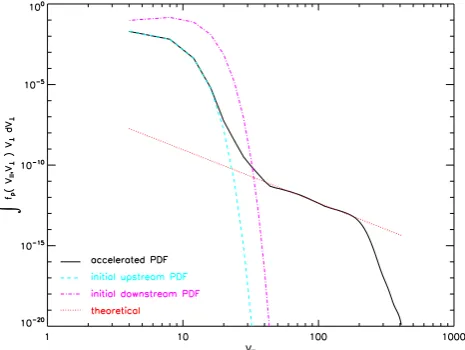
The spectrum of the accelerated protons as a function of the parallel velocity is shown in Fig. 1 using a log-log scale. One can see a power-like spectrum of protons with the exponent close toβ=3.3 that is related to the compression valueβ = 3r/(r-1). This result is in agreement with that of
DSA-based theory (see e.g. Gordon et al., 1999), shown in the figure by dotted linev||−β. However, numerical solution of system of Eqs. (15)–(16) has shown that there is a break on the spectrum at large values of parallel velocity. The spectra of initial Maxwellian upstream and downstream PDFs are shown in the Figure as well with dashed and dash-dotted lines respectively to help understand the position of the break.
4 Discussion
important restrictions. First of all, in order to be applicable the quasi-linear approach requires that the parallel velocity grid points inside each resonant interval should be close enough to allow the overlapping of the trapping regions of neighboring harmonics. The expression for the distanceδv|| between the trapping regions of two neighboring harmonics has the form:
δv||< cpkv⊥
1/2
/ k (22)
where cp=eB/mc,˜ B˜ = |Bk|2δk 1/2
is a root mean square magnetic field of the wave harmonic, v⊥≈vT is
characteristic perpendicular velocity,δkis the wave number distance between neighboring harmonics, and |Bk|2 is a
spectral energy density of the electromagnetic fluctuations. By using cyclotron resonance condition it follows that
δv||< e
2|B k|2
m2c2
v2T ωc
!1/3
(23)
And hence, the width of each resonant interval should satisfy the condition:
1v||δv|| (24)
The conditions (23)–(24) have been checked to be satisfied in our study.
An interesting feature revealed by the model can clearly be seen in Figure 1. It is the presence of a spectral break. The break is located at the high energy part of the particle power spectrum, where acceleration evidently stops and the PDF of accelerated particles (solid line) deviates from the DSA results (dotted line). The non-stationary nature of the model can be used as one possible explanation for the origin of the break. Indeed, we found that the position of the break depends both on distance from the shock front and on time elapsed since the acceleration process has started. As acceleration to higher energies requires more time it is not clear yet if asymptotic stationary solution without the break can be reached in a finite time for any shock configurations or, on the contrary, the position of the break will stabilize at some point in space and time.
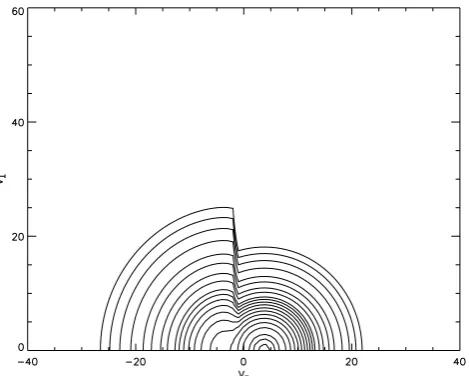
In Fig. 2 the updated distribution function of alpha particles (see procedure 1 of the algorithm) in the upstream region close to the wave front is shown at the beginning of the first time step. This is a plasma-beam distribution with beam component formed by the tail particles of the downstream distribution that crossed the shock front. This distribution is unstable with respect to excitation of MHD waves that are needed for the resonant particles to change their velocities. As a result, some particles can cross the shock front repeatedly and eventually be accelerated. Hence, the solution demonstrates that neither seed population nor initial waves are needed for the acceleration process to start. To emphasize the importance of this finding we would like to stress once more that all previous
Fig. 2. The updated distribution function of alpha-particles at the
beginning of the first time step in the upstream region close to the shock front.
DSA-based macroscopic models needed a seed population for description of acceleration process at shocks. Of course, there was general understanding that “seed” population is injected from the thermal background (see e.g. Drury, 1983; Jones and Ellison, 1991). Malkov and V¨olk (1995, 1998) have shown that the tail particles from downstream thermal distribution penetrating into upstream region and exciting waves needed for particle acceleration can play the role of this seed population. However, DSA-based macroscopic models cannot use this mechanism because they are limited by derivation to energetic particles only. We would like to note that Malkov-V¨olk mechanism is automatically incorporated in our macroscopic model.
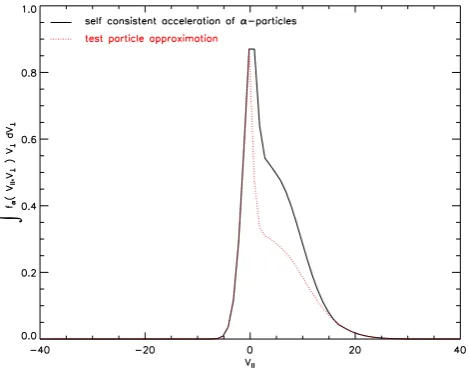
The model showed a substantial difference in acceleration of heavy ions from test particles regime. It can be seen from Fig. 3, that even for relatively small concentration of alpha particles (5%) the number of accelerated alpha particles is much larger when the hydromagnetic turbulence is generated by both protons and alphas themselves, than in the case where heavy ions are treated using a test particle approximation.
Fig. 3. The plot of alpha-particle distribution function over parallel
velocity in the upstream region (units are arbitrary).
Second, similarly to DSA-based models, only resonant wave-particle interactions were included in the model. Including a non-resonant interaction represents a challenging problem and we defer discussion of possible effects of this interaction to a subsequent paper.
Another unsolved problem in the study of shock accel-eration is the role of nonlinear wave-wave interactions in the upstream region. The parametric interaction of Alfv´en and acoustic waves can be described in the framework of the so-called derivative nonlinear Schrodinger (DNLS)-type equation (Shevchenko et al., 2002). Using this description it was shown (Shevchenko et al., 2003) that nonlinear interaction can lead to the development of short large-amplitude magnetic structures (SLAMS) that were observed in the solar wind by Schwartz et al. (1992). Such nonlinear wave structures can reflect protons (see e.g. Claßen and Mann, 1998) and thus provide energy for downstream heating and wave excitation. Our approach permits the inclusion of wave-wave interaction in the shock acceleration model. We will consider these questions in detail elsewhere.
5 Conclusions
The theoretical study of alpha particle acceleration at a shock due to interaction with Alfv´en waves self-consistently excited in both upstream and downstream regions was conducted using a new theoretical scale-separation model. The main difference of the model from DSA models is that it does not treat the accelerated particles as a separate substance but, similar to shock simulations, considers them as an integral part of the plasma distribution function. The model automatically includes an injection scenario in the macroscopic picture of the particle acceleration at shocks and confirms that neither an additional population
of suprathermal seed particles nor external wave turbulence are required for the acceleration process to operate. The numerical analysis based on the model shows quite good agreement with DSA models in predicting power spectra of accelerated particles. However, it was shown that there is a break in the power spectra at large energies of particles. It was shown that in the case where the hydromagnetic turbulence is self-consistently generated by both protons and alphas, the number of accelerated alpha particles is much larger than in the case when they are treated using a test particle approximation.
Acknowledgements. The authors are grateful to Martin Lee and
Gary Zank for useful critical remarks and to Olga Verkhoglyadova and Clare Watt for thorough review of the manuscript resulted in a number of important comments and suggestions. The NASA grant No NNX09AG95G is acknowledged for support of this study.
Edited by: B. Tsurutani
Reviewed by: C. Watt and O. Verkhoglyadova
References
Axford, W. I., Leer, E., and Skadron, G.: The acceleration of cosmic ray by shock waves, Proc. Int. Conf. Cosmic Rays 15th, 11, 132 pp., 1977.
Bell, A. R.: The acceleration of cosmic rays in shock fronts, I, Mon. Not. R. Astron. Soc., 182, 147 pp., 1978a.
Bell, A. R.: The acceleration of cosmic rays in shock fronts, II, Mon. Not. R. Astron. Soc., 182, 443 pp., 1978b.
Blanford, R. D. and Ostriker, J. P.: Particle acceleration by astrophysical shocks, Astrophys. J., 221, p. 269, 1978.
Claßen, H.-T. and Mann, G.: Motion of ions reflected off quasi-parallel shock waves in the presence of large-amplitude magnetic field fluctuations, Astron. Astrophys., 330, 381–388, 1998. Desai, M. I. and Burgess, D.: Particle acceleration at coronal mass
ejection-driven interplanetary shocks and the Earth’s bow shock, J. Geophys. Res., 113, A00B06, doi:10.1029/2008JA013219, 2008.
Drury, L. O’C.: An introduction to the theory of diffusive shock acceleration of energetic particles in tenuous plasmas, Rep. Prog. Phys., 46, 973–1027, 1983.
Galinsky, V. L. and Shevchenko, V. I.: Proton acceleration at oblique shocks, J. Geophys. Res., submitted, 2010.
Galinsky, V. L. and Shevchenko, V. I.: A nonlinear energy balance model of particle acceleration by collisionless parallel shock waves, Astrophys. J., 669, L109–L112, 2007.
Galinsky, V. L. and Shevchenko, V. I.: Nonlinear cyclotron resonant wave-particle interaction in a nonuniform magnetic field, Phys. Rev. Lett, 85, 90–93, 2000.
Gordon, B. E., Lee, M. A., M¨obius, E., and Trattner, K. J.: Coupled hydromagnetic wave excitation and ion acceleration at at interplanetary traveling shocks and Earth’s bow shock revisited, J. Geophys. Res., 104(A12), p. 28263, 1999.
Jones, F. C. and Ellison, D. C.: The plasma physics of shock acceleration, Space Sci. Rev., 58, 259–346, 1991.
Kennel, C. F., Coronity, F. V., Scarf, F. L., Livesey, W. A., Russell, C. T., Smith, E. J., Wenzel, K. P., and Scholer, M.: Plasma and energetic particle structure upstream of a quasi-parallel interplanetary shock, J. Geophys. Res., 89(A7), 5419– 5435, 1984a.
Kennel, C. F., Coronity, F. V., Scarf, F. L., Livesey, W. A., Russell, C. T., Smith, E. J., Wenzel, K. P., and Scholer, M.: Structure of the November 12, 1978 quasi-parallel interplanetary shock, J. Geophys. Res., 89(A7), 5436–5452, doi:10.1029/JA089iA07p05436, 1984b.
Kennel, C. F. and Engelmann, F.: Velocity space diffusion from weak plasma turbulence in a magnetic field, Phys. Fluids, 9, 2377, doi:10.1063/1.1761629, 1966.
Krymsky, G. F.: A regular mechanism for the acceleration of charged particles on the front of a shock wave, Dokl. Akad. Nauk SSSR, 234, 1306–1308, 1977.
Lee, M. A.: Coupled hydromagnetic wave excitation and ion acceleration upstream of the earth’s bow shock, J. Geophys. Res., 87, 5063–5080, 1982.
Lee, M. A.: Coupled hydromagnetic wave excitation and ion acceleration at interplanetary traveling shocks, J. Geophys. Res., 88, 6109–6119, 1983.
Li, G., Zank, G. P., and Rice, W. K. M.: Energetic particle acceleration and transport at coronal mass ejectiondriven shocks, J. Geophys. Res., 108, 1082, doi:10.1029/2002JA009666, 2003. Li, G., Zank, G. P., and Rice, W. K. M.: Acceleration and transport of heavy ions at coronal mass ejection-driven shocks, J. Geophys. Res., 110, A06104, doi:10.1029/2004JA010600, 2005.
Mason, G. M.: The composition of galactic cosmic rays and solar energetic particles, Rev. Geophys., 25(3), 685–696, 1987. Malkov, M. A. and Drury, L. O’C.: Nonlinear theory of diffusive
acceleration of particles by shock waves, Rep. Prog. Phys., 64, 429–481, 2001.
Malkov, M. A. and V¨olk, H. J.: Theory of ion injection at shocks, Astron. Astrophys., 300, 605–626, 1995.
Malkov, M. A. and V¨olk, H. J.: Diffusive ion acceleration at shocks: the problem of injection, Adv. Space Res., 21, 551–554, 1998. Meyer, J. P.: The baseline composition of solar energetic particles,
Astrophys. J. Suppl. S., 57, 151–171, 1985.
Ng, C. K., Reames, D. V., and Tylka, A. J.: Effect of proton-amplified waves on the evolution of solar energetic particle composition in gradual events, Geophys. Res. Lett., 26(14), 2145–2148, doi:10.1029/1999GL900459, 1999.
Rowlands, J., Shapiro, V. D., and Shevchenko, V. I.: Quasilinear theory of plasma cyclotron instability, Sov. Phys. JETP, 23, p. 651, 1966.
Sagdeev, R. Z. and Shafranov, V. D.: On the instability of a plasma with anisotropic distribution of velocities in a magnetic field, Sov. Phys. JETP, 12, 130–132, 1961.
Schwartz, S. J., Burgess, D., Wilkinson, W. P., Kassel, R. L., Dunlop, M., and L¨uhr, H.: Observations of short large-amplitude magnetic structures at a quasi-parallel shock, J. Geophys. Res., 97(A4), 4209–4227, doi:10.1029/91JA02581, 1992.
Skilling, J.: Cosmic ray streaming – I, Mon. Not. R. Astron. Soc., 172, 557–566, 1975.
Shevchenko, V. I., Sagdeev, R. Z., Galinsky, V. L., and Medvedev, M. V.: The DNLS equation and parametric decay instability, Plasma Phys. Rep., 29(7), 545–549, 2003.
Shevchenko, V. I., Galinsky, V. L., and Ride, S. K.: Excitation of left-hand-polarized nonlinear Alfv´en waves by an ion beam in a plasma, J. Geophys. Res., 107(A11), 1367, doi:10.1029/2001JA009208, 2002.
Torsti, J., Kocharov, L., Laivola, J., Pohjolainen, S., Plunkett, S. P., Thompson, B. J., Kaiser, M. L., and Reiner, M. J.: Solar particle events with helium-over-hydrogen enhancement in the energy range up to 100 MeV nucl−1, Sol. Phys., 205, 123–147, 2001.
Tsurutani, B. T., Smith, E. J., and Jones, D. E.: Waves observed upstream of interplanetary shocks, J. Geophys. Res., 88(A7), 5645–5656, 1983.
Tylka, A. J., Reames, D. V., and Ng, C. K.: Observations of systematic temporal evolution in elemental composition during gradual solar energetic particle events, Geophys. Res. Lett., 26(14), 2141–2144, doi:10.1029/1999GL900458, 1999. Vedenov, A. A., Velikhov, E. P., and Sagdeev, R. Z.: Nuclear
Fusion, Supplement, Part 2, 465–475, 1962.
V¨olk, H. J., Zank, L. A., and Zank, G. P.: Cosmic ray spectrum produced by supernova remnants with an upper limit on wave dissipation, Astron. Astrophys., 198, 274–282, 1988.