www.soil-journal.net/1/687/2015/ doi:10.5194/soil-1-687-2015
© Author(s) 2015. CC Attribution 3.0 License.
SOIL
Mitigating N
2
O emissions from soil: from patching leaks
to transformative action
C. Decock, J. Lee, M. Necpalova, E. I. P. Pereira, D. M. Tendall, and J. Six
Department of Environmental Systems Science, ETH Zurich, Universitätsstrasse 2, 8092 Zurich, Switzerland
Correspondence to: C. Decock ([email protected])
Received: 10 August 2015 – Published in SOIL Discuss.: 25 August 2015
Revised: 21 November 2015 – Accepted: 25 November 2015 – Published: 10 December 2015
Abstract. Further progress in understanding and mitigating N2O emissions from soil lies within
transdisci-plinary research that reaches across spatial scales and takes an ambitious look into the future.
1 Introduction
Atmospheric concentrations of nitrous oxide (N2O), a
po-tent greenhouse gas and ozone-depleting substance, have increased steadily from 270 ppb in the pre-industrial era (1000–1750) to 328 ppb in 2015 (IPCC, 2013; NOAA, 2015).
The vast majority of N2O emissions come from agriculture,
where it is emitted from soil, especially following manage-ment or weather events, such as N fertilization, manure appli-cation, tillage, and precipitation (Denman et al., 2007; Dob-bie et al., 1999). Recent projections indicate that to stabilize
atmospheric N2O concentrations between 340 and 350 ppb
by 2050, reducing emissions by 22 % relative to 2005 (i.e.
5.3 Tg N2O–N yr−1) will be necessary (UNEP, 2013).
Mean-while, N2O emissions have further increased since 2005
(FAO et al., 2014), indicating that the currently required emission reductions are even greater. Only concerted efforts combining the most pertinent mitigation strategies, such as increasing N-use efficiency in agricultural production sys-tems, in combination with diminishing food waste and reduc-ing meat and dairy consumption can realize such emission re-ductions (UNEP, 2013). Under business-as-usual conditions,
anthropogenic N2O emissions are expected to almost double
by 2050, leading to a high risk of unprecedented increases in the global temperature and in UVB radiation, with severe consequences for human health and the environment (UNEP,
2013). Despite the clear urgency of reducing N2O emissions,
adoption of the proposed mitigation options remains slow. Political and societal inertia may partly be to blame, but the large uncertainty around management-, crop- and
region-specific predictions of N2O emissions also presents an
im-portant challenge to designing and implementing mitigation options. In this forum article, we use examples of
ongo-ing research on N2O emissions to illustrate and discuss how
soil scientists can collaborate with experts from other
disci-plines, to reduce the uncertainty around N2O emissions
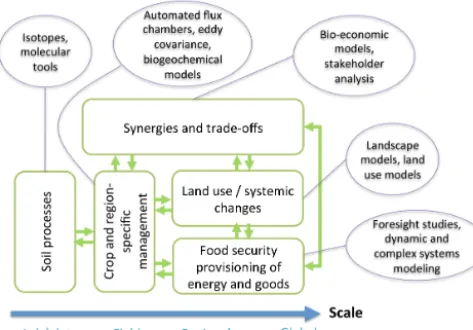
es-timates, hence improving the development and implementa-tion of successful mitigaimplementa-tion strategies. We use a framework of five interacting research themes across different spatial
scales: (1) identification of soil processes underlying N2O
emissions, (2) assessment of the effects of crop- and
region-specific management on N2O emissions, (3) assessment of
the effects of systemic or land-use change on N2O emissions,
and (4) assessment of the synergies and trade-offs between
N2O mitigation and other sustainability indicators,
culminat-ing into (5) sustainable provisionculminat-ing of food and nutrition security, energy and goods (Fig. 1). Each research theme is associated with a set of commonly used research tools. We
then specifically highlight how researchers working on N2O
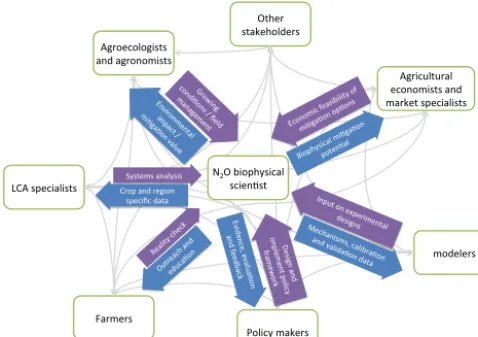
emission understanding and reductions need to proactively seek out relevant collaborations across disciplinary bound-aries (Fig. 2), in order to play a significant role in the global challenge of achieving sustainable agricultural and food sys-tems.
2 Patching the leaks: from “understanding soil processes” to “crop- and region-specific management”
The most discussed and investigated strategies for reducing
Figure 1.Illustration of interactions between major themes relevant for N2O mitigation from patching leaks to transformative action.
Examples of research tools commonly associated with the different themes are shown in the round text balloons.
i.e. improve the N-use efficiency of croplands and grass-lands, mostly by optimizing fertilizer N management (e.g. rate, timing, source, and placement of N fertilizers). Patch-ing the leaks is probably one of the more achievable miti-gation options in the shorter term. In fact, a N-fertilizer tax
for reducing external N inputs and associated N2O emissions
has been evaluated (Franks and Hadingham, 2012; Mérel et al., 2014), and several C-offset programmes already hold a
protocol to estimate net N2O emission reductions from
crop-ping systems, for trading on the C-market (Davidson et al., 2014). From a technical point of view, the potential to reduce
N2O emissions through optimized N management has been
demonstrated (Snyder et al., 2014; Hoben et al., 2011). How-ever, taking up such management options in regulation and policy formulations requires a clear and quantitative descrip-tion of the condidescrip-tions under which the management strat-egy is effective, and the associated uncertainty range. For
example, it is well known that N2O emissions generally
in-crease with increasing N input (Bouwman, 1996; Hoben et al., 2011), but the shape of this response curve varies be-tween agricultural production systems and regions (Decock, 2014; Kim et al., 2012). If the aim of a policy is to achieve
a certain N2O emission reduction target through reduced
N-input rates, not only the response curve at the research sta-tion, but the response curve for all fields targeted by this policy needs to be estimated. Hence, one needs to extrapo-late for which soil types, climate conditions, or management practices a certain response is valid. Moreover, because of
the high variability typically associated with N2O emissions,
policies need to take into account a certain amount of risk. To do so, a good estimate of the confidence interval around an achievable emission reduction is just as important as the
mean value (Springborn et al., 2013). Long-term N2O
mea-surements across a wide range of biophysical conditions (i.e.
ecoregions) and mitigation options are important to under-stand and quantify this uncertainty and variability, but the
cost and time required for direct N2O measurements limits
the number of data sets that can be collected. Here, biogeo-chemical process models are practical tools to bridge data gaps, and improve the precision and accuracy of the effi-ciency and applicability conditions of mitigation options.
Modellers use field- and laboratory-derived N2O data
col-lected for continuous biogeochemical model development, evaluation, and subsequent application of the model to
simu-late field-level N2O emissions toward regional-scale
simula-tions across a wide range of environmental condisimula-tions upon adoption of different management practices (Rochette et al., 2008; Fitton et al., 2011). Models are in essence a math-ematical representation of our understanding of functional relationships between the key drivers, their interactions and the ecosystem responses under different agricultural manage-ments (Chen et al., 2008). Hence, model predictions can only be as accurate as our current understanding of the underlying mechanisms. The simplified process algorithms for
estimat-ing N2O emissions from nitrification and denitrification
dif-fer between the developed biogeochemical process models in terms of the effects of environmental drivers taken into account (Fang et al., 2015) and consequently result in dif-ferent responses to the environmental factors and a diverse
model performance in simulating N2O emissions under
dif-ferent climate, soil and management conditions (Frolking et al., 1998; Vogeler et al., 2013). Current experimental re-search is constantly making progress in improving our
under-standing of mechanisms underlying N2O emissions by using
state-of-the-art molecular and isotope methods (Baggs, 2008, 2011; Butterbach-Bahl et al., 2013; Decock and Six, 2013). It is important that these insights will inevitably lead to
fur-ther refining and re-evaluation of N2O emission process
al-gorithms. To further improve model simulations, modellers and experimentalists could jointly design experiments that provide mechanistic information suitable for improvements in model structure, especially regarding management prac-tices that are difficult to simulate at present (Venterea and Stanenas, 2008) (Fig. 2).
Not only can modellers benefit from communication with biophysical scientists regarding the model input require-ments and availability of the measured data at the studied do-main for the model application, constraining parameter val-ues and model evaluation, but they could also provide feed-back on which data should be measured more accurately, where the major data gaps and uncertainties lie for upscal-ing, and providing relevant and reliable predictions to sup-port policies. Adoption of different management practices should be evaluated across a wide range of environmental conditions, at larger spatial scales and for longer time pe-riods. This would enable identification of areas with higher mitigation potential and boundary conditions for delivering emission reductions. Furthermore, model simulations could
po-modelers
Policy makers LCA specialists
Agroecologists and agronomists
Agricultural economists and market specialists
Farmers
Other stakeholders
N2O biophysical
scien=st
Systems analysis Crop and region
specific data
Desig n an
d im
plem en t p olicy fram
ew ork Evid
en ce, e
val ua=
on an
d fee dbac k
Figure 2.Stakeholder map with examples of knowledge exchange, interactions and opportunities for active collaborations between bio-physical scientists in N2O research and specialists in other
disci-plines.
tential emission reductions is the highest and inform where to invest in new field trials (Hillier et al., 2012; De Gryze
et al., 2011). The sensitivity analyses of N2O model
pre-dictions could indicate where threshold values (e.g. percent clay content, mean daily precipitation) might lie regarding the effectiveness of mitigation options. Cooperative efforts between modellers and biophysical scientists could acceler-ate the identification of applicability conditions and quan-tification of uncertainty around emission reductions, provid-ing a more solid and refined basis to apply theory in practice (Fig. 2).
3 Systemic change: balancing environmental protection, food and nutrition security, and provisioning of energy and goods
Recent N2O emission projections clearly indicate that
patch-ing the leaks is essential, but not sufficient, to stabilize
atmo-spheric N2O concentrations at an acceptable level by 2050
(UNEP, 2013). Systemic change driven by, for example, re-duced meat and dairy consumption in the developed world
is needed to reach the N2O emission target. Various
simu-lation studies have shown that reduced meat and dairy
con-sumption decreases N2O emissions through reduced manure
application and cultivation of feed crops (Popp et al., 2010; Stehfest et al., 2009; Westhoek et al., 2014). However, emis-sion reduction estimates are relatively coarse, mostly due to the lack of information on land-use changes and asso-ciated emissions induced by reduced meat and dairy con-sumption. Would there be a shift toward grass-fed animal production? Would there be increased consumption of fruit and vegetables, driving up the acreage dedicated to horticul-ture? Would there be increased demand for legumes in
hu-man diets? Would consumers cut down on their total calo-rie and protein intake, making part of the land available for bio-energy crops, or nature conservation and recreation areas? Or would production be sustained by increased ex-ports? Clearly, there is a multitude of alternative land-use options, but the greenhouse gas emissions associated with these land-use conversions are not well quantified. Currently available foresight studies on the effects of dietary change
on N2O emissions attempt to take into account alternative
land use to a certain extent. Estimated emissions from alter-native systems are, however, typically based on Intergovern-mental Panel on Climate Change (IPCC) emission factors,
where N2O emissions are a fixed fraction of N inputs (Popp
et al., 2010; Stehfest et al., 2009; Westhoek et al., 2014).
The IPCC emission factors are based on N2O emission data
available when the IPCC guidelines were developed, which mainly consists of experiments in cereal cropping systems in temperate regions (Bouwman, 1996; IPCC, 2006). Empiri-cal data show, however, that crop type and geographic
loca-tion have a significant effect on N2O emissions, irrespective
of N-input rate (Stehfest and Bouwman, 2006; Linquist et al., 2012; Verhoeven et al., 2013; Decock, 2014). Therefore, awareness campaigns or policies aimed at reduced meat and dairy consumption should go hand in hand with considera-tions on how to steer and account for direct and indirect land-use change (Franks and Hadingham, 2012). This requires a whole system approach involving soil scientists, agricultural economists, social and political scientists, geographers and policymakers (Fig. 2) to identify the most likely or most de-sirable alternative cropping systems and/or land-use scenar-ios and the associated greenhouse gas emissions in various regions of the world.
Overconsumption of meat and dairy in developed coun-tries is only a part of the global challenge of “the starving, the stunted and the stuffed”. Millions of people are hungry or malnourished, both in the Global South and Global North (FAO et al., 2014). The prevalence of hunger might even be exacerbated as the global population increases in the coming decennia (Alexandratos and Bruinsma, 2012). The problem could be partly alleviated by reducing food waste, improv-ing food distribution and access to markets, and addressimprov-ing socio-economic inequalities. In many developing countries, however, the low productivity of agricultural systems is a major concern. For example, annual maize yields in Africa
and South America ranged from 2 to 5 Mg ha−1 between
2009 and 2013, compared to 8 to 10 Mg ha−1 in western
insur-ance or loans). Meanwhile, developing countries are the ar-eas where the largest population incrar-eases are predicted (UN, 2013). As more food will be needed to nourish the increas-ing global population, it is important to contemplate which food should be produced, where it should be produced, how the production system should be managed, and at what
en-vironmental cost. While increases in N2O emissions due to
increased N fertilizer use in many developing countries have been predicted (IPCC, 2007), little is known about the actual
effect of intensification on N2O emissions in those
agricul-tural systems (Hickman et al., 2011; Valentini et al., 2014). In N-rate trials in western Kenya, an exponential response of
N2O to N input was observed (Hickman et al., 2015),
simi-lar to many studies in temperate systems (Hoben et al., 2011; Kim et al., 2012). Nevertheless, emissions as a percentage of N applied ranged between 0.01 and 0.11 %, well below the average IPCC emission factor of 1 % (Hickman et al., 2015). Likewise, simulations of intensification scenarios sug-gested a smaller environmental impact relative to productiv-ity gains in Zimbabwe compared to Austria and China (Car-berry et al., 2013). To meet the needs of the growing global population, there is an urgent need to investigate the sustain-ability of various intensification scenarios across the globe, through collaborations between agroecologists, agronomists, rural economists, nutrition specialists and sociologists. Soil
scientists specializing in N2O emissions could help address
where and how intensification would have the largest impact on food and nutrition security with minimal environmental impact, by seeking out experiments in currently underrepre-sented geographic locations and cropping systems, e.g. by investing in climate-smart agricultural projects in develop-ing countries (Marques de Magalhães and Lunas Lima, 2014; Steenwerth et al., 2014).
By “the stuffed”, we are referring to the overconsump-tion of calories worldwide (especially in the form of fats and refined sugars), which has contributed to a global epi-demic of obesity and has been linked to increased risk of non-communicable diseases such as cardiovascular diseases, several cancers, and diabetes (Lustig et al., 2012). The in-creasing consumption of these foods at unhealthy levels has become an undeniable public health issue, and has boosted many debates on policies such as sugar and fat taxes, diet education, and prevention campaigns to address the problem (Malik et al., 2013). Meanwhile, many of the sugar and oil crops are also on the table for bio-energy production. Yet, the net greenhouse gas benefit of biofuels remains contro-versial and tends to strongly depend on the feedstock used (Del Grosso et al., 2014) and regional adoption potentials (Yi et al., 2014). One of the largest uncertainties in life cycle
analysis (LCA) of biofuels relates to direct and indirect N2O
emissions from soil (Benoist et al., 2012). Due to the lack of original data, many LCAs default to IPCC emission
fac-tors to estimate N2O emissions from soil, and therefore fail
to account for land-use, geographical, and management
ef-fects on N2O emissions. For example, there is evidence that
N2O emissions from sugar-cane cultivation might be larger
than expected based on IPCC emission factors, which could change the picture on the greenhouse gas balance of sugar-cane-based biofuels (Lisboa et al., 2011). Meanwhile, there are great hopes that second-generation biofuels (e.g. con-version of lignocellulose rather than sugars) will help meet bioenergy targets. Feedstock production is expected to be
less intensive and cause lower N2O emissions from soil
com-pared to first-generation biofuels (Bessou et al., 2011; Don et al., 2012). From a global perspective, sugar cane, sugar beet, maize, soybeans, rapeseed and palm oil accounted for over 20 % of the harvested crop area and over 30 % of the total crop production in the period 2009–2013 (FAOSTAT, 2015). Up to 20 % of the harvested biomass is used for bio-energy production (FAO, 2013a). This fraction is expected to increase as various countries mandate an increasing share of bioenergy in the total energy consumption (Alexandratos and Bruinsma, 2012). Clearly, interrelated trends in public health, energy and environmental policies could have a significant effect on the cultivated acreage of oil and sugar crops, the emergence of second-generation bioenergy crops, and the
as-sociated changes in N2O emissions.
Feed, oil, sugar and bioenergy crops form an important share of the significant contribution of crop production to
N2O emissions. Soil scientists should take responsibility
in debates on the impact of forthcoming policies that di-rectly or indidi-rectly affect the cultivated acreage of these crops, backed by robust crop-, region- and
management-specific N2O emission measurements. The examples above
clearly illustrate the need to assess public interest and socio-economic feasibility in combination with biophysical effec-tiveness, in order to guide land-use decisions. This requires multi-directional collaborations between biophysical scien-tists and actors engaged in policymaking, socio-economic as-sessments and livelihood enhancement of farmers. Further-more, the highlighted land-use changes are heavily depen-dent on behavioural change of multiple actors, including pro-ducers and consumers. It is not clear how and at what rate such behavioural changes can take place. Step-wise policy implementation may be necessary, and a lag time in effec-tiveness can be expected. Dynamic modelling that takes into account transition phases can help achieve a more realistic
map of projected changes in N2O emissions.
4 Complex synergies and trade-offs challenge the path to sustainability
Sustainable management of agricultural systems evidently
does not end at optimizing productivity and minimizing N2O
in-duced by agrochemicals and fertilizers; restoring and con-serving of biodiversity, including the safeguarding of pollina-tion services and persistence of natural enemies for agricul-tural pests and disease control; preventing air pollution from
agriculture by reducing indirect emissions of NOx, NH3, and
dust particles; preventing unsustainable withdrawals of water for irrigation; protecting soil from depletion and degradation; and increasing the resilience of agricultural production sys-tems, especially in the light of climate change (Schröder et al., 2011; Foley et al., 2011; Bindraban et al., 2012). In ad-dition, social and economic aspects such as labour require-ments and profitability cannot be disregarded (FAO, 2013b). Many solutions and interventions for several of these prob-lems have been sought and applied at field, farm, landscape, national and global scales. Examples at the field and land-scape scale include conservation agriculture, intercropping, agroforestry, precision agriculture, buffer strips, organic agri-culture, recycling of organic waste streams for agricultural production, drip irrigation, and improved crop varieties, of-ten assisted by advances in engineering and technological so-lutions such as genetic modification, novel machinery imple-ments, and recently also drones. Mitigation actions at the na-tional and global scale include environmental regulation and international collaborations. At present, interactions and
con-flicts between N2O mitigation strategies and solutions
pro-posed to address other agronomic, environmental or socio-economic problems remain insufficiently explored. There-fore, it is important to identify where synergies and trade-offs can be found, by collaborating with scientists that spe-cialize in other aspects of agroecology, as well as with sci-entists that develop methods to facilitate transdisciplinary research and engage stakeholders, tools for trade-off anal-ysis, and approaches to deal with complex systems (Klap-wijk et al., 2014; van Mil et al., 2014; Jarvis et al., 2011). In practice, this could include combining management scenar-ios in field trials and modelling efforts; facilitating the trans-fer of the data they produce by collaborating on consistent data and reporting protocols, and standardized, centralized databases; contributing to build integrated bio-physical and socio-economic models; and conducting metastudies
plac-ing N2O-related outcomes among other environmental and
socio-economic indicators, which in turn can feed back into
the design of N2O emission reduction research (Fig. 2).
Mitigating N2O emissions is a complex issue embedded in
the even more complex maze of improving the sustainability of agriculture and food systems. Therefore, finding the right
denominator for assessing N2O emissions is a challenging
task. Yield-scaled emissions are practical for assessing the eco-efficiency of a particular field, but are problematic when it comes to absolute emission reductions at a global scale (Van Groenigen et al., 2010; Murray and Baker, 2011). Fur-thermore, yield-scaled emissions cannot accommodate im-pacts of systemic change and comparisons of land-use sce-narios in which crops with very different nutritional, soci-etal, and economic values are grown. Prior to the start of new
experiments, soil scientists could reach out to policymakers, agricultural and resource economists, and industrial ecolo-gists to identify what ancillary variables (e.g. use of the crop and its residues, yield, nutritional value) should be collected to accommodate a balanced comparison of different systems.
5 Inter- and transdisciplinary research: buzzword versus reality
While the terms inter- and transdisciplinary research are fre-quently dropped as buzzwords, especially in research evolv-ing around real-world problems, challenges associated with working across scholarly disciplines, or collaborations be-tween academic and non-academic actors, cannot be under-estimated. So-called interdisciplinary projects often regress to research consortia that merely accommodate exchange of final research findings, rather than fostering true joint cre-ation of new knowledge (Bruce et al., 2004). Common bar-riers to inter- and transdisciplinary research include the high time commitment for coordination and communication; lack of recognition in traditional institutional reward systems; dif-ferences in attitudes, jargon, philosophies and publication protocols between disciplines; a lack of understanding of methods and outcomes of different disciplinary components; and difficulties in finding referees that appreciate and evalu-ate the quality of interdisciplinary projects (Campbell, 2005; Bruce et al., 2004). Many funding agencies and academic institutions are taking steps to overcome some of these bar-riers by opening calls for interdisciplinary research projects, by organizing meetings to explore potential new interdisci-plinary partnerships, or by establishing competence centres tasked with bringing together knowledge and stakeholders relevant to addressing important national or global problems. Individual researchers committed to the cause of reducing
N2O emissions from soil could contribute by actively seeking
out such opportunities. In this forum article, we presented a
guiding framework for the N2O researcher interested in
inter-and transdisciplinary research, by conceptualizing links be-tween major themes in sustainability of food and agricultural
systems and N2O emissions research across different scales
(Fig. 1), and by drawing a map of relevant stakeholders and their potential interactions (Fig. 2).
6 Concluding remarks
Tremendous progress has been made during the last
decen-nia with respect to the scientific understanding of N2O
emis-sions from soils: various pathways and mechanisms have been elucidated (Butterbach-Bahl et al., 2013); molecular and isotopic tools to assess mechanisms have been advanced (Baggs, 2008, 2011; Decock and Six, 2013); we have a
gen-eral idea of temporal and spatial patterns of N2O emissions
(Groffman et al., 2009); micrometeorological methods are
high temporal resolution (Eugster and Merbold, 2015); var-ious data sources have been synthesized in qualitative and quantitative reviews (Bouwman, 1996; Decock, 2014); and biogeochemical models have been developed and improved
to predict N2O emissions under various scenarios (Chen et
al., 2008). These efforts have paved the way to identify the
major causes of soil-derived N2O and to isolate the strategies
that have the greatest potential for reducing global N2O
emis-sions (e.g. increasing N efficiency in cropping systems and reducing meat and dairy consumption in developed coun-tries) (Snyder et al., 2014; UNEP, 2013; Oenema et al., 2014). The time is ripe to reach across disciplines, not only to fine-tune crop- and region-specific agronomic management strategies for instant mitigation action, but also to better
in-tegrate the issue of N2O emissions in overarching debates on
agricultural change. This will help steer transformative ac-tion for improving the social, economic and environmental sustainability of agricultural and food systems for many gen-erations to come.
Acknowledgements. The authors thank the anonymous re-viewers for excellent comments that have helped improve the manuscript. Charlotte Decock, Engil Pereira, and Juhwan Lee were supported by the FP7 project Plant Fellows coordinated by the Zurich-Basel Plant Science Center when writing the manuscript. Edited by: C. Stevens
References
Alexandratos, N. and Bruinsma, J.: World agriculture towards 2030/2050: the 2012 revision, ESA Working paper No. 12-03., FAO, Rome, 2012.
Baggs, E. M.: A review of stable isotope techniques for N2O source
partitioning in soils: recent progress, remaining challenges and future considerations, Rapid Commun. Mass Sp., 22, 1664– 1672, 2008.
Baggs, E. M.: Soil microbial sources of nitrous oxide: recent ad-vances in knowledge, emerging challenges and future direction, Current Opinion in Environmental Sustainability, 3, 321–327, 2011.
Benoist, A., Dron, D., and Zoughaib, A.: Origins of the debate on the life-cycle greenhouse gas emissions and energy consump-tion of first-generaconsump-tion biofuels–A sensitivity analysis approach, Biomass Bioenerg., 40, 133–142, 2012.
Bessou, C., Ferchaud, F., Gabrielle, B., and Mary, B.: Biofuels, greenhouse gases and climate change. A review, Agron. Sustain. Dev., 31, 1–79, 2011.
Bindraban, P. S., van der Velde, M., Ye, L., Van den Berg, M., Materechera, S., Kiba, D. I., Tamene, L., Ragnarsdóttir, K. V., Jongschaap, R., and Hoogmoed, M.: Assessing the impact of soil degradation on food production, Current Opinion in Envi-ronmental Sustainability, 4, 478–488, 2012.
Bouwman, A. F.: Direct emission of nitrous oxide from agricultural soils, Nutr. Cycl. Agroecosys., 46, 53–70, 1996.
Bruce, A., Lyall, C., Tait, J., and Williams, R.: Interdisciplinary in-tegration in Europe: the case of the Fifth Framework programme, Futures, 36, 457–470, 2004.
Butterbach-Bahl, K., Baggs, E. M., Dannenmann, M., Kiese, R., and Zechmeister-Boltenstern, S.: Nitrous oxide emissions from soils: how well do we understand the processes and their con-trols?, Philos. T. Roy. Soc. B, 368, doi:10.1098/rstb.2013.0122, 2013.
Campbell, L. M.: Overcoming obstacles to interdisciplinary re-search, Conserv. Biol., 19, 574–577, 2005.
Carberry, P. S., Liang, W.-l., Twomlow, S., Holzworth, D. P., Dimes, J. P., McClelland, T., Huth, N. I., Chen, F., Hochman, Z., and Keating, B. A.: Scope for improved eco-efficiency varies among diverse cropping systems, P. Natl. Acad. Sci. USA, 110, 8381– 8386, 2013.
Chen, D., Li, Y., Grace, P., and Mosier, A. R.: N2O emissions from
agricultural lands: a synthesis of simulation approaches, Plant Soil, 309, 169–189, 2008.
Davidson, E., Galloway, J., Millar, N., and Leach, A.: N-related greenhouse gases in North America: innovations for a sustain-able future, Current Opinion in Environmental Sustainability, 9, 1–8, 2014.
Decock, C.: Mitigating Nitrous Oxide Emissions from Corn Crop-ping Systems in the Midwestern US: Potential and Data Gaps, Environ. Sci. Technol., 48, 4247–4256, 2014.
Decock, C. and Six, J.: How reliable is the intramolecular distribu-tion of15N in N2O to source partition N2O emitted from soil?,
Soil Biol. Biochem., 65, 114-127, 2013.
De Gryze, S., Lee, J., Ogle, S., Paustian, K., and Six, J.: Assessing the potential for greenhouse gas mitigation in intensively man-aged annual cropping systems at the regional scale, Agr. Ecosyst. Environ., 144, 150–158, 2011.
Del Grosso, S., Smith, P., Galdos, M., Hastings, A., and Parton, W.: Sustainable energy crop production, Current Opinion in Environ-mental Sustainability, 9, 20–25, 2014.
Denman, K. L., Brasseur, G., Chidthaisong, A., Ciais, P., Cox, P. M., Dickinson, R. E., Hauglustaine, D., Heinze, C., Holland, E., Jacob, D., Lohmann, U., Ramachandran, S., da Silva Dias, P. L., Wofsy, S. C., and Zhang, X.: Couplings Between Changes in the Climate System and Biogeochemistry, in: Climate Change 2007: The Physical Science Basis. Contribution of Working Group I to the Fourth Assessment Report of the Intergovernmental Panel on Climate Change, edited by: Solomon, S., Qin, D., Manning, M., Chen, Z., Marquis, M., Averyt, K. B., Tignor, M., and Miller, H. L., Cambridge University Press, Cambridge, United Kingdom and New York, NY, USA, 2007.
Dobbie, K., McTaggart, I., and Smith, K.: Nitrous oxide emissions from intensive agricultural systems: variations between crops and seasons, key driving variables, and mean emission factors, J. Geophys. Res.-Atmos., 104, 26891–26899, 1999.
Don, A., Osborne, B., Hastings, A., Skiba, U., Carter, M. S., Drewer, J., Flessa, H., Freibauer, A., Hyvönen, N., and Jones, M. B.: Land-use change to bioenergy production in Europe: im-plications for the greenhouse gas balance and soil carbon, Glob. Change Biol. Bioenergy, 4, 372–391, 2012.
Eugster, W., and Merbold, L.: Eddy covariance for quantifying trace gas fluxes from soils, SOIL, 1, 187–205, 2015.
al-gorithms in RZWQM2 in response to N rate on an irrigated corn field., Environ. Modell. Softw., 72, 56–70, 2015.
FAO: FAO Statistical Yearbook 2013: World Food and Agriculture, Food and Agriculture Organization of the United Nations, Rome, 2013a.
FAO: SAFA Sustainability Assessment of Food and Agriculture systems guidelines version 3.0, Food and Agriculture Organiza-tion of the United NaOrganiza-tions, Rome, 2013b.
FAO, IFAD, and WFP: The State of Food Insecurity in the World 2014, Strengthening the enabling environment for food security and nutrition, FAO, Rome, 2014.
FAOSTAT: Food and Agriculture Organization of the United Na-tions Statistics division, available at: http://faostat3.fao.org (last access: 6 December 2015), 2015.
Fitton, N., Ejerenwa, C., Bhogal, A., Edgington, P., Black, H., Lilly, A., Barraclough, D., Worrall, F., Hillier, J., and Smith, P.: Greenhouse gas mitigation potential of agricultural land in Great Britain, Soil Use Manage., 27, 491–501, 2011.
Foley, J. A., Ramankutty, N., Brauman, K. A., Cassidy, E. S., Ger-ber, J. S., Johnston, M., Mueller, N. D., O’Connell, C., Ray, D. K., and West, P. C.: Solutions for a cultivated planet, Nature, 478, 337–342, 2011.
Franks, J. R. and Hadingham, B.: Reducing greenhouse gas emis-sions from agriculture: avoiding trivial solutions to a global prob-lem, Land Use Policy, 29, 727–736, 2012.
Frolking, S., Mosier, A., Ojima, D. S., Li, C., Parton, W. J., Potter, C., Priesack, E., Stenger, R., Haberbosch, C., Dörsch, P., Flessa, H., and Smith, K.: Comparison of N2O emissions from soils at three temperate agricultural sites: simulations of year-round mea-surements by four models, Nutr. Cycl. Agroecosys., 52, 77-105, 1998.
Groffman, P. M., Butterbach-Bahl, K., Fulweiler, R. W., Gold, A. J., Morse, J. L., Stander, E. K., Tague, C., Tonitto, C., and Vidon, P.: Challenges to incorporating spatially and temporally explicit phenomena (hotspots and hot moments) in denitrification mod-els, Biogeochemistry, 93, 49–77, 2009.
Hickman, J., Tully, K., Groffman, P., Diru, W., and Palm, C.: A potential tipping point in tropical agriculture: Avoiding rapid increases in nitrous oxide fluxes from agricultural intensifi-cation in Kenya, J. Geophys. Res.-Biogeo., 120, 938–951, doi:10.1002/2015JG002913, 2015.
Hickman, J. E., Havlikova, M., Kroeze, C., and Palm, C. A.: Current and future nitrous oxide emissions from African agriculture, Cur-rent Opinion in Environmental Sustainability, 3, 370–378, 2011. Hillier, J., Brentrup, F., Wattenbach, M., Walter, C., Garcia-Suarez, T., Mila-i-Canals, L., and Smith, P.: Which cropland greenhouse gas mitigation options give the greatest benefits in different world regions? Climate and soil-specific predictions from integrated empirical models, Glob. Change Biol., 18, 1880–1894, 2012. Hoben, J., Gehl, R., Millar, N., Grace, P., and Robertson, G.:
Non-linear nitrous oxide (N2O) response to nitrogen fertilizer in on-farm corn crops of the US Midwest, Glob. Change Biol., 17, 1140–1152, doi:10.1111/j.1365-2486.2010.02349.x, 2011. IPCC: Guidelines for National Greenhouse Gas Invertories, Chapter
11: N2O emissions from managed soils, and CO2emissions from
lime and urea application, 2006.
IPCC: Climate Change 2007: Synthesis Report, in: Contribution of Working Groups I, II and III to the Fourth Assessment Report
of the Intergovernmental Panel on Climate Change, edited by: Pachauri, R. K., and Reisinger, A., IPCC, Geneva, 2007. IPCC: Climate Change 2013. The Physical Science Basis.
Sum-mary for Policymakers. Working Group I Contribution to the fifth Assessment Report of the Intergovernmental Panel on Climate Change, Intergovernmental Panel on Climate Change, Switzer-land, 2013.
Jarvis, A., Lau, C., Cook, S., Wollenberg, E., Hansen, J., Bonilla, O., and Challinor, A.: An integrated adaptation and mitigation framework for developing agricultural research: synergies and trade-offs, Exp. Agr., 47, 185–203, 2011.
Kim, D. G., Hernandez-Ramirez, G., and Giltrap, D.: Linear and nonlinear dependency of direct nitrous oxide emissions on fer-tilizer nitrogen input: A meta-analysis, Agr. Ecosyst. Environ., 168, 53–56, 2012.
Klapwijk, C., van Wijk, M., Rosenstock, T., van Asten, P., Thorn-ton, P., and Giller, K.: Analysis of trade-offs in agricultural sys-tems: Current status and way forward, Current Opinion in Envi-ronmental Sustainability, 6, 110–115, 2014.
Linquist, B., Groenigen, K. J., Adviento-Borbe, M. A., Pittelkow, C., and Kessel, C.: An agronomic assessment of greenhouse gas emissions from major cereal crops, Glob. Change Biol., 18, 194– 209, 2012.
Lisboa, C. C., Butterbach-Bahl, K., Mauder, M., and Kiese, R.: Bioethanol production from sugarcane and emissions of green-house gases–known and unknowns, Glob. Change Biol. Bioen-ergy, 3, 277–292, 2011.
Lustig, R. H., Schmidt, L. A., and Brindis, C. D.: Public health: The toxic truth about sugar, Nature, 482, 27–29, 2012.
Malik, V. S., Willett, W. C., and Hu, F. B.: Global obesity: trends, risk factors and policy implications, Nat. Rev. Endocrinol., 9, 13– 27, 2013.
Marques de Magalhães, M., and Lunas Lima, D.: Low-Carbon Agri-culture in Brazil: The Environmental and Trade Impact of Cur-rent Farm Policies, Issue Paper No. 54; International Centre for Trade and Sustainable Development, Geneva, Sitzerland, avail-able at: http://www.ictsd.org (last access: 6 December 2015), 2014.
Mérel, P., Yi, F., Lee, J., and Six, J.: A regional bio-economic model of nitrogen use in cropping, Am. J. Agr. Econ., 96, 67–91, 2014. Murray, B. C. and Baker, J. S.: An output-based intensity approach for crediting greenhouse gas mitigation in agriculture: Explana-tion and policy implicaExplana-tions, Greenhouse Gas Measure. Manage., 1, 27–36, 2011.
NOAA: Physical Sciences Division of the National Oceanic and Atmospheric Administration/Earth System Research Laboratory (NOAA/ESRL), available at: http://www.esrl.noaa.gov/ (last ac-cess: 6 December 2015), 2015.
Oenema, O., Ju, X., de Klein, C., Alfaro, M., del Prado, A., Less-chen, J. P., Zheng, X., Velthof, G., Ma, L., and Gao, B.: Reduc-ing nitrous oxide emissions from the global food system, Current Opinion in Environmental Sustainability, 9, 55–64, 2014. Popp, A., Lotze-Campen, H., and Bodirsky, B.: Food consumption,
diet shifts and associated non-CO2greenhouse gases from
Devel-opment of a country-specific methodology, Can. J. Soil Sci., 88, 641–654, 2008.
Schröder, J. J., Smit, A. L., Cordell, D., and Rosemarin, A.: Im-proved phosphorus use efficiency in agriculture: A key require-ment for its sustainable use, Chemosphere, 84, 822–831, 2011. Snyder, C., Davidson, E., Smith, P., and Venterea, R.: Agriculture:
sustainable crop and animal production to help mitigate nitrous oxide emissions, Current Opinion in Environmental Sustainabil-ity, 9, 46–54, 2014.
Springborn, M., Yeo, B.-L., Lee, J., and Six, J.: Crediting uncertain ecosystem services in a market, J. Environ. Econ. Manag., 66, 554–572, 2013.
Steenwerth, K. L., Hodson, A. K., Bloom, A. J., Carter, M. R., Cat-taneo, A., Chartres, C. J., Hatfield, J. L., Henry, K., Hopmans, J. W., and Horwath, W. R.: Climate-smart agriculture global re-search agenda: scientific basis for action, Agriculture Food Se-curity, 3, 11, doi:10.1186/2048-7010-3-11, 2014.
Stehfest, E. and Bouwman, L.: N2O and NO emission from
agricul-tural fields and soils under naagricul-tural vegetation: summarizing avail-able measurement data and modeling of global annual emissions, Nutr. Cycl. Agroecosys., 74, 207–228, 2006.
Stehfest, E., Bouwman, L., van Vuuren, D. P., den Elzen, M. G., Eickhout, B., and Kabat, P.: Climate benefits of changing diet, Climatic Change, 95, 83-102, 2009.
UN: World Population Prospects: The 2012 Revisions, Key Find-ings and Advance Tables, United Nations, Department of Eco-nomic and Social Affairs, Population Division, Working Paper No. ESA/P/WP.227, 2013.
UNEP: Drawing down N2O to protect climate and the ozone layer.
A UNEP Synthesis Report, United Nations Environment Pro-gramme (UNEP), Nairobi, Kenya, 2013.
Valentini, R., Arneth, A., Bombelli, A., Castaldi, S., Cazzolla Gatti, R., Chevallier, F., Ciais, P., Grieco, E., Hartmann, J., Henry, M., Houghton, R. A., Jung, M., Kutsch, W. L., Malhi, Y., Mayorga, E., Merbold, L., Murray-Tortarolo, G., Papale, D., Peylin, P., Poulter, B., Raymond, P. A., Santini, M., Sitch, S., Vaglio Laurin, G., van der Werf, G. R., Williams, C. A., and Scholes, R. J.: A full greenhouse gases budget of Africa: synthesis, uncertainties, and vulnerabilities, Biogeosciences, 11, 381–407, doi:10.5194/bg-11-381-2014, 2014.
Van Groenigen, J., Velthof, G., Oenema, O., Van Groenigen, K., and Van Kessel, C.: Towards an agronomic assessment of N2O
emissions: A case study for arable crops, Eur. J. Soil Sci., 61, 903–913, 2010.
van Mil, H., Foegeding, E., Windhab, E., Perrot, N., and van der Linden, E.: Using a complex system approach to ad-dress world challenges in Food and Agriculture, arXiv preprint arXiv:1309.0614, 2013.
Venterea, R. T. and Stanenas, A. J.: Profile analysis and modeling of reduced tillage effects on soil nitrous oxide flux, J. Environ. Qual., 37, 1360–1367, 2008.
Verhoeven, E., Decock, C., Garland, G., Kennedy, T., Periera, P., Fischer, M., Salas, W., and Six, J.: N2O Emissions from the
Application of Fertilizers in Agricultural Soils, California En-ergy Commission, Publication number: PIR-08-004, University of California, Davis, 2013.
Vogeler, L., Giltrap, D., and Cichota, R.: Comparison of APSIM and DNDC simulations of nitrogen transformations and N2O
emis-sions, Sci. Total Environ., 465, 147–155, 2013.
Westhoek, H., Lesschen, J. P., Rood, T., Wagner, S., De Marco, A., Murphy-Bokern, D., Leip, A., van Grinsven, H., Sutton, M. A., and Oenema, O.: Food choices, health and environment: ef-fects of cutting Europe’s meat and dairy intake, Global Environ. Chang., 26, 196–205, 2014.