Volume 1 issue 2 2014 page no.73-79 ISSN: 2349-2031
Perception Regarding Conversion and Social Change Among
Scheduled Tribes
Dr. N.R. Savatikar
Assistant Professor of Sociology,
KLE Society’s S.V.S. Bellubbi
Arts and Commerce College, Saundatti,
Dist : Belgavi, Karnataka, India
Abstract : Religion is a matter of life and death. A man does not change religion as he changes his clothes. He takes it with him
beyond the grave. But today innumerable people are changing their original religion and converting to other religions. Majority of these are of deprived sections of the society, particularly Dalits and scheduled tribes. Most of the Dalits are embracing to Buddism, where as scheduled tribes embrace to Christianity. In the beginning the tribals, who were despised by the Hindus as uncivilized, very backward group and looked down upon, the Christian missionaries provided with essential educational and medical services, they won over their confidence and affection. The sympathetic understanding shown by the Christian missionaries about the day-to-day problems and coming to their rescue and assistance at times of need has had its impact. Many tribals areas have come under the impact of Christianity more readily than with Hinduism. In many areas the native religious beliefs and practices of the tribals continued hand-in-hand with Christianity.
Keywords : Religion, Conversion, Scheduled Tribes
Introduction
In fact, the issue of tribal identity is not something
new or a very recent phenomenon. In one stage, tribals
preferred to follow the upper caste. Hindus in the process of
Sanskritization, giving up many of their own traditional
beliefs, values and customs just to include themselves in the
Hindu fold. Then with the rapids industrialization tribals
faced a different type of identity crisis. Change in their
traditional economic spheres because of adopting many
industrial jobs, resulted into the reorientation in tribal way
of life with some structural and organizational changes too.
Since time immemorial. They live in isolation,
observing a totally different value system, culture and life
style, which have virtually remained unchanged since
ancient times. Their economy also been independent of
wider economic system and mainly depends on the forestry,
livestock and agriculture.
No doubt, Christianity has been an important factor of cultural and social change among the tribals. After baptization the mentality of the aboriginals began to change in an extensive way the value patterns of the indigenous way of life experienced a service confrontation with the newly development thoughts and ideas resulting from the change of religion. The territories, where Christianity took a deep based and wide spread role, become so much influenced that the physical as well as social setting of the tribal villages developed. In course of time most of the tribal groups came under the spell of the caste system which resulted in the formation of a large number of low – graded communities within the Hindu fold, many other have taken shelter to Christianity and by this way the despotic exercise of power
Christianity appeared as a protective force to these ill-fated people.
Review of Literature
Danda (1988:327) says that, the processes today
are not exactly the same as they were immediately before
independence of the country, still it is a matter of
gratification that due to exposure to the government
sponsored programmes, particularly of education and
development, the scheduled tribe in India, instead of feeling
shy of or loosing their identity by way of absorption could
become assertive about their right to maintain their
independent cultural identity and at the same time become
partner of the larger national whole on equal terms.
In this regard Pati, R.N. and L. Jagatdeb (1991) in
their book tribal demography in India, have opined that
education is essential for the socio-economic modernization
of all the societies. It is one of the important keys, that
unlocks the door of modernization.
The discussion of social change among the tribal
communities in India will be incomplete without a
discussion of the role of Christian missionaries. The
missionary effort in education, health and proselytisation,
was an important agency of starting for reaching social
amongst them. As K.S. Singh (1978) has remarked,
“Christianity gave them an ideology created a myth and a
sense of history sharpened the feeling of separateness and
emphasized identity”.
Christian missionaries working in tribal areas were
the first to start modern formal education among them in
1831, when the illiterate and ignorant folk was found to be
exploited in various ways by the landlords, the
moneylenders and non-tribals. It was against this
background that the work of the Christian missionaries
comes as relief to the tribals. G.E.L. Mission, S.P.G. mission
and Roman Catholic mission were some of the important
missions, which took a leading role in educating the tribals
different tribal belts of the country.
Similarly the role of Christian missionaries was
also notable, which brought about lot of changes among
weaker sections and tribals in this context Nurullah and
Naik (1951:427) have observed that “In Bengal and Assam
the education of the tribal children has been partly taken up
by the direct instrumentality of the state, but chiefly by the
missionary societies with help and encouragement from the
government”.
Patel, Tara (1984:42) is also of the opinion that
upto the end of the 19th century, the spread of education
among the tribal people was very insignificant and that too
only at the primary level. Later on, the missionaries, with
the support of the government, continued their efforts.
While most native states did not make any significant
contribution towards the welfare of the aborigines, some of
the advanced native states, such as Baroda, opened a new
vista in the area of tribal education and welfare.
Similarly Kamat A.R. (1981:1282) has opined that
with the spread of education the Christian missionary
influence became predominant in certain regions while with
the growth of nationalist movement Indian missionary
influence became predominant areas. Inevitably their land
started the process of consensus and conflict, of emulation
of the dominant classes and of search for new self-identity.
Objectives
1. The study aims at understanding the perception of scheduled tribes P.G. students towards process of conversion and change in their social status.
2. The study proposes to understand the impact of conversion to enhance their status in the society.
Methodology
This study was conducted in four universities of
Karnataka, which represent different regions of the state.
The universities are Mysore university, Mysore, Gulbarga
University, Gulbarga, Karnatak University, Dharwad and
survey method to select samples quota sampling method
was used. To collect the required information interview
schedules were used. For the present study 300 scheduled
tribe PG students were selected as a samples.
Limitations of the Study
The present study is confined only to
post-graduate scheduled tribe students. The study covers the
respondents from only four universities representing
different regions of the Karnataka state.
Analysis
Christianity has been an important factor of cultural
change among the tribals since the British rule. Initially the
conversion begun at individual and family level and was an
uphill task. It is significant to note that during the process of
conversion the choice fell on the numerically major tribes.
Sahay, K.N. (1967) said that the first impact of
proselytization in the tribal areas was felt by the Khasis of
Assam in 1813, the Oraons of Chotanagpur in 1850 and
Bhils of Madhya Pradesh in 1880.
The impact of Christianity on the tribes of India has
opened up a lot of changing situations. The converted tribals
witnessed a rapid process of transformation.
After baptization the mentality of the aboriginals
began to change in an extensive way the value patterns of
the indigenous way of life experienced a severe
confrontation with the newly development thoughts and
ideas resulting from the change of religion. The territories,
where Christianity took a deep based and wide spread role,
become so much influenced that the physical as well as
social settings of the tribal villages developed there in faced
thorough change over. In course of time most of the tribal
groups came under the spell of the caste system which
resulted in the formation of a large number of low-graded
communities within the Hindu fold, many other have taken
shelter to Christianity and by this way the despotic exercise
of power of the caste based society had been avoided. After
getting lowly based position in the caste graded Hindu
hardships created by the Hindu landlords in their large scale
malpractices of snatching agricultural lands from the grip of
the so-called socially upgraded tribals. They were faced to
become daily wage earners under the disposal of these
landlords. In this meagre income they hardly could escape
from the greedy clutches of the money lenders. Christianity
appeared as a protective force to these ill-fated people in
that specific situation of degradation and oppression.
After the attainment of India’s independence the
tribal people of India have been focussed in a different
perspective. It has been felt by the national government that
the tribes of India are to be treated as the specific part and
parcel of the traditional Indian civilization and as a
necessary consequence, they should be integrated with the
mainstream of national social system by means of directed
developmental processes. In order to protect the tribals in
the transitional phase some constitutional safe-guards have
been provided by the government. Various measures have
been adopted to help the tribes of India in developing
themselves socially, economically and educationally.
Recent-past the process of conversion among scheduled tribes has gradually increased. As a result they are beginning to enter the main stream of social economic, cultural and political life. Therefore here an attempt is made to understand the process of conversion and its impact on the status of scheduled tribes.
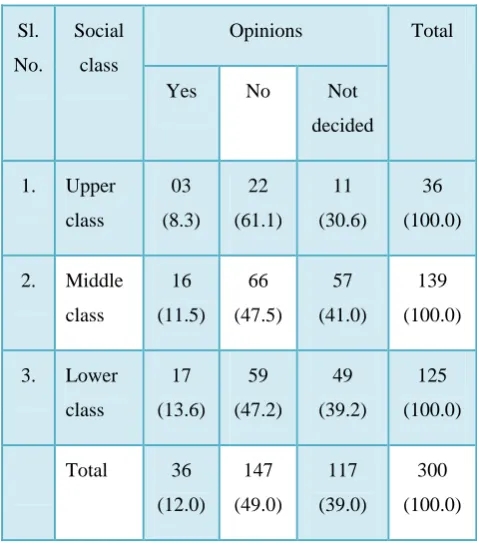
Social class and opinion regarding conversion to other religions
Sl. No.
Social class
Opinions Total
Yes No Not decided
1. Upper class
03 (8.3)
22 (61.1)
11 (30.6)
36 (100.0)
2. Middle class
16 (11.5)
66 (47.5)
57 (41.0)
139 (100.0)
3. Lower class
17 (13.6)
59 (47.2)
49 (39.2)
125 (100.0)
Total 36 (12.0)
147 (49.0)
117 (39.0)
300 (100.0)
As far as social class is concerned a most of the upper class respondents do not want to convert to other religions. But among the respondents who have already decided to convert, most of the respondents belonged to middle and lower social classes. It shows upper class respondents have been enjoying equal social status with the mainstream of the society, whereas the respondents of lower social class have been experiencing inferiority complex. Hence one may find differences of opinions concerning to conversion.
Table 2
Reasons for conversion
Sl. No.
Reasons Frequency Percentage
1. Inequality in Hinduism 80 26.7
2. To remove caste stigma 45 15.0
3. To acquire higher status in the society
112 37.3
4. Attraction towards other religions
63 21.0
Total 300 100.0
The study revealed that conversion helps for attainment of higher social status in society. Because in most of other religions there is no caste based discrimination resemblance to caste system of Hinduism. Among all the respondents 37.3%(112) respondents have opined that so many people convert to other religions to acquire higher status in the society.26.7%(80) respondents have said that low caste people and scheduled tribe people convert to other religions due to practice of inequality of Hinduism. In Hinduism the practice of casteism is present even today 21.0%(63) respondents have opined that the people convert to other religions only due to attraction towards other religions other religions like christainity, Buddism are based on equality. Remaining 15.0% (45) respondents have indicated that the people embrace to other religions to remove caste stigma in Hinduism.
Thus the people of lower castes and scheduled tribes convert to other religions to enhance their social status, to come out of clutches of Hinduism and to inculcate the principles of other religions. In this way it is clear that conversion is helpful to achieve higher social status.
Further in the present study an attempt is made to understand the opinions of the respondents conversing changes after conversion.
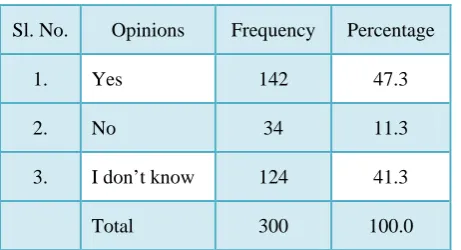
Opinion regarding changes after conversion
Sl. No. Opinions Frequency Percentage
1. Yes 142 47.3
2. No 34 11.3
3. I don’t know 124 41.3
Total 300 100.0
The data has clearly indicated that conversion definitely brings about changes in the life of the converted people. But some respondents have not given clear opinion concerning the aspect. Among all the respondents 47.3(142) respondents have opined that no doubt conversion brings about changes. But 11.3%(34)respondents are of the opinion that conversion does not bring any changes in the life of converted people. But remaining 41.3%(124) respondents have no idea regarding conversion and results of conversion.
Thus from the above table it is clear that conversion brings about lot of changes in the life of the converted people. Therefore further an attempt is made to know the changes occurred after conversion.
Table 4
Changes occurred after conversion
Sl. No.
Changes Frequency Percentage
1. High status in the society
39 13.0
2. Remove caste identity 89 29.7
3. Bring socio-economic change
14 4.7
4. No opinion 154 51.3
5. Others 04 1.3
Total 300 100.0
cannot be identified with caste. But he is being identified by religion but not caste. At the same time they can get higher social status in the society. Among all the respondents, who have said that conversion brings about changes, 29.7%(89) respondents have opined that conversion removes caste identity 13.0%(39) respondents have opined that conversion provides higher social status in the society. 4.7%(14) respondents have said that conversion brings about social, economic changes among converted people. Remaining 51.3%(154) respondents have not given any definite opinion regarding this aspect.
Thus it is understood that conversion brings about changes in the life of converted people. Further an attempt is made to under stand the feelings of respondents if they would convert to other religions.
Table 5
The feelings of respondents if they convert to other religions
Sl. No.
Opinions Frequency Percentage
1. Sense of liberation from caste bindings
60 20.0
2. A sense of feeling something new in future
71 23.7
3. One can achieve higher social status in society
19 6.3
4. Others 08 2.7
5. No opinion 142 47.3
Total 300 100.0
As it is already clear that most of the respondents have not interested in conversion to other religions. These respondents have not given any response to the above question. Among other respondents 23.7%(71) respondents have opined that after conversion they feel a sense of something new in future. They look forward in their life.
they feel a sense of liberation from caste bindings and casteism. 6.3%(19) respondents have said that conversion helps one to achieve higher social status in the society. Remaining 2.7%(08) respondents have opined that conversion can bring about changes other than the above. But 47.3%(142) respondents have not given any opinion. They are of the opinion that conversion does not help to achieve higher social status in the society. Only self effort, good employment, proper utilization of government facilities can help depressed class people to achieve higher social status.
Conclusion
Thus the study has revealed that conversion helps for attainment of higher social status in the society. It is because in most of other religions there is no caste based discrimination resemblance to caste system of Hinduism. Therefore, the people of scheduled tribes wish to convert to other religions to enhance their social status to come out of clutches of Hinduism and to inculcate the principles of other religions. In this way it is clear that conversion is helpful to achieve higher social status.
References
Chakravarthy, M. and Singrole, C.S. “Problems of Tribal Education – A Key to Development” Man in India, Vol. 14, 1988, p. 91-96.
Danda, A.K. “Tribes In India” In Man in India. Vol. 68, 1988, pp. 313-334.
Elwin, V. “The Democracy of North-East Frontier of India” Oxford University Press, Oxford 1963, p. 84.
Jain, L.C. “Emancipation of Scheduled Castes and Tribes : Some Suggestions”. Economic and Political Weekly, Vol. XVI No. 9 Feb, 1981, p. 325.
Naik, D.J. “Tribal Welfare in Gujarat”. Social Welfare, Vol. 15 (12) March, 1969.
India”. Ashish Publishing House 8/81 Punjabi Badh. New Delhi, 1989.
Pati, R.N. and Jagatgdeb, L. “Tribal Demography in India”. Ashish Publishing House, New Delhi, 1991.
Pimplay, P.N. Profiles of Scheduled Caste Students, Punjab University Press, Chandigarh, 1980.
Rath, S.N. and Behera, D.K. “A Glance at the Problems of Educating the Tribal Children in India”. In Scheduled Castes and Scheduled Tribes in India, A Socio-Economic Profile by Upadhyay H.C. Anmol Publication, 1991, pp. 197-209.
Kamat, A.R. “Education and Social Change Amongst the Scheduled Castes and Scheduled Tribes”. Economic and Political Weekly, Vol. XVI No. 31, 1981, pp. 1279-1284.
Nurullah and Naik (1951), “The Indian Education Commission”. Quoted in Development of Education Among Tribal Women. By Patel, Tara Mittal Publications, Delhi, 1984, pp. 41.
Patel, Tara, “Development of Education among Tribal Women”. Mittal Publications, Delhi, 1984, pp. 1-8.
Singh, K.S. “Colonial Transformation of Tribal Society in Middle India”. Economic and Political Weekly, 13 (30) 1978.