THE UPTAKE OF NITROGEN, PHOSPHORUS AND POTASSIUM BY THREE CULTIVARS OF
WHEAT IN RELATION TO GROWTH AND DEVELOPMENT*
R. D. AsANA, P. K. RAMAIAH and M. V. K. RAo
Division of Plant Physiology, Indian Agricultural Research Institute, Delhi-12
SUMMARY
Tiller production (particularly secondary tillers), dry matter and uptake of N, P, and K per plant varied with variety in the order NP 824>NP 826>NP 828. The dry weight and nutrient uptake of the main shoot differed little with variety and the variation in these two attributes per plant was very largely due to number and weig-ht of tillers. The tillering activity was therefore limited more by apical dominance than by nutrient uptake. Hormonal and metabolic effects were apparently involved in the high apical dominance in SP 828, as seen from the early onset of the reproductive phase, low P content as per cent of fresh weight and some increase in tillering due to P-spray. The high mortality of secondary tillers and the consequent low car/tiller ratio of NP 824 wa~ due to limited root growth as v\-cll as uptake of nutrients. Although the dry matter or grain weight produced, per unit of nitrogen absorbed, was the lowest for NP 824, it produced the highest dry matter and grain yield. With equal uptake of nutrients, stem growth was reduced relatively more than grain yield under late sowing. These observation suggest that in breeding of a genotype with high efficiency for nutrient utilization, developmental a~pects must receive equal consideration with meta-bolic a5pects.
96 R. D. ASANA, P .. K. RAMAIAH, AND M. V. K. RAO
INTRODUCTION
There is no unanimity of opinion that high yielding varieties consistently respond to high levels of nutrient supply. Vose ( 1964) in his excellent review on varietal differences in plant nutrition, has discussed this and other aspects critically and it is unnecessary to refer again to earlier work.
The problem of high as well as efficient response to fertilizers is of great concern to Indian agriculture, but little basic research on this aspect has been carried out so far. Tanaka, Patnaik and Abichandani ( 1958) compared the nitrogen requirements of an indica variety, Ptb l 0, and a Japonica variety, Aikoku, of
rice in solution culture at 0, 5, 20, 60 and 150 ppm N levels. The optimal level for the indica variety was found to be 20 ppm N,
the grain yield decreasing with higher concentrations, and for
Japonica, 60 ppm, with little decrease in yield at 150 ppm. At
0 and 20 ppm, the performance of Japonica was poorer. The
soluble/protein nitrogen ratio in the shoot was similar in both during vegetative growth, but was considerably higher in indica,
at 60 and 150 ppm during the reproductive stage. It was concluded that the Japonica performed better than the indica at
higher levels because it utilized N more efficiently. Chinoy and Nanda ( 1952) reported that in wheat, under a long day, flowering was hastened, tillering was checked and the uptake of N and K was reduced, in comparison with normal day ; the uptake of P was, however, more under a long day. Similar trends were noted when an early and a late flowering variety were compared. It was concluded that the same regulatory mechanism controlled flowering, tillering and nutrient uptake.
The association between delay in flowering and increased tiller production has an important bearing on the performance of a variety under north Indian conditions, where temperature gradually rises when grains develop and a sudden rise in tem-perature adversely affects grain filling ( Chinoy, 1950; As ana and Williams, 1965). We considered it of interest therefore to study the uptake of N, P and K in three varieties of wheat, NPs 824, 826 and 828 ( T. aestivum), with small differences in
---·--~.---. .
NUTRITION AND GROWTH OF WHEAT 97
formation of double ridges ; (b) rate of elongation of the spike and of stem prior to ear emergence ; (c) rate of development of tiller-buds and tillers ; (d) rate of uptake of N, P and K from pretillering stage onwards ; (e) effect of spraying P and N plus K on tiller development and survival ; and (f) rate ofincrease in dry matter.
Only one level of external supply of N, P and K was used in view of the amount of work involved. The experiments were carried out under pot-culture in order to provide for better control of conditions.
ExPERIMENTAL PRoCEDURE
Three experiments were carried out, two during the 1959-60 season and the third in 1960-61. The plants were raised in glazed pots, each 45 em high and 22 em in diameter, filled with soil from a fallow land and mixed with 0 · 5 kg of well-rotted farm-yard manure. The pots were kept outdoors under natural conditions of light and temperature. Six uniform seedlings were retained per pot, after thinning, about a month after sowing. In the first two experiments, 2 gm each of ammonium sulphate, potassium sulphate and superphosphate were applied to each pot after thinning and another 2 gm of ammonium sulphate at the flag-leaf stage. In the third experiment, the first application of N, P and K was given three weeks after sowing and was of the same level as in the first two experiments. A week later, half the number of pots were sprayed with an aqueous solution of ~aH2P0
4
, adjusted with HCl to pH 4·0, and mixed with a wetting agent. Six sprays (500 to 1000 ppm P) were given between 27th December, 1960 to 23rd January, 1961, the total quantity of P sprayed per pot being 100 mg. After the maximum tiller number was attained, half the number each of control and P-sprayed pots were sprayed with a mixture of 1 per cent urea+ l per cent K"S04 on four occasions at approximately weeklyintervals.
The sowing dates for the three experiments were : Experiment I Experiment II Experiment III November 4, 1959 November 30, 1959 November 24, 1960
98 R. D. ASANA, P. K. RAMArAH, AND M. V. K. RAO
For the measurement of the various stages of development, dissections were made at periodic intervals in experiments I and II.
Total N and P content of dried plant material were deter-mined according to the methods described by Doneen ( 1932) and Piper ( 1942) respectively. The P-fractions were determined in fresh plant material according to the procedure given by Klein ( 1952). K was determined by the flame-photometer.
RESULTS
Due to different temperature conditions, the growth rate was slower, and total growth was less, in experiment II than in experiment I, but the varietal differences were nevertheless maintained. The results of experiment I are therefore discussed fully and those of experiment II are referred to for important comparisons. Since similar varietal differences were seen in experiment III, the effects of sprays of P and N
+-
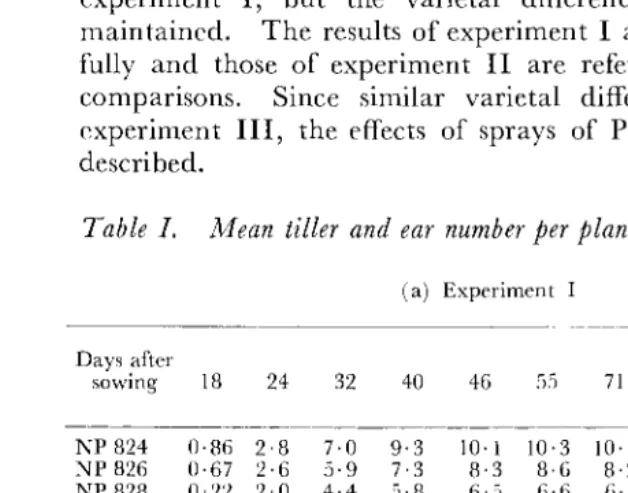
K only are described.Table I. Mean tiller and ear number per plant (excluding main shoot)
Days after
sowing 18 24 32
(a) Experiment
40 46 71 85 109 130 Ear No.
-NP 824 0·86 2·8 7·0 9·3 10·1 10·3 10·1 9·4 8·4 7·9 7·7 NP 826 0·67 2·6 5·9 7·3 8·3 8·6 8·2 7·9 7·4 7·3 7·5 NP 828 0·22 2·0 4·4 5·8 6·'i 6·6 6·'> G·9 6·3 5·9 '>. 9
L.S.D.'i';0P 0·08 0·08 0·07 0·40 0·40 0.'>4 0·77 (J.'i'l 0·40 0·41 0·6B
!b) Success of primary ano secondary til krs
l\laximum No. of pri-mary tillers
Ears from lVlaximum primary No. of
sec-tillers ondary tillers
Ears from secondary tillers ·
Total Ear Number \'aricly -Experimt'nt Experiment Experiment Experiment Experiment
II II JJ II II
- - -
NUTRITION AND GRO\YTI-I OF WHEAT ~)9
Tillering.-It can be seen from the data in table Ia that tiller production varied with variety in the order NP 824 > NP 826> NP 828, and this order consistently prevailed through-out. The maximum tiller number was reached at the same time in the three varieties. The ear/tiller ratio varied as NP 828= NP 826>NP 824. Dissections in experiments I and II revealed that the varietal difference in tillering was very largely due to secondary tillers and that their death rate was also much higher than that of the primary tillers (Table 1 b).
The data on number of unfolded leaves (Table II) showed that the rate of expansion of leaves on the main shoot was per-haps slightly faster in NP 824 in the very early stages but there-after it was more or less similar in the three varieties. NP 824 had one leaf more on the main shoot in experiment I but not in experiment II.
Days from sowing
Table II.
18
Number of unfolded leaves on main shoot
Experiment I
24 27 32 46 55 71 85
-NP 824 3·0 4·0 4·0 5·4 6·2 8·0 10·0 10·0
NP 826 2·0 4·0 4·0 5·2 6·2 8·0 9·0 9·2
NP 828 2·0 3·8 4·0 5·0 6·2 7·8 9·2 9·4
The rate of appearance of the primary tillers slightly lagged behind the rate of unfolding of leaves on the main shoot. For instance, on the 32nd day from sowing, in experiment I, the number of unfolded leaves on the main shoot varied as 5 · 4, 5 · 2 and 5 · 0, for NP 824, NP 826 and NP 828 respectively and the primary tillers varied as 4 · 2, 4 · 0 and 3 · 6; the number of secondary tillers, however, varied as 3·2, 2·0 and 0·8. Since the usual number of expanded internodes and leaves on the main shoot of the three varieties was 4 and 9 respectively, the first 5 internodes must be suppressed (below ground level), from which approximately 5 primary tillers developed. It appears that in these varieties more than 5 primary tillers can rarely develop and that they differ particularly in respect of secondary tillers.
100 R. D. ASANA, I'. K. RAMAIAH, AND M. V. K. RAO
Table III. Increase in length of ear of main shoot in mm.
Experiment I
Days from
sowing IR 24 27 32 46 71 8.-, 109
:\TP 824 0·58 O·R:i I ·30 2·20 3·0 10·0 I 16·0 14'1·0 !50·0 (V) (T) (DR I
.\'P 826 0·53 1·20 I ·80 2·80 4·0 19·0 IOR·O !30·0 !39·0 (V) (DR)
0/P 828 0·55 I ·30 2· 10 2·'i0 3·0 13·6 74·0 124·0 135·0 (V) (DR)
V =vegetative T '~'transitional DR~double ridges
than in NP 824 (Table III). The length of the ear primordium varied as Reprint asNP 828>NP 826>NP 824 up to 27 days, but thereafter the rate was faster in NP 826 up to 55 days, when the maximum tiller number was attained. Since then the increase in length of the ear was faster in NP 824. Similar trends were seen in the growth of the ear of the first tiller and in increase in the length of stems of main shoot and tillers (Table IV).
Table IV. Increase in total length
of stems (main shoot and tillers) per
plant in em.Days after sowing
NP 824 KP 826 :\TP R2R
32
0· 52 0·68 0·94
Experimcn t I
46
8·4 12·9 11·2
,-,3·8
6:i·2
62·8
71
243·0 240·0 125·0
83
411·0 43:i· 0
280·0
109
925·0 738·0 704·0
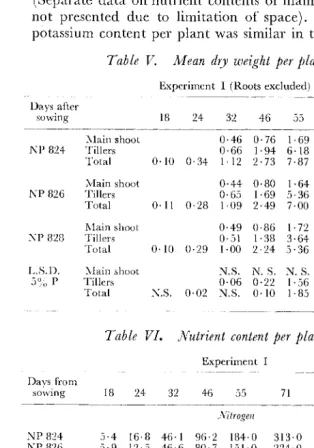
Increase in d1y matter.-The dry weight generally varied with variety in the order NP 824 >NP 826>NP 828, although the differences were not always statistically significant (Table V). The varietal difference was very largely due to weights of tillers, which varied in number in the same order.
---~- "---'~~---~
NUTRITION AND GRO\VTH OF WHEAT 101
as seen earlier, varied in number and weight in the same order. (Separate data on nutrient contents of main shoot and tillers are not presented due to limitation of space). In later stages, the potassium content per plant was similar in the three varieties.
Table V. Mean dry weight per jJlant in gm.
Days after sowing
Experiment l (Roots excluded)
18 24 32 46 55 71 83 109 130
---~---:\lain shoot 0·46 0· 76 1·69 2·9 4·8 6·3 NP 824 Tillers 0·66 1·94 6·18 13·2 22·6 31·6
Total 0·10 0·34 I· 12 2·73 7·87 16·1 27 ·4 37·9 40·9
:\lain shoot 0·44 0·80 1·64 2·8 4·6 6·2 NP 826 Tillers 0·65 1·69 5·36 11·1 22·9 30·4
Total 0·11 0·28 1·09 2·49 7·00 13·9 27·5 36·6 36·0
l\lain shoot 0·49 0·86 1·72 3·0 4·9 6·5 :\P 828 Tillers 0·51 1·38 3·64 8·2 16·2 25·7
Total 0·10 0·29 1·00 2·24 5·36 11·2 21·1 32·2 37·3
L.S.D. l\[ain shoot :'-J.S. N. S. N. S. N. S. N.S. xs.
5~,() p Tillers 0·06 0·22 1·56 3·50 4·99 N.S.
Total 1'\.S. 0·02 N.S. 0· 10 1·85 3·64 5·40 :'-J.S. 2·30
Table VI. Nutrient content per plant in mg.
Experiment I
Days from
sowing 18 24 32 46 55 71 85 109 130
J\itrogen
NP 824 5·4 16·8 46·1 96·2 184·0 313·0 362·0 381·0 355·0 NP 826 5·9 12·5 46·6 80·7 151·0 224·0 307·0 348·0 348·0 NP 828 5·2 12·8 41·0 79·3 121·0 200·0 279·0 308·0 307·0
-L.S.D. 5" o P 0·4 0·8 4·3 12·0 44·0 55·0 6\ ·0 N.S. 28·0
Phosj!ltorul
NP 824 0·92 2·9 7·0 l:"i·O 28·0 3:i·O 45·0 ,-,4·0 ,-,3·0 1\"P 826 0·98 2·0 2·0 13·0 26·0 32·0 42·0 47·0 4:)·0 1\"P 828 0·8:i 2· I 6·2 12·0 17· 0 27·0 38·0 44·0 44·0
L.S.D. 5';o P 0·10 0·16 0·7 2·0 7·0 xs. N.S. N.S. 2·6
Potassium
NP 824 ;)· 0 L-, .. -, 48·8 94·0 207·0 :{30· () 357·0 270·0 316·0
.'\P 826 ;)· 7 13·9 49·0 87·0 1r,-o 320·0 363·0 370·0 311 '0
:\'P 828 4·9 13·6 44·0 84·0 150·0 264·0 320·0 371 '0 322·0
L.S.D. 5"o P 0· 06 \ · 3 ='i.S. :\'.<::. \5·0 N.S. N.S. 1\".S. N.S.
-102 R. D. ASANA, P. K. RA:'v!AIAH AND M. V. K. RAO
The nutrient contents per plant of th~ three varieties in experiment II generally varied in the same order as in experiment I, and were also of equal magnitude, unlike dry weights which were lower in experiment II.
The contents of N, P and K as per cent of dry weight did not differ with variety. The per cent content was higher in experiment II than in experiment I, due to smaller dry weight in the former. In experiments I and II, the total P content, as per cent of fresh weight, during the first four weeks from sowing, varied as NP 824 >NP 826 >NP 828 and P-fractions varied similarly. Determinations were not made beyond this stage.
Grain yield per plant.--The mean grain yield of the three
varieties varied in the order NP 824 = NP 826 > NP 828 in experiment I and in the order NP 826 >NP 824 >NP 828 m experiment II (Table VII). The mean grain yield of
Table VII. Relation of total uptake of nutrients to growth and grain ~vield
N,P,K in mg/plant NP 824
NP 826
NP 828
Grain weight gm/plant
NP 824
NP 826
NP 828
Mean
N 381 348 308
L.S.D. 5% P for experiment L.S.D. 5'; 0 P for interaction
Stem length in em (:vrain shoot)
~p 824
NP 826
NP 828
Tiller stems length in em NP 824
NP 826
NP 828
Ear length in em (::\Iain Shoot)
NP 824
NP 826
NP 828
Experiment I
p 54 47 44 K 370 370 371 N 381 340 326
Experiment II
p 50 43 43 K 374 349 365
Experiment I Experiment II Mean L.S.D. 5% P
16·56 15·64 13·63 1C>·28 0·62 1·06
Experiment I
107 104 105 925 739 703 15·0 13·4 13-.'i 14·04 14·82 13·36 14·07
Experiment II
93 92 94 649 549 607 15·3 13· l 14·0
NUTRITION AND GROWTH OF \VHEAT 103
experiment II was slightly but significantly less than that of experiment I. The differences in yield were largely due to differences in car number (correlation codficicnt, grain yield. ear number=
+
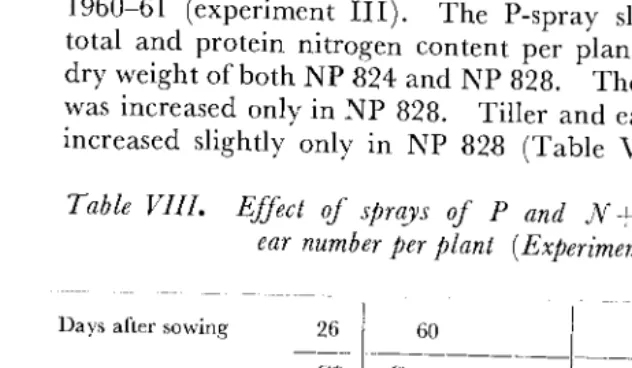
0 ·8618).Ejfect of P and N+K spray.-lt was seen that the P content, as per cent of fresh weight, during the first four weeks, was lower in NP 826 and NP 828. The effect of sodium phosphate spray, during the tillering phase, was, therefore, investigated during 1960-61 (experiment III). The P-spray slightly increased the total and protein nitrogen content per plant and as per cent of dry weight of both NP 824 and NP 828. The P content per plant was increased only in NP 828. Tiller and car number, however, increased slightly only in NP 828 (Table VIII).
Table VIII. Effect of sprays of P and N
+K
on tiller and final ear number per plant (Experiment Ill)Days after sowing 26 60 Ear l'<umbcr
·
-C*
c
P Mean C P NK PNK Mean
-NP 824 NP 826 NP 828
L.S.D. 5°~ P
I· 67 9·9 10·0 9·9 1·48 8·2 8·4 8·3 1·17 7·2 8·2 7·7
-0·14 8·4 8·9
L.S.D. 5';0 P
for variety (V) 0 · 32 , treatment (T) 0 · 26 , VxT 0·45
*C=Conlrol
5·0 5·3 5·4 5·4 5·3 5·4 5·3 5·5
4·8 5·0 4·9 5·1
-5·0 5·2 5·2 5·3
L.S.D. 5';o P for variety for treatment
5·3 5·4 4·9
0· Hi 0·15
Since the uptake of K, per unit increase in dry weight, during the period of declining tillering activity, was less in NP 824 than in NP 826 and NP 828, it was considered worthwhile
Table IX. Dry weight (W) and grain weight (G) in mg per mg N
\'aricty Experiment I Experiment II (W)
- - - · - - - · - - - · - - - -(G) (W) (G)
NP 824 NP 826 NP 828
105 103
121
43 4:1 44
82
81
91
104- R. D. ASANA, P. K. RAMAIAll, AND 1\1. V. K. RAO
to spray potassium sulphate plus urea and sec its effect on tiller survival. There was a small, but significant, increase in car number of all the three varieties (compare C and NK in Table VIII), but the car/tiller ratio of NP 824 was still the lowest. The plants that were sprayed earlier with P did not show further increase in ear number due to N + K spray (compare P and
PNK in Table VIII).
DISCUSSION
Relation of tillering to nutrient uptake.-Tiller production varied in the order, NP 824 >NP 826 >NP 828, from the very early stages. The dry weight per plant generally decreased in the same order, largely due to difference in respective weights and number of tillers. The N, P, K content of the plant, at various stages, varied more or less directly with dry weight. Comparison of the relative rates of uptake of N, P, K and of increase in dry matter of the plant (difference between log e values) indicated a more or less parallel variation in time. TheN, P, K contents of the main shoot and tillers were separately determined on three occasions during the active tillering phase in experiments I and II. TheN, P, K contents of the main shoot of the three varieties were more or less similar, whereas those of tillers (taken together) generally varied in the order NP 824 > NP 826 > NP 828. The N, P, K content, as per cent of dry weight, did not differ with variety at any time. It is, therefore, tentatively concluded that varietal difference in tillering was not directly determined by differential uptake of N, P and K.
Since the number of leaves on the main shoot did not differ materially with variety, the same number of positions was avail-able for the initiation of primary tillers. The rate of appearance of primary and secondary tillers varied in the order NP 824
>
NP 826>NP 828 and the difference in their maximum tiller number was very largely due to secondary tillers. It is suggested that the rate of tiller-bud growth decreased in the order NP 824, NP 826, NP 82{3 due to increase in apical dominance in the same order. Apical dominance is mediated through interaction of auxin with kinetin and also nutrient supply (Gregory and Veale, 1957; Wickson and Thimann, 1958).It is a matter of common observation that the rate of tiller formation normally declines or ceases at the time of stem
J,
\ ,
..
NUTRITION AND GRO\VTH OF \'\'HEAT 105
emerged (Cooper et al., 1949; Chinoy, 1950; Langer, 1965). It is also possible that changes in hormone activity, associated with the onset of flowering, may check growth of tiller buds (Leopold, 1949). It is likely that NP 826 and NP 828 had lower tillering activity than NP 824, because the reproductive activity (double ridges) set in a little earlier in the former two. It may be recalled that the development of the growing point as well of the stem was more advanced in NP 828 than in NP 826 up to about four weeks from sowing, but was slower thereafter, and in fact the ear emerged on the main shoot at the same time as in NP 824. One would therefore expect tiller production in NP 828 to catch up eventually with that in NP 826, but this did not happen. The senior author has also observed that although reproductive phase set in earlier in a dwarf Mexican wheat, Sonora 64, than in NP 876, the former produced one or more tillers per plant. It is therefore obvious that besides changes in hormone activity, associated with the onset of flowering, other factors, such as nutrients and their metabolism, may influence tillering.
It was pointed out that P content, as per cent of fresh weight, varied in the order NP 824>NP 826>NP 828. Varietal difference in P fractions as per cent of total P, or in protein con-tent as percentage of total nitrogen, was however not found. Spray of sodium phosphate increased tillering slightly but signi-ficantly in NP 828, this effect being associated with increase in uptake of nitrogen. Further work on P metabolism and nitrate reductase activity may throw more light on this aspect (c.f. Hoener and De Turk, 1939; Hegeman et al., 1916; Vose and Breese, 1964) .
Mortality of tillers.-The death-rate was much higher among
106 R. D. ASANA, !'. K. RAMALUI AND M. V. K. RAO
Relation of nutrient uptake to d1y weight and grain yield.-From
the data of Table VU it will be seen that the total uptake of N and P varied with variety as NP 824
>
NP 826>
NP 828, whereas that of K did not differ. Lack of complete correlation of varietal difference in uptake of P and N with that in grain yield may partly be due to small magnitude of differences. Even when the dry matter per plant was lower in experiment II (than in I) due to shorter growth period, the uptake of N, P and K did not diminish. It is likely that the uptake in the latter stages was largely determined by the developing grain, and as final grain weight was only slightly less in experiment II, the uptake in both experiments was similar. The dry weight per plant was appreciably less in experiment II, because of smaller stem length and it is noteworthy that with the same nutrient supply and uptake, thr:: growth of stem was relatively more affected than that of the ear in comparison with experiment I. This indicates the limited value of simple criteria like chemical com-position of leaves, or other tissues, in assessing the growth or yield potentiality of different genotypes under varying environmental conditions.NUTRITION AND GROWTH OF WHEAT 107
REFERENCES
Asana, R. D., Williams, R. F. (1965). The effect of temperature stress on grain development in wheat. Austral.]. agric. Sri., 16: I.
Chinoy . .J. J. (1947). Correlation b<"tween yield of wheat and temperature during ripening of grain. }{ature, 159: 442.
- - - (1950). Effect of vernalization and photoperiodic treatments on growth and development of wheat. ./'{ature, 1655: 882.
- - - Nanda, K. K. (1952). Effect of vernalization and photoperiodic treatments on growth and development of crop plants. IV. Uptake of nitrogen, phosphorus and potassium by wheat plant under varying photo-inductive and post-photoinductive trt"atments. Ph_ysiol. Plant., 5: II.
Cooper, J.P., Saeed, S. \\'. (1949). Studies on growth and development in Lolitlm.
I. Relation of the annual habit to head production under various systems of cutting. ]. Ecol., 37: 233.
Doneen, L. D. (1932). A micro-method for nitrogen in plant material. Plant Physiol., 1: 751.
Gregory, F. G., Veale, J. A. (1957). A reassessment of the problem of apical dominance. "The Biological Action of growth substances.'' P.I. The l!niversity Press, Cambridge.
Hageman, R. H., Flesher, D., and Gitter, A. ( 1961 ). Diurnal variation and other light effects influencing the activity of nitrate reductase and nitrogen metabolism in corn. Crop Sci., 3: 291.
Hoener, .J. R., De Turk, E. E. (1939). The absorption and utilization of nitrate nitrogen during vegetative growth by Illinois high protein and Illinois low protein corn. ]. Amer. Soc. Agron., 30: 232.
Klein, R. M. (1952). Nitrogen and phosphorus fractions, respiration and structure of normal and grown galls of tomato. Plant Physiol., 27: 335.
Langer, R.H.M. (1965). Growth and nutrition of timothy (Phleum pratense). I. The life-history of individual tillers. Ann. Af!pl. Bioi., 44: 166.
Leopold, A.C. (1949). Control of tillering in grasses by auxin. Amer. ]. Bot., 36: 437.
Piper, C. S. (1942). "Soil and Plant Analysis". The University Press, Adelaide. Tanaka, A., Patnaik G., Abichandani, C. J. ( 1958). Studies on the nutrition of the
rice plant (Oryz;a sativa L.) Part II. A comparative study of nitrogen requirement of indica and jafJonica varieties of rice. Proc. Indian Acad. Sci., 48B: 14.
Vose, P.B. ( 1963). Varietal differences in plant nutrition. Herbage Abst., 33: I. - - - - and Bresse, E.L. (1964). Genetic variation in the utilization of nitrogen
by ryegrass species Lolium perenne and L. multij/orum. Ann. Bot., 28: 251.