Article
Conceptualizing Public Space Using a Multiple
Sorting Task–Exploring the Links between Loneliness
and Public Space
Jing Jing1,*, David Canter2and Tigran Haas2
1 School of Architecture and Built Environment, Division of Urban and Regional Studies, KTH Royal Institute of Technology, 114 28 Stockholm, Sweden
2 Centre for the Future of Places, KTH Royal Institute of Technology, 114 28 Stockholm, Sweden; [email protected] (D.C.); [email protected] (T.H.)
* Correspondence: [email protected]; Tel.:+46-72-148-63-46
Received: 8 November 2019; Accepted: 22 November 2019; Published: 26 November 2019
Abstract: This study tests the viability of multiple sorting tasks (MST) as a method to explore perceptions of public space and its potential for people that are vulnerable to loneliness. The procedure integrates qualitative and quantitative aspects and obviates the challenge of people articulating how they interact with their surroundings, especially being aware of what features of their environment are influencing them. Two samples, each with six participants of varying ages and backgrounds, viewed 20 photographs of public spaces in Stockholm. They sorted these into categories based upon the activities they anticipated would occur there. Within each sample, a multidimensional scaling procedure was used to reveal the underlying structure across the combination of the six responses. The results showed coherent structures with interesting variations between people. A set of general multi-purpose places are identified, with others being differentiated in terms of whether they were ‘hard’ or ‘soft’ and ‘open’ or ‘enclosed’. The study also found that people conceptualized public space differently when loneliness was the focus during the sorting process. An assemblage of public spaces relevant for loneliness is also illustrated. This demonstrates the utility of the MST and provides theoretical and practical implications for urban planning and design that addresses loneliness.
Keywords: public space; multiple sorting task; loneliness; social interaction; theory of place; environmental probabilism; urban planning; urban design
1. Introduction
The importance of public space in urban areas for social activities and human wellbeing is commonly promoted amongst academia, civil society, and urban planning professionals [1–8]. The definition of public spaces (both conceptually and physically), however, can be a subject of constant debate that is often underpinned by local politics, ownership, and management [9–13]. Generally public space is understood to include places that are essentially open to the public. This ranges from outdoor open spaces such as parks, gardens, squares, and streets to indoor enclosed places like cafés, museums, libraries and malls, as well as virtual spaces that people increasing access through technological advances [14–16]. Time spent in public space is an integral component of daily life for urban dwellers. Although the personal benefits derived from public space have been widely discussed, previous studies mostly focused on the dimensions of physical health. This included benefits such as access to fresh air and opportunities for physical exercises that can reduce cardiovascular diseases and obesity [17,18]. As researchers continue to point out how the body and mind connect and work together for health outcomes [19,20], it is important to also understand the role of public space in mental health and overall wellbeing.
There is a growing body of literature demonstrating how the built environment affects mental health [21–23]. Increased social interactions and social support are distinct values that benefit mental health and can be positively affected by public spaces. Some examples of these benefits include: the restorative and healing effects provided by greater access to greenery and water [24–26]; improved physical accessibility and visual permeability of the front-yard for community building [27]; a strengthened sense of community and belonging produced by active public spaces in local neighborhoods [27,28]; opportunities for relaxation and social exchange provided by privately owned public space (known as POPS) [29] and “a home away from home” [30], as well as “commercial social support” [31] provided by “third places” for people who go there. These few examples underline how the physical and social environment influences how people feel and interact, which in turn impacts people’s health and wellbeing.
Loneliness is not a new phenomenon, but there is increasing concern that it is a growing problem around the world that poses a severe threat to public health and wellbeing and may be reaching historic levels in some countries [32–34]. The negative effects of loneliness range from decreased function of the immunity system and increased anxiety and depression to growing levels of early mortality [35], suicide [36], and violence [37]. These effects are physical, mental, and physiological, and also often attached to a fear of being stigmatized by admitting to others feelings of loneliness.
A core driver of loneliness is the subjective experience of having a deficit of desired social relationships. The (built) environment, and particularly public space, provides a setting where social encounters, interactions, and activities occur. It is highly plausible to assume that social encounters play a role in enabling social relationships to grow or be formed, and that deepening or expanding social relationships can lessen or mitigate feelings of loneliness. This paper builds upon these assumptions to hypothesize that public space can have an impact on social encounters, which in turn impacts on social relationships, and could have an impact on loneliness in urban populations.
Potential challenges to test this hypothesis in relation to urban planning and design include the following factors: (1) it requires multidisciplinary and interdisciplinary approaches to unpack the current knowledge of loneliness and its relation to the built environment; (2) there is a lack of effective tools to document and measure the experience of loneliness and overcome the high stigma perceived by many individuals about sharing their experiences; (3) the subjective nature and transient state of loneliness makes it more challenging to identify specific planning and design efforts that may be of relevance to loneliness and assess the effectiveness of measures taken.
The purpose of the present study is to find pathways for urban planning and design to address loneliness, given the aforementioned challenges. A proposed first step to test the hypothesis is to investigate how people perceive public space and whether people use public space in situations when they feel lonely. This study employs the multiple sort task (MST) method to explore these issues.
The MST [38] was first developed in the field of environmental psychology. It was previously applied to help individuals to articulate their perceptions of “multi-attribute domains” [39] such as architecture styles, casino space, etc. and to ultimately reveal their conceptual systems. This makes the MST of great potential for investigating conceptualizations of places and their relationship to loneliness. The core reason for choosing MST is that, following a long tradition in qualitative research, it is a mechanism of empowering respondents to use their own words/expressions to reveal the knowledge.
The study included two relatively small samples with the aim of testing MST’s viability for exploring people’s perception of public space and its potential for people who are vulnerable to loneliness in the Stockholm context. While striving to promote itself as a leading sustainable city [40], Stockholm inevitably faces urban transformation challenges in terms of hosting a growing urban population, an aging society, a housing shortage, and serving as the capital of the country which has the highest number of single person households in the EU [41].
Urban Sci.2019,3, 107 3 of 22
photographs to different categories that they developed themselves. They were requested to put the photographs into distinct groups on the basis of the activities they anticipated would occur there. The data were collected in a qualitative fashion. On average each individual MST procedure was performed over 30–40 min (Sample One) and 60–80 min (Sample Two), including the sorting and commentaries by the participants of the ideas behind their assignment of places to categories. A multidimensional scaling procedure (MSA) was performed to quantitatively analyze the underlying structure across the combination of the six responses for each sample. The content of the commentary was analyzed to elicit associations to public space in relation to loneliness.
The relatively small sizes of the samples presents a potential limitation to generalizing the theoretical implications of the results. However, despite these possible limitations, the results of these samples showed coherent structures with interesting variations between people. A general multi-purpose set of places were identified, with others being differentiated in terms of whether they were ‘hard’ or ‘soft’ and ‘open’ or ‘enclosed’. Public spaces were conceptualized differently when respondents considered conditions under which they felt lonely. An assemblage of public spaces that are relevant for people when they are in situations of feeling lonely were identified, though these were slightly different for the young adults ofSample Onewhen compared with the elderly ofSample Two.
The paper is structured as follows. The theoretical background of the study is presented in Sections1.1–1.3. This is followed by a detailed account of the material, methods, and procedures in Section2. Section3presents the results of the study, followed by discussion of the findings in Section4. Conclusions are provided in Section5.
1.1. Loneliness in the Urban Context
Loneliness is commonly understood as the discrepancy between one’s desired social relationships and one’s perceived actual social relationships [42]. Scholars have endeavored to define this by using various direct [43,44] and indirect measures [45,46]. Robert Weiss expressed his concern that loneliness could be defined by objective indicators [47] in his influential bookLoneliness: The Experience of Emotional and Social Isolation[48].
While there is a prevailing view amongst societies that loneliness and social isolation are interchangeable [49], others distinguish social isolation from loneliness [50]. They note that people who are objectively socially isolated do not necessarily feel lonely if they do not have personal longings for additional social contact. Solitude, that is noted in some studies as a type of necessary loneliness, as a means to evoke creativity and concentration [51,52], is not the focus of this study. Instead, it considers the ongoing rising levels of loneliness as a negative public health issue. This follows the claims of social psychologist John Cacioppo that loneliness is a fundamental part of human nature and occurs as a social pain that signals an individual’s longing for social connections [53].
Studies have found that loneliness does not follow a simple linear progression of when it occurs in life [54,55]. In fact, it is found across all ages, genders, educational backgrounds, income levels and cultures [56,57]. Recent research from the US reported that loneliness peaks at three age periods: the late 20s, mid-50s, and late-80s [58]. Further, according to the European Social Survey data, polled across 25 European nations [59], adolescents and people of an older age appear to be at higher risk of self-reported loneliness. The common pattern here is that loneliness occurs more often during transition periods when people feel compelled to re-identify themselves within the society. People moving in and moving out of loneliness also adds complexity to evaluating loneliness in individuals and societies. This said, people can be vulnerable to feeling lost, isolated, alone, and lonely, either chronically or temporarily at any point in time. Feelings of loneliness can emerge while in a crowd, in a relationship, or marriage, as well as when one is not in the company of others [60].
have identified the neighborhood environment and mobility as factors contributing to loneliness [63,64]. The latter are closely tied to urban structures and the design of the environment. Weijs-Perreéet al. found that a higher perceived neighborhood quality relates to lower level of self-reported loneliness [65]. Other studies claim that people living in low density suburbs reported higher loneliness [66]; car ownership seems to be associated with lower loneliness [67] because it provides flexible traveling options for people to move between places for social activities, while multiple modes and higher frequency of transportation was also found to be associated with lower loneliness [64]. These suggest that the neighborhood environment and transportation are crucial aspects of the infrastructure relevant to social interactions, which can impact the different risk levels for experiencing loneliness.
1.2. Theory of Place
The relationship between humans and the environment has long been investigated. Concepts such as dwelling [68,69], home(ness) [70,71], place (and placelessness) [72], place attachment [73], and place identity [74] have all been part of these studies. The driving force of all of these is human interest of self-knowledge and the search for meaning.
The ongoing debate of environmental determinism [75,76] and environmental possibilism [77,78] has been traditionally embedded in urban planning and design theory. The former emphasizes the external factors, such as climate, influence human livelihoods, health, culture, civilization, politics, intelligence, religion, etc., whereas the latter considers that the “environment is never more than an advisor”. Science and technology provide strong evidence of the power of human endeavor rather than environmental factors [79] which in turn has effects on human society and behavior [80]. Fekadu [81] called for a middle ground where the two stands consider how much the environment can influence humans and vice versa. Environmental probabilism, as the middle ground, considers the probabilistic relationship between physical environments and human behavior. Although features of the physical environment lend themselves theoretically to all possibilities, the layout, location, and arrangement of space and facilities render some behaviors much more likely, and thus more probable than others [82–84].
Canter proposes that there are three ways of thinking about the relationship between people and place: determinist, interactionist, and transactionist [85] (Figure1). His transactionist view seems to resonate most closely with the environmental probabilism perspective. A transactionist views people’s use of place as a mixture of what people expect and think about those locations and what actually happens there. These conceptions and actions are facilitated by what the physical form symbolizes and makes possible. It facilitates by filtering, allowing appropriate heat, light, and noise in, and keeping unwanted heat, light, noise, and other physical processes like rain out, as well as actually providing space for what people want to do there.
Urban Sci.Urban Sci.20192019,,3 3, 107, 107 5 of 23 5 of 22
Figure 1. Relationships between people and place: determinist, interactionist, and transactionist. (Source: created by the author, derived from reference [85]).
Further, people can influence their relationship with the surrounding environment in ways beyond the modification of its physical conditions. They may change the nature of their surrounding environment and give meaning to it through manipulation and modification of the physical and social environment (for instance by selecting people with whom they mix and to whom they respond) and through interpreting the purposes expected for a place or the importance it holds. For example, the renowned architect Louise Kahn once claimed that the users of the biology laboratories he designed, unsympathetically abused his design because they covered the huge window (a key design feature) with brown paper preventing sun destroying their experiments; Prince Charles’s attack on the proposal of Mansion House Square designed by Mies von der Rohe was in the same vein [86].
1.3. Investigating Links between Loneliness and Public Space using MST
Figure 1. Relationships between people and place: determinist, interactionist, and transactionist. (Source: created by the author, derived from reference [85]).
1.3. Investigating Links between Loneliness and Public Space using MST
Prior to the MST, “sorting” as a model used in psychology studies had utilized Q-sorts [87], repertory grids [88] to open-ended procedures [38]. Earliest work of this kind is found in explorations of concept formation and linguistic behavior (e.g., Vygotsky, 1934, Bruner et al. 1956) [89,90]. This study uses MST to explore people’s conception of public places as well as links between loneliness and the use of public space. The MST is derived from personal construct theory [91]. It is an open-ended interview method focusing on the activity of sorting to reveal people’s constructs (categorizations) of various entities. The underlying principle is derived from two psychological assumptions: the significance of the respondent’s own view of the world; and that this world view is built around a pattern of categorizations [38].
The sorting as an activity can be designed around visual material such as photographs, cards, paper notes, logos, and object elements. It can be conducted with repetitions through multiple sorts which can enhance the data quality [92,93]. The procedure integrates qualitative and quantitative aspects and can be performed verbally, non-verbally or combined. Visual methodologies, such as autophotography and photo elicitation in anthropology and ethnography research, share some similarities with the MST [94,95], though their analytic frameworks differ. The MST was highlighted in recent mental health research for its effectiveness for investigating depression [94,96]. It is also a relatively time- and cost-efficient method [39,93], which could make its wider application in urban design research more easily achieved.
2. Materials and Methods 2.1. Participants and Material
The study consists of two samples (Sample OneandSample Two), each with six participants, conducted consecutively in the city of Stockholm. Sample One performed one sorting round and addressed loneliness only verbally through a commentary session.Sample Twoadded a second sorting round directly addressing loneliness in order to record responses from participants gained by their “doing” (sorting/non-verbal) and “saying” (commentary/verbal) with specific instructions to consider links between loneliness and public space. The data was collected with the consent of the participants, who were informed that full protection of their identity was provided and that no personal information would be disclosed in any form of scientific or other articles.
• Sample One: Adults aged 24–35, three women and three men, all of which had lived in the
Stockholm city area for more than four years, two born and raised in Stockholm, all had lived abroad for study or work purposes.
• Sample Two: Elderly aged 67–74, all female retirees, all of which had lived in Farsta, a suburb of
Stockholm, for more than four years, all were Swedish citizens.
The principle criteria for recruiting the participants is that they volunteered to take part in the MST as they became interested in communicating on the study subject which they learned from the researchers. The age cohorts of the samples reflect the high-risk age groups of loneliness mentioned in previous section. The residence period takes account of the likelihood of the participants knowing the actual public places represented through the photographs since familiarity of the places in the photographs can be an influential factor of people’s conception of places [97]. The background of an international living experience was viewed as being relevant for the group aged 24–35, as transitions and changes of the physical environment and social life can increase vulnerability to loneliness within this age group in particular [98].
Urban Sci.2019,3, 107 7 of 22
useful to consider populations who are vulnerable to loneliness rather than only targeting already self-reported lonely people. According to Johann Hari, the best way to understand loneliness is to deepen the understanding of where and what may go wrong that leads to the onset of loneliness [99]. The responses from participants who did not pre-identify themselves as lonely are therefore relevant and this can be compared to the data from self-reported lonely people at a later stage (this will be done as part of the doctoral research underway, of which this study is one part).
Using color photographs to simulate the real environment has been validated in studies of landscape and architecture [39,97,100,101]. For this study, 20 color photographs of public space (excluding virtual public space) in Stockholm were chosen by the researchers through internet open source materials (e.g., Google, Bing) inSample One(FigureA1in AppendixA), whereas inSample Two the 20 public spaces (FigureA2in AppendixA) were first collectively nominated by a small group of the elderly representatives at a workshop and then the researchers utilized the photographs in the same manner as forSample One.
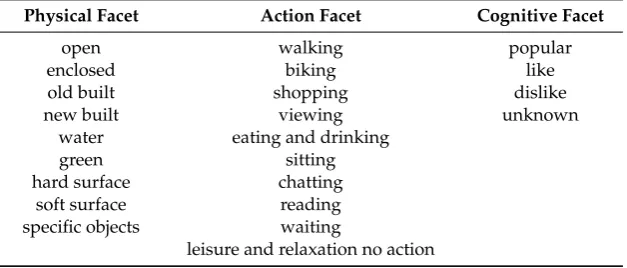
The weather appearing in all photographs is consistent. A variety of actions were captured in the photographs which reflect the three facets of place: physical, actions, and cognitive [102]. For the physical attributes, the chosen photographs reflect elements such as open, enclosed, old built, new built, water, green, hard surface, soft surface, and specific objects. The actions consist of walking, biking, shopping, viewing, eating and drinking, sitting, chatting, reading, waiting, leisure and relaxation and no action. The cognitive facets are popular, like, dislike, and unknown (Table1).
Table 1. The three facets and elements reflected in the photographs for multiple sorting tasks (MST) procedures.
Physical Facet Action Facet Cognitive Facet
open walking popular
enclosed biking like
old built shopping dislike
new built viewing unknown
water eating and drinking
green sitting
hard surface chatting
soft surface reading
specific objects waiting
leisure and relaxation no action
In each sample the 20 photographs were coded with alphabet A-T texts specifying the places or environment settings. These were printed under each picture. Photographs C, K, L, and P were kept the same in both samples since these four places were the top rated places to go when feeling lonely by the participants ofSample One. The remaining 16 photographs ofSample Onediffered fromSample Two as these places were imposed by the researchers for the former and the by the participants for the latter. Notably,Sample Twoproposed by the participants from Farsta neighborhood consisted of twelve places in the local Farsta area and eight places in the city. Half of these places in the city were also used in Sample One.
2.2. Procedures
The MST applied in the study consisted of (1) sorting, including writing descriptors; (2) commentary, including discussing aloud the notes of groupings and responding to four specific questions. The commentary part functions as a member check and verbal elaboration.
I am carrying out a study of what people think and feel about public space so I am asking a number of people chosen at random to look at the following pictures and sort them into groups in such a way that all the pictures in any group are similar to each other in some important way and different from those in other groups. You can put the pictures into as many groups as you like and put as many pictures into each group as you like. It is your view that counts. When you have carried out a sorting, I would like you to tell me the reasons for your sorting and what it is that the pictures in each groups have in common.
ForSample One, the instruction for the sorting is as shown above. ForSample Two, the first sorting round asked the participants to focus on thinking of their experience with the actual places in the photographs. The second sorting round directly asked how the participants would like to sort the places if they were in situations of feeling lonely. The order of the two sorts withinSample Twocannot be reversed as the first sort intended to allow the participants to respond freely to the photographs against the second sort of “loneliness” imposed as the main focus for the participants’ responses.
During the procedure, each participant conducted the sorting alone at first, followed by giving descriptors for each grouping assigned. Afterwards in the commentary session, they verbally elaborated their reasoning for the sortings and associations to the places. A single round sorting took about 15–20 min, followed by commentary of 15–20 min.Sample Onespent an average of 30–40 min for each individual MST procedure, and forSample Twoit was 60–80 min.
3. Results
3.1. Analysis
3.1.1. Multidimentional Scalogram Analysis (MSA)
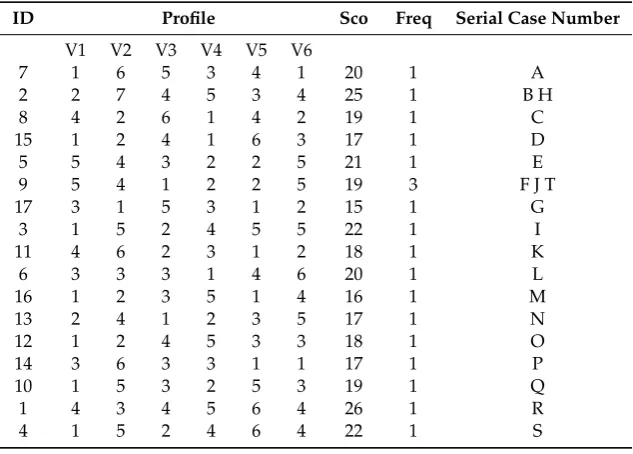
A multidimentional scalogram analysis (MSA) [38,39,93,96,97] was carried out to see whether there were similarities or differences amongst the places sorted by different individuals. The software HUDAP (1997) [103] was used to compute information from the data matrix produced from the sorting tasks using “MSA-1”, though there is other software available for this type of analysis such as the NewMDSX suite [93]. In this non-metric multivariate statistical procedure, each participant’s grouping of the photographs is assigned as a “profile” which can be compared to the profiles of all the photographs. The overview of the MSA result forSample Onecan be seen in Table2. It specifically treats each response as a categorical one comparing the categories with each other. The various categories assigned by different individuals are unique themselves, however their order and meaning are not incorporated into the MSA.
Each picture is given a coordinate by MSA and can be plotted in a Euclidean space as a point, which makes a two-dimensional representation possible. MSA measures the distance between given objects (points in space) [38,93,97]. The closer the points are to each other, the more similar the photographs are considered to be. The photographs that were more frequently grouped together are closer together and therefore can be regarded as conceptually more similar to each other. Points which are further away from each other represent places are that conceptually different to participants.
Urban Sci.2019,3, 107 9 of 22
Table 2.Overview of MDS report ofSample One.
ID Profile Sco Freq Serial Case Number
V1 V2 V3 V4 V5 V6
7 1 6 5 3 4 1 20 1 A
2 2 7 4 5 3 4 25 1 B H
8 4 2 6 1 4 2 19 1 C
15 1 2 4 1 6 3 17 1 D
5 5 4 3 2 2 5 21 1 E
9 5 4 1 2 2 5 19 3 F J T
17 3 1 5 3 1 2 15 1 G
3 1 5 2 4 5 5 22 1 I
11 4 6 2 3 1 2 18 1 K
6 3 3 3 1 4 6 20 1 L
16 1 2 3 5 1 4 16 1 M
13 2 4 1 2 3 5 17 1 N
12 1 2 4 5 3 3 18 1 O
14 3 6 3 3 1 1 17 1 P
10 1 5 3 2 5 3 19 1 Q
1 4 3 4 5 6 4 26 1 R
4 1 5 2 4 6 4 22 1 S
3.1.2. Commentary Content Analysis
There are two parts in the commentary session: articulating aloud the reasoning for the sorting according to the descriptors; and responding to four specific questions directly addressing loneliness in terms of where people may go in situations of feeling lonely. This part was performed in English for the adults group aged 24–35 inSample One, and conducted in both Swedish and English with the elderly ofSample Two(the questions and description texts of the photographs were written in Swedish and printed on paper to hand over to the elderly during the MST procedure; the elderly responded mostly in Swedish occasionally using English words to complement or compare, e.g., lonely, alone, by myself; in Swedish: ensam, själv, utan sällskap). The questions used are:
(1) Which of the 20 places would you be most likely to go to?
(2) Which of the 20 places would you be most likely to go to if you felt lonely?
(3) Do you think any public space (places you go between your home and work) is missing in this selection? If yes, please indicate what they are. You can describe their physical environment, the activities there may be there, with whom you may go or if you may go there by yourself. (4) If you felt lonely (including temporally), where would you like to go and what kind of activities
would you wish to do?
3.2. Results
3.2.1. Visualization of the Conceptualizations
The sorting of the given public spaces for both samples is based on the participants inferring their experience of the places in the photographs. The descriptors the participants used in relation to this experience involve expected activities at those places, as well as emotions, feelings and senses felt from viewing the environments the photographs depicted. These descriptors either reflect an element of the three facets of place [102], or some combination of them. For example, descriptors for physical activities noted by participants include shopping, meeting friends, passing through, sitting, motion, etc.; descriptors for emotions, feelings, and senses included tourism, cultural, happy, relaxed, meditative places or passive places, and other places.
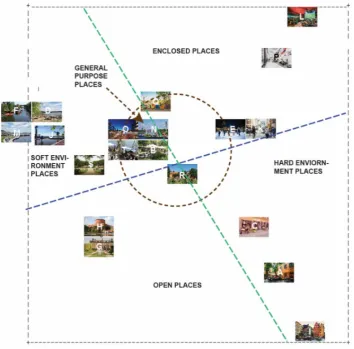
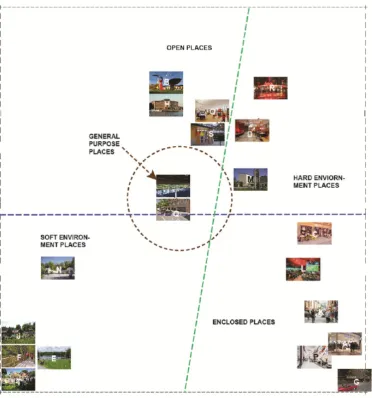
As each picture is coded and given an ID in the MSA procedure, it is possible to insert the original picture back into the two-dimension MSA outputs, which are originally presented with dots (with ID number) in the space (Figure2). ForSample One, five regions emerged from the MSA output. ‘General purpose places’ (GPP) cluster situates in the middle of the plot, ‘enclosed places’ (EP) locates in the upper part and ‘open places’ (OP) positioned in the lower left area, ‘soft environment places’ (SEP) are on the left side and ‘hard environment places’ (HEP) on the lower right. The structure progressed from the lower left ‘OP’/‘SEP’ region upward towards ‘SEP’/‘GPP’ then through ‘GPP’/‘EP’ and finally ends at ‘HEP’/‘OP’ which were in the lower right corner.
Urban Sci.2019, 3, 107 10 of 23
physical activities noted by participants include shopping, meeting friends, passing through, sitting, motion, etc.; descriptors for emotions, feelings, and senses included tourism, cultural, happy, relaxed, meditative places or passive places, and other places.
As each picture is coded and given an ID in the MSA procedure, it is possible to insert the original picture back into the two-dimension MSA outputs, which are originally presented with dots (with ID number) in the space (Figure 2). For Sample One, five regions emerged from the MSA output. ‘General purpose places’ (GPP) cluster situates in the middle of the plot, ‘enclosed places’ (EP) locates in the upper part and ‘open places’ (OP) positioned in the lower left area, ‘soft environment places’ (SEP) are on the left side and ‘hard environment places’ (HEP) on the lower right. The structure progressed from the lower left ‘OP’/‘SEP’ region upward towards ‘SEP’/‘GPP’ then through ‘GPP’/‘EP’ and finally ends at ‘HEP’/‘OP’ which were in the lower right corner.
Figure 2. MSA output of Sample one.
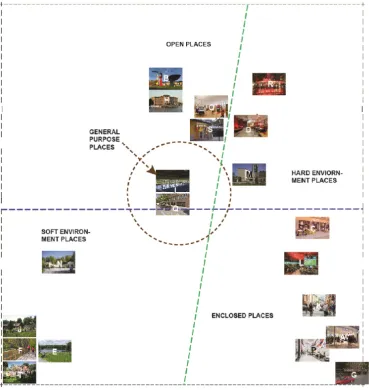
Similarly, for Sample Two’s first sorting focusing on place experience, five regions appear in the MSA output. After plotting the original picture back to the map (Figure 3), one can see two ‘GPP’ items right in the center of the plot, adjacent to a pair of ‘OP’ in the mid-upper plot and several ‘HEP’ in the mid-upper right area; a group of ‘EP’ hangs in the mid to lower right area; and a set of ‘SEP’ appears at the lower left. The structure progresses from ‘SEP’ on the lower left side up to ‘GPP’ and ‘OP’ then ends at ‘EP’ on lower right side.
Figure 2.MSA output of Sample one.
Urban Sci.2019,3, 107 11 of 22
right in the center of the plot, adjacent to a pair of ‘OP’ in the mid-upper plot and several ‘HEP’ in the mid-upper right area; a group of ‘EP’ hangs in the mid to lower right area; and a set of ‘SEP’ appears at the lower left. The structure progresses from ‘SEP’ on the lower left side up to ‘GPP’ and ‘OP’ then ends at ‘EP’ on lower right side.Urban Sci.2019, 3, 107 11 of 23
Figure 3. MSA output of the first sorting round of Sample two.
Sorting directly addressing loneliness was carried out in the second sorting round of Sample Two. It presents a different MSA output than the first sorting. Repeating the same technique, places can be visualized on a two-dimensional map (Figure 4). Four regions emerged in this map. One is a set of places noted by the participants as ‘general purpose places in the city that they can go to alone but are better to go to together with someone’ (GPP-CP- GA/BT) which clusters in the middle of the plot. A second group of places that features a major presence of nature was given the descriptor ‘local places that they can go to alone but are better to go to together with someone’ (LP-GA/BT) gather in the left and upper left region. A set of places featuring mostly hard surfaces or built environment structures were noted as ‘city places maybe they can go alone’ (CP-MGA) are placed in the middle right region. A group of four described as ‘local places that they can go alone’ (LP-GA) that feature enclosed settings are located in the lower region of the plot.
Although the two samples explored have chosen different sets of photographs, which can make any comparison challenging, they both carried out the sorting with a focus on a general place experience and their MSA outputs are mostly consistent. The ‘SEP’ region in Figure 2 and Figure 3 are similar with natural features such as water and greenery present. Public architecture venues with relatively classical building styles, such as museums, appear in the ‘OP’ region of both figures. Places for shopping and consumption can be seen in the ‘EP’ and ‘HEP’ regions in both samples as well.
Figure 3.MSA output of the first sorting round of Sample two.
Sorting directly addressing loneliness was carried out in the second sorting round ofSample Two. It presents a different MSA output than the first sorting. Repeating the same technique, places can be visualized on a two-dimensional map (Figure4). Four regions emerged in this map. One is a set of places noted by the participants as ‘general purpose places in the city that they can go to alone but are better to go to together with someone’ (GPP-CP- GA/BT) which clusters in the middle of the plot. A second group of places that features a major presence of nature was given the descriptor ‘local places that they can go to alone but are better to go to together with someone’ (LP-GA/BT) gather in the left and upper left region. A set of places featuring mostly hard surfaces or built environment structures were noted as ‘city places maybe they can go alone’ (CP-MGA) are placed in the middle right region. A group of four described as ‘local places that they can go alone’ (LP-GA) that feature enclosed settings are located in the lower region of the plot.
natural features such as water and greenery present. Public architecture venues with relatively classical building styles, such as museums, appear in the ‘OP’ region of both figures. Places for shopping and consumption can be seen in the ‘EP’ and ‘HEP’ regions in both samples as well. One exception was picture C (a local café), which was located slightly more toward the center in Figure2than in Figure3, where it is on the edge of the plot. Furthermore, photographs K, L, and P always stay close to each other in both samples.
Urban Sci.2019, 3, 107 12 of 23
One exception was picture C (a local café), which was located slightly more toward the center in Figure 2 than in Figure 3, where it is on the edge of the plot. Furthermore, photographs K, L, and P always stay close to each other in both samples.
Figure 4. MSA output of the second sorting round of Sample two.
A comparison of the two sorting rounds within Sample Two is straight forward because the photographs are the same. The MSA layouts and regions of the two sorting rounds have minor differences. Picture M (a local church) changed from in the area of ‘GPP’/‘OP’/‘HEP’ in the first round to ‘SEP’ (and places where one can go to alone but consider it to be better to go together with someone) in the second round. Picture N (Skansen) moved from ‘SEP’ in the first sort towards general purpose and open places in the city where you can both visit alone but it is better visit together with someone in the second round. Picture A (a second hand store) and G (a supermarket) moved away in the second sort from C, K, L, P cluster in the first round.
3.2.2. Verbal Elaborations
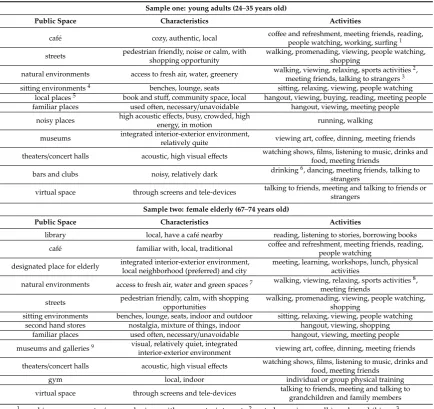
Drawing from the answers of the first two single-option questions, most participants, did turn to their favorite place when they felt lonely. For the 24–35 year old adult participants in Sample One, picture C (a local café) had the highest rate, whereas the highest rate for the elderly in Sample Two
Figure 4.MSA output of the second sorting round of Sample two.
A comparison of the two sorting rounds within Sample Twois straight forward because the photographs are the same. The MSA layouts and regions of the two sorting rounds have minor differences. Picture M (a local church) changed from in the area of ‘GPP’/‘OP’/‘HEP’ in the first round to ‘SEP’ (and places where one can go to alone but consider it to be better to go together with someone) in the second round. Picture N (Skansen) moved from ‘SEP’ in the first sort towards general purpose and open places in the city where you can both visit alone but it is better visit together with someone in the second round. Picture A (a second hand store) and G (a supermarket) moved away in the second sort from C, K, L, P cluster in the first round.
3.2.2. Verbal Elaborations
Urban Sci.2019,3, 107 13 of 22
picture C (a local café) had the highest rate, whereas the highest rate for the elderly inSample Twowas for picture O (a local library). The other two open questions managed to provide an assemblage of types of places, characteristics of the environments, and activities to engage in when feeling lonely (Table3).
Table 3.Characteristics of public spaces people like to go to when they feel lonely.
Sample one: young adults (24–35 years old)
Public Space Characteristics Activities
café cozy, authentic, local coffee and refreshment, meeting friends, reading, people watching, working, surfing1
streets pedestrian friendly, noise or calm, with shopping opportunity
walking, promenading, viewing, people watching, shopping
natural environments access to fresh air, water, greenery walking, viewing, relaxing, sports activities2, meeting friends, talking to strangers3
sitting environments4 benches, lounge, seats sitting, relaxing, viewing, people watching local places5 book and stuff, community space, local hangout, viewing, buying, reading, meeting people
familiar places used often, necessary/unavoidable hangout, viewing, meeting people noisy places high acoustic eenergy, in motionffects, busy, crowded, high running, walking
museums integrated interior-exterior environment,relatively quite viewing art, coffee, dinning, meeting friends theaters/concert halls acoustic, high visual effects watching shows, films, listening to music, drinks and
food, meeting friends
bars and clubs noisy, relatively dark drinking
6, dancing, meeting friends, talking to
strangers
virtual space through screens and tele-devices talking to friends, meeting and talking to friends orstrangers
Sample two: female elderly (67–74 years old)
Public Space Characteristics Activities
library local, have a cafénearby reading, listening to stories, borrowing books café familiar with, local, traditional coffee and refreshment, meeting friends, reading,
people watching
designated place for elderly integrated interior-exterior environment,local neighborhood (preferred) and city meeting, learning, workshops, lunch, physicalactivities natural environments access to fresh air, water and green spaces7 walking, viewing, relaxing, sports activities8,
meeting friends streets pedestrian friendly, calm, with shopping
opportunities
walking, promenading, viewing, people watching, shopping
sitting environments benches, lounge, seats, indoor and outdoor sitting, relaxing, viewing, people watching second hand stores nostalgia, mixture of things, indoor hangout, viewing, shopping
familiar places used often, necessary/unavoidable hangout, viewing, meeting people museums and galleries9 visual, relatively quiet, integrated
interior-exterior environment viewing art, coffee, dinning, meeting friends theaters/concert halls acoustic, high visual effects watching shows, films, listening to music, drinks and
food, meeting friends
gym local, indoor individual or group physical training
virtual space through screens and tele-devices talking to friends, meeting and talking to grandchildren and family members
1working on computer/screen devices with access to internet;2 noted running, walking dogs, biking;3 one
non-Swedish participant noted that he would do such activities at cafés in other countries, e.g., Northern America, Korea, etc. but would not do in Sweden as he was aware of that might not be considered as ‘normal’;4both outdoor
and indoor;5noted comic bookstore;6with alcohol option;7noted the access to Swedish woods;8noted walking
dogs, playing boules;9noted that galleries have a commercial element, they usually present wider art communities
than the museums, they are also small in terms of their physical space on average.
4. Discussion
4.1. Contribution to Methodology: Viability and Value of MST
Whether the focus is the general experience of the place, or specific situations such as feeling lonely, the same places may be perceived differently between people, or even by the same person at different times in their lives [38].
The benefit of the multiple sorting tasks, together with its opportunities for people to discuss their category assignments, lies in its participatory process that is engaging and often enjoyable for the participant. By making sorting the focus of the interview, it allows people to state their conceptions about places without the need to fully clarify and verbalize how places may affect them. The commentary session affirms and enriches the references for understanding people’s associations to places. Overall, the MST has several key qualities that can make it effective. (1) It is a user-friendly interactive tool for both researchers and participants [93]. It enhances communication with its enjoyable form and ability to provide a learning opportunity for all involved. (2) It is time- and cost-effective for exploring people’s conceptual systems or constructs [39]. (3) It is flexible in the choices of material for the sorting and can be performed both verbally and nonverbally [38,39]. (4) Using MSA as the analysis tool allows the development of a quantitative structure to reveal the underlying bases for the qualitative material. It thus merges qualitative and quantitative aspects [93,96].
4.2. Contribution to Understanding the Nature of Interaction with Places
The aggregated results generally align with Canter’s theory of place [85,102] that emphasizes how people hold their own mental constructs of places which contribute to the meaning of a place for any individual. The results suggest that people’s use of public space is likely influenced by their assumptions and expectations of activities which are afforded by those places. This also suggests that perceptions of places can be changed through manipulation of the physical environment as well as social and cultural forces [97]. This proposition could be perceived as being in line with the environmental probabilism perspective [81–84]. The relationship between people and place is dynamic, complex and dialectic, demanding careful examination. Acknowledging this can advance the understanding of the role of urban planning and urban design in relation to public space and the interrelationship between loneliness and public space.
4.3. Contribution to Understanding the Potential of Public Space in Mitigating Loneliness
The results of people’s conceptualization of public space in this study has complemented the current understanding of public space by providing an account of users’ subjective experience. This adds to Alimadanipour’s argument for a multi-dimensional definition of public space, addressing who public space matters for at a rhetorical and reality level [104], and Carmona’s overarching typology of contemporary public space as a reaction to the critiques anchored in the management aspect [11,12]. Through the MST demonstrated in this study, it shows that public accessibility is a key concern for individuals when considering going to a public space, and that this judgement is based upon the participants’ everyday living experiences of the city. The five categories ‘OP’, ‘EP’, ‘SEP’, ‘HEP’ and ‘GPP’ of public space discovered through the samples did not happen by chance. Distinguishing natural environment from the built environment has clearly objective basis, but its subjective implications, especially in an urban context have been emphasized in this study. Furthermore, the built environment has been found to be more complex and interesting because it is a mixture of physical, social, and culture components according to the individual conceptualizations shown in the samples.
Urban Sci.2019,3, 107 15 of 22
City sought to re-energize urban space for social use by inventing ‘privately owned public space’ (POPS) [29]. Another recent example includes the U.K. National Trust project on Loneliness, which is designed to get people to “start talking” to enhance the radical act of community service [105].
On the other hand, both inSample OneandSample Two,those “free” public spaces in terms of streets, libraries, elderly activity centers run by public authorities, as well as natural environments (like parks and waterfronts) are also important meeting places. As such, their presence in urban areas may contribute to reducing the loneliness of urban populations, though establishing a direct link would require further studies. This would be in addition to many other health benefits provided by the presence of nature that have been evidenced in various studies [17,18,21–26]. The effectiveness of these spaces as meeting places, however, may change under different circumstances. For example, one of the elderly participants (Sample Two) commented that in situations of feeling lonely, the picture of Skansen (picture N - the outdoor museum of Swedish culture and history) could make her feel comfortable by walking in a natural and nostalgic environment, but it could also emotionally trigger her loneliness to another level if she saw people around her in that environment were all in pairs or groups.
Familiarity of the actual places in the photographs during the MST procedure plays a vital role in people’s conception process [38,39,97]. One of the 24–35 year old adult participants (Sample One) commented on the picture of a local park (picture S, which features a fountain, trees, benches, and a circular street) that they would go to the place shown in the picture for lunch or to hang out if they did not know that place was “the only place people don’t say hello to each other”. This implies that the individual experience in terms of one’s perceived social dynamics and invisible local culture has a strong influence on people’s conceptualization of places. Similarly, one elderly participant (Sample One) commented on picture C, a local café, that the place looked nice and she may even go there if she felt lonely without the knowledge of what kind of crowd may hang out there. She emphasized that she would never go to that caféif she knew that the regulars of that place hold an opposing political view to her own. Hence knowing the place may be more important than the appearance of the place in influencing an individual’s conception of a place and the decision of whether to go there and what to do there.
When loneliness was directly addressed as a focus in the conception process during sorting in Sample Two,the central concern for the groupings of public space was the consideration of whether it is was better to go there alone, or together with someone else. Compared withSample One,loneliness was only addressed in the verbal part inSample Two, not in the non-verbal part (sorting). Sample Twoalso provided new inputs indicating a distinction between the self and perceived self-situation in relation to the environment. “Going alone” may imply different meanings: one indicates a sense of safety; the other means going alone to those places where you at least would not feel lonelier. Nevertheless, the assumptions the participants hold during their cognitive responses during sorting is that they were physically alone or emotionally felt alone if they are in situations of feeling lonely. Their perceived feeling of comfortableness influences their decisions on which places they can go to seek refuge or social interactions. Out of Cacioppo and Patrik’s tips of ways to find social connections against loneliness, “making the lonely person feel safe” is one of their most genuine pieces of advice because that feeling
can never be logically justified and an unsafe feeling is rooted in feelings of rejection [53].
Further, besides more common points shared by the young adults inSample Oneand the elderly ofSample Twoin their responses to a “place to go in situations of feeling lonely”, there was a slight divergence between the two groups. This demonstrated that social factors might have a stronger influence on what people think they can do and where to go when they feel lonely. For example, a “designated place for [the] elderly” was addressed by the elderly, and “bars and clubs” relating to alcohol consumption was marked by the young adults’ sample.
Finally, there are a few limitations of the study: (1) The current MST samples are relatively small, though the non-metric statistic nature of the analysis made the generation of useful findings possible; (2) the notion of ‘virtual public space’ has not been incorporated into the sorting procedure of the MST. This was discussed in the commentary session but was not included in the sorting itself; (3) ‘public transportation as public spaces’ was considered to be important but disliked by the participants. This shows the emergence of issues that need further exploration within the concept of public space. This leads to results that may undervalue its place in the context of understanding contributing factors to loneliness (and its mitigation), as public transportation can play a vital role in moving people between places for social interactions [64,67]; (4) the elderly sample was all female, as it was more difficult to find engaged males in that community who wished to participate and communicate. This means that gender differences in conceptualization may not be understood or included in the findings. Future studies that may increase the size of the sample with to increase the ability to generalize results should include male and female participants in each age group. Also, perspectives of the evaluation of planning and design of public space [106], as well as spatial knowledge acquisition [107] can be brought in to help advance understanding of the study subject. Nevertheless, the MST’s core strength is measuring proximity of results connoting similarity and differences in conceptions of place in individuals and between them, which is evidenced in the samples completed in this study.
5. Conclusions
The highlight of the study is that it has demonstrated the MST’s viability in eliciting people’s conceptualization of public space and its positive potential for investigating the link between loneliness and public space through a combined qualitative and quantitative methodology. Given the relatively small sizes of the samples, further applications of the MST in this field are recommended to test and compare results. The samples revealed that people conceptualize public space differently when they feel lonely. Although natural environments (‘soft environments’) give people comfort and therefore may be relevant to reducing feelings of loneliness, other social and cultural factors may change those perceptions of that environment and increase feelings of loneliness. Built environments with different features, including ‘open’, ‘enclosed’, ‘hard’, and ‘general purpose places’ (such as a café, library, street, bookstore, second hand store, local places for hanging out, etc.), were illustrated in the study as being able to provide opportunities for social interactions and social support in different ways. Further studies may possibly develop a typology of relevant public spaces that may alleviate specific types of loneliness within specific groups. It could include building a taxonomy of physical features and contexts of those relevant public spaces relevant to stimulating beneficial social interactions among and between groups. The uniqueness of the approach applied in this paper can contribute new pathways in understanding public spaces, and provide theoretical and practical implications for planning and urban design addressing loneliness.
Author Contributions: Conceptualization, J.J., D.C. and T.H.; methodology, J.J. and D.C.; software, J.J. and D.C.; validation, J.J., D.C. and T.H.; formal analysis, J.J.; investigation, J.J.; resources, J.J.; data curation, J.J.; writing—original draft preparation, J.J.; writing—review and editing, J.J., D.C.; visualization, J.J.; supervision, D.C. and T.H.; project administration, J.J.; funding acquisition, J.J.
Funding:This research was made possible by the Axel and Margaret Ax:son Johnson Foundation.
Acknowledgments: The authors would like to thank all respondents whom volunteered to participate in the MST. Special thanks to Mats Lundström, Stefan Lundberg and Hannes Hellgren for their support in assisting the workshops with the elderly in Farsta Stockholm. Additionally the author would like to thank Andrew P. Karvonen for his review and comments for the paper’s first draft.
Urban Sci.2019,3, 107 17 of 22
Appendix A
Urban Sci.2019, 3, 107 18 of 23
Appendix A
Figure A1. Sample One: 20 public spaces for MST (selected by the authors).
Figure A2. Sample Two: 20 public spaces for MST (selected by the participants from Farsta Stockholm).
Urban Sci.2019,3, 107 19 of 22
References
1. Whyte, W.H.The Social Life of Small Urban Spaces; Conservation Foundation: Washington, DC, USA, 1980. 2. Jacobs, J.The Death and Life of Great American Cities; Vintage: New York, NY, USA, 1961.
3. Alexander, C.; Ishikawa, S.; Silverstein, M.; Jacobson, M.; Fiksdahl-King, I.; Angel, S.A Pattern Language: Towns, Buildings, Construction; Oxford University Press: New York, NY, USA, 1977.
4. Lynch, K.The Image of the City; MIT Press: Cambridge, MA, USA, 1960; Volume 11.
5. Project for Public Spaces. Available online: https://www.pps.org/article/grplacefeat(accessed on 3 November 2019).
6. Shaftoe, H.Convivial Urban Spaces: Creating Effective Public Places; Earthscan: London, UK, 2008. 7. Gehl, J.Life between Buildings: Using Public Space; Island Press: Washington, DC, USA, 2011. 8. Sennett, R.Building and Dwelling: Ethics for the City; Penguin: London, UK, 2018.
9. Mitchell, D. The End of Public Space? People’s Park, Definitions of the Public, and Democracy.Ann. Am. Assoc. Geogr.1995,85, 108–133.
10. Kaydon, J. Using and Misusing Law to Design the Public Realm. InRegulating Place: Standards and the Shaping of Urban America; Ben-Josef, E., Szold, T., Eds.; Routledge: New York, NY, USA; London, UK, 2005; pp. 115–140.
11. Carmona, M. Contemporary public space: Critique and classification, part one: Critique.J. Urban Des. 2010, 15, 123–148. [CrossRef]
12. Carmona, M. Contemporary public space, part two: Classification.J. Urban Des.2010,15, 157–173. [CrossRef] 13. Low, S. The Erosion of Public Space and the Public Realm: Paranoia, surveillance and privatization in New
York City.City Soc.2006,18, 43–49. [CrossRef]
14. Turkle, S.Life on the Screen: Identity in the Age of the Internet; Simon & Schuster: New York, NY, USA, 1997. 15. Zizi, P. The Virtual Sphere 2.0: The Internet, the Public Sphere and beyond. InRoutledge Handbook of Internet
Politics; Chadwick, A., Howard, P., Eds.; Routledge: London, UK; New York, NY, USA, 2010.
16. Graham, S.; Aurigi, A. Virtual Cities, Social Polarization, and the Crisis in Urban Public Space.JUT1997,4, 19–52. [CrossRef]
17. Xu, Y.; Wang, F. Built Environment and Obesity by Urbanicity in the U.S.Health Place2015,34, 19. [CrossRef] 18. Lopez, R.P.; Hynes, H.P. Obesity, physical activity, and the urban environment: Public health research needs.
Environ. Health2006,5, 25. [CrossRef]
19. Lutwak, N.; Dill, C. The Mind Body Connection and Cardiovascular Disease. Int. J. Clin. Pract.2012,66, 1126–1127. [CrossRef]
20. Karren, K.; Smith, N.; Gordon, K.Mind/Body Health: The Effects of Attitudes, Emotions, and Relationships, 5th ed.; Pearson: London, UK, 2013.
21. Halpern, D. Mental Health and the Built Environment.J. Biosoc. Sci.1997,29, 251–256.
22. Alcock, I.; White, M.P.; Wheeler, B.W.; Fleming, L.E.; Depledge, M.H. Longitudinal effects on mental health of moving to greener and less green urban areas.Environ. Sci. Technol.2014,48, 1247–1255. [CrossRef] 23. Francis, J.; Wood, L.J.; Knuiman, M.; Giles-Corti, B. Quality or quantity? Exploring the relationship between
Public Open Space attributes and mental health in Perth, Western Australia.Soc. Sci. Med.2012,74, 1570–1577. 24. Oldenburg, R.The Great Good Place: Cafes, Coffee Shops, Bookstores, Bars, Hair Salons, and Other Hangouts at the
Heart of a Community, 3rd ed.; Marlowe & Company: New York, NY, USA, 1999.
25. Rosenbaum, M.; Ward, J. A cup of coffee with a dash of love: An investigation of commercial social support and third-place attachment.J. Serv. Res.2007,10, 43–59. [CrossRef]
26. Francis, J.; Giles-Corti, B.; Wood, L.; Knuiman, M. Creating sense of community: The role of public space. J. Environ. Psychol.2012,32, 401–409. [CrossRef]
27. Kayden, J. The Department of Planning of the City of New York, The Municipal Art Society of New York. InPrivately Owned Public Space: The New York City Experience; John Wiley & Sons, Inc.: Hoboken, NJ, USA, 2000. 28. Swapan, A.; Marinova, D.; Bay, J. Understanding the Importance of Front Yard Accessibility for Community
Building: A Case Study of Subiaco, Western Australia.Urban Sci.2018,2, 41. [CrossRef]
29. Kaplan, S. The Restorative Benefits of Nature: Toward an Integrative Framework.J. Environ. Psychol. 1995, 15, 169–182. [CrossRef]
32. Cacioppo, J.; Cacioppo, S. The Growing Problem of Loneliness.Lancet2018,391, 426. [CrossRef]
33. Campaign to End Loneliness. Available online:https://www.campaigntoendloneliness.org(accessed on 3 November 2019).
34. Tian, X. Loneliness: A Psychological Turning Point in the Reconstruction of the Urban Order in China. Soc. Sci. China2010,31, 147–164. [CrossRef]
35. Holt-Lunstad, J.; Smith, T.B.; Layton, J.B. Social relationships and mortality risk: A meta-analytic review. PLoS Med.2010,7, e1000316. [CrossRef]
36. O’Connell, H.; Chin, A.V.; Cunningham, C.; Lawlor, B.A. Recent developments: Suicide in older people.BMJ 2004,29, 895–899. [CrossRef]
37. Olds, J.; Schwartz, R.The Lonely American: Drift Apart in the Twenty-first Century; Beason Press: Boston, MA, USA, 2009.
38. Canter, D.; Brown, J.; Groat, L. A Multiple Sorting Procedure for Studying Conceptual Systems. InThe Research Interview: Uses and Approaches, 1st ed.; Brenner, M., Brown, J., Canter, D., Eds.; Academic Press: London, UK, 1985.
39. Groat, L. Meaning in post-modern architecture: An examination using the multiple sorting task.J. Environ. Psychol.1982,2, 3–22. [CrossRef]
40. European Green Capital. Available online: https://ec.europa.eu/environment/europeangreencapital/winning-cities/2010-stockholm/(accessed on 3 November 2019).
41. Proportion of Single Person Households, 2017, Eurostat. Available online: https://ec.europa.eu/eurostat/ documents/4187653/8516146/Proportion+of+single+person+households%2C+2017.png (accessed on 3 November 2019).
42. Peplau, L.; Perlman, D. (Eds.) Loneliness: A Sourcebook of Current Theory, Research, and Therapy, 1st ed.; Wiley Series on Personality Processes; Wiley: Hoboken, NJ, USA, 1982; Volume 36.
43. Marangoni, C.; Ickes, W. Loneliness: A theoretical review with implications for measurement.J. Soc. Pers. Relatsh.1989,6, 93–128. [CrossRef]
44. Routasalo, P.; Savikko, N.; Tilvis, R.S.; Strandberg, T.E.; Pitkala, K.H. Social contacts and their relationship to loneliness among aged people—A population-based study. Gerontology2006,52, 181–187. [CrossRef] [PubMed]
45. Russell, D.; Peplau, L.A.; Ferguson, M.L. Developing a measure of loneliness.J. Personal. Assess.1978,42, 290–294. [CrossRef] [PubMed]
46. Gierveld, J.D.; Van Tilburg, T. The De Jong Gierveld short scales for emotional and social loneliness: Tested on data from 7 countries in the UN generations and gender surveys.Eur. J. Ageing.2010,7, 121–130. [CrossRef] [PubMed]
47. Weiss, R.S.Loneliness: The Experience of Emotional and Social Isolation; MIT Press: Cambridge, MA, USA, 1973. 48. Shaver, P.R.; Brennan, K.A. Measures of depression.Meas. Personal. Soc. Psychol. Attitudes1991,1, 195–289. 49. Tanskanen, J.; Anttila, T. A prospective study of social isolation, loneliness, and mortality in Finland.Am. J.
Public Health.2016,106, 2042–2048. [CrossRef]
50. Jong-Gierveld, J.D.; van Tilburg, T.G.; Dykstra, P.A.Loneliness and Social Isolation; Cambridge University Press: Cambridge, UK, 2006.
51. Long, C.R.; Averill, J.R. Solitude: An exploration of benefits of being alone.J. Theory Soc. Behav. 2003,33, 21–44. [CrossRef]
52. Storr, A.Solitude: A Returen to the Self; Free Press: New York, NY, USA, 1988.
53. Cacioppo, J.T.; Patrick, W.Loneliness: Human Nature and the Need for Social Connection; WW Norton & Company: New York, NY, USA, 2008.
54. Mirowsky, J.; Ross, C.E. Age and depression.J. Health Soc. Behav.1992,33, 187–205. [CrossRef]
55. Ladd, G.W.; Ettekal, I. Peer-related loneliness across early to late adolescence: Normative trends, intra-individual trajectories, and links with depressive symptoms.J. Adolesc.2013,36, 1269–1282. [CrossRef] 56. Nicolaisen, M.; Thorsen, K. Who are lonely? Loneliness in different age groups (18–81 years old), using two
measures of loneliness.Int. J. Aging Hum. Dev.2014,78, 229–257. [CrossRef]
Urban Sci.2019,3, 107 21 of 22
58. Lafee, S. Serious Loneliness Spans the Adult Lifespan but there is a Silver Lining. Available online:https://ucsdnews. ucsd.edu/pressrelease/serious_loneliness_spans_the_adult_lifespan_but_there_is_a_silver_lining(accessed on 3 November 2019).
59. Yang, K.; Victor, C. Age and loneliness in 25 European nations.Ageing Soc.2011,31, 1368–1388. [CrossRef] 60. Cacioppo, J.T.; Fowler, J.H.; Christakis, N.A. Alone in the crowd: The structure and spread of loneliness in a
large social network.J. Personal. Soc. Psychol.2009,97, 977. [CrossRef] [PubMed]
61. Killeen, C. Loneliness: An epidemic in modern society.J. Adv. Nurs.1998,28, 762–770. [CrossRef] [PubMed] 62. Pinquart, M.; Sörensen, S. Influences on loneliness in older adults: A meta-analysis.Basic Appl. Soc. Psychol.
2001,23, 245–266. [CrossRef]
63. Scharf, T.; De Jong Gierveld, J. Loneliness in urban neighbourhoods: An Anglo-Dutch comparison.Eur. J. Ageing2008,5, 103–115. [CrossRef]
64. Van den Berg, P.; Kemperman, A.; de Kleijn, B.; Borgers, A. Ageing and loneliness: The role of mobility and the built environment.Travel Behav. Soc.2016,5, 48–55. [CrossRef]
65. Weijs-Perrée, M.; van den Berg, P.; Arentze, T.A.; Kemperman, A. Factors influencing social satisfaction and loneliness: A path analysis.J. Transp. Geogr.2015,45, 24–31. [CrossRef]
66. Van den Berg, P.; Arentze, T.; Timmermans, H. Estimating social travel demand of senior citizens in the Netherlands.J. Transp. Geogr.2011,19, 323–331. [CrossRef]
67. Delmelle, E.C.; Haslauer, E.; Prinz, T. Social satisfaction, commuting and neighborhoods.J. Transp. Geogr. 2013,30, 110–116. [CrossRef]
68. Norberg-Schulz, C.The Concept of Dwelling; Rizzoli: New York, NY, USA, 1985.
69. Fischer, C.S.To Dwell Among Friends: Personal Networks in Town and City; University of Chicago Press: Chicago, IL, USA, 1982.
70. Seamon, D.A Geography of the Lifeworld: Movement, Rest and Encounter St; Martin’s Press: New York, NY, USA, 1979.
71. Dovey, K. Home and homelessness. InHome Environments; Springer: Boston, MA, USA, 1985; pp. 33–64. 72. Relph, E.Place and Placelessness; Pion: London, UK, 1976.
73. Altman, I.; Low, S.M. (Eds.)Place Attachment; Springer Science & Business Media: Berlin, Germany, 2012. 74. Proshansky, H.M. The City and Self-Identity.Environ. Behav.1978,10, 147–169. [CrossRef]
75. Andrew, S. Neo-environmental determinism, intellectual damage control, and nature/society science.Antipode 2003,35, 813–817.
76. Semple, E.C.Influences of the Geographic Environment; Henry Holt: New York, NY, USA, 1933.
77. Ellen, R.Environment, Subsistence and System: The Ecology of Small-Scale Social Formations; Cambridge University Press: Cambridge, UK, 1982.
78. Taylor, G. Environment, village and city: A genetic approach to urban geography; with some reference to possibilism.Ann. Assoc. Am. Geogr.1942,32, 1–67. [CrossRef]
79. Kunz, W.M.Culture Conglomerates: Consolidation in the Motion Picture and Television Industries; Rowman & Littlefield Publishers: Lanham, MD, USA, 2006.
80. Turkle, S.Alone Together: Why We Expect More from Technology and Less from Each Other; Hachette: New York, NY, USA, 2017.
81. Fekadu, K. The paradox in environmental determinism and possibilism: A literature review.J. Geogr. Reg. Plan.2014,7, 132–139. [CrossRef]
82. Lewthwaite, G.R. Environmentalism and determinism: A search for clarification.Ann. Assoc. Am. Geogr. 1966,56, 1–23. [CrossRef]
83. Bell, P.; Green, T.; Fisher, J.; Baum, A.Environmental Psychology; Psychology Press: London, UK, 2001. 84. Littke, H.; Haas, T. Urban Form and human behavior. InReport of the Centre for the Future of Places; KTH
Royal Institute of Sweden: Stockholm, Sweden, 2018.
85. Canter, D. Applied Psychology. InInaugural Lecture at University of Surrey; University of Surrey Archive: London, UK, 1985.
86. Self, J. Mies’s Mansion House Square: The Best Building London Never Had? The Guardian. 2017. Available online: https://www.theguardian.com/cities/2017/feb/11/mies-van-der-rohe-mansion-house-square-best-building-london-never-had(accessed on 3 November 2019).
88. Fransella, F.; Bannister, D.A Manual for Repertory Grid Technique; Academic Press: London, UK, 1977. 89. Vygotsky, L.Thought and Language; MIT Press: Boston, MA, USA, 1934.
90. Bruner, I.; Goodnow, I.; Austin, G.A Study of Thinking; Wiley: New York, NY, USA, 1956. 91. Kelly, G.The Psychology of Personal Constructs; Norton: New York, NY, USA, 1955.
92. Canter, D.; Comber, M. A multivariate approach to multiple sorting Sequence Analysis. InSurrey Conferences on Sociological Theory and Method II; Proctor, P., Ed.; Aldershot: Gower, UK, 1985.
93. Morrison, P.; Gluyas, H.; Stomski, N. Structuring educational decisions using the multiple sorting task: An example focusing on international placements in nursing.Nurse Educ. Pract.2017,26, 53–58. [CrossRef] 94. Glaw, X.; Inder, K.; Kable, A.; Hazelton, M. Visual Methodologies in qualitative research: Autophotography
and Photo elicitation applied to mental health research.Int. J. Qual. Methods2017,16, 1609406917748215. [CrossRef]
95. Jung, H. Let their voices be seen: Exploring mental mapping as a feminist visual methodology for the study of migrant women.Int. J. Urban Reg. Res.2014,38, 985–1002. [CrossRef]
96. Morrison, P.; Stomski, N. Carers’ Perspectives on Mental Health Consumers’ Use of Antipsychotic Medication: A Multidimensional Scalogram Analysis.Contemp. Fam. Ther.2018,40, 99–109. [CrossRef]
97. Scott, M.J.; Canter, D.V. Picture or place? A multiple sorting study of landscape.J. Environ. Psychol.1997,17, 263–281. [CrossRef]
98. A Brief Guide to Measuring Loneliness. Available online: https://whatworkswellbeing.org/product/brief-guide-to-measuring-loneliness/(accessed on 3 November 2019).
99. Hari, J.Lost Connections: Uncovering the Real Causes of Depression-and the Unexpected Solutions; Bloomsbury Publishing: London, UK, 2019.
100. Shuttleworth, S. The use of Photographs as an banks of the Tees Environment Presentation Medium in Landscape 11. Scaling Dam. An artificial dam used for water Studies.J. Environ. Manag.1980,11, 61–76. 101. Hull, R.B.; Revell, G.R. Cross-Cultural Comparison of Landscape Scenic Beauty Evaluations: A case study in
Bali.J. Environ. Psychol.1989,9, 177–191. [CrossRef]
102. Canter, D.The Psychology of Place; Architectural Press: London, UK, 1977.
103. HUDAP—Hebrew University Software Informer. Available online:https://hudap.software.informer.com/ (accessed on 3 November 2019).
104. Madanipour, A. (Ed.) Whose Public Space? International Case Studies in Urban Design and Development; Routledge: Abingdon-on-Thames, UK, 2013.
105. “Start talking”: National Trust Project Takes on Loneliness. Available online: https://www.theguardian. com/uk-news/2019/mar/01/start-talking-national-trust-initiative-tackles-issue-of-loneliness(accessed on 3 November 2019).
106. Shahab, S.; Clinch, J.P.; O’Neill, E. Impact-based planning evaluation: Advancing normative criteria for policy analysis.Environ. Plan. B Urban Anal. City Sci.2019,46, 534–550. [CrossRef]
107. Ahmadpoor, N.; Shahab, S. Spatial Knowledge Acquisition in the Process of Navigation: A Review. Curr. Urban Stud.2019,7. [CrossRef]