THE IMPACT OF BLENDED LEARNING IN HIGHER EDUCATION ON STUDENTS’ LANGUAGE LEARNING SKILLS DEVELOPMENT- CASE STUDY
Sylwia Stachurska
Jan Dlugosz University, Waszyngtona 4/8, Czestochowa, Poland
Abstract
The purpose of this article is to present the results of an experiment investigating the impact of the teaching process with the use of electronic educational technology on students’ language learning skills development in English as a foreign language. The paper consists of six parts. The first section defines a model of the education in the Jan Dlugosz University in Czestochowa. The second part focuses on the essential research categories used in the experiment, different solutions in teaching English for academic purposes and receptive and productive aspect of language acquisition. The last but not least part presents the hypotheses and the applied methodology as well as detailed description of the investigation. The author reveals here the results of the research with respect to the form of online education. Conclusions from the experiment and suggestions for possible follow-up investigations of this issue can be found in the final part of this paper.
Key words: e-learning, blended learning, skills development
1. THE MODEL OF EDUCATION
The Jan Dlugosz University is a public institution, with history that traces back to 1971. Currently the University community is created by nearly 8,200 students and over 700 academic staff members. The students can choose among over 50 specialities at five faculties. They can also take to study three foreign languages: English, German and Russian. All of them are conducted in the Department of Foreign Languages. In the first cycle the foreign language course lasts 120 hours and is carried out within four semesters. It ends with a final examination that proves the upper-intermediate level (B2) in accordance with the Common European Framework of Reference for Languages. The Department of Foreign Languages uses a lot modern solutions that contribute substantially to the increase of the level of education. In accordance to the mission and the strategies of the Jan Dłogosz University the Department of Foreign Languages has started a testing process of e-learning solutions since 2012. The widespread use of online learning requires the staff of educators to be involved in the process of teaching with the use of the information technologies. For this reason the head of the Department of Foreign Languages appointed a group of teachers who took up a number of around hundred of students to take part in blended learning process. It took one semester. The main objective of the team was to coordinate the online activities, administrate the course and implement the technological innovations in teaching General English and German language to Polish and foreign students enrolled in the course. The author of this article was responsible for one group of the Safety Engineering faculty. The students were testing the TELL ME MORE software which was used as a supplementation for the general course offered in the Department of Foreign Languages. Further description of TELL ME MORE service will be discussed in detail in the fourth part of this article.
2. THE DEFINITION OF E-LEARNING
The development of new technologies is dynamic and noticeable in every area of life. We already have banks, shops, books, accounts, internet auctions, portfolios, messengers and finally e-learning. There are still many people who do not know what an e-learning is. Knowledge of this issue is absolutely essential in the situations where the distance learning is implemented in almost all sectors of education. Therefore, vast popularity of ICT (Information and Computer Technology) has led to the diversification of the extent to which new technologies are presented in the teaching foreign languages. This in turn has caused terminology chaos. Several terms are used interchangeably, for
instance: learning technology, multimedia learning, technology-enhanced learning (TEL), based instruction (CBI), computer managed instruction, based training (CBT), computer-assisted instruction or computer-aided instruction (CAI), internet-based training (IBT), flexible learning, web-based training (WBT), online education, online learning,virtual education and digital education (Przybyła, Ratalewska, 2012).
There are several definitions of learning ( see Horton 2011 for a theoretical description of the e-learning terminology). Horton (2011) presents a basic one which states that ,, e-e-learning is the use of information and computer technologies to create learning experience’’(p.1). In other words, it is a form of learning and teaching in which the teacher -student or the teacher-students contact is via the Internet. ,,E’’ in this case is equivalent to ,,electronic’’.
According Dudeney and Hockly (2007) e-learning is the type of education in which electronic media, such as a computer, the Internet or any mobile device is used. Whether a student seeks for some information in order to broaden his or her knowledge or else uses a word processor, an mp3 player or a computer programme with the aim of studying, each of these activities comply with the definition of the e-learning.
There are several kinds of e-learning. Due to the limited scope of this publication, the author omits a detailed discussion of this terminology ( see the Information and Communications for Language Teachers on www.ict4lt.org for further theoretical description of e-learning terminology). For the purpose of this article only one will be presented in detail, namely blended learning.
This term refers also to hybrid or mixed learning. It deals with a combination of e-learning and the traditional activities in the classroom. The issue of the proportion of class contact hours to virtual classes or the degree of integration between the virtual component and stationary is debatable but most scholars agree that these two ways of transferring the content of education should merger together. The concept of blended learning is often not translated in the national languages. An example of this state is German literature (Żylińska 2007). However, in Polish there were some attempts to translate this term into that language. Wajs (2008) uses the following terms: blended learning, mixed learning and hybrid teaching. The author of this article also selects these terms and uses it interchangeably in the further part of this paper.
3. WHAT IS BLENDED LEARNING?
The terms "blended," "hybrid," "technology-mediated instruction," "web-enhanced instruction," and "mixed-mode instruction" are often used interchangeably in current research literature (Martyn 2003 p.18). Blended learning is a simple combination of classroom activities carried out by the teacher at school with the supplementary online exercises and materials which he or she commends the students to complete. Practitioners emphasize the need to change the approach to teaching and the traditional understanding of the teacher and the student’s status in the learning process, thereby allowing to use as flexible and diverse media as information and computer technologies (ICT). Otherwise, the online platforms will become just a web libraries of electronic books which can be used only in printed version or as a set of exercises containing rigid formulas.
Garrison and Kanuka (2004) draw attention to the interactivity and flexibility of ICT which enables communication deprived of temporal and spatial constraints, thus easily adapting to the needs and capabilities of users. The authors differentiate three types of e-learning namely: asynchronous, synchronous and blended learning. The first one deals with communication by means of an e-mail, or online forums that allow to formulate answers in individual working pace. By contrast synchronous communications, for example chat and the Internet communicators acquiesce to obtain desired information quickly. Furthermore, the diversity of media, namely a video, an audio and text resources let students to customize the content of teaching to different types personalities and learning styles (Krajka 2007).
These features allow to shift the responsibility of acquiring knowledge onto students. An active attitude towards obtaining knowledge is fundamental. This fact is confirmed even by psychologists of
counter positions involved in learning process such as cognitive scientists: O'Malley and Chamot (1990) and constructivists: Williams and Burden (1997). Because of this, it is not surprising that a large number of teachers involved in e-learning indicate the necessity of activating new tasks and promoting the learners’ autonomy (Garrison and Kanuka, 2004).
There are many advantages of online and computer-based learning when compared to traditional face-to-face courses and lectures. However, practitioners point to blended learning advantage over synchronous or asynchronous learning. Stracke (2007, p. 59) emphasizes the impossibility of replacing the human factor in teaching a foreign language. This thesis is confirmed by the results of the research conducted by Stracke at the University of Munster. The aim of the investigation was to assess the reception of blended teaching by students (Stracke 2007). They displayed positive attitude towards new technologies. Similar findings are exemplified by Olapiriyakul and Scher (2006, p. 300) from the New Jersey Institute of Technology. Their students also confirmed genuine reactions to the experience of blended learning. The authors suggested that combining of teacher-student or teacher- students face-to-face interaction with a virtual component is helpful for these who are less autonomous and unable to plan and control their learning process independently. Moreover, the proper teacher’s motivation helps students to hang on a course till the end. The authors cited above who took up the process of blended teaching demonstrate three main components of web-enhanced instruction:
a) A solid educational foundation taking into consideration the needs, personality of the student as well as an autonomy and their learning styles during the decision-making process.
b) Technology adjusted to the educational objectives and he students and the teacher’s possibilities. c) The integration of the Internet and a digital media content with an established classroom forms.
4. CHARACTERISTIC OF ONLINE SOLUTION IN ELF CONTEXT
The principal aim of e-learning is to provide online applications to share knowledge, information and support learners in language learning activities efficiently and effectively by involving new technologies. Nowadays, more and more universities both public and private begin to use the e-learning platforms in the educational process. They offer variety of solutions at different levels ranging from a simple sharing course materials in electronic form to tutoring website systems at every stage. Since many years one can find plenty of educational materials such as discussion forums, language activities, grammar support exercises and tests provided online by individual teachers. Before characterizing different types of e-learning educational platforms it is important to understand what is the definition of an online platform.
4.1. Definition of e-learning platform
The term of ‘’e-learning platform’’ refers to the system designed to create, maintain and administrate courses in an online environment. This online solution is especially regarded as useful tool in formal education since it allows to take registration and supervise the participants’ activity. Furthermore, e-learning platforms generate reports, let to asses learners works and manage the educational resources. In other words, this is an integrated set of tools that allow to carry out specific objectives related to teaching, in particular the management of the course and its constituent resources. Platforms are also set up to support students' activity during on-line training so that their actions are effectively implemented (Pelet 2013).
4.2.Types of e-learning platforms
The first factor which differentiate e-learning platforms is their accessibility to their recipients. To be more precise they are distinguished between online and offline. An online mode means that the access to the Internet is indispensable in order to use the electronic resources. In contrast, an offline mode determines the condition to operate independently of, or being currently not connected to the Internet, computer or other devices. Another key aspect is whether the platform is commercial or non-commercial. The first one is closely associated with generating profits whereas the other one refers to
an activity that has a nonprofit objective. Non-commercial educational platforms are usually bare ones. It means that the information technology specialist, the teacher or the administrator of the platform need to put all the necessary content inside it. The entire materials such as visual, audio, video and text activities have to be prepared and implemented into a course. Therefore many Universities use ready-made solutions which obviously have to be paid for but on the other hand they do not involve so much time to be created and managed. There are uncounted educational platforms. Among many we can distinguish the TELL ME MORE® Campus. The next section describes this particular platform in detail since that one will be taken into account during the research.
4.3.The TELL ME MORE® Campus solution
The TELL ME MORE® Campus solutionis a commercial platform thatgives students an opportunity to go into further detail on topics taught in the class and provides language immersion in coherence with higher education courses. As it has so far been mentioned it is a licensed platform with unlimited access. Pupils have an open entry to all of the languages available within a license.
Among various advantages one is that the content is suitable for higher education classes. There are several tools available on the platforms such as: student, administration and tutor portal as well as a separate one for tracking student. The TELL ME MORE® Campus solution uses general and professional content for optimal instructional. The situations are taken from everyday life and the resources help to improve the basics issues like grammar, conjugation, vocabulary, and culture. Another good point is cross-functional topics namely, talking on the telephone, welcoming clients or partners and so on.
The teacher running traditional language course in the classroom usually spends a lot of time to monitor students’ work. The TELL ME MORE® Campus solution gives detailed monitoring of each student's results and the activities they worked on. It generates real-time or retroactive grades based on criteria that the teacher selects and weights as well as it gives possibility of two-way communication via instant messaging. Also the platform enables students to log in and out wherever and whenever they like, via the Internet. During the first encounter with the TELL ME MORE® campus students are asked to fill in the assessment test (ranging from levels A1 to C1) after which they obtain the result and from now they are able to work on their weak points choosing from reading, writing, listening and speaking activities. The platform offers numerous multi-media activities, motivating students to learn. There more than forty different exercises and around 110 hours of authentic video lessons about a variety of subjects such as politics, economy banking, culture, sport, life and many others.
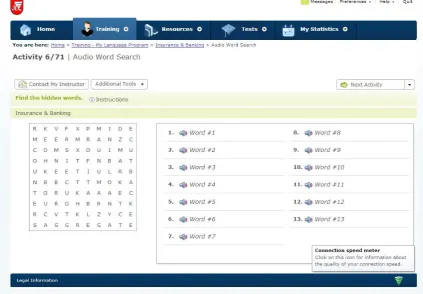
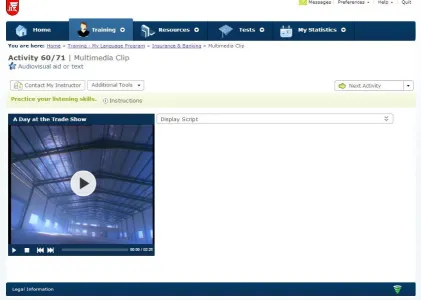
Some of the activities are presented in the Figures below. Figure 1 represents one of the speaking activities namely picture-word association. It helps students to revise new vocabulary and practice pronunciation. The next activity not only practices vocabulary but also listening since it exercises an audio skill through searching the hidden words ( see Figure 2). Figure 3 shows another vocabulary activity namely word associations. The last but not least picture depicts a reading activity in which students has to fill in the text with the given words (see Figure 4). The last task is a simple listening activity.
Figure 1 Picture word association. Source: http://www.rosettastone.co.uk/he-fe/foreign-language-solutions, accessed June 2013
Figure 2 Audio word search. Source: http://www.rosettastone.co.uk/he-fe/foreign-language-solutions, accessed June 2013
Figure 3 Fill in the blanks. Source: http://www.rosettastone.co.uk/he-fe/foreign-language-solutions, accessed June 2013
Figure 4 A Multimedia Clip. Source: http://www.rosettastone.co.uk/he-fe/foreign-language-solutions, accessed June 2013
The final thing that need to be mentioned is the latest speech recognition technology that is used in revolutionary speaking activities. Also interactive conversations and numerous additional oral activities such as speaking exercises, phonetics, the pronunciation of words, phrases and sentences increase students’ self-sufficiency in real speaking situations.
5. THE RESEARCH METHODOLOGY IN EFL CONTEXT 5.1. Initiation
In March 2013 the Foreign Languages Department of the Jan Dlugosz University decided to examine an educational platform called the TELL ME MORE® Campus. This e-learning solution was chosen among others available on the market by a group of teachers involved in a testing project. The experiment started in March 2013 and it finished in June 2013. It took four months. There were six teachers who were responsible for around a hundred of students. The author of this article was responsible for a group of 15 pupils. In order to find out whether this particular education platform is effective and has a positive impact on students’ language learning skills she decided to carry out an investigation. The teacher had chosen two groups of Safety Engineering faculty before the experiment started they wrote a pre-test. It is also worth to mention that they were supposed to be at the same lave, namely B2 in accordance with the Common European Framework of Reference for Language. However, one had slightly worse result. Hence, it can be assumed that if that group which scored fewer points in the pre-test had spent more time on doing language activities and practiced the receptive and the productive skills, it would have better grades.
5.2. Hypothesis
After the investigation and collecting the data, it could conceivably be hypothesised that the experimental group will have better results. This might be determined by the fact that this group of students put more effort towards studying since they had spent much more time on exercising than a control group. However, the results of pre-test has shown that the experimental group had slightly worse result. Because of this, the null hypothesis (H0) assumes that there will be no difference in the final outcome of the groups involved in the experiment. The alternative hypothesis (H1) supposes that the occurrence of teaching result difference between these two groups will ensue from blended learning implementation towards the experimental group curriculum. According to the above assumptions it has been assumed that different conditions of language acquisition (the advantage of teacher’s direct contact with students in the classroom in the control group and the predominant participation in the TELL ME MORE® platform in the experimental group) determine an independent variable and the students’ post-test results constitute a dependent variable. In order to test these two hypothesis the author of this article has implemented certain investigation procedures. They will be described in details in the next section.
5.3. Investigation
As it was mentioned in section 5.1. the investigation started in March 2013 and it finished in June 2013. The experiment was designed in such a way that it was possible for the teacher to obtain information on the learners’ progress both in terms of receptive (listening and reading) and productive (speaking and writing) skills. The study involved two groups: experimental and control group. The choice of these two groups was purposeful and was dictated by the availability of respondents and the fact that they possess certain characteristics that were essential for the experiment, namely an appropriate language level. The experimental group was studying English in the traditional context. However, they also did extra work online on the platform. On the other hand the control group was working mainly in the classroom context. Both groups had 30 hours of English (1 academic hour is 45 minutes) in the classroom conditions. The experimental group apart from taking part in traditional course they spent in average 17 hours doing extra activities online (1 hour spent online is 60 minutes). Chart 1. below presents how much time each of the student spent online.
Chart 1 Time spent by students on the TELL ME MORE® Campus compiled from TELL ME MORE® Campus solutions for higher education, accessed June 2013.
The curriculum of online platform was designed in such a way that the following topics were discussed: weather report, breakfast menu, insurance and banking, seeing the USA, the post office. Whereas in the classroom context the students work on such subjects as: attitude to money, mobile phone mania, music and advertisement and life in travel. The two groups were graded online as well as in the classroom during the whole research. When the investigation finished students were asked to write a post-test. One more important thing that has to be mentioned is that both experimental and control group was much more of the same size and mixed sex.
5.4. Result
After four months of investigation the following result may be presented. Firstly, it occurred that the experimental group had better results on the platform. The outcomes of the research are presented below. The first table shows the results of the control group which participated mainly in the traditional context classes. Both test 1 and 2 were written in the classroom by students within the experiment after pre-test but before post-test and they were based on the material thought during the traditional course.
Student Pre-test Post-test Test 1 Test 2
Student 1 36% 65% 74% 58%
Student 2 47% 75% 68% 33%
Student 3 21% 46% 66% 33%
Student 4 17% 30% 55% 28%
Student 5 28% 30% 76% 61%
Student 6 45% 65% 85% 64%
Student 7 37% 65% 81% 56%
Student 8 44% 55% 66% 50%
Student 9 45% 65% 93% 46%
0 5 10 15 20 25 30
Time
Time spent
Student 10 37% 90% 97% 95%
Student 11 50% 95% 97% 75%
Student 12 40% 83% 66% 52%
Student 13 41% 75% 87% 50%
Student 14 51% 75% 88% 83%
Student 15 63% 91% 70% 64%
Student 16 33% 70% 68% 42%
Average 40% 67% 77% 56%
Table 1 The results of the control group
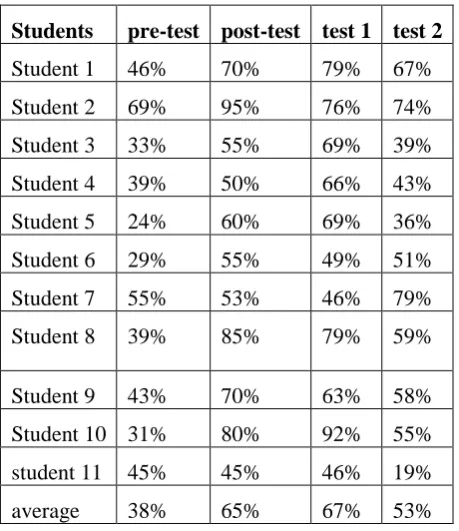
According to the results presented in the table the average grade of the pre-test is 40% . However, a significant increase can be notified in the post-test as the final grade was 67%. The highest score of the pre-test was 63% whereas the worst was 21%. Surprisingly, the experimental group had quite similar results. See table 2.
Students pre-test post-test test 1 test 2 Student 1 46% 70% 79% 67% Student 2 69% 95% 76% 74% Student 3 33% 55% 69% 39% Student 4 39% 50% 66% 43% Student 5 24% 60% 69% 36% Student 6 29% 55% 49% 51% Student 7 55% 53% 46% 79% Student 8 39% 85% 79% 59%
Student 9 43% 70% 63% 58% Student 10 31% 80% 92% 55% student 11 45% 45% 46% 19% average 38% 65% 67% 53% Table 2 The results of the experimental group
Comparing the finding it can certainly be stated that both groups had similar outcomes. Surprisingly, the post-test results were explicitly the same. When it comes to receptive and productive skills it occurred that experimental group got the highest scores in reading and listening. Whereas, the same two skills came out to be the worst among the others.
6. CONCLUSION
The results presented in that experiment confirm the assumptions established at the beginning of that investigation. They prove that web-enhanced instructions influence students’ language learning skills development in English as a foreign language. They substantiate the fact that these two different ways of acquiring English as a second language, namely traditional language teaching and mixed-mode instruction contributed to a similar extent to the final studying result. Therefore it can be concluded that regardless of the applied didactic solutions students who participated in the presented experiment made a similar progress in the mastery of general English knowledge. However, the receptive skills occurred to be a stronger point of experimental group since they received more scores in reading and listening. Such result may be due to the fact that the experimental group spent more time working online.
Another thing is that after the whole research students were asked to complete a survey. The outcomes revealed that the students working online had possibility to take the language activities more than once and the best result was considered by TELL ME MORE® grading system as final. Hence the results of this study should be treated as preliminary and not ultimately decisive for several reasons. One of them is the use of intentional or biased instead of random strategy to select the respondents. For this reason the representativeness of the results is difficult to determine and is definitely lower than in case of random selection. Another significant reason is that the individual variables such as the use of language acquisition strategies relevant to singular student were not taken into consideration. This factor could have a relevant impact on the processes of acquiring a foreign language.
Due to limitations of the experiment presented in this article it is difficult to presume that the results are highly representative. Moreover, on the basis of the investigation’s outcomes it cannot be clearly concluded that the web-enhanced instructions have a huge impact on the foreign language acquisition in contrast to traditional teaching since the experimental group students had spent considerably greater amount of time while completing the online activities. It cannot be excluded that if the students who were practicing their language using web technologies had relevant language acquisition strategies they would have better post-test results than the control group that was working under the guidance of a teacher. Analyzing the results obtained in the experiment it ca be assumed that educational activities promoting the advantages of traditional solutions such as working under the guidance of the teacher are among the most well-known students working methods and for this reason they can be considered as more efficient and effective in terms of acquiring a foreign language.
Therefore the results of the experiment support the null hypothesis (H0) which assumed that there will be no difference in the final learning outcome of these two groups involved in the experiment. Consequently the alternative hypothesis (H1) conjecturing that the occurrence of teaching result differences between the two groups ensuing from blended learning implementation towards the experimental group curriculum has to be rejected. However it has to be mention that the online materials used on the TELL ME MORE® platform were not compatible with the traditional language course curriculum. This fact could have influenced the outcomes of the experiment.
In conclusion, further research into the influences of many different didactic solutions based on web-enhanced instructions on the language learning acquisition is advisable. It is also desirable to use a simple random selection instead of applying only deliberate strategy or biased selection of the respondents. Furthermore, individual differences between learners cannot be ignored while comparing two methods of teaching since different methods of teaching and learning are more effective with respect to diverse people. Therefore, it is vital to supplement further research on this issue on selected individual variables such as personality features and learning strategies which can significantly affect the process of foreign language learning acquisition.
Finally, during the whole process of the research variety of activities were implemented so as to improve students’ language learning outcomes. However, the materials that were used on the TELL ME MORE® platform were not fully compatible with the traditional language course curriculum. It is assumed that if the online exercises were adjusted to the programme of the course then the learning
results of the experimental group could be higher in comparison to the controlled group. Thus, further research should be done to investigate this issue.
BIBLIOGRAPY
Basturkman, H 2010, Developing Courses in English for Specific Purposes, Palgrave Macmillan, New York
Basturkman, H 2006, Ideas and Options in English for Specific Purposes, Lawrence Erlbaum Associates, Mahwah
Claypole, M 2003, Blended Learning: new resources for teaching Business English, Pulverness, UK Dakowska, M 2001, Psycholingwistyczne podstawy dydaktyki języków obcych, Wydawnictwo Naukowe PWN, Warszawa
Dudeney, G & Hockly, N 2007, How to Teach English with Technology, Pearson Longman, England Duddley-Evans, T & St John, MJ 2009, Developments in English for Specific Purposes: A Multi-disciplinary Approach, CUP, Cambridge
Eysenck, H & Eysenck, M 2003, Podpatrywanie umysłu, Gdańskie Wydawnictwo Psychologiczne, Gdańsk
Gajewska, E & Sowa, M 2014, LSO, FOS, Fachsprache... Dydaktyka języków specjalistycznych, Werset, Lublin
Garrison, DR & Kanuka, H 2004, ‘Blended Learning: Uncovering its transformative potential in higher education’, Internet and Higher Education, no. 7, pp. 95-105.
Horton, W 2011, e-Learning by Design, Pfeiffer, San Francisco
Krajka, J 2007, English Language Teaching in the Internet Assisted Environment, Wydawnictwo Uniwersytetu Marii Curie-Skłodowskiej, Lublin
Motteram, G & Sharma, P 2009, ‘Blending Learning in a Web 2.0 World’, International Journal of Emerging Technologies & Society, vol. 7, no. 2, pp. 83-96, viewed 20 April 2015, <http://ictaugustine.pbworks.com/f/Blending+Learning+in+a+Web+2+World.pdf>.
Martyn, M 2003, The hybrid online model: Good practice’, Educause Quarterly, vol. 26, no.1, pp. 18– 23
Mokwa-Tarnowska, I 2014, ‘Struktury wsparcia a efektywność kształcenia środowisku e-learningowym’, E-mentor, vol. 54, no. 2, pp. 34-39, viewed 30 March 2015, <http://dx.doi.org/10.15219/em54.1100>.
Nunan, D 2004, Research Methods in Language Learning. Cambridge University Press, Cambridge Olapiriyakul, K & Scher, JM, ‘A guide to establishing hybrid learning courses: Employing informa-tion technology to create a new learning experience, and a case study’, Internet and Higher Education, no. 9, pp. 287-301.
Oliver, M & Trigwell, K 2005, ‘Can „Blended Learning” be redeemed?’, E-learning and Digital Media, vol. 2, no. 1, pp. 17-26
O'Malley, JM & Chamot, AU 1990, Learning Strategies in Second Language Acquisition, Cambridge University Press, Cambridge
Pelet, JE 2013, Advances in Higher Education and Professional Development: Premier reference source, IGI Global, USA
Przybyła, W & Ratalewska, M 2012, Poradnik dla projektujących kursy e-learningowe, Krajowy Ośrodek Wspierania Edukacji Zawodowej i Ustawicznej, Warszawa
Rodgers, TS 2001, Language Teaching Methodology, viewed 6 April 2015 <http://www.tronest.cn/Article.asp?id=1370809>.
Stracke, E 2007, ‘A road to understanding: A qualitative study into why learners drop out of a blended learning (BLL) environment’, ReCALL, vol. 19, no. 1, pp. 57-78.
Tomlinson, B & Whittaker, C 2013, Blended Learning in English Language Teaching: Course Design and Implementation, British Council, London
Wajs, E 2008, Blended-learning w praktyce szkolnej, paper presented on the 8th Virtual University Conference at Warsaw Technical University ,Warsaw 18-20 June
Wilczyńska, W & Michońska-Stadnik, A 2010, Metodologia badań w glottodydaktyce. Wprowadzenie, Avalon, Kraków
Williams, M & Burden, RL 1997, Psychology for Language Teachers, Cambridge University Press, Cambridge
Żylińska, M 2007, Postkomunikatywna dydaktyka języków obcych w dobie technologii informacyj-nych. Teoria i praktyka, Fraszka Edukacyjna, Warszawa