TO STRUCTURAL FEATURES IN SOME CROP PLANTS V.S. RAMA DAs and G. RAJENDRUDU
Department of Botany, Sri Venkateswara University, Tirupati 517502
Received on December 15, 1976
SUMMARY
The vein and stomatal frequencies in flag leaves of four crop plants were significantly higher than those of the lower three leaves of the same plant. The vein frequency of the leaves of a C3 plant, Oryza was less than half of that observed in the C4 plants, Pennisetum, Sorghum and Zea. The rate of absorption and translocation of 32
P04
by the cut ends of leaves has steadily risen from the fourth leaf on the same plant to the flag leaf. Similarly the rate of carbon fixation was also the higher for the flag leaf decreasing gradually in the lower leaves. There was high correlation of the faster rates of carbon fixation and phosphate absorption with the greater frequencies of veins and stomata in the leaves.
INTRODUCTION
Existing evidence suggests that the photosynthetic activity of flag leaf is the most important and that any restriction of this activity would result in drastic yield reduction (Stoy, 1973). When 14
C02 is fed to flag leaf of an intact plant, only a minor
124 V. S. RAMA DAS AND G. RAJENDRUDU
Significant differences exist in stomatal frequency of leaves at different positions on the culm (Geok-Yong Tan and Dunn, 1975). The stomatal frequency was also positively related to yield as indicated by Walton (1974). The possible role of stomatal characters on the process of plant growth had been indicated (Geok-Tan and Dunn, 1975). However the spacing of vascular bundles in flag leaves when compared to other basal leaves was not well established. Emphasis has not been paid on the structural factors contributing to high photosynthetic and translocation efficiencies in flag leaves. The aim of the present work has therefore been to investigate the structural factors contributing to high photosynthetic efficiency in flag leaves.
MATERIALS AND METHODS
Plant material. -The seeds of Pennisetum typhoides Stapf & Hubb. var. NNHB 3; Sorghum mlgare Pers. var. MaleC 53541 and Zea mays L. var. Hi-Starch were obtained from Standard Seeds Private Limited, Guntur-1. The seeds of Oryza
sativa L. var. IR-20 were obtained from local agricultural farm. These plants were grown in experimental plots in Botanical Garden under natural photoperiod. The plants were selected for regular experiments at the time of anthesis. Four culms were selected from each of the selected plant species. Four leaves were chosen from each culm and we designated the first leaf below the panicle as L1 ; second, L2; third, L3 and
fourth as L4•
Leaf vein frequency. -The vein frequency was measured according to Rama
Das and Rajendrudu (1976) with some modification. Free hand sections were prepared at the one-third and two-third distances of the leaf blade from the culm. The number of vascular bundles were counted under a light microscope (at 100 x magnification). By
knowing the diameter of the light microscope the leaf vein frequency (number of vascular bundles/mm width of the leaf blade) was calculated. Ten observations were made from each specific leaf sites. The data were subjected to statistical analysis.
Stomatal frequency. -Stomatal frequency was determined according to Chiha
and Brun (1975). Nail polish impressions of the leaf on the abaxial surface at two different sites were taken. Stomatal counts were made in 10 randomly chosen micro-scopic fields from each impression (each micromicro-scopic field area consisted of 0.035 mm2
at 400 x magification). A total of 4 peelings were taken from each leaf to calculate stomatal frequency.
32P0
4 absorption and translocation.-A total of four leaf segments (with an
equal area of 10 cm2) from four different leaves (L1 , L2 , L3 and L4) were placed with their basal ends in a diluted solution of labelled phosphate. Then they were exposed to incandescent light at 15 klux for thirty minutes. After the fixed time the leaf segments were removed from the labelled phosphate solution. The portion of the leaf segments in contact with the labelled solution, were removed. The rest of the segment of each leaf was macerated and extracted with water separately. The radioactivity in each extract was measured with a GM counter. Percent of 32P0
4 absorbed and translocated in each leaf segment was calculated by knowing total 32P0
4 in four leaf segments.
Three replicates were made for each plant species. 14C02 incorporation.-14C0
-
..
FLAG LEAF PHOTOSYNTHETIC EFFICIENCY 125
(1975). Four leaf segments (with equal leaf area) were taken from four different leaves
(LI> L2 , L3 , and L4) and exposed to HC03 in a closed chamber for 30 minutes. Then
the leaf tissue (segments) was killed in 80~~ ethanol and extracted separately for total
14C incorporation. Percent of 11C0
3 incorporation in each leaf was calculated by
knowing total incorporation by all the four leaf segments. Three replicates were made for each plant species.
RESULTS
There were significant differences in the leaf vein frequency of the flag leaf
(Ll), second leaf (L2), third leaf (L3) and fourth leaf (L4). 0. sativa, a C3 plant,
exhibited lower vein frequency than the other C4 plants. The vein frequency gradually
declined from flag leaf to fourth leaf (Table 1). Stomatal frequencies also differed Table I. Vein frequency (number of veinsjmm width of leaf) of different leaves
on the same plant at the time of anthesis (Mean of four replicates of
Plant species
Pennisetum typhoides Sorghum vulgare Zea mays Oryza sativa
ten observations each
±
S. E.)Leaf position on the plant*
---~---L, L, L, L«
53.3±0.75 5!.3±0.75 44.5± 1.89 41.0±0.71 43.0±0.71 41.0±0.71 39.8±0.85 39.0±0.41 49.0±0.71 44.0± 1.30 40.3±1.70 37.3±0.87 21.0±0.41 19.5±0.50 18.5±0.50 17.5±0.50
*Lr, L,, L, and L. are the first, second, third and fourth leaves respectively from the panicle, Lr being the flag leaf
significantly among leaves of different plant species. Stomatal frequency declined sharply from the flag leaf to fourth leaf on the culm. The stomatal frequency in 0. sativa was higher than the other leaves (Table IT).
Table II. Stomatal frequency (number of stomatajmm2 leaf area) of different
leaves on the same plant at the time of anthesis (Mean of four replicates of ten obserrations each
±
S. E.)Plant species Leaf position on the plant*
---Lr L, L, L«
Pennisetum typhoides 152±3.72 !33±2.65 119±3.94 96.±2.55
Sorghum vulgare 214±1.89 192±0.9 185±2.54 176±0.76
Zea mays 156±2.12 142±2.18 !31 ±2.54 125±0.76
Oryza sativa 336±1.29 316±2.12 303±4.35 294±3.48
126 V. S. RAMA DAS AND G. RAJENDRUDU
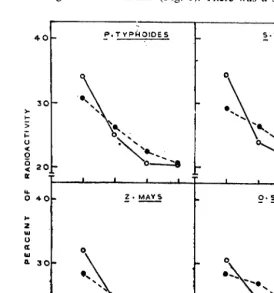
The magnitude of 32
P04 absorption and translocation in all the four plants
decreased from flag leaf to fourth leaf (Fig. 1 ). There was a sharp decrease from flag
..
40 1- P.TvP.:.OIDES 1- S·VULGARE
-
\_
...
\
l
...
..,
~
...
~~-....
-~.f.. 0~
--0
.
30
>
...
>
j: u < 0 0 20 <a:
""
0 40 Ia ~·~ Ia ~·~)
..
z
"'
00
~
...
-~--8-
~
-
....
,
...,
...::.:.::s
~..
~
..
a:"'
II. 30
20
.
;: IL 1 L3 L4 Lt L2
0
LE~ POSITION
FIG. 1. The pattern of 32
PO, absorption and translocation (0--0) and "C02 incorporation
(e--- -e) by different leaves of the same plant.
leaf to second leaf of all the four species. Similarly there was a gradual decrease of
14C0
2 incorporation from first leaf (L1) to the fourth leaf (L4) (Fig. 1). Flag leaves
incorporated about 30 per cent of the total14C0 2 fixed. DISCUSSION
Greater vein frequency was always associated with higher stomatal frequency. The increase in the distance of interveinal tissues, increases the number of stomata, as the stomata are situated mainly at the interveinal leaf tissue on the epidermis on the abaxial surface. A close spacing of vascular bundles can contribute to more efficient translocation not only because of increased amounts of vascular tissue per unit leaf area but also because photosynthate has to traverse less mesophyll tissue.
Stomata are one of the important factors influencing photosynthesis and hence the stomatal frequency differences observed in leaves could alter their carbon dioxide exchange rates. The rate of 32P0
to stomatal and leaf vein frequencies. Higher translocation percentage of 32P0
4 in flag
leaf is believed to be due to the higher stomatal frequency and the greater cross sectional area of the vasculal bundles by increasing the number per unit leaf area. Although Walton (1974) observed a correlation of yield among different cultivars with the stomatal frequency in the leaves, the present investigation reveals the direct influence of stomatal frequency on carbon assimilation and translocation of leaves on the same plant. On the whole plant basis, lower leaf blades fix less carbon dioxide because of reduced light penetration into the lower canopy. Only a smaller portion of the carbon fixed by the lower leaf blades is retained by the entire plant (Plamer eta/., 1973).
Crookston and Moss (1974) observed variations of interveinal distance in leaves of C3 and C4 grasses and concluded that less interveinal distance in leaves of C
4
grasses help them in achieving faster translocation of carbohydrates. Our results confirm their findings and further indicate that there are significant differences in stomatal and leaf vein frequency among different leaves of the same plant. It is evident that an invariable correlation existed between the structural factors (leaf vein frequency and stomatal frequency) and the physiological processes (translocation and photosyn-thesis). We feel therefore that the structural factors (leaf vein frequency and stomatal frequency) may also be kept in view during genetic manipulation towards greater photosynthetic efficiency.
ACKNOWLEDGEMENTS
G. Rajendrudu held a Junior Research Fellowship from the Council of Scientific and Industrial Research, New Delhi, during the period of this work.
REFERENCES
CHIHA, A. J. and BRUN, W. A. (1975). Stomatal size and frequency in soybeans. Crop Sci., 15: 309-12.
CROOKSTON, R.N. and Moss, D. N. (1974). Interveinal distance for carbohydrate transport in leaves of Ca and C4 grasses. Crop Sci., 14: 123-25.
GEOK-YOUNG TAN and DUNN, G. M. (1975). Stomatal length, frequency, and distribution in Bromus
inermis Leyss. Crop Sci., 15 : 283-86.
LUPTON, F. G. H. (1966). Translocation of photosynthetic assimilates in wheat. Ann. Appl. Bioi., 5:
355-64.
PALMER, A. F. E., HEICHEL, G. H. and MusGRAVE, R. B. (1973). Patterns of translocation, respiratory loss and redistribution of 14C in maize tabled after flowering. Crop Sci., 13: 371-76 RAGHAVENDRA, A. S. (1975). A comparative Study of Cc and Ca photosynthetic systems in some
mono and dicotyledonous plants. Ph. D. Thesis. Sri Venkateswara University, Tirupati. RAMA DAs, V. S. and RAGHAVENDRA, A. S. (1974). Photochemical efficiency of chloroplasts from flag
!eves during grain production in millet crops. Proceedings of the symposium on biological
approach to problem in medicine, industry and agriculture, Bhabha Atomic Research Centres,
Bombay, Pages 96-109:
- - - a n d Rajendrudu, G. (1976). A simple photorespiratory ratio for the delimitation of
c.
from theCa plants. Proc. Indian Acad. Sci., 84 B : 148-53.128 V.S. RAMA DAS AND G. RAJENDRUDU
STEPHENSON, R. A., BROWN, R. H. and AsLEY, D.A. (1976). Translocation of 14C-labled assimilate and photosynthesis inc, and C4 species. Crop Sci., 16 : 285-88.
STOY, V. (1963). The translocation of 14C-labled photosynthetic products from the leaf to the ear in
wheat. Physiol. Pl., 16: 851-56.
---(1973). Assimilatbitdung und-verteilung als komponenten der Ertragsbildung beim Getreide.
Angew. Bot., 47: 17-26.
WALTON, P. D. (1974). The genetics of stomatal length and frequency and clones of Bromus inermis and relationships between these traits and yield. Can. J. Pl. Sci., 54 : 749-54.
WILSON, D. (1975). Variation in leaf respiratiOn in relation to growth and photosynthesis in Lolium.