584
A Good Sample is Hard to Find: Noise Injection Sampling and
Self-Training for Neural Language Generation Models
Chris Kedzie Columbia University Department of Computer Science
Kathleen McKeown Columbia University Department of Computer Science
Abstract
Deep neural networks (DNN) are quickly be-coming the de facto standard modeling method for many natural language generation (NLG) tasks. In order for such models to truly be use-ful, they must be capable of correctly gener-ating utterances for novel meaning represen-tations (MRs) at test time. In practice, even sophisticated DNNs with various forms of se-mantic control frequently fail to generate ut-terances faithful to the input MR. In this pa-per, we propose an architecture agnostic self-training method to sample novel MR/text ut-terance pairs to augment the original train-ing data. Remarkably, after traintrain-ing on the augmented data, even simple encoder-decoder models with greedy decoding are capable of generating semantically correct utterances that are as good as state-of-the-art outputs in both automatic and human evaluations of quality.
1 Introduction
Deep neural network (DNN) architectures have become the standard modeling method for a host of language generation tasks. When data is plen-tiful, the sequence-to-sequence framework proves to be incredibly adaptable to a variety of problem domains. Recent evaluations of end-to-end trained DNNs for dialogue generation have shown that they are capable of learning very natural text real-izations of formal meaning representations (MRs), i.e. dialogue acts (DAs) with slot-filler type at-tributes (see Figure 1 for an example). In many cases, they beat rule and template based sys-tems on human and automatic measures of quality (Duˇsek et al.,2019).
However, this powerful generation capability comes with a cost; DNN language models are notoriously difficult to control, often producing quite fluent but semantically misleading outputs. In order for such models to truly be useful, they
Inform name[The Golden Curry] near[The Six Bells] familyFriendly[yes]
Training Reference Utterance
Near The Six Bells is a venue that is children friendly named The Golden Curry.
Figure 1: Example MR for the Inform DA with exam-ple human reference utterance.
must be capable of correctly generating utterances for novel MRs at test time. In practice, even with delexicalization (Duˇsek and Jurˇc´ıˇcek, 2016;
Juraska et al., 2018), copy and coverage mech-anisms (Elder et al., 2018), and overgeneration plus reranking (Duˇsek and Jurˇc´ıˇcek,2016;Juraska et al.,2018), DNN generators still produce errors (Duˇsek et al.,2019).
In this work, rather than develop more sophisti-cated DNN architectures or ensembles, we explore the use of simpler DNNs with self-training. We train a bare-bones unidirectional neural encoder-decoder with attention (Bahdanau et al., 2014) as our base model from which we sample novel ut-terances for MRs not seen in the original training data. We obtain a diverse collection of samples us-ing noise injection samplus-ing (Cho, 2016). Using an MR parser, we add novel utterances with valid MRs to the original training data. Retraining the model on the augmented data yields a language generator that is more reliable than the sophisti-cated DNNs that have been recently developed, in some cases reducing test set semantic errors to zero, without sacrificing linguistic quality.
self-training. 2) We show a reduction of attribute re-alization errors across several dialog generation datasets, while achieving competitive automatic and human quality evaluation scores. 3) Finally, we show that these results hold even when the MR parser is noisy or we use fully lexicalized genera-tion models.1
2 Datasets and Problem Defintion
We ground our experiments in three recent di-alogue generation datasets, the E2E Challenge Dataset (Duˇsek et al.,2019), and the Laptops and TVs datasets (Wen et al.,2016). We only briefly review them here. Each dataset consists of dialog act MRs paired with one or more reference utter-ances (seeFigure 1for an example from the E2E dataset). The structure of each MR is relatively simple, consisting of the dialog act itself, (e.g. in-form, recommend, compare, etc.) and a variable number of attribute slots which need to be realised in the utterance. All attribute values come from a closed vocabulary. If an attribute is not present in the MR it should not be realized in the correspond-ing utterance.
The three datasets also represent different train-ing size conditions; there are 42,061, 7,944, and 4,221 training examples in E2E, Laptops, and TVs datasets respectively.
The NLG task for all three datasets is to produce an utterance for a given MR such that all attributes in the MR are realized naturally and correctly.
E2E Model Input Following previous
sequence-to-sequence approaches for the E2E dataset (Juraska et al., 2018), we treat the MRs as a linear sequence of tokensx = (x1, . . . , x8)
where each of the 8 positions represents the value of a corresponding attribute. If an attribute is not specified in the MR we assign it an attribute specific n/a token. In the E2E dataset there is only one dialog act type, Inform, so we do not represent it inx.
Prior work often delexicalizes the Name and
Nearattributes (i.e. replaces verbalizations of at-tribute values with a placeholder token), which can later be replaced with the original attribute value in a post-processing step. For example, the delexicalized version of the utterance inFigure 1
would be “Near NEAR is a venue that is children friendly named NAME.” Name and Near have
1Code and data for this paper can be found at https://github.com/kedz/noiseylg
a relatively large vocabulary of valid slot fillers, some of which are only seen infrequently in the training data; it can be difficult for fully lexical-ized models to produce some of the rarer location names for these attributes.
However, since delexicalization might be dif-ficult or impossible in other domains, we imple-ment both delexicalized and lexicalized versions of the generation models on the E2E dataset to more fully evaluate the self-training method.2
Laptops and TVs Model Inputs The Laptops and TVs datasets have a more diverse set of dia-log acts and can have repeated attributes (with dif-ferent values) in some cases, so we abandon our fixed length, fixed position encoding, and repre-sent each MR as a initial dialog act token and then a variable length sequence of tokens for each of the specified attributes. The evaluation script for these datasets uses delexicalization to evaluate at-tribute realization error, and so we use it here to be consistent with prior work, delexicalizing all pos-sible attributes. SeeAppendix Bfor example input sequences for all datasets.
3 Generation Model
We treat the generation task as a sequence-to-sequence transduction problem, where we learn a probabilistic mapping p from the linearized MR
x to a sequence ofN tokensy = (y1, . . . , yN)
consituting the utterance. The modelp is imple-mented using a two-layer unidirectional3 encoder-decoder architecture with gated recurrent units (Cho et al.,2014) and feed-forward style attention (Bahdanau et al.,2014) as this is a canonical recur-rent architecture for sequence-to-sequence model-ing. We use 512 dimensions for all embeddings and GRU states.
We fit the model parameters θ by minimiz-ing the negative log likelihood of the trainminimiz-ing set
D, i.e. L(θ) = −P
(x,y)∈Dlogp(y|x;θ) using
stochastic gradient descent. Going forward we omitθfor clarity.
3.1 Generating fromp
Deterministic Decoding Given an arbitrary MR
x, we can generate an utterance y˜ using greedy decoding, i.e. y˜i = arg maxyip(yi|˜y<i, x).
2
Additional preprocessing details can be found in Ap-pendix A.
3In initial experiments, we found the unidirectional
To produce an “n-best” list of outputs, we can also use beam decoding wherencandidate utter-ances are maintained during each decoding step. Both greedy and beam decoding are known to produce somewhat homogeneous outputs (Serban et al.,2016). Diversifying beam outputs often in-volves careful tuning of secondary search objec-tives which trade off fluency (Li et al.,2015).
Moreover, when training fully lexicalized mod-els we found that we could often not pro-duce certain Name and Near attribute values. For example, we constructed a novel MR with
near[Burger King] and fed it into our base gen-erator. Even with an impractically large beam size of 512, we could not produce an utterance with “Burger King” in it. This failure mode makes beam search a relatively unuseable method for producing utterances for MRs under-represented in the training data.4
To overcome this limitation we explored several sampling methods for generating these rarer utter-ances, namely ancestral and noise injection sam-pling.
Stochastic Decoding Ancestral sampling (i.e. drawing a random token fromp(Yi|y<i, x)at each
decoder step) is another option for generating di-verse outputs, but the outputs can be of lower flu-ency and coherence. Producing rare tokens often involves tuning a temperature parameter to flatten the output distribution, but this again can hurt flu-ency.
As an alternative, we can obtain diverse sam-ples from greedy decoding by injecting Gaus-sian noise into the decoder hidden states follow-ing Cho(2016). Under our model, the probabil-ity p(yi|y<i, x) = f(x, hi) of thei-th token is a
function of the encoder inputs xand the decoder hidden state hi ∈ RD. When peforming noise
injection sampling, we replace hi with a noisy
state ˜hi = hi +i wherei is drawn from aD
-dimensional Gaussian distributionN(0, σi2I)with varianceσi2 = σ02
i . The base varianceσ 2
0 is a a
hy-perparameter. Effectively, the first few steps allow the decoder to reach a novel hidden state space, while the gradually diminishing noise allows the decoder to produce fluent outputs.
Generating Rare Values Remarkably, the sam-ples obtained by noise injection maintain fluency
4The MR in this case had three attributes.
near[Burger King]only occurs in size eight MRs in the training data.
and valid syntactic structure. At the same time they often hallucinate or drop attributes. For ex-ample, see the last noise injection sample in Ta-ble 1where the attributenear[The Bakers]is hal-lucinated. This kind of error is actually useful be-cause, as long as we have a reliable MR parser, we can recover the MR of the sample and we now have a totally valid extra datapoint that we could use for training. Syntactic errors of the kind pro-duced by ancestral sampling (see the last ancetral sampling example inTable 1), on the other hand, are not good to train on because they damage the fluency of the decoder.
Returning to the “Burger King” example, with noise injection sampling we were able to produce over 10,000 novel instances of it. SeeAppendix D
for more samples.
4 MR Parsing Model
Given a novel utterance y˜ sampled from p, we need to reliably parse the implied MR, i.e. x˜ = q(˜y), whereqis our parsing model. We have two things going for us in our experimental setting. First, even with noise injection sampling, model outputs are fairly patterned, reducing the variabil-ity of the utterances we need to parse in practice.
Second, the MRs in this study are flat lists of attributes that are somewhat independent of each other. We only need to detect the presence of each attribute and its value. For the Laptops and TVs datasets we also need to recover the dialog act but these also are signaled by a fairly limited reper-toire of cues, e.g. “we recommend.” Given this, we experiment with both hand crafted regular ex-pression rules and learned classifiers to predict the value of an attribute if present or that it is missing.
Rule-based parser qR We design hand-crafted
regular expression based rules to match for the presence of key phrases for each of the attributes and DAs in the datasets while also checking to make sure that there is only one match per at-tribute.
To construct the rules, we look through both the training data references as well as the generation model outputs as this is what the rules will be oper-ating on in practice. For each lexicalized attribute (and DA) we develop a list of regular expres-sions such as, /is (family|kid|child)
friendly/ ⇒ familyFriendly[yes]. For the
Input MR
Inform(name[The Cambridge Blue], eatType[Restaurant], customerRating[high], food[Italian])
Ancestral Sampling
The Cambridge Blue is an Italian restaurant with a high customer rating. The Cambridge Blue is an Italian restaurant with high ratings.
*Italian restaurant, the Cambridge Blue, has a high customer rating. (Phrase fragments, not fluent.)
Noise Injection Sampling
The Cambridge Blue is a restaurant that serves Italian food. it has a high customer rating.
*The Cambridge Blue is a highly rated restaurant. (Dropsfood[Italian].)
*The Cambridge Blue is a restaurant located near the Bakers. (Hallucinatesnear[The Bakers].)
Table 1: Examples of ancestral sampling and noise injection sampling(σ0= 1.0).*indicates output that is either
not grammatical or is not correct with respect to the input MR. Text in parentheses explains the details of the error in either case.
We design these rules to be high precision, as it is safer to miss out on more obscure varieties of utterance to avoid adding incorrectly parsed data points. However, in many cases the rules are also high recall as well. The average F-score on the E2E validation set is 0.93.
Classifier-based parserqφ It is perhaps too
op-timistic to believe we can construct reasonable rules in all cases. Rule creation quickly becomes tedious and for more complex MRs this would be-come a bottleneck. To address these concerns, we also study the feasibility of using learned classi-fiers to predict the presence and value of the at-tributes. For each attribute in the E2E dataset, we trained a separate convolutional neural net-work (CNN) classifier to predict the correct at-tribute value (orn/aif the attribute is not present). The CNN architecture follows that ofKim(2014) and is trained with gradient descent on the original training data. SeeAppendix Cfor full architecture and training details. The average E2E validation F-score is 0.94.
5 Self-Training Methodology
Our approach to self-training is relatively straight-forward and invariant to the choices of whether or not to use delexicalization, and rule vs. classifier based parser. There are minor differences depend-ing on the dataset and we elaborate on those be-low. There are three main steps to our self-training approach. Starting with an initially empty aug-mented datasetA, we
1. Train a base generator modelp0 on the
origi-nal training dataD.
2. Repeat many times:
(a) Sample a random MRx∼ X.
(b) SampleKutterancesy˜(i)∼p0(·|x, )
(c) Parse MR, x˜(i) = q(˜y(i)), discarding any samples with invalid parses, and adding the survivors toA.
3. Train a new generator p1 on the combined
datasetD ∪ A.
Steps 1 and 3 are identical, the generatorsp0 and
p1 have the same architecture and training setup,
ony the dataset,Dvs.D ∪ A, is different. We now discuss step 2 in detail.
Step 2: E2E Dataset To sample a novel MR with S attributes, we sample a combination of
S−1attributes uniformly at random (always ap-pending thename attribute since every MR con-tains it). We then sample attribute values for each slot inversely proportional to their empirical fre-quency in the training set so as to increase the likelihood of creating a novel or under-represented MR.
After obtaining such a sample x we then per-form noise injection sampling, generating 200 samples y˜(i) ∼ p0(·|x, (i)) in parallel and
dis-carding all but the top 20 samples by average log likelihood according to p0. We also discard any
utterances that have previously been generated. We then apply the parser to the sampled utter-ances, to obtain its predicted MR,x˜(i) = q(˜y(i)). If using the rule based parserqR andx˜ = ∅, i.e.
less than 50% probability we discard it. All sur-viving(˜x(i),y˜(i))pairs are added toA. We repeat this process 25,000 times for each valid MR size
S. See Table 8 for statistics on the total sample sizes after filtering.
Step 2: Laptops and TVs On the Laptops and TVs dataset, for each DA and legal number of at-tributesS we draw S random attributes (modulo any required attributes likeName; not all DAs re-quire it).5
We then perform noise injection sampling, gen-erating 200 samplesy˜(i) ∼p0(·|x, (i))under the
same settings as the E2E dataset. We repeat this process 25,000 times for each DA and DA size. We obtain 373,468 and 33,478 additional samples for the Laptops and TVs datasets respectively.
6 Experiments
6.1 E2E Self-Training
We train base generatorsp0on the original training
dataD, with and without delexicalizing theName
andNearattributes. We train for 500 epochs with gradient descent. We use a batch size of 128, with a learning rate of 0.25, weight decay penalty of 0.0001, and a dropout probability of 0.25. We se-lect the best model iteration using validation set BLEU score6.
Using the self-training method outlined in sec-tion 5, we create augmented datasets using either
qR orqφ, which we refer to as AqR and Aqφ
re-spectively (qφis only in the delexicalized setting).
For bothD∪AqRandD∪Aqφwe train new gen-eratorsp1using the same training setting as above
(although we terminate training after 50 epochs because the models converge much faster with the additional data).
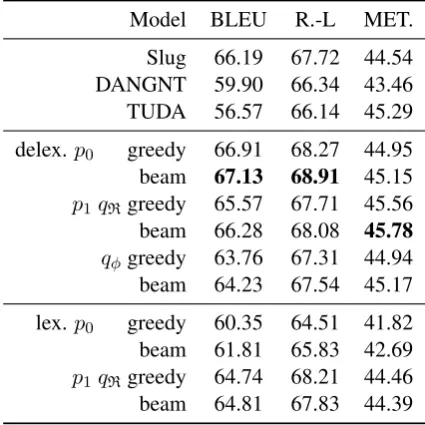
Results Table 2 shows the automatic quality measurements on the E2E test set using BLEU, ROUGE-L, and METEOR. We show results for both greedy and beam decoding with beam size 8 underp0andp1models. We compare our
mod-els to the best sequence-to-sequence DNN model, Slug (Juraska et al., 2018), the best grammar rule based model, DANGNT (Nguyen and Tran,
2018), and the best template based model, TUDA
5
A number of attributesS is “legal” if we observe a DA instance with that many attributes in the original training data.
6We use the official shared task script to compute
auto-matic quality metrics on the E2E dataset.
Model BLEU R.-L MET.
Slug 66.19 67.72 44.54 DANGNT 59.90 66.34 43.46 TUDA 56.57 66.14 45.29
delex.p0 greedy 66.91 68.27 44.95
beam 67.13 68.91 45.15
p1qRgreedy 65.57 67.71 45.56
beam 66.28 68.08 45.78 qφgreedy 63.76 67.31 44.94
beam 64.23 67.54 45.17
lex.p0 greedy 60.35 64.51 41.82
beam 61.81 65.83 42.69
p1qRgreedy 64.74 68.21 44.46
[image:5.595.309.522.63.276.2]beam 64.81 67.83 44.39
Table 2: BLEU, ROUGE-L, and METEOR metrics on the E2E test set. Baseline methods all rely on at least partial delexicalization, puting our delexicalized mod-els at a relative disadvantage.
(Puzikov and Gurevych,2018), as determined dur-ing the shared task evaluation (Duˇsek et al.,2019). Surprisingly,p0using greedy decoding surpases
all of the baseline systems. This is quite shock-ing as the Slug model ensembles three different sequence-to-sequence models producing 10 out-puts each using beam search and reranking based on slot alignment to select the final generation out-put. The p1/qR model remains competitive with
Slug, again even using greedy decoding. The
p1/qφstarts underperforming Slug on BLEU score
but remains competitive on ROUGE-L and ME-TEOR again when using greedy decoding. Overall the augmented training data tends to hurt genera-tion quality. In this regard, the added noise of the trained classifier exacerbates things as it reduces quality more than the rule-based filtering.
In the lexicalized setting, p0 produces lower
quality output than the Slug system. However, the augmented training procedure increases the qual-ity of the lexicalizedp1 model which beats Slug
on ROUGE-L.
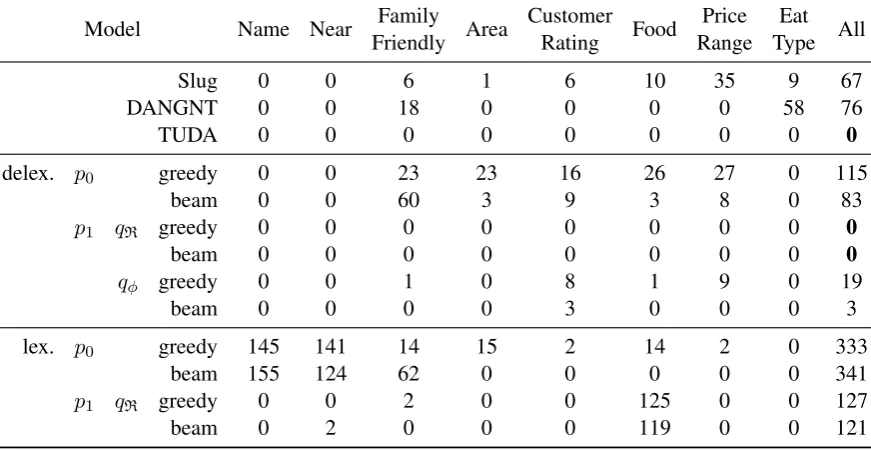
The automatic quality evaluations are somewhat limited, however. To gain more insight into model performance we apply our rule based parser to estimate attribute realization error for all system outputs on the test set, similarly to (Duˇsek et al.,
Model Name Near Family Area Customer Food Price Eat All Friendly Rating Range Type
Slug 0 0 6 1 6 10 35 9 67
DANGNT 0 0 18 0 0 0 0 58 76
TUDA 0 0 0 0 0 0 0 0 0
delex. p0 greedy 0 0 23 23 16 26 27 0 115
beam 0 0 60 3 9 3 8 0 83
p1 qR greedy 0 0 0 0 0 0 0 0 0
beam 0 0 0 0 0 0 0 0 0
qφ greedy 0 0 1 0 8 1 9 0 19
beam 0 0 0 0 3 0 0 0 3
lex. p0 greedy 145 141 14 15 2 14 2 0 333
beam 155 124 62 0 0 0 0 0 341
p1 qR greedy 0 0 2 0 0 125 0 0 127
[image:6.595.81.517.65.290.2]beam 0 2 0 0 0 119 0 0 121
Table 3: Attribute realization errors on the E2E test set. The Slug model and our delexicalized models delexicalize the NAME and NEAR slots, thus making 0 errors on these attributes. DANGNT and TUDA models perform complete delexicalization.
Table 3. Immediately, it is revealed that p0 is far
worse than the baseline methods making 115 and 83 errors using greedy and beam decoding respec-tively.
The p1/qR model achieves zero test set
er-rors even when using the greedy decoding. The
p1/qφ model is slightly worse (in agreement
with the automatic quality measurements), but its greedy search is still superior to the more sophis-ticated Slug decoder, achieving 19 total test set er-rors compared to Slug’s 67 erer-rors.
The lexicalized p0 model has especially high
error rates, particularly on the Name and Near
attributes. With augmented data training, the
p1 model reduces these errors to zero when
us-ing greedy search and 2 with beam search. Un-fortunately, the augmented training is more unsta-ble in the lexicalized setting, as it produces a large spike infoodattribute errors, although thep1
mod-els still have lower overall error thanp0.
6.2 Laptops and TVs Self-Training
We perform similar experiments on the Laptops and TVs datasets. We train a separate p0 model
for each dataset for 300 epochs with a learning rate of 0.1 for Laptops and 0.25 for TVs. The weight decay penalty was 0.0001 and dropout probability was 0.25. Best model iteration is determined by validation set BLEU score. As in the E2E exper-iments, we create an augmented dataset for both
the Laptops and TVs dataset using the method out-lined in section 5. We then train new generators
p1 on the union of original training data and the
augmented dataset.
Results We automatically evaluate our models using the evaluation script of Wen et al. (2016), which computes BLEU scores, as well as slot alignment error rate (since this dataset is almost fully delexicalized, it simply checks for the pres-ence of the correct attribute placeholders accord-ing to the MR). We compare again to the Slug model as well as the Semantically Conditioned LSTM (SCLSTM) (Wen et al.,2015) which report state-of-the-art results on these datasets.
The results are more mixed here. Our BLEU scores are about 15 points below the baselines on the Laptops dataset and 20 points below the base-lines on the TVs dataset. Upon examing the evalu-ation script in detail we see that BLEU score is cal-culated using 5 model outputs whichJuraska et al.
(2018) andWen et al.(2016) do. We only produce the 1-best output at test time, perhaps explaining the difference.
Laptops TVs Model BLEU Err. BLEU Err.
SCLSTM 51.16 0.79% 52.65 2.31%
Slug 52.38 1.55% 52.26 1.67%
p0 beam 37.13 0.72% 32.63 0.72%
p1 greedy 37.21 0.13% 32.43 0.28%
[image:7.595.72.294.63.169.2]beam 37.19 0.14% 32.59 0.20%
Table 4: BLEU and automatic attribute error on the Laptops and TVs datasets.
0.79% and 1.67% of the time on the Laptops and TVs datasets respectively. Ourp1 model reduces
that error to only 0.13% and 0.20%.
6.3 Experiment 4: Human Evaluation
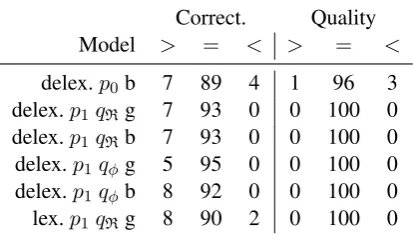
E2E Dataset We had two undergraduate stu-dents not involved with the research look at 100 random test set utterances for six of our model variants. They were shown both the Slug output and one of our model outputs and asked to se-lect which output was of better linguistic quality and correctness or indicate that they were equally good. We resolved disagreements in favor of the baseline, i.e. if any annotator thought the base-line was better we considered it so. If an anno-tator marked one of our systems as better and the other marked it as equal, we considered it equal to the baseline. Inter-annotator agreement was high, with 92% agreement on correctness and 88% agreement on quality.
Table 5shows the results of the evaluation. We find that the p1 model outputs are
indistinguish-able from the Slug model in terms of linguistic quality, regardless of the setting. In terms of cor-rectness, the lexicalizedp1model is as good as or
better than the Slug model 98% of the time. When using the delexicalized models, we don’t even need beam search. The delexicalized p1 greedy
decoder is as good as or better than Slug 100% of the time.
Laptops Dataset We had the same annotators look at 100 randomInformDAs from the Laptops test set since they are the majority DA type and we could use the same annotator guidelines from the E2E experiment. We do not have access to the Slug or SCLSTM outputs on this dataset, so we compared to one of the two test set reference sentences (picking at random) vs. thep1/qRwith
greedy decoding. Table 6 shows the results.
De-Correct. Quality Model > = < > = <
delex.p0b 7 89 4 1 96 3
delex.p1qRg 7 93 0 0 100 0
delex.p1qRb 7 93 0 0 100 0
delex.p1 qφg 5 95 0 0 100 0
delex.p1 qφb 8 92 0 0 100 0
lex.p1qRg 8 90 2 0 100 0
Table 5: Human correctness and quality judgments (%). Comparisons are better than (>), equal to (=), and worse than (<) the baseline Slug model. (g) and (b) indicate greedy and beam decoding respectively.
Correct. Quality Model > = < > = <
delex.p1 qRg 0 100 0 2 91 7
Table 6: Human correctness and quality judgments (%). Comparisons are better than (>), equal to (=), and worse than (<) the test set references.
spite the low BLEU scores, we find our outputs to be of comparable quality to references 91% of the time. Moreover, they are equally as correct as the human references 100% of the time. Annotators agreed 99% and 87% of the time on correctness and quality respectively.
7 Sample Analysis and Discussion
We hypothesize that self-training improves the correctness of outputs by sacrificing some expres-sivity of the model. For example,p1BLEU scores
on the E2E dataset drop by at least 0.8 as com-pared to p0 with beam search. We see a similar
pattern on the TVs dataset. Self-training increases automatic metrics in the lexicalized setting, but this could be attributable to reductions in Name
andNearrealization errors, which are orthogonal to the syntactic diversity of generation.
To better quantify these effects we report the average length in words, average number of sen-tences, and average revised Developmental Level (D-Level) score according to the D-Level analyser (Lu, 2009). The D-Level analyser automatically categorizes the syntactic complexities of an utter-ance into one of eight categories, with eight be-ing the most complex, based on the revised Devel-opmental Level scale (Rosenberg and Abbeduto,
[image:7.595.313.520.64.181.2]Model Words Sents MDL
Human Refs. 24.06 1.76 2.25
Slug 24.20 1.86 1.39
lex.p0greedy 25.73 2.18 1.84
lex.p0beam 26.00 2.20 1.50
lex.p1qRgreedy 26.01 2.20 1.39
lex.p1qRbeam 26.04 2.17 1.45
delex.p0greedy 24.83 2.10 1.79
delex.p0beam 24.51 2.03 1.48
delex.p1qRgreedy 26.50 2.29 1.74
delex.p1qRbeam 26.46 2.28 1.74
delex.p1qφgreedy 25.33 1.76 1.77
[image:8.595.77.286.310.374.2]delex.p1qφbeam 25.49 1.75 1.87
Table 7: Words/sentences per utterance and mean D-Level score of model outputs on the E2E dataset.
A Size Words Sents MDL
delex. Aqφ 384,436 22.5 2.0 1.77 delex. AqR 501,909 22.7 2.1 1.76
lex.AqR 1,591,778 23.2 2.1 1.69
Table 8: E2E augmented dataset statistics: total ut-terances, words per utterance, sentences per utterance, and mean D-Level score.
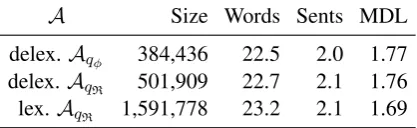
Table 8 shows the statistics for the E2E test set outputs. In the lexicalized setting, the mean D-level results support our hypothesis; syntac-tic complexity of test set outputs decreases from
p0 top1. In the delexicalized setting this is
some-what true; three of the p1 models have lower
mean D-level scores thanp0 with greedy
decod-ing. Curiously, p1/qφ with beam search has the
highest overall syntactic complexity of any our model variants, at odds with our hypothesis. No models are as syntactically complex as the human references, but our models come closest, with a mean D-Level category of 1.87 using the delex.
p1/qφmodel with beam decoder.
We also see thatp1/qRmodels are over two
sen-tences in length on average while the human ref-erences are under two sentences, suggesting they are more often falling back to simple but reliable ways to realize attributes (e.g., appending “It is a family-friendly venue.”).
That our simple models with greedy search and no semantic control mechanisms can perform as reliably as more sophisticated models suggest that in standard training regimes we are often not fully
learning from all information available in the train-ing data. Via sampltrain-ing we can uncover novel re-combinations of utterances that are only implied by the provided references. The gains of self-training also suggest that additional research into active learning for this task might bear fruit.
One curious observation about the self-training procedure is that it leads to a convergence in out-put complexity of greedy and beam decoding. The differences between mean D-level score on the
p0 models is 0.34 and 0.31 in the lexicalized and
delexicalized settings respectively. This shrinks to 0.0 and 0.1 in the delexicalizedp1 settings and
0.06 for lexicalizedp1, suggesting that the model
probability distributions are sharpening around a smaller set of output structures.
8 Related Work
Neural encoder-decoder models, are a popular choice for dialog generation (Mei et al., 2015;
Duˇsek and Jurˇc´ıˇcek, 2016; Chen et al., 2018;
Juraska et al., 2018; Elder et al., 2018). How-ever, the quality can vary significantly, with rela-tively similar architectures yielding both poor and competitve performance (Duˇsek et al.,2019). All of the cited work on the E2E or Laptops and TVs datasets uses beam search to achieve compet-itive performance. In addition, they often employ reranking to ensure that all attributes are realized (Duˇsek and Jurˇc´ıˇcek, 2016; Juraska et al., 2018;
Wen et al., 2015). (Elder et al., 2018) employ pointer generators to directly copy attribute values, while also using coverage penalties on the atten-tion weights to ensure that all attribute slots are at-tended to. Unlike these approaches, we do not re-quire beam search, reranking, or other specialized attention mechanisms or loss functions to obtain low error rates. Instead we use data-augmentation to obtain a more reliable but simpler model.
Data augmentation has also been used by prior neural generation models. Juraska et al. (2018) breaks multi-sentence utterances into separate training instances. They also try training on more complex sentences alone but this model was less reliably able to realize all attributes correctly. They also do not generate new utterance/MR pairs for training as we do.
Our method is in some ways similar to the re-constructor setting ofShen et al.(2019), where a base speaker modelS0 produces utterances and a
framework of rational speech acts (RSA) ( Mon-roe and Potts, 2015), a rational speaker model is obtained by composing the base speaker and lis-tener, i.e. S1(y|x) = L(x|y)·S0(y|x). While
we do not directly compose our parserq andp0,
thep1 model is learning from the composition of
the two. The theoretical commitments of RSA are somewhat orthogonal to our approach. It would be interesing to combine both methods, by incor-porating self-training into the RSA framework.
9 Conclusion
We present a novel self-training methodology for learning DNN-based dialogue generation mod-els using noise injection sampling and a MR parser. Even with relatively simple architectures and greedy decoding we are able to match the performance of state-of-the-art baselines on auto-matic measures of quality while also achieving su-perior semantic correctness. These findings hold under a human evaluation as well. On automatic measures of syntactic complexity we also find our approach is closer to matching human authored references than prior work. In future work, we in-tend to explore methods of self-training that futher improve syntactic diversity.
10 Acknowledgements
The authors would like to thank the anonymous reviewers for their valuable feedback, as well as Thomas Effland, Katy Ilonka Gero, and Christo-pher Hidey for their comments during the drafting of this paper.
This research is based upon work supported in part by the Office of the Director of National Intel-ligence (ODNI), IntelIntel-ligence Advanced Research Projects Activity (IARPA), via contract #FA8650-17-C-9117. The views and conclusions contained herein are those of the authors and should not be interpreted as necessarily representing the official policies, either expressed or implied, of ODNI, IARPA, or the U.S. Government. The U.S. Gov-ernment is authorized to reproduce and distribute reprints for governmental purposes notwithstand-ing any copyright annotation therein.
References
Dzmitry Bahdanau, Kyunghyun Cho, and Yoshua Ben-gio. 2014. Neural machine translation by jointly learning to align and translate. arXiv preprint arXiv:1409.0473.
Mingje Chen, Gerasimos Lampouras, and Andreas Vlachos. 2018. Sheffield at e2e: structured predic-tion approaches to end-to-end language generapredic-tion.
E2E NLG Challenge System Descriptions.
Kyunghyun Cho. 2016. Noisy parallel approximate decoding for conditional recurrent language model.
arXiv preprint arXiv:1605.03835.
Kyunghyun Cho, Bart van Merrienboer, Caglar Gul-cehre, Dzmitry Bahdanau, Fethi Bougares, Holger Schwenk, and Yoshua Bengio. 2014. Learning phrase representations using rnn encoder–decoder for statistical machine translation. InProceedings of the 2014 Conference on Empirical Methods in Nat-ural Language Processing (EMNLP), pages 1724– 1734.
Michael A Covington, Congzhou He, Cati Brown, Lo-rina Naci, and John Brown. 2006. How complex is that sentence? a proposed revision of the rosenberg and abbeduto d-level scale.
Ondˇrej Duˇsek and Filip Jurˇc´ıˇcek. 2016. Sequence-to-sequence generation for spoken dialogue via deep syntax trees and strings. arXiv preprint arXiv:1606.05491.
Ondˇrej Duˇsek, Jekaterina Novikova, and Verena Rieser. 2019. Evaluating the state-of-the-art of end-to-end natural language generation: The e2e nlg challenge.
arXiv preprint arXiv:1901.07931.
Henry Elder, Sebastian Gehrmann, Alexander OCon-nor, and Qun Liu. 2018. E2e nlg challenge sub-mission: Towards controllable generation of diverse natural language. InProceedings of the 11th Inter-national Conference on Natural Language Genera-tion, pages 457–462.
Juraj Juraska, Panagiotis Karagiannis, Kevin K Bow-den, and Marilyn A Walker. 2018. Slug2slug: A deep ensemble model with slot alignment for sequence-to-sequence natural language generation.
Yoon Kim. 2014. Convolutional neural networks for sentence classification. InProceedings of the 2014 Conference on Empirical Methods in Natural Lan-guage Processing (EMNLP), pages 1746–1751.
Jiwei Li, Michel Galley, Chris Brockett, Jianfeng Gao, and Bill Dolan. 2015. A diversity-promoting objec-tive function for neural conversation models. arXiv preprint arXiv:1510.03055.
Xiaofei Lu. 2009. Automatic measurement of syntac-tic complexity in child language acquisition. Inter-national Journal of Corpus Linguistics, 14(1):3–28.
Hongyuan Mei, Mohit Bansal, and Matthew R Walter. 2015. What to talk about and how? selective gen-eration using lstms with coarse-to-fine alignment.
arXiv preprint arXiv:1509.00838.
Dang Tuan Nguyen and Trung Tran. 2018. Structure-based generation system for e2e nlg challenge. E2E NLG Challenge System Descriptions.
Yevgeniy Puzikov and Iryna Gurevych. 2018. E2e nlg challenge: Neural models vs. templates. In Proceed-ings of the 11th International Conference on Natural Language Generation, pages 463–471.
Sheldon Rosenberg and Leonard Abbeduto. 1987. In-dicators of linguistic competence in the peer group conversational behavior of mildly retarded adults 1.
Applied Psycholinguistics, 8(1):19–32.
Iulian V Serban, Alessandro Sordoni, Yoshua Bengio, Aaron Courville, and Joelle Pineau. 2016. Building end-to-end dialogue systems using generative hier-archical neural network models. InThirtieth AAAI Conference on Artificial Intelligence.
Sheng Shen, Daniel Fried, Jacob Andreas, and Dan Klein. 2019. Pragmatically informative text genera-tion. arXiv preprint arXiv:1904.01301.
Tsung-Hsien Wen, Milica Gaˇsi´c, Nikola Mrkˇsi´c, Lina M Rojas-Barahona, Pei-Hao Su, David Vandyke, and Steve Young. 2016. Multi-domain neural network language generation for spoken di-alogue systems. In Proceedings of the 2016 Con-ference of the North American Chapter of the Asso-ciation for Computational Linguistics: Human Lan-guage Technologies, pages 120–129.
Tsung-Hsien Wen, Milica Gasic, Nikola Mrkˇsi´c, Pei-Hao Su, David Vandyke, and Steve Young. 2015. Semantically conditioned lstm-based natural lan-guage generation for spoken dialogue systems. In