Improved Neural Network-based Multi-label Classification
with Better Initialization Leveraging Label Co-occurrence
Gakuto Kurata IBM Research [email protected]
Bing Xiang IBM Watson
Bowen Zhou IBM Watson [email protected]
Abstract
In a multi-label text classification task, in which multiple labels can be assigned to one text, label co-occurrence itself is informative. We propose a novel neural network initializa-tion method to treat some of the neurons in the final hidden layer as dedicated neurons for each pattern of label co-occurrence. These dedicated neurons are initialized to connect to the corresponding co-occurring labels with stronger weights than to others. In experi-ments with a natural language query classifi-cation task, which requires multi-label clas-sification, our initialization method improved classification accuracy without any computa-tional overhead in training and evaluation.
1 Introduction
In multi-label text classification, one text can be associated with multiple labels (label co-occurrence) (Zhang and Zhou, 2014). Since la-bel co-occurrence itself contains information, we would like to leverage the label co-occurrence to im-prove multi-label classification using a neural net-work (NN). We propose a novel NN initialization method that treats some of the neurons in the final hidden layer asdedicated neurons for each pattern of label co-occurrence. These dedicated neurons are initialized to connect to the corresponding co-occurring labels with stronger weights than to oth-ers. While initialization of an NN is an important research topic (Glorot and Bengio, 2010; Sutskever et al., 2013; Le et al., 2015), to the best of our knowl-edge, there has been no attempt to leverage label co-occurrence for NN initialization.
To validate our proposed method, we focus on multi-label Natural Language Query (NLQ) classifi-cation in a document retrieval system in which users input queries in natural language and the system re-turns documents that contain answers to the queries. For NLQ classification, we first train a model from training data that contains pairs of queries and cor-responding one or more than one document labels, and then predict the appropriate document labels for new queries with the trained model.
Through experiments with a real-world document retrieval system and publicly available multi-label data set, simply and directly embedding label co-occurrence information into an NN with our pro-posed method improved accuracy of NLQ classifi-cation.
2 Related Work
Along with the recent success in NNs (Collobert et al., 2011; Kim, 2014), NN-based multi-label fication has been proposed. An NN for NLQ classi-fication needs to accept queries with variable length and output their labels. Figure 1 shows a typical NN architecture (Collobert et al., 2011). This NN first transforms words in the input query into word em-beddings (Mikolov et al., 2013), then applies Con-volutional Neural Network (CNN) and Max-pooling over time to extract fixed-length feature vectors, and feed them into the output layer to predict the label for the query (Collobert and Weston, 2008; Col-lobert et al., 2011; Yih et al., 2014). To take care of multi-labels, label co-occurrence has been incor-porated into loss functions such aspairwise ranking loss(Zhang and Zhou, 2006). More recently, Nam et
al. (2014) reported thatbinary cross entropycan out-perform the pairwise ranking loss by leveraging rec-tified linear units (ReLUs) for nonlinearity (Nair and Hinton, 2010),AdaGradfor optimization (Duchi et al., 2011), anddropoutfor generalization (Srivastava et al., 2014). Considering the training efficiency and superior performance, we used the binary cross en-tropy as one of the baselines in our experiments in Section 4 in addition tonegative log-likelihoodand
cross entropy.
Letx denote the feature vector of a query, y be the vector representation of the label,obe the output value of the NN, andΘbe the parameters of the NN. Note that the representation ofydiffers depending on the loss function. For simplicity in the following explanation, assume that we have a finite set of la-belsΛ ={λ1, λ2, λ3, λ4, λ5}and that a queryxhas
multiple labels{λ1, λ4}:
Negative Log Probability With minimization of negative log probability, a single label is assumed. To circumvent this limitation, we used copy trans-formation (Tsoumakas et al., 2010) and obtained two training examples ((x,y(1)),(x,y(2))), where
y(1) = (1,0,0,0,0)andy(2) = (0,0,0,1,0). The
loss for each example becomes l(Θ,(x,y(1))) = −log(o1) and l(Θ,(x,y(2))) = −log(o4), where
softmax activation is used to calculateoin the out-put layer.
Cross Entropy We assumed multi-labels as prob-abilistic distribution as y = (0.5,0,0,0.5,0). The cross entropy loss for the training example (x,y)
becomesl(Θ,(x,y)) = −ylog(o), where softmax activation is used in the output layer.
Binary Cross Entropy As Nam et al. (2014) in-dicated, minimizing binary cross entropy is supe-rior for handling multi-labels. By representing the target labels as y = (1,0,0,1,0), the binary cross entropy loss for the training example (x,y) be-comes l(Θ,(x,y)) = −∑5
k=1(yklog(ok) + (1−
yk) log(1−ok)), where sigmoid activation is used
in the output layer.
3 Proposed Method
In this section, we explain our proposed method in detail.
…
… … … …
do smoking
void life insurance
Convolution layer
Hidden layer
Output layer
Max- Pooling
over time
Word embedding for each word Query
[image:2.612.315.538.58.155.2]…
Figure 1: Neural network for NLQ classification. Proposed method is applied to the weight matrix between hidden and out-put layers as detailed in Figure 2.
Hidden layer Output layer 1
2
3
5 4 C
0 0 0 0 C
C C
0 C
Random initialization
1 2 3 4 5
{ 1, 4} { 2, 4, 5}
Weight matrix between hidden and output layers initialized by proposed method
Dedicated neurons Label co-occurrence
patterns
Number of units in hidden layer
Number of labels in output layer
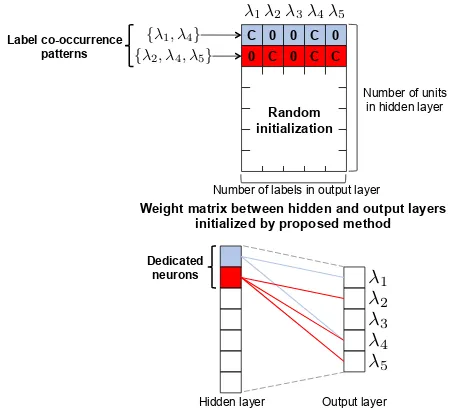
Figure 2: Overview of the proposed method. Label co-occurrence patterns of{λ1, λ4}and {λ2, λ4, λ5}are used in weight initialization, as shown in the above. This initialization corresponds to preparing dedicated neurons for each label co-occurrence pattern, as shown in the below.
3.1 Weight Initialization Leveraging Label Co-occurrence
[image:2.612.313.538.220.425.2]Loss Function 1-best Accuracy Recall@5 Full Accuracy
Negative Log Likelihood 49.75 → 51.27 69.80 → 71.07 47.03 → 48.65
Cross Entropy 50.51 → 52.54 71.32 → 72.08 46.96 → 48.71
Binary Cross Entropy 49.75 → 50.51 70.81 → 71.32 48.09 → 48.34
Table 1:1-best accuracy, recall@5, and full accuracy for evaluation data using different loss functions (Random initialization→ Proposed initialization). [%]
have a weight of 0, as shown in Figure 2 (above). Note that the remaining rows that are not associated with the pattern of label co-occurrence are randomly initialized. This initialization is equivalent to treat-ing some of the neurons in the final hidden layer as dedicated neurons for each pattern of label co-occurrence, where the dedicated neurons have con-nections to the corresponding co-occurring labels with an initialized weightC and to others with an initialized weight of0, as shown in Figure 2 (below). Finally, we conduct normal back-propagation using one of the loss functions, as discussed in the previ-ous section. Note that all the connection weights in the NN including the connection weights between the dedicated neurons and all labels are updated through back-propagation.
Since (1) computation of proposed initialization itself is negligible and (2) computation of back-propagation and the architecture of NN does not change with or without the proposed initialization, our proposed method does not increase computation in training and evaluation.
3.2 Weight Setting for Dedicated Neurons
For the weight value C for initialization, we used the upper bound UB of the normalized initializa-tion (Glorot and Bengio, 2010), which is determined by the number of units in the final hidden layernh and output layernc asUB =
√
6
√
nh+no .
Addition-ally, we changed this value in accordance with the frequency of the label co-occurrence patterns in the training data. The background idea is that the pat-terns of label co-occurrence that appear frequently (i.e., the number of queries with this pattern of label co-occurrence is large) are more important than less frequent patterns. Assuming that a specific pattern of label co-occurrence appears in the training dataf times, we tryf×UBand√f×UBfor initialization to emphasize this pattern.
C 1-best Recall@5 Full
— 50.51 71.32 46.96
UB 52.54 72.08 48.71
f×UB 51.52 70.81 48.39
√
f ×UB 53.55 72.08 50.04
Table 2:1-best accuracy, recall@5, and full accuracy for eval-uation data with changing initialization valueC. [%]
4 Experiments
We conducted experiments with the real-world NLQ classification data and the publicly available data to confirm the advantage of the proposed method.
4.1 Real-world NLQ classification Data
Experimental Setup We used NLQs for a docu-ment retrieval system in the insurance domain for the experiments. Users of the system input queries in natural language, and the system returns the la-bels of the documents that contain answers. We used
3,133queries for training and394queries for eval-uation,1,695and158of which had multiple labels, respectively. The number of unique document labels assigned to the training data was526.
We used the NN shown in Figure 1. The dimen-sion of word embedding was 100, number of ker-nels for the CNN was1,000, which means 1,000
units exist in the final hidden layer on top of Max-pooling over time, and number of output units was
Loss # Survived Neurons Weights-Dedicated Weights-All Function (# dedicated neurons:252) [Mean / Variance] [Mean / Variance]
Negative Log Likelihood 194 0.251 / 0.004 -0.024 / 0.023
Cross Entropy 197 0.267 / 0.005 -0.017 / 0.021
Binary Cross Entropy 168 0.279 / 0.015 -0.007 / 0.011
Table 3:Investigation of neural network after back-propagation training.
the number of training epochs to1,0001.
For the proposed method, we investigated the
1,695 queries with multiple labels in the training data and found252patterns of label co-occurrence. We then embedded this information in a1,000×526
weight matrix between the final hidden and output layers. In other words, we treated 252neurons in the final hidden layer as dedicated neurons in weight initialization.
For the hyper-parameter settings, we first tuned the hyper-parameters including L2-regularization and learning rate so that the accuracy of the baseline system with random initialization was maximized. For the proposed initialization, we used the same hyper-parameters obtained in the former tuning.
We used three evaluation metrics that are closely related to the usability of the document retrieval sys-tem: (1)1-best accuracyjudges if the1-best result of a system is included in the correct labels2. (2) Recall@5 judges if the 5-best results of a system contain at least one of the correct labels. (3) Full accuracyinvestigates thej-best results of a system and judges if they match the correct labels whenj labels are assigned to the query3.
Different Loss Functions Table 1 shows the ex-perimental results using three different loss func-tions. Comparing the values to the left of the arrows, which did not use the proposed initialization, supe-riority of binary cross entropy (Nam et al., 2014) was confirmed in full accuracy, while cross entropy
1We confirmed that NN training sufficiently saturated after 1,000epochs in preliminary experiments. We also compared the best accuracy achieved in1,000epochs for all experimen-tal conditions and confirmed that the same improvement was achieved with the proposed method.
2This metric is comparable withOne-error(Tsoumakas et al., 2010) by 1-best Accuracy = 100 - One-error.
3If a query has three labels, the system needs to return 3-best results that contain the three correct labels of the query to obtain
100% full accuracy.
was the best in 1-best accuracy in this experiment. As shown to the right of the arrows, we obtained improvement for all loss functions with every eval-uation metric with the proposed method. Overall, cross entropy training with the proposed initializa-tion achieved the best in all three metrics, where 1-best accuracy improvement from50.51%to52.54%
was statistically significant (p <0.05).
Different Weight Initialization Table 2 shows the results of emphasizing the frequent patterns of la-bel co-occurrence. We used the cross entropy loss function, which was the best in the previous exper-iments. Using√f ×UB yielded further improve-ment in 1-best accuracy and full accuracy, though usingf ×UB deteriorated in all metrics compared withUB. This suggests that there is room for im-provement if we can appropriately emphasize fre-quent patterns of label co-occurrence.
Analysis on Trained Neural Network We inves-tigated if the dedicated neurons for patterns of la-bel co-occurrences still simultaneously activate the corresponding labels after back-propagation. Table 3 shows the analysis on the NNs trained in the ex-periments for Table 1. In the# Survived Neurons
that simultaneously activate the co-occurring labels even after back-propagation.
There can be an overlap in label co-occurrence patterns. One typical case is “A, B” and “A, B, C”, and another case is “D, E”, “F, G”, and “D, E, F, G”. While we prepared the dedicated neu-rons for each co-occurrence pattern before back-propagation, some overlapped co-occurrences might be explained by the superset or combination of sub-sets after back-propagation. Table 3 suggests that some of the dedicated neurons did not survive af-ter back-propagation. We confirmed that about half of the label co-occurrence patterns whose dedicated neurons did not survive were covered by the patterns whose neurons survived. “Cover” means that if a neuron for “A, B” did not survive, a neuron for “A, B, C” survived, or if a neuron for “D, E, F, G” did not survive, neurons for “D, E” and “F, G” survived. If we change the network structure by connecting the dedicated neurons only to the corresponding units or preparing the special output units for co-occurring labels (label powerset (Read, 2008)), this flexibility might be lost.
4.2 Publicly Available Data
We used multi-label topic categorization data (RCV1-v2) (Lewis et al., 2004) to validate our method. We used the same label assignment and the same training and evaluation data partition with the
LYRL2004split (Lewis et al., 2004) where 23,149
training texts and781,265evaluation texts with 103 topic labels are available. We used the bag-of-word (BoW) feature for each text prepared by Chang and Lin (2011) whose dimension was47,236and con-structed a feed-forward NN that has an input layer that accepts the BoW feature, hidden layer of2,000
units, and output layer of103output units with the cross entropy loss function. By embedding the la-bel co-occurrence information between the hidden and output layers with the initial weights set toUB, which corresponded to treating 758neurons out of
2,000hidden units as the dedicated neurons, we im-proved 1-best accuracy of topic label classification from 93.95% to 94.60%, which was statistically sig-nificant (p <0.001).
To the best of our knowledge, 1-best accuracy
of94.18% (5.82% one-error)4 (Rubin et al., 2012)
was the best published result with using the standard LYRL2004 split of RCV1-v2. Our proposed method has advantages in a sufficiently competitive setup.
5 Conclusion
We proposed an NN initialization method to lever-age label co-occurrence information. Through ex-periments using the data of a real-world document retrieval system and publicly available data, we con-firmed that our proposed method improved NLQ classification accuracy. The advantage of the pro-posed method also includes no computational over-head during training and evaluation.
When we have large training data, the number of label co-occurrence patterns can be larger than that of hidden units. In such a case, one option is to select an appropriate set of label co-occurrence patterns with certain criteria such as the frequency in the training data. Another option is to make a larger weight matrix using all patterns and then to reduce its dimension with such as Principal Com-ponent Analysis (PCA) in advance of NN training. Our future work also includes setting the initializa-tion weight in a more sophisticated way and combin-ing the proposed method with other NN-based meth-ods (Kim, 2014; Johnson and Zhang, 2015).
Acknowledgments
We would like to show our gratitude to Dr. Ramesh M. Nallapati of IBM Watson for supporting the ex-periments. We are grateful to Dr. Yuta Tsuboi, Dr. Ryuki Tachibana, and Mr. Nobuyasu Itoh of IBM Research - Tokyo for the fruitful discussion and their comments on this and earlier versions of the paper. We thank the anonymous reviewers for their valu-able comments.
References
Chih-Chung Chang and Chih-Jen Lin. 2011. LIB-SVM: A library for support vector machines. ACM Transactions on Intelligent Systems and Technology, 2(3):27:1–27:27.
Ronan Collobert and Jason Weston. 2008. A unified ar-chitecture for natural language processing: Deep neu-ral networks with multitask learning. InProc. ICML, pages 160–167. ACM.
Ronan Collobert, Jason Weston, L´eon Bottou, Michael Karlen, Koray Kavukcuoglu, and Pavel Kuksa. 2011. Natural language processing (almost) from scratch.
The Journal of Machine Learning Research, 12:2493– 2537.
John Duchi, Elad Hazan, and Yoram Singer. 2011. Adaptive subgradient methods for online learning and stochastic optimization. The Journal of Machine Learning Research, 12:2121–2159.
Xavier Glorot and Yoshua Bengio. 2010. Understand-ing the difficulty of trainUnderstand-ing deep feedforward neural networks. InProc. AISTATS, pages 249–256.
Rie Johnson and Tong Zhang. 2015. Effective use of word order for text categorization with convolutional neural networks. InProc. NAACL-HLT, pages 103– 112.
Yoon Kim. 2014. Convolutional neural networks for sentence classification. InProc. EMNLP, pages 1746– 1751.
Quoc V Le, Navdeep Jaitly, and Geoffrey E Hin-ton. 2015. A simple way to initialize recurrent networks of rectified linear units. arXiv preprint arXiv:1504.00941.
David D Lewis, Yiming Yang, Tony G Rose, and Fan Li. 2004. RCV1: A new benchmark collection for text categorization research. The Journal of Machine Learning Research, 5:361–397.
Tomas Mikolov, Kai Chen, Greg Corrado, and Jeffrey Dean. 2013. Efficient estimation of word represen-tations in vector space. InProc. ICLR.
Vinod Nair and Geoffrey E Hinton. 2010. Rectified lin-ear units improve restricted boltzmann machines. In
Proc. ICML, pages 807–814.
Jinseok Nam, Jungi Kim, Eneldo Loza Menc´ıa, Iryna Gurevych, and Johannes F¨urnkranz. 2014. Large-scale multi-label text classification―– revisiting
neu-ral networks. InProc. ECML-PKDD, pages 437–452. Jesse Read. 2008. A pruned problem transformation method for multi-label classification. InProc. NZC-SRS, pages 143–150.
Timothy N Rubin, America Chambers, Padhraic Smyth, and Mark Steyvers. 2012. Statistical topic models for multi-label document classification. Machine learn-ing, 88(1-2):157–208.
Nitish Srivastava, Geoffrey Hinton, Alex Krizhevsky, Ilya Sutskever, and Ruslan Salakhutdinov. 2014. Dropout: A simple way to prevent neural networks from overfitting. The Journal of Machine Learning Research, 15(1):1929–1958.
Ilya Sutskever, James Martens, George Dahl, and Geof-frey Hinton. 2013. On the importance of initializa-tion and momentum in deep learning. InProc. ICML, pages 1139–1147.
Grigorios Tsoumakas, Ioannis Katakis, and Ioannis Vla-havas. 2010. Mining multi-label data. InData mining and knowledge discovery handbook, pages 667–685. Springer.
Wen-tau Yih, Xiaodong He, and Christopher Meek. 2014. Semantic parsing for single-relation question answering. InProc. ACL, pages 643–648.