M
AWPS: A Math Word Problem Repository
Rik Koncel-Kedziorski*1, Subhro Roy*2, Aida Amini1, Nate Kushman3, andHannaneh Hajishirzi1
1University of Washington,2University of Illinois Urbana Champaign,3Microsoft Research {kedzior, amini91, hannaneh}@uw.edu, [email protected], [email protected]
Abstract
Recent work across several AI subdisciplines has focused on automatically solving math word problems. In this paper we introduce
MAWPS, an online repository of Math Word
Problems, to provide a unified testbed to
eval-uate different algorithms. MAWPS allows for
the automatic construction of datasets with particular characteristics, providing tools for tuning the lexical and template overlap of a dataset as well as for filtering ungrammatical problems from web-sourced corpora. The on-line nature of this repository facilitates easy community contribution. At present, we have amassed 3,320 problems, including the full datasets used in several prominent works.
1 Introduction
Automatically solving math word problems has proved a difficult and interesting challenge for the AI research community (Feigenbaum et al., 1995). Math word problems serve as a testbed for algo-rithms that build a precise understanding of what is being asserted in text. Consider the following:
Rachel bought two coloring books. One had 23 pictures and the other had 32. After one week she had colored 44 of the pictures. How many pictures does she still have to color?
To solve such a problem, an algorithm must model implicit and explicit quantities in the text and their relationships through mathematical operations.
Many researchers have taken on this challenge to design data-driven approaches to solve different
* denotes equal contribution
types of math word problems (Hosseini et al., 2014; Kushman et al., 2014; Roy and Roth, 2015; Zhou et al., 2015; Koncel-Kedziorski et al., 2015). Treat-ments of this task range from template-matching to narrative-building, and methods including integer linear programming, factorization, and more appear in the literature. As a result of the variety of ap-proaches, several datasets have emerged. The va-riety of math word problems in these datasets is such that researchers have already begun specializ-ing in the types of problems that their systems are able to successfully solve. Additionally, in some datasets one may find significant repetition of com-mon words, a small set of equation templates used again and again, or problem texts which map to highly degraded grammatical structures. Therefore, designing general algorithms that can address dif-ferent problem types while still being robust to the variations across datasets has remained a challenge. In response to the burgeoning interest in this task, we present MAWPS (MAth Word ProblemS, pro-nounced mops), a framework for building an on-line repository of math word problems. Our frame-work includes a collection of varying types of math word problems, their answers, and equation tem-plates, as well as interfaces which allow researchers to dynamically update and add more problem types. Additionally, in light of the problematic features of the current datasets cited above, our framework pro-vides the possibility for customizing a dataset with regard to considerations such as lexical and template overlap or grammaticality, allowing researchers to choose how many of the difficulties of open do-main web-sourced word problem texts they want
to tackle. We report the important characteristics of the current available data as well as the perfor-mance of some state-of-the-art systems on various subsets of the data. MAWPS is located at http:
//lang.ee.washington.edu/MAWPS. 2 Related Work
Recently, automatically solving math word prob-lems has attracted several researchers. Specific topics include number word problems (Shi et al., 2015), logic puzzle problems (Mitra and Baral, 2015), arithmetic word problems (Hosseini et al., 2014; Roy and Roth, 2015), algebra word prob-lems (Kushman et al., 2014; Zhou et al., 2015; Koncel-Kedziorski et al., 2015), and geometry word problems (Seo et al., 2015).
A few recent works, Kushman et al. (2014) and Zhou et al. (2015) focus on solving math word prob-lems by matching quantities and variables (nouns) extracted from the problem text to templates appear-ing in the trainappear-ing data. These methods have a broad scope, but they rely heavily on overlap between tem-plates in the training and test data. As shown in our experiments, when that overlap is reduced, the per-formance of the systems drops significantly.
Other work has focused on more limited domains, but aims to reduce the reliance on data overlap. Hosseini et al. (2014) solve addition and subtrac-tion problems by learning to categorize verbs for the purpose of updating a world representation de-rived from the problem text. Roy and Roth (2015) treat arithmetic word problem templates as equa-tion trees and introduce a method for learning the least governing node for two text quantities. Koncel-Kedziorski et al. (2015) focus on single equation problems and use typed semantically-rich equation trees where nodes correspond to numbers and an as-sociated type derived from the problem text, and ef-ficiently enumerate the space of these trees using in-teger linear programming.
Our work is also inspired by the recent work in introducing datasets to evaluate question answering and reading comprehension tasks that require rea-soning and entailment. In contrast to Richardson et al. (2013), our work is focused on making a dataset for math word problems to evaluate robustness, scal-ability, and scope of algorithms in quantitative rea-soning. In contrast to Weston et al. (2015), our work
has more natural text and a larger vocabulary, does not use synthetic data, and is only focused on math word problems which is an extension of the counting sub-category introduced in that work.
3 Data
We compile a dataset of arithmetic and algebra word problems of varying complexity from different web-sites. This data extends the published word problem datasets used in Hosseini et al. (2014), Kushman et al. (2014), Koncel-Kedziorski et al. (2015), and Roy and Roth (2015). In addition to this strong founda-tion, the MAWPSrepository provides interfaces for adding new word problems, allowing for its exten-sion and development.
Noting that word problem datasets have varied with regard to noisiness and repetition, we define several data characteristics to capture these proper-ties below. We then allow a user of the repository to select a subset of the data that optimizes these char-acteristics. The three data characteristics that can be automatically manipulated by MAWPSare:
Lexical Overlap. Lexical overlap describes the reuse of lexemes among problems in a dataset. For example, several problems may describe tickets be-ing sold for a play, with only the number of adult and child tickets changed among them. These problems would have high lexical overlap. Previous work has shown that lexeme reuse in a dataset allows for spurious associations between the problem text and a correct solution (Koncel-Kedziorski et al., 2015). Researchers have sought to reduce this characteris-tic in their data so as to facilitate the development of more robust methods.
Template Overlap. By template we mean an equation where numerical values are replaced by a consistent, ordered set of constant variables. For ex-ample, the equations(12∗2) + 7 =xand(6∗15) + 105 =xhave the same template,(a∗b)+c=x. As shown in Roy and Roth (2015) and elsewhere, the appearance of a similar template in the training data is a requirement for some systems at test time. More general math word problem solvers have been intro-duced that reduce or eliminate this reliance. MAWPS provides for the automatic construction of a dataset with minimized template overlap.
Repository
Reduce Lexical Overlap
Minimize Template Overlap
Automatic Optimization Tools Grammaticality
Checker
Word Problem Dataset Online Interfaces for
Contributing
[image:3.612.78.296.64.196.2]Problems/Datasets MAWPS
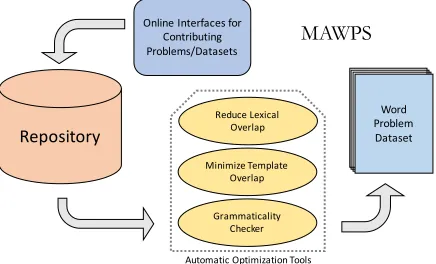
Figure 1: MAWPS System overview: Online interfaces allow for extending repository. Optimization Tools allow for real-time delivery of usable datasets with particular characteristics.
online sources. Some problems from these sources contain grammatical errors including morphologi-cal agreement failures, misspellings, and other more complicated ungrammaticalities (for example, “Joan paid $8.77 on a cat toy, and a cage cost her $10.97 with a $20 bill.”). While some researchers wish to develop methods robust to these kind of errors, oth-ers would focus on the subset of the data that adheres to a high-precision, expertly developed grammar of English. To facilitate both lines of research, we al-low for the selection of only those problems which meet this judgment, or the full data.
4 System Overview
The goal of the MAWPSrepository is to provide an extendable collection of math word problems which allows researchers to select the portion of the data that meets their needs. To facilitate the growth of the collection, our framework allows for easily adding a single word problem or a whole dataset to the repository. We design backend tools which allow researchers to select a dataset with reduced lexical overlap, minimized template overlap, or improved grammaticality characteristics even as the repository continues to grow through community contribution. Figure 1 shows an outline of the MAWPSsystem.
4.1 Reduce Lexical Overlap
We consider the lexical overlap of a datasetDto be the average of the pairwise lexical overlap between each pair of problems inD. First, letW(p) denote the set of unique unigrams and bigrams in a problem
p. Then PairLex(p, q) = ||WW((pp))∩∪WW((qq))|| denotes the pairwise lexical overlap between problemspandq.
We formally define the lexical overlap of a dataset Das
Lex(D) = 1
N X
pi,pj∈D
i<j
PairLex(pi, pj)
where N = |D2| is the number of problem pairs inD. Given a datasetDand a target subset sizek, MAWPSautomatically finds a subsetD0 of reduced lexical overlap by solving the following optimiza-tion problem:minD0⊆D,|D0|=kLex(D0).
This is the remote clique problem1, which is NP
hard. As a result, we resort to a greedy strategy which gives an approximation ratio of2(Birnbaum and Goldman, 2007). We define flex(p, D0) = P
q∈D0PairLex(p, q), which describes the overlap between a problem p and dataset D0. The greedy
method to generate subsetD0ofDis as follows: we
iteratively add a problempfromD\D0toD0which
minimizes the value offlex(p, D0). That is, at each step, we add a problem which has the least average pairwise lexical overlap with the problems already in D0. We repeat this process, starting with a randomly
initialized singleton set, until a set ofkproblems is created.
4.2 Minimize Template Overlap
The template overlap of a datasetDis defined anal-ogously to lexical overlap as the average of the pair-wise template overlap between each pair of prob-lems ofD. LetPairTempl(p, q)be1ifpandq have the same template (corresponding to the gold equa-tion), and0otherwise. We then define the template overlap of a datasetDas
Tmpl(D) = N1 X
pi,pj∈D
i<j
PairTempl(pi, pj)
where N = |D2|. Given a dataset D and a target subset size k, the template overlap re-duced subset of D is generated by the following:
minD0⊆D,|D0|=kTmpl(D0).
Dataset # Probs|D| # Gramm. k=|DLexical Overlap (Lex)|/2 k=|D| Reduction k=|Template Overlap (Tmpl)D|/2 k=|D| Reduction
AddSub 395 357 6.1 7.9 22.8 33 37.2 11.3
SingleOp 562 491 6.1 7.8 21.8 24.7 25.4 2.8
MultiArith 600 526 7.8 9.4 17.0 19.7 22.1 10.9
SingleEq 508 434 5.4 6.8 20.6 11 17.9 38.5
SimulEq-S 514 437 4.7 6 21.7 2.9 12.5 76.8
[image:4.612.85.529.59.154.2]SimulEq-L 1155 980 4.4 5.7 22.8 0.1 3.3 97.0
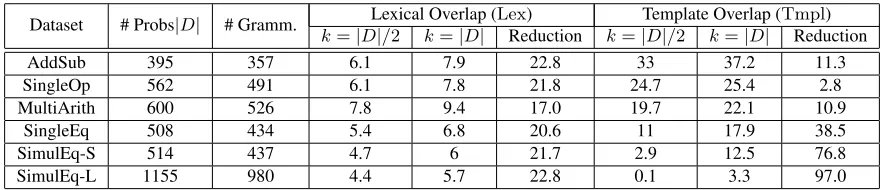
Table 1:Characteristics of datasets added to our repository. # Gramm. is no. of problems which passed our
grammat-icality check, theLexcolumn reports minimum lexical overlap for sizekdataset, theTmplcolumn reports minimum
template overlap for sizekdataset, Reduction denotes the % decrease in overlap value obtained by our system, when
going fromk=|D|tok=|D|/2. We report all numbers as percentages.
Dataset System All|D| Gramm. Lex(|D|/2) Tmpl(|D|/2) Random (|D|/2) SingleEq (Koncel-Kedziorski et al., 2015) 72.2 74.2 63.6 67.0 67.2
SimulEq-S (Kushman et al., 2014) 68.7 70.3 61.1 59.9 66.8
Table 2:Effect of lexical, template overlap and grammaticality data characteristics over various systems.
This again is an instance of remote clique prob-lem, and we follow a similar greedy strategy. We de-fineftmpl(p, D0) = Pq∈D0PairTempl(p, q), which describes the overlap between a problem p and dataset D0. The greedy method to generate subset D0 of D is as follows: we iteratively add a
prob-lempfromD\D0 toD0which minimizes the value
offtmpl(p, D0). In other words, the algorithm itera-tively chooses problempfromD\D0and adds it to D0 such that (if possible)padds a new template to D0. If there are no new templates to be added, then
apwhose template is least frequent among those of D0is selected. This process is repeated untilD0has kproblems.
4.3 Template/Lexical Interaction
Given a dataset and a target subset sizek, we would like a subset with the best lexical and template over-lap characteristics. As an approximation, we reduce the arithmetic mean of the two overlap values. This mean can be expressed as H(D) = 1
2(Lex(D) +
Tmpl(D)). A similar greedy iterative approach as before generates the required dataset with the afore-mentioned approximation guarantee.
4.4 Grammaticality
Given a dataset, MAWPScan automatically remove ungrammatical word problems, resulting in a sub-set with improved grammaticality. Our system uses the broad-coverage, linguistically precise En-glish Resource Grammar (ERG) (Flickinger, 2000;
Flickinger, 2011) for determining grammaticality. The ERG is a continually-developed implemen-tation of the grammatical theory of Head-Driven Phrase Structure Grammar that covers an increas-ingly wide variety of phenomena. Moreover, the ERG makes binary decisions for sentence accept-ability: if it cannot find a valid parse among its rules, it returns no parse for that sentence. This contrasts with statistical parsers whose utility for this task is limited by the difficulties of tuning a cutoff confi-dence threshold for acceptability. We allow for fil-tering problems with ungrammatical sentences. 5 Properties of Current Data
We initialize our repository by extending the pub-licly available datasets. We list them below in order of increasing complexity of the final equation form.
• AddSub: Collection of addition, subtraction problems (Hosseini et al., 2014).
• SingleOp: Collection of single operation arith-metic problems (Roy et al., 2015).
• MultiArith: Collection of multi-step arithmetic problems (Roy and Roth, 2015).
• SingleEq: Single equation problems from (Koncel-Kedziorski et al., 2015).
• SimulEq-S: Single and two equation word prob-lems from (Kushman et al., 2014).
lexi-cal and template overlap. Template overlap varies greatly across datasets, and decreases sharply with increase of complexity of target equation. Lexical overlap, on the other hand, does not show much variation, with most datasets having overlap value of around7%. Our system effectively reduces over-lap, obtaining around 20%reduction in most cases (going fromk =|D|tok =|D|/2). In the case of template overlap, this reduction varies greatly based on the complexity of target equation, ranging from
2.8%for SingleOp to97%for SimulEq-L.
As no current system can processSimulEq-L, we report the performance of the two most general sys-tems (Koncel-Kedziorski et al., 2015; Kushman et al., 2014) onSingleEqandSimulEq-Sunder differ-ent overlap and grammaticality properties in Table 2. We use a 5-fold cross validation setup and report average accuracy across folds. We include perfor-mance on a randomly selected dataset of the same size to analyze the effect of decreased data-size on performance.
Both systems gain from the pruning of grammati-cally incorrect problems from the dataset. Our re-sults support the findings of Koncel-Kedziorski et al. (2015) regarding the diminishing performance of systems when faced with reduced lexical and tem-plate overlap. We expect, as that work showed, that further reducing these characteristics would result in even lower performance. The results on a random subset of the data show that data set size does not have as strong of an effect on algorithm performance as lexical or template overlap.
6 Conclusion
In this paper, we introduced MAWPS, a repository of math word problems. MAWPSoffers a large collec-tion of data from new and published datasets, pro-vides interfaces for adding data, and includes data optimization tools. As current results show, de-signing general algorithms that can address different problem types while still being robust to the tem-plate or lexical variations has remained a challenge. We hope that our framework will help facilitate com-parison between results while allowing researchers to focus on targets such as all grammatical problems or all single equation problems. We also include an official 80/20 test/train split of all problems available at the time of this publication.
Acknowledgments: This research was supported by the Allen Institute for AI (66-9175), Allen Dis-tinguished Investigator Award, NSF (IIS-1352249), DARPA (FA8750-13-2-0008) and a Google research faculty award. We thank the anonymous reviewers for their helpful comments.
References
Benjamin Birnbaum and Kenneth J. Goldman. 2007. An Improved Analysis for a Greedy Remote-Clique
Al-gorithm Using Factor-Revealing LPs. Algorithmica,
55(1):42–59.
Edward A Feigenbaum, Julian Feldman, and Paul Armer.
1995.Computers and Thought. AAAI press.
Dan Flickinger. 2000. On building a more effcient
gram-mar by exploiting types. Natural Language
Engineer-ing, 6(01):15–28.
Dan Flickinger. 2011. Accuracy vs. Robustness in
Grammar Engineering. Language from a cognitive
perspective: Grammar, usage, and processing, pages 31–50.
Mohammad Javad Hosseini, Hannaneh Hajishirzi, Oren Etzioni, and Nate Kushman. 2014. Learning to Solve Arithmetic Word Problems with Verb Categorization. InEMNLP, pages 523–533.
Rik Koncel-Kedziorski, Hannaneh Hajishirzi, Ashish Sabharwal, Oren Etzioni, and Siena Ang. 2015.
Pars-ing Algebraic Word Problems into Equations. TACL,
3:585–597.
Nate Kushman, Yoav Artzi, Luke Zettlemoyer, and Regina Barzilay. 2014. Learning to Automatically
Solve Algebra Word Problems. InACL, pages 271–
281.
Arindam Mitra and Chitta Baral. 2015. Learning to
au-tomatically solve logic grid puzzles. InEMNLP.
Matthew Richardson, Christopher JC Burges, and Erin Renshaw. 2013. MCTest: A Challenge Dataset for the Open-Domain Machine Comprehension of Text. InEMNLP, volume 1, page 2.
Subhro Roy and Dan Roth. 2015. Solving General
Arith-metic Word Problems. InEMNLP.
Subhro Roy, Tim Vieira, and Dan Roth. 2015. Reasoning
about Quantities in Natural Language.TACL.
Minjoon Seo, Hannaneh Hajishirzi, Ali Farhadi, Oren Et-zioni, and Clint Malcolm. 2015. Solving Geometry Problems: Combining Text and Diagram
Interpreta-tion. InEMNLP.
Shuming Shi, Yuehui Wang, Chin-Yew Lin, Xiaojiang Liu, and Yong Rui. 2015. Automatically Solv-ing Number Word Problems by Semantic ParsSolv-ing and
Jason Weston, Antoine Bordes, Sumit Chopra, and Tomas Mikolov. 2015. Towards AI-complete
Ques-tion Answering: a set of prerequisite toy tasks. arXiv
preprint arXiv:1502.05698.
Lipu Zhou, Shuaixiang Dai, and Liwei Chen. 2015. Learn to Solve Algebra Word Problems Using