Search Space Pruning: A Simple Solution for Better Coreference Resolvers
Nafise Sadat Moosavi and Michael Strube Heidelberg Institute for Theoretical Studies gGmbH
Schloss-Wolfsbrunnenweg 35 69118 Heidelberg, Germany
{nafise.moosavi|michael.strube}@h-its.org
Abstract
There is a significant gap between the per-formance of a coreference resolution system on gold mentions and on system mentions. This gap is due to the large and unbalanced search space in coreference resolution when using system mentions. In this paper we show that search space pruning is a simple but effi-cient way of improving coreference resolvers. By incorporating our pruning method in one of the state-of-the-art coreference resolution systems, we achieve the best reported over-all score on the CoNLL 2012 English test set. A version of our pruning method is available with the Cort coreference resolution source code.
1 Introduction
Coreference resolution is the task of clustering refer-ring expressions in a text so that each resulting clus-ter represents an entity. It is a very challenging task in natural language processing and it is still far from being solved, i.e. the best reported overall CoNLL score on the CoNLL 2012 English test set is 63.39 (Wiseman et al., 2015).
Text spans referring to an entity are called men-tions. Mentions are the primary objects in a corefer-ence resolution system. As with most previous work on coreference resolution, we only consider men-tions that are noun phrases. However, not all of the noun phrases are mentions. A noun phrase may not refer to any entity at all. The pronounitin the sen-tenceit is rainingis an example of a non-referential noun phrase. Noun phrases which do refer to an en-tity (mentions) can be further divided into two
cat-egories: mentions referring to entities which only appear once in the discourse (i.e. singletons), and mentions realizing entities that have been referred to more than once in the text (i.e. coreferent men-tions). Henceforth, we refer to both singletons and non-referential phrases as non-coreferent mentions. A large number of mentions that appear in a text are non-coreferent. For instance, more than 80% of mentions are singletons in the OntoNotes English development set (Marneffe et al., 2015).
The latent ranking model is the best perform-ing model for coreference resolution to date (Wise-man et al., 2015; Martschat and Strube, 2015). If we use gold mentions, the latent ranking model of Martschat and Strube (2015) achieves an overall score of 80% on the CoNLL 2012 English test set. This result shows that once we have the ideal pruned search space, the ranking model with the current set of features is reasonably capable of finding corre-sponding entities of mentions. The substantial gap (17%) between the results of the gold mentions and system mentions implies that search space pruning is a promising direction for further improvements in coreference resolution.
Marneffe et al. (2015) examine different search space pruning methods that exist for coreference res-olution. Among those, anaphoricity detection is the most popular method (e.g. Ng and Cardie (2002), Denis and Baldridge (2007), Ng (2009), Zhou and Kong (2009), Durrett and Klein (2013), Martschat and Strube (2015), Wiseman et al. (2015), Peng et al. (2015), and Lassalle and Denis (2015)), while sin-gleton detection is a more recent method (Recasens et al., 2013; Ma et al., 2014; Marneffe et al., 2015).
Anaphoricity detection examines whether a phrase is anaphoric. Singleton detection examines whether a phrase belongs to a coreference chain re-gardless of being anaphor or antecedent. There-fore, anaphoricity detection only prunes the search space of anaphors while singleton detection prunes the search space of both anaphors and antecedents.
Except for Clark and Manning (2015), all of the state-of-the-art coreference resolvers explicitly model anaphoricity detection (Martschat and Strube, 2015; Wiseman et al., 2015; Peng et al., 2015). Therefore, modeling search space pruning as single-ton detection can provide additional information for the state-of-the-art coreference resolution systems.
In this paper we propose a simple but efficient sin-gleton detection model. We first perform intrinsic evaluations and show that our simple model signifi-cantly improves the state-of-the-art results in single-ton detection by a large margin. We then evaluate our singleton model extrinsically on coreference res-olution showing that search space pruning improves different coreference resolution models.
2 Simple but Efficient Singleton Detection In this section we show that pruning the coreference resolution search space is not a very difficult task. By using a simple set of features and a standard classifier, we achieve new state-of-the-art results for classifying coreferent and non-coreferent mentions. Unlike Marneffe et al. (2015) who use both sur-face (i.e. part-of-speech and n-gram based) features and a large number (123) of carefully designed lin-guistic features, we select a simple and small set of shallow features:
1. lemmas of all words included in the mention; 2. lemmas of the two previous/next words
be-fore/after the mention;
3. part-of-speech tags of all words of the mention; 4. part-of-speech tags of the two previous/next
words before/after the mention; 5. complete mention string; 6. length of the mention in words;
7. mention type (proper, nominal, pronominal); 8. whether the whole string of the mention
ap-pears again in the document;
9. whether the head of the mention appears again in the document.
We use an anchored SVM (Goldberg and Elhadad, 2007) with a polynomial kernel of degree two for classification. When only few features are available, anchored SVMs generalize much better than soft-margin-SVMs (Goldberg and Elhadad, 2009). In our experiments, we use a count threshold for discard-ing vary rare lexical features that occur fewer than 10 times.
Similar to Marneffe et al. (2015), we use three different configurations for evaluation. TheSurface configuration only uses the shallow features. The Combined configuration uses the surface features plus the linguistic features introduced by Marneffe et al. (2015). The linguistic features of Marneffe et al. (2015) also include some pairwise combinations of the single features. Since our SVM with a poly-nomial kernel of degree two implicitly models fea-ture pairs, we only include the single feafea-tures in our Combinedconfiguration. When removing mentions that are classified as non-coreferent during prepro-cessing, precision matters more than recall in order not to over prune coreferent mentions. To achieve higher precision, the Confident configuration uses high confidence predictions of SVM (i.e. classify-ing a mention as non-coreferent if the SVM output is less or equal to -1, and as coreferent if the output is greater or equal to +1). We use the same set of shallow features asSurfaceforConfident. However, Marneffe et al. (2015) use their combined feature set forConfident.
2.1 Results
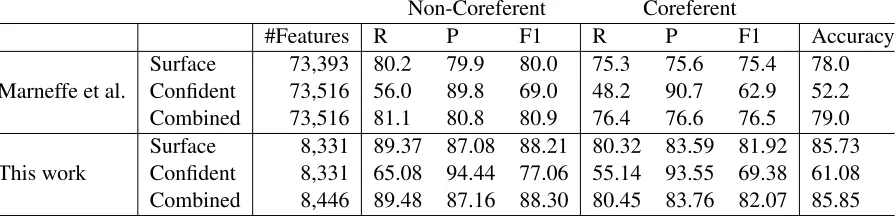
Table 2 shows the results of our singleton detec-tion model in comparison to that of Marneffe et al. (2015). We train our model on the CoNLL 2012 English training set and evaluate it on the develop-ment set using recall, precision, F1 measure and ac-curacy for both coreferent and non-coreferent men-tions. Unlike Marneffe et al. (2015) that also use some gold annotations for their features, we extract all of our surface features from ’auto_conll’
Non-Coreferent Coreferent
#Features R P F1 R P F1 Accuracy
[image:3.612.83.531.57.165.2]Surface 73,393 80.2 79.9 80.0 75.3 75.6 75.4 78.0 Marneffe et al. Confident 73,516 56.0 89.8 69.0 48.2 90.7 62.9 52.2 Combined 73,516 81.1 80.8 80.9 76.4 76.6 76.5 79.0 Surface 8,331 89.37 87.08 88.21 80.32 83.59 81.92 85.73 This work Confident 8,331 65.08 94.44 77.06 55.14 93.55 69.38 61.08 Combined 8,446 89.48 87.16 88.30 80.45 83.76 82.07 85.85
Table 1:Results on the the CoNLL 2012 English development set.
percent in comparison to theSurfaceresults. How-ever, in our case, the linguistic features only improve the results by about 0.1 percent.
As the results show, by only using shallow fea-tures, we achieve a new state-of-the-art performance for singleton detection that improves the results of Marneffe et al. (2015) by a large margin for classi-fying both coreferent and non-coreferent mentions.
2.2 Error Analysis
For a singleton detector, precision errors (classify-ing a coreferent mention as non-coreferent) are more harmful than recall errors. If a coreferent mention is classified as non-coreferent, the recall of the coref-erence resolver that uses the singleton detector will decrease. On the other hand, recall errors only af-fect the singleton detector itself and not coreference resolvers.
The precision error ratios of ourSurfaceand Con-fident systems for proper name (NAM), nominal (NOM) and pronominal (PRO) mentions are listed in Table 2. For each mention type, Table 2 also shows the precision error ratio by mention type re-lated to the mentions that are first mentions of their corresponding entities. For example, in the Confi-dent system 73.45% of the nominal mentions that are incorrectly classified as non-coreferent are first mentions of their corresponding entities. As can be seen, many of the precision errors in both Surface andConfident systems are errors in which the first mention of an entity is detected as non-coreferent. Detecting whether a mention will be referred to later, is indeed very hard and requires more context infor-mation. Features (8) and (9) from our feature set are designed to address the correct detection of the first mentions of entities to a limited degree. These fea-tures only address first mentions of entities that are
NAM NOM PRO
Surface Error rateFirst mentions 57.68 65.54 20.1923.17 70.61 6.22
Confident Error rateFirst mentions 62.63 73.45 33.3323.52 74.70 1.78
Table 2:Precision error ratio. NAM NOM PRO Surface 30.48 34.07 35.45 Confident 23.65 58.25 13.50
Table 3:Recall error ratio.
referred to by later mentions with head or complete string match. More features considering properties of other mentions, rather than the examined mention itself, are required in order to improve the correct detection of the first mentions of entities.
Table 3 shows the ratio of recall errors for each mention type. For ourSurface system, this ratio is more or less the same for different mention types. However,Confident’s main source of recall errors is the detection of non-coreferent nominal mentions.
2.3 Discussion
Our results significantly outperform the results of Marneffe et al. (2015) who use both surface features and a set of hand-engineered features targeting dif-ferent linguistic phenomena related to the task. Our findings are mirrored by Durrett and Klein (2013)’s work on the coreference resolution task. Durrett and Klein (2013) show that a coreference resolution sys-tem that uses surface features can outperform those using hand-engineered linguistic features.
re-MUC B3 CEAFe Avg.
R P F1 R P F1 R P F1 F1
[image:4.612.74.540.66.188.2]Stanford Baseline+Stanford Singleton 64.58 63.65 64.11 49.53 55.21 52.22 53.06 44.82 48.59 54.9764.26 65.19 64.72 49.09 56.84 52.68 52.54 46.55 49.37 55.59 +Preprocess Pruning 64.27 69.01 66.56 48.65 60.32 53.86 48.71 51.48 50.06 56.83 Cort Pairwise+Preprocess Pruning 68.19 73.38 70.69 53.62 62.02 57.52 51.42 55.07 53.18 60.4668.46 71.01 69.71 54.02 59.47 56.61 51.88 52.17 52.02 59.45 Latent Ranking 68.55 77.22 72.63 54.64 66.78 60.11 52.85 60.3 56.33 63.02 +Pruning Feature 68.81 78.37 73.28 55.46 66.9 60.65 52.07 62.23 56.7 63.54 Wiseman et al. (2015) 69.31 76.23 72.60 55.83 66.07 60.52 54.88 59.41 57.05 63.39
Table 4:Results on the English test set. All the improvements made by our singleton detection models are statistically significant.
cency, focus (Grosz and Sidner, 1986), and center-ing (Brennan et al., 1987) are examples of useful linguistic features for coreference resolution which have the additional benefit of being applicable to dif-ferent languages. For example, Hobbs’ algorithm and agreement features are being used successfully in the Stanford system (Lee et al., 2013). How-ever, apart from features like these, a large number of linguistically motivated features have been pro-posed which either do not have a significant impact or are only applicable to a specific language or do-main. Therefore, designing general linguistic fea-tures which provide information that is not captured by surface features deserve more attention in order to gain higher recall and better generalization.
We combine a simple set of surface features with a standard machine learning model that can handle a large number of surface features. This leads to a new state-of-the-art singleton detection with high preci-sion that can easily be incorporated in a coreference resolution system for pruning non-coreferent men-tions.
3 Pruning = Better Coreference Resolvers In this section, we investigate the effect of search space pruning on coreference resolution. We choose the Stanford rule-based system (Lee et al., 2013) and the Cort1 system (Martschat and Strube, 2015) as
our baselines for coreference resolution. Wiseman et al. (2015) is the best performing coreference res-olution system to date. However, we choose Cort as our learning-based baseline because Cort is a frame-work that allows evaluations on various coreference
1http://github.com/smartschat/cort
resolution models, i.e. ranking, antecedent trees, and pairwise. The pairwise model is the most commonly used model in coreference resolution, and latent ranking is the best performing model for coreference resolution to date (Wiseman et al., 2015; Martschat and Strube, 2015).
3.1 Results
Table 4 shows the results of integrating singleton detection into different coreference resolution ap-proaches. We evaluate the systems on the CoNLL 2012 English test set using the MUC (Vilain et al., 1995), B3 (Bagga and Baldwin, 1998), and
CEAFe (Luo, 2005) measures as provided by the
CoNLL coreference scorer version 8.01 (Pradhan et al., 2014). According to the approximate random-ization test (Noreen, 1989), all of the improvements made by our singleton detection module are statisti-cally significant (p <0.05).
Baseline shows the result of the Stanford system without using singleton detection.+Stanford Single-tonis the result of the Stanford system including its singleton detection module (Recasens et al., 2013). +Preprocess Pruning is the result when our Confi-dentmodel from Section 2 is used.
system by about 2 percent on the test set.
Cort uses a perceptron for learning. Therefore, we use a perceptron in Cort while an anchored SVM would have performed slightly better. We also in-clude all the additional features that are used in Cort for our Cort singleton detection model. SVM accu-racy with surface features on the development set is about 0.1 percent better than that of the perceptron with Cort’s additional features.
For the pairwise model, singleton detection is per-formed in a preprocessing step. The singleton detec-tion module improves the overall performance of the pairwise model by about 1 percent on the test set.
The Cort latent model already performs search space pruning in the form of anaphoricity detection. Additional pruning of potential anaphors in the pprocessing step by the singleton model hurts the re-call of the latent model. Therefore, we add the out-put of the singleton model as a new feature for both anaphor and antecedent. For obtaining these fea-tures for training, we split the training data into two halves and train a singleton perceptron separately on each half. The values of the singleton feature for the first half are computed based on the model that is trained on the second half, and vice versa. This way, the accuracy of singleton features on both training and testing is similar. If we would train the singleton model on the whole training data, we would over-fit the model seriously. The values of the singleton feature would be very accurate on the training data, and the learner would overestimate the importance of this feature.
The new feature improves the overall perfor-mance of the latent ranking model by about 0.5 percent on the test set. This result is the best re-ported overall score for coreference resolution on the CoNLL 2012 English test set to date.
The singleton feature support is added to the Cort source code. It is available at http://github.com/smartschat/cort.
3.2 Discussion
Recent improvements in coreference resolution have been made by exploring more complex learning and inference strategies, a larger number of features, and joint processing. There are also technically vi-able solutions for improving the performance of a coreference resolver which do not work in
prac-tice. For instance, since coreference resolution is a set partitioning problem, entity-based models seem to be more suitable for coreference resolution than mention-pair models. However, entity-based mod-els do not necessarily perform better than mention-pair models (e.g. Ng (2010) and Moosavi and Strube (2014)). The same is true for incorporating more semantic-level information in a coreference resolu-tion system (e.g. Durrett and Klein (2013)).
In this paper, we show that coreference resolution can also simply be improved by performing search space pruning. The significant gap between the per-formance of the latent ranking model on gold men-tions and on system menmen-tions indicates that there is still room for further improvements in search space pruning.
4 Conclusions
We achieve new state-of-the-art results for singleton detection by only using shallow features and simple classifiers. We also show that search space pruning significantly improves different coreference resolu-tion models. The substantial gap between the per-formance on gold mentions and on system mentions indicates that there is still plenty of room for further improvements in singleton detection. Therefore, search space pruning is a promising direction for fur-ther improvements in coreference resolution. The proposed singleton detector as a feature for erence resolvers is implemented for the Cort coref-erence resolver. It is available with the Cort source code.
Acknowledgments
References
Amit Bagga and Breck Baldwin. 1998. Algorithms for scoring coreference chains. InProceedings of the 1st International Conference on Language Resources and Evaluation, Granada, Spain, 28–30 May 1998, pages 563–566.
Susan E. Brennan, Marilyn W. Friedman, and Carl J. Pol-lard. 1987. A centering approach to pronouns. In
Proceedings of the 25th Annual Meeting of the Asso-ciation for Computational Linguistics,Stanford, Cal., 6–9 July 1987, pages 155–162.
Kevin Clark and Christopher D. Manning. 2015. Entity-centric coreference resolution with model stacking. In
Proceedings of the 53rd Annual Meeting of the As-sociation for Computational Linguistics (Volume 1: Long Papers),Beijing, China, 26–31 July 2015, pages 1405–1415.
Pascal Denis and Jason Baldridge. 2007. Joint determi-nation of anaphoricity and coreference resolution us-ing integer programmus-ing. InProceedings of Human Language Technologies 2007: The Conference of the North American Chapter of the Association for Com-putational Linguistics, Rochester, N.Y., 22–27 April 2007, pages 236–243.
Greg Durrett and Dan Klein. 2013. Easy victories and uphill battles in coreference resolution. In Proceed-ings of the 2013 Conference on Empirical Methods in Natural Language Processing, Seattle, Wash., 18–21 October 2013, pages 1971–1982.
Yoav Goldberg and Michael Elhadad. 2007. SVM model tampering and anchored learning: A case study in He-brew NP chunking. InProceedings of the 45th Annual Meeting of the Association for Computational Linguis-tics,Prague, Czech Republic, 23–30 June 2007, pages 224–231.
Yoav Goldberg and Michael Elhadad. 2009. On the role of lexical features in sequence labeling. In Proceed-ings of the 2009 Conference on Empirical Methods in Natural Language Processing,Singapore, 6–7 August 2009, pages 1142–1151.
Barbara J. Grosz and Candace L. Sidner. 1986. Atten-tion, intentions, and the structure of discourse. Com-putational Linguistics, 12(3):175–204.
Jerry R. Hobbs. 1978. Resolving pronominal references.
Lingua, 44:311–338.
Emmanuel Lassalle and Pascal Denis. 2015. Joint anaphoricity detection and coreference resolution with constrained latent structures. In Proceedings of the 29th Conference on the Advancement of Artificial In-telligence,Austin, Texas, 25–30 January 2015, pages 2274–2280.
Heeyoung Lee, Angel Chang, Yves Peirsman, Nathanael Chambers, Mihai Surdeanu, and Dan Jurafsky. 2013.
Deterministic coreference resolution based on entity-centric, precision-ranked rules. Computational Lin-guistics, 39(4):885–916.
Xiaoqiang Luo. 2005. On coreference resolution per-formance metrics. InProceedings of the Human Lan-guage Technology Conference and the 2005 Confer-ence on Empirical Methods in Natural Language Pro-cessing,Vancouver, B.C., Canada, 6–8 October 2005, pages 25–32.
Chao Ma, Janardhan Rao Doppa, J. Walker Orr, Prashanth Mannem, Xiaoli Fern, Tom Dietterich, and Prasad Tadepalli. 2014. Prune-and-score: Learning for greedy coreference resolution. InProceedings of the 2014 Conference on Empirical Methods in Natu-ral Language Processing,Doha, Qatar, 25–29 October 2014, pages 2115–2126.
Marie-Catherine de Marneffe, Marta Recasens, and Christopher Potts. 2015. Modeling the lifespan of discourse entities with application to coreference res-olution. Journal of Artificial Intelligent Research, 52:445–475.
Sebastian Martschat and Michael Strube. 2015. Latent structures for coreference resolution. Transactions of the Association for Computational Linguistics, 3:405– 418.
Nafise Sadat Moosavi and Michael Strube. 2014. Unsu-pervised coreference resolution by utilizing the most informative relations. InProceedings of the 25th In-ternational Conference on Computational Linguistics,
Dublin, Ireland, 23–29 August 2014, pages 644–655. Vincent Ng and Claire Cardie. 2002. Identifying
anaphoric and non-anaphoric noun phrases to improve coreference resolution. InProceedings of the 19th In-ternational Conference on Computational Linguistics,
Taipei, Taiwan, 24 August – 1 September 2002. Vincent Ng. 2009. Graph-cut-based anaphoricity
deter-mination for coreference resolution. InProceedings of Human Language Technologies 2009: The Conference of the North American Chapter of the Association for Computational Linguistics,Boulder, Col., 31 May – 5 June 2009, pages 575–583.
Vincent Ng. 2010. Supervised noun phrase coreference research: The first fifteen years. InProceedings of the 48th Annual Meeting of the Association for Computa-tional Linguistics,Uppsala, Sweden, 11–16 July 2010, pages 1396–1411.
Eric W. Noreen. 1989. Computer Intensive Methods for Hypothesis Testing: An Introduction. Wiley, New York, N.Y.
Sameer Pradhan, Xiaoqiang Luo, Marta Recasens, Ed-uard Hovy, Vincent Ng, and Michael Strube. 2014. Scoring coreference partitions of predicted mentions: A reference implementation. In Proceedings of the 52nd Annual Meeting of the Association for Compu-tational Linguistics (Volume 2: Short Papers), Balti-more, Md., 22–27 June 2014, pages 30–35.
Marta Recasens, Marie-Catherine de Marneffe, and Christopher Potts. 2013. The life and death of dis-course entities: Identifying singleton mentions. In
Proceedings of the 2013 Conference of the North American Chapter of the Association for Computa-tional Linguistics: Human Language Technologies,
Atlanta, Georgia, 9–14 June 2013, pages 627–633. Marc Vilain, John Burger, John Aberdeen, Dennis
Con-nolly, and Lynette Hirschman. 1995. A model-theoretic coreference scoring scheme. InProceedings of the 6th Message Understanding Conference (MUC-6), pages 45–52, San Mateo, Cal. Morgan Kaufmann. Sam Wiseman, Alexander M. Rush, Stuart Shieber, and
Jason Weston. 2015. Learning anaphoricity and an-tecedent ranking features for coreference resolution. InProceedings of the 53rd Annual Meeting of the As-sociation for Computational Linguistics (Volume 1: Long Papers),Beijing, China, 26–31 July 2015, pages 1416–1426.