Toward Multimedia: A String Pattern-based Passage Ranking Model for
Video Question Answering
Yu-Chieh Wu Jie-Chi Yang
Dept. of Computer Science and Infor-mation Engineering
Graduate Institute of Network Learning Technology
National Central University National Central University
Taoyuan, Taiwan Taoyuan, Taiwan
[email protected] [email protected]
Abstract
In this paper, we present a new string pat-tern matching-based passage ranking al-gorithm for extending traditional text-based QA toward videoQA. Users interact with our videoQA system through natural language questions, while our system re-turns passage fragments with correspond-ing video clips as answers. We collect 75.6 hours videos and 253 Chinese ques-tions for evaluation. The experimental re-sults showed that our method outperformed six top-performed ranking models. It is 10.16% better than the sec-ond best method (language model) in rela-tively MRR score and 6.12% in precision rate. Besides, we also show that the use of a trained Chinese word segmentation tool did decrease the overall videoQA per-formance where most ranking algorithms dropped at least 10% in relatively MRR, precision, and answer pattern recall rates.
1 Introduction
With the drastic growth of video sources, effective indexing and retrieving video contents has recently been addressed. The well-known Informedia pro-ject (Wactlar, 2000) and TREC-VID track (Over et al., 2005) are the two famous examples. Although text-based question answering (QA) has become a key research issue in past decade, to support mul-timedia such as video, it is still beginning.
Over the past five years, several video QA stud-ies had investigated. Lin et al. (2001) presented an earlier work on combining videoOCR and term weighting models. Yang et al. (2003) proposed a complex videoQA approach by employing abun-dant external knowledge such as, Web, WordNet, shallow parsers, named entity taggers, and
human-made rules. They adopted the term-weighting method (Pasca, and Harabagiu, 2001) to rank the video segments by weighting the pre-defined key-words. Cao and Nunamaker (2004) developed a lexical pattern matching-based ranking method for a domain-specific videoQA. In the same year, Wu et al. (2004) designed a cross-language (English-to-Chinese) video question answering system based on extracting pre-defined named entity words in captions. On the other hand, Zhang and Nunamaker (2004) made use of the simple TFIDF term weighting schema to retrieve the manual-segmented clips for video caption word retrieval. They also manually developed the ontology to im-prove system performance.
In this paper, we present a new string pattern matching-based passage ranking algorithm for video question answering. We consider that the passage is able to answer questions and also suit-able for videos because itself forms a very natural unit. Lin et al. (2003) showed that users prefer pas-sage-level answers over short answer phrases since it contains rich context information. Our method makes use of the string pattern searching in the suffix trees to find common subsequences between a passage and question. The proposed term weight-ing schema is then designed to compute passage score. In addition, to avoid generating over-length subsequence, we also present two algorithms for re-tokenization and weighting.
2 The Framework of our VideoQA System
An overview of the proposed videoQA system can be shown in Figure 1. The video processing com-ponent recognizes the input video as an OCR docu-ment at the first stage. Second, each three consecutive sentences were grouped into a passage. We tokenized the Chinese words with three grained sizes: unigram, bigram, and trigram. Simi-larly, the input question is also tokenized to
gram, bigram, and trigram level of words. To re-duce most irrelevant passages, we adopted the BM-25 ranking model (Robertson et al., 2000) to re-trieve top-1000 passages as the “input passages”. Finally, the proposed passage ranking algorithm
retrieved top-N passages as answers in response to
the question. In the following parts, we briefly in-troduce the employed videoOCR approach. Section 2.2 presents the sentence and passage segmentation schemes. The proposed ranking algorithms will be described in Section 3.
Figure1: System Architecture of the proposed videoQA system
2.1 Video Processing
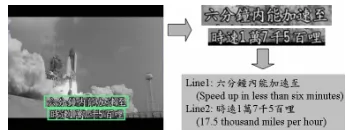
Our video processing takes a video and recognizes the closed captions as texts. An example of the input and output associated with the whole video processing component can be seen in Figure 2. The videoOCR technique consists of four important steps: text detection, binarization, frame tracking, and OCR. The goal of text detection is to locate the text area precisely. In this paper, we employ the edge-based filtering (Lyu et al., 2005) and slightly modify the coarse-to-fine top-down block segmen-tation methods (Lienhart and Wernicke, 2002) to find each text component in a frame. The former removes most non-edge areas with global and local thresholding strategy (Fan et al., 2001) while the latter incrementally segments and refines text blocks using horizontal and vertical projection pro-files.
The next steps are text binarization and frame tracking. As we know, the main constituent of video is a sequence of image frames. A text com-ponent almost appears more than once. To remove redundancy, we count the proportion of overlap-ping edge pixels between two consecutive frames. If the portion is above 70%, then the two frames
were considered as containing the same text com-ponents. We then merge the two frames by averag-ing the gray-intensity for each pixel in the same text component. For the binarization stage, we em-ploy the Lyu’s text extraction algorithm (Lyu et al., 2005) to binarize text pixels for the text compo-nents. Unlike previous approaches (Lin et al., 2001; Chang et al., 2005), this method does not need to assume the text is in either bright or dark color (but assume the text color is stable). At the end of this step, the output text components are prepared for OCR.
[image:2.612.335.508.324.389.2]The target of OCR is to identify the binarized text image to the ASCII text. In this paper, we de-veloped a naïve OCR system based on nearest neighbor classification algorithms and clustering techniques (Chang et al., 2005). We also adopted the word re-ranking methods (Lin et al., 2001, strategy 3) to improve the OCR errors.
Figure 2: Text extraction results of an input image
2.2 Sentence and Passage Segmentation
In this paper, we treat all words appear in the same frame as a sentence and group every three consecu-tive sentences as a passage. Usually, words that occur in the same frame provide a sufficient and complete description. We thus consider these words as a sentence unit for sentence segmentation. An example of a sentence can be found in Figure 2. The sentence of this frame is the cascading of the two text lines, i.e. “speed-up to 17.5 thousand miles per hour in less than six minutes” For each OCR document we grouped every three continuous sentences with one previous sentence overlapping to represent a passage. Subsequently, we tokenized Chinese word with unigram, bigram, and trigram levels.
2003). We replicated the Okapi BM-25 (Robertson et al., 2000), which is the effective and efficient retrieval algorithms to find the related segmented passages. For each input question, the top-1000 relevant passages are input to our ranking model.
3 The Algorithm
Tellex et al. (2003) compared seven passage re-trieval models for text QA except for several ad-hoc approaches that needed either human-generated patterns or inference ontology which were not available. In their experiments, they showed that the density-based methods (Lee et al., 2001) achieved the best results, while the BM-25 (Robertson, 2000) reached slightly worse retrieval result than the density-based approaches, which adopted named entity taggers, thesaurus, and WordNet. Cui et al. (2005) showed that their fuzzy relation syntactic matching method outperformed the density-based methods. But the limitation is that it required a dependency parser, thesaurus, and training data. In many Asian languages like Chi-nese, JapaChi-nese, parsing is more difficult since it is necessary to resolve the word segmentation prob-lem before part-of-speech (POS) tagging, and pars-ing (Fung et al., 2004). This does not only make the parsing task harder but also required to train a high-performance word segmentor. The situation is even worse when text contains a number of OCR error words. In addition, to develop a thesaurus and labeled training set for QA is far time-consuming. In comparison to Cui’s method, the term weight-ing-based retrieval models are much less cost, portable and more practical. Furthermore, the OCR document is not like traditional text articles that have been human-typed well where some words were error predicted, unrecognizable, and false-alarm. These unexpected words deeply affect the performance of Chinese word segmentation, and further for parsing. In our experiments (see Table 2 and Table 3), we also showed that the use of a well-trained high-performance Chinese word seg-mentation tool gave the worse result than using the unigram-level of Chinese word (13.95% and 13.92% relative precision and recall rates dropped for language model method).
To alleviate this problem, we treat the atomic Chinese unigram as word and present a weighted string pattern matching algorithm. Our solution is to integrate the suffix tree for finding, and
encod-ing important subsequence information in trees. Nevertheless, it is known that the suffix tree con-struction and pattern searching can be accom-plished in linear time (Ukkonen, 1995). Before introducing our method, we give the following no-tations.
passage P = PW1, PW2, …, PWT
question Q = QW1, QW2, …, QWT’
a common subsequence for passage
x
i x
k k k
i =PW,PW+,...,PW+− if| Sub |=
Sub P
1 1
P
a common subsequence for question
y
j y
l l
l
j =QW,QW+,...,QW+− if| Sub |=
Sub Q
1 1
Q
A common subsequence represents a continuous string matching between P and Q. We further im-pose two symbols on a subsequence. For example,
SubiP means i-th matched continuous string
(com-mon subsequence) in the passage, while SubjQ
in-dicates the j-th matched continuous string in the
question. The common subsequences can be ex-tracted through the suffix tree building and pattern
searching. For example, to extract the set of SubiP,
we firstly build the suffix tree of P and incremen-tally insert substring of Q and label the matched common string between P and Q. Similarly, one can apply a similar approach to generate the set of
SubjQ. By extracting all subsequences for P and Q,
we then compute the following score (see equation (1)) to rank passages.
P) Q, QW_Weight( )
-(1
P) (Q, QW_Density ore(P)
Passage_Sc
×
+ ×
= λ
λ (1)
The first term of equation (1) “QW_Density(Q, P)” estimates the question word density degree in the passage P, while “QW_Weight(Q, P)”
meas-ures the matched question word weights in P. λ is a
parameter, which is used to adjust the importance of the QW_Density(Q, P). Both the two estima-tions make use of the subsequence information for P and Q. In the following parts, we introduce the computation of QW_Density(Q,P) and QW_Weight(Q, P) separately. The time complex-ity analysis of our method is then discussed in the tail of this section.
The QW_Density(Q, P) is designed for quantify-ing “how dense the matched question words in the passage P”. It also takes the term weight into ac-count. By means of extracting common
subse-quence in the question, the set of SubjQ can be used
to measures the question word density. At the be-ginning, we define equation (2) for weighting a
) Sub ( DP ) Sub ( length )
Weight(SubQ Q 1 Q
j j
j = ×
α (2)
Where length(SubjQ) is merely the length of SubQj
i.e., the number of words in SubjQ. α1 is a parameter
that controls the weight of length for SubjQ. In this
paper, we consider the long subsequence match is
useful. A long N-gram is usually much less
am-biguous than its individual unigram. The second term in equation (2) estimates the “discriminative power” (DP) of the subsequence. Some high-frequent and common words should be given less weight. To measure the DP score, we extend the BM-25 (Robertson et al., 2000) term weighting schema. Equation (3), (4), and (5) list our DP scor-ing functions. ) Q , Sub ( TF ) Q , Sub ( TF ) 1 ( ) P , Sub TF( ) P , Sub ( TF ) 1 ( ' ) Sub ( DP Q 3 Q 3 Q Q 1 Q j j j j j k k K k W + × + × + × + ×
= (3)
) 5 . 0 ) Sub ( PF 5 . 0 ) Sub ( PF log( ' Q Q + + − = j j P N
W (4)
|) P (| AVG | P | ) 1 ( − + ×
= b b
K (5)
3 1 ,b ,k
k are constants, which empirically set as 1.2,
0.75, 500 respectively (Robertson et al., 2000).
) P , Sub ( TF and ) Q , Sub (
TF Q Q
j
j represent the term
frequency of SubjQ in question Q and passage P.
Equation (4) computes the inverse “passage
fre-quency” (PF) of SubjQ as against to the traditional
inverse “document frequency” (DF) where Np is
the total number of passages. The collected Dis-covery video is a small but “long” OCR document set, which results the estimation of DF value unre-liable. On the contrary, a passage is more coherent than a long document, thus we replace the DF es-timation with PF score. It is worth to note that
some SubjQ might be too long to be further
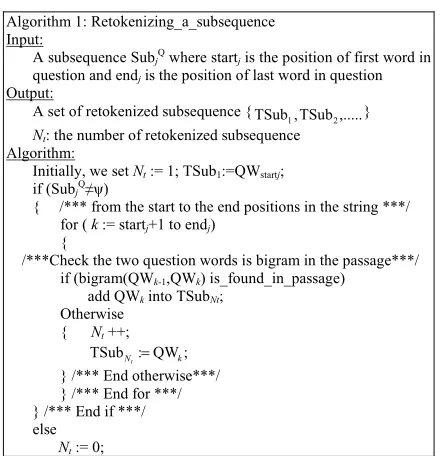
re-tokenized into finer grained size. We therefore propose two algorithms to 1): re-tokenize an input subsequence, and 2): compute the DP score for a subsequence. Figure 3, and Figure 4 list the pro-posed two algorithms.
The proposed algorithm 1, and 2 can be used to compute and tokenize the DP score of not only
SubjQ for question but also SubjP for passage. As
seeing in Figure 4, it requires DP information for
different length of N-gram. As noted in Section 2.2,
the unigram, bigram, and trigram level of words had been stored in indexed files for efficient re-trieving and computing DP score at this step. By
applying algorithm 1 for the set of SubjQ, we can
obtain all retokenized subsequences (TSubj). We
then use the re-tokenized subsequences to compute the final density score. Equation (6) lists the QW_Density scoring function.
∑
−= +
+
+ = _ 1
1 1 1 2 ) TSub , TSub ( dist ) TSub ( Weight ) TSub ( Weight P) (Q,
QW_Density T CNT
i i i
i i
α (6)
1 )_in_P TSub , (TSub ce_between min_distan ) TSub , TSub ( dist 1 1 + = + + i i i
i (7)
T_CNT is the total number of retokenized subse-quences in Q, which can be extracted through
ap-plying algorithm 1 for all SubjQ. Equation (7)
merely counts the minimum number of words
be-tween two neighboring TSubi, and TSubi+1 in the
passage. α2 is the parameter that controls the
im-pact of distance measurement.
Algorithm 1: Retokenizing_a_subsequence Input:
A subsequence SubjQ where startj is the position of first word in
question and endj is the position of last word in question
Output:
A set of retokenized subsequence {TSub1,TSub2,...} Nt: the number of retokenized subsequence
Algorithm:
Initially, we set Nt:= 1; TSub1:=QWstartj;
if (SubjQ≠ψ)
{ /*** from the start to the end positions in the string ***/ for ( k := startj+1 to endj)
{
/***Check the two question words is bigram in the passage***/ if (bigram(QWk-1,QWk) is_found_in_passage)
add QWk into TSubNt;
Otherwise { Nt ++;
; QW : TSubNt = k } /*** End otherwise***/ } /*** End for ***/ } /*** End if ***/ else
[image:4.612.314.534.260.488.2]Nt := 0;
Figure 3: An algorithm for retokenizing subsequence
Algorithm 2: Copmuting_DP_score Input:
A subsequence SubjQ where startj is the position of first word
of SubjQ in question endj is the position of last word of SubjQin
question
Output:
The score of DP(SubjQ) Algorithm:
head := startj;
tail := endj;
Max_score := 0; for (k := head ~ tail)
{ let WORD := QWk, QWk+1,…, QWtail;
/*** look-up WORD in the index files ***/ compute DP(WORD) using equation (3); if (DP(WORD) > Max_score)
Max_score := DP(WORD); } /*** End for ***/
DP(WORD) := Max_score;
[image:4.612.313.532.500.686.2]The density scoring can be thought as measuring “how much information the passage preserves in response to the question”. On the contrary, the QW_Weight (second term in equation (1)) aims to estimate “how much content information the pas-sage has given the question”. To achieve this, we further take the other extracted common
subse-quences, i.e., SubjP into account. By means of the
same term weighting schema for the set of SubjP,
the QW_Weight is then produced. Equation (8) gives the overall QW_Weight measurement.
∑ ∑ = = × = = CNT S i i i CNT S i i _ 1 P P _ 1 P )) Sub ( DP ) Sub ( (length ) Weight(Sub P) Q, QW_Weight( 1 α (8)
where the DP score of the input subsequence can
be obtained via the algorithm 2 (Figure 5). S_CNT
is the number of subsequence in P. The parameter
α1 is also set as equal as equation (2).
In addition, the neighboring contexts of a sen-tence, which contains high QW_Density score might include the answers. Hence, we stress on either head or tail fragments of the passage. In other words, the passage score is determined by computing equation (1) for head and tail parts of passage. We thus extend equation (1) as follows.
⎪ ⎩ ⎪ ⎨ ⎧ = = = = + = + = × + × × + × = 1 2 1 1 2 2 1 1 2 1 3 2 2 2 1 1 3 2 1 2 2 1 1 S P P n, the S : sentence 1 has P if else S P and S P then, S , S : sentences 2 has P if else S S P and S S P , then S , S , S : sentences 3 has P if )} P Q, QW_Weight( ) -(1 ) P (Q, QW_Density ), P Q, QW_Weight( ) -(1 ) P (Q, QW_Density max{ ore(P) Passage_Sc λ λ λ λ
Instead of estimating the whole passage, the two
divided parts: P1, and P2 are used. We select the
maximum passage score from either head (P1) or
tail (P2) part. When the passage contains only one
sentence, then this sentence is indispensable to be used for estimation.
Now we turn to analyze the time complexity of our algorithm. It is known that the suffix tree con-struction costs is linear time (assume it requires
O(T), T: the passage length for passage and O(T’),
T’: the question length for question). Assume the
search time for a pattern in the suffix trees is at
most O(hlogm) where h is the tree height, and m is
the number of branch nodes. To generate the sets
of SubjQ and SubjP, it involves in building suffix
trees and incrementally searching substrings, i.e.,
O((T+T’)+(T+T’)(hlogm)). Intuitively, both
algo-rithm 1, and algoalgo-rithm 2 are linear time algoalgo-rithms, which depends on the length of “common”
subse-quence, i.e., at most O(min(T, T’)). Consequently,
the overall time complexity of our method for
computing a passage is O((T+T’)(1+hlogm)+
min(T, T’)).
4 Experiments
4.1 Evaluation
We should carefully select the use of videoQA col-lection for evaluation. Unfortunately, there is no benchmark corpus for this task. Thus, we develop an annotated collection by following the similar tasks as TREC, CLEF, and NTCIR. The Discovery videos are one of the popular raw video sources and widely evaluated in many literatures (Lin et al., 2001; Wu et al., 2004; Lee et al., 2005). Totally, 75.6 hours of Discovery videos (93 video names) were used. Table 1 lists the statistics of the Dis-covery films.
The questions were created in two different ways: one set (about 73) was collected from previ-ous studies (Lin et al., 2001; Wu et al., 2004) which came from the “Project: Assignment of Dis-covery”; while the other was derived from a real log from users. Video collections are difficult to be general-purpose since hundreds hours of videos might take tens of hundreds GB storage space. Therefore, general questions are quite difficult to be found in the video database. Hence, we provide a list of short introductions collected from the cover-page of the videos and enable users to browse the descriptions. Users were then asked for the system with limited to the collected video top-ics. We finally filter the (1) keyword-like queries (2) non-Chinese and (3) un-supported questions. Finally, there were 253 questions for evaluation.
averagely, there are 1.45 labeled answers for each question.
The MRR (Voorhees, 2001) score, precision and pattern-recall are used for evaluation. We measure the MRR scores for both top1 and top5 ranks, and precision and pattern-recall rates for top5 retrieved answers.
Table 1: Statistics of the collected Discovery videos
# of videos # of sentence # of words # of passages
93 49950 746276 25001
AVG # of words per sentence
AVG # of words per passage
AVG # of sentences per passage
AVG # of words per video
14.94 48.78 537.09 8024.47
4.2 Results
In this paper, we employed six top-performed yet portable ranking models, TFIDF, BM-25 (Robert-son et al., 2000), INQUERY, language model (Zhai and Lafferty, 2001), cosine, and density-based (Lee et al., 2001) approaches for
compari-son1. For the language model, the Jelinek-Mercer
smoothing method was employed with the
parame-ter settings λ=0.5 which was selected via several
trials. In our preliminary experiments, we found that the query term expansion does not improve but decrease the overall ranking performance for all the ranking models. Thus, we only compare with the “pure” retrieval performance without pseudo-feedback.
The system performance was evaluated through
the returned passages. We set α1=1.25, α2= 0.25,
and λ=0.8 which were observed via the following
parameter validations. More detail parameter ex-periments are presented and discussed later. Table 2 lists the overall videoQA results with different ranking models.
Among all ranking models, the proposed method achieves the best system performance. Our ap-proach produced 0.596 and 0.654 MRR scores when evaluating the top1 and top5 passages and the precision rate achieves 0.208. Compared to the second best method (language model), our method is 10.16% better in relatively percentage in terms of MRR(top1) score. For the MRR(top5) score, our method is 7.39 relative percentage better. In terms of the non-answered questions, our method also covers the most questions (253-69=184) compared
1 For the TFIDF/BM-25/INQUERY/Language Model approaches
were performed using the Lemur toolkit
to the other ranking models. Overall, the experi-ment shows that the proposed weighted string pat-tern matching algorithm outperforms the other six methods in terms of MRR, non-answered question numbers, precision and pattern recall rates.
Table 2: Overall videoQA performance with differ-ent ranking models (using unigram Chinese word)
Word-Level (Top1)MRR (Top5)MRR Non-answered Questions Precision Pattern Recall
TFIDF 0.498 0.572 81 0.189 0.649
BM-25 0.501 0.581 78 0.186 0.638
Language Model 0.541 0.609 74 0.196 0.671
INQUERY 0.505 0.583 78 0.188 0.644
Cosine 0.418 0.489 102 0.151 0.519
Density 0.323 0.421 102 0.137 0.471
Our Method 0.596 0.654 69 0.208 0.711
Table 3: Overall videoQA performance with differ-ent ranking models using word segmdiffer-entation tools
Word-Level (Top1)MRR (Top5)MRR Non-answered Questions Precision Pattern Recall
TFIDF 0.509 0.567 89 0.145 0.597
BM-25 0.438 0.500 104 0.159 0.543
Language Model 0.486 0.551 89 0.172 0.589
INQUERY 0.430 0.503 97 0.164 0.562
Cosine 0.403 0.480 100 0.158 0.548
Density 0.304 0.380 125 0.133 0.451
Our Method 0.509 0.561 89 0.181 0.608
the best results in terms of precision and pattern recall rates while marginally worse than the TFIDF for the MRR(top5) score.
There are three parameters: λ, α1, α2, in our
rank-ing algorithm. λ controls the weight of the
QW_Density(Q, P), while α1, and α2 were set for
the power of subsequence length and the distance measurement. We randomly select 100 questions for parameter validations. Firstly, we tried to verify
the optimal α1 via different settings of the
remain-ing two parameters. The best α1 is then set to verify
α2 via various λ values. The optimal λ is
subse-quently confirmed through the observed α1 and α2
values. Figure 5, 6, 7 show the performance evaluations of different settings for the three pa-rameters.
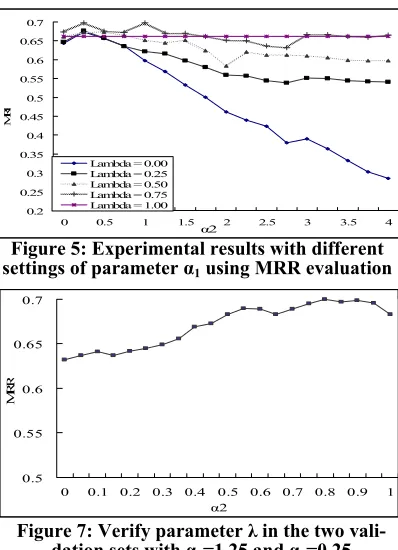
As shown in Figure 5, the optimal settings of
(α1=1.25) is obtained when and α2=0.25, and
λ=0.75. When α1 is set more than 1.5, our method
quickly decreased. In this experiment, we also
found that large α2 negatively affects the
perform-ance. The small α2 values often lead to better
rank-ing performance. Thus, in the next experiment, we
limited the α2 value in 0.0~3.0. As seeing in Figure
6, again the abnormal high or zero α2 values give
the poor results. This implies the over-weight and no-weight on the distance measurement (equation
(7)) is not useful. Instead, a small α2 value yields to
improve the performance. In our experiment,
α2=0.25 is quite effective. Finally, in Figure 7, we
can see that both taking the QW_Density, and QW_Weight into account gives better ranking re-sult, especially QW_Density. This experiment in-dicates that the combination of QW_Density and QW_Weight is better than its individual term
weighting strategy. When λ=0.8, the best ranking
result (MRR = 0.700) is reached.
Next, we address on the impact of different number of initial retrieved passages using BM-25 ranking models. Due to the length limitation of this paper, we did not present the experiments over all the compared ranking models, while we left the
further results at our web site2. For the three
pa-rameters, we select the optimal settings derived
from previous experimental results, i.e., λ=0.8,
α1=1.25, α2=0.25. Figure 8 shows the experimental
results with different number of initial retrieved passages. When employing exactly five initial re-trieved passages, it can be viewed as the re-ranking improvement over the BM-25 ranking model. As seeing in Figure 8, our method does improve the conventional BM-25 ranking approach (MRR score 0.690 v.s. 0.627) with relatively 10.04% MRR value. The best system performance is MRR=0.700 when there are merely 20 initial re-trieved passages. The ranking result converges when retrieving more than 40 passages. Besides,
2 http://140.115.112.118/bcbb/TVQS2/
Figure 5: Experimental results with different settings of parameter α1 using MRR evaluation
0.2 0.25 0.3 0.35 0.4 0.45 0.5 0.55 0.6 0.65 0.7
0 0.5 1 1.5α22 2.5 3 3.5 4
M
R
R
Lambda = 0.00 Lambda = 0.25 Lambda = 0.50 Lambda = 0.75 Lambda = 1.00
Figure 6: Verify parameter α2 with α1=1.25, and
variant λ
0.2 0.25 0.3 0.35 0.4 0.45 0.5 0.55 0.6 0.65 0.7
0 0.2 0.4 0.6 0.8 1 1.2 1.4 1.6 1.8 2 2.2 2.4 2.6 2.8 3
α2
M
RR
[image:7.612.102.301.60.335.2]Lambda = 0.00 Lambda = 0.25 Lambda = 0.50 Lambda = 0.75 Lambda = 1.00
Figure 7: Verify parameter λ in the two vali-dation sets with α1=1.25 and α2=0.25 0.5
0.55 0.6 0.65 0.7
0 0.1 0.2 0.3 0.4 0.5 0.6 0.7 0.8 0.9 1
α2
M
R
[image:7.612.315.521.61.324.2]R
Figure 8: Experimental results with different number of initial retrieval passages (TopN)
0.67 0.68 0.69 0.7 0.71
5 20 40 100 300 500 1500 3000 5000 TopN
MR
we also continue the experiments using only top-20 retrieved passages on the actual 253 testing questions. The ranking performance is then further enhanced from MRR=0.654 to 0.663 with 1.37% relatively improved.
5 Conclusion
More and more users are interested in searching for answers in videos, while existing question answer-ing systems do not support multimedia accessanswer-ing. This paper presents a weighted string pattern matching-based passage ranking algorithm for ex-tending text QA toward video question answering. We compare our method with six top-performed ranking models and show that our method outper-forms the second best approach (language model) in relatively 10.16 % MRR score, and 6.12% pre-cision rates.
In the future, we plan to integrate the other use-ful features in videos to support multi-model-based multimedia question answering. The video-demo version of our videoQA system can be found at the
web site (http://140.115.112.118/bcbb/TVQS2/).
References
Cao, J., and Nunamaker J. F. Question answering on lecture videos: a multifaceted approach, International Conference on Digital Libraries, pages 214 – 215, 2004.
Chang, F., Chen, G. C., Lin, C. C., and Lin, W. H. Caption analysis and recognition for building video indexing sys-tems. Multimedia systems, 10: 344-355, 2005.
Cui, H., Sun, R., Li, K., Kan, M., and Chua, T. Question an-swering passage retrieval using dependency relations. In Proceedings of the 28th ACM SIGIR Conference on Re-search and Development in Information Retrieval, pages 400-407, 2005.
Fan, J., Yau, D. K. Y., Elmagarmid, A. K., and Aref, W. G. Automatic image segmentation by integrating color-edge extraction and seeded region growing. IEEE Trans. On Im-age Processing, 10(10): 1454-1464, 2001.
Fung, P., Ngai, G., Yuan, Y., and Chen, B. A maximum en-tropy Chinese parser augmented by transformation-based learning. ACM Trans. Asian Language Information Proc-essing, 3: 159-168, 2004.
Lee et al. SiteQ: Engineering high performance QA system using lexico-semantic pattern matching and shallow NLP. In Proceedings of the 10th Text Retrieval Conference, pages 437-446, 2001.
Lee, Y. S., Wu, Y. C., and Chang, C. H. Integrating Web in-formation to generate Chinese video summaries. In Pro-ceedings of 17th international conference on software engineering and knowledge engineering (SEKE), pages 514-519, 2005.
Levow, G. A. The third international Chinese language proc-essing Bakeoff: word segmentation and named entity rec-ognition, In Proceedings of the 5th SIGHAN Workshop on Chinese Language Processing, pages 108-117, 2006.
Lin, C. J., Liu, C. C., and Chen, H. H. A simple method for Chinese videoOCR and its application to question answer-ing. Journal of Computational linguistics and Chinese lan-guage processing, 6: 11-30, 2001.
Lin, J., Quan, D., Sinha, V., Bakshi, K., Huynh, D., Katz, B., and Karger, D. R. What makes a good answer? the role of context in question answering. In Proceedings of the 9th in-ternational conference on human-computer interaction (INTERACT), pages 25-32, 2003.
Lienhart, R. and Wernicke, A. Localizing and segmenting text in images and videos. IEEE Trans. Circuits and Systems for Video Technology, 12(4): 243-255, 2002.
Lyu, M. R., Song, J., and Cai, M. A comprehensive method for multilingual video text detection, localization, and ex-traction. IEEE Trans. Circuits and Systems for Video Technology, 15(2): 243-255, 2005.
Over, P., Ianeva, T., Kraaij, W., and Smeaton, A. F. TRECVID 2005 - an overview. In Proceedings of the 14th text retrieval conference (TREC), 2005.
Pasca, M., and Harabagiu, S. High-performance question an-swering. In Proceedings of the 24th ACM SIGIR Confer-ence on Research and Development in Information Retrieval, pages 366-374, 2001.
Robertson, E., Walker, S., and Beaulieu, M. Experimentation as a way of life: Okapi at TREC. Journal of Information processing and management, 36: 95-108, 2000.
Tellex, S., Katz, B., Lin, J. J., Fernandes, A., and Marton, G. Quantitative evaluation of passage retrieval algorithms for question answering. In Proceedings of the 26th ACM SIGIR Conference on Research and Development in In-formation Retrieval, pages 41-47, 2003.
Voorhees, E. M. Overview of the TREC 2001 question an-swering track. In Proceedings of the 10th Text Retrieval Conference , pages 42-52, 2001.
Ukkonen, E. Constructing suffix trees on-line in linear time. In Proceedings of the international federation of information processing, pages 484-492, 1995.
Wactlar, H. D. Informedia search and summarization in the video medium, In Proceedings of Imagina 2000 Confer-ence, 2000.
Wu, Y. C., Lee, Y. S., Chang, C. H. CLVQ: Cross-language video question/answering system. In Proceedings of 6th IEEE International Symposium on Multimedia Software Engineering, pages 294-301, 2004.
Wu, Y. C., Yang, J. C., and Lin, Q. X. Description of the NCU Chinese Word Segmentation and Named Entity Recogni-tion System for SIGHAN Bakeoff 2006. In Proceedings of the 5th SIGHAN Workshop on Chinese Language Process-ing, pages 209-212, 2006.
Yang, H., Chaison, L., Zhao, Y., Neo, S. Y., and Chua, T. S. VideoQA: Question answering on news video. In Proceed-ings of the 11th ACM International Conference on Multi-media, pages 632-641, 2003.
Zhai, C., and Lafferty, J. A study of smoothing methods for language models applied to ad hoc information retrieval, In Proceedings of the 24th Annual International ACM SIGIR Conference on Research and Development in Information Retrieval (SIGIR), pages 334-342, 2001.